
Broke (but unbowed)
Many of you will know SEAHORSE as the premiere sailboat racing publication in the world, covering the latest developments and cutting edge technology in the global race to win. However they also have a deep respect for the lineage from which today’s boats evolved. Over the next few months we will bring you a series of handpicked articles from their archives highlighting this history, and showing that deep satisfaction in sailing comes from understanding, just as much as winning! The generous people at SEAHORSE are offering readers of SWS a significant discounts of up to 30% on both digital and print editions of this seminal magazine. Click the banner below to check out the offer.

Following on from our April Article on the Mercurial Uffa Fox, thsi week we bring you Clare McComb’s take on the ‘B Side’ of the story…
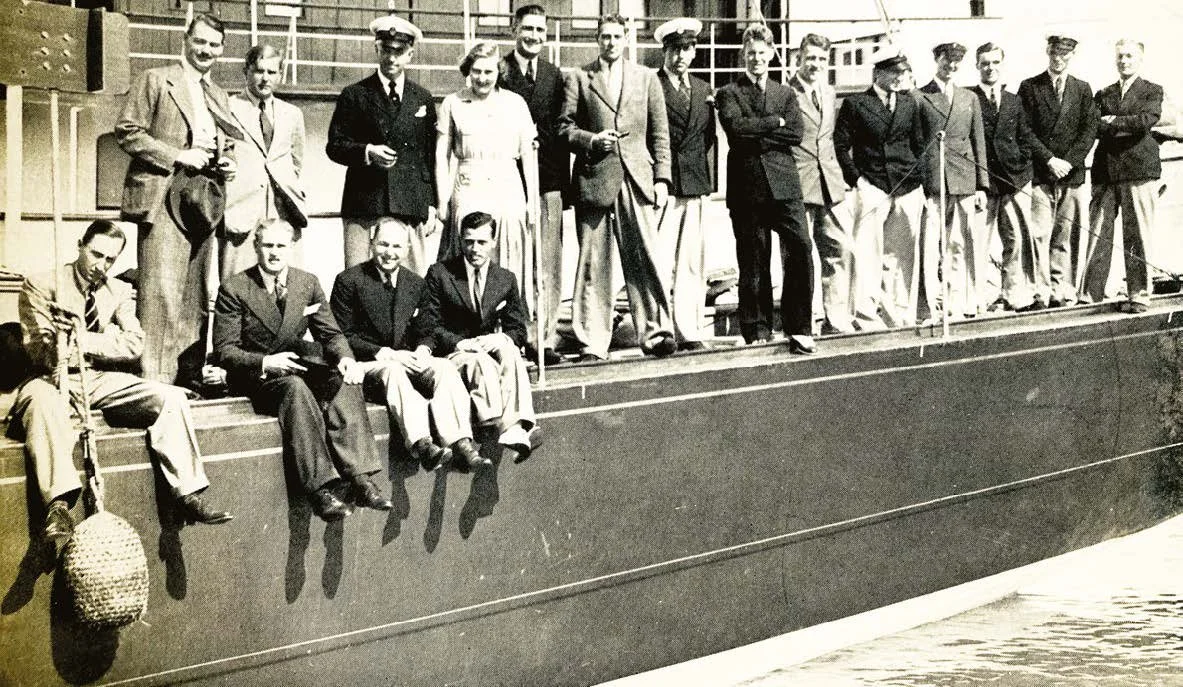
After refusing to be held to ransom by his striking professional crew, Tommy Sopwith’s replacements for Cup challenger Endeavour were famously recruited from the Royal Corinthian Yacht Club. He had received ‘hundreds of offers from adventurous people’. Uffa Fox too had the drawing power to enlist others to share his America’s Cup dreams… but not Sopwith’s wealth with which to pay for it
Uffa Fox's life would have been hugely different as a rich man. Had he been born a Tommy Sopwith he could have explored his international dreams and schemes on an America's Cup scale. The energy spent fending off creditors, sourcing funding for his everyday life, might have been diverted to produce strange and wonderful inventions, projects of true originality, for few today will deny him at least moments of genius. Wealth would have given him freedom to be his most creative self. As it was he had to make do with what he had, or indeed what he could beg and borrow from other people. There were times he and his first wife, Alma, had to live off rabbit, sour blackberries and whatever else they could hunt and gather; her teacher's income was often used to pay the workmen.
According to June Dixon, his niece-biographer, Uffa was never interested in money for money's sake – merely in the time, materials and opportunities it could buy. He 'invariably emptied the till when travelling abroad', leaving nothing for wages, housekeeping or even feeding the dogs. In addition his clients were often of the silver-spoon-birthright brigade, and socialising with them did not help with making economies. His achievements, spectacular as they are, were vastly scaled-down versions of what might have been.
Thankfully Uffa found a way to progress, and our lives are the richer for it. After realising that fame could lead to commissions, he ensured his notoriety by widening his lecture circuit of yacht clubs and affiliated groups to enthral with tales of adventures on the high seas. After the crazy 1928 voyage to and from Le Havre in the 14ft Avenger he found he never needed to advertise again. Of course, once created the publicity monster requires regular fodder, but luckily Uffa's early 1930s were a triumphant stream of conquests and breakthroughs, nationally and internationally, which still inspire adulation today.
Vigilant
Taking Vigilant to Sweden in 1930 was a crazy voyage that firmly established Uffa as a pioneer sans pareil. Having first gone on a recce to Germany, where these small craft were very much in vogue, he produced his 22m2 skerry cruiser, the largest boat he could afford to build for himself, around the size of a Six but with half the sail area and half the displacement. She was, he said, 'hardly adapted for open sea', but nonetheless he headed off to a huge international centenary regatta in Sweden, a grand affair that mixed banquets with racing, with over 500 yachts taking part.
The slightly astonished Swedes beat Uffa and Vigilant fair and square in both light and heavy winds, but gave him a compensatory cup to mark the adventure. This was followed by a British Cruising Association accolade.
His trusty camera had naturally been documenting everything, making excellent copy for the press back home and new grist for the lecture circuit.
One of Vigilant's crew had been forced to return home so there were only two to nurse her back to Cowes through patches of pretty interesting weather, one of which left the crosstrees bent double. At times the seas were going 'clear over the boat', and the helm was 'anything but a soft job… the worst being when the helmsman had to both steer and pump hard, with the boat often dipping to her cabin top and not having a self-draining cockpit'. They 'were overtaken at one point by a steamer with her starboard bridge swept away, her lifeboat smashed and upside down in the davits.'
When the Island Sailing Club welcomed back their most famous member with his 'Swedish Cup', the Commodore, old Tom Ratsey, one of the great pillars of the yachting world whose experience stretched back to mid-Victorian times, told a tale of Uffa's great-grandfather. He had been celebrated as one of the strongest men in the world, capable of hoisting a pilot cutter's peak and main halyards together, or hauling on the chain cable to raise a heavy anchor single-handed. Alongside this, said Tom, 'he had the nature of a child'. He had sailed the world, been wrecked in the South Sea Islands and lived there for seven years before being finally drowned off the coast of Africa. There was a sense that the Uffa acorn had not fallen far from the family tree. A suggestion followed that Uffa had 'done enough on the sea now and should stay at home to attend to those dinghies'.
Landfall and Sea Serpent
Chance would be a fine thing. In 1931 Uffa was invited by the American Paul Hammond to join the crew of his newly built Francis Herreshoff-designed ketch Landfall, for the upcoming Transatlantic Race. The offer 'was accepted like a shot'. Our man was down as sail trimmer, but he would have had an eye in and on everything. Against his advice Landfall took the southern route to gain the Gulf Stream and avoid the Arctic currents: they came in second. The winner, Dorade, had gone north.
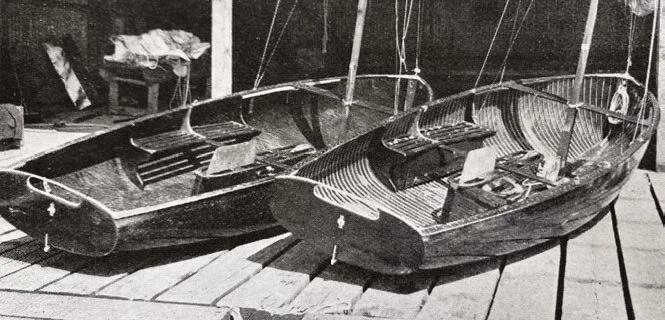
Fox’s ribless triple-skin International 14 Sea Serpent (left) set alongside one of his own beautifully crafted Canadian elm ribbed designs. In smaller craft he could invariably find backers to commission his innovative ideas. Unfortunately the trial, error and improvement methods which underpinned dinghy development in the late 1920s and ’30s would have seemed unattractively risky to an America’s Cup challenger in search of a naval architect
Back home Uffa was still breaking ground as a designer. Having achieved the blue riband International 14 Prince of Wales trophy twice running himself, in 1928 and '29, 1930 had shown that other clients like Tom Thornycroft could now bear the Fox colours successfully into the lists. The next Uffa sensations were the invention of Sea Serpent and following that the humbling of British, American and Canadian opponents with mould-breaking sailing canoe designs.
Sea Serpent caused quite a stir in 1931. She appeared, somewhat later than originally hoped for, to head the Fourteens by the end of the year. Many came to marvel at her unique design: her strength lay in a three-skin hull construction: 'two of them diagonal in opposition, and the outer fore and aft which allowed the designer to try the experiment of dispensing with timbers'. Eyebrows were raised and much pondering ensued.
She did top the league tables but sharp eyes soon noticed that, despite a late arrival to the season, the dinghy had raced many times more than some other successful Fourteens, so won on points gained but not on percentage of victories. Nonetheless Sea Serpent seized the headlines, and her owner, YRA Dinghy Committee stalwart Sir John Field Beale, will have been very pleased, given that many different hands had helmed that year in his sustained absences.
Canoes
Next came Uffa's canoe projects which were to cause an international stir and change that branch of the sport for ever. Firstly he and a young Oxford student named Robert de Quincey turned up at the 1932 British Canoe Championships with a brand new canoe design, Wanderer, and carried both Challenge trophies back to the Isle of Wight.
This was unprecedented – the first time these cups had been won by anyone other than a bona fide member of the Royal Canoe Club. Then Uffa set his sights on the New York Canoe Club's International Challenge trophy, which had been held near the city since the first races in 1886, a miniature version of the America's Cup concept. Two new 'deep chested V-ed type planing canoes' were promptly created in Uffa's workshops, the first in the world to date; his was called East Anglian in recognition of his own heritage, having been named after an ancient king of the Angles.
After transporting their little craft across the pond the intrepid British pair first knocked the stuffing out of the Canadians on the St Lawrence River, working as a team to carry off all three trophies up for grabs. Then it was on to New York, for the renewing of their sails by the American branch of the Ratsey family and preparation for the big event.
The canoes were beautiful little boats, more like a miniature 'rater' than anything else, limited to 17ft in length. Twenty-five years later Uffa wrote, 'No other single-handed boat can match them in speed or movement as they slip along with the grace of a sea bird.'
At that time the US rules were very different from their British counterparts: sliding seats were allowed but not side-stays, and a proportion of 2/3 and 1/3 in the two sails was required; this was supposed to enforce a ketch rig…
But Uffa's ingenuity bypassed the US restrictions permitting only fore and aft stays, by replacing a conventional forestay with a sort of raking foremast stepped in the bow and attached to the head of the main mast which was set further aft.
The rogue British cutter rig, a brilliant 'interpretation' of the US rule, was accepted by the hosts. Uffa had defended it thus: 'Well, if that (ketch) is the object of the rule why not say so?'
The British boats were able to 'point at least one point better than their rivals on the wind', and therefore scored heavily on the windward leg of the course. The Challenge Cup was snatched from the Americans' grasp.
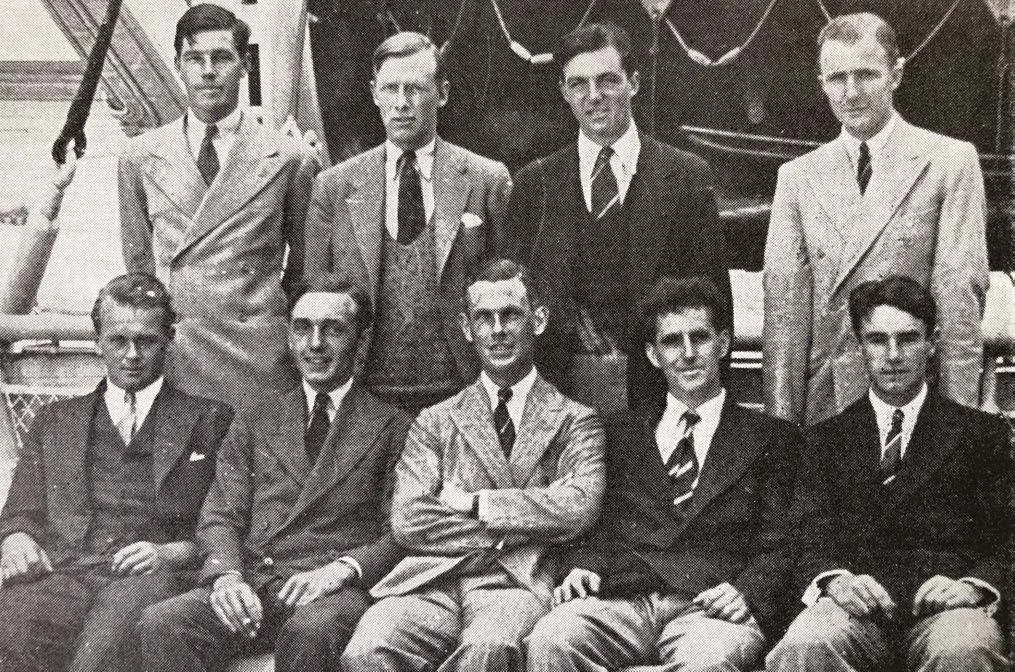
Uffa’s restless ambitions soon extended across the Atlantic. Following his extraordinary success seizing both the Canadian and American Canoe trophies in 1933, here he is pictured the following year as the diminutive non-sailing ‘Manager’ of an International 14 team onboard the SS Empress of Britain; the group included early dinghy legends Stuart Morris, Peter Scott, John Winter and David Beale. Their challenge to America’s best dinghy racers met with equal success. Note only one of those pictured is slouching…
Meanwhile, there was much Uffa-driven discussion about finding a working compromise between the two systems so that such rule contortions would no longer be necessary. The resultant new International Rule merged the best points of the American, British and Swedish types and was soon approved to be used worldwide.
But despite a fair number of column inches and much congratulation, even this American triumph did not catapult Uffa into the true big time. At a triumphant gathering of the Humber Yawl Club, under whose burgee he had competed, and even while members were struggling to drink from the two unwieldy silver trophies being passed around, there was talk of Mr Fox being the very man to drive us to victory in the America's Cup. 'Surely' he could ask the right people?
In reality it was 'surely not'. To many of the 'right people' in those days Uffa was an anathema, a foolhardy eccentric showman, with 'eyebrows which were the envy of Groucho Marx', who didn't even speak the King's English, had no appropriate background, no wealth to speak of and was an accident waiting to happen. Not the sort of chap to represent the country.
Feeding the publicity beast
Uffa was always up against the big boats when it came to column inches. Quite apart from new RORC craft such as Trenchemer coming on stream, the King's Britannia, of course, was so old and beautiful she still took much of everyone's attention. Then when Lipton died, and Tommy Sopwith came forward with his Endeavour in 1934, the subsequent contest dwarfed everything else going on sailing-wise.
Like the infamous Toledo worm, that challenge infested the whole sport: the what, the where, the how and the who of the design, the designer, the build, the rig, the launch, the trials, the crews, the crossings, the reception, the races themselves and the inevitable defeat seemed to block out everything else… as this contest always had. When Endeavour's crew went on strike, to be replaced by young Corinthian volunteers, it was journalist gold. So what rabbits could Uffa now pull out of his hat to keep his name in the headlines and protect his brand?
In fact, he did two things. Firstly, starting in late 1934, he produced the first of a marvellous series of books which are now iconic. They gave everyone a chance to come up close and personal with Uffa's pithy eye view of the sailing world. They are amazing repositories of our yachting history and its development, where copious technical detail blends into wit and whimsical statements, some utterly true, some that resonate because you know they are not quite accurate but it may well take days, or even years, to tease out why.
Many yachting historians can barely function without reference to them; their range is as wide as it goes. Apparently Uffa only agreed to produce them because a grim bank manager point blank threatened to pull the plug on the American canoe adventure just at the point of departure unless serious adjustments were made to his overdraft. Cash was needed urgently, so Uffa made a phone call to sign on the dotted line. Well done, that bank manager. He knew not what he did.
This series of books reached far wider and deeper than Uffa's magic lantern illustrated talks, or indeed any of his press coverage. They established his voice, which was also the voice of his times. They stand today as a superb body of work, flawed, flamboyant on occasion, opinionated at others, yet seminal to everything that was going on during that decade.
Uffa and the RORC
And then there was the RORC. Uffa had never stopped trying to link himself to 'Ocean Racing'. He could see, despite the dangerous dip in the club's fortunes in the early 1930s when the Fastnet Race itself was under threat, that the club held the keys to a new branch of sailing, one with huge international potential.
In that he was no fool. He could see beyond the, some might say, disastrous mass resignation of RORC flag officers in late 1934, when the direct royal connection was severed with Admiral Sir Philip Hunloke leaving, and Vice-Commodore Bobby Somerset, one of the finest sailors of his age, also stepping down. Even the famous American Rear Admiral Sherman Hoyt backed away. George Martin was still there of course, towering over the institution he founded, but even he was moved sideways to Admiral.
Malden Heckstall-Smith and the other technical types were still chuntering in the background and doughty Algernon Maudsley remained treasurer. A certain Lieutenant Commander JH Illingworth had appeared on the all-powerful committee while Major TP Rose Richards was the new Commodore.
Yet the magic still remained. One student writing in to Yachting World declared that his great dream was to qualify to be a RORC member…
For Uffa, as for so many, the strongest currents of change were flowing from the RORC, and he wanted, as he had always wanted, a personal slice of it. For him one of the joys of life was pitting his knowledge, his creativity and his physical strength against whatever the seas could throw at him. The cut and thrust for which he loved dinghy and canoe racing was, in a way, matched by the exhausting, exhilarating challenges of a long voyage, at speed, against the worst that wind and wave could smash into his boat. He was too much of an individualist to earn his place as a committee man, yet he still wanted his voice to count.
Waterwitch
His eternal problem, just like George Martin, was lack of money. Neither at this point could afford a proper racer. In October 1932 Fox published yet another article, this time in the Yachtsman, detailing a 36ft canoe-stern cutter which he had designed to offer 'an answer, if not the answer' to the question that had always fascinated him: 'what is an Ocean Racer?'
As ever he was provocative. The sea and the weather are constants. Why not build to combat them, instead of spending time and energy conforming to human restrictions. Then he launched into a full blast of classic Uffa: 'The Fastnet Race in August demands a manly and weatherly vessel, able to beat to windward 400 miles to the rock, taking her punishment bravely, and then travel at high speed 200 miles as she chases way before the gale to Plymouth… the artificial rating rule must be ignored as much as possible, for rules made by men are usually so weak and futile they have to be so carefully worded that very few can understand them, then more formulae are added so that still fewer understand.
'The law, being an ass, is made very complicated so that lawyers can have jobs, and the more complicated the rules the better for the designers…' You can feel blood pressure soaring among the RORC technical committee members whose life's work was the constant querying, tweaking and adapting the precious formulae for which their club was so rightly famous.
But, as usual, the only thing stopping Uffa taking part in ocean racing as an owner was his financial situation, and as usual he broadcast this to the entire world in his article: 'Had I the money her keel would be laid tomorrow'. It never was.
Wishbone
At the end of 1934, just as his first book hit the presses, word leaked out that Uffa had finally secured a commission to build a large vessel, with talk of contesting the Fastnet. He made the most of the opportunity to produce something extraordinary.
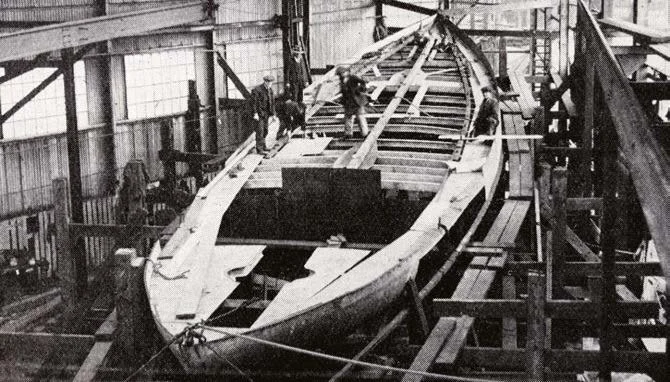
At 83ft LOA, and with a displacement of 60 tons, 3,000ft2 of sail and 25 tons of lead in her keel, the construction methods used were considered revolutionary. Plating and frames had been welded by an 'electrical process', perfected by the builders J Samuel White of Cowes, who had used these techniques before but only for a commercial vessel. The plates themselves were 'joggled' both inside and outside, giving a perfectly smooth surface.
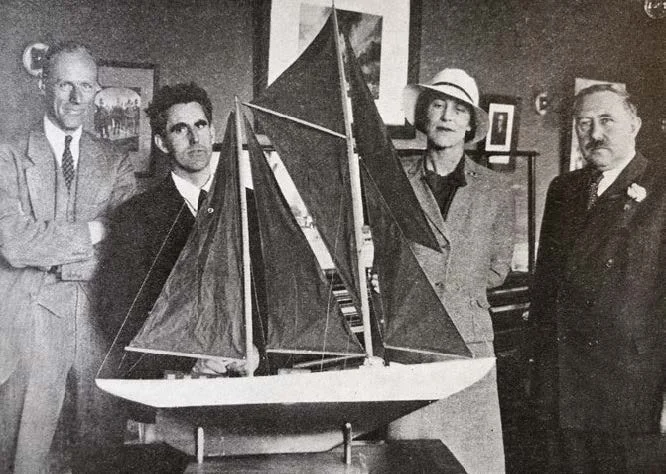
A scale model of Wishbone seen in 1935 with Mr and Mrs Alan Coleman, Uffa and AT Wall, managing director of J Samuel White; the yard used the new 83-footer to trial an electrically welded steel building system that eliminated the need for rivets
Wishbone, as she was named, was trumpeted as 'the first vessel of her type to be made entirely of welded steel… without the use of a single rivet', a method claimed to save 17 per cent of her weight yet without sacrificing strength in any degree.
Uffa's client was Alan Coleman, born with a silver mustard spoon in his mouth, to a family that had marketed their famous product since 1814, possessing exactly the stable financial background that his outspoken designer lacked. Coleman was quite comfortable with Uffa's unorthodox methods. One tale tells that the lines of the boat were initially laid out on a grass lawn at Alan's home. He certainly seems to have embraced the suggestion of a wishbone rig, which had been used very successfully over 10,000 miles in 1934 on Vamarie, a successful American ocean racer.
Back in 1926 a ketch rig had been devised with a double-sprit curved in such a way that the sail, when properly hauled out, could fill on either tack without its curve being interfered with by the gaff. Jasper Morgan who developed it claimed that the spar was set at an angle to the mast, chosen so that when the clew of the sail was hauled out taut the spar was subjected to no force other than compression – which allowed the whole contraption to be lighter than a normal gaff.
After the launch there was a 'very cheery luncheon party' where Uffa suggested that those who were never sure whether the sail stretched between the mainmast and the outer end of the double curved gaff should be called a mainsail or topsail could use a new term he had invented: the 'bones'!
In fact, Wishbone ended up more famous than victorious, not even attempting the upcoming Fastnet; she 'did a bit' but not enough to catapult Uffa's name into the list of ocean racing designers. She was no Ortac, no Myth of Malham. If Uffa had helmed her in a Fastnet who knows what would have happened, but you have to win to create legends, and Wishbone didn't really get her chance.
Uffa was frequently put forward as someone who had the drive, ingenuity and sheer bloody cussedness to win the America's Cup back for King and Country, by transferring his magnificent international successes to the J-sized yacht… But without funding and millionaire backing he was for ever confined to the size of racing boat he could afford to build for himself.
Or would he
He certainly did what he could. Around this time a cable was apparently dispatched to the Secretary of the New York Yacht Club which read 'Understand you are considering contests between smaller craft than usual for the America's Cup… can you accept a challenge from me… the contest would be for sailing canoes to the present American Canoe Association Rules?'
Uffa's reasoning was that having beaten them in their own waters with canoes in 1933 and International 14 dinghies in 1934, they might just give him a chance…
One impediment, of course, was the requirement for a challenger to 'cross on her own bottom'. An editor mused – 'was Uffa just being facetious?' He thought back to the outrageous crossings of open water with a whaleboat full of sea scouts, the undecked 14ft dinghy Avenger, the slim, sharp 22m2 Vigilant – his mind probably then stretched forward to a passage through the cold, grey, unyielding waters of the north Atlantic.
I can imagine him shuddering. One man and his canoe. The problem was, as he said, with a man such as Uffa you simply never knew.