
Mercurial
Many of you will know SEAHORSE as the premiere sailboat racing publication in the world, covering the latest developments and cutting edge technology in the global race to win. However they also have a deep respect for the lineage from which today’s boats evolved. Over the next few months we will bring you a series of handpicked articles from their archives highlighting this history, and showing that deep satisfaction in sailing comes from understanding, just as much as winning! The generous people at SEAHORSE are offering readers of SWS a significant discounts of up to 30% on both digital and print editions of this seminal magazine. Click the banner below to check out the offer.

Artist and yacht designer… both often at the same time. Uffa Fox sketches one of his Flying series (easily identified by the unique keel configuration) at his Cowes home with its magnificent vista out across the Solent.
One man gave the Northern Hemisphere (at least) the first successful planing dinghy when in 1928 Uffa Fox’s groundbreaking International 14 Avenger literally planed off into the distance race after race after race. Avenger was just one mof the numerous innovations and new approaches to boat design and build that this colourful figure bequeathed to naval architecture and which still influence the boats we sail and race 50 years after his passing. |
Julian Everitt celebrates a maverick genius
The word mercurial could have been invented to describe the yacht designer, yacht builder, artist and author Uffa Fox. Fox was born on the Isle of Wight into the late-Victorian period in 1898, in the internationally famous town of Cowes which became the centre of his universe throughout his extraordinary life.
A local saying on the Isle of Wight, used to demonstrate how Uffa was regarded by both those who knew him or knew of him, sums up very well his impact on the yachting Mecca that was Cowes: 'If it was Queen Victoria who put Cowes on the map, it was Uffa Fox who kept it there.' While Uffa Fox was undoubtedly a very talented, original and free-thinking yacht designer, his force of personality served him remarkably well in his pursuit of what were almost always perceived as radical avenues to improved boat performance. Fox personified self-belief – an essential quality in almost every yacht designer who has successfully practised, but enjoyed by Uffa in spades.
If your destiny is to be truly inventive and original you have to be brave and you have to have a total conviction that you are right. These are 'qualities' that the most successful yacht designers have to have… to an extent. And when that self-belief is particularly strong, as was the case with Uffa, it can also have a surprisingly positive effect on potential clients.
At different times of his career Uffa Fox was awash with work. In a conservative world, in the decade before WW2, sailboat racing had become an outlet for extroverts, for individuals to express themselves. And Fox was the perfect character to benefit from this atmosphere with his relentless originality.
Uffa Fox's way with words, put to such good use entertaining potential clients while securing many an owner with swaggering tales and bawdy humour, was also highly illustrative of his views when expressed in print.
He was undoubtedly, along with Ricus van de Stadt, a pioneer of what today would be described as ultra-light, offshore-capable racing yachts. But while most yacht designers contented themselves with measured weight reduction, Fox famously described weight as something that 'is only useful in a steam roller…'
In his colourful way Uffa referred to personal weight reduction, by diet, covered extensively by newspaper advertising of the time, as a way to illustrate the inherent contradiction of excessive boat weight.
Conversely he was by his own admission rarely listened to by rulemakers who believed that weight was the cure for all ills in yacht design. But this belief in weight to create better seaworthiness had, in turn, been fuelled by a previous period in racing yacht design when there were no minimum limits on displacement, which had helped to create an era of long-ended, lightweight boats that were structurally unsound and so didn't last very long.
All very graphic, to say the least, but such conflicting opinions give an accurate flavour of the man and his determination and singlemindedness to be proved right.
If you are good at setting the scene with words, as Fox certainly was, you will not only be remembered for a long time, but commercially his observations could prove highly beneficial for his own career… as well as equally destructive for would-be clients who didn't share his visions.
The most successful of Fox’s bigger offshore Flying series was the now beautifully restored Flying 30 Huff of Arklow (above), built in 1951. While Huff was still relatively. light at nine tons on a 30ft waterline, she featured relatively more draft and sail area than her sisters and was a better boat as a result.
But Uffa's individuality did not make him the world's best businessman. Partly because he wasn't into schmoozing, small talk or, dare I say it, bull…t. As a client you had a simple choice: accept the wisdom and originality inherent in Fox's work, or go elsewhere. But circumstances played a part as well.
So Uffa Fox was not a particularly good businessman – undoubtedly had his commercial flair matched his inventive genius he would have ended his days a rich man. As it was, others made far more money out of Uffa's brain than he did himself. But it can be argued that this is characteristic of many highly creative people; things like managing money are simply a distraction from the free-thinking flow that can create great and original design art.
He could write really objectively about other yacht and boat designers, being a genuine admirer of most good work in the field of naval architecture. But he rarely, if ever, followed the lead of others. To his dying day Uffa's path in yacht design was relentlessly individualistic, but his observations and presentations of his great rivals in his various books were nevertheless always both entertaining and informative.
The books too were works of art, in words and drawings. He was highly praised in the press whenever a new book was published. On his third book, Sail and Power, the following was written: 'Fox has now reached a very high pitch of perfection. Sail and Power is undoubtedly a remarkable book; it is far and away the best book of 1936' – The Field. 'Many of his ideas, like his actions, are so daring that they take the ordinary mariner's breath away but they always have expert knowledge behind them' – Basil Lubbock.
A completely intuitive designer like Uffa Fox will simply accept that his gut feelings about what makes a boat fast, seaworthy, nice to sail and safe will sometimes work incredibly well and other times dramatically less so. Certainly the Fox approach is not necessarily scientific – or logical – it's all about 'feel' and an acceptance that you can just as easily have a disaster as you can pen a breakthrough. Many great yacht designers throughout history simply wouldn't have the courage to adopt this approach; it's fair to say that keeping a weather eye on what is commercial and what isn't plays a much bigger part in the great majority of successful design careers.
But ironically even great free-thinkers like Uffa often get their key breakthrough moments, not through the prism of freedom but by being cleverer at interpreting and exploiting the measurement rules of the day. It is all very well having a gift to design fast shapes, and indeed to have the necessary knowledge to extract very high speeds from a vessel propelled only by wind, but to 'know' that your talent for this is potentially greater than your design rivals there has to be some sort of benchmark by which to compare yourself. And this, nine times out of 10, comes from a rating rule or measurement system.
In the case of Uffa Fox it was the International 14 class rules that gave him the 'box' to design within, and to allow him to come up with a breakthrough planing design that not only fitted the rules but was also demonstrably faster than its rivals. That momentous moment in yacht design history was in 1928, and the boat called Avenger, after the ship that claimed the life of his great-grandpa Miller.
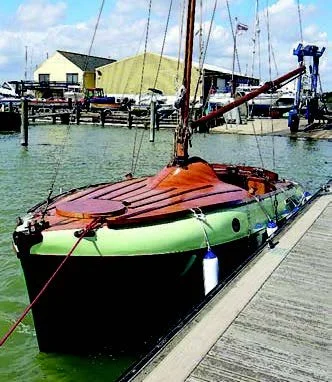
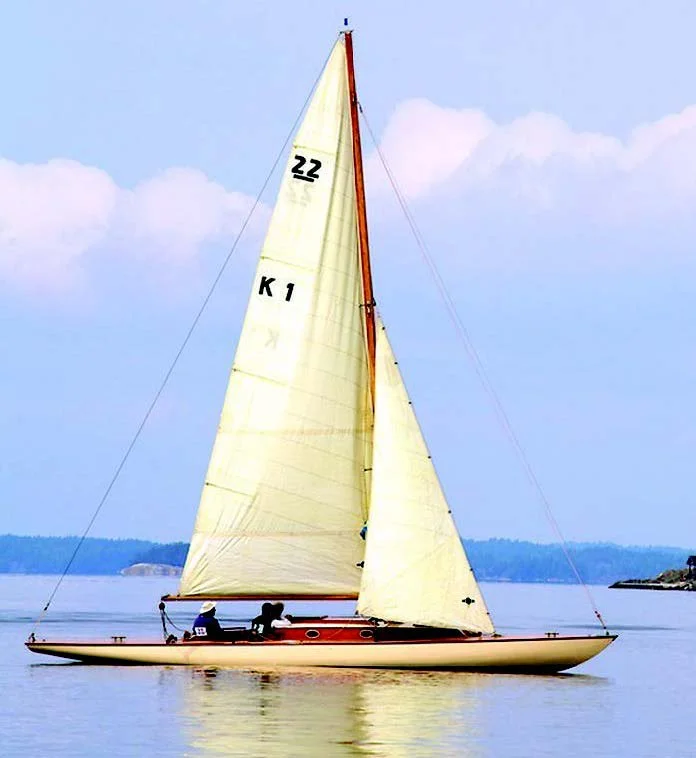
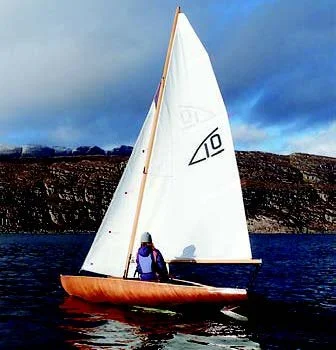
Left: Not Uffa’s prettiest design but functional, innovative and immensely robust, the hot-moulded Atalanta built at Fairey Marine was in truth Fox’s most successful all-round offshore creation. Bearing a striking resemblance to the lifeboats of the time, with deep retractable bilge keels and sweet underwater lines this reassuringly secure design was a delight to sail in a steady breeze. Numerous safe transatlantic crossings are recorded for this tough little blue water 26-footer – whose futuristic design dates right back to 1955. Center: by contrast Fox’s famous Flying 22 Vigilant is a true thing of beauty and another of his bigger designs that is still in active use. Right: a handful of original Flying 10s are still sailing but in 2018 two young craftsmen in Ullapool in the UK – a hotbed of traditional boatbuilding – built this beautiful new example, necessarily cold-moulded rather than using the original Fairey hot-moulding system (Click to Enlarge)
Such was Avenger's superiority that in 57 race starts she took 52 firsts, two seconds and three third places. She was the total embodiment of Uffa's thoughts and dreams. Uffa had introduced a new dimension to yacht design producing a hull shape that was to become accepted and copied throughout the world… and would be the foundation of everything that followed right up to the present day.
But, perhaps paradoxically, the planing dinghy – and the forerunner of today's planing ocean racers – was born through the tightest of measurement rules, through a mindset of producing a winning fast boat within a strict structure of a rule rather than simply to draw an unrestricted boat that is just simply fast. The former always being much more difficult than the latter.
The Uffa Fox breakthrough of the planing International 14 was revolutionary because it worked within a code of rules that allowed its effectiveness to be directly measured against other boats built to the same rules. The superiority has to exist within certain parameters to be valid and this is what thrilled Uffa so much in that summer of 1928.
But he was equally adept at exploiting rules. After the game-changing success of Avenger the rule gods demanded increased weight in International 14 design. Uffa's response was typically radical. He threw out the notion of planing and instead he now produced winning designs with much deeper and narrower underwater sections.
He had quickly reasoned that to compromise with weight would be a mistake. Instead he produced boats that would excel upwind and down, but not reach well, figuring, correctly, that superior speed to windward and running would more than make up for any losses reaching against overweight semi-planing designs.
It was a bold move, but an approach that brought him 10 more years of success in the Int 14 Class before he switched direction once again, in 1938, when the rules on weight were once again relaxed.
Now arrived Fox's legendary Thunder and Lightning Int 14 designs, light with even more extreme full-on planing, further helped by another Fox innovation: the trapeze. These two designs would give Fox another era of dominance in the class.
Fox on one of his quiver of high-performance sailing canoes off Cowes – among the forerunners of the modern IC10 class; he successfully completed many singlehanded crossings of the English Channel on these boats, revelling in the simplicity, strength and speed of these elegant and efficient designs.
Bigger Boats
But Uffa Fox's forays into offshore boat design gave little or no thought to rating rules. As with his breakthrough planing dinghy designs drawn before World War II, Uffa adopted a hull shape that he felt would plane most easily. The configuration of a deep-V forefoot and wide flat underwater sections aft was combined with lots of flare, lots of forward overhang, but fine forward waterlines.
Uffa most certainly did not see the need for flat sections forward or indeed the use of chines to promote planing. He understood, all those years ago, a dynamic of yacht design that is lost today in the pursuit of fashion. His long overhang hull shape proved itself convincingly in 1948 with the first of the Flying designs: the 15.
Like the 'correct' naval architect he was, Uffa used waterline length to designate the size of his creations. Hence the Flying 15 was 15ft on the waterline and close to 20ft overall. The success of the 15, drawn in 1948, with some 4,100 built to date, gave rise to a range of both inshore and offshore 'Flying' designs also designated by their waterline lengths.
The inshore fleet consisted of the Flying 10, the 12, the 15 and the 25. Apart from the 15 all were built in very limited numbers, but the original 25, called Kingfisher, built soon after the birth of the 15, did have the speed that was pretty respectable for a 32ft boat at the end of the 1940s.
The offshore Flying designs did not emulate the overwhelming success of the 15 but they were still intriguing boats and great examples of free thinking. The Flying 30, 35 and 50 were all conceived and built at around the same time – 1950/51.
The first to be designed in 1950 was the Flying 50… all 70.5ft of her. Built by H McLean & Sons in Scotland for owner Gerald Ross, this Maxi-sized yacht displaced a mere 20 tons. Compare this with the 'lightweight', 31.2-ton EG Van de Stadt-designed maxi Stormvogel, launched some 12 years later. Such a shame the two never sailed against each other, but in reality the Flying 50 was conceived solely as a cruising yacht for pottering around the Caribbean and to this end sported a shallow draft of only 6ft.
But as with all of the Flying designs the underbody, keel and rudder of the Flying 50 mirrored the iconic Flying 15 shape. The keel and rudder designs adopted by Uffa were again typical of the man – radical.
First seen on the 15, Fox's aggressively swept-back keel was deep but extraordinarily short fore and aft compared to other keels of the time. This low wetted surface fin supported a highly flared bottom end to enable the required ballast to be carried as low as possible.
Conceptually the design, drawn in 1948, was similar to today's strut and bulb keels with the advantages of low wetted surface and low CofG. It might fairly be said, however, that the keel profile, with its small plan area, wasn't the best for windward performance and unfortunately Fox's conviction of being always 'right' about his work meant that these keel and rudder designs were not developed that much away from the original concept.
Relatively little work on the keels, in particular, would have given them a very modern shape and well ahead in design terms of the Van de Stadt fin keel and separate rudder designs that shook up yacht design in the 1950s.
Next down in size in the Flying offshore range came the 35 – actually known as the Flying Fox 35. Again she was incredibly light at 7.5 tons displacement on an overall length of 48ft. Once again she has the characteristically low freeboard favoured by Fox, to help keep structural weight to a minimum, matched to a swooping shear line with plenty of height and overhang forward. In Fox's design philosophy these long, full bow overhangs were very much part of the pursuit of speed when combined with seaworthiness.
Like the 50, the 35 was well fitted out below and consequently featured a large coachroof to give plenty of headroom. By today's standards these designs didn't necessarily look like racing yachts, but this belied their performance potential derived from their very light displacements.
You can unquestionably see direct inspiration from these offshore Flying designs to many of the lightweight designs emanating from Australia and New Zealand in the 1960s. There seems little doubt that, for designers like John Spencer and even Bruce Farr, Fox showed what was possible given the considerable limitations of building materials available at the time. For sure Farr's first big offshore racer, the 46ft Gerontius – designed in 1974 – took a lot from the similar-sized Flying Fox.
But the development of ultra-light offshore racing boats was hampered by several factors when Fox was doing his pioneering work. Neither the RORC nor the American CCA rule – the primary rating systems throughout the world – measured displacement particularly fairly.
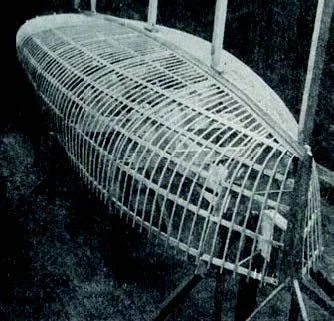
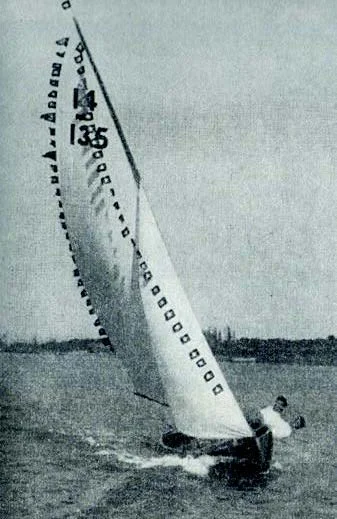
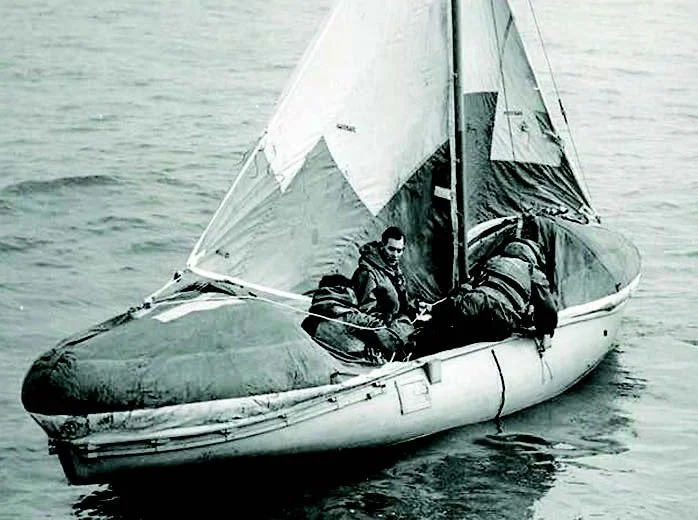
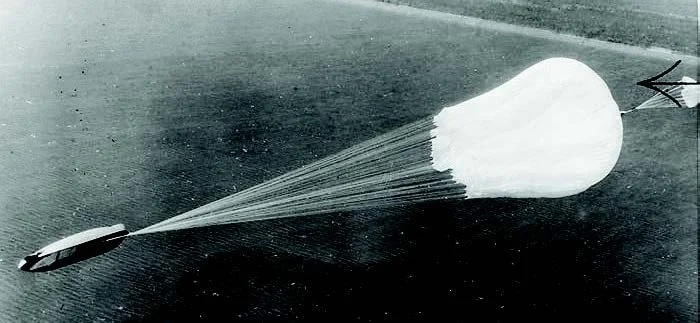
The most significant of Uffa Fox’s small boat designs, his Int 14 Avenger, takes shape in his Cowes workshop in 1928. Avenger is generally acknowledged as the first planing dinghy to appear outside Australia and New Zealand – and may well pre-date those too; Fox and Avenger celebrate their first-year tally of 52 wins out of 57 race starts; Avenger might have been his most significant recreational design but Uffa Fox’s Airborne Lifeboats were responsible for saving the lives of hundreds of downed pilots during WW2; these boats were dropped by parachute and featured a workable sailing rig, oars plus a small 16hp petrol engine. (Click to Enlarge)
Designers like van de Stadt and John Illingworth got as close to the light-displacement competitive window as was practicable under the contemporary rules of the 1950s and '60s. Indeed van de Stadt really did master the genre with Zeevalk in 1949/50. At 36ft on the waterline Zeevalk weighed an incredible 5.5 tons. She was fast too, placing second overall in the Fastnet of 1951 raced under the RORC rule.
Construction materials also played an indirect part in limiting the competitiveness of Fox's creations under the rating rules in use. While Fox had mastered the concept of low centre of gravity keels to give high stability there still wasn't enough inherent power to carry a rig size that would perform just as well in light airs as in big breezes. Such lack of sail area and the ability to carry it was a definite Achilles' heel in the pioneering days of lightweight offshore boat design.
The most famous and successful of Uffa's offshore Flying series was the Flying 30 Huff of Arklow. Built in 1951 by Tyrell of Arklow for owner Douglas Heard, Huff did win a number of races, including the prestigious Faulkner Cup in 1962 and 1964 under her second owner. And in the right conditions she was certainly very fast, recording over 23kt in the Azores Race of 1960.
Interestingly, though, Huff was the heaviest of the Fox creations weighing in at just under nine tons on a 30ft waterline. Moderate, for sure, by his standards, but she also had proportionally more draft and sail area, making her a stronger all-round boat.
The iconic stepped shear on Huff was also a classic example of an owner brief leading a design characteristic that seemed to have little to do with enhanced performance; it was also completely unlike any other Flying design.
The new yacht's owner simply wanted to be able to step aboard his 44ft yacht from a dinghy with the minimum of effort. This required a radically low freeboard aft, which if continued forward would have produced a submarine with very little headroom or accommodation. The obvious solution was a stepped shear line, but by any standards it was pretty radical looking. Typically Uffa.
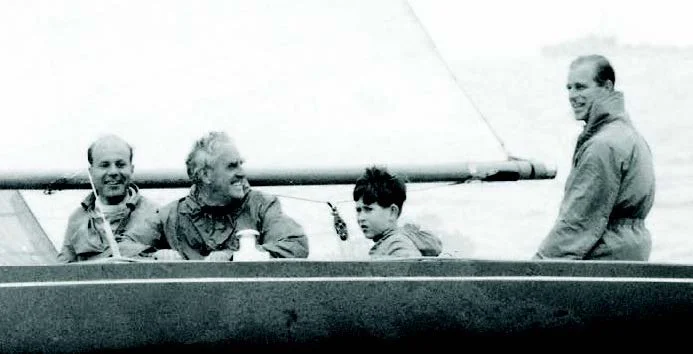
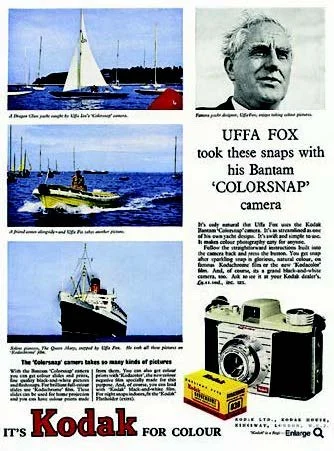

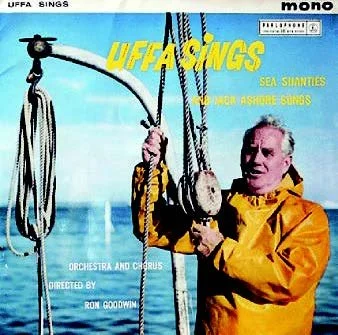
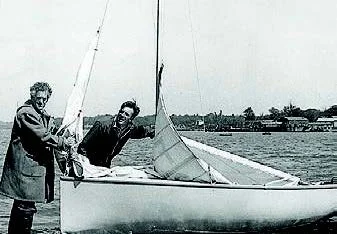
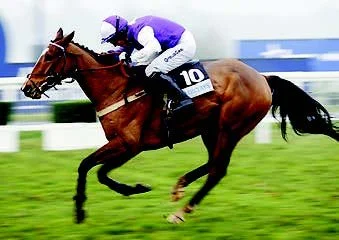
Uffa Fox’s close friendship with the British Royal Family spanned the generations. This is HRH Prince Philip’s Dragon Bluebottle (a wedding gift from Cowes) with Fox, a young Prince Charles and Lt Commander Alastair Easton; Fox’s fame extended far beyond the nautical environment… being widely renowned as a free thinker and a man of technical authority he made frequent appearances in advertisements of the time – though there was less emphasis on his technical skills when promoting Martini; you want songs, Uffa’s your man; with Charles Currey preparing to take Firefly No1 for its maiden sail – 75 years later the boat remains popular among team racers; then there’s the racehorse… Uffa Fox ridden by Noel Fehily wins at Ascot in 2007. (Click to Enlarge)
Catalyst
Aircraft manufacture, in particular, during World War II created factories and skills that leant themselves extremely well to small boat production. With not a lot else to do after the ending of hostilities many of these aircraft companies set up boat-building operations. But they also needed talented boat designers to help them create suitable craft for a whole new market of family-oriented buyers.
It was a perfect opportunity for Uffa Fox to display his talents when he became the principal designer for Faireys, who were busily adapting their highly successful timber hot-moulding manufacturing techniques from aircraft manufacture. This process, building up layers of fine flexible veneer, particularly suited Fox's style of curvy design which he felt gave a more natural performance through the water. He was not a particular fan of chines.
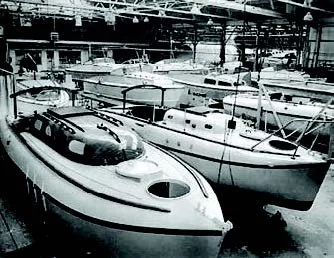
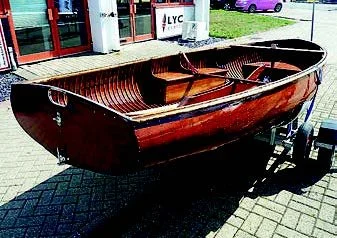
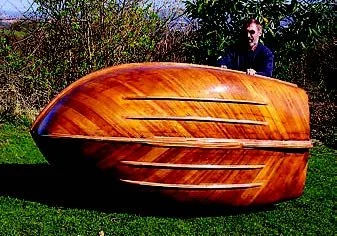
A line-up of what today are all highly desirable hot-moulded classic craft at Fairey Marine in the late 1950s,including Huntsman and Huntress powerboats and several Atalanta sailing cruisers; pièce de résistance from this master boatbuilder, fine designer and innovator is the legendary Uffa Fox-built International 14, constructed from two thin mahogany veneers with an intermediate silk layer for extra waterproofing all laid up over tiny 3/8in x1/4in elm ribs; aesthetic perfection: Fox’s Fairey Duckling (Click to Enlarge)
This curvy look produced the landmark Atalanta design in 1955. Typically Fox, it married what was, to all intents and purposes, a 26ft dinghy hull, not unlike an International 14, resplendent with near-zero overhangs, a deep-veed forefoot and ultra-flat run aft, and with cruising accommodation for up to six people. The deck design similarly employed a large radius rolled edge from the gunwale up to the deck. This had been a key feature of the Airborne Lifeboat Uffa had designed during the war for ditched aircrew; one of his less well-known creations that deserves much higher billing, having saved the lives of hundreds of airmen who had survived ejecting or crash landing on water.
But most noteworthy of the Atalanta's many radical features were the twin retracting keels, or bilge boards as they would be known today. The Atalanta was a great commercial success, with 186 built despite being fairly pricey for the time; and the retracting keels and lifting rudder allowed the boat to explore shallow water, be trailerable and launched off a slipway.
Being very high aspect ratio, once lowered the bilge boards gave good performance relative to many more conventional keels of the time, but the Atalanta never really became a mainstream racing boat as its dinghy-like shape didn't fit in with the RORC and CCA rating rules! But it was a good fast passage maker and its success led Faireys to commission a smaller 20ft Fulmar and the larger Atalanta 31.
Uffa could not have survived easily, or indeed thrived, in today's politically correct world. His inspiration for great design derived from spontaneity, risqué humour and a kind of 'charm' that would not sit well in a society that so easily takes offence. No, as the saying goes, Uffa Fox was a man of his times. But then those times produced and allowed opportunities for original and radical thinking to flourish.
Thought provoking
For me, putting this article together has been revealing. Usually our heroes and the people we follow are of our own time. Typically we are inspired by those who are at the top of their game, when we are starting out on our own paths. So for me it was Illingworth & Primrose and Sparkman & Stephens who I looked to for inspiration. If I had studied Uffa a bit more closely, and indeed read his brilliant books, I might have discovered my own planing offshore boats, like the North 26 and Wavetrain, a bit earlier in my career.
Indeed reading his books, written from upwards of 85 years ago, it is fascinating, just to take one example, that the Nicholson-designed 6 Metre Lalage was already flying what today we would call a Big Boy. This was way back in 1936 at the 6 Metre World Championships. The sail was called a 'Paranora'. You can always find so much to learn if you look back with an open mind – and one of Uffa's greatest legacies is to remind us of the value of just such an attitude.
But perhaps for the mercurial human being that Uffa Fox undoubtedly was there can be no greater accolade for his design skills than the immortal words offered by Prince Philip, on the occasion in 1955 of the presentation of the Diploma of Royal Designer to Industry. Upon presenting the award, Prince Phillip, in the manner only he could, offered the most splendid backhanded compliment to a designer that you could possibly imagine…
'There is a tendency today to believe that every new invention must be scientific or rational. I can confirm that there is nothing scientific or rational about Mr Fox.'