
Stern warning: one man’s mission to clear the rotting boats poisoning Cornwall’s creeks
This both sad and inspirational article is eautifully produced and one of a series entitled SEASCAPE appearing occasionally in the Guardian. The initiative is intended to draw attention to the dramatic changes taking place in our oceans, and the innovations under way to tackle them.
Words by Anna Fazackerley, Photographs by Jonny Pickup
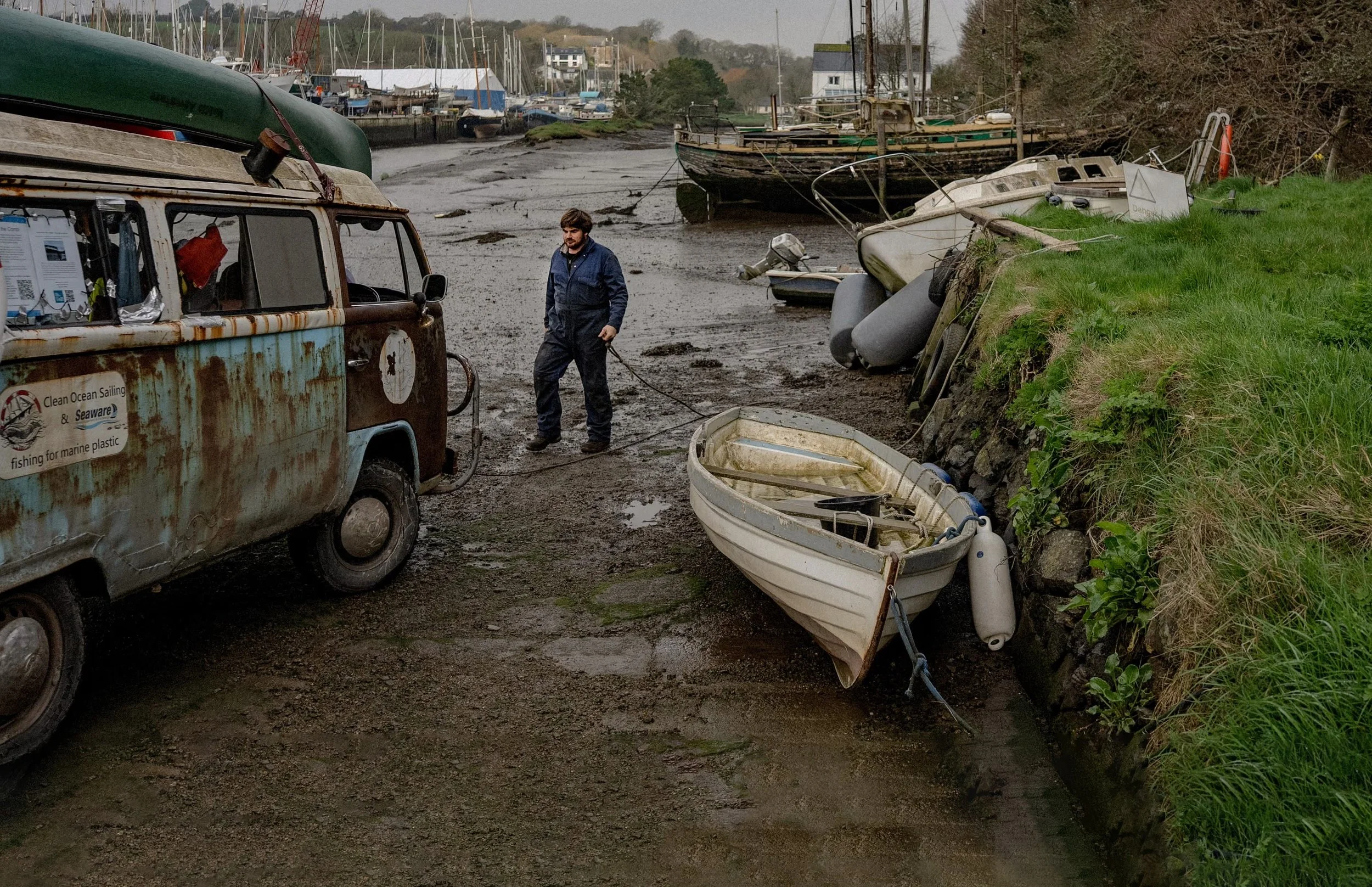
Steve Green of Clean Ocean Sailing with his 1972 VW van Cecil in Gweek, Cornwall
Steve Green, a boat engineer from Cornwall, was pulled over by the police just before Christmas. He was driving a decrepit-looking VW campervan and towing an even more dilapidated yacht up to Truro. He hadn’t broken any laws, but he admits that Cecil the campervan, which runs on donated chip oil from local pubs and has a crane and a winch on the front, “wasn’t quite what VW intended”.
Green (and Cecil) are on a mission to rid the beautiful hidden creeks of Cornwall’s Helford and Fal rivers of 166 abandoned fibreglass yachts, which are leaking plastic and toxins into the predominantly marine waters. Marine biologists have likened the thousands of shards of fibreglass they have found embedded in the flesh of sea-creatures in areas with wrecks such as these to asbestos, a substance known to have a noxious effect on humans.
The problem stretches far beyond Cornwall. Across the UK – and indeed the world – the legacy of the mass-produced fibreglass pleasure boat boom is unfolding. Yachts bought in the 1960s and 1970s are now reaching the end of their useful lives and there is no clear plan for what to do with them.
Green was towing the 22ft Hurley yacht that had alarmed the police to Truro recycling centre – but the recycling part is euphemistic. These yachts end up in landfill. Disposal is charged by the tonne and Green paid £1,200 to dump it there. Larger yachts cost up to £3,000. It’s one reason so many of them are abandoned by their owners, who don’t want to foot the cost or take responsibility for disposing of them.
It takes Green days to clear a discarded yacht of rubbish, silt and sand, bail it out and float it to a place where it can be lifted on to Cecil’s trailer or pulled upstream to Truro by Annie, the 100-year-old wooden “pirate ship” schooner he has lived on for most of the past two decades. But it matters to him that even he is causing some damage to the environment by doing this. “I don’t want a massive barge with a digger on it,” he says. “That would do it in a day, but the impact [of that vehicle on the environment] is huge.”
The organisation he runs with his wife, Clean Ocean Sailing, relies on small charitable grants, crowdfunding and enthusiastic volunteers willing to paddle kayaks out to wrecks and help. Green ran up £8,000 on credit cards last year when the grants didn’t cover all the decaying boats he took to the dump. “It’s a balance between not being so broke that my kids can’t live a normal life, and wanting to preserve the environment for their future,” he says.
Each rescue mission starts with Green putting a notice on the abandoned yacht, giving the owner 30 days to come forward and claim it. Unlike road vehicles, or even boats destined for rivers or canals, you don’t need a licence for a boat on coastal waters. This often makes tracing the owner impossible, especially if they don’t want to be found. “So many people have a dream of getting a boat, but with no thought of where to keep it or how much it will cost,” says Green.