
A Spiritual Force
Many of you will know SEAHORSE as the premiere sailboat racing publication in the world, covering the latest developments and cutting edge technology in the global race to win. However they also have a deep respect for the lineage from which today’s boats evolved. Over the next few months we will bring you a series of handpicked articles from their archives highlighting this history, and showing that deep satisfaction in sailing comes from understanding, just as much as winning! The generous people at SEAHORSE are offering readers of SWS a significant discounts of up to 30% on both digital and print editions of this seminal magazine. Click the banner below to check out the offer.

Yachts named Recluta have been a long-running intimate part of the Frers family story since the late 1930s. From a magnificent shipwrecked wooden yawl to Admiral's Cup champions, the name has never really gone away over the past 80 years. Today Germán Frers Sr himself has a 'new' Recluta of his own to enjoy and celebrate. He relates how once again Recluta is working its family magic…
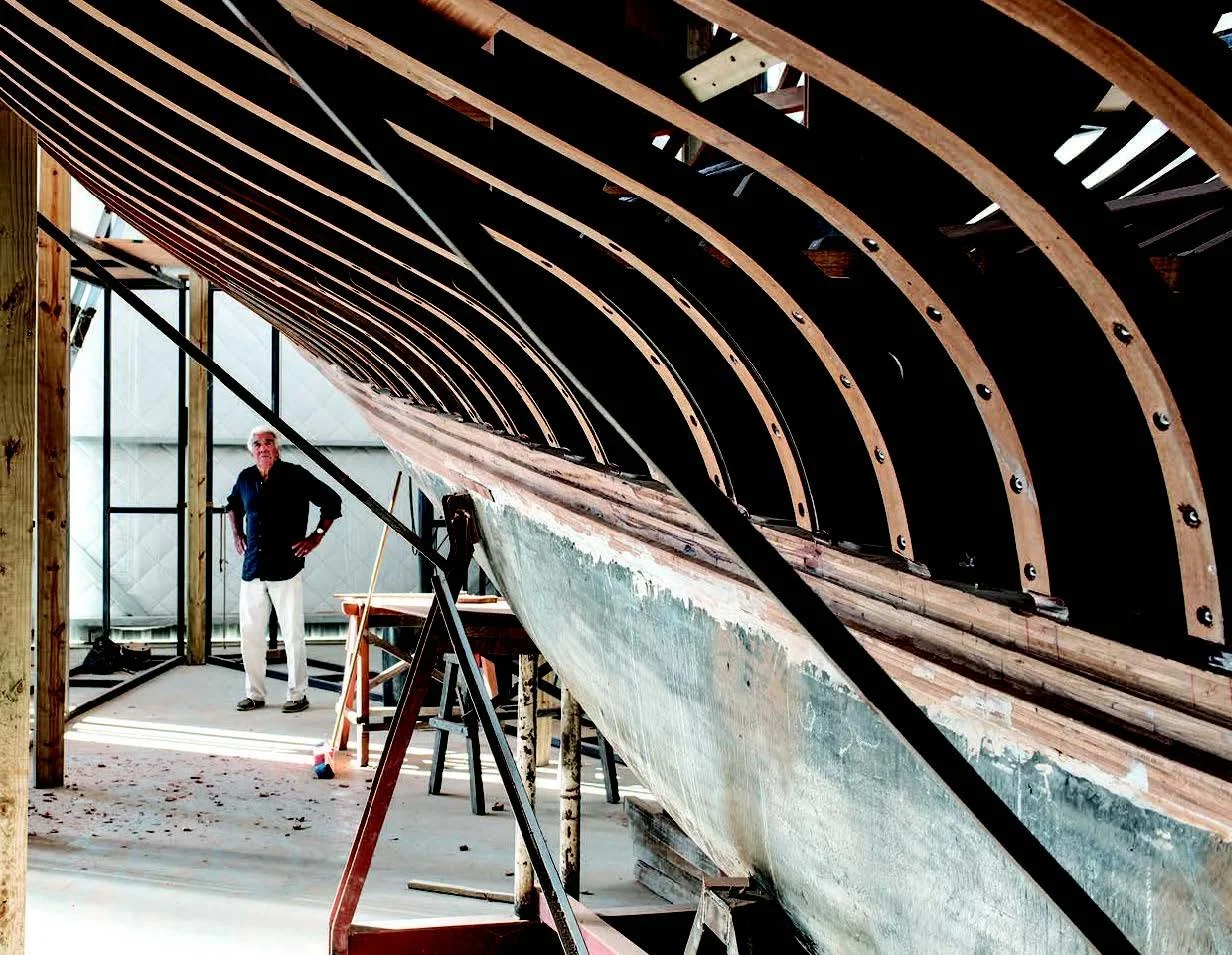
An understandably proud Germán Frers admires the workmanship of 82-year-old master-craftsman Tito Szyka’s team as the new Recluta begins to appear in the large shed which Frers had built at the Yacht Club of Argentina especially for the project. Frers prepared the lines and drawings using 3D modelling to achieve the accuracy he is accustomed to with modern builds, in turn offending some of Szyka’s craftsmen who had spent their careers quite satisfactorily delivering yachts they’d faired entirely by eye.
Background
Recluta was designed by my father in 1943 to replace the original yacht Recluta that was lost in 1942 while racing from Buenos Aires to Mar del Plata along the Argentine Atlantic shore. She had only lightly touched the bottom while straying too close to the coast when taking the shortest distance to the finish. Unfortunately, as they tacked away to sail offshore one of the crew fell overboard and during the process of recovering him the yacht ran aground much more seriously.
In spite of all efforts the situation steadily got worse, Recluta was trapped in the midst of breaking seas. Eventually she was pushed further up the beach and after a few more hours began to fill up with a mixture of water and sand which eventually led to her breaking up.
Before her fateful voyage the owner at the time, Charles Badaracco, had had his yacht fully refitted and re-rigged as a Bermudian ketch including an extensive inventory of new equipment.
Fortunately, as the boat lay on her side on the beach, when the tide receded a lot of this equipment, including winches, instruments and even her recently fitted new engine, was recovered by the crew who camped on the beach for several days to save as much of their yacht as they could. They were cheerfully helped in their efforts by several hardworking gauchos from the nearby 'estancias' (ranches and farms).
With as much gear as possible saved from the shipwreck, the owner, after lengthy consideration, commissioned my father to design a new yacht to replace Recluta, able to be fitted out using all the material recovered from the wreckage of his previous yacht.
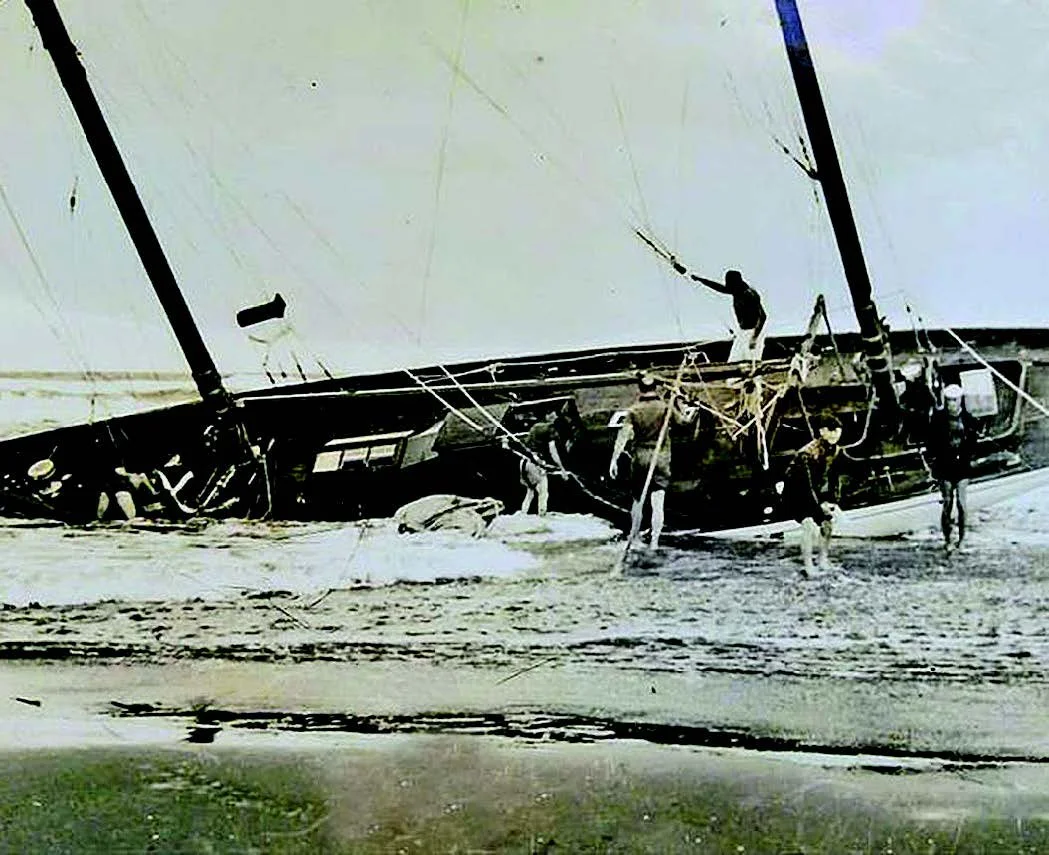
How many of us look at this photo of the original Recluta stranded on a beach in 1942 and think, there but for the grace of…
Construction was started in 1943. However, because of the scarcity of many essential materials during World War II, particularly lead, copper and so on, construction was halted soon afterwards. Mr Badaracco bought another yacht and that was that. Or so everyone thought.
Nagging away
For many years afterwards, though, large colour prints of the sailplan, GA and deck plans of Mr Badaracco's new, never completed design remained hanging on the walls of my father's design office – my father occasionally glancing over at them and always with a slightly regretful look. And all of the yacht's original plans and construction drawings remained carefully stored in the drawing cabinet.
Around 15-20 years later, when I started frequenting the office after school, I become familiar with the saga of Recluta; which had become a familiar topic of after-hours conversations with ourselves and other friends who used to visit the office for high tea… before cocktail time began!
Later in life, after I had become a professional naval architect, I got involved in designing and being part of the crew of other more modern boats also named Recluta, owned by Charles Badaracco's nephew, Carlos Corna Badaracco.
I designed and sailed on Recluta III in the Admiral's Cup of 1973, finishing as second individual scoring yacht and second overall in the Fastnet Race. We also won the Buenos Aires to Rio Race and later on won Class C and finished second overall in the 1974 Bermuda Race.
I similarly designed and sailed aboard a new Recluta IV in the 1977 Admiral's Cup and that year's Buenos Aires to Rio Race, and the final Recluta of the modern era, Recluta V, in the Sardinia Cup.
Meanwhile, the unfinished earlier attempt at building a new yacht to the lines of the original Recluta languished away, her bones finally disappearing after 70 years of abandonment… But that was not the end of the story.
A new century
Back in 2014, in the heat of a political discussion with a group of friends and artisans at a local traditional yard, all of us feeling equally worried about the future (a common situation in Argentina during the past 70 years), somehow I found my mouth, quite unbidden, saying that, if the results of that year's elections were positive, then I was going to build a new boat myself. And the results, even at the time, were looking encouraging.
And so it turned out… good for Argentina certainly, while a few months later I was faced with the obligation of building a new boat. Something I must admit that I have thoroughly enjoyed! I have found in the classic yacht fleet a new niche where I am able to compete while sailing with good friends from the early years, including many Recluta crew – a fun-loving, reckless, tireless and fearless bunch, as well as with their sons and daughters and other family.
I began this new sailing 'career' with Folly, a 1907 Charles Nicholson International 8-Metre he designed and sailed himself to compete against the Fife 8-Metres that at the time were dominant. I raced Folly for several years, in many European events, including Argentario Week (where I received very nice compliments about the boat from Olin Stephens), Antibes, Cannes and St Tropez, as well as at Porquerolles Week near Toulon which we won. There was also an 8-Metre World Championship on Lake Geneva, where I was unceremoniously disqualified as helmsman (to be replaced by Doug Peterson) after the police reported that we were not wearing life jackets when the flashing light on their vessel indicated that we should do so!
After Folly I moved to Sonny, a 1935 Frers Sr canoe-stern 50ft cutter, with which we got a second prize in Cannes and won our class at the Voiles de St Tropez.
Meanwhile, nearer to home on the River Plate, I also kept Aguacil, a 1939 44ft double-ended centreboard ketch, another old Frers Sr creation, which is very competitive under the local CIM rule. But after 20 years with Aguacil I began to get tired of looking at the white top of the double-ender's external rudder head and started thinking about jumping to a more conventional, traditional-looking craft…
It was not long before we realised that a yacht built to those old Recluta drawings from 1943 would fit our new recipe perfectly. And being larger than our previous boats, being the largest of all my father's sailing yacht designs, she would also double as a family cruiser.
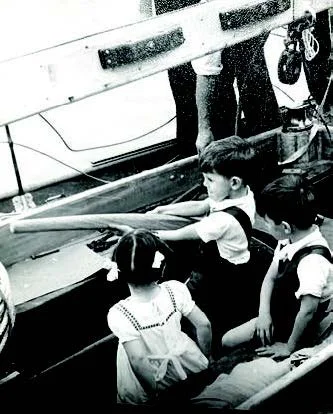
Germán Frers with his siblings ‘dry-sailing’ one of their grandfather’s designs in the late 1940s
This time I had never really considered another restoration. Instead, from the outset I was strongly attracted to the whole idea of building a replica of the original Recluta design. First, because in Argentina there were no old boats that I liked left to be restored; secondly, because after four restorations I have learnt that taking apart an old craft and then rebuilding it using minuscule pieces of the original in order to call it a 'restoration' is very expensive and also counterproductive.
I communicated my decision to Tito Szyka, a master-yachtbuilder with whom I have done all the restorations of my previous classic yachts mentioned above, plus two other notable designs, Heroina, a 75ft laminated wood sloop for which he built the interior and finished a hull built by Belarmino Sarmiento, and Bluebell, a 24m motor yacht restoration.
Tito was 82 in 2015 but he never hesitated and got to work immediately on the very substantial laminated keel, stem and backbone of our new yacht. Meanwhile, I made a deal with the Yacht Club of Argentina to construct a large build shed at their premises in San Fernando, in exchange for using it for the next three years (this would later be turned into a well-appointed paint shed for members and others to use).
In January 2016 the lead keel arrived and, with the laminated Viraró keel stem and backbone, it was moved to the shed when construction properly started.
The detail
The challenges of building a new yacht to a design and drawings that are now 80 years old are many and varied.
We started by digitising the original hand drawings and translating them to a 3D program with the idea of facilitating construction and allowing prefabrication of larger metal components. The metal floors and centreboard case were then welded up quickly and, with the benefit of the 3D model, to a high degree of accuracy… certainly much more accurately than was possible in the 1940s.
Meanwhile, the original lines were being re-faired in the computer in lieu of having any traditional full-sized loft floor drawings. Laminating jigs for each of the laminated frames were made up and the lamination was started; but here is where some of our local workforce's innate resistance to change began to surface.
The frames were laminated exactly as per design. They were then supposed to be joined at the deck level as per our digitised plans; however, the guys had insisted on fairing out the hull and deck connections 'by eye'. In addition, they had elected to use cheap green wood to create the joints… which changed length each day with the humidity.
It took a lot of time and effort to persuade them to switch to the process we had designed… and we lost a lot more time while they changed what had already been done; all the completed frames were now realigned and levelled according to our plans by connecting them to a steel beam in turn connected to a steel structure that we designed and built for the purpose.
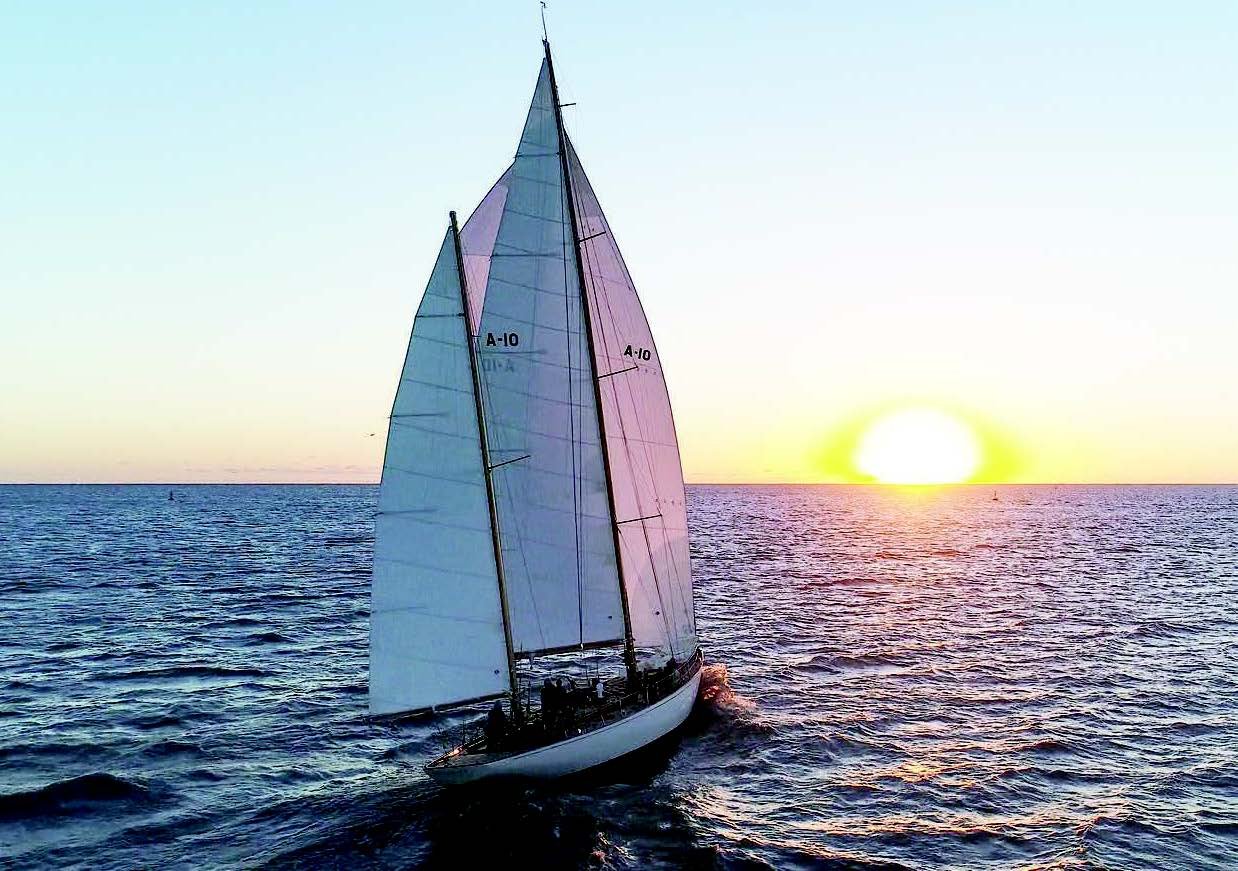
The latest incarnation of RECLUTA
Another challenge, one we cannot talk very much about, was the fact that every piece of equipment bought overseas had to be shipped to Uruguay, rather than direct to Argentina. From screws, to winches, Sitka spruce for the spars, batteries, stove, fridge, water maker, blocks… everything.
So we spent a lot of time travelling to and from Uruguay to bring everything back to the yard. A lot of emails over a period of two or three years…
1943 Recluta vs 2021 Recluta
I changed the original interior layout completely to reflect the changes that have occurred over the past 70-80 years. The galley was moved aft, from the forward crew quarters to the middle of the boat close to the main saloon.
Two double guest cabins were built forward with an adjacent toilet. These two cabins can be converted into one large one with the removal of a longitudinal dividing panel. Aft there is now an owner's cabin sporting a double berth and toilet with separate shower.
The coachroof is a little higher than the original to allow for the fact that people are taller… and also that I now have a 2m tall grandson. I maintained the height of the bulwark, but I raised the deck within the bulwark to gain headroom.
And now
The launching of 'Recluta' took place on 18 December 2019, on the occasion of the visit of my granddaughter Camila Frers who is the yacht's godmother. One week after launching she went back to the shed to finalise various jobs and installations which I expected to take two or three months maximum before she was ready to sail to the Med in April 2020…
Then in March a draconian quarantine was declared by the government. It was forbidden for anyone to go to the boat or do any work on her. So Recluta remained unattended for nine months or so; once the lockdown was lifted it took us a further two months to get things moving again.
A moving tale
From the start of the Recluta project no one was more deeply involved than my own daughter Zelmira. As well as being a qualified naval architect, Zelmira took it upon herself to photograph and record every moment of the Recluta build, firstly for our family, but then transforming her hard work into a magnificent 200-page book* full of words and magical photos, including many historic images reflecting my family's – and the original Recluta's – long story with the sea.
Once afloat Recluta has weaved her magic further with Zelmira, who from being rather lukewarm about sailing classic yachts is now sailing whenever she can, trimming sails and understanding what sailing is about. It is now a deep emotion, and it gives me great pleasure.
Of course our family has cruised together for many years during the southern winter school recess. I have also competed with my other children regularly on Heroina, but Zelmira was never involved in the sailing itself.
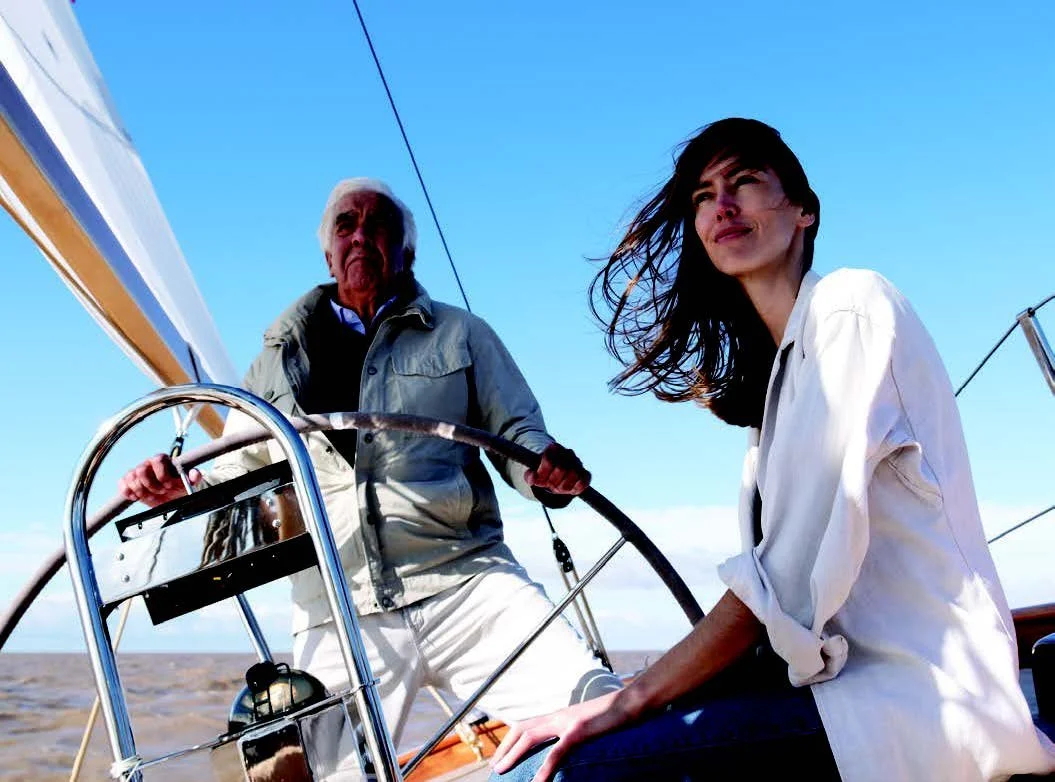
A family affair… Germán Frers Sr and daughter Zelmira, the naval architect and photographer who wrote The Story Behind Recluta – as much a family history as the story of a yacht name that has been an integral part of the Frers family for over 80 years.
Now Recluta has aroused the interest of my children and grandchildren. She has inspired them in many ways related to our family life and family history. She has contributed very greatly to our togetherness.
Today Recluta is safely ashore at the Cantieri Navale dell'Argentario being maintained and prepared for next summer, racing and cruising… and perhaps then a nice sail back home to South America.
The Story Behind Recluta, by Zelmira Frers