
The Best Sailboat Racing to Watch this year!
& Why racing coverage has lost its way, and how you bypass the confusion
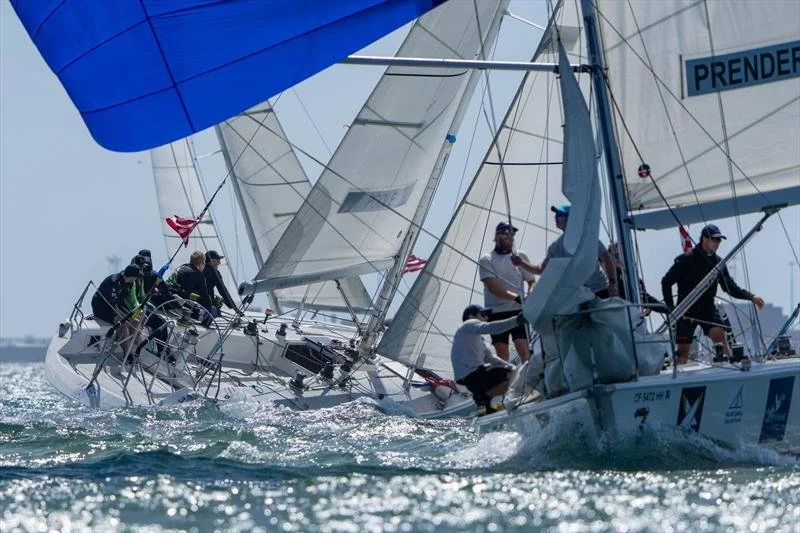
OK, I’ll admit it, I watch a fair amount of sailing boat racing… much of the time with a scowl on my face, as parts of our sport descend into an on water version of Formula One.
Despite the manufactured hype of Sail GP, I do watch it, but on YouTube, days after the event has finished as I refuse to part with money to listen to the imbecilic commentators yell inanities into their microphones to try confect some sort of excitement.
The craft are incredible pieces of engineering, and the speeds they reach are terrifying, but it doesn’t necessarily follow that the racing becomes exciting. In fact, it’s the opposite. There is zero sail handling, no visible personality, and minimal match racing tactics. And let’s face it, when 75% of the time, the boat that reaches the first mark in the lead wins the race, (more in the three boat finals) the excitement doesn’t come from boats tussling for the gun. (And just FYI, in Formula One, its only 45% of the cars that come out of the first corner in the lead go on to win the race 80 odd laps later!)
And although I have no evidence for this, I can help thinking that the relatively small non-sailing audience watch the event in the hope of a big pile up. The fact that the most watched clip, on Sail GP’s own YouTube Channel is entitled “Must See Crash!” tells us that they know where their “clicks” are coming from.
And then there is the Olympics, which for generations has been the gold standard in testing a sailor’s pure ability. It was never about technology or audience, but always about pure athleticism, talent and raw sailing ability. But now the IOC has decided that TV ratings are more important, and the dumbing down in the hunt for eyeballs has begun.
In Tokyo 2020, the existing "medal race" format was already in place — sailors accumulated points over an opening series of fleet races, then the top ten contested a final medal race with doubled points. But the sport was still criticised for being hard to follow on TV, with complex scoring, unpredictable timing due to weather, and races too long to fit neatly into broadcast windows.
For Paris 2024, World Sailing pushed further, introducing faster and more visually spectacular boat classes. The traditional RS:X windsurfer was replaced by the foiling iQFOiL, which trialled a knockout bracket format — quarter-finals, semis and a final — designed to create a clear, drama-filled climax. The IOC's criteria explicitly included media appeal and a shift from a sports-based to an events-based programme, so the intent was always partly about making things more broadcastable. And the conclusions from a relatively windless Marseille, is that it didn’t work.
Looking ahead to LA 2028, the pressure has intensified further. According to Olympic Broadcasting Services data, sailing ranked very poorly among the 312 Olympic events in broadcast coverage, with specific problems including unpredictable start times, races lasting anywhere from one to four hours, and scoring systems too complex for casual viewers. World Sailing's proposed revamp for LA 2028 would split events into an Opening Series, a Semi-Final, and a Medal Series Final — with points potentially reset at each stage to make the final race a decisive, standalone spectacle. World Sailing has set two concrete requirements: the winner of the last race must be the overall winner, and the entire finals sequence must fit into a 52-minute television package. That's a radical shift from traditional sailing's ethos of rewarding consistent performance over a full week of racing — and it has not been without controversy among athletes and class associations.
So that’s where we are with a couple premiere global sailing events… And I’m not even going to give oxygen to what has become the bizarre and irrelevant vaudeville event called the America’s Cup.
So you can imagine how enriching it was last weekend to watch some real sailing!
My favourite televised event on the sailing calander is the Congressional Cup in California. I spent a few hours sitting on the edge of my seat mesmerised as the incredibly talented and charismatic young Australian Crew, beat the best in the world, in their bare feet and ill matching T-Shirts… I felt genuinely proud!
The Congressional Cup began in 1965 at the Long Beach Yacht Club with a simple ambition: bring top-level match racing to the U.S. West Coast. It is widely regarded as the "grandfather" of modern world-class match racing and holds the distinction of being the oldest continuously held match race event in the world. From the start, the regatta helped pioneer many of the rules and practices now standard in match racing worldwide, including on-the-water umpiring and the round-robin format — innovations that are now used at every major match racing event globally.
The boats they race in are thirty-five-year-old Catalina 37s. Weighing in at around 7 tonnes, with dacron sails and symmetrical kites. They have a maximum speed of around 7 knots. The event is living proof that excitement in sailboat racing comes from tactics, personality and crew work, not speed and technology. The commentary is intelligent and amusing, the camera work is simple but informative.
FROM THE WORLD MATCH RACING TOUR’S WEBSITE
LONG BEACH, Calif. (May 3, 2026) – Australia’s Cole Tapper and his Kairos Racing Team from Sydney delivered a sensational performance to win the 61st Congressional Cup today at the Long Beach Yacht Club, earning Tapper the legendary Crimson Blazer and etching his name into sailing history.
Sailing with crewmates Max Brennan, Jack Frewin, Nathan Guliksen, George Richardson, and Hamish Vass, Tapper became the first Australian skipper to win the prestigious event since Peter Gilmour in 2004. Defending champion Eric Monnin (SUI) finished runner-up, while Chris Poole (USA) claimed third place.
The final day of racing delivered high drama, surprise twists, and an unforgettable comeback. Entering the morning, former champions Johnie Berntsson (SWE) and Chris Poole both held commanding 2-0 leads in their semifinal matches and appeared destined to advance to the final.
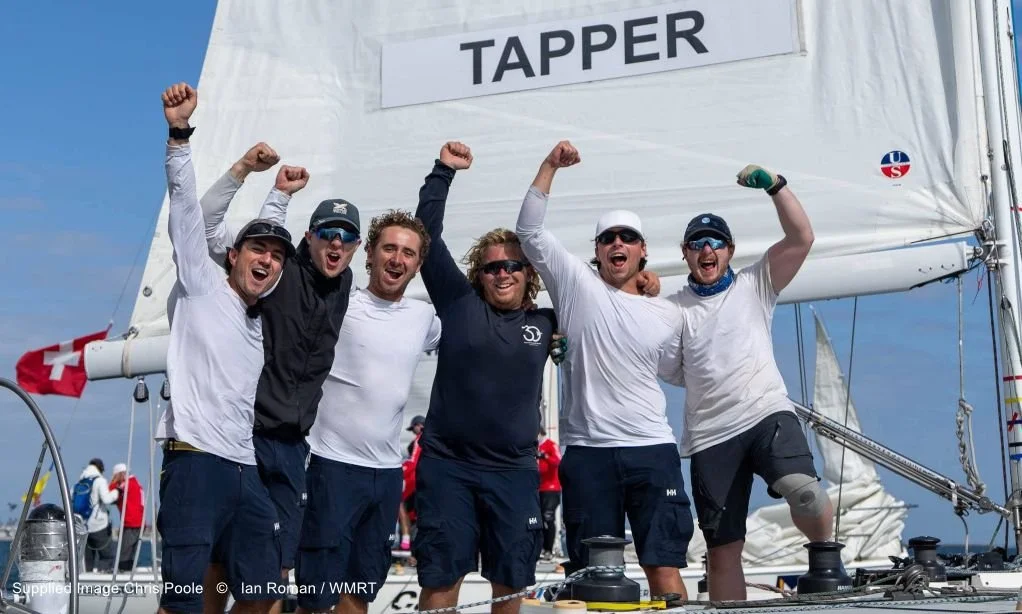
But Tapper and Monnin had other ideas. Facing elimination and needing three consecutive wins to survive, both teams mounted extraordinary turnarounds. Tapper reeled off three straight victories over Poole, while Monnin matched the feat against Berntsson, setting the stage for a thrilling championship showdown.
In his first-ever Congressional Cup final, Tapper remained calm under pressure against defending champion Monnin. In race one, Tapper forced an early penalty during a tense pre-start dial-up, then capitalized on a second Monnin penalty downwind to seize the opening point.
Tapper followed with another composed performance in race two to move ahead 2-0, leaving Monnin once again needing three straight wins to keep his title hopes alive.
“Well it’s a challenge to win three races, but we’ve been here before, so that’s what we now need to do again,” said Monnin.
Race three brought one final dramatic battle. Monnin led at the first windward mark, but Tapper struck decisively at the leeward gate with a perfectly timed luff that forced another penalty. A difficult spinnaker takedown from Monnin’s crew opened the door, and Tapper surged ahead, never looking back as he crossed the finish line to claim the 2026 Congressional Cup crown.
“This means so much to me and to the team,” said Tapper moments after victory. “Waking up this morning, we definitely felt like we were facing an uphill battle. But we’re so glad to have rallied and come back, and the only reason we were able to do that is because of these guys on my crew. Also from us, a very special thank you has to go to Jordan Reece, our coach, as he’s done a huge amount of work helping us get where we are today.”
Tapper’s dramatic victory will be remembered as one of the great final-day comebacks in the Long Beach Yacht Club Congressional Cup history.
If you missed it here is a guide to the most efficient way to watch the Aussie crew in the Semi Finals and Finals.
Take the time. Remind yourself what sailing races are really about. I promise you won’t regret it!
SEMI FINALS -Cole Tapper AUS v Chris Pool USA
Race One Go to 2hours 29 mins and 30 sec
Race Two Go to 3 hours 9 minutes 50 sec
Next Day….
Race Three Go to 20 minutes 10 sec
Race Five Go to 2 hours and 14 minutes
FINALS - Cole Tapper AUS v Eric Monnin SWITZ.
Race One Go to 3 hours 34 mins
Race Two Go to 4 hours 10 minutes
Race Three Go to 4 hours 52 mins and 20 secs