
How I Got Politicized
Many Thanks to Genevieve Jacobs for letting us share this story about how Dinner Key was an early battleground in the Florida USA liveaboard Wars. I love her writing style almost as much as the content. And if you think that Florida is a long way from where you sail and anchor, it’s still worth a read, because this sort of thing is beginning to happen in Australia.
Picture a gentle peninsula on the coast of the last solid land before the Everglades. Coconut groves spill all the way down to the waterfront. Bungalows grow up, too. It’s a little village called Dinner Key because an eccentric photographer and captain once settled here and wanted to have his mail delivered by the sloop that came up from Key West and needed a spot to anchor over for lunch. PO Box Dinner Key, Coconut Grove, Captain Peacock. Or Monroe. Then came the railroad.
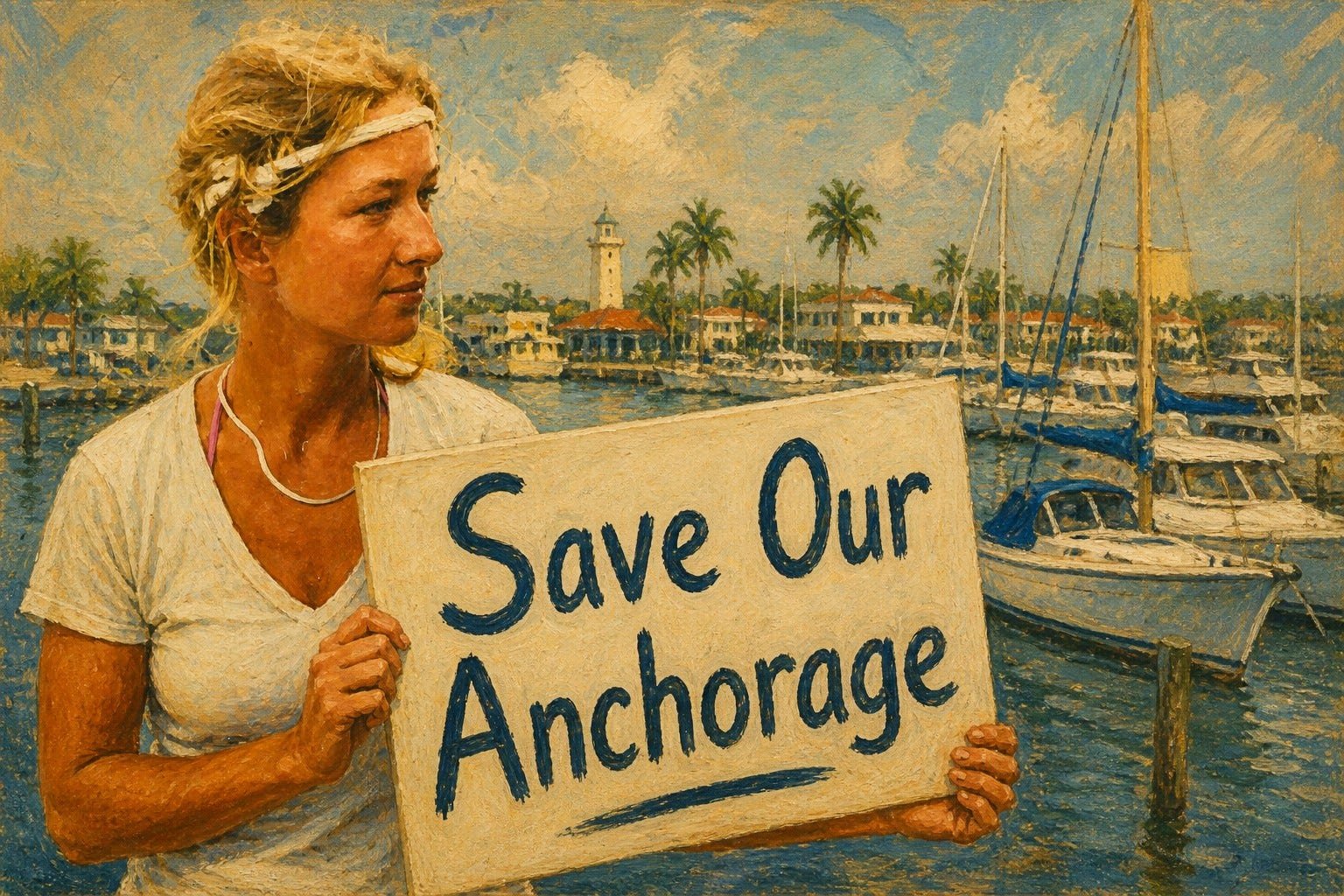
AI me (in the style of an early 20th century French painting) in resistance mode.
Picture now a five-fingered marina extending from the fist of this gentle knuckled peninsula. Beyond this, three curving spoil islands, dredged up by the Army Corps of Engineers back in the early World Wars 1 and 2, creating a basin and channels and space for the hangars of PanAmerican Airlines and Chalk Seaplanes.
These buildings later become home to City Hall of Miami and a few marinas. The anchorage lies beyond the spoil islands, exposed to north, east and south.
This became my home port from 1974—love at first sight, a homing pigeon landing— until 1983. I have a soft spot in my heart for this place, and I think you will see why.
I got back from a sojourn in the U.K. and surrounds, a bunch of yacht deliveries and silver polishing and apple picking and thatch roofing and train riding and youth hostels and hungry, not actual starvation but the kind of habitual hungry that you don’t know is actually hungry anymore.
You just have this dull feeling in your middle all the time. Your tummy is numb, gave up on getting any sustenance and happy to make do with tea and the occasional snack. But you’re only a teenager so you thrive on mere air. As long as it is fresh, salty and free. Citti
So I go to the anchorage where my 28-foot Wharram catamaran Citti is supposed to be on the hook with an ex-boyfriend living aboard. Instead, he meets me at the Lums #64 in Coconut Grove with a sad sack story about how my boat got stolen, and he doesn’t know where it is. I ask for details. He says, “Well, I tried to sail it up the coast and i got a little disoriented and anyway we ended up on the beach and ain’t that great how the Wharram can DO that…and then when i came back the next day it was gone. Like, stolen.”
I remember vividly why he’s an EX. Boyfriend. All vestiges of my guilt feelings for “abandoning” him, how I heartlessly left him for Europe, only offering him a free home aboard my boat in exchange for my escape, these vanish in a wisp of hot gut breath. I think I yelled. Something really quiet like “WHAT?!” Inhale, “Jesus”. Exhale, “fucking god.”
And a gulp of coffee to wash it down. And then say in a level voice: Okay. Roger that.
But to be generous I was only just 19 and turning 20 in a couple of weeks. So, I found a berth aboard Bouffon (in French, it means “clown”) for a few weeks in the forepeak by myself, a boat fashioned after Moitessier’s Joshua. Even a red hull! The owner had done a circumnavigation and come to anchor in DKA after a season in Haiti Club Med where he taught the old folks to windsurf, yelling from the beach:
“You got to Fook the Ma! Fook the MA!” He was trying to get them to push their pelvises in towards the center of gravity. Translation: Fuck the mast. Or you are lost.
In the crepuscule of pre-dawn each day, I silently pop out the forehatch like a woodchuck to hop in a dinghy with a couple of new friends who sailed their Wharram 30 from England. He had been a policeman, which struck me funny for some reason. And she was like a Viking, long blonde braids, always wearing a navy blue turtleneck sweater with her jeans. It was winter in Miami (but still, not that cold.) Nevertheless, they had a big contract up at Jones Boatyard refinishing the exterior of a 90-foot yacht, Southwind (or some wind, I don’t really recall).
We would stop on the way for a quick little waxy pill cup of cafe cubano on 27th Ave., served onto the street via a little window, and work the rest of the day until dark under the big sheds. The hull was done, the yacht was in the water, but the vertical topsides needed to be filled, faired, smooth as a baby bum, and painted gloss white by a certain date. I think we had three weeks.
My Brit friends paid me $10 an hour, not bad at all for the times. I was happy. There were a lot of round-bellied men muttering through moustaches, sandpaper folded to the smooth side. I asked the foreman who they were. He said “$17.50 plus benefits. You, you work like a damn Yankee, you make them look bad. Want a real job? Union thing going on.” I guess that made me a scab. Then again, I was only a kid, and a hungry one. I don’t want to get political. It’s just this one job, and I’ll be gone.
We finished just on the day of my 20th birthday. That last day I was standing on the middle deck with my arm around this stanchion, guiding the whaler dinghy up on the davits of the 90-foot yacht as the electric winches ground away. Suddenly, a thought before words told me to step back, and I did. Releasing my hug, as the hollow steel column snapped in two, impaling the steel hull behind me and ripping through the upper deck.
When I poked back to look over the side, people were standing below on the dock, their lines slack, aghast, the dinghy askew, the stanchions cockeyed. They seemed sure I had died. A kind of horror, as if you expect blood.
For a minute I wondered if I had.
But I lived, not a scratch. Knowing again that my unspoken angels protect me. If I can just listen to them in time.
Later that day I walked the waterfront around the winding way to the bulletin board in front of the Dinner Key Marina to see what was what. I had a little index card I had written by hand to tack up for work. A door opened. A man in a khaki uniform stepped out. His hairdo looked like Robert Redford posters. Unlike the rest of us, his tan was sort of all even and regular. And his blonde streaks, too. (I thought, does he go to a salon?)
He goes, “Are you looking for a job?” Yes, yes i am, actually. How did he know? (Did he go to a salon? Yes, yes he did, actually.) He goes, “Do you know boats?” Yes, yes, i kinda DO, actually. He goes, “You’re hired as Assistant Dockmaster!”
What a nice 20th birthday gift that was. For a minute my heart swelled under my scruffy French sailor striped shirt, I felt like I was a person of worth and value. I eagerly learned all the buttons on the telephones and how to switch calls and so forth and the slip board with chalk and how to do a time sheet and take reservations. Three hundred and fifty slips. I totally got this. I learn every slip length and width and boat name and transient dock occupants. It’s not hard.
But then I meet the rest of the crew. A very skinny, very nervous, very pretty, very jittery assistant radiating smells of Breck shampoo, sweat, and something i can’t identify. She’s from Connecticut. Her Private Development Company from Rhode Island has just bought the place. Breathlessly. I don’t dare ask more questions. I fear she will hyperventilate and faint on the spot. Like those little poodles do if you stress them out too much.
Her main preoccupation is ordering uniforms from a colorful catalog she keeps waving around in the air. I could care less about that. I’m booking boats in and running down to catch lines and answering the phone and monitoring the VHF and feeling pretty darn good. But she kept pestering me about whether the shorts should have pleats. So I complimented her on her gold necklace.
“Why is it a spoon? So tiny. Cute. Miniature! Like, for a charm bracelet? So what’s the symbolism of that?” She gave me a crooked smile trying to figure out if I was joking or serious.
I had no clue. (This happens rather a lot in my life.)
Then The Boss told me I had to put signs up on all the five finger docks that no liveaboards are allowed. First, I was to go from boat to boat with a checklist on a clipboard to determine who were and were not allowed anymore at our formerly Public City Marina. I objected.
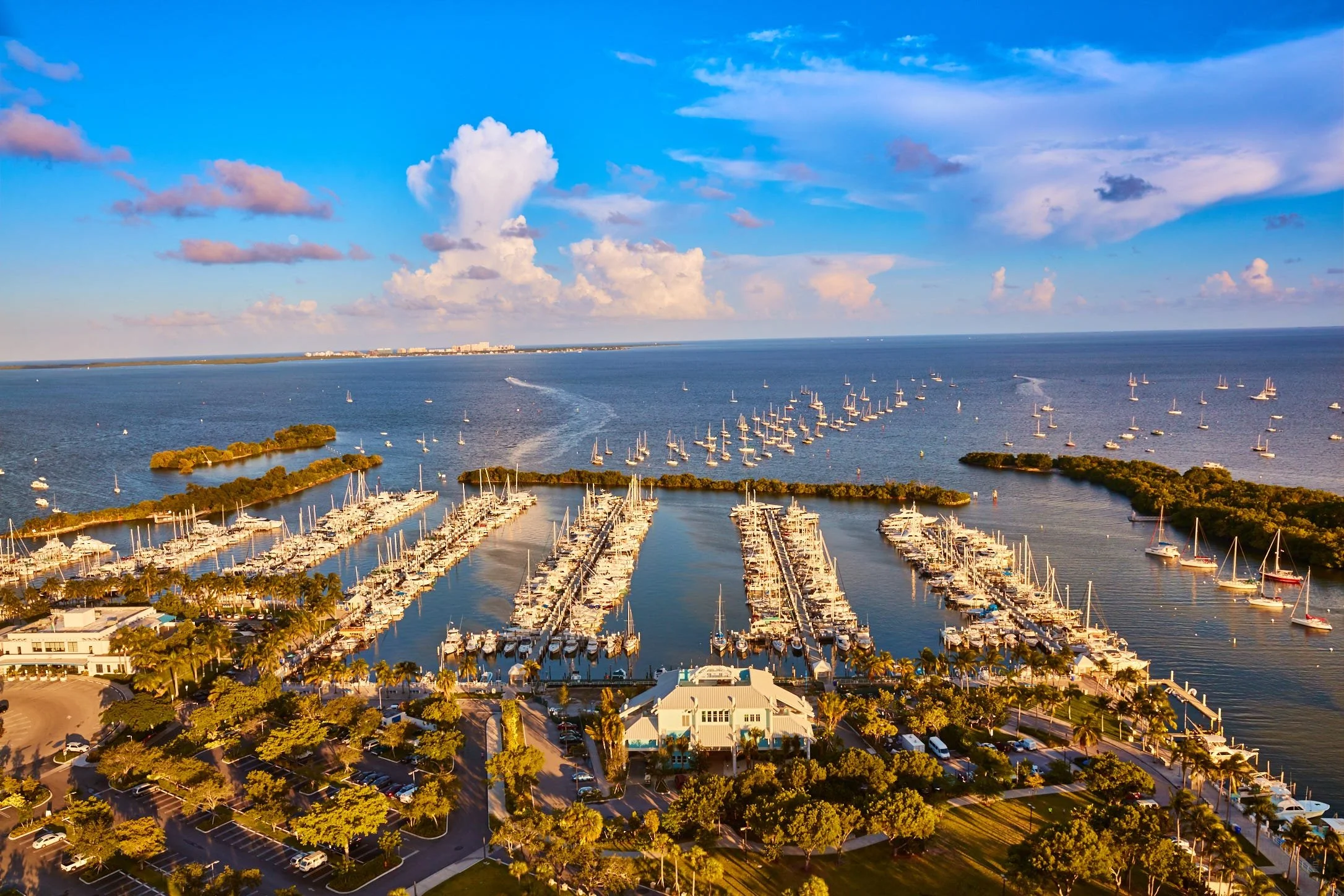
Dinner Key Marina as it looks today.
Then I obeyed while walking to each boat saying “So, they want to know if you live aboard because if you do, your rent will triple next month.” Naturally I came back with a sheet that said nobody lived aboard their boats.
While I was standing in The Boss’s office, discussing this finding, a helicopter landed on the oval next to the City Hall which is conveniently right there in Coconut Grove, like a quaint little keyhole for the whole damn city of Miami. Guys run out with suitcases and disappear under the old Quonset entries. It’s broad daylight but they act like rats. There are no markings on the heli. I start to figuratively scratch my chin.
Back to my point I argued with The Boss: Why do people living aboard bother you? Is it fair to raise their rent like that?
Why?
Pointless points.
Next day he has a bunch of placards that Nervous Spoon Woman has printed out and laminated: “No laundry allowed in the rigging, no barefoot on the dock, no dinghies allowed…”
No this, No that. Regulations. Forbidden, verboten, interdit! NO NO NO this and that. I was perplexed. And disturbed.
At night I climb down the seawall to my dinghy and row a half hour out to my newly acquired home at anchor, an old gutted Prowler built by Forrest E. Johnson, back in the 1930s prohibition era (beautiful flared bow and reverse-camber stern, with a planing hull to outrun the feds! Double planked honduran mahogany!). I lay at anchor with my kerosene lantern and munched on Cuban chocolate bars and sun tea I had made in a jar set on deck during the daytime. And sleep.
Next day row back to work. I had quite a love affair with sweets during this time in my life and it never receded. So at lunch time I’d jog up the Lums across from Peacock park and order a piece of key lime pie to keep me going. Quick and easy. There were two old Haitian men raking the grounds who always said hello, and I asked if they’d like me to bring them something back. They smiled, leaned on their rakes and said, “Big Iced Tea!”
So I did. They GRINNED and howled when I came running back and handed em over…they LAUGHED! I didn’t see what was so funny.
The next day as I went they called and waved and handed me a maroon beret. A gift.
Deep smiling, the real kind. I wore the beret even though it made my head feel hot. For them.
Showdown at the NOT OK Corral
This went on for several months. I was a capable assistant dockmaster as it turned out I could maneuver twin screw Hatterai gin palaces into slips on the spot as needed and hooked up a lot of people looking to buy boats with people who were looking to be selling boats, and also I was kind of just very happy to have all these wonderful cruising yachties afoot from all over the world and life was grand!
But The Boss kept ordering me to restrict the dockage for people, raising the rent, anybody who was cruising or came from afar, anybody who actually USED their boats was increasingly discouraged by rules and regulations that came out of no-place from doing so. It was like a depopulation of the marina. They introduced me to a word “transient” as if that were dirty. Most of the lively people said HUFF pah, and went out to anchor, and used their dinghies to motor or row ashore instead.
Meanwhile the guy in charge of Marinas and Stadiums, his name was Rodriguez I think? Ended up in the hospital with a heart thing. The Boss called after 5 p.m. and ordered me to go get him a gift and take it to him at the hospital. I went straight to the Mighty Oak bookstore, of course, my favorite hangout, and picked up an easy read called “The Blood Coast” thinking he might like that. Sort of an airport book, you know? A quick read? Easy read? Entertaining read? Local read?
Oy vey. I’m not really Jewish but that’s the best words to describe the look on the face of the manager of Marinas and Stadiums in his white sheets at the hospital when he opened it.
The Boss was really pissed off hearing about it from the Manager of Marinas and Stadiums. I said that I hadn’t reae book! I just thought it was cogent? I mean, it’s fiction, right?! He said, flowers—that’s what you should bring somebody. If that ever happens again. Duly Noted.
So suddenly, my friends in the anchorage are getting yellow stickers on their boats saying they will be towed away. Slapped on by parking lot police guys taking a little tour on the harbor launch. One of them has binoculars, they all have various badges and so on. 150 boats, people living their lives and mostly sailors, some derelicts (yes, technically my Prowler is a derelict but it’s also my home) and dinghies are getting confiscated and so forth.
I need to share with you that the majority are world cruisers on stopover, some small business owners, a bunch of firemen and schoolteachers. Families with kids. You know, bookstore clerks and people like me. Unclassified, I like to think. We are miscellaneous. But indispensable.
The guy from Marinas and Stadiums is patched up and back in his office next to the Dockmaster’s and City Hall, and boat people are distraught. We gather in the green loop of grass and Barbara Crittenden rises to the occasion. Barbara lives on the houseboat “Led Belly” in the anchorage with her man Greg who won the Olympics for hobie cat sailing back when. She and I seem to be the two people who everybody kind of wants to find a solution to this crisis, as mothers of children are crying and so on. We are the envoys of the newly forming Dinner Key Anchorage Association.
Barbara and I spend hours at LUMS scratching out talking points on the backs of placemats. We decide going to talk to the director of Marinas and Stadiums is probably a good move. We make an objective list of concessions like: Where we can park our dinghies without bothering anybody, and where we can pay to dump our trash and pay to use the showers, even?
Talk about wishful thinking. We thought the problem was practical. But when we go to our appointment, our great disappointment: He says “NO. You people cannot be allowed to exist here.” I was flabbergasted and said “What is your problem with us?” He tried, “You’re an eyesore” and Barbara snorted, “Tell that to all the tower people with their telescopes on us hahaha” and I said, “You can’t even see us from shore, we’re beyond the spoil islands!” But then…
…He said:
“Nobody is controlling you. You are not under our control.”
Okay, it didn’t help that the third person in our embarrassing ambassadorial mission was Captain Midnight (a reprobate named for his habit of staying up all night to talk on ham radio to his friends in China and play some game with them, sleeping during the day while his solar panels charge up and playing Bugs Bunny—louder and louder as the sun rises, deafening by noon).
But you know. You know. There’s people out here. PEOPLE who MATTER and who control themselves. Don’t NEED your control.
A thing happened. Right then. When Rodriguez (I think that was it) said, “You need to be controlled,” my heart leapt up to my throat. My brain froze in fire. My feet stomped out the door. Tears welled.
I fled and I marched straight over to the City Hall and to the counter in the basement where the real power lies.
A woman there looked at me curiously and said “Can I…help you?” I asked, “Can you? Please? Show me the original documents by which the City of Miami gained control of the seawall and the anchorage!” She provided blueprints and mimeo, the indigo faded kind originals. We made copies. We said thank you. She said, “My pleasure.”
And then we clearly discovered and could delineate that when PanAm airlines gave over the control of the waterfront to the City of Miami, there was a clause that said there would be public access for fishing, a fishing dock, and dinghies. A particularly useless stretch of the seawall on the north by Cap’n Dick’s: where the waves bounce and intersect in a continuous jangle of pyramidial chaos. This section was the limbo for us free spirits. Fishermen and dinghies.
So the rest is history. We fought hard, City Hall and all, going to every single meeting. I vaguely recall making a poster that quoted William Blake: “What was once only imagined has now come to pass” at the very thought that people living their own lives, a half hour row offshore, could be eradicated by these bureaucrats just because they don’t like seeing people with wet hemlines climb up the wall.
Barbara and I hustled to a big Uni Auditorium one morning to address the Department of Environmental Regulations, where a very handsome crowd awaited. I was a little surprised as the developers presented an impressive slide show of their fantastical mooring scheme involving rubber tires and ridiculous barricades that would never work in our weather.
Barbara chickened out momentarily, so I had to stand up at the podium with zero color slides or diagrams and talk about the blue heron who sat on my dinghy no matter where I tied up, and the way the fish came up to say good morning every day at dawn when I swabbed my decks, grasping at straws.
I looked into the crowd wondering who the heck these people were in the audience wearing crimson. As we left they stood to shake our hands and said “We are with Christo. Flamingo Project”. I looked down at the wet hems of my turquoise silk trousers and said, “Ok well…We are with…uh…Blue Heron Anchorage project” like it was some code for cults. They managed to get their approval to dress the islands with scarlet, and we got away with staying anchored for some years beyond. My heron continued to land on my dinghy no matter where I tied up.
Well, it’s been a long haul. We did succeed in our efforts through organizing and attendance and sheer stubborn perseverance, I saw that the anchorage association had gone on to even get a flag and a Facebook page, but it’s all gone now. The moment of our triumph was a letter from the Norfolk office of the U.S. Coast Guard, asserting that the city had no jurisdiction over federal bottom land a certain distance from the shore. Thanks to Attorney John Thomas for writing to them on our behalf.
Nowadays, I don’t imagine there is anywhere you can anchor and live independently, cooperatively, without a big payout. Not on the Eastern Seaboard, nor the West Coast of this Continental USA. I’m not entirely sure what we have lost. But I am sure we have lost.
Well. Like my friend from Bouffon used to say, sometimes “you gotta Fook the Ma!”
The author is a longtime professor of Psychology and Communications. She landed in Vermont in 1987 after a decade of cruising under sail. This is an excerpt from her forthcoming book tentatively entitled “Jenny: A Night Sea Journey.” Her Substack site is HERE