
The Right Stuff
Many of you will know SEAHORSE as the premiere sailboat racing publication in the world, covering the latest developments and cutting edge technology in the global race to win. However they also have a deep respect for the lineage from which today’s boats evolved. Over the next few months we will bring you a series of handpicked articles from their archives highlighting this history, and showing that deep satisfaction in sailing comes from understanding, just as much as winning! The generous people at SEAHORSE are offering readers of SWS a significant discounts of up to 30% on both digital and print editions of this seminal magazine. Click the banner below to check out the offer.

Many of those returning from the conflict of 1939-1945 were soon pursuing new activities where they could find some small element of the excitement (and dangers) of wartime service. So began modern – and for many years extraordinarily dangerous – motor racing, as did the idea to race small yachts for long distances, two-handed and later solo (in time electrifying offshore performance). A product of this movement was the Junior Offshore Group, which has been running offshore races ever since its launch in 1950. David Munge was among early enthusiasts
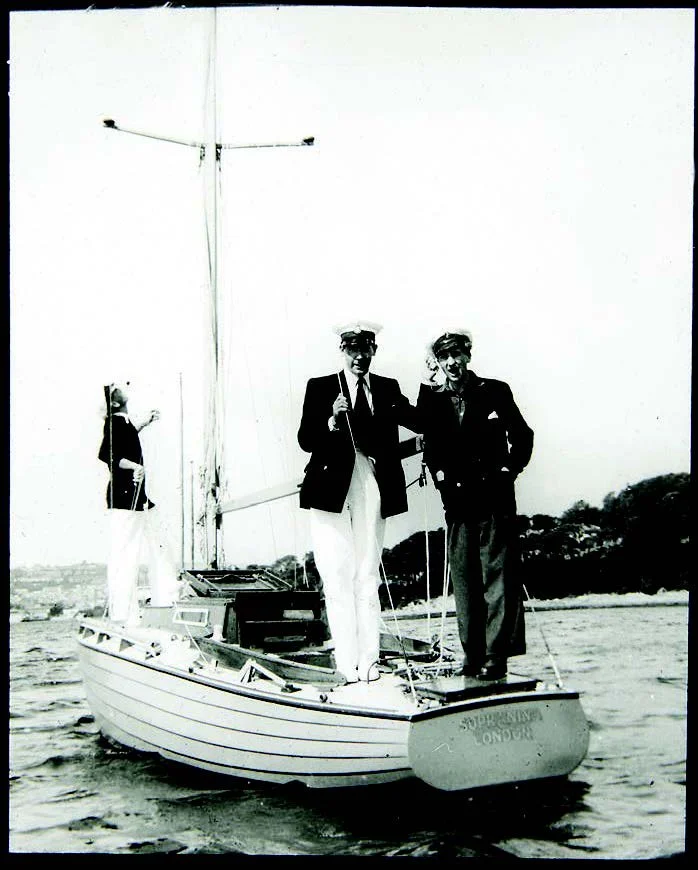
Patrick Ellam and Colin Mudie in 1951 on Sopranino shortly before the start of the pair’s two-up transatlantic trip to Cuba, which finally ended in New York 16 months later with 10,000 blue water miles under her keel. Encouraged by Capt John Illingworth, Sopranino was Ellam’s step-on from the sailing canoe he previously used for offshore adventures. (COLIN MUDIE ARCHIVE)
Sopranino and the Junior Offshore Group
As a few 'oldies' will remember, the use of yachts and pleasure boats was obviously very restricted during World War II. At the end of the war men who were used to a certain amount of physical deprivation were being squeezed into office jobs or other work that was restrictive, and those who had been active sailors before the war now needed to rethink how to spend their free weekends.
One such sailor was Patrick Ellam, who attended Stowe School and passed the exams to go to Oxford but chose instead to travel to France and Germany, where he became fluent in both languages. He enlisted at the outbreak of war in 1939, joined the Royal Artillery and was sent to France. Given his familiarity with both the countries and their language, it will be no surprise to learn that a couple of years later he was recruited into the Special Operations Executive (SOE). Unlike many in this most dangerous area of the conflict, Ellam survived the war; meanwhile, his wartime activities had given him unique experience, as well as an urgent hunger for further adventures… albeit of a less risky variety.
Ellam had soon joined his father's office equipment company but at the weekends he started sailing again. Up until 1946 small boats tended to be scaled-down versions of bigger yachts, and therefore had awfully bad performance and were rather dull. Uffa Fox had started sailing 10m2 canoes, which were single-seaters but Ellam, seeking adventure, realised that if you started with a dinghy design such as the 10m2 canoe you could build a slightly larger version, retain its speed and agility, and consequently sail far greater distances. He decided, therefore, on a doubleseater, and commissioned Kenneth Gibbs, naval architect and boatbuilder, to build a modified version with buoyancy tanks and storage for navigation equipment.
This slender new boat, Theta, was built initially without a plank, but instead of flying over quiet inshore waters Ellam used her largely for English Channel crossings; with various 'picked off the beach crews' he crossed the Channel at least nine times. Often he would leave England ahead of the forecast of a decent breeze, arrive in France, enjoy the atmosphere, wait until the thing had blown over, and then dash back to England on the back of the breeze.
Ellam had also formed a firm friendship with Capt John Illingworth, then Commodore of the RORC and already a major figure in the development of post-war yacht design. Illingworth was founder of the annual Sydney-Hobart Race, and he persuaded Ellam to stop sailing Theta and build a small, lightweight ocean racer.
By this time the firm of Laurent Giles of Lymington had built a reputation for innovative design, so Ellam commissioned them to design his next boat, Sopranino (named after the smallest known wind instrument). However, regardless of her more robust purpose, Ellam wanted Sopranino to retain dinghy-like properties so for her build he returned to Kenneth Gibbs' renowned small boatyard at Sunbury-on-Thames near London.
She was designed and built following Ellam's tried and tested philosophy. Just 20ft overall, wooden clinker built, again with a very narrow beam. The accommodation was barely enough for two, with a tiny chart table. She was rigged as a Bermudian sloop.
Sailed by a crew of two, she proved to be very fast; and in the opinion of her skipper also extremely safe and seaworthy. After all, 'risk' to men like Ellam was a different concept altogether from bouncing around the English Channel in a small boat – especially without being shot at.
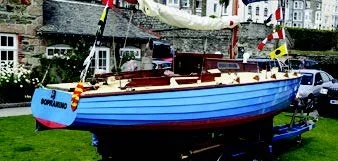
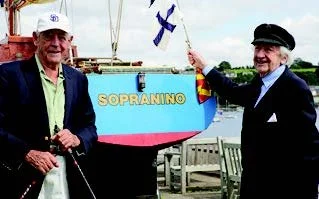
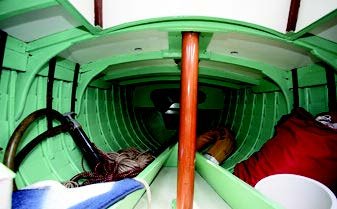
War service in the SOE had left Ellam with few fears about going to sea in small craft, nor did it leave him with a need for luxury (above) on his lightweight 20-foot ‘ocean racer’. Sopranino eventually fetched up in Rhode Island at the Newport Museum of Yachting where she was spotted some 15 years ago and shipped back to England by a syndicate of current JOG members, who relaunched her in sailing condition in 2010. Center: Patrick Ellam and Colin Mudie – this time pictured with Sopranino during the 60th Anniversary JOG celebrations in 2011.
At only 20ft, however, Sopranino was considered too small to compete in RORC races, 24ft being the minimum.
So in December 1950, led by John Illingworth, it was decided to form the Junior Offshore Group (JOG). Patrick Ellam was the first class captain, and Illingworth the first president. Early members included luminaries like Bruce Banks, Ian Proctor, Laurent Giles, Michael Henderson and Robert Clark, among others, and 'the Group' is still, of course, very active today.
The following year, 1951, was the first JOG season, with the longest race being from Cowes to Ostend. Sopranino (JOG sail number 1) was an instant success, winning many of the races in this inaugural season and in the increasingly competitive JOG seasons that followed.
The architect Colin Mudie, who had worked on Sopranino at Laurent Giles, so impressed Ellam that he persuaded Mudie to join him on an Atlantic crossing. They left Falmouth in September 1951, crossing via the Canaries and Barbados to meet Ernest Hemingway in Cuba, where Mudie had to leave and fly home.
In their cramped and tiny boat the pair carried Augas de Firgas fizzy water in aluminium hotwater bottles to shave with and wash in. They also had a stuffed elephant (called Hannibal) who had his own hammock. They had a compass, sextant, tables and an early Beme loop radio, which was useful for direction finding – although Colin remembers it more because it was used to suspend the hammock for the elephant (who sat with his trunk facing down, suspiciously close to the drinks cabinet!). There was self-steering – one using a load from the mainsheet with an elastic centrepiece to return the helm to neutral. But once in the trade winds they instead set twin spinnakers so both could sleep below. Colin later wrote: 'People say "weren't you brave" – no, we were out to enjoy ourselves.'
All these adventures, which can only have stemmed from Ellam's SOE experiences, are vividly described in his book, Sopranino, published by Rupert Hart-Davis in 1954. I can heartily recommend it: it is a good read, and I have cribbed much from the book, plus from obituaries in the JOG archives. It is also nice to know that Sopranino, after many further adventures, is now safe and well cared for at the Classic Boat Museum in Cowes, Isle of Wight.
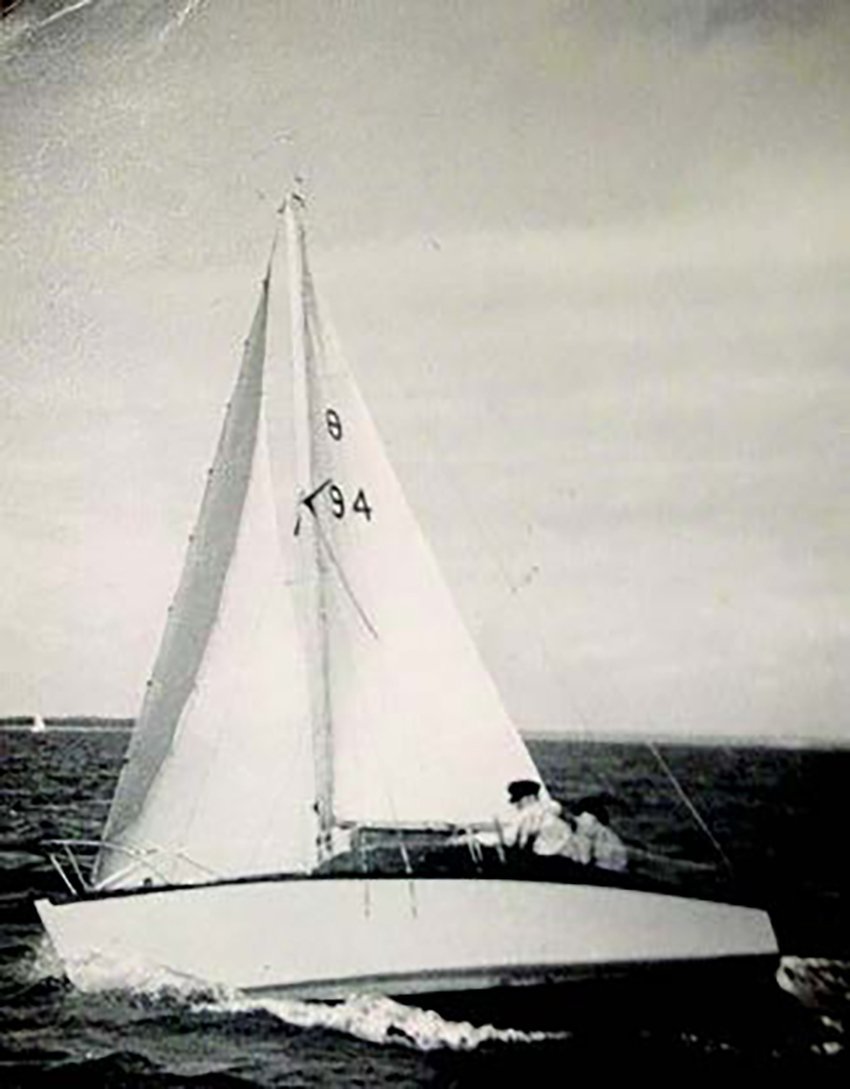
The author with Bob Price in 1960 on their 18ft plywood sloop, It’s all in the Mind, in their own JOG championship-winning year
Sopranino's voyaging was all about the Corinthian ideal – of amateurism, of sailing for sailing's sake and not for profit. Values that are perfectly reflected in the continuing popularity of the Junior Offshore Group today.
David Munge, Devon