
Kings Of The Hill– Part II
Many of you will know SEAHORSE as the premiere sailboat racing publication in the world, covering the latest developments and cutting edge technology in the global race to win. However they also have a deep respect for the lineage from which today’s boats evolved. Over the next few months we will bring you a series of handpicked articles from their archives highlighting this history, and showing that deep satisfaction in sailing comes from understanding, just as much as winning! The generous people at SEAHORSE are offering readers of SWS a significant discounts of up to 30% on both digital and print editions of this seminal magazine. Click the banner below to check out the offer.

Last week we brought you part one of this story
This week Julian Everitt continues our voyage through the 20th century in the company of New York design giants Rod and Olin Stephens, heading a little way north to Newport and the America’s Cup, and the setting for many of the two brothers’ greatest successes… and also some humbling public failures
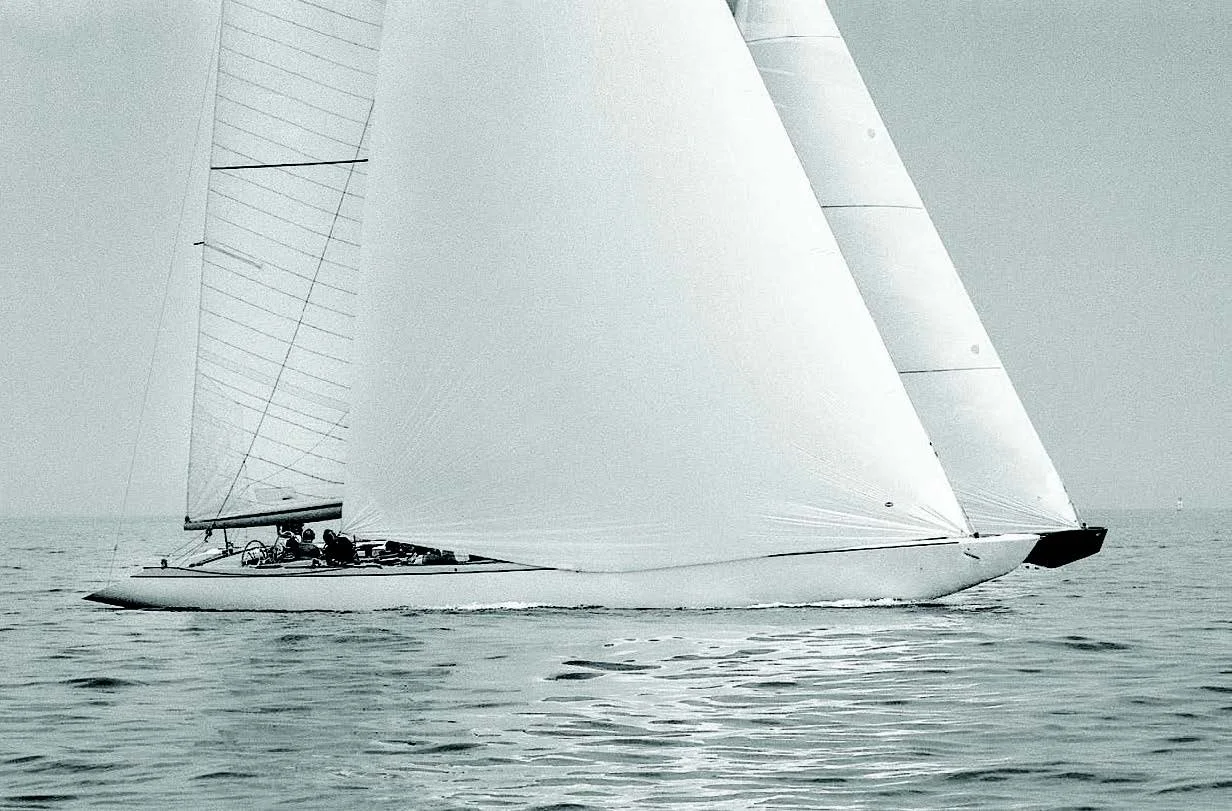
Intrepid was good but perhaps Olin Stephens’ follow-up Cup defender Courageous was even better? The first aluminium 12 Metre defended the Cup in 1974 then came back three years later, now in the colourful hands of Ted Turner, to win again. A further three years later she was still fast enough that, had she made it into the 1980 Match, plenty of 12 Metre aficionados believe that she could have seen off Alan Bond’s Challenger Australia – though less comprehensively than Dennis Conner’s first mighty ‘no excuse to lose’
If a single event loomed large in the Olin and Rod story it would be the America’s Cup. Such was the success of Sparkman & Stephens’ 6 Metre designs in the 1930s and, following Dorade’s Transatlantic and Fastnet race wins in 1931, it seemed only a matter of time before they would become involved in the America’s Cup. And the call did indeed come in 1936 from Harold S Vanderbilt – planning a second defence of the Cup in 1937 after an unexpectedly close shave in 1934 against Sopwith’s faster J Class challenger, Endeavour.
Looking for a design advantage Vanderbilt created what was probably the first ever America’s Cup design team by partnering the young Olin Stephens with the highly established naval architect Starling Burgess. Vanderbilt had called on the services of Burgess for two previous defences in 1930 and 1934, but after coming so close to losing the Cup in 1934 he was looking for a clear design advantage.
The fact that Burgess had a phenomenal reputation for drawing fast yachts – particularly in the Metre boat classes – did not allay Vanderbilt’s fear that a second Endeavour designed by Charles Nicholson might prove a faster vessel. In teaming Burgess with the young Olin, Vanderbilt was looking for the perfect mix of evolution and revolution.
But the way forward for this ‘dream’ team was not to join forces to produce the ‘perfect’ lines plan, but to allow each designer to come up with his own interpretation of the J Class Rule and to ‘test’ the resultant shapes against each other. This is the moment when the application of science and the art of yacht design came together by utilising models of the Burgess and Stephens creations in a series of controlled tank tests. Each designer produced two sets of lines, independently, from which four models were built. The model that proved to have the least resistance in the tank would be built but, by agreement, neither designer would reveal which shape was chosen.
As it turned out many years after the resultant J Class, called Ranger, successfully defended the Cup, and after Starling Burgess had passed away in 1947 Olin finally revealed which of the four models had been chosen. Popular belief had it that Ranger was primarily a Stephens design, but in fact the opposite turned out to be the case when Olin penned a letter to Vanderbilt, putting the record straight, revealing that one of the Burgess model lines was used for building Ranger.
In reality, of course, having picked the best lines, both architects worked away ferociously on the final design to produce what became known as the ultimate J Class. Another part of the design package Vanderbilt demanded was that both Rod and Olin would sail onboard, reinforcing the notion that yacht design wasn’t simply an academic exercise but required a practical skill base and a ‘knowledge’ of the sea.
With a world war intervening, America’s Cup competition didn’t reconvene until 1958, when the defender and challenger agreed to race the Cup in the much smaller 12 Metre class. The New York Yacht Club, still successfully defending the Cup since 1851, also encouraged more than one potential defender to be built.
Sparkman & Stephens got the nod to draw one of them in the form of Columbia.
She raced the selection trials of 1958 against designs from Raymond Hunt and Phillip Rhodes – the same Phillip Rhodes who had given Olin his first significant job in yacht design back in the late 1920s.
Columbia won the trials and went on to easily beat the tragi-comedic British challenger Sceptre. Columbia’s closer rival that summer was the 12 Metre Vim, drawn by Olin for Harold Vanderbilt around the time of the Ranger defence in 1937.
S&S were not given the opportunity to produce a new design for the 1962 defence and the Americans came uncomfortably close to losing the Cup against Australia’s lovely Alan Payne design Gretel, but for the 1964 defence Olin and his Madison Avenue team were back with Constellation, which first defeated the Bill Luders-designed American Eagle in the defence trials and then defeated a marginally better British challenger, Sovereign, in the Cup Match.
For the 1967 defence Olin penned arguably one of his greatest designs, Intrepid. Like Dorade, in 1931, Intrepid was a revolutionary interpretation of a particular set of measurement rules. The gradual shift of art into science, a development that Olin was a great proponent of, was expressed perfectly with Intrepid. First you have the inspiration to try something different – albeit based on logic and experience – then you apply the science of the day (tank testing in this era) to develop the ‘art’.
I well remember a philosophical conversation with Olin, some 10 years later, when he was in the thick of trying to keep International Offshore Rule development under control, where he theorised about the possibility of a perfect mathematical solution to the art of hull shape. He mused about sets of numbers one day creating shapes with the least resistance – a portent indeed of today’s computer-generated fluid dynamics, but tempered by the knowledge that the sea and the wind give highly variable and multiple playing fields, further complicated by measurement rules and other random factors that demand such unscientific applications like intuition as the starting point to a fast hull shape. It was honing this intuition that had fascinated Olin from his early boyhood days… the relationship between lines and speed.
But science was to take something of a step backwards when Olin wanted to further develop the Intrepid concept with 1970 defence candidate Valiant. The science of the tank became the unwilling partner of a mistake in intuitive, logical thinking.
Olin had proved with Intrepid that the bustle was a huge success. Metre boat rules demand a certain displacement within a given length and beam; this displacement requirement produces deep and full midship sections. The bustle, helping to give more displacement aft, allowed for some of the volume to be taken out of the midship sections producing a potentially faster shape.
Olin also wanted to make the keel substantially smaller to reduce wetted surface, but this further reduced volume and hence displacement which had to be put back somewhere. The bustle, which effectively extended the underwater lines aft, also took care of the lost volume from the smaller keel.
With the Intrepid design this redistribution of displacement was fairly subtle, but devastatingly effective. It seemed logical with Valiant to take this concept of volume redistribution and small keel to even greater lengths – an evolution supported by the scientific data from tank testing. But it was flawed science, and the on-the-water performance of Valiant failed to live up to the performance prediction of the smallscale model in the towing tank.
The Valiant experience was a salutary lesson for Olin Stephens. You could take a successful idea and push it too far. The brand new Valiant had not only been beaten by Intrepid, albeit now modified by another designer, but had also failed to show the expected performance gains from the 1958 Weatherly design which was being used as a trial horse.
Valiant’s humbling lack of performance caused a complete re-evaluation of the science of tank testing. The relatively small models used at the time were blamed for the poor data that persuaded Olin to push the lines of Valiant to the extreme. Olin’s follow-up, 12 Metre Courageous for the 1974 defence, was a much more conservative evolution of the original Intrepid design and went on to defend the Cup easily that year and again in 1977.
For the 1980 defence Olin, once again, was responsible for Dennis Conner’s successful defender Freedom, which arguably took the original Intrepid concept to its ultimate successful conclusion. But the next stage of the 12 Metre story would feature another design revolution in the form of the wingkeeled, Ben Lexcen-designed Australia II and it would not include S&S. Olin’s retirement from competitive yacht design rather neatly coincided with this new era.
The esoteric art of Metre boat design had fascinated Olin in his formative years, after meeting Clinton Crane back in the late 1920s, as the rule really did, very successfully, ‘measure’ incremental changes in hull shape, helping to define that all-important relationship between lines and speed, the study that had hooked Olin at the start.
But while the Metre boats, culminating in Freedom, were a huge part of the S&S story, more significant was the oceanracing lineage from Dorade, through the Maxi Bolero, the centreboard Finisterre, the 34ft Hestia, the 1965 Admiral’s Cupper Firebrand (one of Olin’s favourite designs), the 1966/67 One Tonners Roundabout, Sunmaid and Rainbow, the five Prospect of Whitbys, the 61ft Running Tide, through to the final golden boat of Olin’s era, the 51ft Pinta which placed second individual boat in the 1975 Admiral’s Cup.
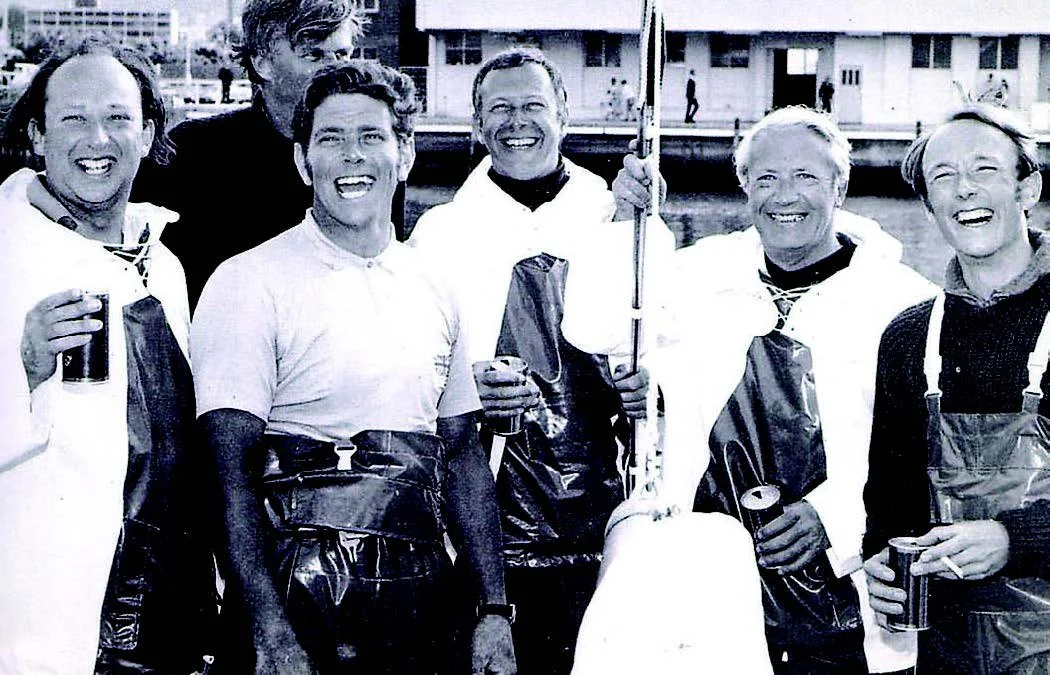
Among S&S’s most loyal clients was British PM Edward Heath (second right) – seen with his crew having just won the 1969 Sydney Hobart Race on the little S&S 34 Morning Cloud. Seahorse founder and Heath’s regular navigator Anthony Churchill is far left
Indeed, in many ways the 1975 Admiral’s Cup denoted the pinnacle of the success story of Olin and Rod: an amazing 24 out of the 57 yachts competing in Cowes that year were designed by Sparkman & Stephens.
Finally, one of the company’s last offshore racing designs, the 46ft Challenge, overseen by Olin and drawn by Bill Langan, appropriately bookended Olin’s remarkable career at the top of ocean racing yacht design by winning the 1983 Sydney Hobart Race with Olin now in semi-retirement at the age of 75.
Throughout the S&S design era both Olin and Rod always struck a careful balance between speed and seaworthiness.
Olin with his fast, but not extreme, hull shapes and Rod with deck layouts that not only looked after the handling requirements of the crew, but kept the ocean where it belonged. This innate conservatism influenced much of what Sparkman & Stephens produced, but as with many things it wasn’t the whole story.
In the pursuit of race results and ever faster boats in the ongoing dance between speed and rating, S&S more or less invented the offshore ‘racing machine’ with boats like the 48ft Bay Bea in 1968 and her close sistership Aura in 1970. These boats were stripped out below with just pipe cots and everything taken out of the ends. On deck, coamings and any protection for the crew disappeared in the interests of windage and weight. They began a trend that would ultimately lead to the end of the dual-purpose ocean racer and open the door to ever lighter dedicated raceboats.
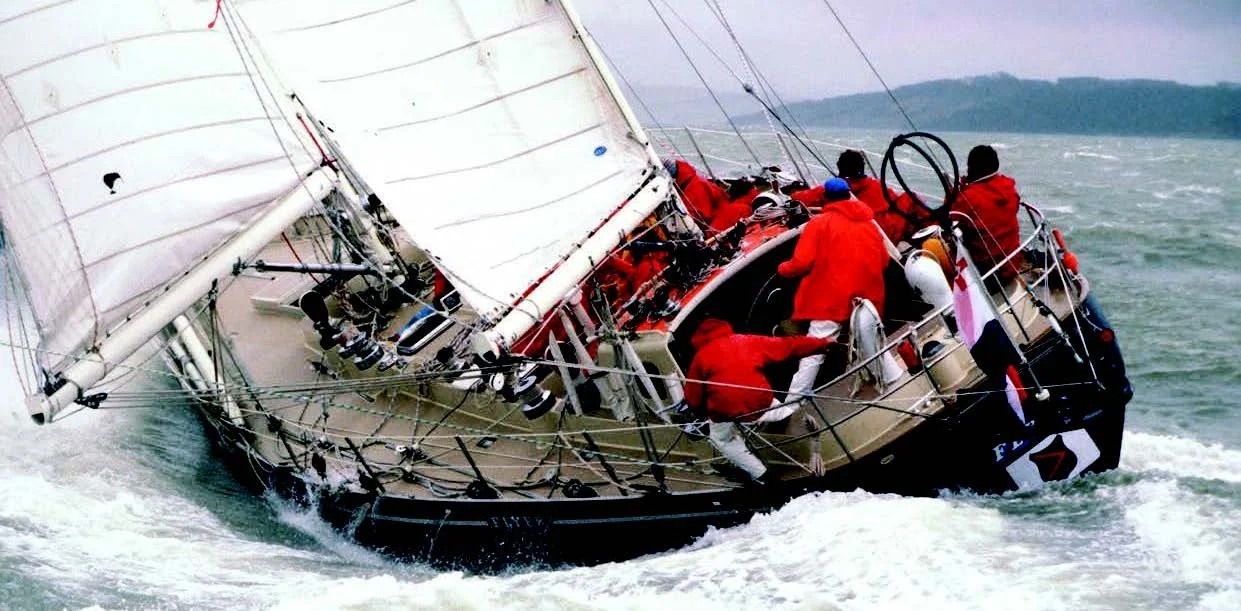
Sparkman & Stephens’ IOR dominance peaked in the mid-1970s with the appearance of names like Doug Peterson, Holland, Frers and Dubois, who would take over with surprising speed. In 1975 of 57 yachts racing the Admiral’s Cup 24 were designed by the New York firm. Two years later (above) Cornelis van Rietschoten’s Maxi Flyer would deliver S&S their second – and final – Whitbread Race title after their earlier win with the S&S-designed Swan 65 Sayula. But as younger designers found their feet – and some clients – things then moved fast and come the 1977 Admiral’s Cup you would be hard pressed to find a single S&S design in the top half of the results
Series-produced designs, throughout the Sparkman & Stephens history, were another key part of the success story and helped to enable a staggering number of yachts to be afloat throughout the world bearing the moniker of S&S. Indeed, Olin’s first ever design to be built, drawn in 1928, was a production boat, albeit in timber, as were many of his designs before World War II and later throughout the 1950s.
But when glassfibre became the material of choice for series boatbuilding, then the numbers really took off. If you wanted the best guarantee of commercial success in production yacht building then having a design by S&S was the way to go. An astonishing 242 different S&S designs were series produced; one of the most successful numerically was the Tartan range built in the USA with a total of 22 different designs from 1961 starting with the Tartan 27, of which 712 examples were built over the following 19 years. In all the total number of Tartan branded yachts built was 3,620 – every one of them by S&S.
But this production boat success story was to be eclipsed only a handful of years later when amateur yachtsman Pekka Koskenkylä elected to make what turned out to be an epoch-defining decision: to start a new yacht-building facility in Finland.
He consulted his friends at the local yacht club on how to get started. The advice they gave was to employ a top-class designer, preferably one with an international reputation. The name Sparkman & Stephens came to the minds of the assembled members. S&S were enjoying a very productive period conquering the European market, notably with the huge success of the Dutch 34-footer Hestia, the 43ft Admiral’s Cupper and 1963 Fastnet winner Clarion of Wight and the follow-up Admiral’s Cupper Firebrand, a member of the UK team in 1965 and again in 1967.
Duly armed with this new-found knowledge, Pekka set about contacting this faraway design company S&S on the other side of the Atlantic Ocean. But he was about to discover that ordering a new production design from an international yacht design company involved a lot more than simply asking for and paying for a new design…
Such was the reputation and success of S&S during this mid-1960s period that the design team at 79 Madison Avenue, by now counting some 20 employees, was flat out drawing new yachts, motorboats, motor sailors, keelboats and dinghies. They could afford to be a little choosy about who they designed for and which clients would best take their reputation forward.
A transatlantic phonecall from Pekka to the offices of S&S managed to illicit the possibility of a brief meeting with Rod Stephens, who was soon to be on a longplanned northern European tour of boatyards building S&S yachts. In a hectic schedule involving yards in Sweden, Norway, Germany and Finland, Rod could schedule a brief meeting at Helsinki Airport around 6am to meet the embryonic would-be yacht builder.
Naturally enough Pekka took the meeting opportunity. But with no established boatyard Rod was reluctant to sell a brand new design, or indeed a production version of their latest One Ton designs, Clarionet and Roundabout, to Mr Koskenkylä.
Instead Rod offered what was to become the Swan 36, an earlier design that had been originally commissioned in GRP by the Italian yacht builder Benello and sold as the Gaia class (19 of these were built).
But the basic hull concept of the 36 could trace its roots all the way back to the 1959 Hestia design – one of the foremost boats to put the S&S name at the forefront in Europe. Some 50 derivatives, mainly in timber, were constructed from this basic design, but where the Gaia and Swan designs differed was in adopting a separated rudder configuration – albeit a lot less radical than the One Tonners like Roundabout and Clarionet.
Though few clients would ever hear the term, designs like the Swan 36 were referred to by Olin and Rod as ‘bottom drawer designs’. Meaning they were development copies of existing designs rather than brand new ones and so were offered for a lower design fee, usually around 40 per cent less than a new one-off.
After a slightly shaky start – the first ever Swan 36 was delivered to her UK agents, Hurrell & Johnson and promptly almost sank at her launching, her builders having not appreciated the need for sealant in the through-hull fittings – the Swan 36 went on to great success with 86 built. But perhaps Rod’s caution about inexperienced yacht builders was proved justified by the near-miss at the launching.
A landmark racing statistic was achieved by the 36 design in 1968, when her UK agents scored seven out of seven wins in Cowes Week. The 36 was to be the start of a truly great partnership between yacht builder and designer.
For the 1969 season Olin created a real gem of a design as a successor to the Swan 36, in the form of the Swan 43. This was no ‘bottom drawer’ design, but a state-ofthe- art Admiral’s Cup contender designed as a series production boat to take on the very best one-offs. It proved to be a winning formula when Casse Tete was selected for the UK Admiral’s Cup team alongside the new S&S-designed 42ft Prospect of Whitby and the 50ft Camper & Nicholson-designed Phantom.
Pekka Koskenkylä’s dream to become a major player in the international yacht building world, with the Swan brand, was born with more than a little help from Olin and Rod Stephens. Together they went on to produce 22 different designs, coincidentally an identical number to that of the Tartan range, and launch a total of 588 boats ranging from the 36 to the Maxi-sized Swan 76 that was derived from the all-conquering S&S Maxi Kialoa III.
Arguably the most famous Swan of them all was the 65. After the Mexican owned Swan 65 Sayula II won the first Whitbread Round the World Race in 1973, this triumph for the Swan brand, only six years after the company launched its first boat, put the Nautor name at the top of the production boat league. Helped, of course, in no small part by the skill of the Sparkman & Stephens design office.
The speed and seaworthiness of the 65 led directly to a one-off 65ft development of the design called Flyer, designed and built specifically for the Round the World racecourse. Flyer went on to replicate Sayula’s success by winning the following 1977 edition of the race.
All 22 of the S&S Swans were commercially successful, helping to create a brand of unprecedented quality and a similar testament to the designers. It didn’t hurt either that these early Swan designs like the 36, 43 and 65 were so successful on the inter - national racing circuit. The follow-up to the 36 design, the Swan 37, shared the same hull shape as the 1971 One Ton Cup winner Stormy Petrel; it all helped Nautor to sell 59 of their new model in only three years.
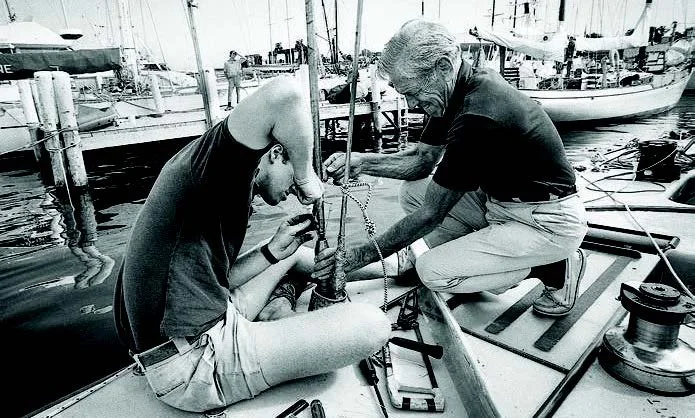
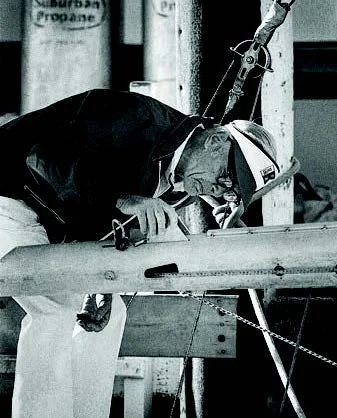
Once they hit the superyacht scene even the best designers can drift away from their roots in small racing boats with the risk, as the late Ed Dubois inimitably put it, of ‘popping out of the top’ in terms of design inspiration and currency. The Stephens brothers never made that mistake, staying informed and close to their racing roots until well past the retirement age of regular human beings. Here (left) legendary rigger and perfectionist Rod Stephens helps repair a chafe guard on Dennis Conner’s 1980 Cup-winner Freedom as Olin (right) gives Freedom’s boom the once over. Reagan’s motto ‘trust but verify’ could have been written for these two great men
The differing but complementary roles that Olin and Rod had within S&S were another of their great strengths. Olin would muse over hull shapes, keels, rig proportions and their relationships with the appropriate rating systems while Rod oversaw the development of structures, deck layouts, rigging schedules and detailing.
It’s fair to say Rod was the practical man, who became famous for his snag lists on newly built boats. This what might be termed after-sales service was performed mainly by Rod and proved to be a valuable contributor to the S&S legacy. Tough though Rod could be with his inspections, the massive snag lists that he produced on yard visits, and again after only a day of sailing a newly launched boat, were invaluable to both builders and owners.
I had the pleasure of accompanying Rod on a couple of these almost ceremonial inspections. One on the first Swan 55, the third design in the 22-boat Nautor range, the other on the first sea trials for the Abeking and Rasmussen-built Maxi Baccarat.
The bigger the boat the longer the snag list and after a day’s sailing a ‘detailed’ list of issues emerged. Nevertheless Rod had missed something spotted by the owner, shipping magnate George Coumantaros… no baize in the cutlery drawer! Owners and designers often have different priorities.
But Rod could be almost contemptuous of builders who needed detail drawings. If they didn’t know how to build something as simple as a companionway hatch, for example, then they weren’t good enough to build the entire boat. This approach by S&S to detailing led to the famous concept of so-called ‘type plans’, issued by the design office but allowing the builders to interpret the drawings and apply the appropriate dimensions as they saw them.
Common sense was the prevailing ethic and the Stephens brothers used this to shield them from rogue builders who can prove ruinous to a designer’s reputation.
Getting to spend time with either Olin or Rod was always a privilege. Whether it be watching them work in their respective roles within S&S, interviewing them about their latest creations or just having philosophical chats about the esoteric art of yacht design and the relative position of science and maths within the framework of drawing a fast, seaworthy and balanced yacht.
I remember one such occasion aboard a spectator craft off Newport Rhode Island watching a selection trial for the USA One Ton Cup team. One of Olin’s latest, Columbine, was strutting her stuff and I asked him how her design, with a relatively beamy and sawn-off back end, had come about, compared with his longer and finer ended Lightnin’ design. His reply surprised me, but then again perhaps not given Olin’s love of art and the application of aesthetics in the creation of a ‘complete’ design.
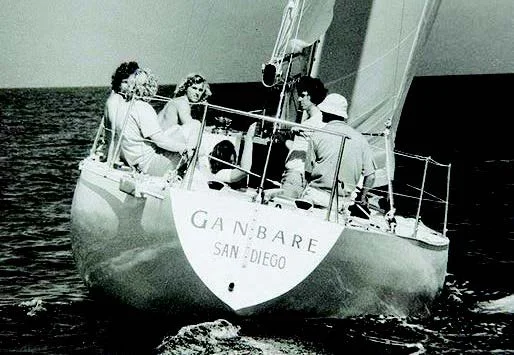
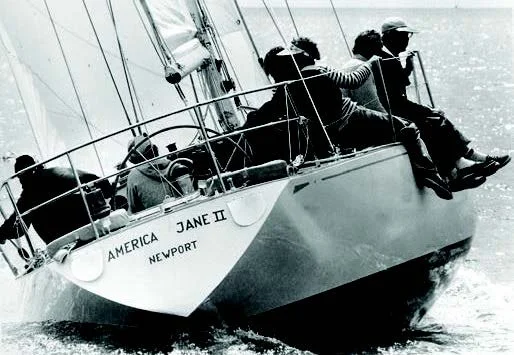
Doug Peterson’s 1973 breakthrough One Tonner Ganbare spelt the beginning of the end for Sparkman & Stephens in the IOR fleets, along with other older-established firms who now looked more to production boats and large custom cruisers – many successfully. But the S&S One Tonner America Jane II was a better reply to Peterson’s ideas than was thought at the time. With a return to Olin’s favoured U-shaped bow sections America Jane was a big step forward for S&S, but sadly a poor sailing performance at that year’s One Ton Cup disguised the boat’s potential until it was too late, by which time S&S had reverted to their previous (slower) shapes
He began with a question. ‘Do you remember last year we did a little Quarter Tonner called the Northstar 500?’ I did, so Olin continued. ‘The design wasn’t so effective as an IOR Quarter Tonner, but I did like the look and proportions of it, so for Columbine we used as the starting point of the design the Northstar 500 profile.
‘The design was, of course, suitably scaled in regard to displacement, beam, draft and rig size, but the aesthetic value was maintained.’ An interesting triumph of art over science from a man who had spent his entire career – already some 40 years – pondering the potential dichotomy of science versus art in raceboat design.
Back in 1957 Olin had observed that sailboat design had started as 90 per cent art and 10 per cent science and that some day he hoped it would be the other way around. His assessment by the late 1950s was that the ratio was now closer to 50/50.
Other somewhat philosophical conversations I had with Olin tended to take place during the annual IOR conferences, around November time in London, which dealt with all sorts of administrative elements of international offshore racing but were fundamentally of interest to yacht designers and owners as the key time when rule tweaks were applied by the International Technical Committee of the IOR.
As one of the three original yacht designers involved in writing the IOR towards the end of the 1960s, Olin kept a keen eye on how the rule was being exploited and if amendments were required to curb extreme developments.
When, with the input of Ricus van de Stadt and Dick Carter, Olin began framing the IOR as a single offshore rule to replace the somewhat divergent RORC and CCA systems, he could hardly have imagined the way the rule would encourage development and with it the explosion of interest in highly competitive offshore racing.
By the start of the 1970s Olin’s scientific approach to fast boat design was being challenged powerfully by a new breed of lightweight dinghy-like designs that paid scant attention to the concept of evolutionary progress. Indeed, fuelled by a rapid increase in boat-for-boat level racing, started by the reintroduction of the One Ton Cup in the mid-1960s under the RORC rating system, a whole new breed of home-grown level raters of different sizes were appearing.
Leading the development charge, which was to prove decisive in the future direction of offshore racing, were the Quarter Tonners. Small, and therefore relatively inexpensive, they encouraged a whole new breed of young yacht designers to have a go at creating a winning offshore racer. Many, like Olin, had not completed formal naval architecture school but were super keen to see if their imagination could outwit the science of Olin’s International Offshore Rule. This is indeed what transpired but Olin, as pragmatic as ever, took the development of the ‘offshore-dinghy’ very much in his stride. He certainly never allowed the S&S design practice to follow this route, but rather acknowledged incremental changes to hull shape and displacement in line with the evolutionary design philosophy that had served the firm so well.
But revolutionary or at the very least quantum leaps also played their part in the hugely successful S&S history, starting with Dorade and perhaps finding ultimate expression with the 12 Metre Intrepid in 1967. Dorade, in her time, was as different from the prevailing norm of ocean racer as were the early Quarter Tonners to the S&S style in the early 1970s. Intrepid marked the biggest change in Metre boat design since the rule came into being in 1906.
Olin’s lack of formal training, both in the finer points of naval architecture and indeed drawing itself, proved a major factor in shaping his career, his brother Rod’s career and indeed the direction of travel for the S&S organisation. Not being tied down to the finer points of completing a set of drawings no doubt helped free the mind of the young Olin after he quit the Massachusetts Institute of Technology after a single term of learning about naval architecture.
The relevance of big ship design had been lost on the creative spirit of a mind obsessed only with the lines of yachts and how the nuances of hull shape might impact on both speed and seaworthiness.
A brief illness caused Olin to leave MIT, but it also gave him the space to decide not to return. Dorade was very much a product of an unrestrained mind. I know that young yacht designers constantly look around at what works and what the conventions of the time are, but then, if you are like Olin, you think, I’m not going to follow those routes. I’m going to take a chance and do my own thing.
A success like Dorade, of course, demands a successor; then the revolutionary zeal has to be channelled into careful evolution. It is a story often repeated in the development of successful yacht designers.
Some 40 years after Dorade’s debut a certain Doug Peterson created the One Tonner Ganbare which, being slim and small compared to the established designs of the time, more or less mirrored the revolutionary impact of Dorade itself. Peterson’s success (followed by others) in 1973 against S&S designs and those of yet another untrained American naval architect, Dick Carter, actually marked the beginning of the end of Olin’s unprecedented run of success at the very top of offshore racing yacht design.
Dorade was followed by the similar sized Stormy Weather, but the more radical departures enshrined in S&S design #07 were moderated in this follow-up design. Stormy Weather proved, however, to be every bit as competitive as Dorade, repeating the double of winning the transatlantic race and the Fastnet in 1935.
Life for the Stephens brothers was both busy and rewarding. In 1934 eight sailboat designs, plus Stormy Weather, were under construction on the eastern seaboard of the USA including a 70ft yawl – a precursor to what would become, after World War II, the Maxi class – a class in which S&S would have considerable success, culminating in the 79ft ketch Kialoa III which, among numerous race wins, held the Sydney to Hobart line honours record for 21 years from 1975 until 1996.
Many owners of S&S designs remain faithful, but few more so than Thomas J Watson who had five custom S&S designs dating from 1952 Design #991 through to Design #2203, spanning some 25 years.
Four were sailboats called Palawan, while the fifth was a 38ft powerboat.
Palawan number three – a 58-footer – was extensively tank tested and went on to be highly successful on the racing circuit from 1966 to 1971. She was one of Olin’s first separate rudder designs and with her relatively narrow beam, optimised directly from the tank test data, she could be said to be a true forerunner of the breakthrough 12 Metre Intrepid.
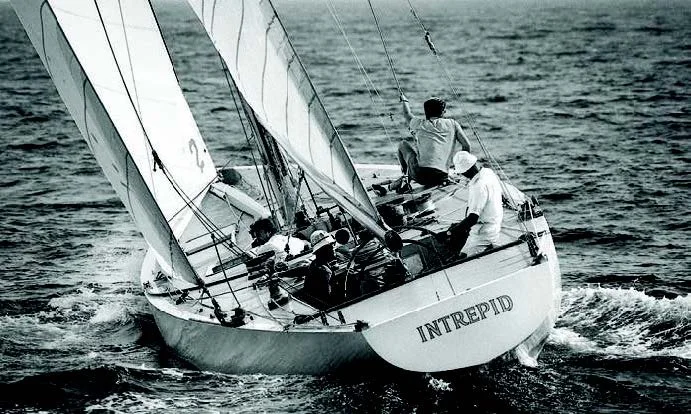
A really fast boat never stops being fast: 13 years after that first Cup win the original separate keel-and-rudder 12 Metre Intrepid – now with most crewing functions below deck – proved a very ‘uncomfortable’ trial-horse for the 1980 French Cup challengers
Arthur Slater had a total of six designs, starting with a 42ft centreboard yawl called Saboo and then a string of 40ft+ racing boats aimed specifically at Admiral’s Cup competition called Prospect of Whitby.
Three of these became members of British teams, in 1967, ’69 and ’71.
Edward Heath, UK politician and Prime Minister, had four Morning Clouds from S&S. Two of them made the Admiral’s Cup team in 1971 and 1973. The first Morning Cloud – a production S&S 34 – won the Sydney Hobart Race overall in 1969. Italian Marina Spaccarelli commissioned five One Tonners from S&S under the names Kerkyra and Paxos.
All in all Olin had a total of 14 clients who returned for multiple one-off designs as well as a host of production boatbuilders who returned time and time again for a touch of the S&S magic. And throughout all of this truly prolific output of yacht and motorboat designs there remains the distinctive S&S ‘look’.
For an architect who rarely got to draw many of his creations, Olin maintained an iron grip on the concepts, the aesthetics and the principles of every design that ever left the office. He gave a great deal of freedom to the many architects who worked for him, including such greats as German Frers and indeed Frers Sn before him, but you always got a Sparkman & Stephens design and perhaps, more to the point, an Olin Stephens design.
It is a subject of popular myth about who actually drew any particular boat, especially if it proved successful, but the fact remains the client is essentially buying an Olin design no matter who drew it.
Perhaps this is best illustrated by the three S&S designs that made up the 1971 British Admiral’s Cup team. Morning Cloud II, regarded as supremely important to the reputation of the firm, was designed by a veritable army of talent within the office overseen by Olin, while the slightly smaller Cervantes IV was quietly drawn by a single architect – Francis Kinney.
I remember a year or so later being in the Madison Avenue office when the story went round that the group responsible for Morning Cloud were secretly relieved that the mega man-hours poured into her concept had resulted in sufficient success as to survive comparison with the success of Cervantes… created by a single architect.
But a big design firm like S&S can still have quality control issues. And if ever a profession is subject to the adage that you are only as good as your last work it is racing yacht design.
To stay at the very pinnacle of this mixture of art, science and business for over 45 years, albeit it with five years lost to the global war of the 1940s, is some achievement.
But this success relies on more than results alone. Intel is a key ingredient and results don’t always tell the whole story.
Olin and Rod both raced a lot themselves and could see first-hand how their designs were performing, but in the boom times of the 1970s and the pace of change brought about by the IOR they increasingly farmed out this performance intelligence gathering.
Having been comprehensively outperformed by new kid on the bloc, Doug Peterson, at the 1973 One Ton Cup, S&S changed design direction for their 1974 One Ton design America Jane II. Most notably there was a return to the more U-shaped bow sections that Olin had always favoured on his Metre boat designs and used also to particularly good effect on the second Morning Cloud. That and flatter midship sections.
America Jane proved to be quick on the water – equal to a whole new generation of Doug Peterson and Ron Holland designs – but bad luck on the racecourse pushed her down the results that year.
Much worse, intel from the S&S man onboard America Jane did not reflect the true potential of the design and as a direct result of this poor performance analysis a promising new design direction was not followed up on subsequent S&S designs…
Ironically as a plethora of new young designers developed the new IOR-inspired flatter, lighter shapes, Olin had been persuaded that the AJ shape was not the way to go. The firm’s 1975 generation of raceboats returned to deeper veed, heavier shapes and, with the exception of the 51ft Pinta, were not as successful at the Admiral’s Cup level.
Perhaps in this final analysis of the Olin and Rod design era, inspiration and intuition had lost out to science… In his own words, as Olin put it: ‘My own direction in yacht design has been from intuition towards computation. Neither one is altogether complete. You really need a combination of the two. You need a feel and an eye for both.’
Finally, the word ‘balance’ aptly sums up the Stephens brothers’ story. Again in his own words: ‘In all phases of my work I was conscious of the need for balance and I did my best to find balance in both the long and the short view. Broadly I think I can say that I applied the principles of balance in design, in business and in the pleasures I enjoyed.’