
Kings Of The Hill– Part I
Many of you will know SEAHORSE as the premiere sailboat racing publication in the world, covering the latest developments and cutting edge technology in the global race to win. However they also have a deep respect for the lineage from which today’s boats evolved. Over the next few months we will bring you a series of handpicked articles from their archives highlighting this history, and showing that deep satisfaction in sailing comes from understanding, just as much as winning! The generous people at SEAHORSE are offering readers of SWS a significant discounts of up to 30% on both digital and print editions of this seminal magazine. Click the banner below to check out the offer.

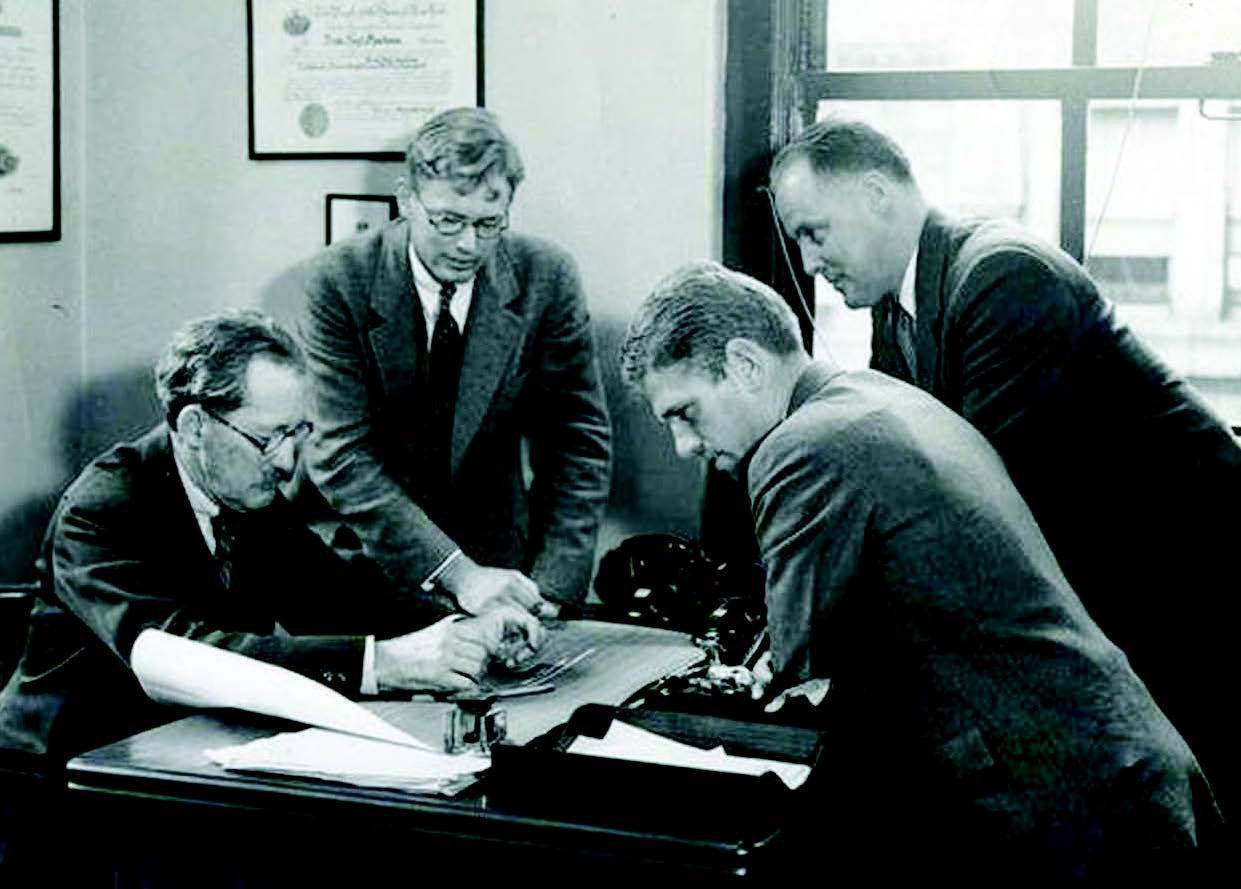
A tsunami of talent is gathered together in the Madison Avenue offices of Sparkman & Stephens in 1933. Seen left to right – Starling Burgess, Olin Stephens, Rod Stephens and Drake Sparkman.
For more years than any other designer in history, and with more international influence, during the course of the 20th century the New York office of Sparkman & Stephens was the dominant force in yacht design. Today a much changed company of the same name still ticks along nicely in various fields of naval architecture but with a much lower profile. Nevertheless, pioneering Sparkman & Stephens offshore designs like Dorade and Stormy Weather, as well as America’s Cup winning 12 Metres such as Intrepid and Courageous, continue to draw the eye wherever they appear at modern regattas... and they are still winning too. Designer and former Seahorse editor Julian Everitt takes an extended look at one of the most famous yachting brands of them all
In a sunny New York City on 20 October 1970 a team of FBI agents scoured the buildings on both sides of Manhattan’s Madison Avenue between 28th and 29th Streets. Questioning shopkeepers, janitors and secretaries, they gave special attention to the offices overlooking no79, a dull 16-storey building on the east side. From early the next morning uniformed police banned all parking on the block and kept pedestrians on the move. They vetted every entrant to no79.
Shortly before 11am three cars drew up and disgorged 10 men into the building.
Two stayed in the lobby; the rest took an elevator to the 12th floor where two more took up station on the landing. The remainder marched through a door numbered 1209 bearing the legend Sparkman and Stephens Inc Naval Architects.
Finally two of the men, one a tanned, plumpish, slightly hunched figure with silver hair and a pointed nose, often caricatured by political cartoonists, were shown into a corner office and the door shut behind them. The then leader of Her Britannic Majesty’s Opposition, the Right Honourable Edward Heath, Member of Parliament, was interrupting diplomatic business at the United Nations to discuss the highly confidential matter of the design of his new ocean racing yacht – the second Morning Cloud. She would become the boat in which, as Prime Minister, he was to captain a team of three British yachts, all of which were designed, as it happens, by Sparkman & Stephens, to victory against 17 other international three-boat teams in the 1971 Admiral’s Cup.
But the waiting phalanx of bodyguards, a mix of FBI and Scotland Yard men, had no interest in the yacht or any design secrets it held; this was the beginning of a dangerous era of political abductions. The detectives were nervous when an S&S secretary got up to take a telephone message in to Mr Heath; several leaped up and restrained her before one of them eventually took the message in himself. An hour or so after the grand entrance, Heath, with his personal assistant, reemerged and swept out, beaming at the secretaries and at the bent heads of the disinterested draughtsmen. The occasion is vaguely remembered by some of the designers working in the office at the time, if only because it held a touch of irony. At the same time that morning, in the office’s small conference room, sat another client of Sparkman & Stephens, a client whose followers, far more impassioned than those of Mr Heath, numbered tens of millions, and whose personal fortune could also be counted in tens of millions of dollars, and who therefore might reasonably have been regarded as a far greater kidnapping risk. Yet the Aga Khan, there to consider the specifications for his radical new turbine-driven 90ft, 60kt three-million dollar (sic) motor yacht, was accompanied solely by his private secretary. For more than 50 years and even after his retirement in 1982 Olin Stephens presided over a design office, for the most part housed in 79 Madison Avenue, that opened its doors to a procession of princes and premiers, of the world’s famed and wealthy, all bent on acquiring a fragment of the genius of the two brothers Olin and Roderick Stephens. Since the early 1930s these sons of a Bronx, New York coal merchant had dominated the fickle, imprecise science-cum-art of designing sailing boats.
Their fame began in storybook style in 1931… and not long after they had both flunked out of college.
They entered a 52ft sailboat in a race across the Atlantic, a yacht of then radical lines that Olin himself had designed. He skippered the boat, named Dorade, and Rod, who had supervised its construction, sailed as first mate. Their father, Roderick Snr, who had thrown economic caution to the winds to finance his boys’ project, went along as a general hand in the all-amateur crew of seven. Most of their competitors were larger and crewed at least in part by professionals – which was the norm back then for serious big boat racing.
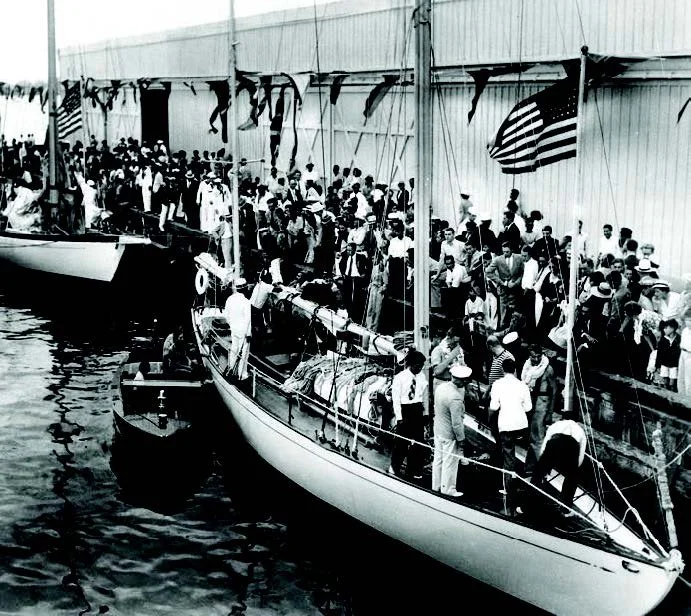
The new firm had burst onto the scene with Dorade (left) which in her first seasons twice won the Fastnet Race, won the Transatlantic Race at a canter and in 1936 the Transpac Race. Remarkably, in 2013 she would win the Transpac for a second time, nearly 80 years later. Here she is being greeted at the US Navy dock in Honolulu after her ’36 Transpac victory.
Dorade won the 3,000-odd mile trans - atlantic race by an astonishing margin, finishing two days ahead of the next competitor in the 10-boat fleet. In a way that was later to become almost a norm of embryonic young talent maturing into superstar yacht designers, Olin’s career really took off after Dorade’s win. His seventh design, Dorade set a new benchmark that redefined how an ocean racing yacht could perform and indeed what it should look like.
When the family returned to the United States after the finish of the race they enjoyed a triumphant ticker-tape reception along Broadway. Adventurous and successful yacht racing was a public interest sport in those days, made all the more special by the young age of the Stephens brothers and by the fact that this was their first foray into offshore racing yacht design. The only other time such a welcome was offered to members of the sailing community was when, 56 years later, Dennis Conner returned the America’s Cup to USA shores after his successful Fremantle challenge in 1987.
The Dorade design was indeed a new generation of ocean racing yacht. Up to this point designs deemed safe to traverse the oceans were heavy and beamy with an emphasis on what were thought to be seaworthy design features. Dorade blew a hole in this theory with her much leaner, Metre-boat style lines. Essentially what was then regarded as an inshore, sheltered water style racing design rather than one capable of transoceanic passages.
This was much in the manner of the designs of EG Van de Stadt, some 20 years later, that began the development of socalled light-displacement offshore racing yachts, and later still the designs of others, most notably Bruce Farr, that brought about the acceptance as seaworthy of the style of 40ft plus ‘big-dinghy’ ocean racers.
In 1931 Dorade won both the Transatlantic and Fastnet races. She won the Fastnet again in 1933. Later she won her class in two Bermuda Races and a Transpacific race from San Francisco to Hawaii. Six decades later she received a cosmetic overhaul in 1997 and then a full structural restoration by Buzzards Bay Yacht Services in 2007. In recent years she’s been an active participant in classics regattas on both sides of the Atlantic. Dorade also sailed again in the Bermuda Race and won the Pacific Cup overall in 2013.
To help put the Dorade design into context in 1931, she was as significant in setting a new trend in offshore boat design as Myth of Malham was in 1947, as Zeevalk in 1951, as Roundabout in 1966, as Ganbare in 1973, as the Imoca 60 style is for trans-ocean racing today.
I got to know Olin well in the autumn of 1971, a year after I had witnessed the ‘birth’ of Morning Cloud II, spending some more time in his company and in the company of, what appeared to me, a very large number of naval architects, engineers and draughtsmen, producing a staggering number of sailboat and motorboat designs out of the central New York office.
It was fascinating to be a spectator during the peak of a magic run of success for Sparkman & Stephens designs. They were drawing so many boats, of so many different sizes and concepts… it was extraordinary.
It was at this frenetic time in the S&S story that Olin offered me a position as a trainee designer.
Perhaps, remembering his own lack of academic achievements, which had not held him back when he started his career as a draughtsmen for yacht designer Philip Rhodes, he was willing to give me an opportunity to flourish in the S&S offices despite my own lack of formal training in naval architecture. Strangely enough, when Olin was first seeking his ‘correct’ path into yacht design, he turned down a stint at Glasgow University, at the time regarded as one of the best places in the world to learn naval architecture; I ended up doing the same thing some 40 years later.
Nevertheless, I turned down Olin’s offer to work at S&S in New York – not because I wouldn’t have learnt an almost unimaginable amount about yacht design, but because I had already just ‘launched’ my own career as a designer. In fact, it was Olin himself who helped me make the decision to decline his flattering offer, by reminding me of his own experiences and how the big breaks often depended on taking the less conventional approaches.
Our paths had in fact crossed some two years earlier when, as a budding designer and yachting journalist, I was in Breskens with Frans Maas while Olin was conducting sail trials on the second Prospect of Whitby for owner Arthur Slater.
Over the years it was generally Rod who undertook the sailing trials of new designs – his builder snag lists being famous or infamous, if you were the builder, but a key part of the S&S success story as it helped to ensure that new builds were presented at their best to their new owners.
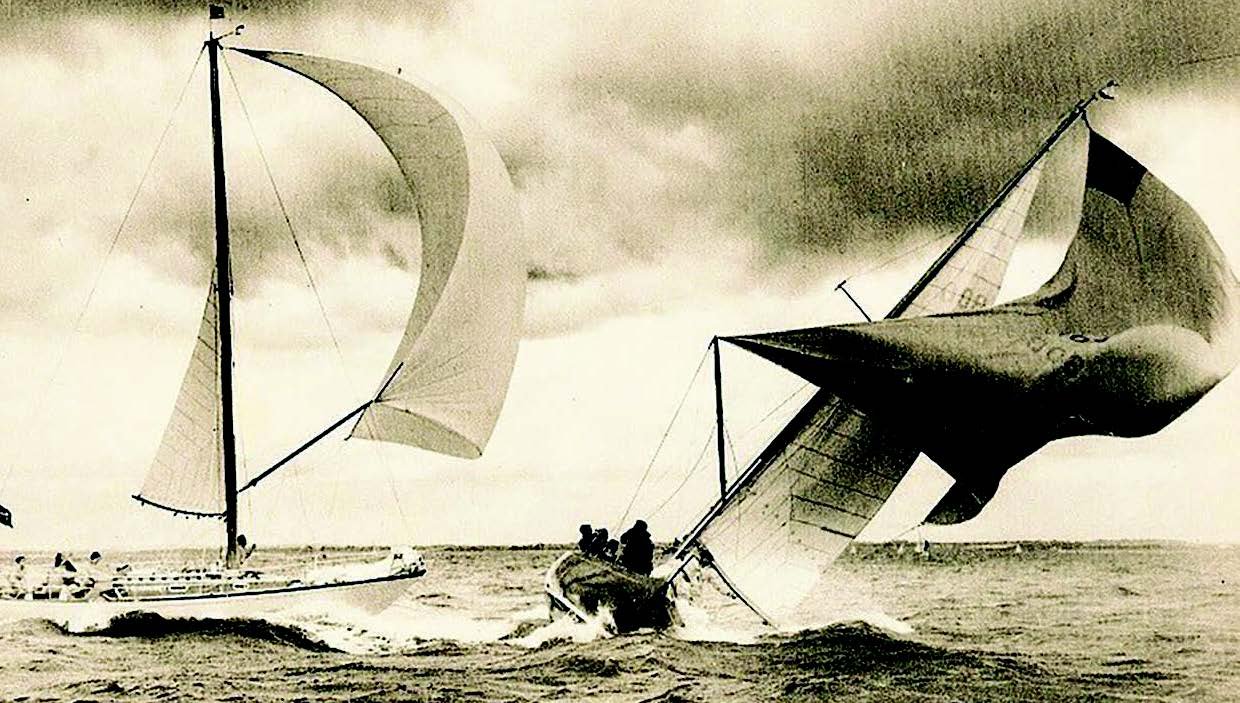
The ‘terrible twins’ Clarionet (left) and Roundabout were both commissioned to fit the RORC’s new One Ton Rule. After taking some earlier tentative steps into the genre the two near-identical 1965 designs marked Sparkman & Stephens’ first real commitment to the concept of a fin keel plus a skeg-mounted rudder. The two boats were fast but they could also be tricky to control, especially when pressed hard downwind, and scenes like this were far from uncommon. Olin Stephens was sufficiently encouraged, however, to use the same separate keel and rudder configuration with his new 12 Metre Intrepid in 1967… the rest, as they say, is the stuff of legends.
On this occasion, however, Olin had a particular interest in the new 1969 Prospect and how it would perform.
Sparkman & Stephens, at the top of their game in the 1960s, had found themselves challenged by a new young American designer, Dick Carter, who, like Olin, had little formal training in naval architecture.
Having won the Fastnet Race in 1965 with his first ever offshore design, Carter cemented his reputation by winning the One Ton Cup in 1966 with the steel-built Tina, built by Frans Maas. Olin Stephens was intrigued by the use of steel construction in a racing yacht built to the RORC rule and realised that Carter was exploiting rating gains from the material under this particular rating system. The 42ft Prospect of Whitby was designed to take advantage of this rating anomaly, but she was something of a departure for Olin in terms of ballast-to-displacement ratios.
The first day of the trials was windy – perhaps more windy than is welcome for a first sail – but in any event Olin returned after a couple of hours ashen faced. The new Prospect had none of the upwind power associated with past S&S designs.
In these empirical days of yacht design, so-called trimming ballast was an everyday norm for optimisation, but Prospect was in need of a little more than trimming ballast… Over two days Prospect gained 6,000lb of displacement with added lead internal ballast. What began as a fairly typical medium-freeboard S&S design now became a low-freeboard flying machine with all of the added weight significantly reducing the freeboard.
But this was another classic example of Olin’s pragmatic approach to the art of creating a fast sailboat to a particular set of rules. Prospect went on to be hugely successful on the racecourse, placing second overall in the 33-boat, 11-nation Admiral’s Cup fleet of 1969. The sanguine experiences of launch day were now long forgotten, though they had been somewhat reminiscent of Olin’s pragmatic approach to his very first ocean racing design, Dorade, which had floated 3in deep when first launched. (The answer to that particular problem wasn’t extra ballast, but simply to repaint the boot top 3in higher!) Another example of pragmatism or perhaps expedience was Cherokee, Olin’s second 6 Metre design, in 1929. Soon after her launch she was measured and found to be overweight, so much so as to fall outside the 6 Metre rule. Possible solutions were to marginally reduce sail area or ballast; but Olin’s solution was to order 18in of hull length cut off the back. This produced the desired reduction in weight without compromising the performance.
The name Olin has often given rise to romantic speculation that he and his brother came from seafaring Norse or Viking stock. In fact, the Stephens family emigrated from England in the 17th century, settling in the Guilford area of Connecticut.
As far as is known, no forebears of the brothers, except their father, had any interest whatsoever in the sea or in boats.
Olin’s interest in boats began at the tender age of five when he and his four-year-old brother became excited spectators in motor - boat racing held on Lake George, where the family would spend summer vacations.
Olin rapidly became an avid sketcher of motorboats, inspired by the racers on the lake. Indeed the family’s first serious boat was a 30ft motorboat which further cemented the boys’ interest in what was to become, only a few years later, a lifelong dedication to the creation of the finest boats, sailing and power, in the world.
The brothers’ introduction to wind rather than powerboats was anything but plain sailing. Yet the difficult performance characteristics of the 14ft centreboard dinghy Corker, which their father bought primarily as a convenient way to get to the local shops, proved an inspiration to Olin and Rod to improve; and through this they became addicted to the technicalities of sailing and the esoteric art of boat tuning.
In fact, all through their teens it almost seemed as if father Roderick was determined to buy boats that didn’t sail well, as if to put the boys off sailing. A succession of boats, Corker, Token, Trad, Sou’wester and Scrapper, ranging in size from 14ft to 45ft, were all enthusiastically championed by Olin and Rod to their father, only to be soon rejected by them due to poor performance.
In reality Roderick Stephens Snr was in fact, albeit inadvertently, slowly fostering a belief in both Olin and Rod that they could not only improve an existing boat, but dare to dream of designing altogether better yachts from scratch.
Early on, when they were still boys, Olin and Rod competed with one another to design and build models to outdo each other. Rod was generally more meticulous and enjoyed the process of the build. Olin simply wanted to get his ideas on the water as quickly as possible. Generally Rod’s design ideas proved to be faster!
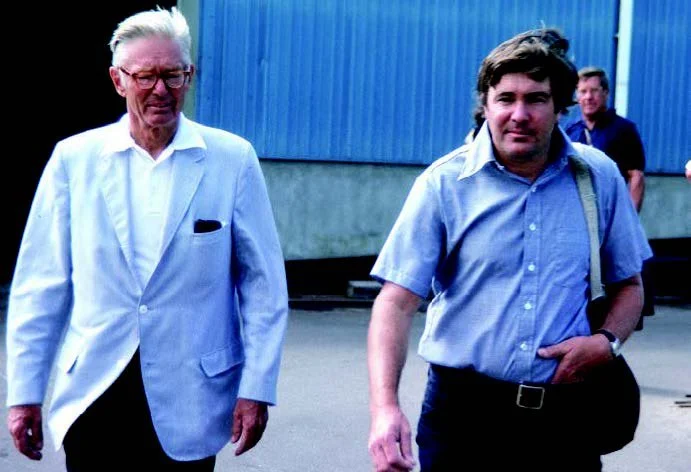
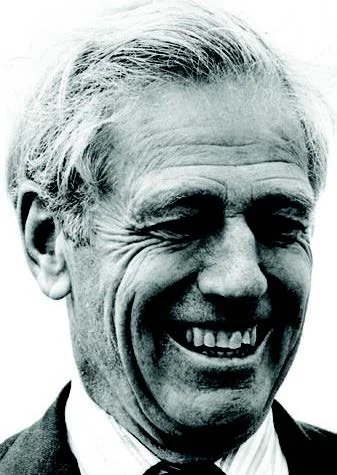
Geniuses all. Olin Stephens walks down to the dock in Newport during the 1974 Cup Match with the great Ben Lexcen. Stephens’ Courageous, skippered by Ted Hood, would see off Lexcen’s first challenger, Southern Cross, 4-0, after which Alan Bond’s upstart Australians slowly got faster before taking the Cup off the USA in 1983 racing Lexcen’s brilliant Australia II. During the 1974 defence trials Courageous had a tough battle with Olin Stephens’ 1967 and 1970 Cup winner Intrepid, which had by now been put back to her original S&S lines after being ‘improved’ by Britton Chance in 1970 (which had made her slower). The 1974 Cup saw some significant new names join the Cup family; Dennis Conner started the summer as Ted Turner’s tactician on the dog-slow Mariner, before first taking over the helm then moving over to join Courageous as tactician. Three years later Ted Turner himself would return, this time having bought Courageous, then seeing off all the new 1977 designs to successfully defend the Cup. Alongside them (right) master project manager, rigger and a fine bluewater racer Rod Stephens is seen at builder Camper and Nicholsons in Gosport, UK, at the 1975 launch of Edward Heath’s latest Admiral’s Cupper, Morning Cloud IV, the first built in aluminium and the last to an S&S design
It was a fortuitous meeting at the Larchmont Yacht Club, after returning from another slow and wet sail on Scrapper, when Rod announced: ‘I wouldn’t go on a boat now if you paid me’, after a certain Sherman Hoyt, then considered the best helmsman in America, had offered Olin and Rod a sail on his two new 6 Metres.
Fortunately for sailing, the Stephens boys eventually relented, the experience opening their eyes to what a true performance sailboat should feel like after their formative years of sailing clunkers. They also met the yacht’s designer, Clinton Crane, who proved to be hugely influential in Olin’s progression to become a successful 6 Metre designer. Crane was not only a mentor and tutor to the 19-year-old Olin, but with the British-American Cup races for 6 Metres coming up in 1930, Crane, suitably impressed by Olin’s first 6 Metre design, Thalia, encouraged four other owners to take a chance on the teenager; while Crane, a prestigiously successful yacht designer, contented himself with designing only for his friends, leaving the field more open for the young talent.
Sherman Hoyt was the source of another element of synchronicity in the young Olin’s journey to become, arguably the world’s most successful yacht designer, when he helped him get his first drawing job with Henry J Gielow – a leading firm of naval architects specialising in large motor yachts.
But despite his intense interest in all things boat, Olin’s practical knowledge of draughtsmanship was still almost nil. His enthusiasm lay only in creating the lines and sailplans (a characteristic he shared with the late Doug Peterson, whose IOR One Tonner Ganbare would have a similarly electric effect on racing yacht design decades later). Actually, Olin Stephens had never considered the conventions of drawing a construction plan and at J Gielow he was largely condemned to reducing existing drawings of motor yachts to illustrations suitable for advertising purposes.
But, as it happened, Olin’s workplace was in the same building as Yachting Magazine… On an almost daily basis Olin pestered the assistant editor to publish drawings of his racing boat ideas. It paid off. In a bid to spice up interest in American designers, who were lagging behind their European rivals in the elevated world of 6 Metre design, Yachting Magazine published Olin’s Six Metre drawings.
For the 19-year-old Olin it was a blue chip piece of public relations that had an almost instant effect, and soon he had switched jobs to work with yacht designer Phil Rhodes as a hull draughtsman. But as Olin himself later admitted, Rhodes had to accept a degree of inexperience and a very mediocre drawing talent!
But the mechanics of putting a yacht on paper mattered little to Olin compared to the ideas and shapes in his head that he craved to put into a real boat.
Most designers or indeed yacht design firms such as Sparkman & Stephens only get to count their total number of designs in the hundreds, while for S&S, as they are known the world over, it is in the thousands.
By the time of Olin’s extended retirement in the early 1980s he had overseen the drawing of more than 2,200 yachts and motor boats. The Second World War was a significant break in the business of designing pleasure boats, but Sparkman & Stephens continued designing boats suitable for war, including the hull of the well-known Ford GPA amphibious Jeep; more famously the company also drew the DUKW (colloquially known as Duck) which became a mainstay of the American army as an amphibious troop transport.
Designed primarily by Rod Stephens Jnr, in conjunction with General Motors, the Duck proved to be extraordinarily seaworthy for an amphibious vehicle, being able to safely – if slowly – cross the English Channel in fairly rough conditions. Such was the successes of Rod’s design, drawn in 1942, that he was awarded the US Medal of Freedom – the highest award possible for a civilian.
Such is the scale of the body of work that Olin and Rod presided over it’s not easy to single out a so-called golden era.
When I first started putting this piece together for Seahorse I tended to think, perhaps naturally, of the era I grew up with, that the mid-1960s through to the late 70s was their prime time. Yet it turns out that in the prestigious world of design Sparkman & Stephens ruled with remarkable success during four distinct eras.
Although Sparkman & Stephens was formerly constituted as a design and brokerage partnership in November 1929 Olin’s first design was built in 1928 yet carries the official title of S&S design number 01. Called the Manhasset Bay One Design, it was a useful start for the young Olin, as several of these 21ft onedesigns were built and this commercial success quickly led to more commissions.
Indeed five more, including S&S’s first 6 Metre, Thalia, before, in 1929, Olin drew the lines of S&S design number 07… which was to be christened Dorade.
The relationship created by the partnership between Drake Sparkman, a successful yacht broker only 10 years older, with Olin and Rod Stephens created a dynamic that worked well from the start. Drake had an established client base and if he couldn’t find an existing boat to satisfy his customers he would then ask the brothers Stephens to commission a brand new design to their requirements. But it was to be Dorade, design seven, that would catapult the young brothers, Olin and Rod, under the partnership title of S&S, to international recognition.
Dorade’s successes sparked an extraordinary run of designs. Ocean racers, Metre boats, one-designs, cruising yachts, daysailers, motorboats and several designs that successfully entered production. Most notable of the latter was the Lightning which was drawn in 1938. At 19ft long, this centreboard dinghy would become their most successful production design with over 15,500 built. Also in 1938 came the larger 35ft Week-Ender class. Thirtynine of these timber-built yachts were produced in only two years.
This was all part of a run of no fewer than 316 design projects completed before America entered the Second World War in 1941, bringing to an end the first S&S era.
However, hugely successful production runs of S&S designs were to become a mainstay of the commercial success of the business throughout Olin’s life. Then, as we have seen, the subsequent period of WWII was no less successful in terms of recognition with the acclaimed DUKW taking centrestage.
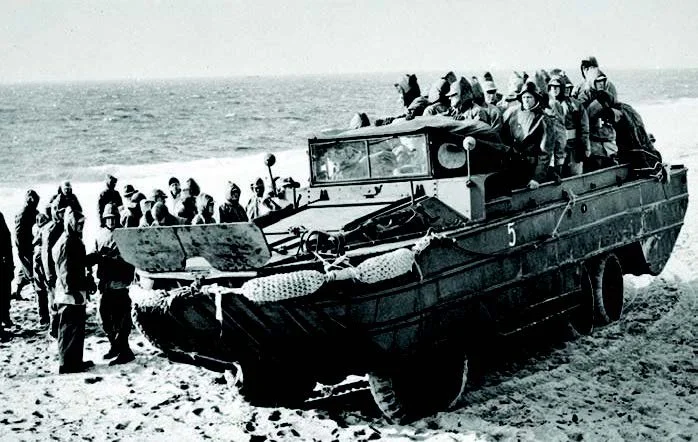
Beauty as functionality… Arguably the most important S&S design of them all was the innovative and incredibly successful World War II DUKW amphibious transport vehicle.
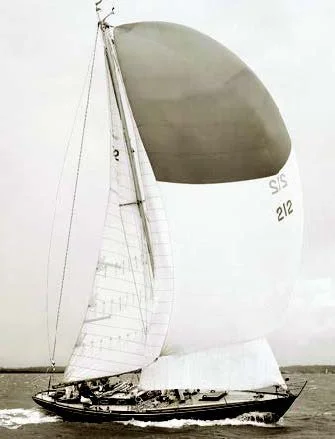
At the other end of the output was Dennis Miller’s beautiful, in the conventional sense, 42-foot Admiral’s Cupper Firebrand, part of the winning British team in the 1965 unofficial ‘world championship of offshore racing’
With the ending of hostilities the third Stephens era began in 1945 with the Pilot 33 – a simple small cruising design. But interest in racing yachts soon exploded, particularly during what were to become boom times for the USA, fuelled by a post war optimism throughout North America.
Sparkman & Stephens were now centre - stage in what was to become their most prolific design era with over 1,300 boats drawn between 1945 and 1966.
This was also the era when S&S made real and longlasting inroads into the European sailing scene and other parts of the globe outside the USA. In 1965 Olin created what was to prove to be one of his favourite designs of all – the 42ft Firebrand for British yachtsman Dennis Miller. Drawn to be a flat-out racing boat for Admiral’s Cup competition, Firebrand became a member of both the 1965 and 1967 British teams (perhaps symbolically, Firebrand was later purchased and campaigned by designer Ed Dubois).
The fourth S&S era, from 1966 until Olin’s retirement, might be deemed the separate-rudder period. Successful racing boat designers have to be adventurous, be prepared to push their ideas out and take chances and Olin was no exception, but he was also cautious about what he considered to be the key areas of design. From the outset of the business in 1928 design mantra number one was that windward performance was the key to winning. Olin and Rod learned this lesson when, as kids, they spent inordinate hours seemingly tacking back and forth always over the same piece of water in the succession of boats bought by their father, Rod Snr, to introduce them (or not) to the joys of sailing!
It was this desire to maintain upwind superiority that kept Olin away from developing the separate keel and rudder configurations that by the mid-1960s were proving so successful on the designs of Dutchman EG van de Stadt. It was only when fellow American designer Dick Carter won the Fastnet with his first design Rabbit in 1965, also using a separate keel-rudder configuration, that a whole new era of S&S separate rudder designs was unleashed.
In point of fact Olin had already launched a first cautious exploration of the separate rudder concept in the same year as Rabbit with the 36ft Gaia class. Nineteen Gaias were built in Italy, but the design was destined to become more famous when it was used as the first ever Swan model – the Swan 36.
Nevertheless, this first-generation S&S separate rudder design could almost be described as a full-keeler with a skeg-hung rudder tacked on. It proved, however, to be very fast but, more importantly, it opened the door for Olin to go seriously radical one year later with his 1966 One Ton Cup designs.
Spearheaded in the UK by near-sisterships Roundabout and Clarionet, the fourth era of the Stephens brothers began with a bang. So fast were these two 36- footers that they were dubbed ‘The Terrible Twins’ by their fellow competitors. In both offshore and inshore races they regularly finished with, or ahead of larger, supposedly faster, Admiral’s Cup racers. Olin, at a stroke, had more or less halved the keel area compared to his earlier designs, and in the process not only reduced wetted surface, but actually improved that all important upwind performance. The Terrible Twins also embodied the first hints of the bustle, invented by Olin to help redistribute fore and aft displacement for potentially higher top-end speeds.
The bustle, with the introduction of the IOR four years later in 1970, would morph into an iconic piece of rating trickery.
Meanwhile, closer to shore, this was also the period when in 1967 the relatively staid world of 12 Metre design was revolutionised by Olin Stephens with the separated rudder and bustle concept on Intrepid – a seismic development that quickly filtered into all of the Metre boat classes.
In part II, ‘Intrepid and beyond’, I’ll take a more detailed look at the Stephens brothers’ remarkable role in the America’s Cup and the development of the 12 Metre itself, the weapon of choice in the America’s Cup from 1958 until 1987, and fittingly the ultimate development design type that in the smaller 6 Metre had first inspired them under the tutelage of Clinton Crane.