
Around Tasmania in a Jock Muir Classic.
Doing what she was designed to do
-By Vernon Powell
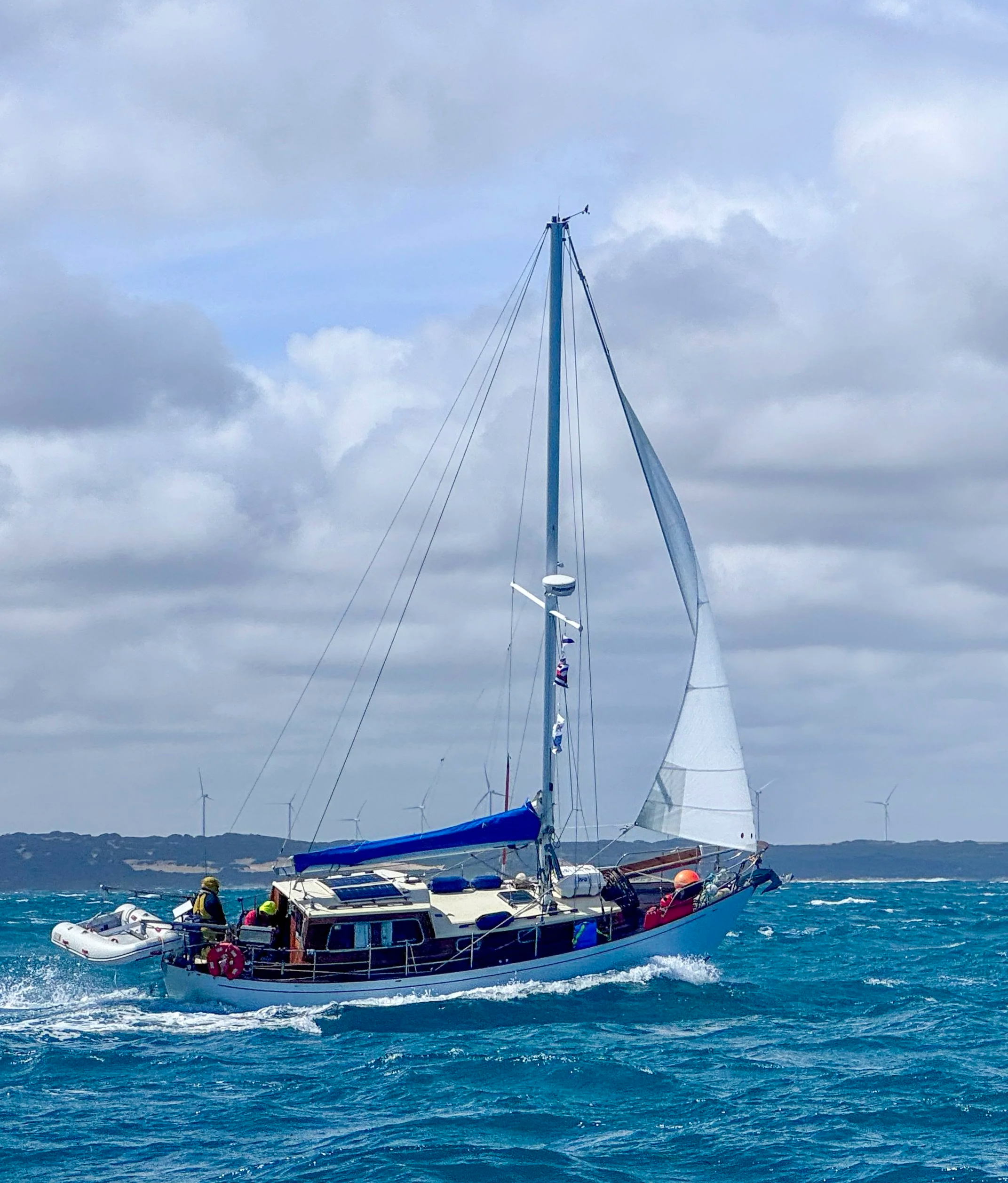
SAELIETH going for it!
I’ll profess to being a little mad. I already own a 26” Couta boat, My Girls, that I built about 20 years ago. My attachment to that boat defies description. And then along came another wooden boat! In that new boat I saw amazing bones, history and purpose. So when my daughter and son in law, who had been looking for a family boat, spotted Donna Maree at Kettering (yes I realise it sounds like she spent too much time in the f’castle of a fishing boat) and asked me for an opinion, it didn’t take me long to see the potential. I placated myself with the words of Tim Phillips, who once said to me that, you can have two boats but you never get rid of a Couta boat.
So a 34’ Tasmanian built Jock Muir pilot house double ender sloop was the boat. Carvel Huon, splined with King Billy, Blue Gum back bone and Celery ribs. Beam shelves and bilge stringers that must have come from a battle ship. Bronze floors. The deck is 3/4” teak over two layers of 1/2 inch ply and dynelled. Almost 50 years old and the maximum wear in the teak is 3mm! They don’t make teak like that any more. Cabin house teak and the inside Bolivian mahogany. Classic 70’s Tasmanian fit out. And a pretty new Volvo D2 40 with less than 100hours.
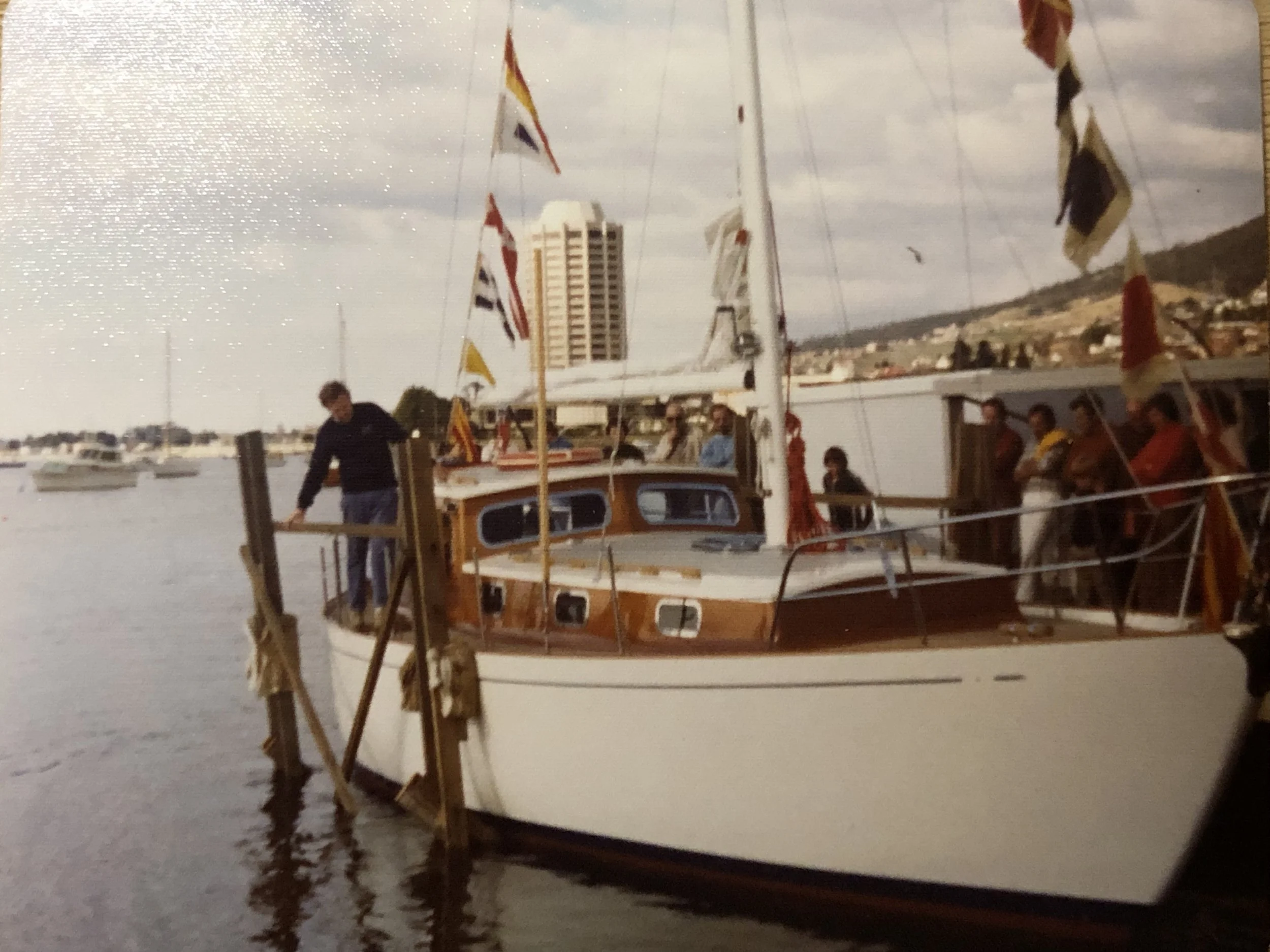
Launch day 1976
Where is the “but” ?
Turned out there were a few “buts” and then more ! The big issue was that the main positive battery cable to the main switch was rubbing on the chain for the worm drive steering. That cable was down to about 6 strands of copper. So the battery was always flat. The owners, who lived interstate and visited rarely, sought help and were told that the solution was to add a mains powered battery charger. Now 240 volt 50 amp was running through this short circuit, exiting the boat via the rudder fittings and coming back in through the HF radio earth plate. What a battery !
What damage could that cause ? Well the HF areal became part of the circuit, naturally. So the end result was delignification of the stern post, and a direct track for fresh water, and to summarise, “rot in the stern post”. Did I mention that all the bronze skin fittings were copper strap bonded ?! This isn’t looking good, but I couldn’t let go.
Then Trevor Sharman turned up. Trevor and his mate Alan Perkins had built the boat under Jock’s supervision. She was built to Jocks 100 A1! The stern post was 18 laminations of hard wood and the delignification had only gone as far as the depth of the backstay chainplate screws. This was very “fixable”. Trevor and his “boss” Bigsea then offered to do the job. How could I refuse, and they were happy for me to work along side.
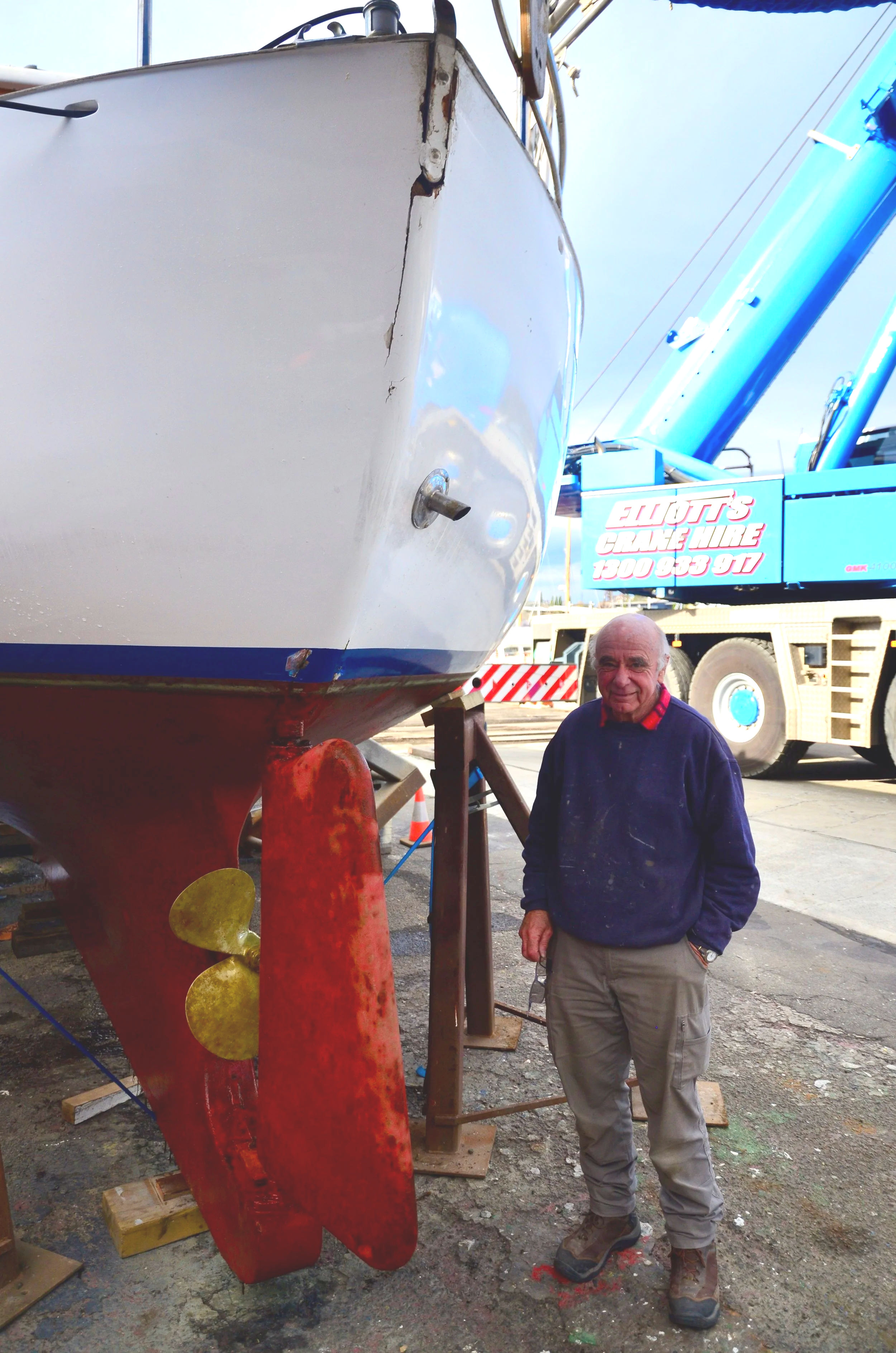
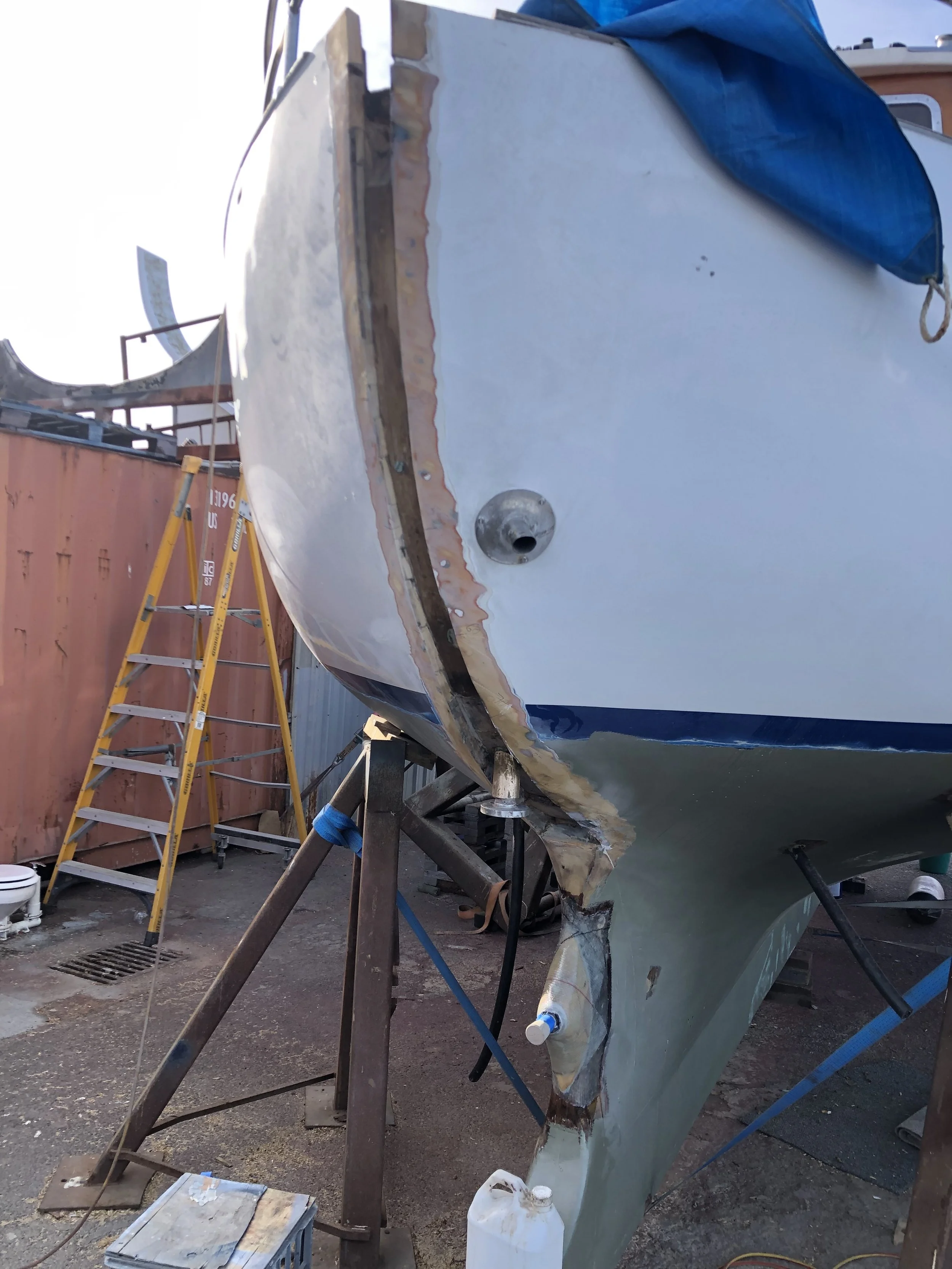
So we took on Donna Maree. Turns out that Trevor had built the boat so that the engine room could be dismantled and the bilge access under the cockpit opened up. On to the hard, next to Bigsea’s workshop, we were soon back to solid stern post. No planks had to be sprung and the laminations removed were replaced with Celery. OK, while we are about it, lets get rid of the old bronze stern tube and but in a glass tube and dripless seal. I stripped the hull back to timber, wow, that’s a job, and outside in the Tasmanian winter.
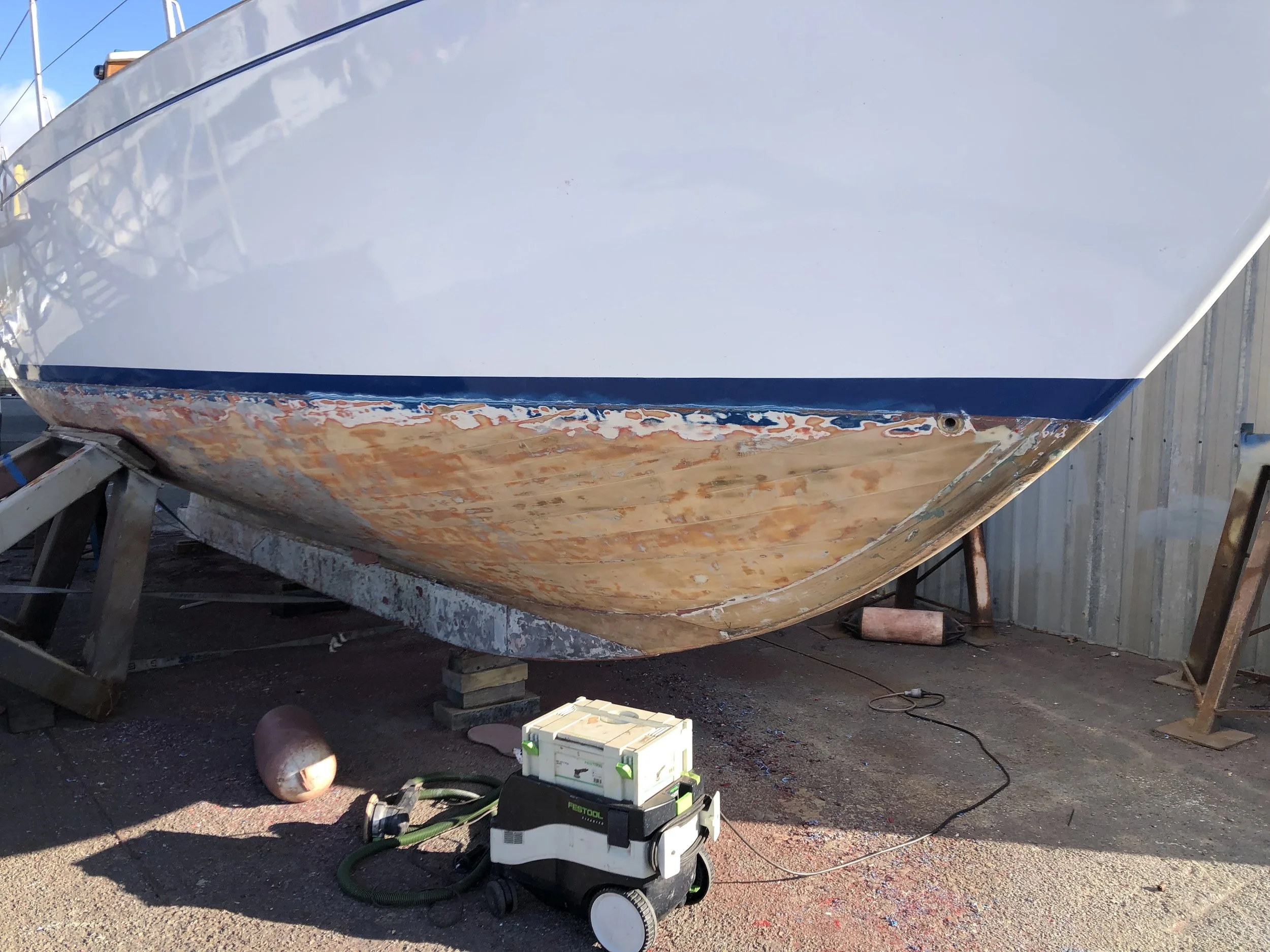
Huon as good as the day the planks were laid
No surprises this time. Well there was “wow, she has a bronze slipper” on the stem from waterline to the forward end of the full length lead keel. Oh, and what’s is that stain in the timber below the diesel tank? “It’s diesel”! Check the tank, which again because of Trevor’s forethought was easy to access. No leak to be found, so only one thing to do; get the tank out of the boat and pressure test it. It took less than an hour to get the 150L stainless tank out and when pressure tested the welded seams leaked tears of diesel. OK so a new tank was made up and installed. I removed all skin fittings and replaced them with True Design glass impregnated plastic. The spaghetti of wiring, some functional, and most related to past 70’s car alarms and detritus was removed. So new wiring, and lets add solar and a lithium house battery and management system. We took the opportunity with the mast out, to strip the mast, epoxy paint and all new fittings, standing and running rigging, And that almost 50 year old headsail had to be replaced along with a new Reefit furler from Tasmania. There were some minor leaks in the cabin house, and I chased any soft wood and repaired those, and stripped the cabin top back to the dynel. There were a couple of breaches, and so I re glassed all seams, after grinding back to clean dry wood. I came to realise that an “angry grinder” is a very useful tool in boat building.
Come the spring, with a new paint job, varnished deck house and a dry bilge and no deck or cabin leaks, Saelieth as she was launched, and would become again, was now looking 1970s with 2023 specs. Trevor had told me about the trips to Port Davey, and stories such as the time all the anchor chain stashed under the Purdon dinghy on the foredeck, had come loose on their way around SW Cape. 75 m of 10mm chain dragging over the side! The tall tales and true slowly came to the surface. But what was true, was that Saelieth was a very capable sea boat in the Tasmanian fishing boat style. There was a sister ship, Lady Nelson built by Jock a couple of years before. She was built for an American who married a Tasmanian girl, and they shipped the boat back to the US. A quick trawl of American registered shipping shows that she is still “alive” and in northern California. It was time to start dreaming of adventures. The VDL Circumnavigation seemed like a great idea.
Now “The VDL” is a wonderful thing. And it comes with a 108 page Cruise Manual. It covers everything, and I mean everything. You guessed it; the safety regs ! Liferaft, tethers, drogue (and lines), AIS etc etc. My sailmaker friend Steve Walker, wisely advised that going offshore with one headsail was not advisable, so he made up a furling heavy duty No 3. It came to be well used. And if you want to enter a World Heritage area, then better have a black tank (no room) or put in a composting toilet.
No, I haven’t added up the cost of all of this ! Because excitement and adventure only lives on the other side fear. As one gets older, and as a septuagenerian I can say, that the focus has to be on living span and not life span. So lets get on and do what has to be done and have the adventure. The future will take care of itself.
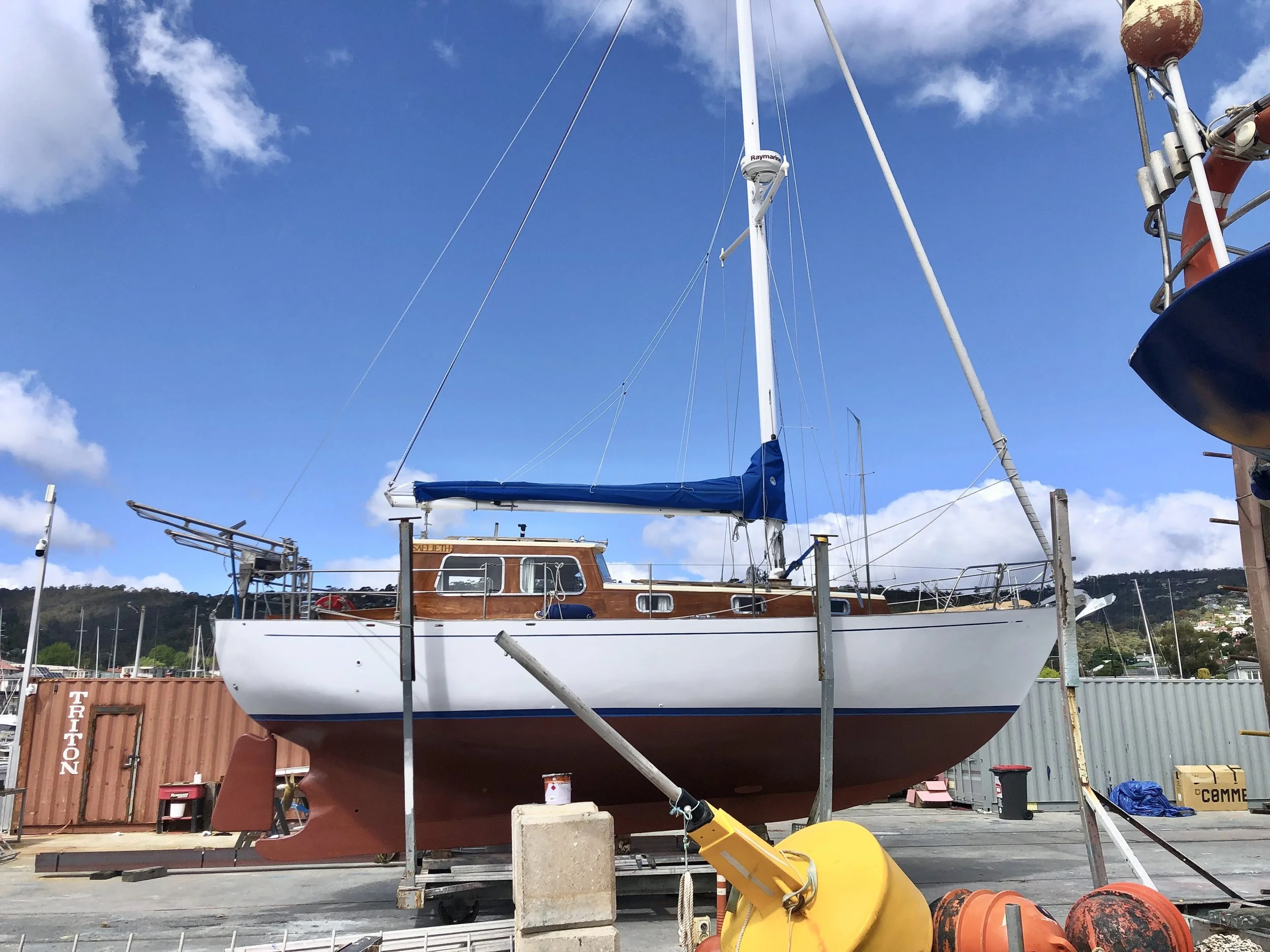
Ready for the VDL
The idea of the VDL is that it is a cruise in company, around Tasmania. Held every second year and starting mid February, as the weather calms down a bit. Numbers are limited to 45 boats. We were the smallest (and one of only two carvel timber boats), to new 40’ French/ Polish plastic boats with plumb stems and square port holes, to 60 odd foot power boats from northern states and shmick catamarans. Whilst the boats varied, the people were the essence of the cruise. A fantastic bunch of people with differing abilities from solo Atlantics to never having really been offshore. The benefit of the cruise in company was that it made a 1000nm circumnavigation available to all. There was help with repairs and problem solving, help with passage planning, we Tasmanians threw in local knowledge, and then there was the camaraderie of the ad hoc BBQs on remote beaches and a number of social events catered for by third parties.
On an island in western Bass Strait, described by Giuseppe Garibaldi in the following accolade; “O desert island of the Hunter Group - how many times have you pleasantly excited my imagination. When tired of this civilised society, so full of tyrants and gendarmes, I have often transported myself in my imagination into your gracious bosom”, we even had “Scuba Eats”. That’s what happens when one boat catches a 40kg tuna and another boat has a chef and provisions to make sushi ! And it all gets shared around, and delivered by the chef no less.
None of this is compulsory. It is not as though 45 boats moved en masse from one anchorage to another. At one point we had boats from Launceston to Strahan and King Island in between. The only compulsory daily event was the 1830 sched, held by Zoom rather than HF. It was a requirement to have internet access (read Starlink). But that meant we had the internet for weather, passage planning, running businesses, communicating with family on Whats App, and it never failed.
The voyage is anticlockwise around Tasmania over 5 weeks. The theory being that most boat and crew problems occur early in the cruise, and are much easier to deal with on the East Coast. “Born Free” was happy that we didn’t follow the clock, after a tow back from Eddystone to St Helens, and an exhaust system fix.
We set off across Storm Bay on a grey day with a very civilised nor easter and headed for “the slot” inside Tasman. Some boats went to Port Arthur, others had left a couple of days earlier, and some were yet to leave in a week or so. Such is the nature of the VDL. We had a very benign and pleasant day, and even approaching and entering the slot, I didn’t see what was coming ! That nor easter was still there but a lot bigger on the outside. Inside Tasman is only 10m deep. The equation is “big NE driving sea onto 10m shelf = short, sharp, big seas”. Our first test. The wind was building, the sky was getting blacker and the driving rain was headed our way with the next change, and we were headed for Fortescue on the Tasman Peninsula. On the nose. Saelieth handled it all with aplomb. Never slammed. Just took it all in her stride; “I’ve done this before”. And so we entered Fortescue on dusk, were late for the sched, “because we had a bit on”, and settled in to a very peaceful night and stunning sunrise to follow. There were about six other VDLers there, but plenty of room.
The next passage was up to Wineglass, going inside Maria and past Ile des Phoques and it’s seals. We lunched at Schouten. The weather was now glorious. Turquoise water and clear blue skies. The afternoon was an easy passage to Wineglass. Now Wineglass is not the best anchorage, and it’s a bit of a siren in terms of beckoning you in and then treating you very badly, so that you leave full of regret. But as you look over your shoulder, she still looks beautiful and forever the siren. But for us she was benign. Glorious. Turquoise. Crayfish. And a swim. We were really starting to relax and leave the mad rush of preparation behind.
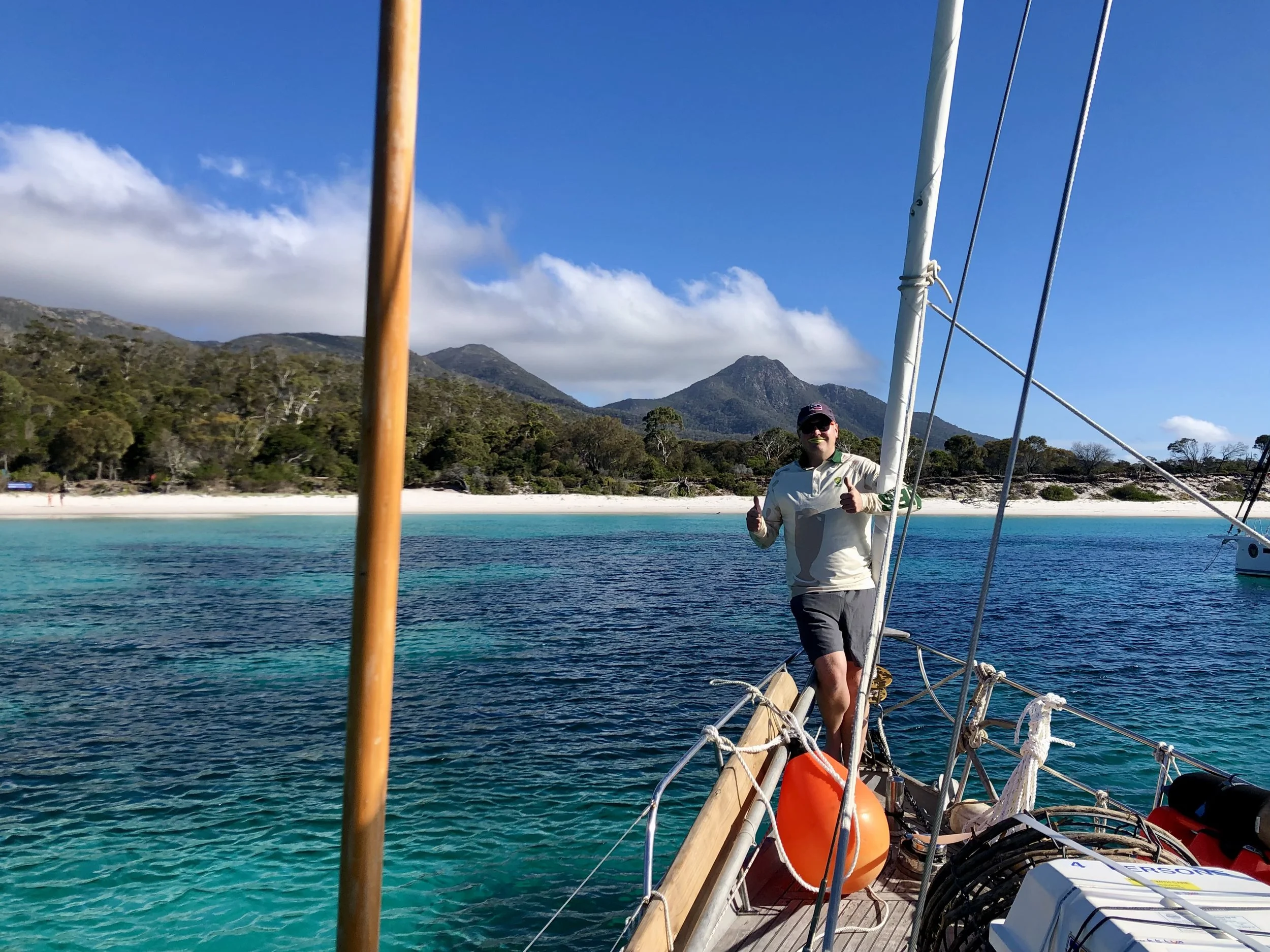
Saelieth foredeck Wineglass
From Wineglass to the NE corner of Tasmania, there is very little shelter. We had the remnants of the nor easter, so our passage plan was an early 0300 departure and head north. Motoring on a glassy sanguine sea. The phosphorescence was breathtaking, but more so, as torpedos of green light rocketed towards us in the pre dawn. Then a massive ball of light appeared off the port quarter and the torpedos locked onto that ball of light. Dolphins hitting on a bait ball was the explanation. Nothing much eventuated in the way of wind that day, but the seas were kind and we made good progress. A couple of boats decided to stop at Eddystone, and some even made it around the corner to Foster Inlet, but Eddystone looked a bit rolly for us. Last time I was at Eddystone, was when I and two mates were sailing my Couta Boat from Smithton to Hobart. We were three men in an open boat, careering down the Tasmanian coast in front of a big sea breeze, and yah hooing with the 12.6 knots we ere repeatedly getting. So we set our sights on Clarke Island. We would be entering Banks Strait at low slack and the nor easter sea breeze was picking up in the late afternoon. This should be a fun passage. We were doing 8’s and 9’s and made Spike Bay, with a couple of VDLers already there, just after sunset. 120 odd miles in 18 hours. Not bad.
Then to Thunder & Lightning Bay on Cape Barren. Great name and fantastic spot. This was a chance for a walk on the beach and a spot of fishing. Lovely walk and explore but no fish ! Hmmm. The engine won’t start. Nothing. So between a doctor, an electrical engineer and a solar sparky we rigged up a jury rig starter by bypassing the solenoid and used the auxiliary stop lever when required. Time to consult Dr Google. Seems the Volvo Penta MDI (mechanical diesel interface or “black box”) can cause a few issues. The engine had only less than 500 hours, but it had died. We theorised that the long run and heat in the engine bay may have been the problem. Anyway, we were able to get a new black box from Hobart to meet us at Beauty Point, and it was a straight plug and play. All good.
The passage to Waterhouse was a great reach with the nor easter that was still in play. And then the next day we entered the Tamar at high slack and tied up at the Georgetown Yacht Club pontoon. Floating pontoon, security, shower, water and electricity for $20. That’s 2% of a BOAT (bring out another thousand) dollar ! Bargain. It was close to town and the laundromat. And a visit to the Bass & Flinders Museum was a treat. It has to be one of the best small maritime museums I have visited one the planet.
We had the first of our large gathering functions at the Tamar Yacht Club in Beauty Point. Wonderfully catered and great hospitality. This was really the first time we started to get to know the others on the cruise. And we were also joined by the fleet from Geelong. It was all coming together. Apart from diesel and water, we had nothing else to do for Saelieth. The fleet had a wonderful lunch at Marion’s Vineyard, overlooking the Tamar. The passage under the Batman Bridge was spectacular with whirlpools, but created no challenges. To put it in context, a 505 under kite managed it without drama at the same time. Pilot Bay at Low Head was our overnight tie up before the passage to the NW. Very sheltered. Not much room. Very shallow (concrete block on the bottom) on the northern side of the pontoon. And there can be bright lights when the pilot boat leaves at 0300 to meet a ship.
We had a crew change in the Tamar. We had been three up for the East Coast. Richard Bevan, past Commodore of the RYCT left us, and we were joined by a mate, Simon Fraser, who had sailed two up, non stop from Brazil to Launceston in the biplanar junk raged catamaran, China Moon (if this makes no sense then Google China Moon or Peter Hill/ catamaran), that he had purchased from Pete Hill. He and his wife Carolyn had sailed China Moon around Tasmania a few times and he knew the West Coast well. Simon had also done a two up North Atlantic with Pete Hill, so was well credentialed. It is hoped that Pete, plus or minus China Moon will be at the 2027 AWBF. Pet has recently been awarded the Cruising Club of America Blue Water Medal. Previous recipients include Bill Tilman, Bernard Moitessier, Eric & Susan Hiscock and Sir Robin Knox Johnston. He has some stories to tell, not least of which is his last crossing of the Tasman. The only time in a lifetime at sea, often solo, when he thought he may die at sea!
We made Stanley after a daytime passage, and entered the boat harbour just as the SW front came through. We had been watching this all day and hoping we could just beat it. It beat us. But as I had been in and out of the harbour many times previously, I knew it was a matter of set the course, keep up good way and get through the entrance to the calm inside. People on the dock commented that Saelieth looked so at home doing just that. Stanley was a great chance to meet up with good friends, have a hot tub under the Nut, and eat MS8 Wagyu that they farm. They also very generously stocked our freezer with Wagyu !
Stanley became famous on the cruise, as a group of boats, who for various reasons were behind the bulk of the fleet, were held up there by “The Easterly” for many days. They became known as the “Stanley Stragglers”, and a great bunch they are too. I've lived in the far NW for 25 years, and “The Easterly” is blamed for many things, including “you’ll never get a cake to rise in an easterly”! An easterly in Stanley tends not to be a gentle, benevolent breeze, but is a screaming monster that portends the SW front. Its something to do with the “squeeze” that western Bass Strait forces on the breeze.
Now onto that “desert island of the Hunter Group”; Three Hummock Island. The Hummocks is a decent sized round island. In theory, whatever the breeze, there is an anchorage in the lee. Good theory, but there are also massive tides and currents, so a calm evening anchorage can turn into rock and roll as the the 3 or 4 knot current whips past the bay and the wind pumps down the gully of the bay. That said, we had a wonderful time there in anchorages such as East Telegraph, The Mermaids and Chimney Corner. The visit to the Hummocks also came with crayfish and abalone, so really quite delightful.
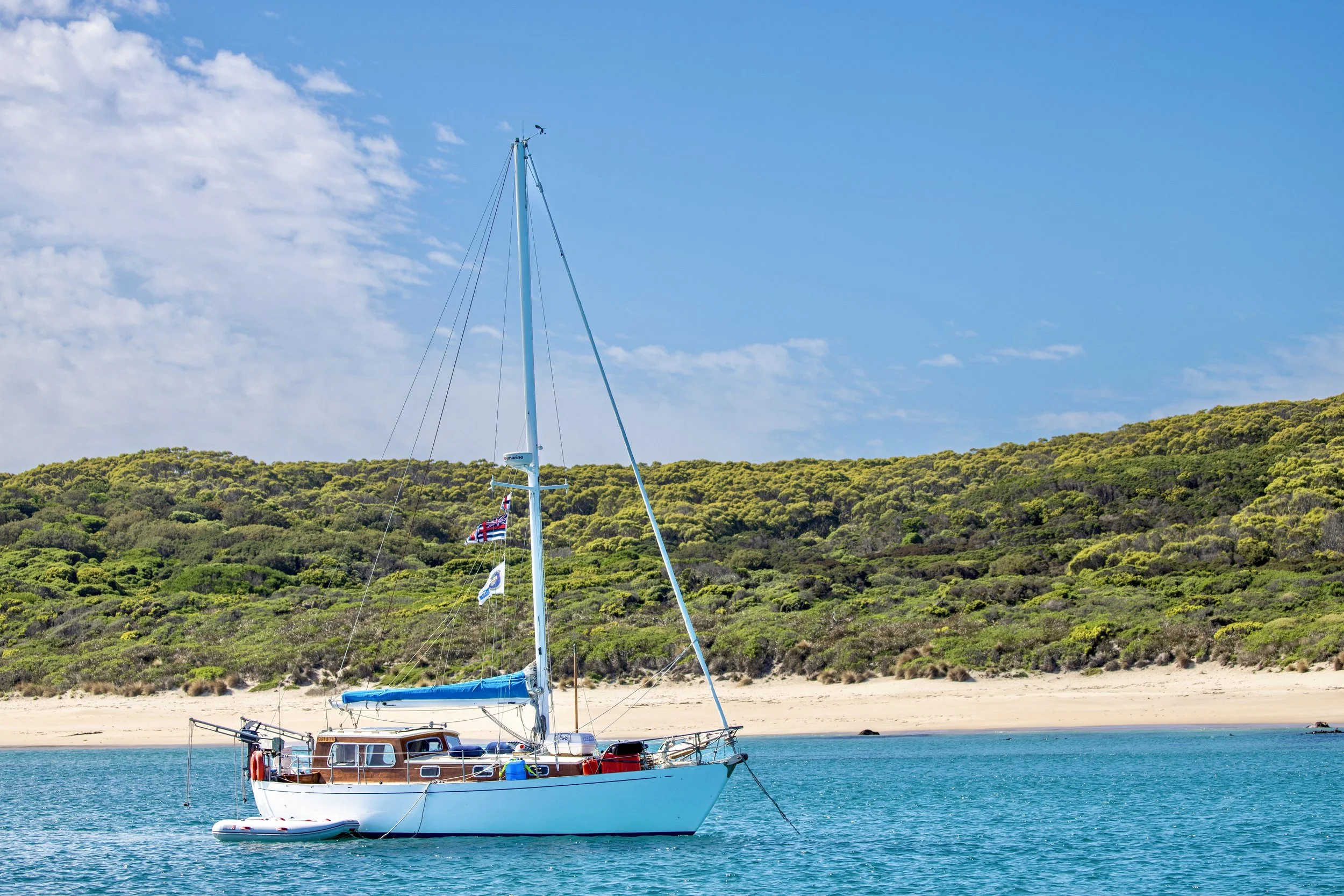
Saelieth at The Mermaid, Three Hummock Island
Much thought went into our next passage; leaving Bass Strait and entering the Southern Ocean and heading down the West Coast of Tasmania. To go inside Hunter or outside? The passage around Bird Island or “Hells Gates” just off the Woolworth coast? We decided to go inside Hunter and shoot the Hunter Passage and it’s big rips and overfalls. The pilot says that one should turn immediately to port after passing Bird Island, and head SW. We were doing 10 knots over the ground and passed Bird Island in a flash, and were suddenly in the midst of the big overfall. No sooner in, than we were out. Saelieth again said “No drama!”.
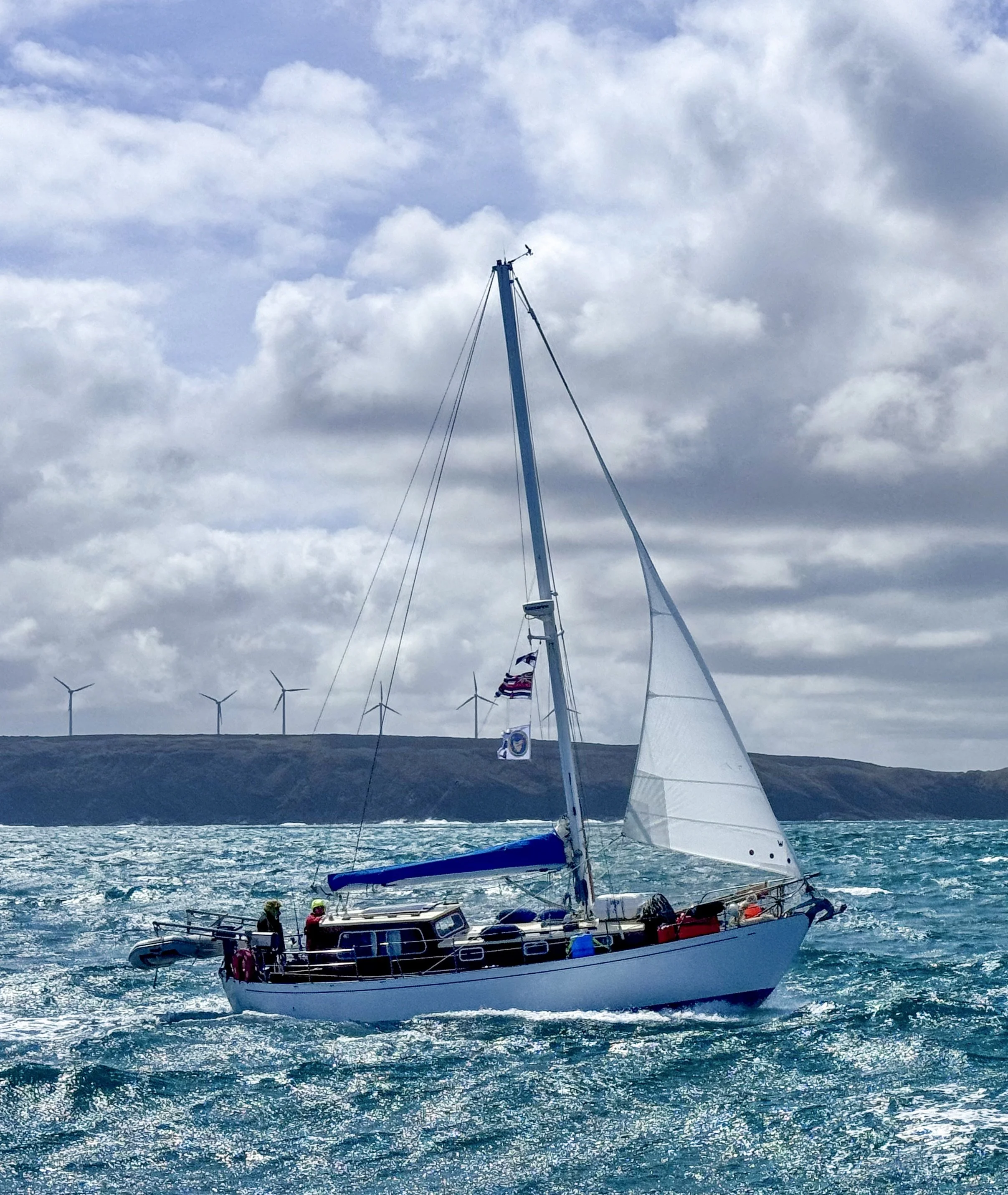
Heading south off Woolworth, NW Tasmania. Flying the VDL flag of 1851
Wow, that SW swell was pretty big, and we had a 20 to 25 knot nor easter over our port quarter. We were very pleased to be doing 7’s past Cape Grim and on to Marrawah and past Ann Bay. The warning of unexpected cray pots, a decent way out to sea was prophetic, as we found ourselves suddenly in a field of orange buoys. This wasn’t the last time we would encounter this phenomenon on that day. I would not want to be there at night time. Still, we didn’t tangle with them.
Somewhere south of West Point we lost the nor easter, to be replaced by a sou wester that varied between 5 and 25 knots. And there seemed to be at least 2 or 3 other swells and waves on top of the SW swell. We beat into it for a while, but as dusk approached, we figured that it was best to drop the sails and just motor into the ugly sea. Surely it would get better once we reached Sandy Cape and headed SSE for Macquarie Heads. Nope! No such luck. As we reached Sandy Cape, the breeze swung to the SSE. Some of the other boats ducked in behind the Cape for a couple of hours respite. Saelieth was happy to keep going into the sea and the night.
As we approached dawn, life was getting easier. The day was going to be a cracker. As we found the leads and calm of the Heads, we realised our timing was perfect. The backlight pre dawn gave us wonderful definition of land and sea, and the lead lights shone bright. There was almost no current. We were inside and passing the convict built Training Wall in no time. A couple of hours later, one of our fleet said he was managing 5.5 knots against a 5 knot current as he passed Entrance Island Lighthouse. He took a long time to get inside the Harbour. The determinants of the current at the Heads relate to tide, river flow and atmospheric pressure. Not quite as simple as tide only.
Strahan was bliss after our last day. A secure tie up, a good coffee, big breakfast and then face cleaning up the boat. Simon caught the bus to Launceston and we looked forward to the arrival of family. The plan was to take our young grandsons up the Gordon. That has to be one of the highlights of the cruise. I first acquainted with the Gordon in the days of the Dennison Star, the most magnificent Huon Pine Cruise boat of a past era. I then rafted the Franklin in the very early 80’s. Whilst I was on that trip, my father died, and so the river holds special memories for me.
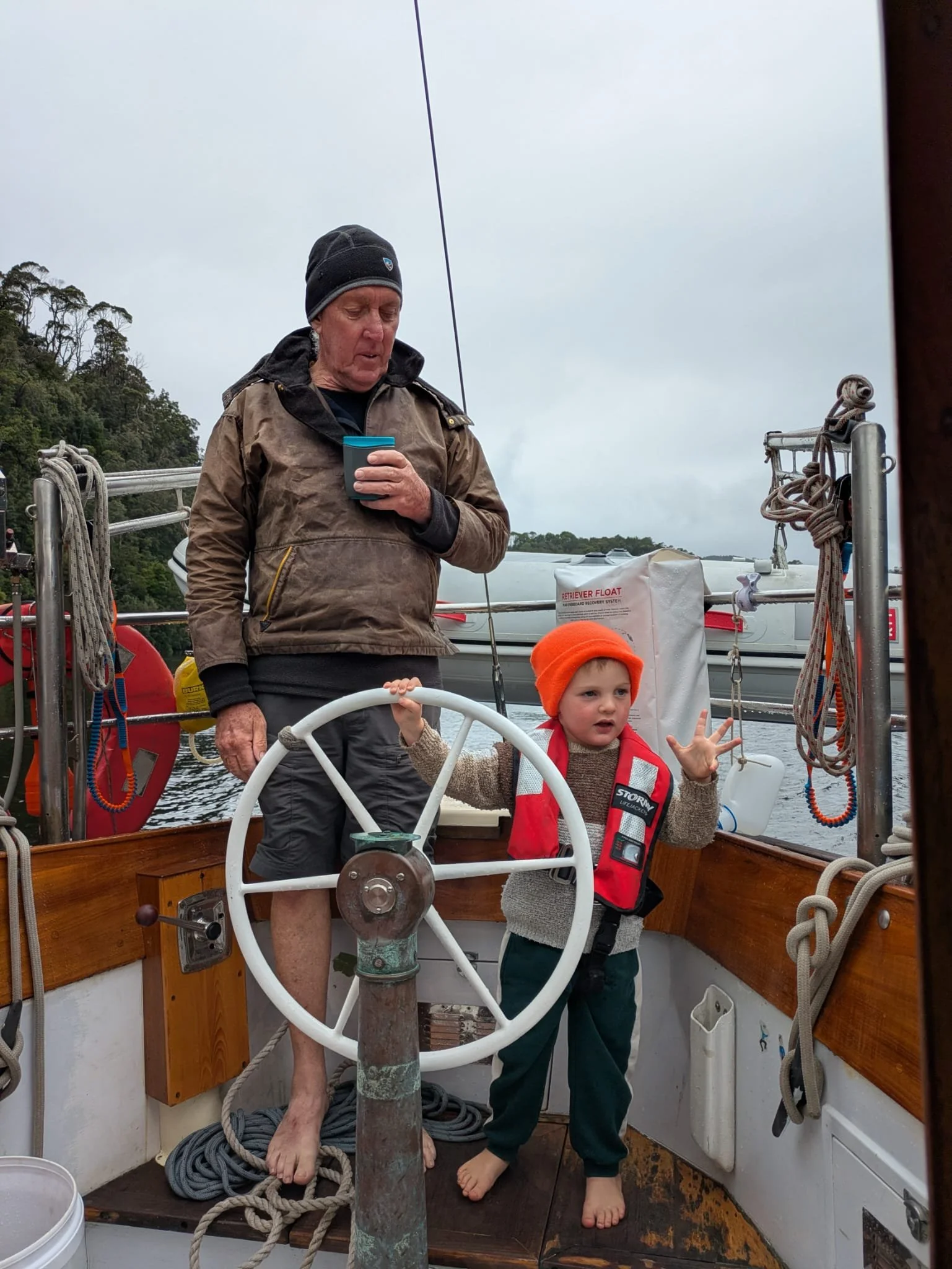
Grampa and The Skipper
The boys loved it. And so did I. We nosed into the bank at Heritage Landing and did the interpretive walk. We played “spot the Huon Pine”. After all Saelieth was of this river, as was Born Free. Everyone else was of epoxy, fibreglass and carbon fibre. OK, there was some Western Red Cedar. How far could we go? We passed the Marble Cliffs, the Boom Camp (where you can tie up at a rudimentary jetty, light the fire in the hut and have a hot shower), Sir John Falls and to within 2 miles of the Franklin/ Gordon junction. This is past where the dam wall would have been built. We rafted up with four other yachts in the depths of the absolute peace that is this World Heritage rainforest. At this point, as the crow flies, we were only 40 miles from Davey Gorge in Port Davey. We were closer to Port Davey than we were to Macquarie Heads!
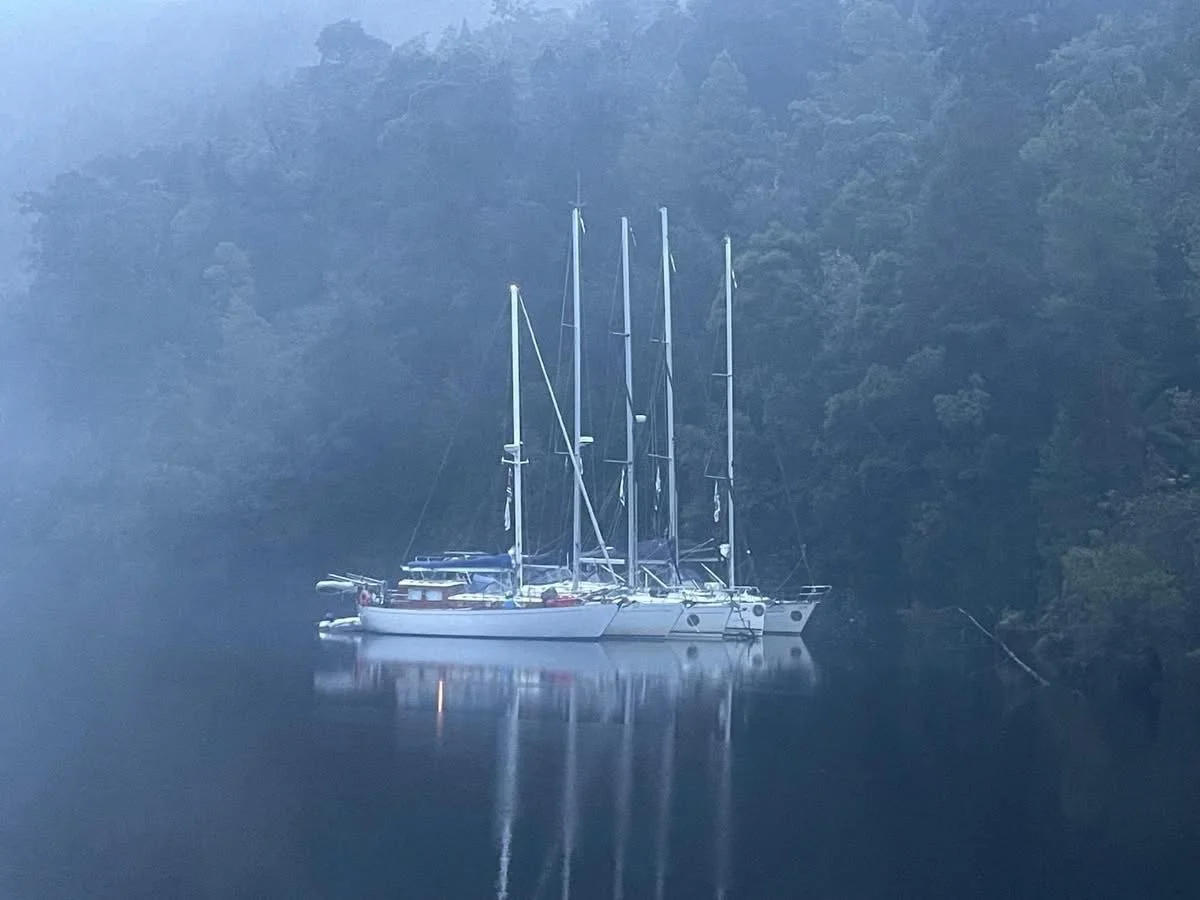
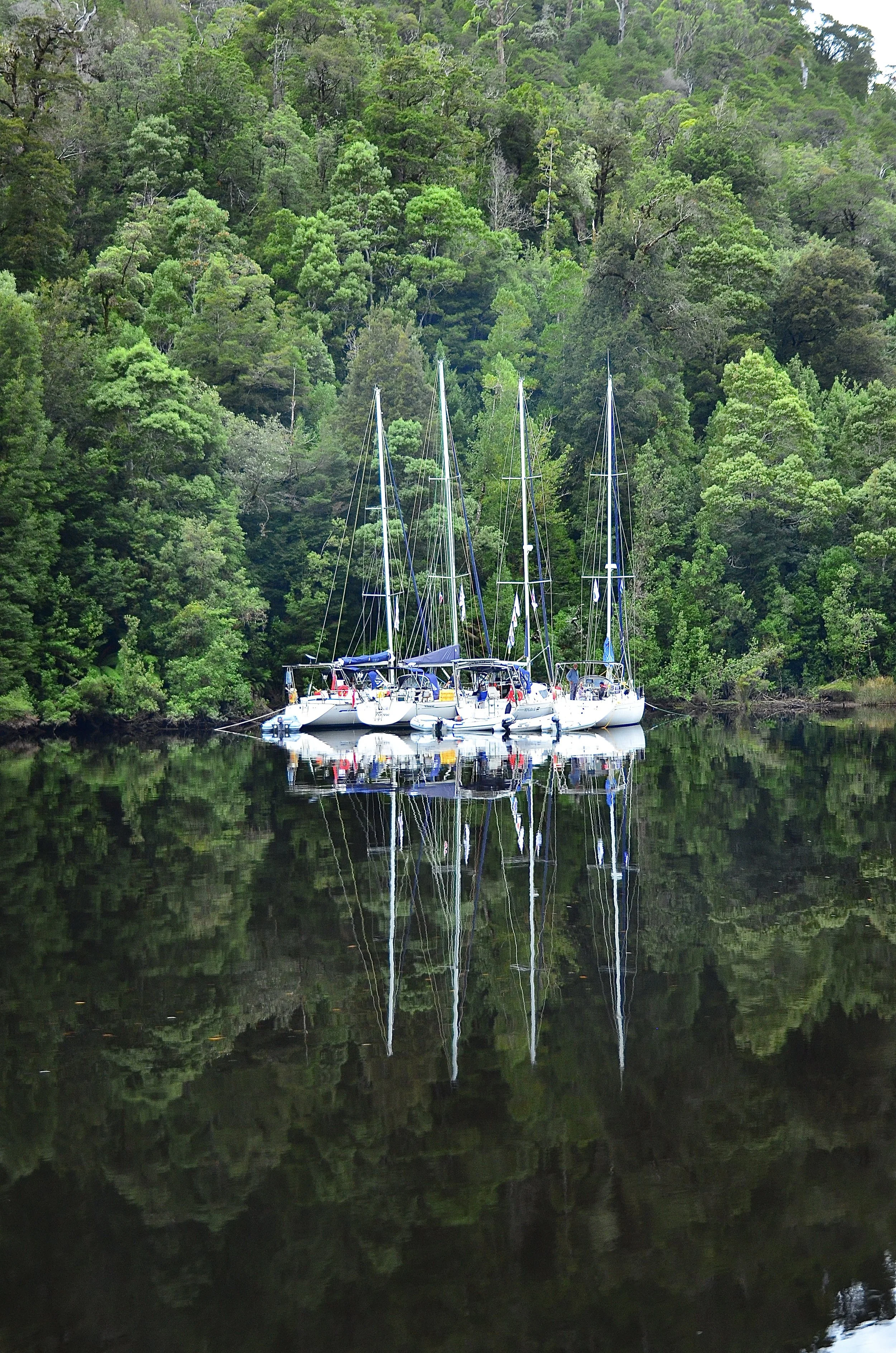
It was here that the next mechanical issue raised it head. We couldn’t start the motor. Dead. But this time it wasn’t the black box, it was the starter motor. Time, luck and a “tap” and the Volvo fired up for our trip back to Strahan. It would have been a long tow. Another phone call to the Volvo dealer in Kettering, some logistical juggling and a drive from Strahan to Derwent Bridge to “liase” with the new starter motor flown in from Melbourne overnight and we were operational again. There is no doubt that it helps to be reasonably mechanically proficient to undertake a cruise such as this. Not essential, but I’m sure it save BOAT dollars.
One could spend a lot more time in Macquarie Harbour, exploring the anchorages, walking through the history and heritage, bird watching, exploring creeks and just soaking in the SW Wilderness. We didn’t have enough time, but next time ……The hand drawn charts of Trevor Norton are a must & so helpful. Trevor’s charts have a 3m line drawn on them. Stay outside that line and you shouldn’t find any “hard”. He has followed that line by dinghy to survey for the charts ! Ask anyone in Strahan where Trevor lives and go and visit him. That is the only way to get hold of them. And while in Strahan, make sure you see the longest running play in Australia, “The Ship That Never Was”.
Again, before poking ones nose out into the Southern Ocean, there is much discussion, searching forecasts and deliberation. We spent the night outside the Heads in Pilot Bay, ready for a predawn departure and a passage to Bathurst Harbour. The big swell was till there and the breeze was SW. We hoped there would be enough west in it to spring sheets, but it was on the nose again. Our new crew, Richard had not done any ocean sailing, but managed it magnificently and with humour. There was always humour on the boat. An essential ingredient.
We passed the Shank and spotted a large fishing boat in there. Hmmm tempting. But not in a sou’westerly. Ian Johnston’s book, “The Shank Returns” would have to stay in Sealieth’s bookshelf. But we started to see tuna jumping and being chased by dolphins. Out with the lines and it wasn’t long before we had a strike. Thankfully we weren’t able to hang on to “the barrel”, because I’m not sure what we would have done with a 50kg tuna in our small cockpit. As we approached Breaksea, the breeze was getting well up. We were almost surfing as we went through the North Passage, north of Breaksea. Spume and white water all around, but I knew the passage, and it wasn’t long before we dropped the pick in the calm of Schooner Cove. And as we dropped the anchor, calamity broke loose in the engine room ! The mounting bracket for the compressor for the eutectic fridge and freezer had fractured, so the belt driven compressor was on the loose. The fridge and freezer were cold enough, so let’s look at it in the morning.
We were able to jury rig the mount with fast cure epoxy and ladder straps as stays. That Heath Robinson affair lasted a week to get us home. Necessity is the mother of invention - we had too much food to lose and the prospect of the beer not being cold was not on,
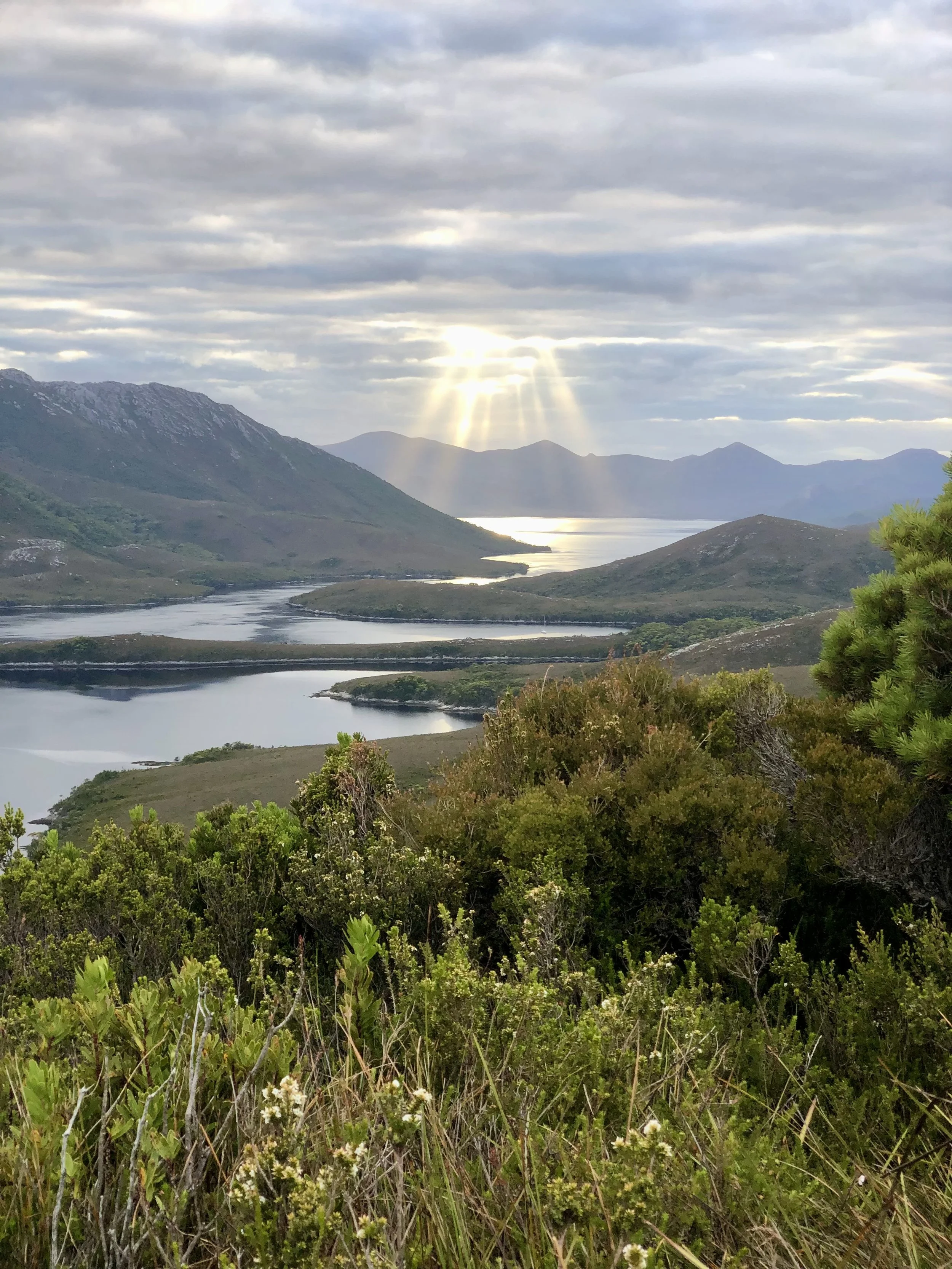
The Narrows, Bathurst Harbour
Bathurst Harbour is my favourite place on the planet. Sandra, my wife and I spent time with Deny King back in 1985. It was the end of June/ early July. We lived with Deny, mined tin, went wood collecting, made bread and enjoyed Deny’s company, stories and humour. “King of the Wilderness” is well worth reading. And we experienced sub zero temperatures and ice on the inlet through to bluebird days and a prefrontal 18 degrees! Boy, did we pay for that when the front came through. But that’s Bathurst Harbour, or as any Tasmanian yachtsman calls it, Port Davey. The ancient geology and river valleys. Weather in the Roaring Forties. Isolation. Walking the hills and mountains. Am I in the Western Isles of Scotland, or perhaps Terra del Fuego ? No this is World Heritage Tasmania and may it long remain so.
We had arranged to meet Sandra and two of my daughters who flew in to Melaleuca for the day. The girls had never been to Melaleuca but had heard the stories and read the books. We were able to take Saelieth all the way up the Inlet, but then, thinking of the photo of Juliene, Ian Johnston’s boat in his Shank volumes, sitting at the jetty in the Creek, I thought awe should also have a go. He states on his mud map that the last corner was 1.2m deep at low tide. We draw 1.4m, and with a full keel. We ‘kissed” the mud on the bottom at the last corner, 10 meters to the jetty. An acquaintance who skippers a top end cruise boat was there with his punters, and helped us tie up.
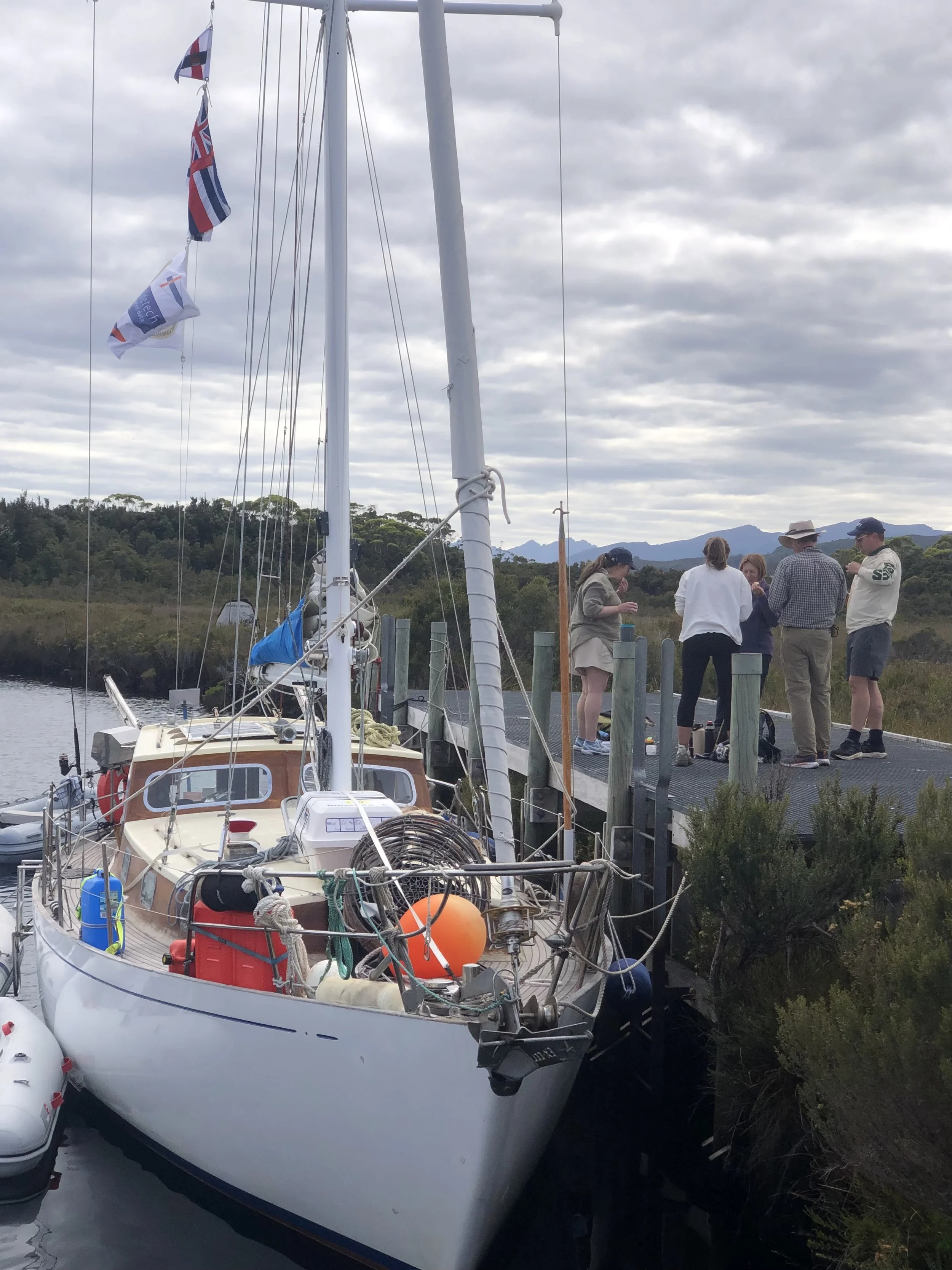
Melaleuca Creek
Besides, I was on a mission. I had been asked to bootleg some grog for National Parks volunteers who couldn’t bring it in by air. Well, that was my excuse. Sandra was joining us for more of Bathurst Harbour and the trip home to Hobart. The Creek is about as wide as Saelieth is long, and we had to turn her in that boat length to get out. Some fellow VDLers, used their inflatables as tugs and nudged us around. And we were out without issues. When I told Trevor, the builder, this story, he confirmed that Saelieth had been there before “in the day”. And Deny would have been there then. There is a wonderful interpretive walk relating to the Nuenonne people of the area, a small museum of great interest relating to Deny, and of course the hide for observing the critically endangered OBP (Orange Bellied Parrot), one of only two migratory parrots in Australia. We had taken 4 weeks, battled the elements and come in from our special maritime adventure, but Sandra and the girls flew in, and it took them 40 minutes from Hobart. The paradox only magnifies the significance and beauty of this place. And for that, we Tasmanians count ourselves exceptionally lucky.
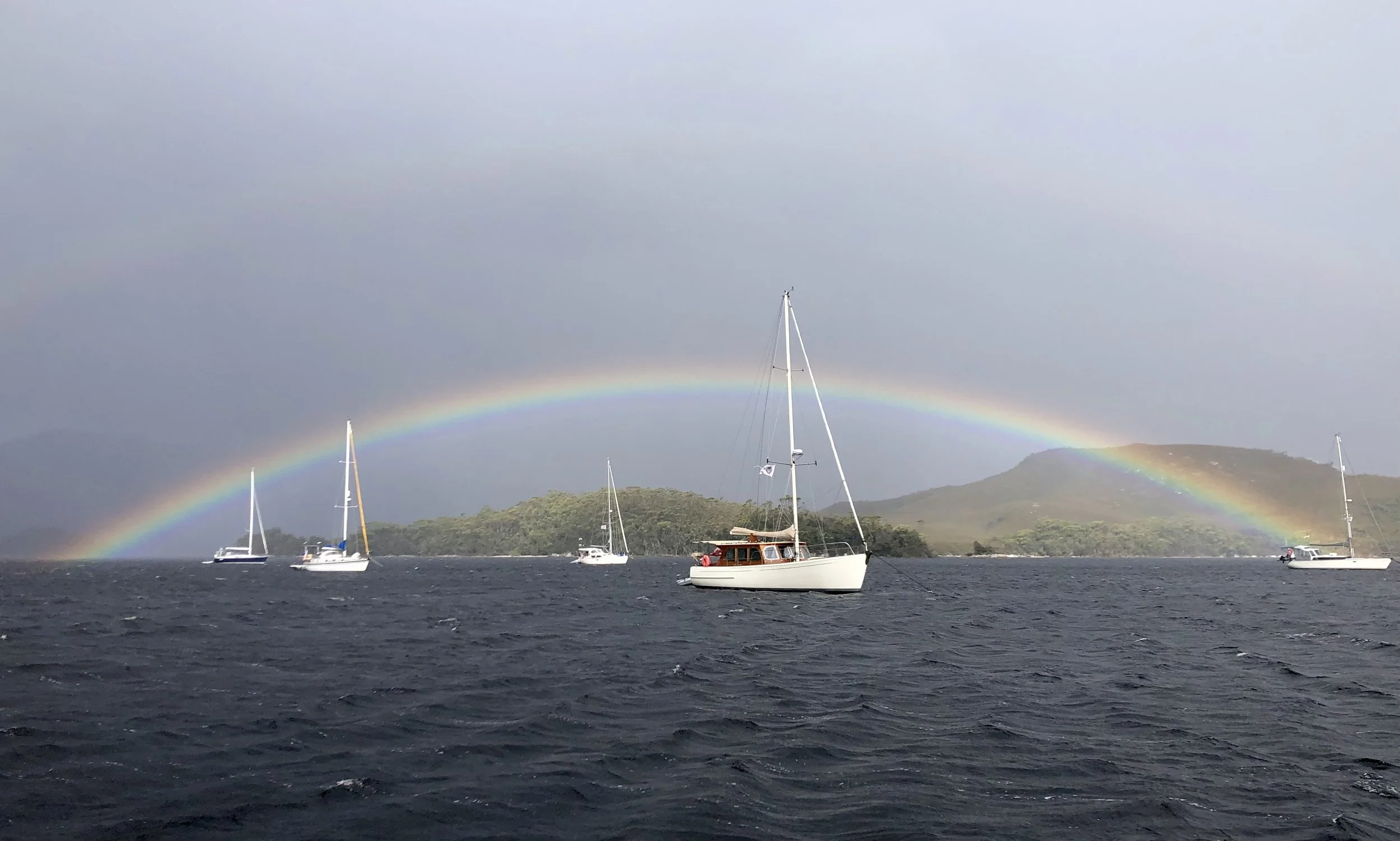
Born Free has found the rainbow
Some of the fleet headed off pretty well straight away to beat the next weather system, but I hadn’t come all this way to miss precious time in the SW of Tasmania. We, and a number of other boats decided to stay and leave with the following system. They are fairly predictable at this time of the year. The high pressure systems are down in the low 40s. They come through every 4 or 5 days. So there will be the northerly and fine weather, followed by an increasing breeze and then the front. The one we experienced was vicious. The weather then gradually improves and you leave with the sou’westerly. So you get a decent breeze and a left over sea. But that’s OK. We had one day hunkered down in the boat at Clayton’s Corner, read and baked bread. That was until a particularly vicious gust flipped the inflatable and outboard. Lucky it was a two stroke. We pulled it apart, flushed it with fresh water, emptied lines and tank, flushed the carbie with white spirit, dried the whole lot in the engine bay, and then put it all back together. Started first pull and hasn’t been a problem since.
We left Wombat Cove before dawn, with a decent sou’westerly. The sunrise highlighting the dramatic southern coast. Past the Carolines, then SW Cape. I’ve never been around Cape Horn, but SW Cape is one of the Great Capes of the Southern Hemisphere, and bears a striking resemblance to the Horn.
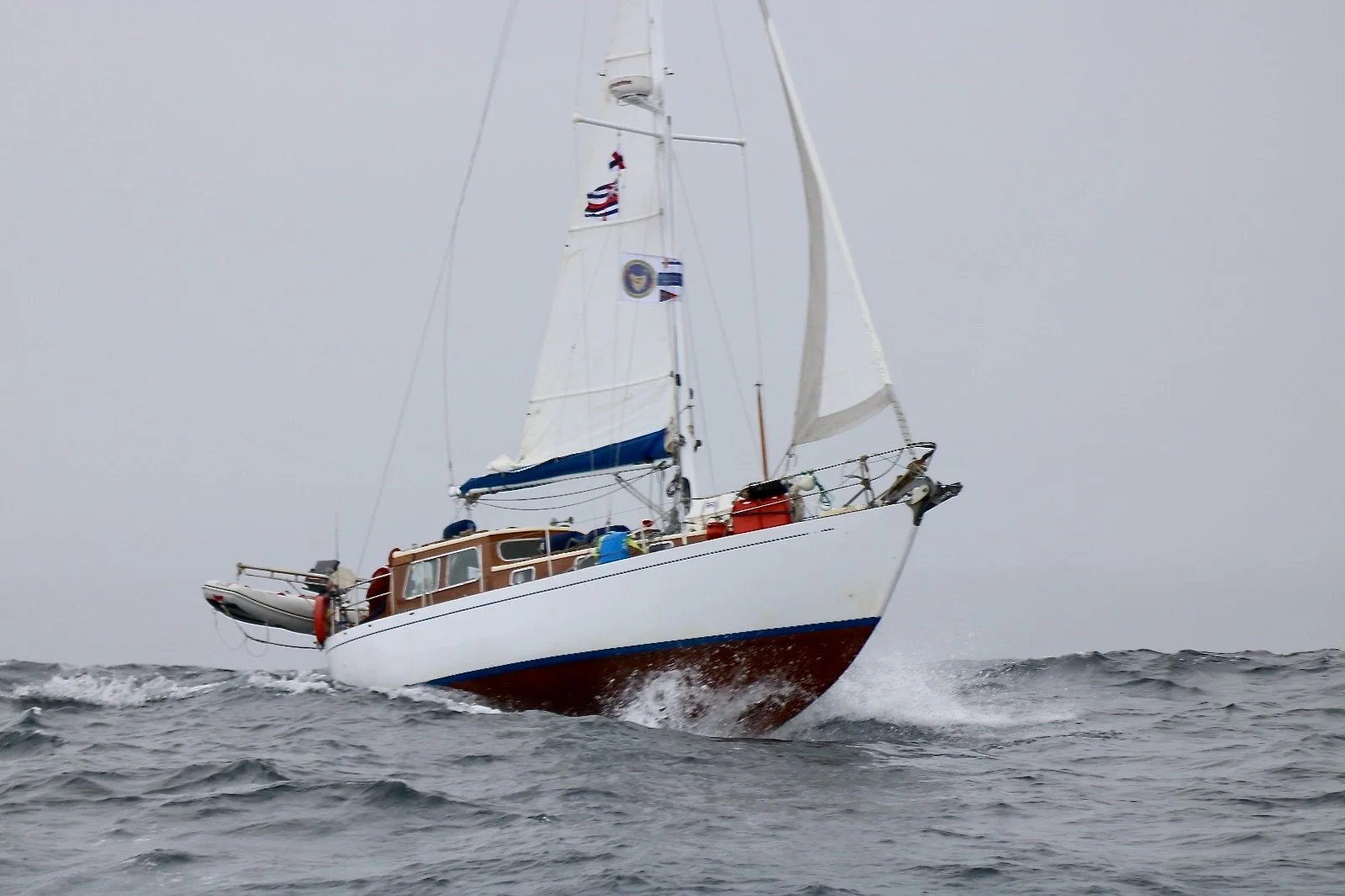
Off Low Rocky, Southern Ocean
Well, I was happy to believe that. As we passed between De Witt and Maatsuyker, we, as were other boats, were trolling for tuna. Everyone was getting strikes; none were being landed. Born Free was doing circle work for an hour, but still failed to land the beast. One of the fleet, who had done a lot of fishing, said that his trick was to treat a tuna strike like a person overboard ie keep circling to make slack in the line and wind like hell. There was quite some commotion on VHF. We developed a vibration in the helm and as we were motor sailing, it became obvious that we couldn’t take the revs above 1800, with out vibration and noise. We shut the motor down and checked everything, without finding the cause. As the day progressed, the wind eased and the seas settled. We eventually worked out that we were trailing and massive tail of kelp. This is tenacious stuff. Once the sea state allowed it, we put the engine in full reverse, and were amazed at the weed left floating behind us. We had to do that 4 or 5 times to unload the weed. In a later debriefing over a beer, it turned out that pretty well everyone had had the same problem. One boat even put a diver over the side to clear the recalcitrant weed.
Our last night of the VDL was in the Deep Hole at Southport. This was the day that diesel prices escalated as a result of the war with Iran. Michael, from Tabby Cat and one of the circumnavigators, owned the fuel supply at Dover and most graciously let us all fill up at the old price. Thank you Michael. It made quite a difference with 200 litres. And that probably best sums up the VDL. A bunch of great people, enjoying the same but different adventures, but with support if needed. Would I do it again? I’ve already put Saelieth’s name down. See you in February 2027.
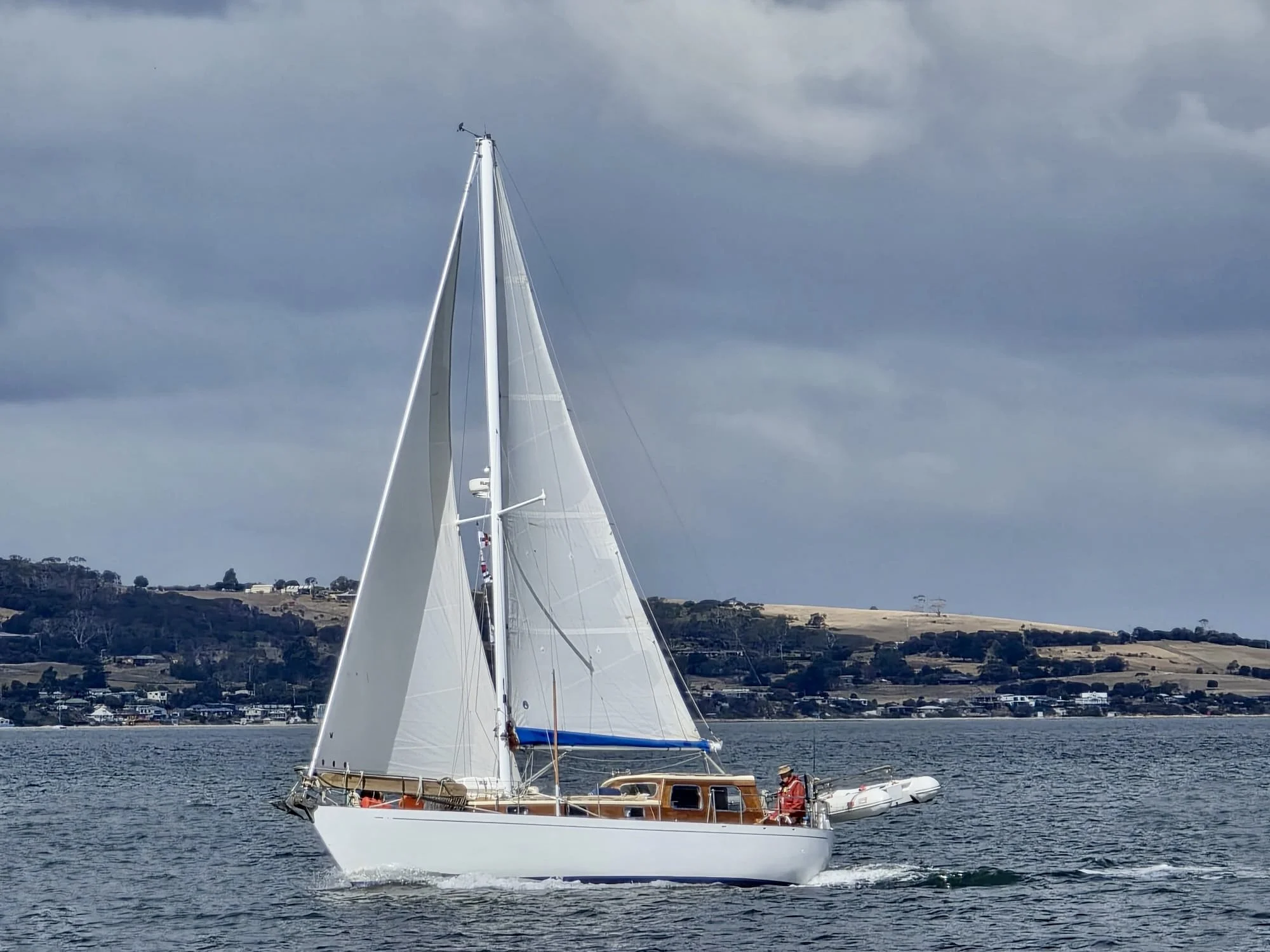
Saelieth heading up the Derwent completing the circumnavigation