
The (Not So) Impossible Race Around the World – The 2025 Mini Globe Race. Part Two
MARQUESAS ISLANDS TO MAURITIUS
By Graham Cox
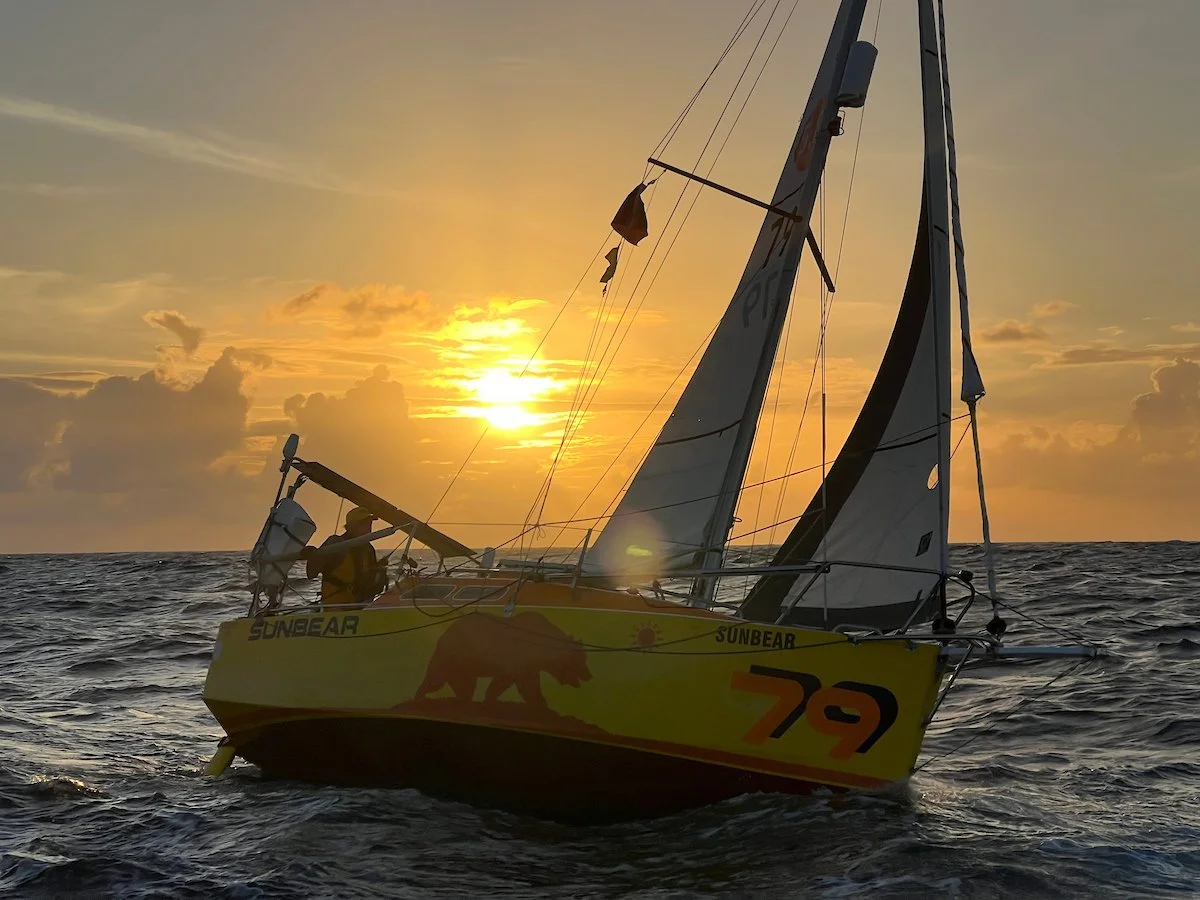
Eric on Sunbear.
After leaving the Marquesas for Tahiti, Renaud pushed hard to cut straight through the Tuamotu Atolls, once called the Dangerous Archipelago because of the number of vessels wrecked there. He wanted to get clear of the area before a predicted series of violent squalls arrived. Battling chaotic currents and steep seas, he had to drop sails to sleep or go to the toilet, as the sea-state was too boisterous for either his Hydrovane or autopilot. “Waves from all directions, thunderstorms every hour, weird currents,” he reported. “I was only getting 3 hours a day!” By the time he made landfall on Tahiti, he was so tired that he rang me to ask what day it was!

Ertan sailing in the Marquesas Islands. Photo by Mark Sinclair, Australian GGR skipper.
Dan had an unsettling encounter while battling a squall during his approaches to one of the atolls. “A fishing vessel turned and followed me for an hour,” he said. “No AIS, no VHF response. I wasn’t taking chances so I alerted my manager.” He also said he sailed faster than he had ever done before, suggesting that maybe getting chased by fishing boats was good for progress!
Then he was struck by a doozy of a prolonged squall. “50-60 knots, gusting 70, right on the nose. It went on for hours as the sea built in freezing rain. Immortal Game was flying along under bare poles at 6 knots,” he said. He deployed a sea anchor to slow the drift, but the boat still took a beating. “I lay in my bunk, locked inside, and listened to the mast shaking. Not fun.”
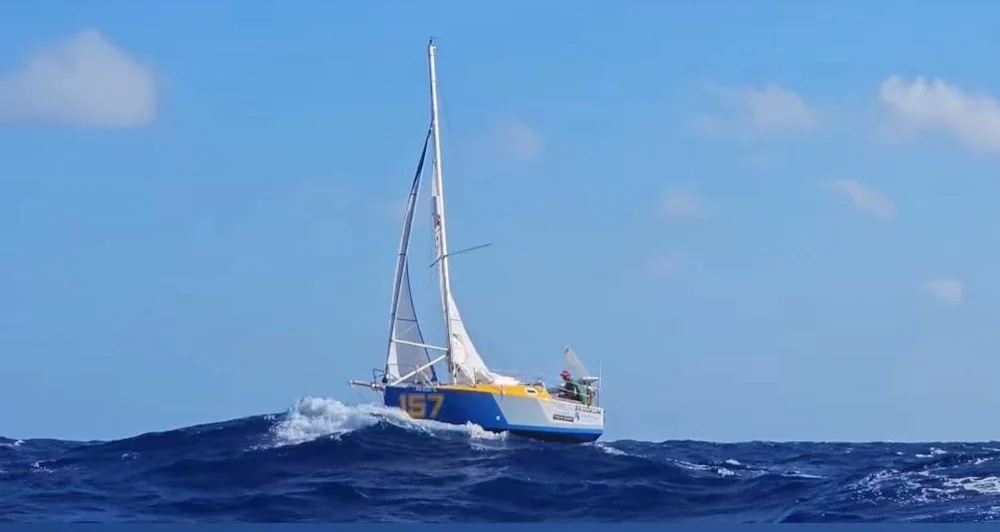
Skookum scooting past Coconut off the Tuamotu Archipelago.
At 72, Eric was still out-sailing skippers half his age, and made steady progress between Panama and Hiva Oa. He did a lot of hand-steering during the day, as he believed that Sunbear was faster with a hand on the helm. Also, he said, it gave him something to do! He celebrated his birthday in Tahiti with his wife Brenda. “I’m getting faster as I go,” he said. “This fleet’s going to be neck-and-neck by Cape Town.”
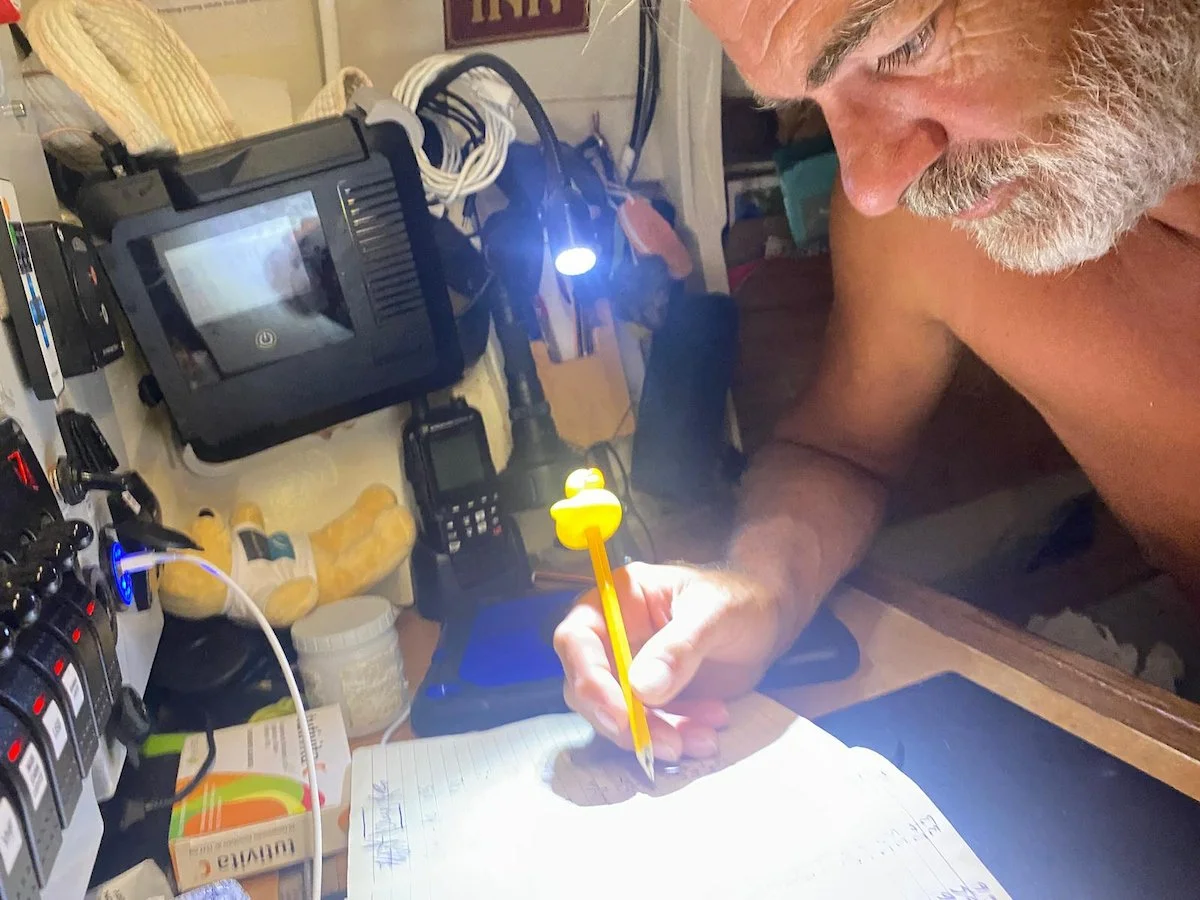
Adam Waugh navigating.
Adam navigated the Tuamotus using sextant sights, a nod to traditional skills. “My accuracy varied from 5 to 40 miles,” he admitted. “Good enough for government work.” Anyone who has taken sextant sights from a 19ft yacht, or even tried to obtain bearings from landmarks using a hand-bearing compass, knows how difficult it can be. He had Little Wren’s cracked windvane bracket welded up in Hiva Oa, and the job was so well-done that he continued using it even after South Atlantic Windvanes sent a complete replacement bracket to Tahiti.
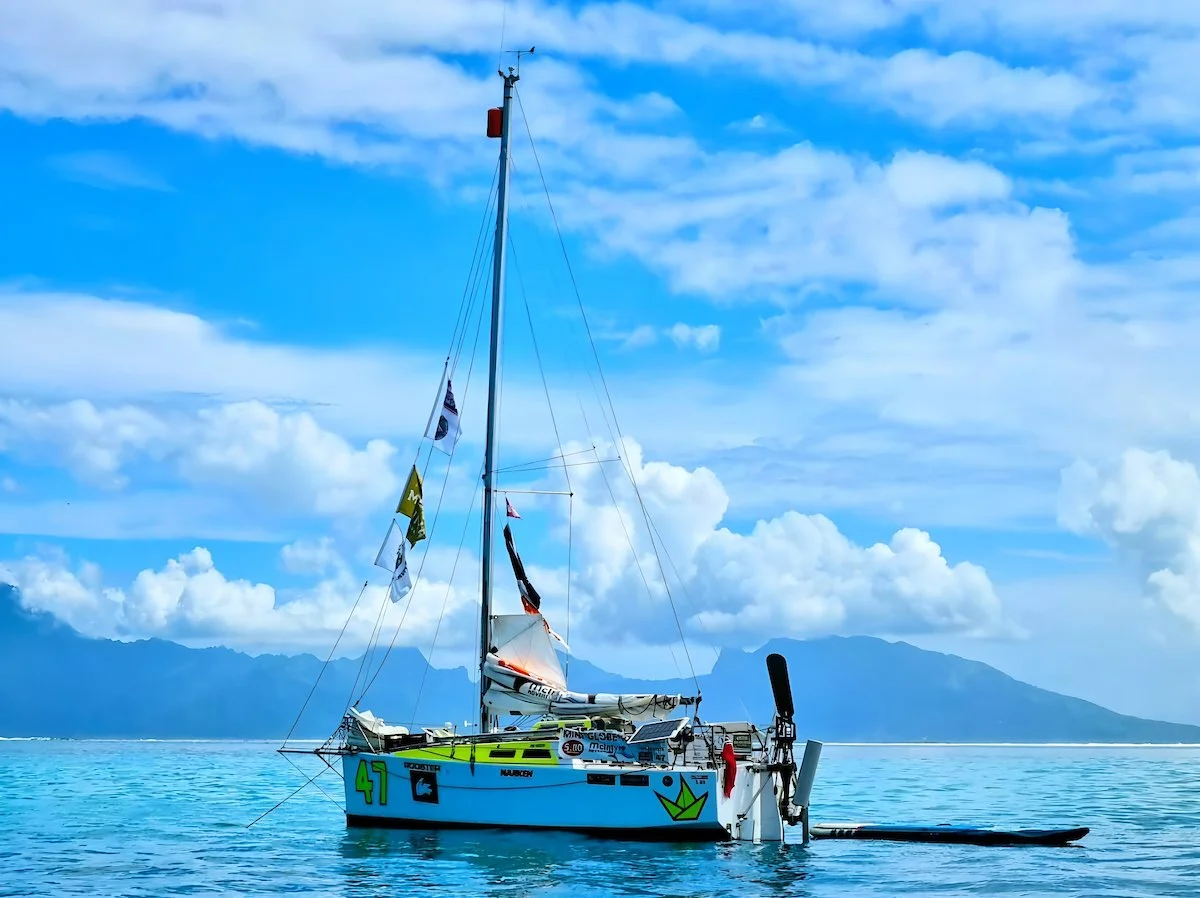
Origami anchored at Papeete, with Moorea in the background.
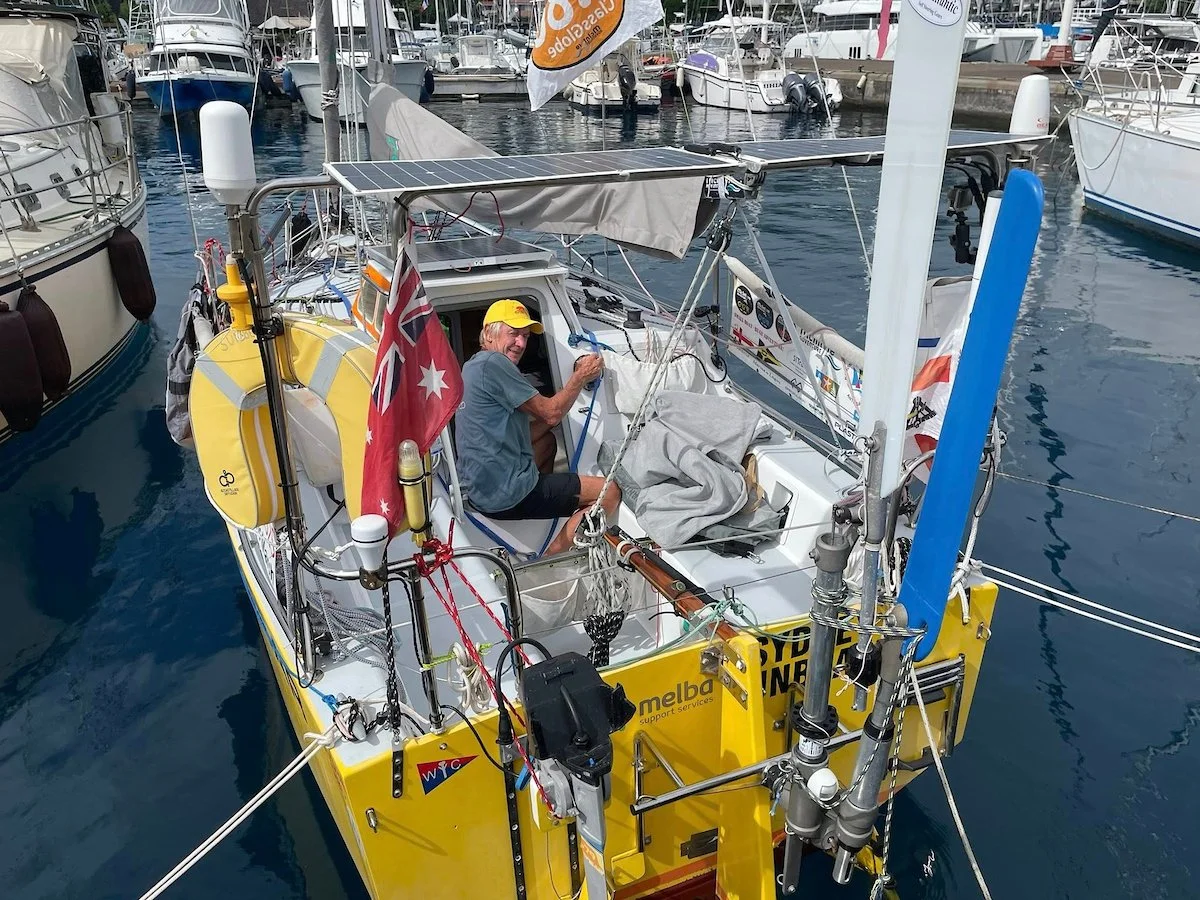
Sunbear in Tahiti.
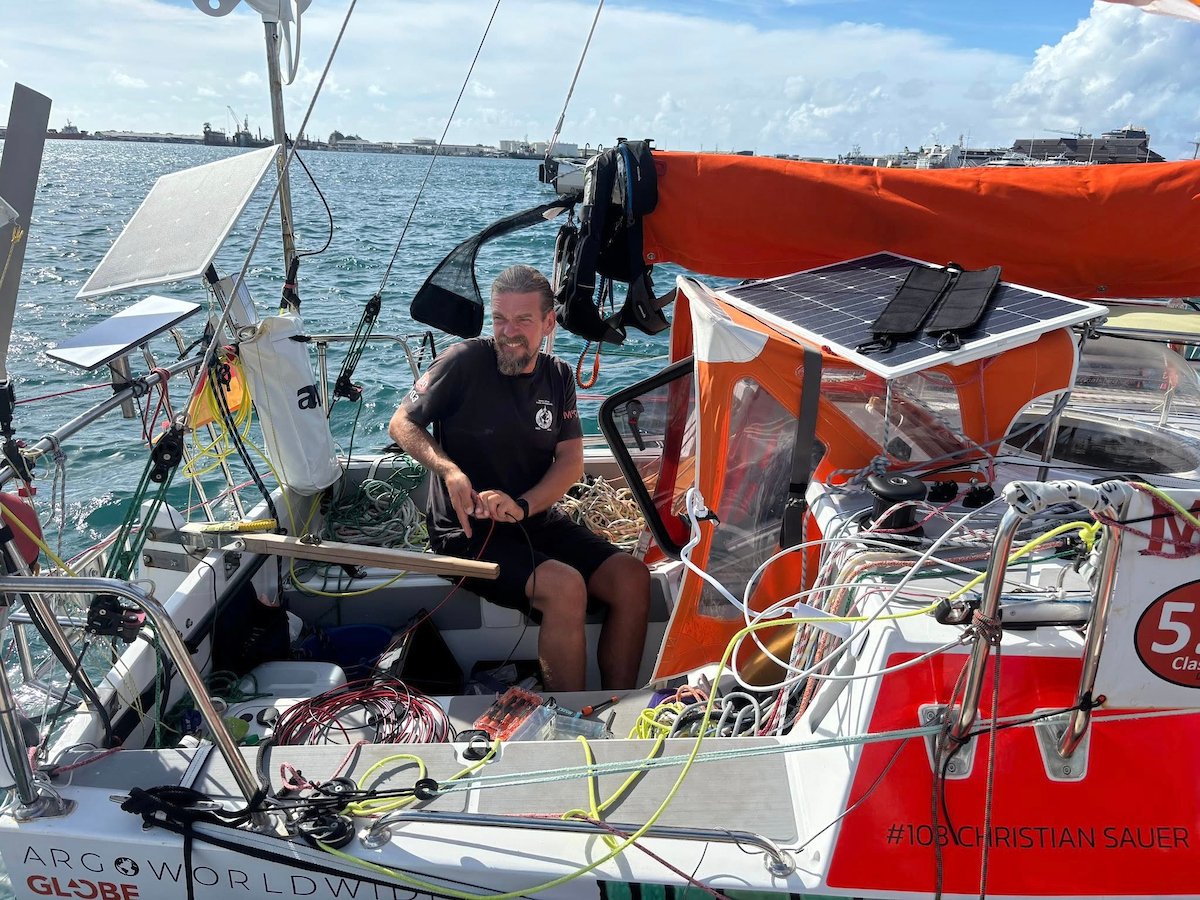
Christian servicing gear in Papeete.
With the MGR’s pitstop format, all boats maintained their relative positions until the end of Leg 3 in Fiji, so with 5500 miles already covered, the leading boats were only a few hundred miles apart at 0800 UTC on the 22nd of May, 2025, enroute from Tahiti to Tonga. Renaud was leading Aussie Dan by 146 miles, then 115 miles further back, Kerri and Pilar were neck and neck, just six miles apart, while another 100 miles further east, Canadan was just 20 miles from Papeete! Gary still had 200 miles to reach Papeete, while Popeye and John were still 500 miles from landfall in the Marquesas. The final 500 miles from Tonga to Fiji was the toughest, with some skippers sailing under bare poles for nearly four days in strong 30-40kt winds and 4-5m seas.
After dominating Leg 1, Renaud secured another victory in Leg 2, crossing the finish line off Vuda Marina, Fiji, on 13 June, after 79 days, 17 hours, and 19 minutes at sea from Balboa. Racing hard all the way, checking weather and options every four hours, trimming incessantly, working as hard as any Vendee Globe Skipper, he had but one objective – to win! His secret? Consistency, discipline, and an almost supernatural ability to avoid wind holes.
Despite dodging 45-knot squalls and wrestling with unpredictable Windy forecasts, he maintained his lead with surgical precision. His biggest complaint? “I wish the fleet started each stage together – I’m basically racing myself!” When asked about his strategy, he shrugged. “Keep the boat balanced,” he said. “Don’t push too hard, and never trust the weather apps.” His track, when viewed on the MGR Tracker, was the straightest of all competitors.
Aussie Dan was Renaud’s shadow across the Pacific, nipping at his heels but never quite overtaking. Renaud was generous with everyone, offering performance tips to any who asked, but Aussie Dan was the one who benefitted most. From being halfway back through the fleet in the Atlantic, he had surged up to the leading pack and stayed there. He was an accomplished short-handed racer, being a veteran of the Melbourne to Osaka doublehanded race, but this was his first solo challenge. His passage from Tahiti to Tonga was a rollercoaster of adrenaline, exhaustion and exultation, featuring 35-knot squalls that forced 20 sail changes in one night, a broken emergency solar panel, courtesy of a mid-sleep bunk ejection, and a triumphant tuna catch just before arriving in Tonga – which he promptly traded for customs clearance and cold beers – such is the MGR!
Pilar was proving to be one to watch. A master mariner of commercial ships, she had stepped down from racing CLASS MINI 650’s in the Atlantic to campaign the MGR. Used to planing hulls, she initially hated the semi-displacement design of the Class Globe 580 (she famously told me, in a sat-phone call mid-Atlantic, “This boat sails like a snake!”), but she had come to know her boat and get the most out of it. Too busy sailing for social media updates, but with a steely focus on performance, she stealthily climbed past Keri to claim the final podium spot for Leg 2. Her strategy? “Sail fast, sleep little, and don’t let Dan Turk pass me.” Mission accomplished.
Keri’s daring southern detour after leaving Papeete, in search of stronger winds, had initially looked like a masterstroke. However, battling 6m swells near the Cook Islands, he injured his back and spent four days bunk-ridden, popping painkillers. Recovery was not helped by the bunk being just a plywood plank – Keri left the mattress and his shoes ashore to save weight. “Life as a watch-dodging sick bay ranger wasn’t in the plan,” he joked. Yet, despite the agony, he clawed back to 4th place, proving that sheer British stubbornness is a valid racing tactic.
The battle for 5th to 10th place was just as dramatic. In order of their arrival, Canadan (5th), survived a 70-knot knockdown, loosing his A7 spinnaker overboard. Christian sailed halfway around the world with a busted shoulder and skin infections. Doctors told him to quit – he told them to watch him finish the race. Adam, like Ertan, was a Zen master – while others fought squalls, he slept eight hours a night and arrived looking as fresh as a daisy.
Eric nearly drifted onto a reef after his electric outboard failed, repeating the scenario that Jasmine rescued him from in Papeete. He still managed to hand-steer like a demon when the wind returned. Jakub wore a cowboy hat for his arrival at Vuda Marina, and crossed the line flying enough flags to rig a schooner, proving that Irish luck works at sea. Ertan, who might hold the record for being the cleanest sailor alive, arrived in Fiji bright-eyed, clean-shaven, and wearing a spotless white shirt – despite having just spent 7,000 miles living in a 19ft plywood sailing box.
Jasmine’s voyage since leaving Lagos, Portugal, in December 2024, had been somewhat brutal, including broaches, black eyes, face-planting the tiller, food poisoning in Tonga, courtesy of suspect fish & chips, a near-miss with an active underwater volcano, headwinds, calms, big winds and big seas, right down to the tiring finish off Vuda Marina! Yet, she never once considered quitting. “I joined this race to see the Pacific,” she had declared in Lanzarote after her first, challenging passage from Lagos, Portugal, “and I am not stopping now!”
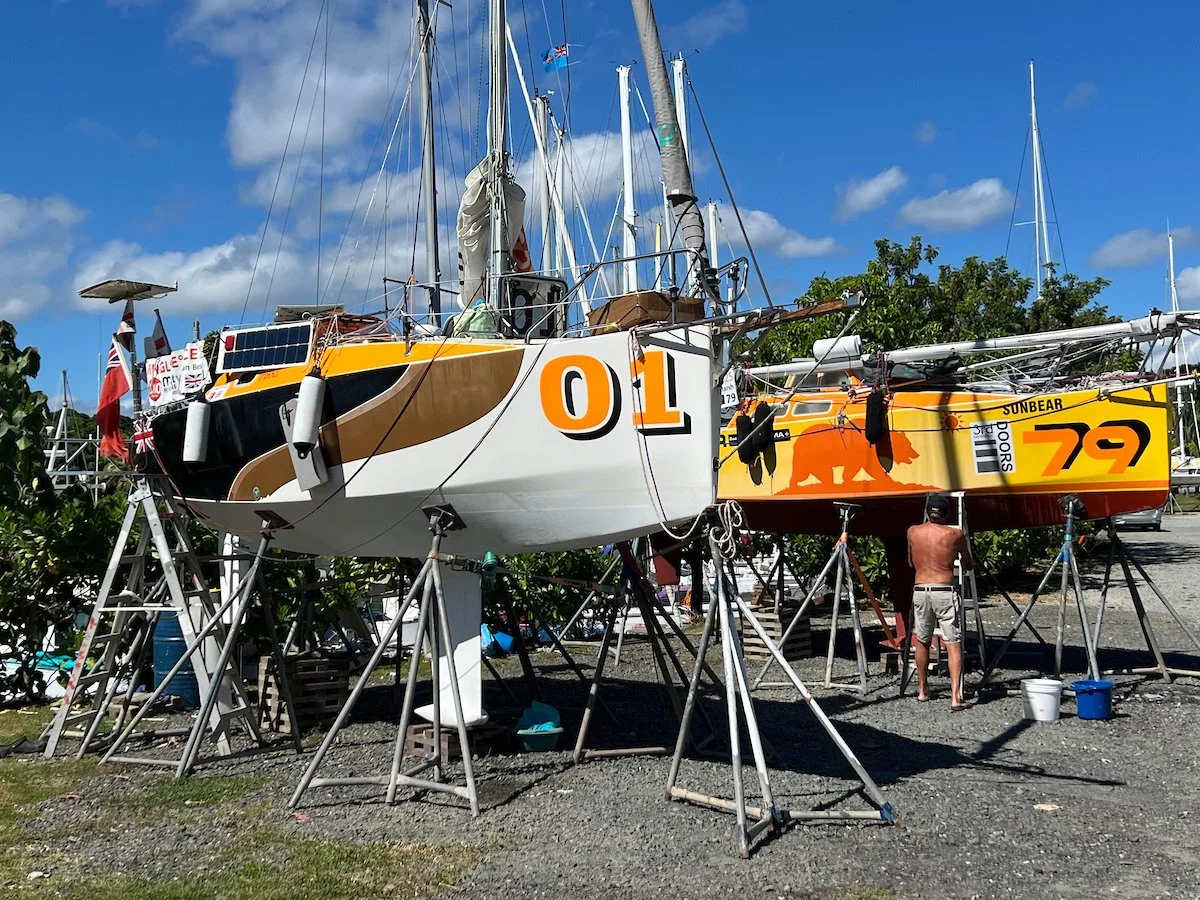
On the hard, Vuda Marina, preparing for the remaining 16,000 miles.
Josh sailed into Vuda Marina looking as relaxed as always, doing well, come what may! He spent his time avoiding squalls, cooking up delicious meals, enjoying audiobooks, and waiting out heavy seas offshore to arrive stress-free. Always near the back of the fleet, his only real competition was trying to outdo Ertan in who was the most laid-back voyager! Skookum and Trekka always arrived in port looking immaculate, with fresh, bright-eyed skippers.

Josh arrives at Vuda Marina, Fiji, at the end of Leg 2. He was always clean, relaxed and Skookum was in good order.
Poor Gary, the Pacific Ocean’s favourite punching bag, was stuck in yet another wind hole between Tahiti and Fiji. Even the fish got sick of him hanging around and took to butting Question 2’s transom with their heads. Then, the last four days saw the boat under bare poles, while Gary stayed down below watching YouTube movies, but he finally made it in. For the first time since the race began, he was rafted alongside the entire fleet.
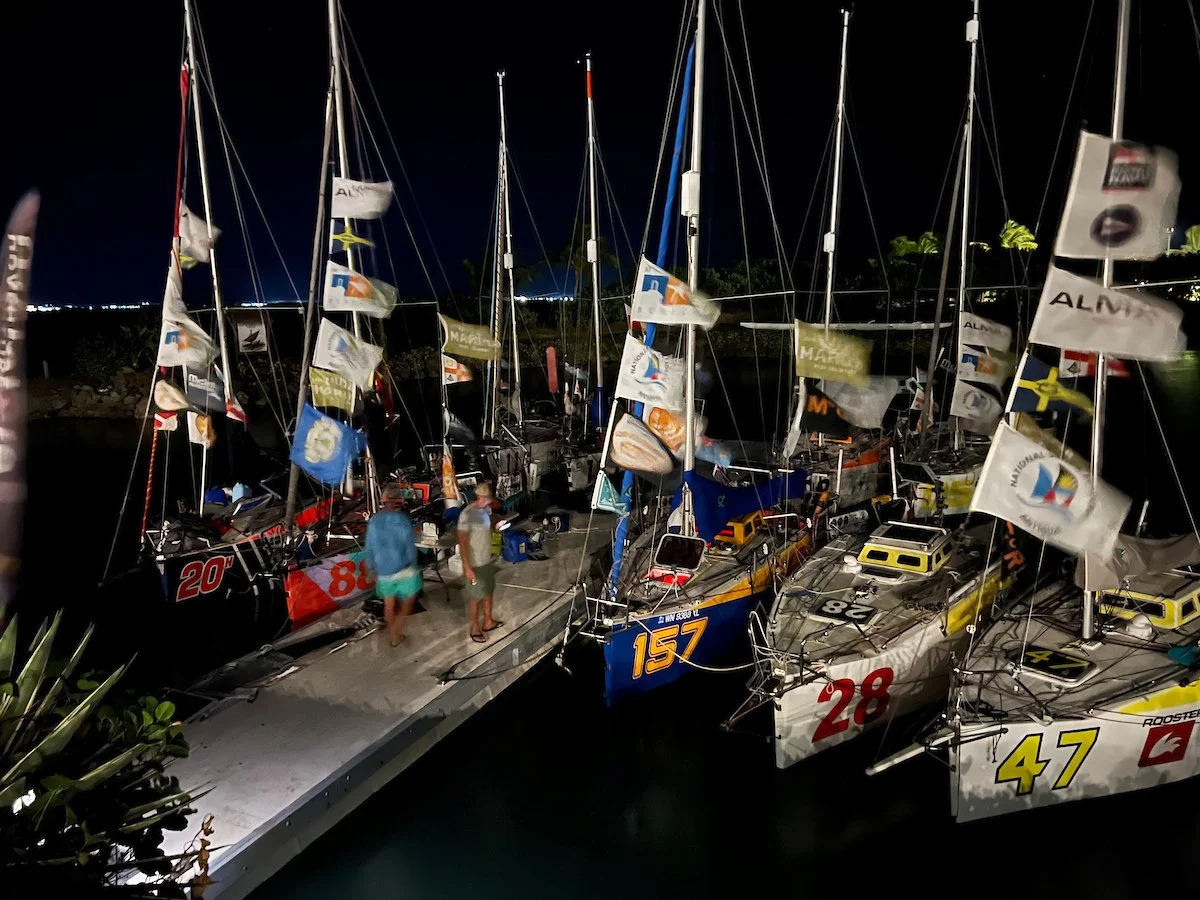
Secret Cove, Vuda Marina.
Sadly, Canadan decided to retire from the MGR for personal reasons while the fleet was in Fiji, leaving only 12 Class Globe 580s to cross the start line for the 10,000nm Leg 3 to Cape Town via the Torres Strait. Gary also announced that he would retire when the fleet arrived in Australia, meaning that only 11 yachts would remain to cross the Indian Ocean.

A Fiji Drua, managed by the University of Fiji and captained by traditional navigator, Setareki Ledua, at the start of Leg 3.

MGR fleet departing Secret Cove, Vuda Marina for the start of Leg 3.
The MGR fleet bid an emotional “Vinaka vakalevu” to Vuda Marina on July 26th, with a start so picturesque it could have been a postcard. The University of Fiji’s drua (traditional voyaging canoe), I Vola Sigavou, marked the eastern end of the start line, while Captain Coconut’s trusty Coconut (the unofficial ‘Big Mama’ of the fleet) held the west. A Fijian choir sang farewells, warriors blew sacred conch shells, and the skippers – some still scrambling with last-minute fixes – set off in a light NW breeze.
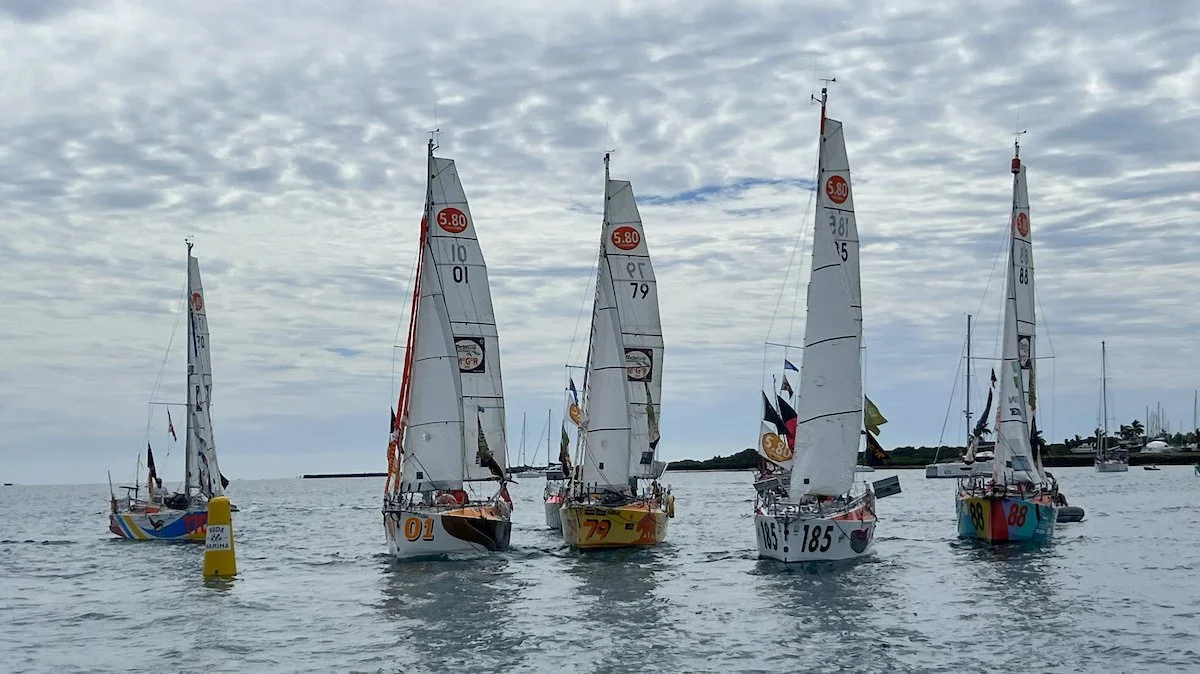
Approaching the start line off Vuda Marina, Fiji.
The first night out of the blue lagoon was brutal. Adam spent it hand-steering in 20-30kt gusts, muttering about how this was not the South Pacific paradise he’d dreamed of. Jakub battled an ear infection, feeling off! Jasmine wrestled a stubbornly-tight Hydrovane mount and had no sleep, hand-steering all night. At one point, looking out, she was startled to see Trekka almost pecking Numbatou’s transom. Christian also found it hard to relax, having discovered a faulty rigging terminal in his new standing rigging just before departure. He sorted it out, but wondered about the other terminals for some time afterwards.
Meanwhile, Renaud and Aussie Dan were engaged in a drag race, swapping the lead like two kids fighting over the last cookie. Now that Canadan was no longer in the race, Aussie Dan will just be referred to as Dan. Keri – ever the maverick—zoomed off north, muttering, “There is not much point following the leaders in a one-design race.”
The Middle Pack, known as the “Friendly Rivalry Club”, included Pilar (who would ultimately push ahead and join the lead pack), Jakub, Eric, Josh, Adam, Jasmine, and Gary. For a while, they were locked in a VHF-fuelled gossip fest. Highlights of their conversations including advising Jasmine about how to best perform Hydrovane Yoga – hanging upside-down over Numbatou’s stern, loosening overtight bolts like a contortionist mechanic.
Dan had a scary Orca encounter. He threw fish scraps overboard, only to be greeted by a pod of killer whales charging up out of the depths towards Immortal Game’s transom. Luckily, they only wanted snacks, not his rudder. As he approached Australia, Dan began to miss Australia, and questioned whether he should retire and go home to his family. They had visited him in Fiji and he was missing them badly.
Gary fell out of his bunk on the first night out, when Question 2 lurched over a wave crest. Landing on his kettle, he dented it badly (he is a big lad), but was pleased to discover that he could still use it. Josh kept Skookum in the groove, savouring the company of other MGR boats on the horizon for a change. It brought out the racer in him, sailing hard, hand-steering for long hours. But his competitive mood didn’t last long, and soon he was back to doing what he did best, just sailing his own voyage, in tune with boat and ocean.
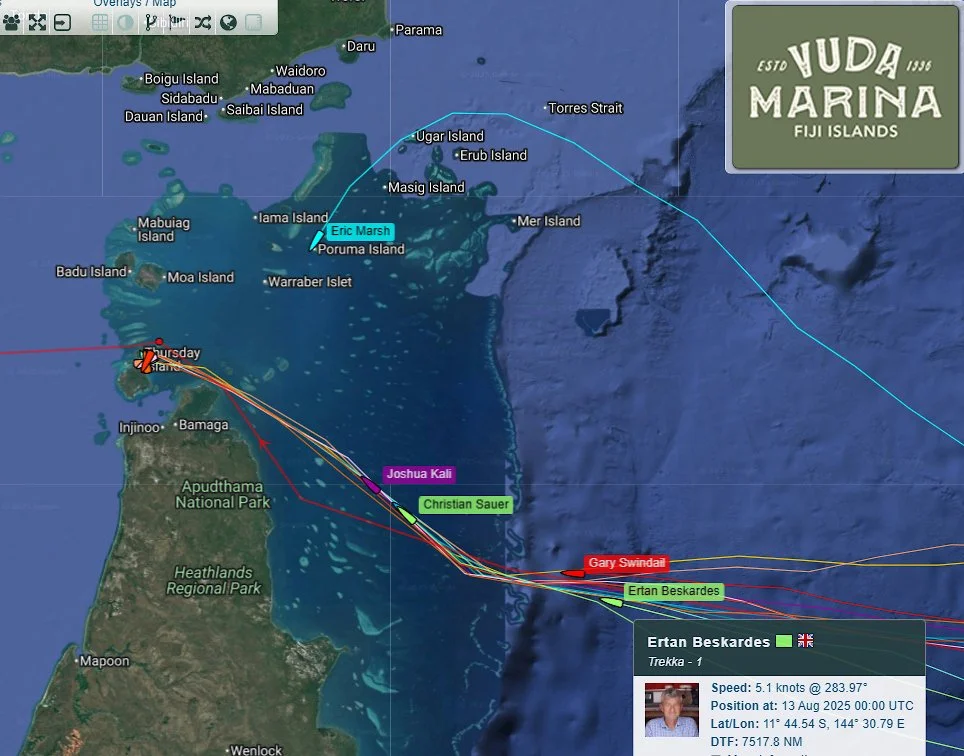
Passage into the Great Barrier Reef.
As the fleet approached Australia’s Great Barrier Reef, things got spicy. Renaud was first through Raine Island Passage in the early hours, guided by a full moon, battling 1.5kt currents and confused seas. Keri followed a few hours later, channelling his inner naval commander with cryptic messages like, “Damage Control State 3, Condition Yankee!” (Translation: “I’m tired, but pretending I’m not.”) Both skippers did not sleep for over 30 hours until they put the anchor down at Thursday Island.
Immortal Game screeched past Cape York, with Dan looking like a kid on a sugar high, grinning about being back in Australian waters, and dreaming of meat pies with sauce and a beer! Pilar was 4th into Thursday Island. She smashed out a 144-mile day along the way, proving that Peter Punk was not messing around. Pilar was hunting a podium position.
The Jakub versus Eric versus Adam showdown reached gladiator levels on this stage. At one point, Bibi and Sunbear were just two miles apart all night, with neither skipper sleeping as they duelled under A3 spinnakers. Then Eric diverted to Bligh Entrance, 100 miles north, unnerved by the rough seas and gambling on a longer but safer route. He proved, decisively, that passing through Raine Island Passage was the quickest way to get to Thursday Island, slipping from 5th to 7th place in the rankings by the time he arrived. In the meantime, Adam finally pulled ahead of Jakub, after trying for way too long. He celebrating with a bucket bath. Keri’s comment, “Not THAT bucket!”, brought howls of laughter from other skippers.
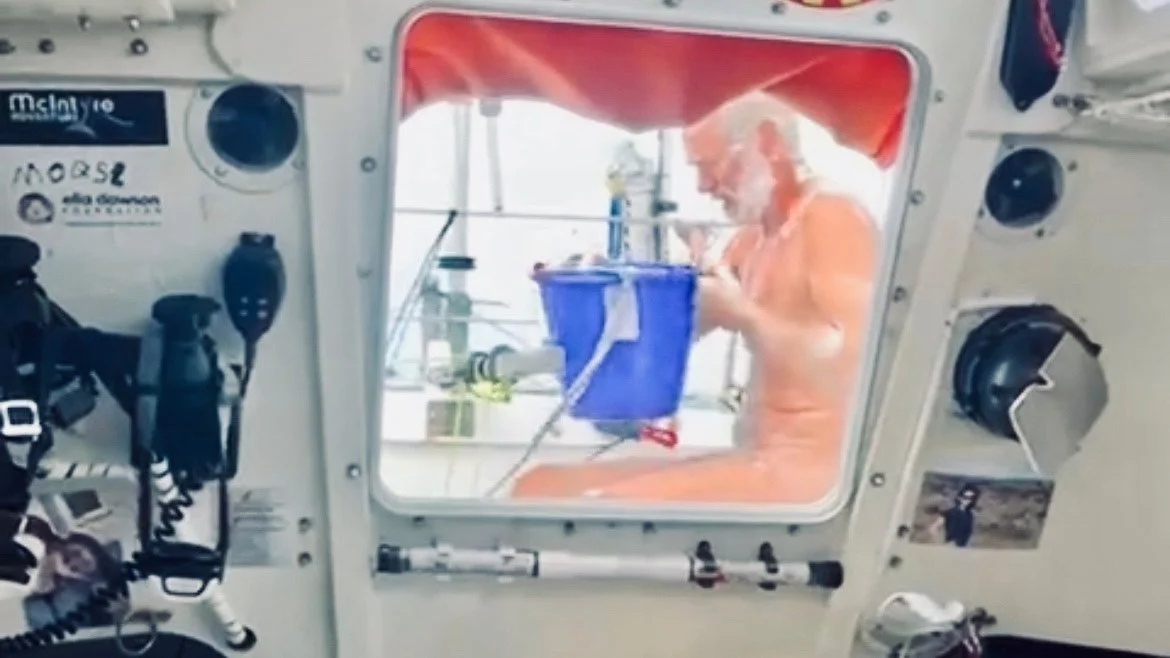
Adam's bath day. Not THAT bucket!
In the boisterous waves of the Coral Sea, an unexpected cross-sea slammed Argo’s boom across unexpectedly, giving Christian a nasty head wound. After consulting MSOS medics, he shrugged it off and kept charging towards Raine Island. Once inside the protection of the Great Barrier Reefs, he had a fast and furious but sleepless passage to Thursday Island, duelling with Jasmine all the way, with 25-knot SE easterlies and short, steep, 2m seas chasing them north. It was anybody’s guess who would get there first, until Jasmine went east of an island and Christian west. When they emerged at the northern end, Numbatou had edged out Argo by a couple of miles.
Thursday Island received mixed reviews from the fleet while they were there, with the incessant, howling trade winds, 3m crocs in the anchorage, and limited facilities ashore. After the wild ride from Fiji, they might have appreciated a more settled anchorage. Luckily, there was a water taxi available to take them to the pub, though they only managed one late night by special arrangement with the taxi driver. Looking back, they mostly agreed it had been a unique experience!

Journey’s end. Gary Swindail and Question 2 arrive in Darwin, marking the official conclusion of his race. Credit Christine Elizabeth Turner..jpg
By early September, the fleet stretched like a necklace across the eastern Indian Ocean, bound for Cocos-Keeling Atoll. At the sharp end, Renaud, Dan, Keri, and Pilar drove hard, carving out a commanding lead of 400 miles over the rest of the fleet. They battled 30-40kt winds and 4m seas for the last few days before landfall, but made spectacular daily runs of over 140nm. Behind them, Adam, Jakub, Josh, Jasmine, Christian, Eric and Ertan finally shook free of Australia’s wind-shadow and surged west, often logging 120-mile days once again. For a while there, crossing the Arafura Sea and skirting Timor, with its fluky winds, adverse currents and unpredictable Indonesian fishing boats, patience was sorely tested.

Argo sailing on the Arafura Sea. This shot was captured by Eric Marsh aboard Sunbear, who sailed in close company with Christian at one point.
The fleet had been nervous about meeting pirates, but the real challenge proved to be swarms of fishing boats, scary-looking FADs (fish attraction devices), near-misses with large commercial ships, and collisions with UFOs (unidentified floating objects). Numbatou hit something very hard, and later inspection showed a dent in the 20mm-thick plywood bottom panel. Gear failures were also mounting: torn sails, broken spreaders, fading electronics. The sun was shredding spinnakers, with replacements earning 48-hour penalties. The penalties and gear restrictions added an interesting dimension to the MGR – ensuring that the team with the deepest pockets would not necessarily dominate the competition.

Indonesian fishing boats in the timor Sea, photographed by Keri.
Renaud arrived first at Cocos, Dan hours behind, then Keri, followed by Pilar. Heavy weather made anchoring a drama – Dan got his anchor line tangled around the keel and had to be extracted from the situation by Renaud. Pilar’s anchor fouled in the coral and she needed assistance to raise it and move into more sheltered water close under the lee of Direction Island.
The rest of the fleet also had their challenges approaching Cocos. Jakub managed the impressive feat of spearing an entire tree – a floating ecosystem of branches and plastic – on his keel. After some ingenious heaving-to using a bucket as a drogue, he freed his boat, only to discover a torn jib that required a five-hour sewing session.
Jasmine endured a brutal final 24 hours, battling squalls interspersed with dead calm, to make a nerve-wracking, pre-dawn entrance. Soaked and exhausted, she rafted up to Jakub for a 3am pancake summit.
Adam sailed much of the way under twin jibs, the picture of Guzzwell-inspired tradition, though had an uncomfortably close encounter with the windward reef of Direction Island on his final approach. Only quick thinking, and a sharp knife to slash his boom preventer, allowing him to gybe clear, saved the day. He was just 50m away from disaster.
Josh brought up the rear, dealing with a second broken spreader aboard Skookum, after an accidental gybe, and a demanding beat into the anchorage under sail. He had repaired the same spreader at Thursday Island (along with Keri, who had the same problem).
Eric fought a biblical downpour and 35-knot gusts just miles from the finish. Luckily, it calmed down enough to allow him to sail safely in through the pass. He took a well-earned break ashore for a few days, staying in the mansion that was once the residence of the last ‘King of Cocos”, John Cecil Clunies-Ross, and his forebears.
The anchorage in the lagoon at Cocos Keeling, in the lee of Direction Island, proved to be another windy, exposed place, with limited access to facilities or provisions, but the lagoon was spectacularly beautiful – plus there were no crocodiles! There were plenty of sharks, but Ertan reckoned they were friendly – he swam with them every day. Everybody enjoyed Cocos, and the 10-day stopover provided a much-needed break before facing the sometimes-brutal passage to Mauritius and South Africa.

The entire fleet of eleven ALMA Globe 580s eventually congregated in the stunning, if blustery, lagoon of Cocos Keeling Atoll. Each arrival was a drama in itself. Credit SV Sipi.

Diving at the pass in Cocos. Left to right - Eric, Dan, Pilar and Renaud.
The stopover was a blur of beach barbecues, failed provisioning runs (yielding mysterious tinned buffalo meat and quail eggs, among other oddities), and, for Jasmine, a burst of creativity as she finger-painted a commemorative MGR sign, gleefully abbreviating boat names like a seasoned graffiti artist (Punk, Skook, Wren… you get the idea).
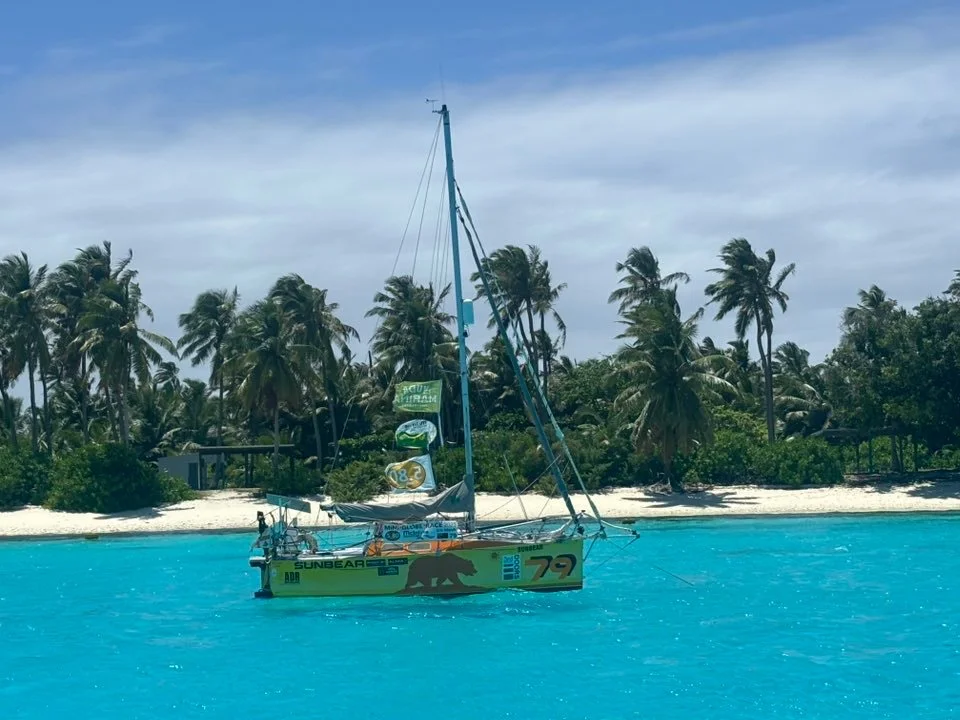
Sunbear anchored at Cocos
On September 18th, the exodus began. The 2,000-mile leg to Rodrigues Island started with a bang – or more accurately, a series of crashes. A large, confused cross-sea, relentless squalls, and winds gusting to 35 knots welcomed the fleet back to the deep. This passage, from Cocos to Rodrigues and Mauritius Islands, is often known for being boisterous – and it was.
Renaud continued to set a blistering pace. While his track on the YB tracker looked deceptively straight, he confessed that it required ‘permanent work’ – a constant, exhausting dance with the sheets and windvane to counter shifting winds.
Capucinette, like all the ALMA Globe 580 yachts, was structurally in good shape, considering they have already travelled 17,000 miles in the past nine months, though Renaud had a major problem with condensation and mould. Halfway through this passage, he reported, “With all the rain we have had, all the wind, and waves from everywhere, you cannot open the hatch. And a lot of the time, you are on the side, I don’t know how far. I don’t know how close the mast is to the water or whatever, but it’s very far. Then you have to close the air vent, because if you don’t, you have a shower in the boat. There is condensation everywhere. Capucinette is fast, but is developing a serious ecosystem of its own.” With humidity at 92% and hatches sealed against waves, he joked about harvesting mushrooms for a salad. “This is the hardest passage so far,” he admitted.
Dan, holding a strong second, endured a “comedy of errors.” amongst his knockdowns. His world was a sequence of being becalmed, then being slammed by 30-knot headwinds, being assaulted by vengeful flying fish, and witnessing a container of couscous explode below decks like a culinary grenade. A rogue wave through an open hatch then drenched his last dry bunk. “I can’t say that I’ve enjoyed this passage much,” he said, something of an understatement. He was dreaming of a restaurant meal in Rodrigues, and a cold beer or two.

Keri Harris capturing the emotion, contemplating the meaning of life, all while he pushes hard.
Keri immediately dove south, following his usual tactic of not following the leader, where he battled the same chaotic seas. He spent days sheltering below, letting his trusty Aries windvane handle the “brave stuff” outside. His biggest battle was mental; with his audiobook gear lost in the mail, he was alone with his thoughts, especially about his gravely-ill mother, with whom he was very close. “Sometime you think, I am going crazy here,” he confessed, voicing the silent struggle of many solo sailors under duress.
Pilar, holding station in 4th place, was working hard to hang onto the three boats up front, often sailing 145-mile days. She experienced one bad knockdown that bounced her off a cleat, with a serious bruise making sleep difficult. As usual, communications with her were infrequent.
Adam was the fleet’s stalwart. He diligently cooked hot meals with his questionable Cocos provisions (including buffalo meat that he says was obviously very old when it found its way into the can). Along with sardines, it soon joined the list of banned foods aboard Little Wren! He also shaved his head, adopting a startling new look. Perhaps he thought the streamlined look would make him go faster!
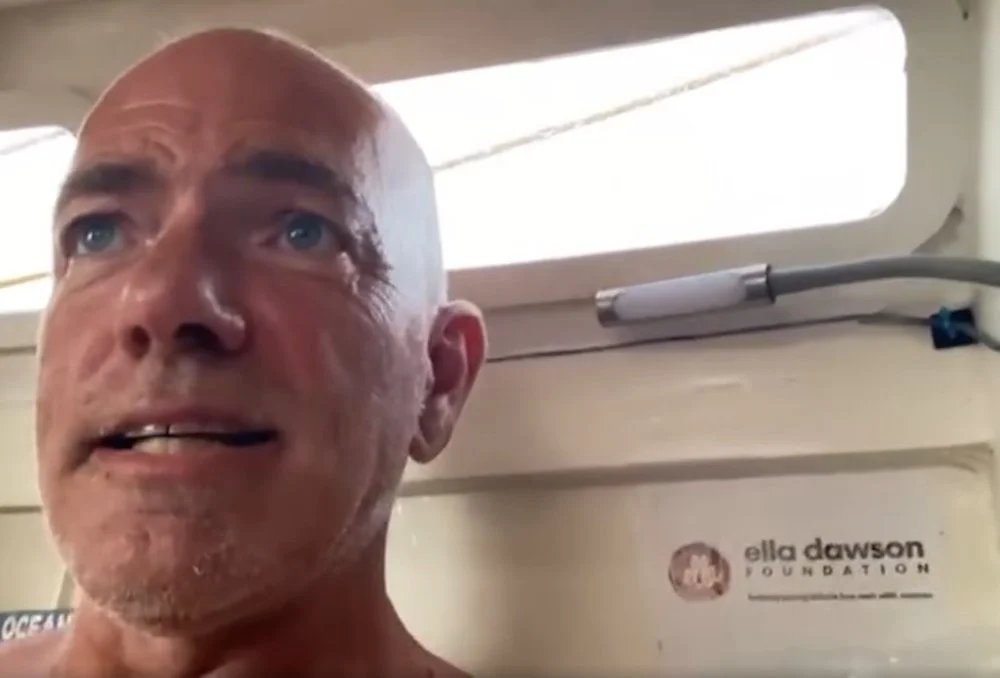
Adam with his go-fast crew cut.
He rarely hand-steered Little Wren. He was one of only two MGR skippers (Josh being the other), who stuck with the originally-specified South Atlantic windvane all the way around the world. They both proved that with proper attention to boat balance, the unit worked perfectly well. It was only when the hotshots up front pushed their boats to the limit that the need for more powerful units became obvious.
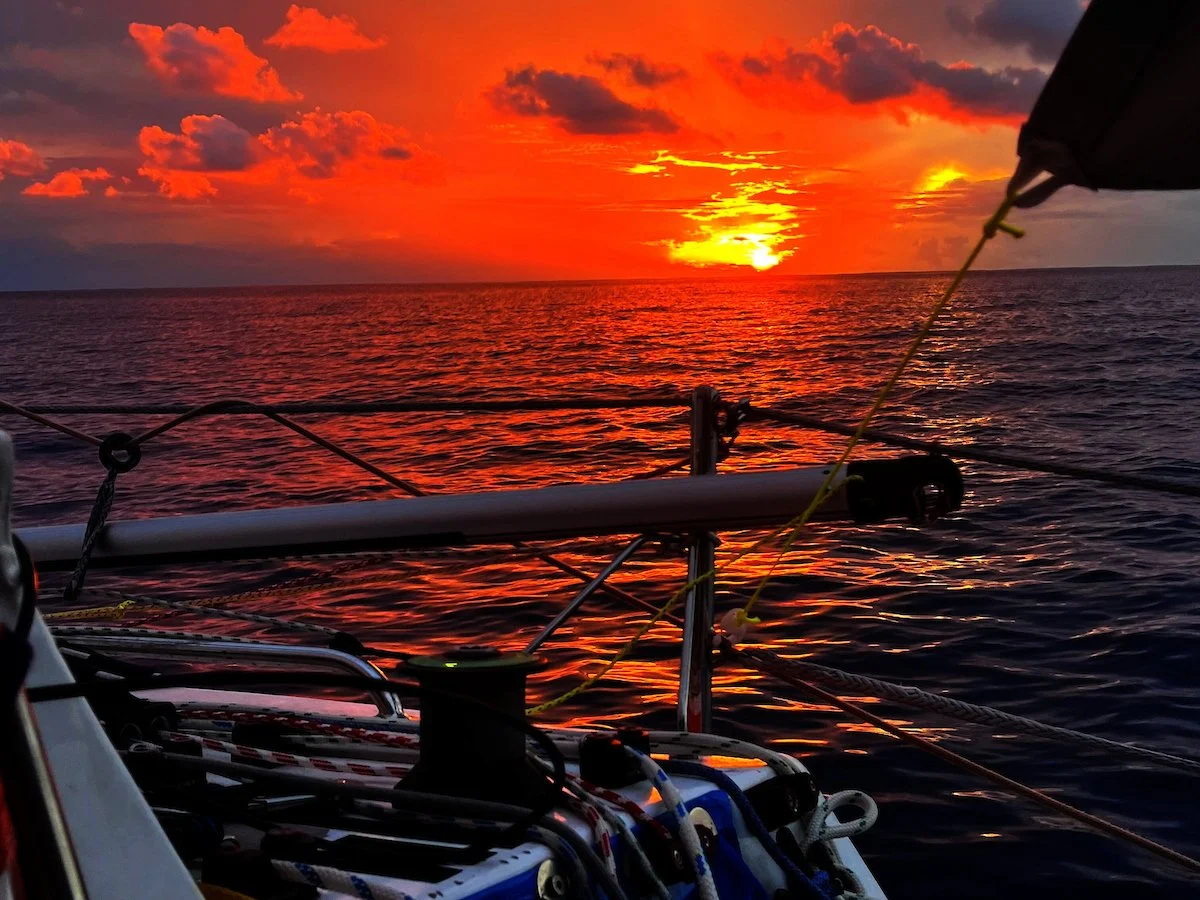
Sunset aboard Little Wren.
Jakub was in his element on this passage. “I like to roll to one side instead of one-two, left-right!” he quipped, revelling in the fast beam reaches. He was feeling the cold as Bibi worked further south, and had already broken out his beanie and sleeping bag as the air grew cooler. He kept his AIS, Echomax and VHF radio on all the time to assist with watchkeeping while he slept. However, he was shocked to find a ship creeping up on him one day, with a close CPA, despite the alarm not sounding, or getting a radio call. Upon investigation, he realised that he had switched his AIS alarm off when approaching Cocos, due to the number of signals from boats in the anchorage, and had forgotten to reset it. Ditto the VHF – it was still set to Channel 20, the working frequency of Cocos-Keeling. For Jakub, life aboard Bibi had become his new normal. What he was worried about was life after the MGR.
Christian was having a “bumpy” ride, so much so that he began using his mountain bike helmet and chest harness inside Argo, strapping himself against the windward side of the hull to avoid injury to his damaged shoulder while sleeping. He was also engaged in a fierce duel with Jakub, determined to pass him before they arrived in Rodrigues Island, “I thought it would be easier to pass Bibi,” he chuckled, “but it is not over yet!” He never did catch Bibi – Jakub was on fire.
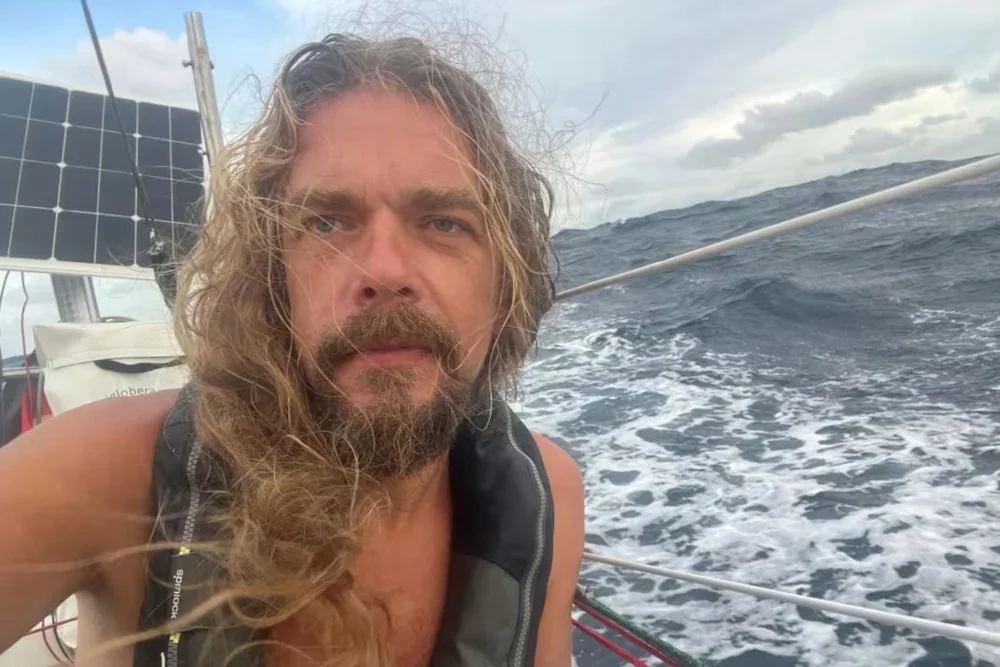
Christian riding the big seas of the Indian Ocean.
Jasmine was exhausted, but she was as tough as nails. She went to bed at 6:30 pm most nights, but was regularly woken when her boat rounded up violently in the beam seas, sending her “flying to the other side of the boat.” She hung onto her sail, though, and was keeping up with the middle fleet. In the cloudy, stormy conditions, she was managing power by shutting off her AIS during the day, and was desperately looking forward to eating food from a plate in Rodriguez Island, not straight from the pan. When all else failed, she gorged on chocolate – there was always lots of chocolate on Numbatou.
Ertan had perfected the art of cruising in this race. With 25-knot winds and 4m seas on the port stern quarter, he rolled up his jib and sailed under a triple-reefed main, making a serene 4 knots. “I’ve not been out on deck at all for the last two days,” he reported from his cabin cot, happily bingeing on downloaded movies. He slept 10-12 hours a day. “I could roll out a bit of jib, but then I would have to go out and get wet,” he noted. Nonetheless, he was still staying in contact with the middle fleet.
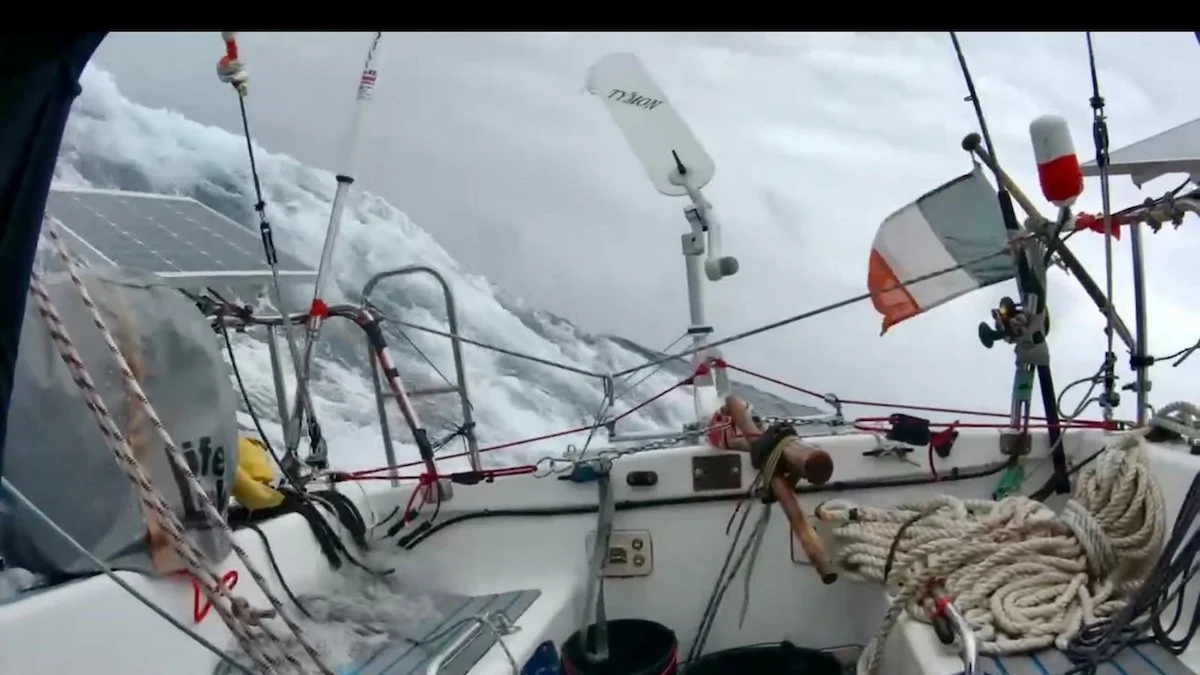
It was rough going after leaving Cocos - Bibi gets slammed by a breaking sea.
Josh, the MGR’s unflappable mountaineer turned sailor, was in his absolute element. He had been looking forward to the challenges of the Indian Ocean. Generally dry, he did finally take a wave down below. The biggest issue was that his mainsail split right across, just below the Globe 580 logo, and could not be repaired. He sailed on under headsails. He hand-steered for fun during the day, enjoying the way Skookum surfed across the waves, and then left the boat under control of his windvane at night. He wore his climbing harness in the windward bunk (to help Skookum sail more upright), clipped to the hull. “It’s like sleeping on a mountain ledge,” he explained. For him, it was just another day at the office.

19 October 2025 - Josh Kali arrives at the Customs Dock in Port Louis, Mauritius . He is pointint to his torn mainsail.
Luckily for Josh, Jasmine had a spare mainsail that he was able to acquire in Rodrigues. By this time, most of the boats were suffering UV damage to their sails, particularly mainsails, and patching them up was to become an ongoing chore. Jasmine had already switched over to her new mainsail, hence the spare being available. For her, the A sails (asymmetric spinnakers) were the challenge. Her beautiful, bright pink A5, which had become her signature sail at the start of each leg, had faded to a dusty rose colour.
Eric reported that Sunbear was experiencing a violent motion that forced him to sleep on the cabin sole, wedged between the settees against a bucket. He noted that the bucket was not for throwing up in, despite what it looked like! It was the only way to get some rest due to the boat’s rolling motion.
This leg invites comparison with the Indian Ocean passage experienced by the late, great John Guzzwell, Patron of the McIntyre Mini Globe Race, who sailed this route in 1958 on the original Trekka. He wrote at the time of perfect tradewind sailing, day after glorious day, sitting on deck with his shirt off in glorious sunshine. The 2025 MGR fleet saw a different, feistier Indian Ocean. The MGR boats proved on this leg that they were a little faster than Guzzwell’s Trekka, but one has to remember that Guzzwell did not have the benefits of self-steering gear, roller-reefing sails, or daily weather and tidal-stream updates from Windy via Starlink.
The fleet thoroughly enjoyed their time at Rodrigues Island, which boasts a quaint community little affected by tourism. They then went on to Mauritius, where they regrouped in picturesque Grand Baie before a mass restart off the capital, Port Louis, for the passage to Durban. This was perhaps the most feared passage of the entire circumnavigation, as there is no place to hide as you sail south of Madagascar and across the Mozambique Channel. This is traditionally the home of monstrous seas and broken boats.
However, the most dramatic moment of the entire MGR occurred on the short, relatively benign sail from Reunion Island to Mauritius. At approximately 0300 UTC on 17th October, Eric reported to MGR management that he was back on board Sunbear after being swept from the foredeck by a large wave, while putting his spinnaker pole away. He was about 70 miles from Mauritius, broad-reaching in rain squalls, 20-25kt easterly winds and 2-3m seas. He was clipped on with his long tether to the jacklines on deck, but had neglected to attach his short tether to the mast, which he usually did when needing to use both hands. As a result, he was dragged alongside the bows, with the boat charging along at 5 knots, and had to roll over onto his back to avoid being drowned.

Swept overboard from Sunbear by a rogue wave just before reaching Mauritius, veteran sailor, Eric Marsh, clawed his way back onto the deck. Note here the harness jackline and hull bridle that saved him.
Three things saved his life – a running bridle rigged along both sides of the hull from bow to stern, outside of the shrouds and lifelines, the short tether, and the snap-shackle at the end of that tether. All three items are unique to the 580 fleet’s safety planning. He managed to attach the short tether to the bridle, disconnect the long tether, slide down the side of the hull to the stern, then drag himself back aboard under the lifelines. There was one extra-scary moment, when he had to unclip himself from the bridle to get back into the cockpit, because his self-inflating lifejacket was hindering him. In the heat of the moment, he could not locate the valve to release air from the jacket. If he had lost his grip at that moment, it would have all been over.
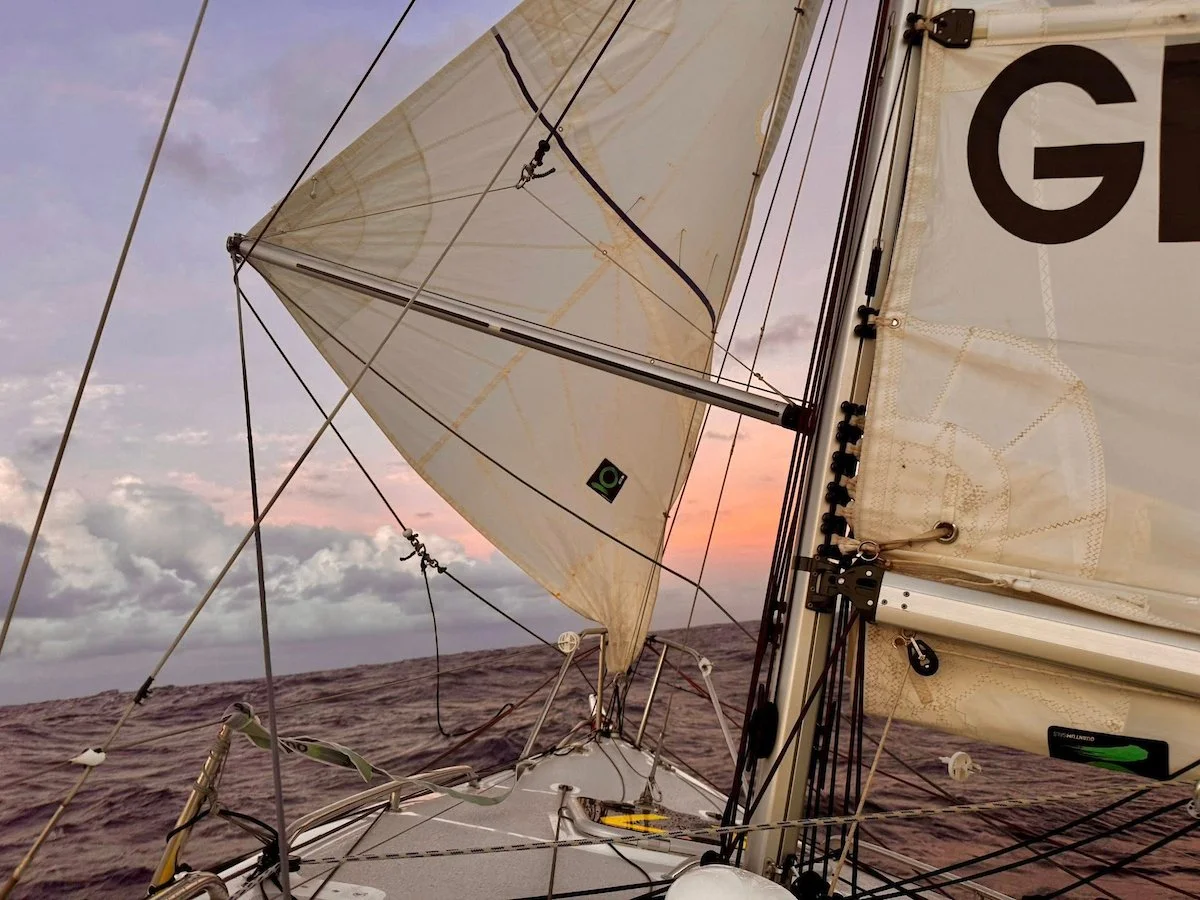
Origami with Keri's favourite rig setup - he did not like sailing dead downwind under twin jibs
PART THREE NEXT WEEK
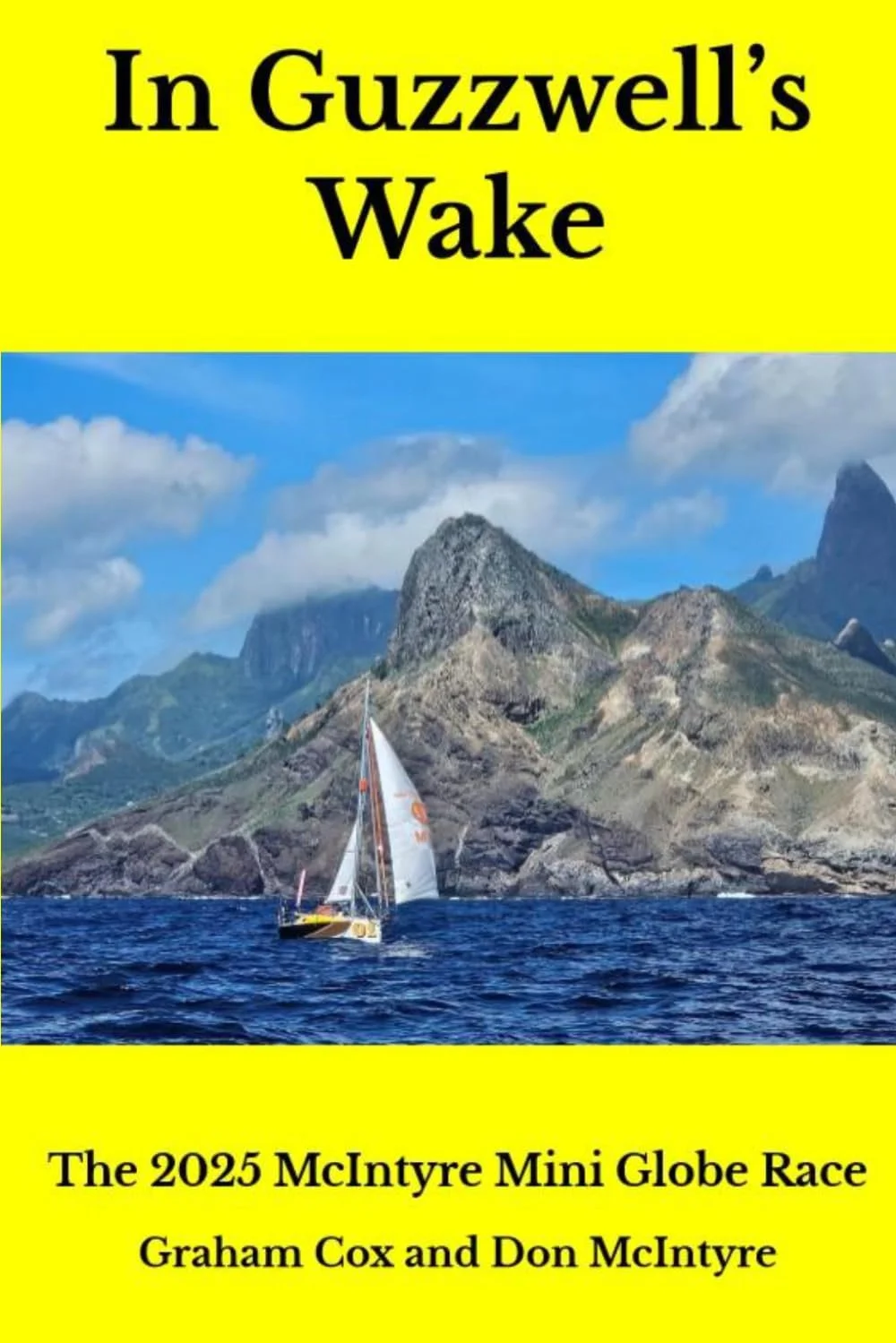
Graham Cox was the official scribe for the Mini Globe Race, talking to each skipper once a fortnight while they were at sea. He is the author of In Guzzwell’s Wake, the official story of the Mini Globe Race. He is also the author of Last Days of the Slocum Era, the acclaimed memoir which is also a selective history of cruising under sail in the days before satellite navigation. Both titles are available from Amazon, and the e-book versions are also offered by Kobo.
All images used in this article are the property of McIntyre Adventures and their respective owners, and may not be reproduced without permission.