
The (Not So) Impossible Race Around the World – The 2025 Mini Globe Race.
By Graham Cox
In the decades since the first singlehanded, long-distance ocean race took place – the 1960 OSTAR – the sport has evolved to become almost a mainstream activity, although the Golden Globe Race (GGR), a nonstop circumnavigation race, could best be described as an extreme sport! In 2025, another solo circumnavigation race, the Mini Globe Race (MGR), joined the GGR in terms of sheer audacity.
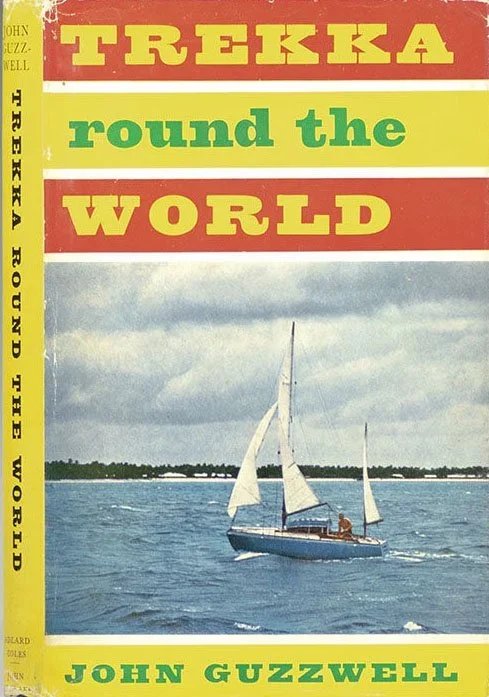
Sailed largely in the southern hemisphere, and including five Australian entrants, the MGR was the brainchild of Australian adventurer and entrepreneur, Don McIntrye (known to his friends as the mad bastard). Don conceived the MGR as a tribute to John Guzzwell, on the 70th anniversary of the date that John set out from Vancouver, BC, to sail solo around the world aboard his self-built 20ft 6in yawl, Trekka. John had no electrical system on Trekka, or self-steering gear, and yet he made fast, seamanlike passages. His voyage, completed in 1959, was the first circumnavigation of the world in a micro-yacht.
The book that he subsequently wrote, Trekka Round the World, remains a cult classic, and reading it has launched thousands of dreamers on adventures of their own, including Don and myself. For Don, having relaunched the GGR in 2018 (the 1968 GGR also had a seminal influence on him) it was a natural progression.
The idea was simple. A singlehanded race around the world, following Trekka’s route as much as possible, in double-chined, 5.8m (19ft) sheet-plywood sloops. Entrants were encouraged to build their own boats, though it was not mandatory. Don commissioned a design, the Class Globe 580, from Janusz Maderski in Poland, had hull #1 professionally built, named it Trekka, and in 2021, raced across the Atlantic in the inaugural Globe 580 Transat race.
Crossing the Atlantic alone in a micro-yacht has always been considered a feat of significance, and prior to the MGR, there had been only a handful of circumnavigations by boat under 6m. The idea of racing around aboard homebuilt plywood boxes, in a little over 12 months, was considered outrageous by some people, and bets were laid that not many would complete the course.
Nine of the 15 skippers who crossed the start line of the MGR in Antigua on February 23rd, 2025, built their own boats, while another four boats were homebuilt by their original owners. The process was simplified, as much as it can be, by files being programmed to produce CNC-routed kits, though the task of constructing the boats remained daunting enough. Some of the skippers had never built a kitchen cabinet before, let alone a boat – and yet the standard of construction was striking.

Australian skipper, Eric Marsh, aboard Sunbear at the start in Antigua
There was a second Globe 580 Transat in 2023, and another in 2025, just prior to the start of the MGR. All MGR contestants were required to complete one of these Transats, though special dispensation was given to three sailors, who completed their qualifying sails in other ways. All boats and skippers had to pass rigorous examination both before the event began and again at the start of each major leg.
The passage from the Caribbean to Panama has a reputation for wild sailing in the winter months. Fresh NE trade winds funnel down into the Isthmus, and when opposed by fierce ocean currents can create rough seas. Over the years, a number of boats have found themselves in trouble here. The MGR fleet had their own share of adventures, and also set a blistering pace that was to become a hallmark of this event. The Caribbean Sea served up its usual mix of beauty and challenges.
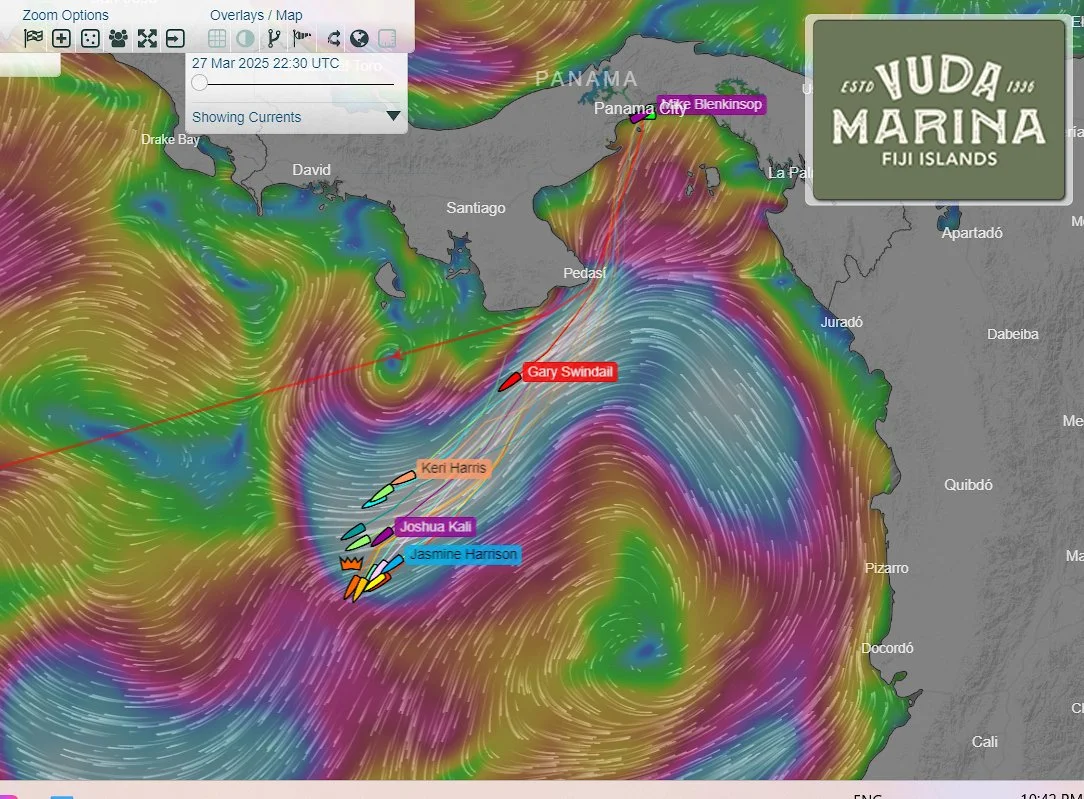
Bay of Panama screenshot showing fierce currents.
Strong currents became the wildcard, creating confusing, even dangerous seas that kept most of the skippers busy and alert for much of the passage. Fresh trade winds kept the average speeds high, but at times – when the wind was blowing against the current – 6m short, steep seas developed, all this when inside cabin temperatures were running at 33°C. Living below with closed hatches was sometimes suffocating. Dan Turk on Little Bea had a collision with what could have been a small whale, which brought his boat to a sudden halt from 6kts and sent him flying into the galley bulkhead. It was quite an impact, but no damage was done.
Meanwhile, Renaud Stitelmann continued to set the pace with Capucinette, as he had done in the 2025 Globe Transat. That did not stop him treating himself to his signature homemade banana cake (slightly lopsided but delicious), and proving that even in the middle of an around-the-world race, you can still enjoy the finer things in life. For a while, until he got bored with the game, he continued to post pictures of his culinary triumphs, while some other skippers were eating straight from the can! John Guzzwell, who also prided himself on cooking proper meals and cakes, would have approved!

Renaud bakes a cake at sea. No packet mixes here!
Keri Harris, on Origami, despite hand-steering virtually the entire passage, clung to Renaud’s coattails, showing incredible determination. He left Antigua without the windvane fitted, and only had one small electric autopilot, which barely coped with the conditions. All was good until it wasn’t, about three days from the finish. He was down below with the companionway hatch open in a comfortable sea, under autopilot, when an unexpected, large sea slammed into the back of the boat, knocking it down, wiping out both solar panels, and flooding the cabin with 5-600ltrs of seawater. This destroyed his sat-phone which was being charged at the time, as well as other electrical equipment. He wasn’t worried about wet bunk cushions, as he has none – only a yoga mat to sleep on. He spent many hours evacuating the water and clearing the damage before returning to the race.
Jasmine Harrison, aboard Numbatou, who was the youngest skipper in the fleet, also had her share of adventures.
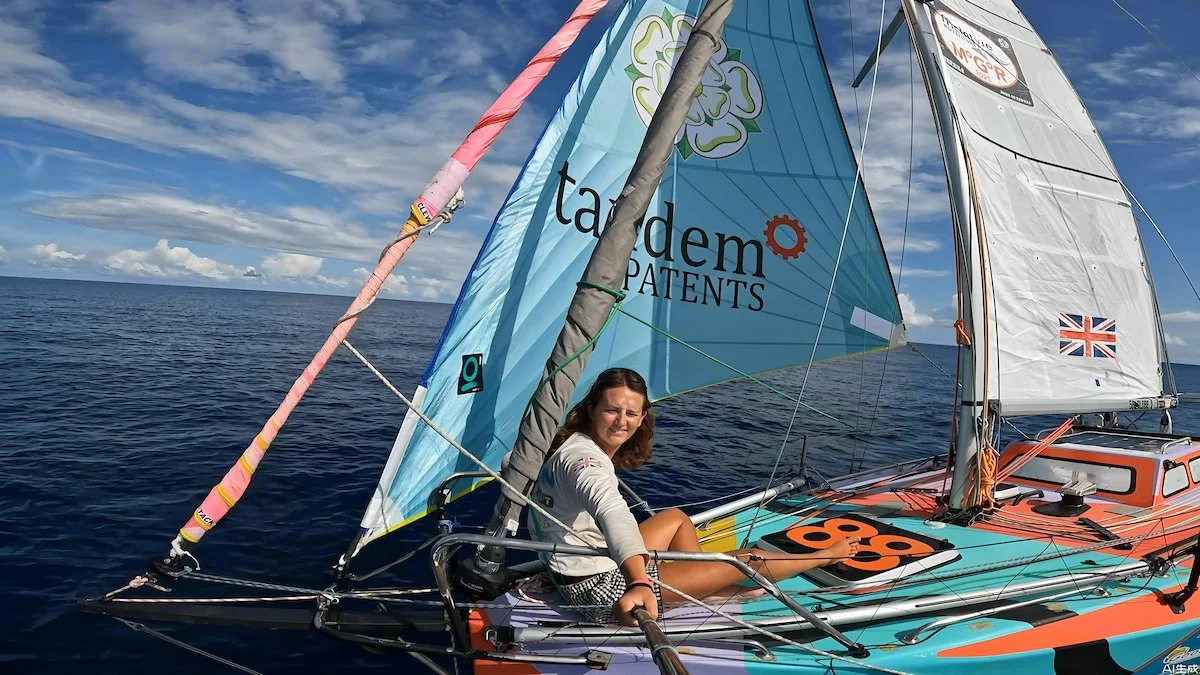
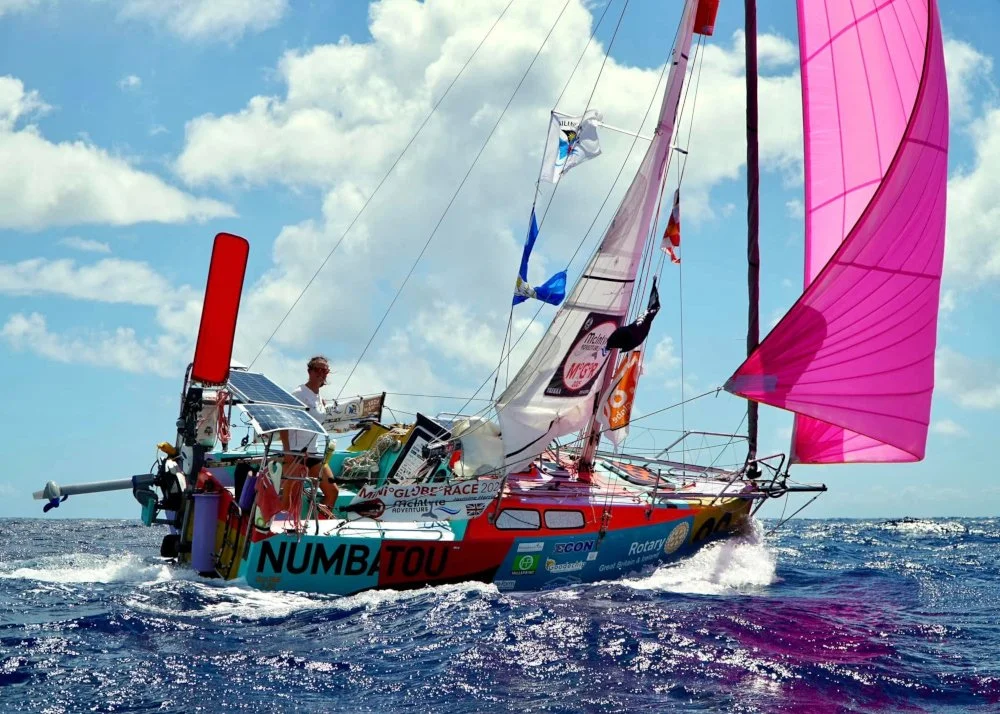
From battling sargassum seaweed that wrapped around her furling line, which had been trailing over the side, to hand-steering through squalls, she proved she’s a force to be reckoned with. Her bright pink spinnaker became a signature sight as the race progressed, though it faded progressively as the miles clocked up. Looking back on the first leg, she reported, ‘It’s been a bit messy, but I’m loving every minute of it.’ She had initially struggled at the beginning of the Globe 580 Transat, saying that her previous adventure, rowing across the Atlantic, was easier!
Australian sailor, Mike Blenkinsop, from Mooloolaba, and affectionately known as Popeye, was not one of those hard-nosed racing types who saw the handle off their toothbrush to save weight – he had an Aussie barbie and an electric scooter aboard Delja 99, but in a fit of enthusiasm decided to hand-steer with full mainsail and A7 in a quartering breeze.
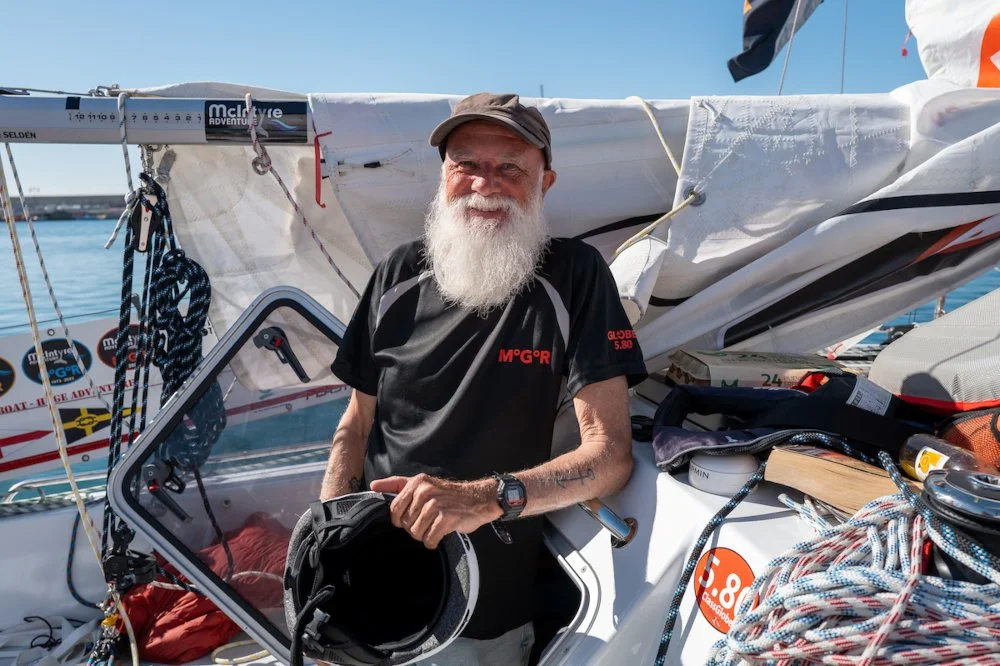
Mike (Popeye) ready to go
He set himself up in the back corner of the cockpit on a short tether, as the sea was building past 4m, and he could steer a straighter course than the Hydrovane could manage. All went well for the first hour, but then a bigger than usual set came under him. Rolling off the back of it, Delja 99 entered a deep trough, then the next wave crest swept the boat from bow to stern, putting the mast nearly in the water. Popeye was laid backwards, virtually underwater, and said that without the short tether, he would have been swept overboard.
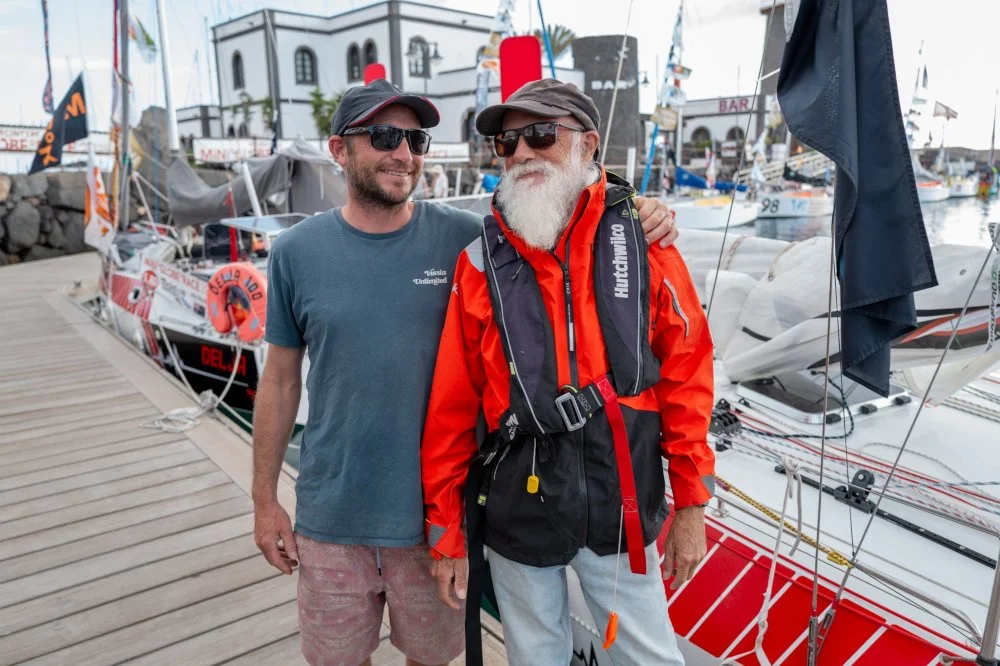
John and Mike Blenkinsop, from Mooloolaba
Popeye’s son, John Blenkinsop, aka Blinky, campaigning Delja 100, and Dan Turner from Adelaide on Immortal Game, emerged as great characters and engaging storytellers in the race. John, with his infectious enthusiasm, kept the fleet entertained with tales of pirate-scouting pigeons and green water sweeping his deck. Dan, meanwhile, had to face a disconnected forestay that could not be fixed. The internal rigging screw inside his furling gear unscrewed! Fortunately, the inner baby-stay kept the mast up, but he could no longer use any headsails, and completed the last few days with mainsail and spinnakers only! Dan became known as Aussie Dan, to distinguish him from Canadian sailor, Dan Turk of Little Bea, who became known as Canadan.
Renaud crossed the finish line first, completing the leg in 8 days, 18 hours, and 40 minutes. Capucinette’s average speed for the 1200 miles was 5.68kts, or 136 miles a day! Not bad for a semi-displacement 19ft /5.8m ocean voyaging micro-yacht! Keri followed just five hours later, with Canadan close behind. Adam Waugh of Little Wren, taking a more northerly route to avoid adverse currents, sailed an impressive 1,232 nautical miles and arrived relaxed and in good spirits. On arrival, referring to the injury he sustained crossing the Atlantic, he said, I’d forgotten how nice sailing is without broken ribs! Like Renaud, he usually sailed with twin headsails poled out when running downwind, which put less stress on skipper and boat.
Just as the leaders were reaching the Panama finish line, the final entrant, Gary Swindail from Sydney, Australia, was crossing the start line on Question 2. Gary was a late starter after facing shipping delays from Australia, and was very excited to finally be racing, having just finished his mandatory solo qualifying voyage days before. It was a slow start for him. with light winds, but apart from missing family and friends all appeared ok. His ETA in Panama was 16th March, just in time for the fleet’s overland transit to Balboa on the Pacific side of the Canal zone.
It is never over until it is over, as the old saying goes, and Renaud illustrated this. Having won the McIntyre Globe 580 Transat, and now the first leg of the McIntyre MGR, Renaud was in high spirits after crossing the finish line in the dark, on the still waters inside the Cristobal breakwaters. As he dropped the mainsail and prepared to make for Shelter Bay Marina under jib, he stepped from the deck down into the cockpit and slipped on a large flying fish that had snuck aboard. He crashed down on his back, and then cracked his head, seeing stars. For a few minutes he thought his race was over, but the only serious injury was to his foot. It had recovered by the time he set sail across the Pacific on Leg 2.
One of the most remarkable aspects of the McIntyre MGR was the sense of camaraderie among the skippers. Despite the competition, they formed a tight-knit community, supporting each other through challenges, pooling various skill sets during stopovers, and celebrating each other’s successes. This was evident during preparations to de-rig the boats and transport them overland from Cristobal to Balboa, across the Isthmus of Panama.
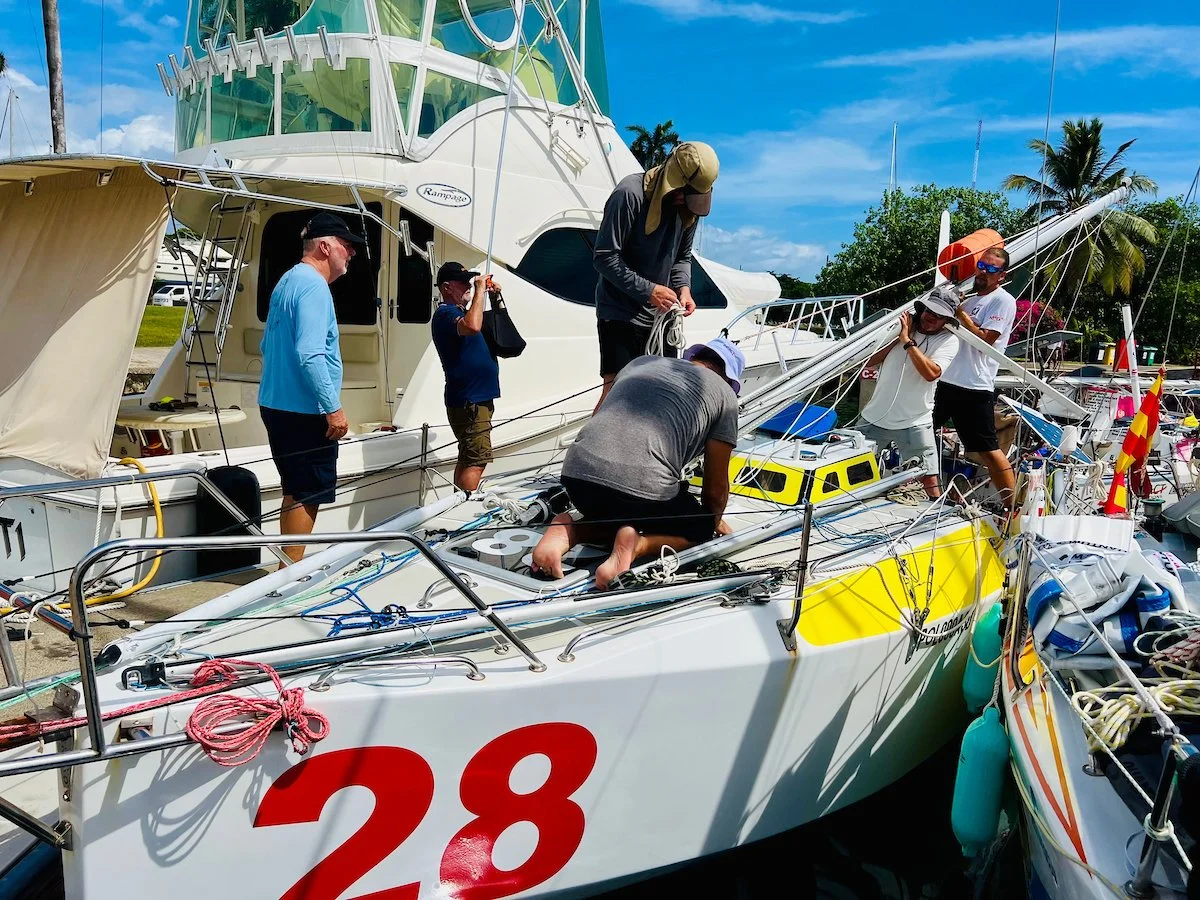
Skippers helping each other prepare for the Panama transit
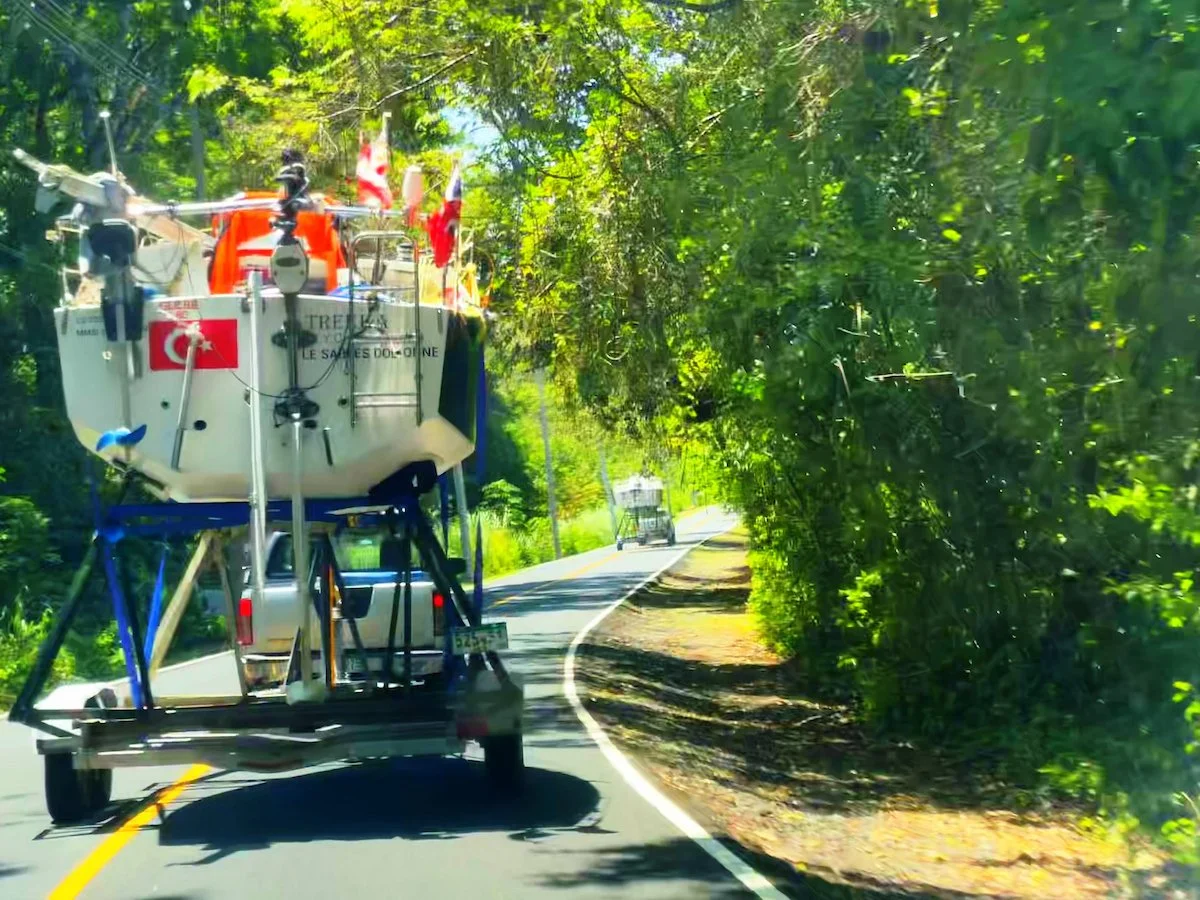
Transporting the boats overland across the Isthmus of Panama.
Ahead lay a mammoth 6,700 nm journey to Vuda Marina, Fiji, via the Marquesas Islands, Tahiti, and Tonga with only 23 days allowed for stopovers. The skippers would face many challenges, from navigating the doldrums to crossing the vast Pacific Ocean. The first stage of Leg 2, from Balboa to the Marquesas Islands, was 4000 miles.
Popeye decided to retire in Balboa (citing the rules as being too much bother), and John remained behind to support his father. They eventually cruised across the Pacific back to Australia, rendezvousing with the MGR fleet in Fiji. Having built their boats in Mooloolaba, then shipped them to Lagos, Portugal, they had sailed some 14,000 miles by the time they returned home in late 2025.
Leg 2 started on Tuesday, March 25th, although a few boats started late, due to unfinished work projects. With the cost of Starlink Mini units being only US$200 in Panama, all but three entrants installed the system there. This not only provided spectacular social media posts for MGR followers, and even the ability to stream YouTube movies or Netflix for their own entertainment, but also gave entrants access to accurate weather forecasting, through sites like Windy, which soon demonstrated how useful this could be.
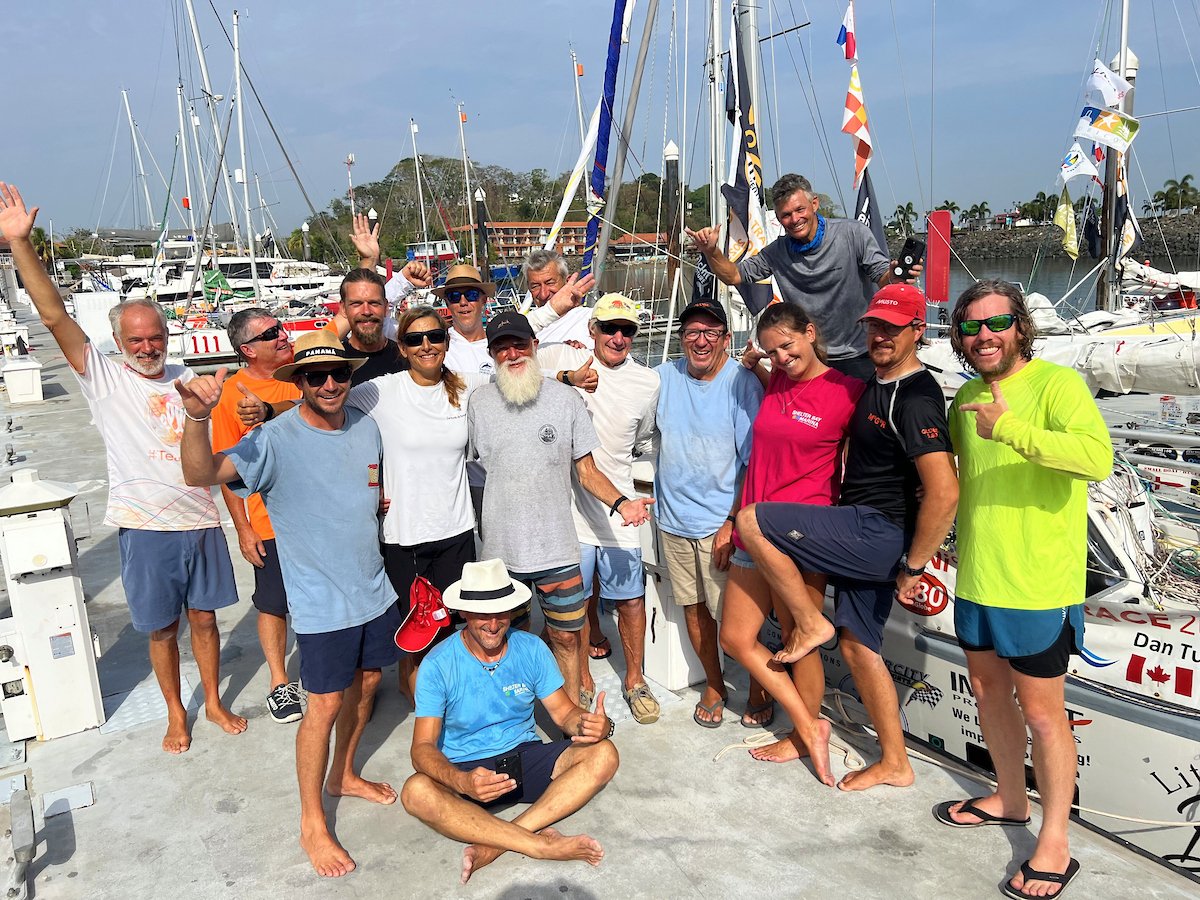
The skippers before the Balboa start
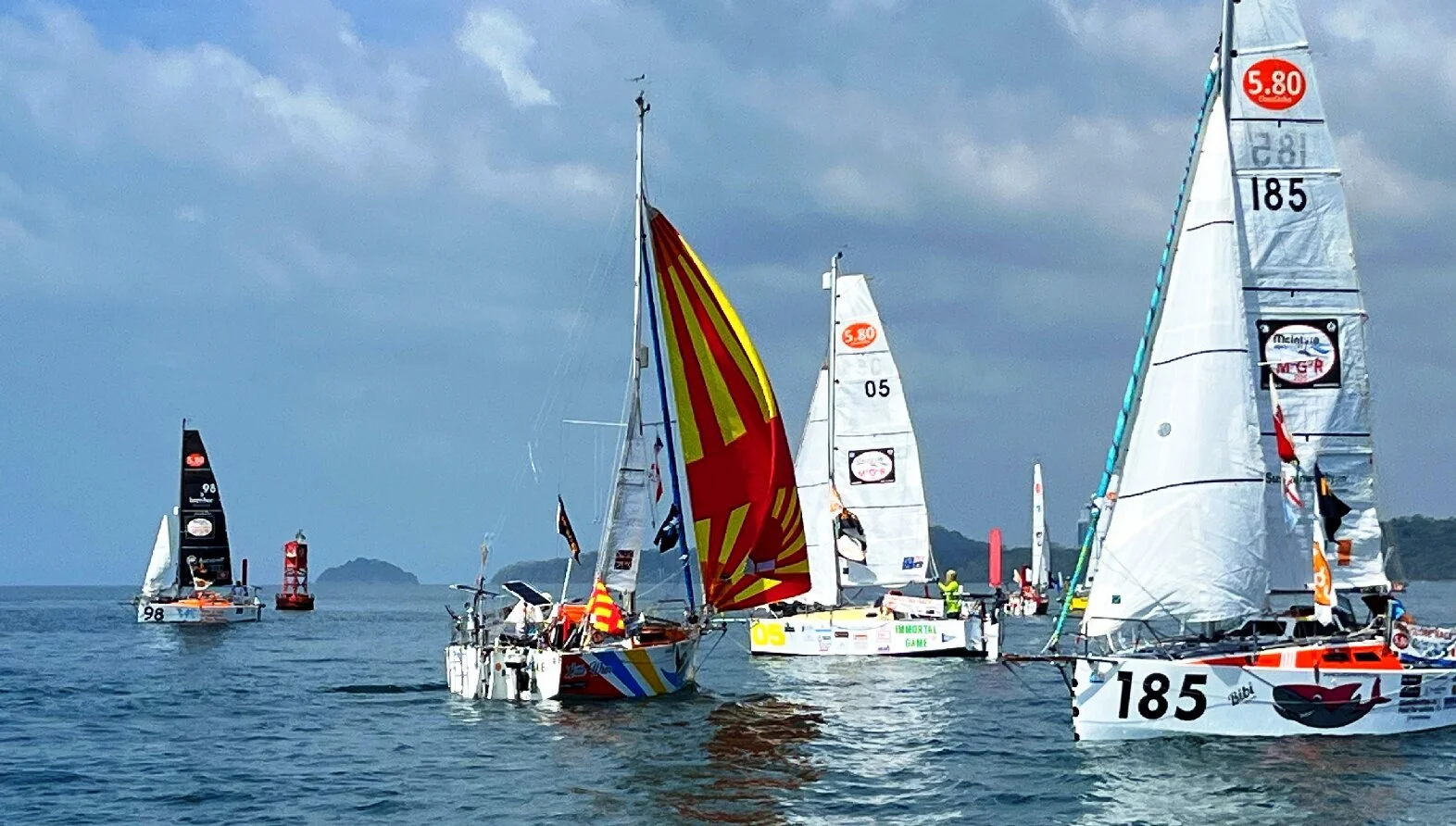
Balboa start, light winds
For three glorious days, the fleet surged southwest, broad-reaching in 10-15 knot breezes, aided by a generous 2-3 knot current from behind. Speeds of 7-8 knots over the ground had skippers dreaming of record passages to the Marquesas. But once out of the Gulf of Panama, the true test began. Two weeks in, and the fleet was facing up to the great inter-tropical-convergence zone (ITCZ) challenge – how to get past the Galapagos and into the SE trade winds. It became a test of Grit, Wit, and Seamanship.
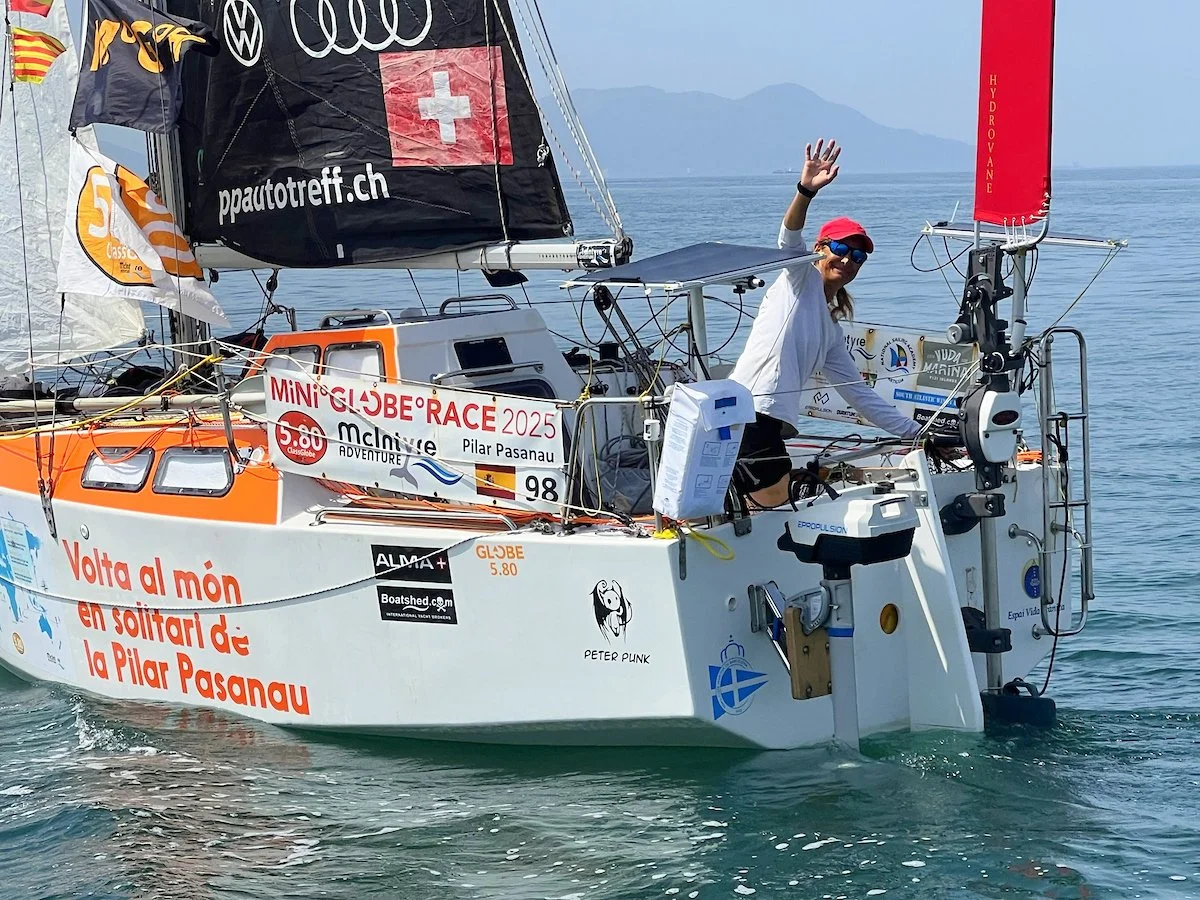
Pilar departing Panama
In the pre-departure briefing, race organiser, Don McIntyre, warned entrants of high UFO sightings (unidentified floating objects!), floating trees and rubbish, etc, in the first weeks of sailing out of Panama. The first reality check came in the form of massive floating logs – some measuring 13m long and 60cm in diameter, seen by over half the fleet. Aussie Dan became entangled with one, forcing him to drop his spinnaker and reverse off under power. Adam filmed a log “at least as long as my boat,” drifting ominously close to Little Wren, while Ertan Beskardes, on Trekka, reported hitting similar logs twice in one day. Christian’s Argo suffered the worst damage, with a hard hit that took paint off the keel and hull, after stopping the boat completely.
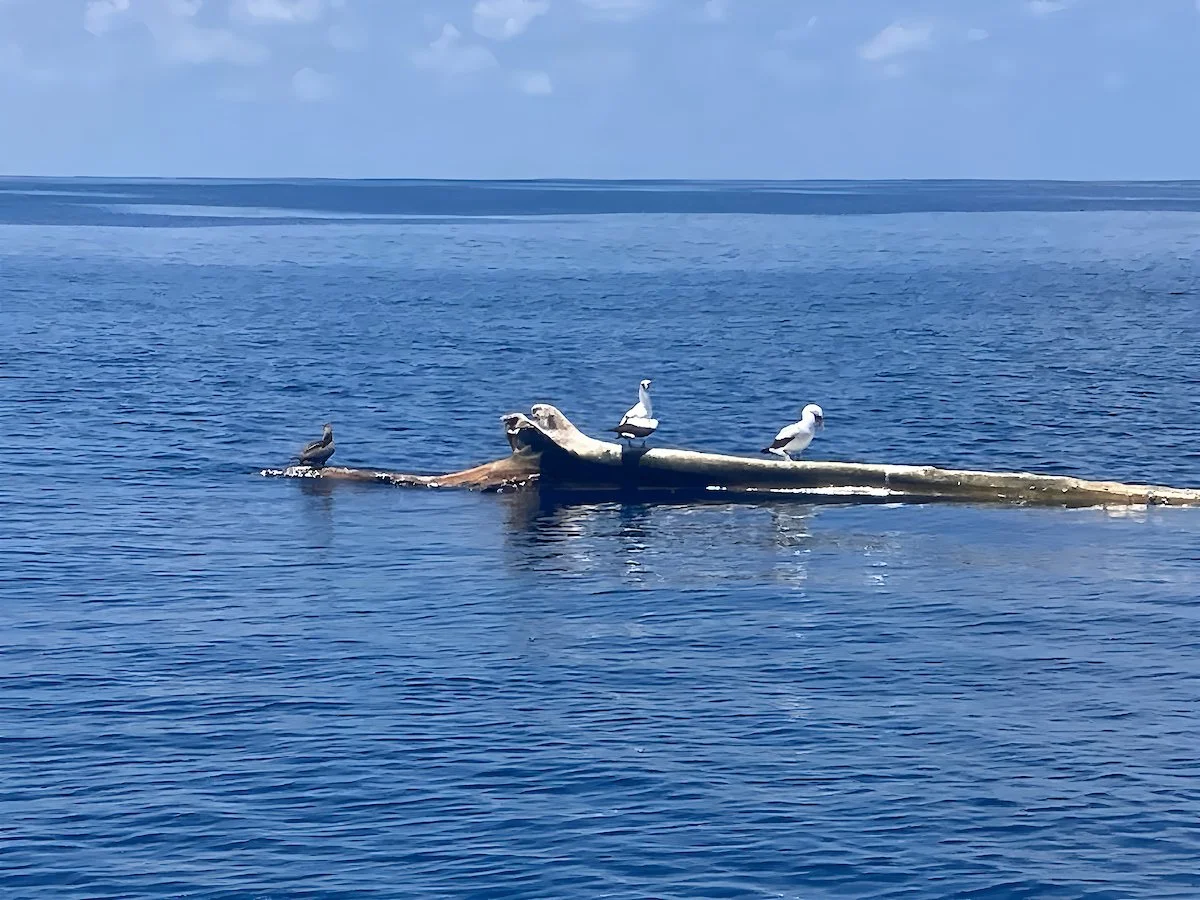
Panama log that Christian ran into
Wildlife encounters provided spectacular distractions. Adam had a whale surface 20m off his beam, which he reported was, “twice as long as Little Wren” – while boobies (the avian variety) took up residence on virtually the entire fleet. Bowsprits and solar panels were the favoured roost! Renaud documented the birds roosting on his square-top mainsail and pushpit, utterly unfazed by sail changes. “They’d just stare at me like I was the intruder,” he laughed, adding, “Pilot whales were common and dolphins plenty, with the occasional turtle thrown in!”
Nights regularly brought spectacular lightning displays that both awed and terrified the fleet. Keri posted a haunting video of storms illuminating the horizon. He admitted, “It’s beautiful until you remember you’re the tallest thing for miles, that’s when you start calculating the odds.”
By April 1st, the fleet’s rapid progress stalled as they entered the Intertropical Convergence Zone (ITCZ). The Doldrums – that infamous belt of fickle winds and soul-crushing calms – with its stifling 40°C heat and high humidity, stretched wider than anticipated, with the southeast trade winds retreating to 5°S latitude.
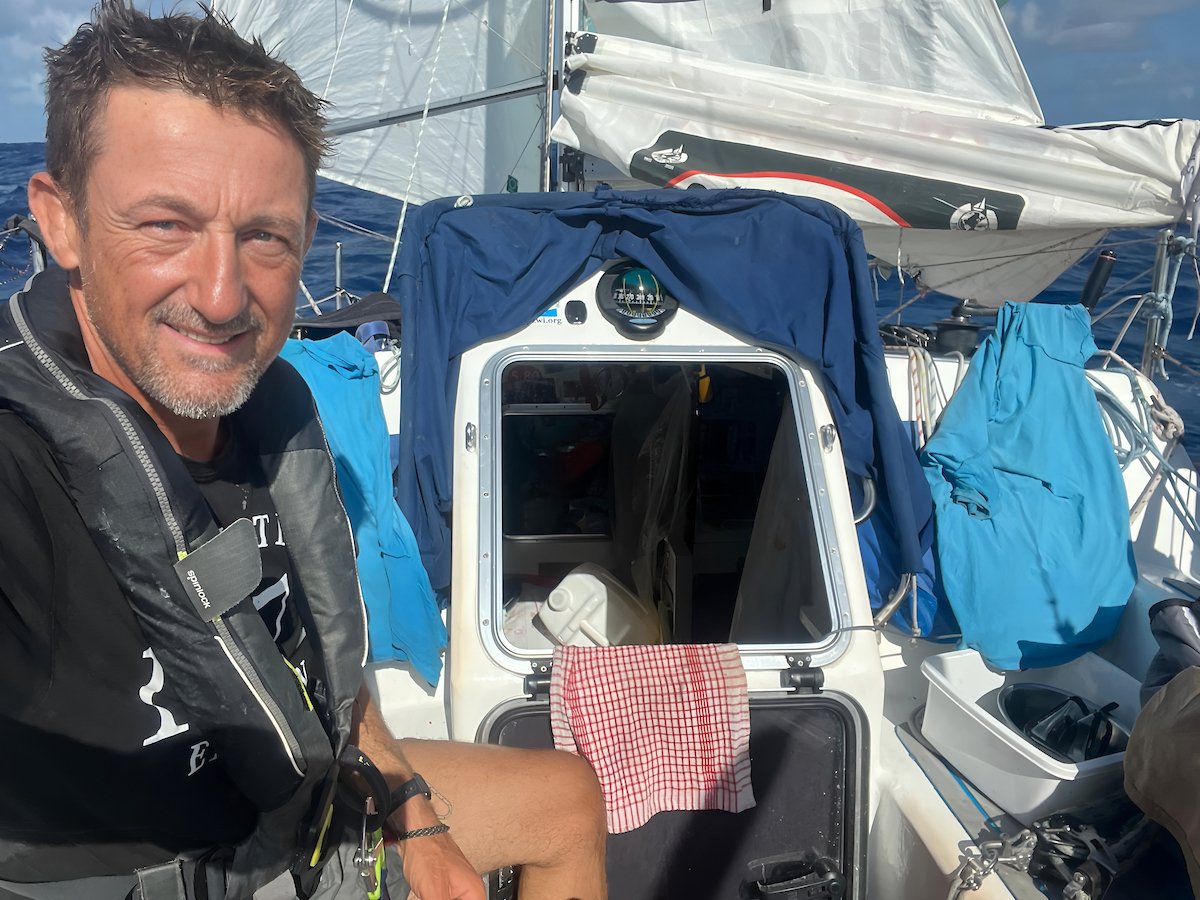
Jakub in Bibi's cockpit in the doldrums
The tracker became a surreal display of drifting yachts, some actually moving backward in contrary currents. Jasmine reported that Numbatou drifted 20 miles north in 24 hours. “I’d wake up to find us facing Panama again; it was like some cosmic joke,” she said. The fleet’s daily runs plummeted from 120-mile days to 20 miles or less, even going into negative values due to currents. Sail changes became constant as skippers chased every zephyr.
Canadan reported, “Five sail changes in four hours – that was my personal hell. The squalls would hit like clockwork at 2am, with winds shifting 180 degrees in seconds.”
Irish competitor, Jakub Ziemkiewicz on Bibi, described the psychological toll. “In the doldrums, your world shrinks to this tiny, sweltering box. The boat doesn’t move, your skin erupts in rashes, and time stretches endlessly.” He resorted to garlic poultices to treat his festering saltwater sores, a remedy learned from his Polish grandmother.
American, Josh Kali, who had once been an intrepid mountaineer, took a philosophical approach aboard Skookum. “After being storm-bound for weeks in the Alaska Range, this was just another form of confinement. At least here I could see the horizon.”
Renaud proved to be the master of light-air sailing, his Hydrovane somehow steering Capucinette in just 3 knots of wind. Others weren’t so lucky. Aussie Dan reported hand-steering for hours and drifting for days, saying, “The Hydrovane needs at least 5 knots to work properly. Below that, it’s you, the tiller, and your sanity.”
The fleet’s passage across the equator provided much-needed comic relief. Ceremonies ranged from solemn to absurd. Jakub was formally initiated by “King Neptune” (a cormorant perched on his solar panel), and was duly renamed Anarhichas lupus (Atlantic wolffish) by his daughter. She said it was the perfect name for him because he was as ugly as the fish!
Aussie Dan‘s celebration went viral when he posted an equator-crossing naked photo of himself, featuring a strategically-placed, clip-art eggplant to shield his modesty, with followers doubting the need for such a LARGE piece of clip-art! Josh celebrated by posting an image of himself sitting in Skookum’s cockpit wearing a pair of underpants on his head. Threatened with the moniker, Bumface Josh, he retorted that it was a well-known naval tradition passed down through his seafaring family.

Josh claimed that wearing undies on your head while crossing the Equator for the frst time was an old naval tradition.
As Week 2 of Leg 2 progressed, the fleet began escaping the Doldrums’ grip – but not without cost. Christian developed a severe skin infection on hands, knees and body that forced him to take Argo into port in the Galapagos Islands for an emergency 24hr stop to collect extra drugs, after talking to MSOS.org.uk, the MGR’s 24hr Telemedicine team. This ailment, along with his rotator cuff injuries, first noticed during his Atlantic crossing, plagued him for the rest of the circumnavigation. A lesser sailor might have retired, but Christian likes to finish what he started.
Gary gambled on taking Question 2 north of the Galapagos Islands, which initially paid off with fast sailing, only to see currents drag him northwest toward Hawaii. “I’m not panicking yet,” he insisted, but ended up having a real struggle to get south into the trade winds – there is almost always a windless hole NW of the Galapagos Islands. Eventually he managed it, at one point closing to within 60nm of Josh, but he was to trail the fleet all the way to Fiji.
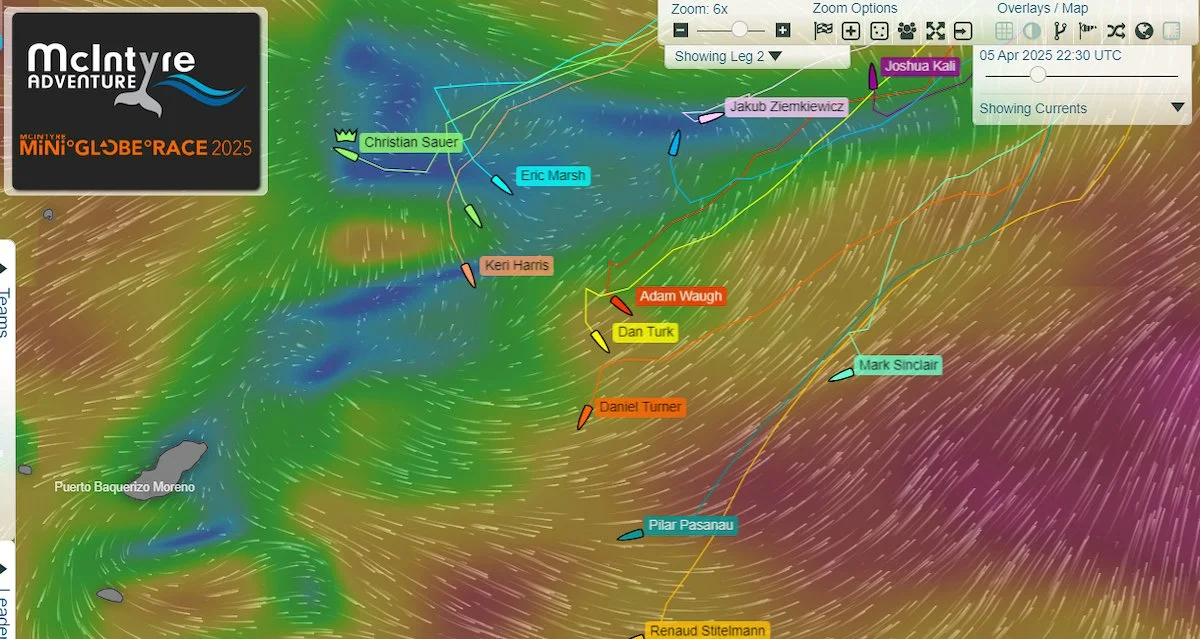
The great scatter gun game NE of the Galapagos Island in the doldrums
Keri staged an impressive comeback after Origami’s 12-hour late start from Panama (due to the work needed after his spectacular knockdown approaching Cristobal). He climbed back up to third place through a combination of smart routing and relentless boat speed. His jury-rigged spreaders – shimmed with Antiguan and Canadian coins – held firm, as Origami consistently maintained speed. He lost a halyard at one point, decided to climb the mast while sailing at 3 kts with full sail up (not wanting to lose a few minutes), but as he passed the spreaders, the little boat started to capsize, and he scrambled down fast. Most of the skippers who had Selden masts had trouble with their spreaders at various times during the race, a design issue that has since been rectified.
As the frontrunners finally came into the southeast trade winds, tactical decisions loomed large. Renaud dove south and led the charge west along the 5th parallel, with Capucinette consistently posting 135-mile days. Others who turned west sooner had less-stable winds and more squalls.
The Blenkinsop duo, Popeye and John, finally cleared Panama three weeks behind the fleet, and immediately began chipping away at the deficit. Their daily radio check-ins became a fleet favourite, mixing tactical discussions with heated debates about cricket statistics, all thanks to Starlink. “Dad thinks Bradman was overrated,” John complained. “It’s like sailing with a heretic.”
Adam discovered that his windvane frame had cracked badly. His jury-rig solution – two hose clamps joined together – became the talk of the fleet. “It looks like something from Mad Max,” Adam admitted later, “but it’s held for 2,000 miles so far.”
Christian battled multiple system failures simultaneously. “First the Windpilot clamp slipped, then my solar panels stopped working, then my skin infections returned. Some days the Pacific feels like it’s testing me personally.” His batteries were also failing, and were unable to take a charge from the solar panels. He turned everything off, including Starlink, and only used navigation lights when sleeping.
Eric Marsh, the 72-year-old Australian sailor from Coffs Harbour campaigning Sunbear, lost all battery power for 36 hours after an electrical fault. “I was navigating by sextant like it was Golden Globe 1968 again,” he reported. “Thank God overcast days turn to clear nights – at least I could see some stars.”
Spanish sailor, Pilar Pasanau, on Peter Punk, one of the MGR’s two female skippers, faced her own crisis when her autopilot failed, forcing her to hand-steer for 36 hours straight through challenging weather. “I tied the tiller to my leg so I could doze off for a few minutes at a time,” she revealed. “Now I have the tan lines of a striped hyena.”

Pilar carried 200L of water for this leg. Boats were required to carry a minimum of 100L
Because shipping delays from Australia meant that Gary did not have time to antifoul Question 2 in Antigua, and then arrived in Panama with just days to spare, he again left without having antifouled the boat. Five weeks later, already at the back of the fleet, he had a barnacle infestation and was getting slower every day.
As the fleet headed toward the Marquesas, an unexpected adversary emerged in greater than usual numbers. Red-footed boobies began treating the yachts as personal rest stops, with Jasmine documenting the escalating conflict. “At first, it was just one bird – cute even. Then came his friends. Soon I had a rotating cast of feathered squatters covering every horizontal surface with guano.” Her attempts at diplomacy failed when the birds began pecking at her during sail changes. Even worse, she reported, “They would sit on my windvane and Numbatou would turn off course!” Her solution – waving a frying pan while screaming like a banshee – became legendary in fleet communications. Gary made the fleet laugh by saying that he was attempting to train the boobies to be lookouts, using fish bribes.
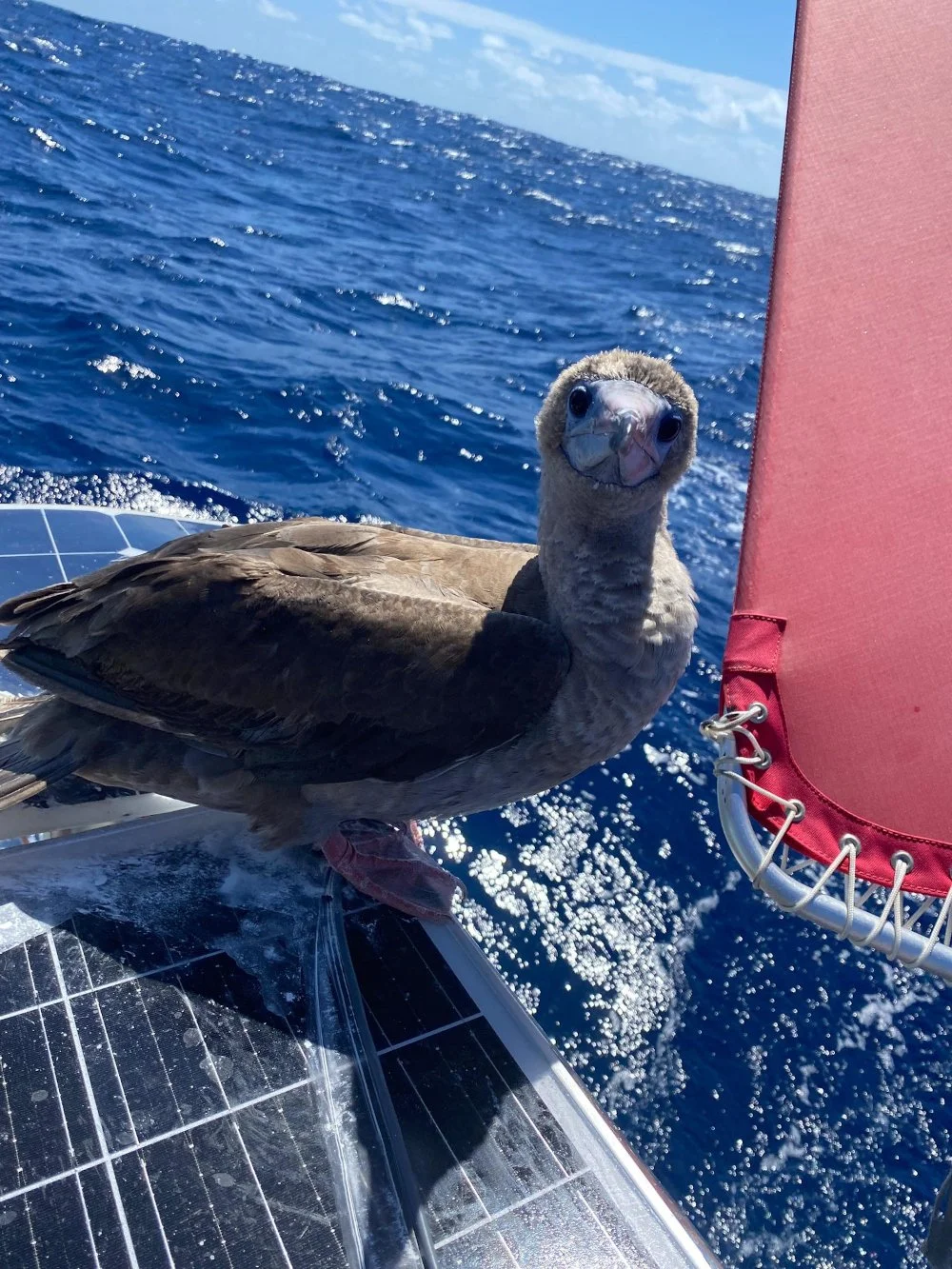
Get off my boat, Jasmine, yes I mean you
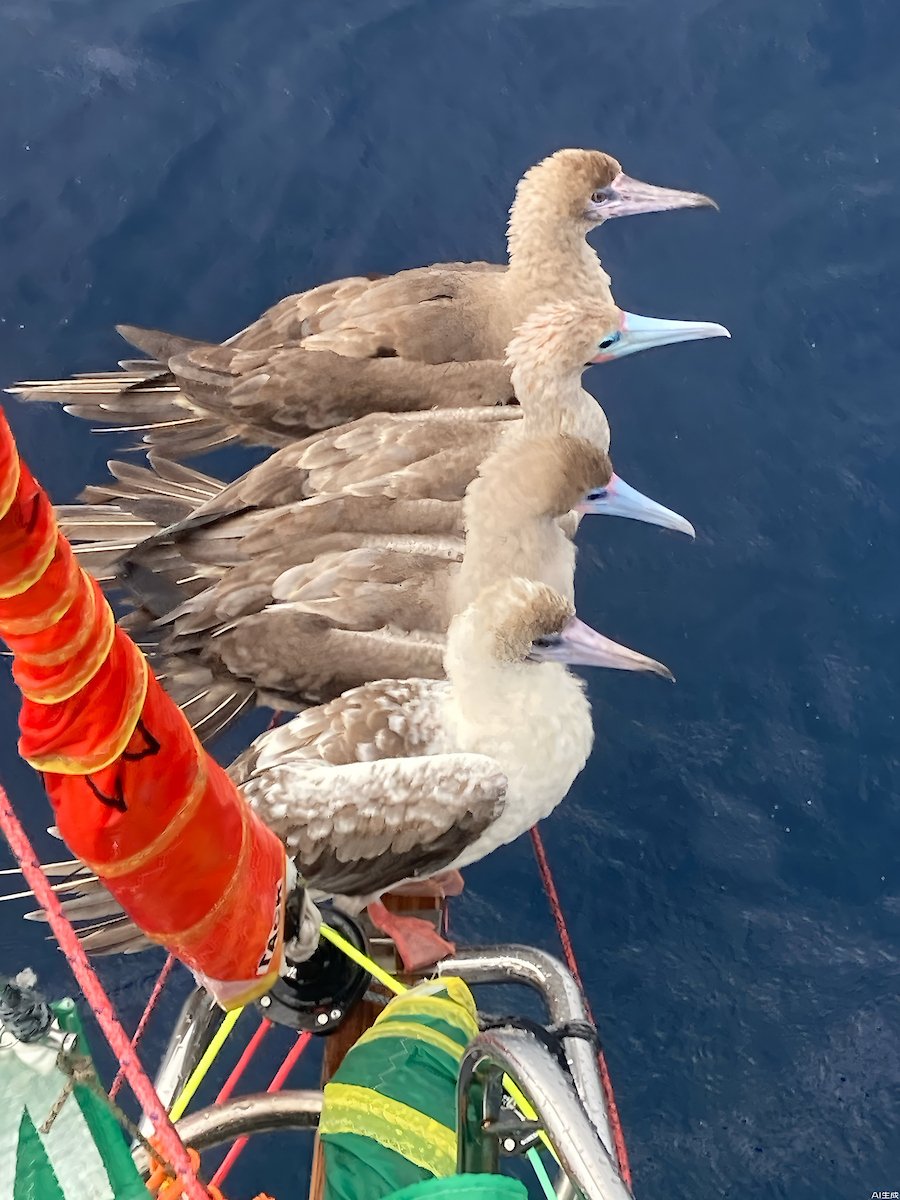
Christian's Boobies enroute to the Galapagos
Not all wildlife encounters were hostile. Aussie Dan reported dolphins playing in Immortal Game’s bow-wave at sunset, while Ertan was visited by an exhausted barn swallow that rode in his cabin for a full day before flying off.
With freeze-dried meals growing tiresome, competitors got creative. Josh elevated canned tuna to haute cuisine with his “Five-Star Tuna Surprise” – a mix of instant rice, sun-dried tomatoes, and the last precious drops of his Sriracha. He also made tacos. “Presentation is everything,” he insisted, serving meals on a Frisbee salvaged while beachcombing.
Jakub’s pancake experiments, already famous among the fleet and followers, reached new heights when he began using Polish honey as both ingredient and plate adhesive. “Now my pancakes stay put during 30-degree rolls,” he boasted.
Pilar sustained herself on Spanish delicacies including tinned octopus and paprika-spiked beans while Canadan admitted to, “eating sardines until I started dreaming about them.” The most surprising culinary star proved to be Eric. Although he claimed to exist on freeze-dried instant meals, he transformed his boat into a floating bakery. “Turns out yeast still rises in 90% humidity,” he reported, showing off surprisingly fluffy dinner rolls baked in his jury-rigged oven.
The mental challenge of 40+ days alone at sea manifested in different ways. Christian reported profound moments of clarity. “Sometimes at night, with the boat surfing down waves, I feel completely connected to something greater. Then a squall hits and I’m back to swearing in German.”
Jasmine struggled with sleep deprivation. “You start hallucinating. I once had a full conversation with my Hydrovane before realizing it wasn’t talking back.”
For Ertan, the challenge was monotony, despite making the most of Starlink. “I shower twice daily just to feel human. Sometimes I dress for dinner – why not? The fish don’t care if I’m wearing my good shirt.” His Starlink ran HOT every day, catching world news, reading papers, magazines, WhatsApp video calls to family, and monitoring business interests. Without a doubt, life on the ocean waves is changing in the 21st century!
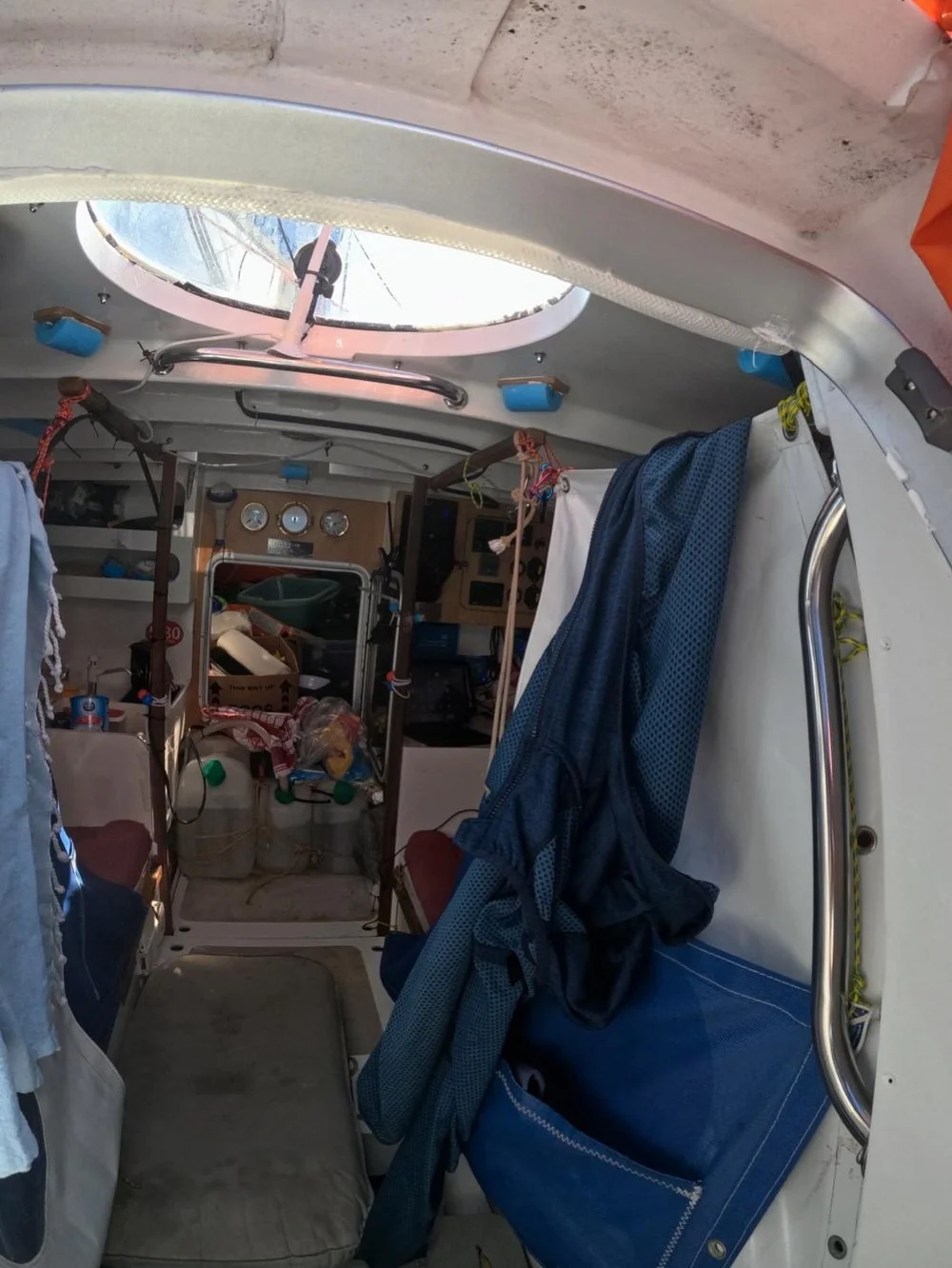
Ertan's cot
For Aussie Dan, no matter how hard the day had been, he remembered that he was achieving his dream. He had never built anything in his life before, did not know how to use basic boatbuilding tools, and yet he built his boat, and now he was sailing it solo around the world. “Some days I was brought to tears just remembering so many things about how I got here, how stunning it is, a dream no longer, even though it still is!“ But his biggest buzz was date nights with his wife, Nikki, courtesy of Starlink, watching movies together on video Whatsapp calls!
Renaud sailed into the anchorage at Hiva Oa on April 28th, leading the fleet by just 15 hours after 4300 miles. Over the next couple of days, he was followed into port by Dan, Keri and Pilar. Keri was delighted to back in the game, and even more happy to purchase an Aries windvane from another yacht in Hiva Oa, which he hoped would allow him to press Origami harder and catch up to Renaud. The South Atlantic unit worked perfectly well as long as he did not press the boat too hard. There was no doubt that the boats with Hydrovane self-steering units had a distinct advantage when it came to driving hard.
Pilar was quietly holding onto 4th place, maintaining her reputation as one of the fleet’s most skilled competitors. Her electric autopilot failed during this passage but the Hydrovane saved the day. Pilar only spoke a little English, while I spoke no Spanish at all, so it was difficult for me to get updates from Peter Punk during the MGR, but I gathered that her friendly rivalry with Canadan continued to be a highlight for her. They had a great time ashore together in Hiva Oa.

Pilar arriving in Hiva Oa, 36 days out of Panama. Frieda Fennell photo.
Their rivalry went right back to the start of the Globe 580 Transat in 2024. “Pilar beat me by half an hour into Lanzarote, and she’s still ahead now,” Canadan laughed. “I swear she’s part fish – she just glides through the water. We had lunch at a roadside spot in Hiva Oa where all the locals eat. I wanted to hit the market, but they close from 12 to 2. Island time, man.”
Jasmine arrived in Hiva Oa just after her birthday, greeted by MGR sailors bearing chocolate cake, bread, and – of course – beer. “She went from exhausted solo sailor to party animal in seconds,” her mother reported. Jasmine’s time in the Marquesas wasn’t all celebrations, though. The anchorage in Hiva Oa was “rolly as hell,” but nearby Tahuata Island made up for it. “She swam with manta rays… and two sharks,” her mum added. “One was 2m long and only 2m away when she turned around. She grabbed her knife, but it swam off. No drama!”

CanaDan aboard Little Bea, running under A5 and A3 in the trade winds
Christian’s passage was a masterclass in perseverance. Between a worsening skin condition, a slipping windvane, and electrical gremlins, he’d had his hands full. “I arrived with flat batteries, and now my solar panels are shaded by the sails every afternoon,” he sighed. Still, he managed to climb Argo’s mast mid-passage (at risk of capsizing the boat) to retrieve a lost halyard – no small feat for a 100kg man on a bouncing 5.8-meter boat. “I’m not racing, I’m adventuring,” he laughed.
Ertan, ever the city boy, found the Marquesas beautiful but… repetitive. “Tropical islands are all the same,” he shrugged. “How do people live here permanently?” Not having a dinghy, he swam ashore every day with his clothes in a dry bag, ignoring the sharks, rented a car to explore, and harvested coconuts with Jakub. “The locals are amazing—always offering lifts,” he said. “But I’m ready for Tahiti, civilization, showers, and real food.”
Jakub, ever the optimist, credited his girlfriend’s “witchcraft” (white sage burning) for keeping storms at bay. Still, Bibi got knocked down hard, the biggest ever, near Ua-Pou, when a squall sent the boat careering off downwind before broaching. “The boat just went over,” he said. “I hung on, dragged the mainsail down, and prayed.” His solution from then on was to tow a 30m warp astern in squalls or gales, keeping the warp coiled in the cockpit ready for action the rest of the time.
After 41 days at sea, Josh finally arrived in Hiva Oa with just 6L of water left, but his spirits were high. “The little boat did a great job and is a lot of fun to sail,” he reported. His passage was marked by being becalmed for four days in the doldrums, but he took it in his stride. During the long weeks at sea, he maintained an easy routine. “I’d get up in the morning, make coffee, choose my sails, put on music, and steer for 10-12 hours,” he said. “At dusk, I’d reef down, get the boat self-steering, cook dinner, listen to audiobooks, and sleep all night. I checked the boat every 40 minutes.” His approach may not have been the fastest, but it certainly was the most Zen. “There’s a long way to go,” he smiled. “Tortoise and hare, right?”
Gary, the fleet’s tail ender, finally found consistent winds, and Question 2 began making up lost ground, arriving in Hiva Oa while Josh was still in port. Gary’s biggest challenge was the solitude. “Every day’s the same. Wake up, sail, sleep, repeat,” he said. “I regularly call my wife on Starlink, but it’s not the same as seeing people.” He had sailed offshore before, but never alone, and was surprised to discover how much solitude affected him.
Meanwhile, John and Popeye continued their synchronized sailing spectacle, no longer contesting the MGR but still a part of the family. They were still 700 nm from Hiva Oa when Gary arrived there. They had weathered 60-knot squalls, rib injuries for Popeye (courtesy of stepping on a slippery liferaft canister, stowed just inside the companionway), and water balloon fights. They weren’t always that close, but remained in VHF range. “We called each other 20 times a day,” John admitted. “Mostly to say, You’re too close, idiot.”
After a brief stop, Renaud and Aussie Dan sailed south to Baie Hanamoenoa on Tahuata Island, where they were given fresh tuna by a French cruising couple. “Sashimi for lunch, then snorkelling with manta rays,” Dan reported. “This place is ridiculous.” Later, several other skippers went down there, too, and enjoyed snorkelling in the clear water. Returning to Hiva Oa, Adam was startled one day when a small crab fell out of his beard. Jasmine found one in her ear.
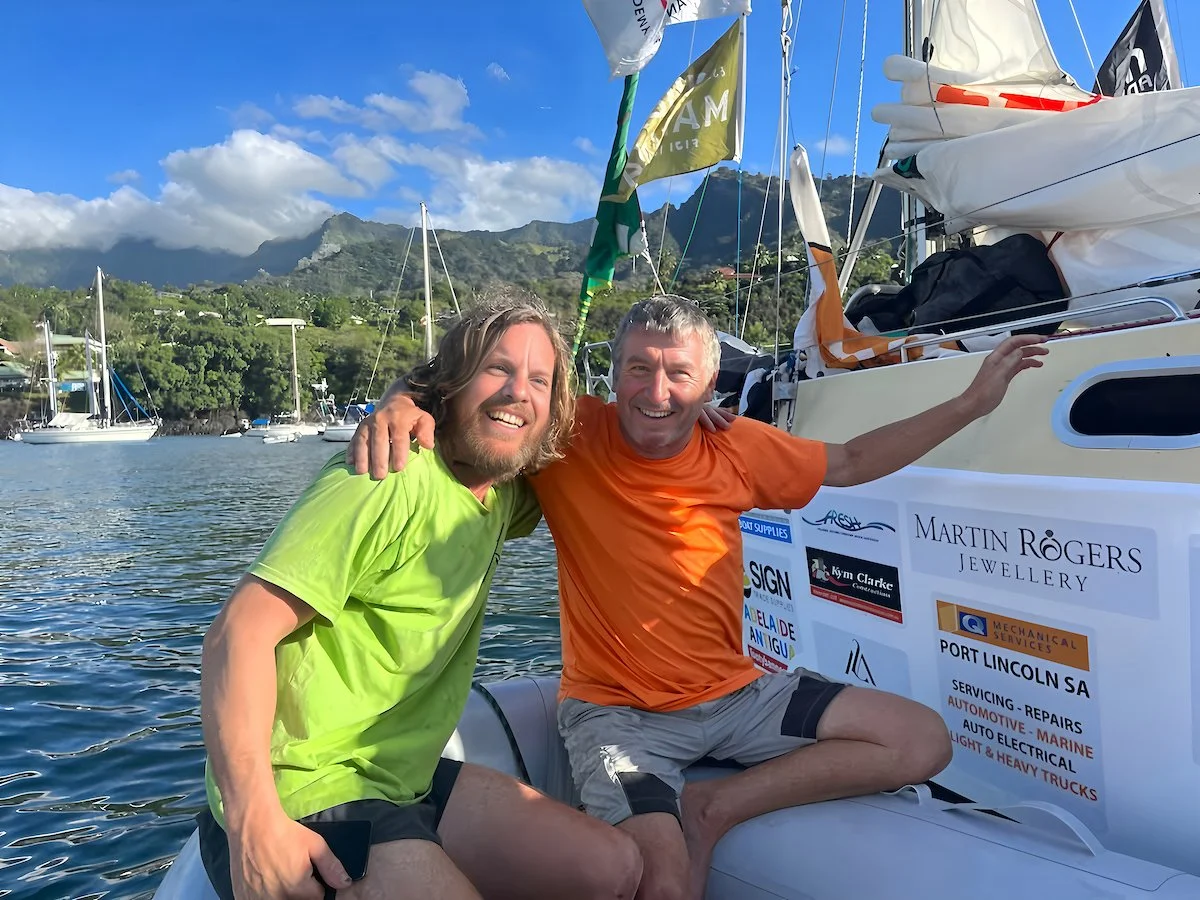
Aussie Dan and Renaud after arriving in Hiva Oa

Tahuata anchorage. It was here that a crab got into Adam’s beard, and another into Jasmine's ear
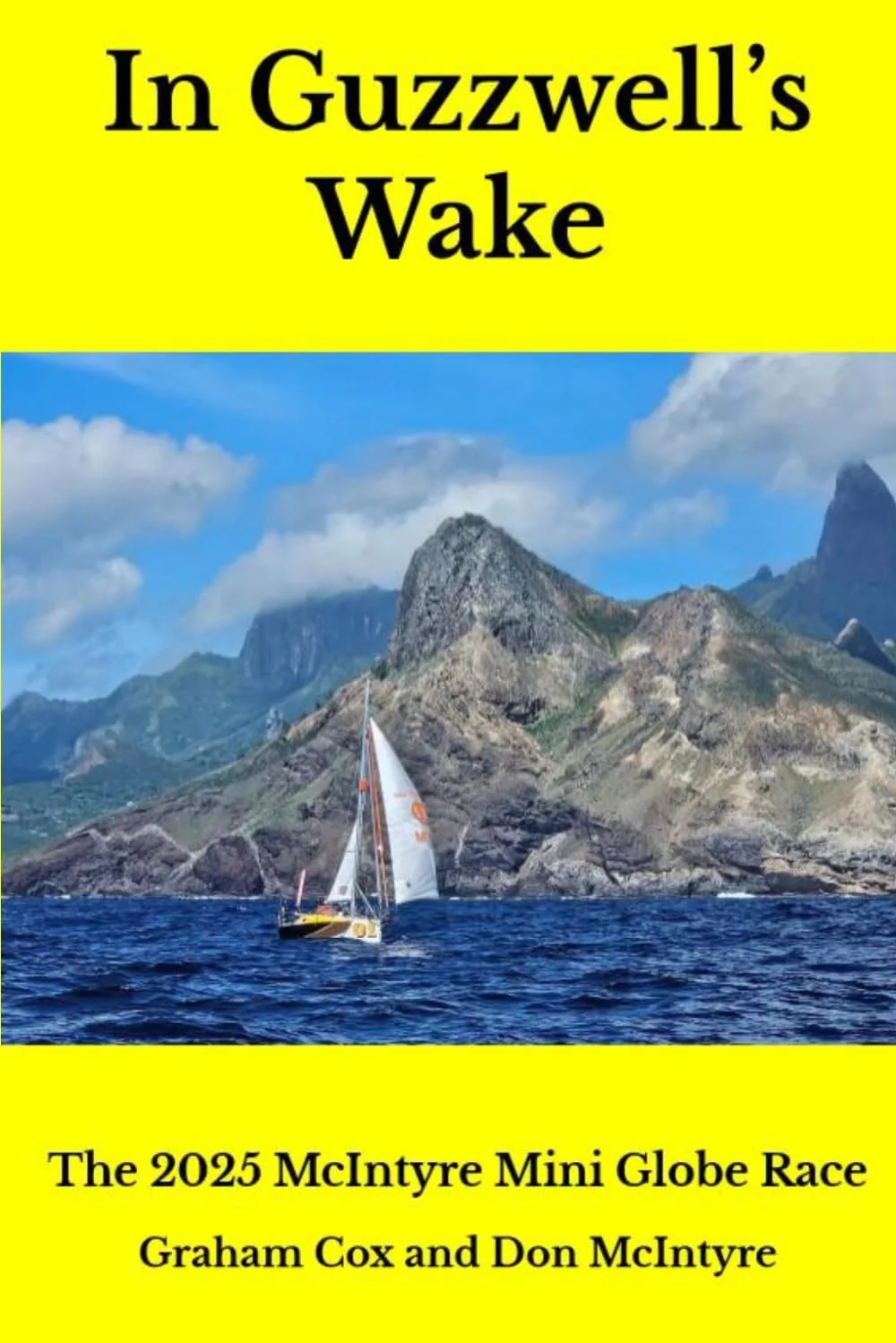
Graham Cox was the official scribe for the Mini Globe Race, talking to each skipper once a fortnight while they were at sea. He is the author of In Guzzwell’s Wake, the official story of the Mini Globe Race. He is also the author of Last Days of the Slocum Era, the acclaimed memoir which is also a selective history of cruising under sail in the days before satellite navigation. Both titles are available from Amazon, and the e-book versions are also offered by Kobo.
All images used in this article are the property of McIntyre Adventures and their respective owners, and may not be reproduced without permission.