
Master Craftsman
Many of you will know SEAHORSE as the premiere sailboat racing publication in the world, covering the latest developments and cutting edge technology in the global race to win. However they also have a deep respect for the lineage from which today’s boats evolved. Over the next few months we will bring you a series of handpicked articles from their archives highlighting this history, and showing that deep satisfaction in sailing comes from understanding, just as much as winning! The generous people at SEAHORSE are offering readers of SWS a significant discounts of up to 30% on both digital and print editions of this seminal magazine. Click the banner below to check out the offer.

Giuliano Luzzatto talks to Federico Nardi, co-owner of the Cantiere Navale dell’Argentario in Tuscany, arguably the world’s most famous restorers of fine classic yachts and also the shipyard that in the early 1990s started the classics movement itself
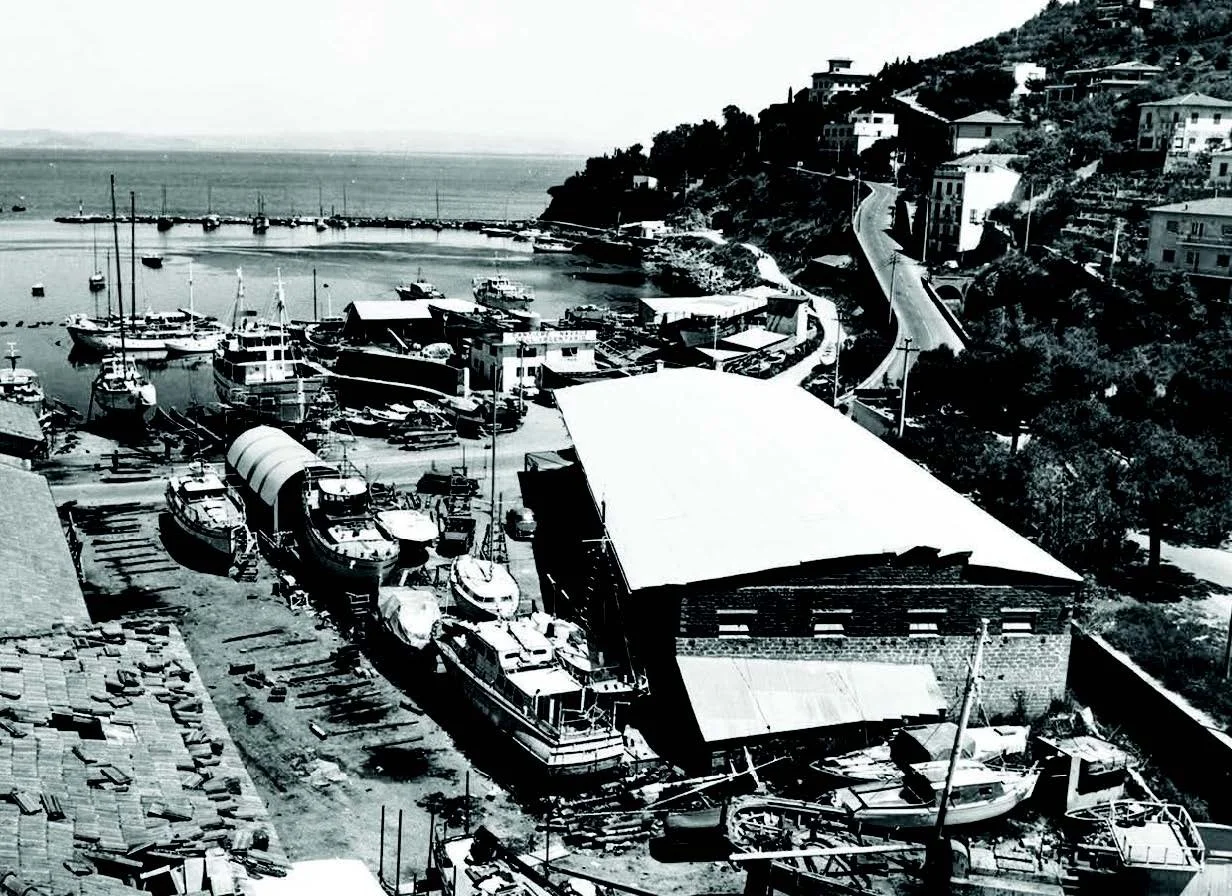
Following the end of WWII Cantiere Navale spent the next 10 years repairing local fishing boats and working craft damaged in the conflict. By the mid-1950s, though (left), thoughts were turning to the future with a first move into leisure craft, and by the 1960s the yard was turning out small numbers of traditional cruising craft – power as well as sail. However, this remained a traditional artisanal shipyard until Patrizio Bertelli’s 1996 decision to have his tired wooden 12 Metre Nyala restored by his friend Federico Nardi, one of the yard’s co-owners, triggering the start of an explosion in classic restorations. In the years since then Argentario craftsmen have kept busy superbly restoring many of the sport’s most important yachts…
Giuliano Luzzatto talks to Federico Nardi, co-owner of the Cantiere Navale dell’Argentario in Tuscany, arguably the world’s most famous restorers of fine classic yachts and also the shipyard that in the early 1990s started the classics movement itself
In Italy there is a very special shipyard for the restoration of classic yachts, one where Olin Stephens and Doug Peterson felt completely at home and where important owners, such as the patron of Luna Rossa, Patrizio Bertelli, keep and maintain the many vintage boats they collect and aboard which they participate in all the world’s premier classic yacht regattas. It is located in the southern part of Tuscany, in beautiful Porto Santo Stefano, a place known for its seafaring vocation on the Argentario promontory which connects the mainland with a small mountainous island, reaching up some 600m above sea level. In the distant past Argentario was indeed an island but over the centuries the sea currents created an isthmus that today connects it with the mainland.
In the 1990s it was this boatyard, which takes its name from the promontory where it is located, that started the whole modern classic yacht movement with their first wonderful restorations.
Since the end of the 1700s the maintenance and repair of the local fishing fleet were entrusted to the caulkers living in Santo Stefano, with their centuries of artisan practices operating as best they could on the beaches around the village. Then in 1845 a small basin was built for the caulkers, carpenters and shipwrights. It was only in the 1930s that a slipway was added, but it was still a public area without a real owner, where everyone could independently build or just work on boats.
The modern yard was established in 1945, with the town still in ruins from bombing during the recent war, because torpedoes for submarines were produced in Santo Stefano and were also tested in the adjacent torpedo testing area called Siluripedio. There are photos taken from aboard the same bombers that show these dramatic moments, with clusters of bombs falling right on the shipyard itself.
At the end of WWII the town’s workforce returned to civilian life by repairing the many damaged fishing boats and constructing new vessels for the needs of the local fleet. Today in the yard’s offices many half models of these boats are still displayed… But these models were not trinkets to satisfy an owner’s vanity – the boatbuilders’ actual work started from the realisation of a half model, not from a drawing.
With the development of the leisure market in the years that followed, in 1957 the Cantiere Navale dell’Argentario reorganised its operation and its activities turned increasingly to the pleasure craft sector. It was a slow start, however, and while in the 1960s they made a series of Laurent Giles hulls which were presented at the Genoa Boat Show in the 1970s, little similar work followed. The skilled artisans of Argentario continued to ply their trade working on traditional craft, mainly fishing boats. Little appeared likely to change.
But change things did… Patrizio Bertelli himself started the ball rolling, unwittingly launching a whole new industry when in 1996 he approached his friend Federico Nardi to propose a restoration of his ageing but beautiful 1938 12 Metre Nyala. Since then the Cantiere Navale dell’Argentario has been responsible for many of the world’s most beautiful restorations, such as that of Dorade, built in 1930 and restored in 1997, and of Stormy Weather, built in 1934 and restored in 2001.
The splendid 8 Metre Aria, built in 1935 in the Costaguta boatyard in Genoa Voltri, was restored in 1999 for her owner Serena Galvani. With the restoration in 2003 of the legendary 1899 Sibbick design Bona Fide, the shipyard won the world’s highest award for the finest restoration of an important classic yacht.
By the end of the same year the yard had also completed the restoration of Cholita, built in 1937, Sonny from 1935 and Tamara IX, built in 1933. Vim, the 12 Metre from 1939, was restored in 2004, while the long restoration of Amorita, built in 1937, was finally completed in 2007.
But behind the many authoritative restorations we must consider the in-depth and meticulous research to find the original drawings, information, details and necessary and suitable materials, all essential for the success of the restoration itself. Correctly identifying the original construction techniques, which must be the same as those of the time, is also extremely important and requires a lot of work before some of the materials are even ordered.
We spoke to Federico Nardi, one of the shipyard’s current four partners (there were five but Umberto Berti passed away some time ago). Today Nardi is ‘front of house’, travelling the globe on behalf of the owners before co-ordinating the safe transport back to Santo Stefano of a suitable candidate for restoration, then once home starting work setting out a programme for a project that may take years to complete.
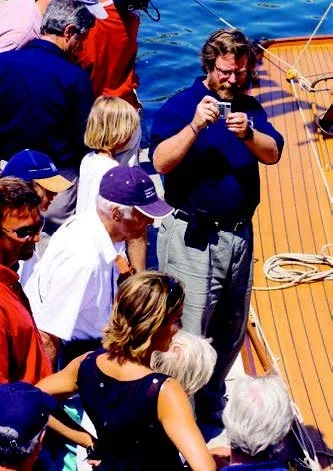
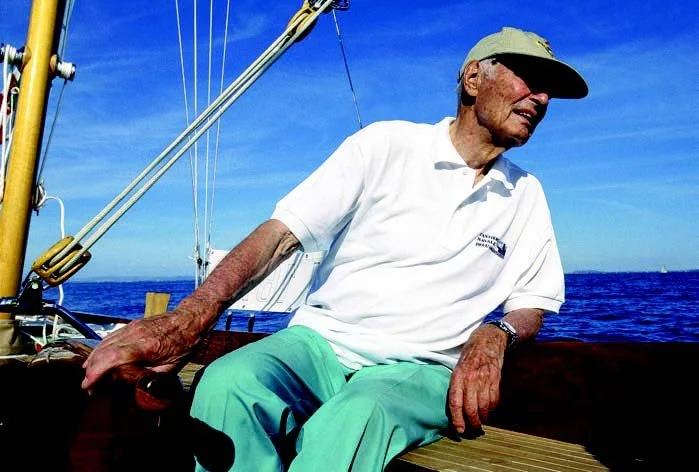
It was Doug Peterson (above left) who rescued and then commissioned the restoration of the lightweight Charles Sibbick skimming-dish Bona Fide. Another perennial visitor to the Italian shipyard was Olin Stephens, seen in 1997 at the helm of his own most famous design Dorade following her restoration
Seahorse: how did Cantiere Navale dell’Argentario (CNA) become the world’s most famous restorer of beautiful classic yachts?
Federico Nardi: I think it was a combination of circumstances, but it was certainly helped by my great friendship with Olin Stephens. Now we have restored many of his boats, Stormy Weather and Nyala of course, but the first one we restored was Dorade for Italian industrialist Giuseppe Gazzoni Frascara. Olin and I went together to see her on a small island near Seattle, which we reached by seaplane. Maybe we just found ourselves ready at the right time, when there was this sudden explosion of classic yachting, something that unfortunately today is finally losing momentum – partly due to a shortage of good enough candidates for restoration.
But soon the true fans started to appear, the best known of whom is certainly Patrizio Bertelli. In those 25 years or so between 1994 and 2019 our boatyard had become a living room where these captains of industry met to chat about boats… and sometimes about business. Sadly today we no longer see so many famous people who were once attracted by this magical call. The old enthusiasts remain but the latest generation of businessman does not seem as interested in the sporting heritage.
SH: What was your first restoration?
FN: I remember Sea Gypsy, a big John Alden schooner that I had been the skipper of, because in my previous life I was a sailor. In the 1980s I attended the Argentario yard because I brought the boats here for repairs. I arrived as a customer. The proposal to make the professional leap was made to me directly by the yard not long after that.
SH: Does the CNA currently take the form of a sort of association of craftsmen?
FN: When I arrived the yard was owned by a ‘middle-man’ representing a remote businessman from Rome. When I became involved I organised myself with the ‘master craftsmen’ to remove him! In the end we managed to take over the site and since then we’ve found ourselves a nice group of five, though now we are four partners because one of us sadly passed. We all have equal shares: Carlo Terramoccia who is boatyard manager, Piero Landini, philosopher and master of boats, and also of life, Stefano Busonero who takes care of the administrative part, and myself. I deal with external relations, technical management, I am often away finding new boats to be restored. The partners have also involved their sons to pass on this art. Between partners and direct employees we are about 20 people and then we collaborate with various other external artisans as we go.
SH: What does the CNA have that others who offer restorations do not?
FN: I can’t exactly identify it, also I don’t know other yards from the inside. But there are very few who do a job similar to ours. Above everything else our approach to the restoration process is driven by passion. My partners arrive at work at 7am and finish at 8pm, they live in this place. Restoration has its own philosophy, the soul of the boat resides within it, a copy cannot simply be built next to it. Therefore, an attempt is made to reconstruct a boat on and within itself, a rather complex process. In economic terms in most cases it would certainly be more convenient to build a new boat, but this is not a viable path for us because it would be unethical.
SH: Is there one part of the boat that allows it to retain its original aura?
FN: Several examples come to mind. Generalising, the lead keel is certainly one of the things that keeps best over time. If we then go into detail every boat has other unique elements that characterise it and which have survived time.
I am thinking of the restoration project of Scud, the 1903 class auric cutter designed by Nat Herreshoff, actually also owned by Patrizio Bertelli; the furnishings of this boat remain because they were dismantled at the time and saved from decades of natural wear and tear. Very little of the original remains of the hull, the bulkheads, maybe a few of the floor timbers. Unfortunately, when the starting condition is compromised, it is impossible to keep some parts of the boat. Many elements often cannot be saved.
One very important clarification must be made here. The restorations carried out by us are not museum restorations, it is a question of restoring yachts that are then engaged in high-level competitive racing. So when carrying out a restoration you must be sure that once the boat is in the water it can sail in total safety. Drawing a line between old and new therefore becomes complicated.
In some boats, on the other hand, more elements can be saved. For example, partial but significant interventions were carried out in the restoration of Stormy Weather and Dorade, but the base of the boat has always remained the same. On the other hand, yachts such as Bona Fide, which dates back to 1899, had been heavily damaged by wear over many years.
SH: Do you think your craftsmanship has something to do with being in Tuscany and with the area’s famous art and excellence in related fields… the sculptors of Pietrasanta and the famous marble caves of Carrara are of course not very far away?
FN: Perhaps. I do believe that the geographical area in which we find ourselves has a positive influence when the owners are selecting us to restore their vessels, both for a regional tradition of making beautiful things but also for the guarantee that the work is done in the most correct way. This gives the owner a lot of confidence.
SH: Can you tell us more about your relationship with Olin Stephens?
FN: I remember that he would always come to the yard for a couple of weeks in the spring or early summer. He loved Tuscany and Maremma, the area where we are, he would visit the ancient churches around here.
Olin was a wonderful person, his mind travelled faster than the words he spoke. But I learned many secrets by listening to his whispers, his explanations of the projects, of the acronyms he had placed on the project papers. Knowing which period of the year he preferred to spend in Italy, we tried to make the final restoration works coincide with that moment, so that for the official launch he was always at the helm for the first navigation of the new life of the boat. Olin was even made an honorary citizen of Porto Santo Stefano!
Another character who frequented our little piece of Tuscany was Doug Peterson, he literally lived for years at my home. In the end I forced him to buy a house here in Santo Stefano…
SH: You have restored the 1936 BobKat II, a 6 Metre owned by Doug Peterson. What is the difference between restoring a designer’s own boat versus restoring the yacht of a multimillionaire?
FN: It is certainly more fun!! But then Doug was particularly passionate, he started living in the yard office and at the same time he was closely following other restorations of ours.
One of his passions was to check all the offsets, he included them in all his programmes and diagrams and quickly spotted if there were errors and the extent of them; he did the same for other boats that we had here under restoration. During his many stays he supported us, but sometimes it was us who ‘put up with him’!
Doug had some quirks: one, for example, was that of the wooden plugs in the teak deck, concealing the metal fasteners; he preferred to put them in without glue, instead relying on a perfect fit. Later Doug steered BobKat II to her class win at the 6 Metre Worlds in 2007.
SH: What about Patrizio Bertelli? His name often comes up in the conversation…
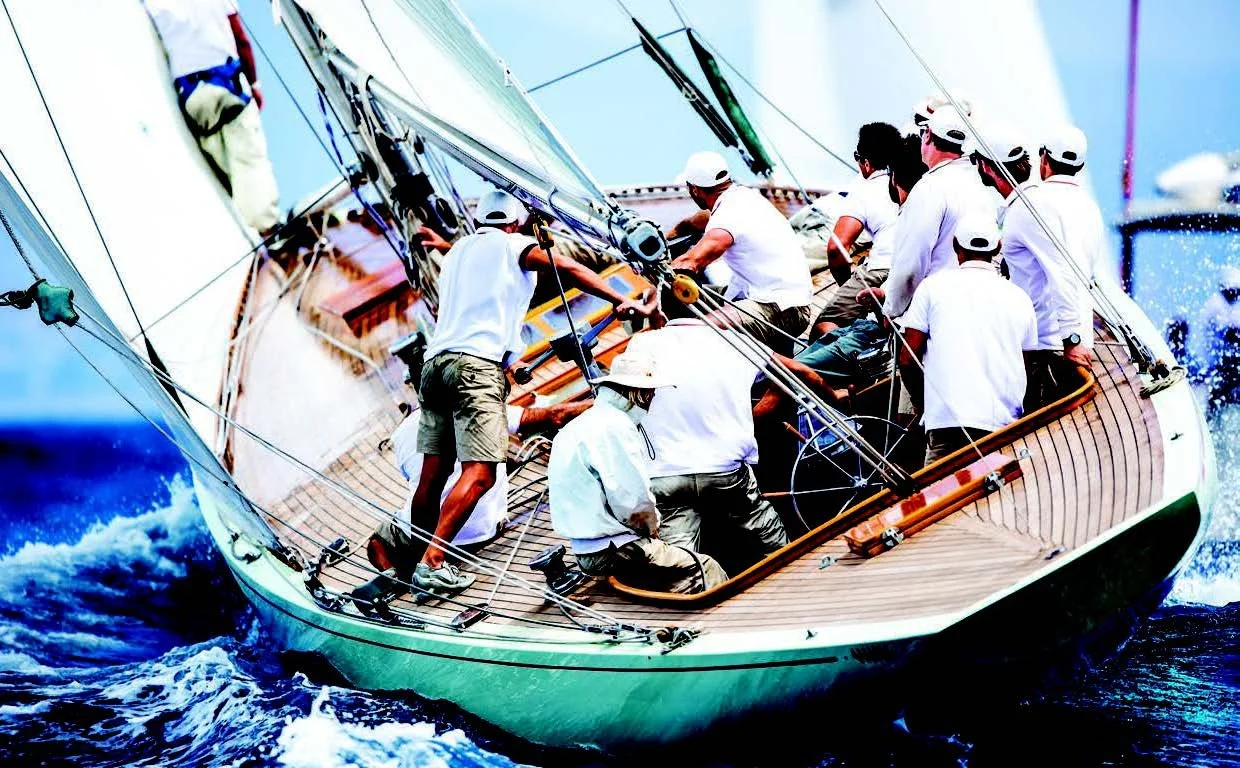
Above Top: where it all began. When Patrizio Bertelli asked Federico Nardi to rebuild his 1938 Olin Stephens design Nyala he had no idea that he was about to launch an entire new yacht racing industry. This is Nyala winning the 12 Metre Worlds in Barcelona in 2014 – she continues to be a regular on the Med circuit where Bertelli is often joined on his always beautifully turned-out yacht by fellow Cup veterans Torben Grael and Mauro Pelaschier. Nyala was originally commissioned by Standard Oil tycoon Fred Bedford as a wedding gift to his daughter and new husband Briggs Cunningham… he of luff-tensioning fame.
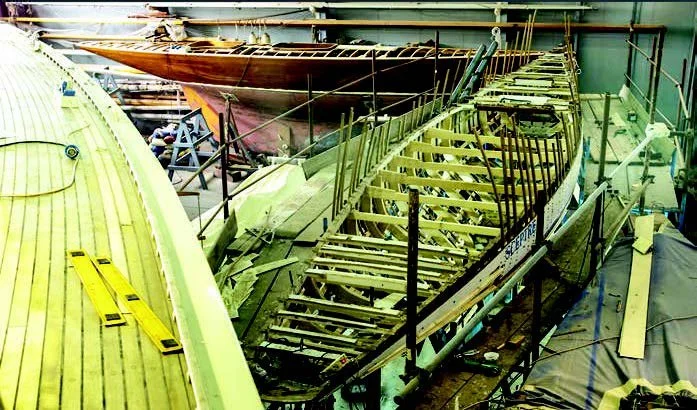
Above: not quite ‘before’ but the notably unsuccessful British 12 Metre Sceptre is seen in the foreground at the Argentario yard during her refit five years ago. After being soundly thrashed by 1958 Cup Defender Columbia, Sceptre has enjoyed a far happier later life as a charter yacht
FN: Yes it’s true, we work a lot for him, at the moment with the 12 Metre Kookaburra which just returned to the yard. Also with Vanessa, Vispa, Linette. Bertelli’s latest acquisition, Amorette, is in critical condition and she was also not easy to find… several searches were necessary before eventually I found her sitting in Maine. She is one of the very rare P Class, as Mr Bertelli had requested. Almost all the boats still left to be restored are now in America, because WWII did not leave the heavy scars there as it did in Europe.
Actually Patrizio Bertelli involved me during his debut in the America’s Cup. I was going back and forth to the USA to recover IACC yachts such as America3 and Mighty Mary to start the campaign. The team base was located in Punta Ala. Once I went there with Olin Stephens and, despite being elderly at the time, Doug told me not to let him in anywhere because he was eternally curious… by his own admission!
Others yachts are also now based at the CNA. For example, we usually have Recluta, German Frers’ personal yacht, which lives with us when she is in Europe and to which we continue to make improvements. This is one of the last major current projects, we have others in the pipeline but I have a duty of confidentiality and I cannot name these boats.
SH: Which boat is the most significant for you among those you have restored?
FN: If I really have to choose I say Dorade. I have very pleasant memories… in those years the classic yacht regattas were still held in Porto Cervo. We were leading the fleet around the Islet of Monaco, I was steering upwind, in the stretch of sea towards the finish in Porto Cervo, when I realised that the rudder was no longer responding. Then we all got to windward and the boat sailed by itself, with perfect sail trim, all the way to the finish with no one at the helm. A magical moment.
SH: Do you have other special memories of sailing on yachts you have restored?
FN: Without a doubt the America’s Cup Jubilee at Cowes in 2001. I did the Round the Island Race on Stormy Weather with Doug, there was the perfect breeze, 11-12kt, and we always sailed close to Dorade. We got to the Needles together, beautiful! But other boats from our yard also took part in that regatta – Nyala with Torben Grael, Aria with Mauro Pelaschier and Cerida. It was a great satisfaction for us as a boatyard.
SH: You are also involved in the production of the Wianno Senior one-designs that exist mostly in America…
FN: We have made seven and sold one more just recently. They are very expensive!! For us they are not economically advantageous but they are delightful boats that have a niche market.
SH: A final very important question for you, Federico… How do you keep and pass on this wonderful local craftsmanship to the new generations?
FN: It must be said that in Italy very little is invested in this area, which is why so many trades are disappearing. The craft of wood carpentry is linked to naval carpenters… when they disappear the art disappears. Always the hope is that the sons can keep this knowledge, but that is not always the case. Other boatyards such as Beconcini had to cope with the disappearance of a lot of important craftsmanship knowledge when many of their workers retired or moved away – it was a very tough situation for them. You cannot teach these skills without demonstrating them for many hours, days and weeks.
It is not a profession that can be invented, it must be handed down. Many years ago, with Serena Galvani, Aria’s owner, we tried to create a school for naval carpenters here – I wanted to set it up like the school in Newport. Unfortunately, however, for various reasons, many of those reasons to do with local politics, this project never really got going...