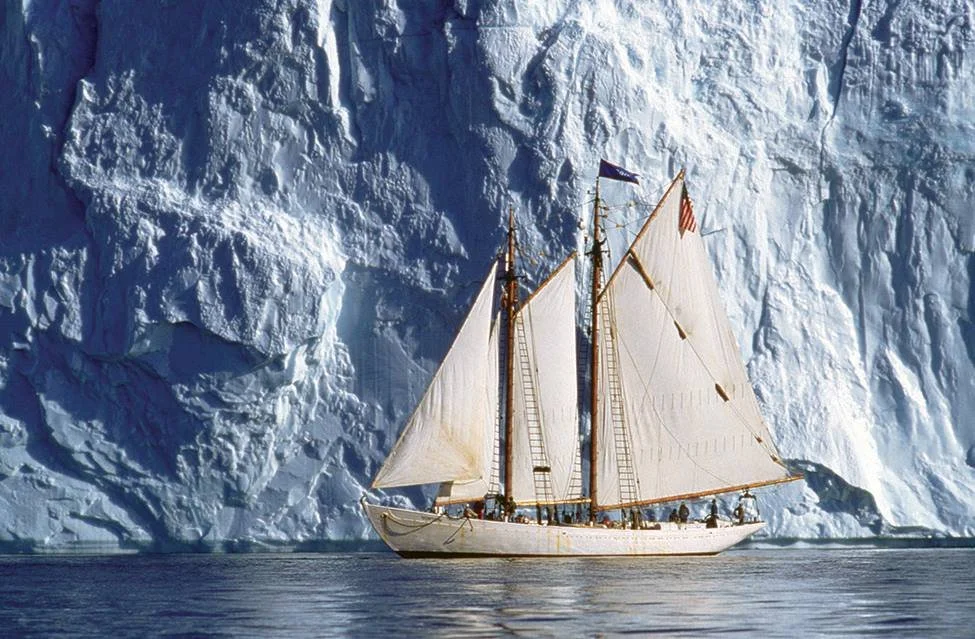
The Arctic Schooner Bowdoin
Thanks to Peter Smith a regular reader based in Maine, USA, for sharing this incredible image. Peter writes…
It’s of BOWDOIN during a rendezvous with the schooner STATE OF MAINE in the Laurentian Channel. I had the honor of skippering her on a 10-day charter in mid-coast Maine in the summer of 1976. Her then-caretaker’s wife was in labor and HIOBS gave me a couple weeks off, to take her out. She sails beautifully, and still to this day makes her home in Maine.
This made me want to find out more and here’s what I came up with…with a tenuous Australian connection?
BOWDOIN’s creation came about partly from necessity and partly from obsession. In 1913, the explorer Donald Baxter MacMillan found himself stranded in the Arctic wastes, waiting four years for a relief ship strong enough to navigate the grinding pack ice of Melville Bay. While the polar winds howled around him, he started dreaming up the perfect vessel to survive and thrive in the Arctic.
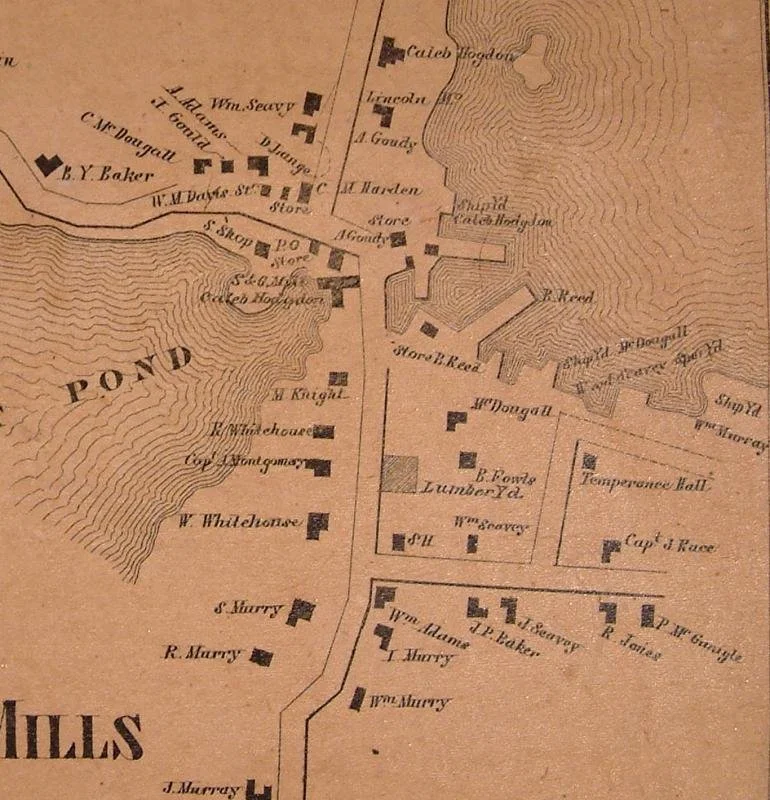
That dream took shape on the slipways of the Hodgdon Brothers Shipyard in East Boothbay, Maine, during the winter of 1920–21.
Designed by William H. Hand Jr. of New Bedford, the Bowdoin was inovative for the time: the only American schooner ever built expressly for Arctic exploration. At 88 feet long and 60 tons, she was not huge but her construction was extraordinary. Her hull was double-planked and double-framed in white oak. Its recorded that “a five-foot belt of Australian greenheart — one of the hardest woods on earth — wrapped her waterline against the ice”. This confuses me a little as I thought Greenheart timber was a premium, tropical hardwood native to South America. (Can readers clarify?) Her hull was rounded, not flat-sided, so that when pack ice closed around her she would rise up rather than be crushed. An 1,800-pound steel nosepiece armoured her bow. Her rudder was oversized, because it was belived that twisting through t leads in the ice would demanded quick, decisive turns. Every design and construction choice had the Arcticin mind.
MacMillan named her after his alma mater, Bowdoin College, and on a late summer day in 1921 she crossed the Arctic Circle for the first time, heading toward Baffin Island. Writing home from their ice-locked winter harbor, MacMillan declared simply: "The boat is a wonder."
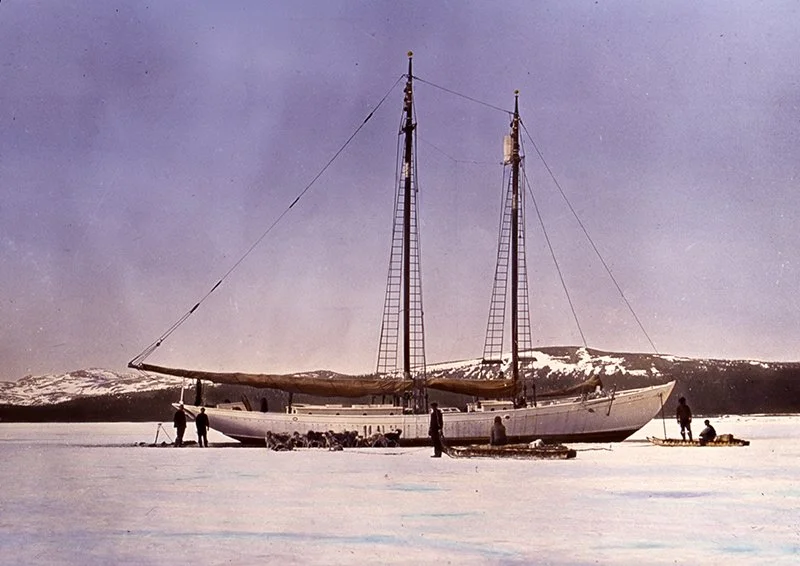
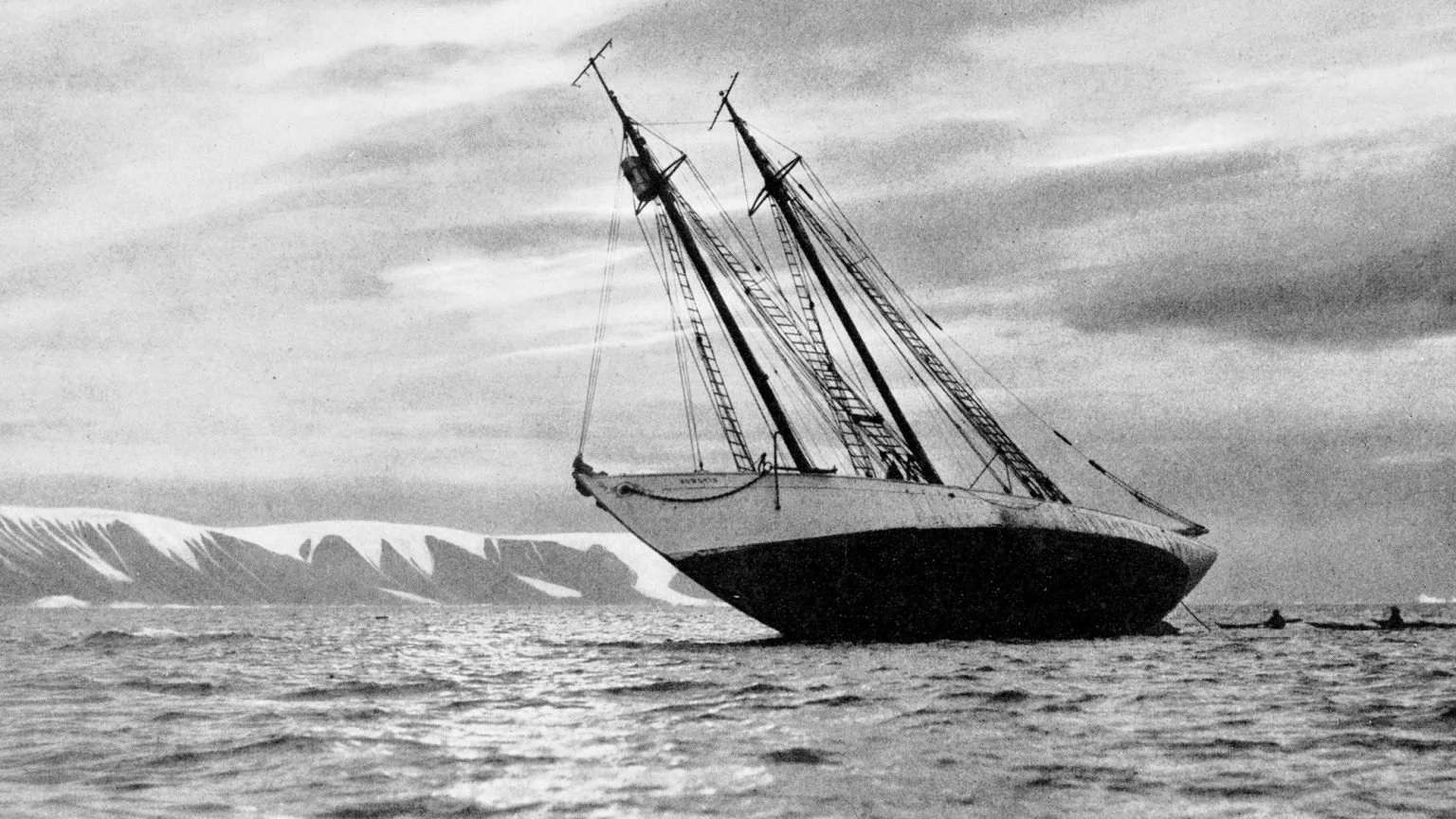
And so she proved to be. Over the next three decades, MacMillan sailed the Bowdoin north twenty-six times. She carried scientists, students, and adventurers deep into a little known world — into the fjords of Greenland, past the icebergs of Davis Strait, in both Arctic summers and long dark of polar winters. She accumulated more than 300,000 nautical miles in waters that had undone far larger ships. The Inuit communities of coastal Greenland came to know her white hull as a returning friend, and elders would keep black-and-white photographs of her visits for the rest of their lives.
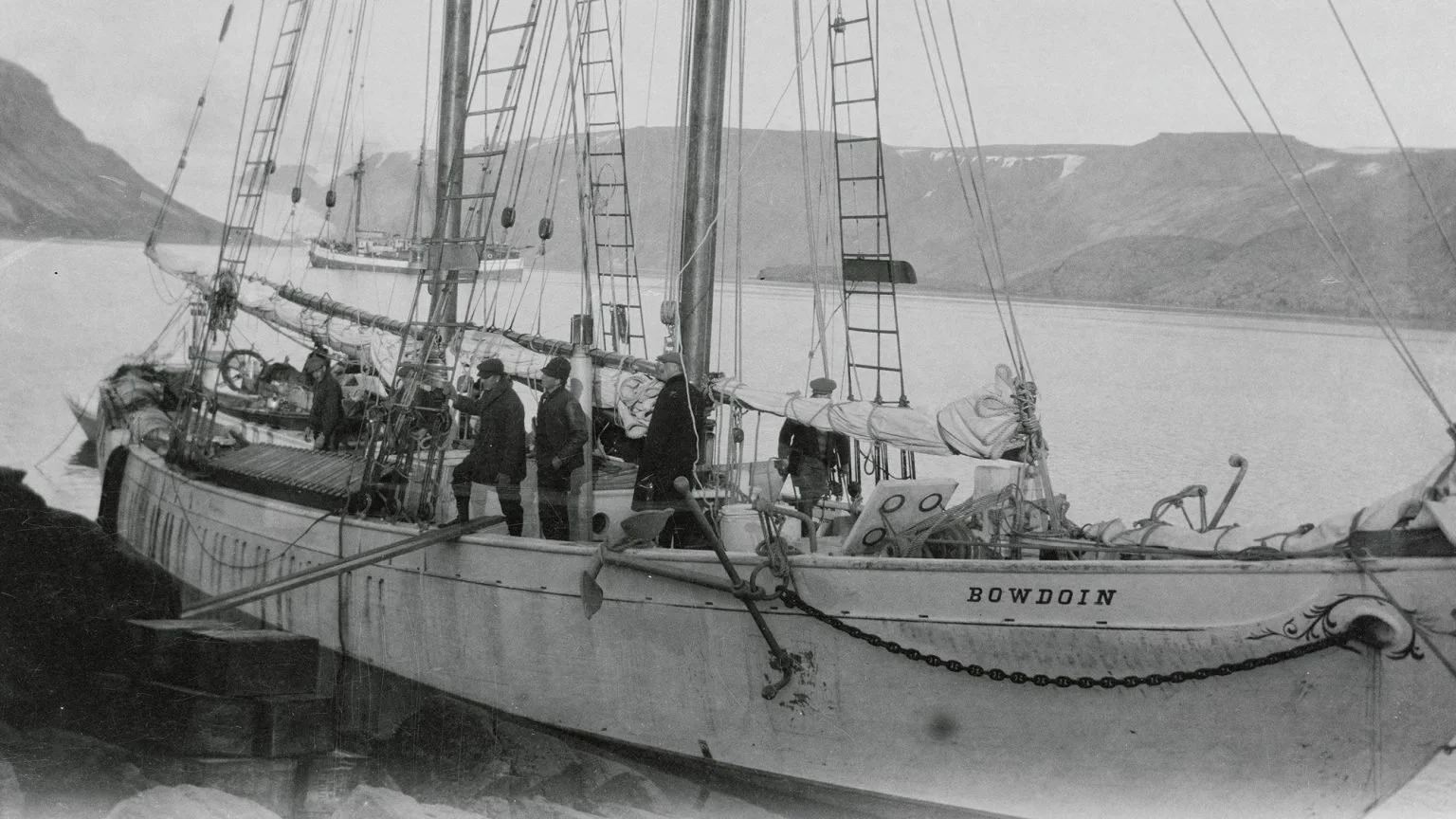
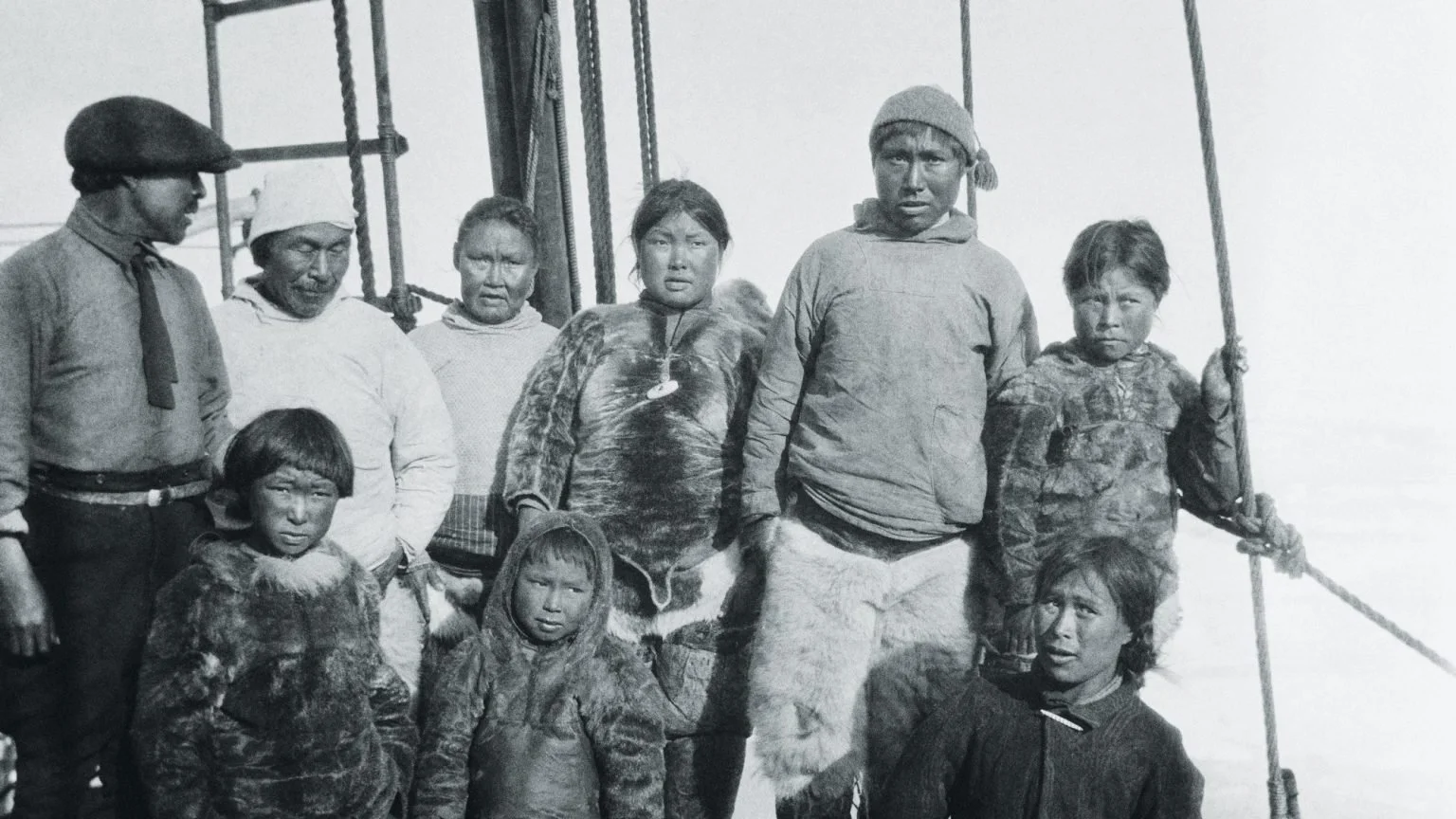
War interrupted these journeys. In May 1941, the United States Navy purchased the Bowdoin so she could patrol. Greenland. Under the command of Lieutenant Stuart Hotchkiss, she helped establish airfields in Greenland and conduct hydrographic surveys … All slightly ironic given USA/Greenland relations today! She was one of only a handful of sail-powered vessels in active Navy commission during the war. By 1943 she was decommissioned, struck from the Navy list, and sold as a hulk.
But the Bowdoin had friends. Purchased by MacMillan's associates and refitted once more, she was returned to her captain after the war. He sailed her north again, and again, until 1954, when the old explorer — in his eighties — finally sailed his last Arctic voyage aboard the vessel that had defined his life. Five years later, in a reportedly sad little ceremony he presented her to Mystic Seaport in Connecticut for display. The museum removed her masts and let her fall into neglect.
In 1967 she was rescued again when the Schooner Bowdoin Association reclaimed her; in 1969, a restored she sailed to Provincetown, where a 90-year-old MacMillan stood on the shore and watched her pass one final time. A major restoration between 1980 and 1984 brought her back to full vitality. In 1986, the State of Maine named her its official sailing vessel. In 1989, she was designated a National Historic Landmark.
Since 1988, the Bowdoin has belonged to the Maine Maritime Academy in Castine, Maine, training the next generations of mariners in her ice-scarred holds. She returned above the Arctic Circle in 1991, in 1994, in 2008 — and again in the summer of 2024, when Captain Alexander Peacock sailed her 4,500 miles to cross the 70th Parallel, her 30th Arctic voyage. Inuit elders on the Greenland coast came to the dock, carrying the old photographs.
Now, more than a century old, she is perhaps the most accomplished timber high latitude explorer in existence. Very Cool!