
Staying Upright- Part Two
Last week we had a look at the evolution and gradual demise of the hiking board as a way of keeping small boats the right way up. This week we take a quick tour of the origins and history of a technology that in many ways has replaced the hiking board, the trapeze.
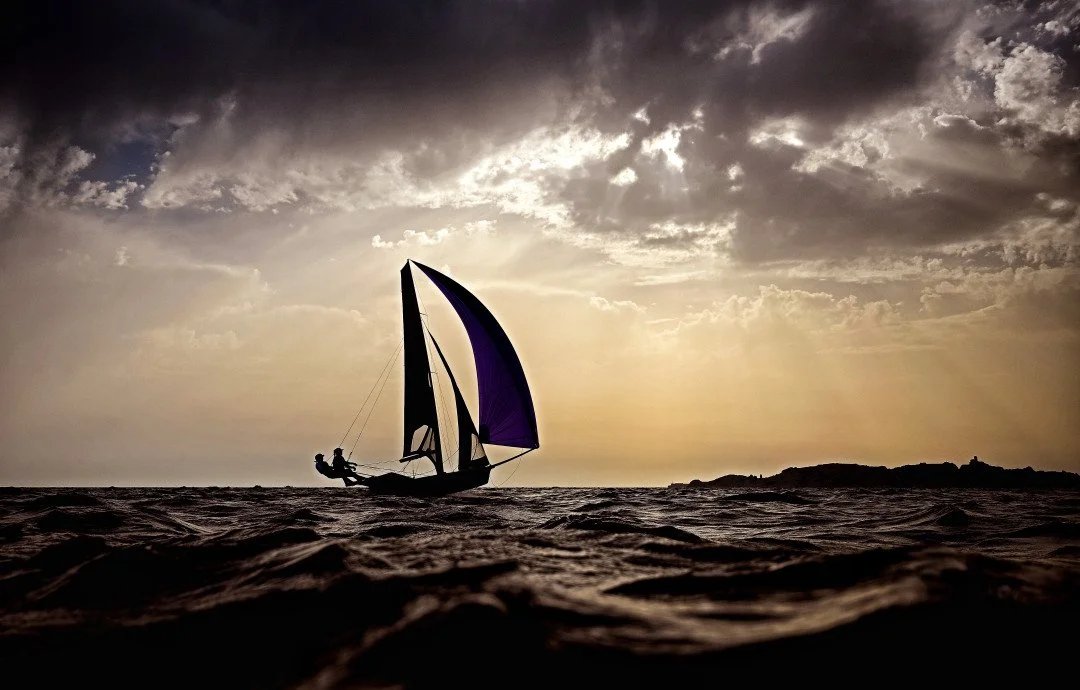
Image- Mason Clive from Pataenius Yacht Racing Image Awards 2024
Few pieces of sailing equipment are as visually dramatic — or as fundamentally transformative. The sight of the crew suspended horizontally over the water, skimming the waves, feet braced against the gunwale has become one of the defining images of modern dinghy racing. Yet the trapeze's journey from experimental curiosity to universal standard, spans not just decades but centuries - with roots that reach back far beyond the yacht clubs of Europe — to the traditional waterways of Southeast Asia and the competitive sailing scene of New Zealand between the wars.
The Problem
The problem the trapeze sets out to resolve, identical to the problem addressed by the hiking board but the solution is more elegant. A sailing dinghy heels when the wind pushes against its sail. The only counterforce available to the crew is their body weight, and the further that weight can be placed from the centreline of the boat, the greater the righting moment — the leverage that keeps the boat flat and the sail driving efficiently rather than spilling wind. For decades, Western sailors simply hiked: hooking their feet under a toe strap and leaning their upper bodies out over the side. It worked, but it was limited by human anatomy. The furthest a hiker could move their centre of gravity was perhaps half a metre beyond the gunwale. The trapeze changed that calculation entirely. By suspending the crew from a wire or line attached to the mast, it allowed them to stand fully outboard — feet on the hull, body nearly horizontal, centre of gravity extended dramatically further from the boat's centreline. The righting moment available to a trapezing crew member is roughly double what hiking alone can provide. As it turns out, sailors in one corner of the world had understood this instinctively for generations before it ever occurred to a European racing designer.
An Ancient Precedent: The Kolek of the Malay Archipelago
Long before the concept appeared in any Western sailing context, the fishermen and competitive sailors of the Singapore region and the broader Malay Archipelago had developed the kolek — a narrow, nimble racing canoe whose crew used a remarkably similar outboard suspension technique by which crew members would extend their bodies outboard using a rope or sling attached to the mast or an outrigger support, holding their weight clear of the hull to balance the craft in exactly the same fashion as a modern trapeze. The technique was not an outcome of competitive racing, but simply how these boats were sailed. It’s a is significant precedent. It suggests that the principle of body-weight suspension for righting moment is not a product of 20th-century engineering ingenuity but a natural solution that independent seafaring traditions arrived at independently. The kolek sailors of the Malay world were, in effect, trapezing centuries before the term existed in a sailing context. That this knowledge did not flow directly into Western yacht racing practice is a reminder of how insular and self-referential the development of European and colonial dinghy sailing could be.
Early Western Use: Auckland's M Class
The Emmy as it is affectionately known, is an active class of unballasted centreboard dinghies. The Class was formed in 1922 after designs by Arch Logan were adopted by the Royal New Zealand Yacht Squadron. Since that time the boats have raced continuously on the Waitemata Harbour for over 100 years. Back in the 1930s, sailors competing in these 18-footers developed a fierce and technically adventurous racing culture — They were experimenting with outboard suspension systems that clearly predate the trapeze as it later became known in Europe. The M Class sailors, driven by the same imperative to keep their powerful, lightly built boats flat at speed, rigged lines from the mast that allowed crew members to extend their weight dramatically outboard. The competitive culture of the Auckland skiff scene, was famous for pushing technical boundaries well ahead of conservative European class rules. The precise timeline is difficult to establish, but this Auckland practice appears to predate Beecher Moore's famous 1938 experiment by at least a few years. Whether Moore was aware of what was happening in New Zealand remains unclear, though given the relative isolation of the sailing communities involved, parallel development seems entirely plausible.
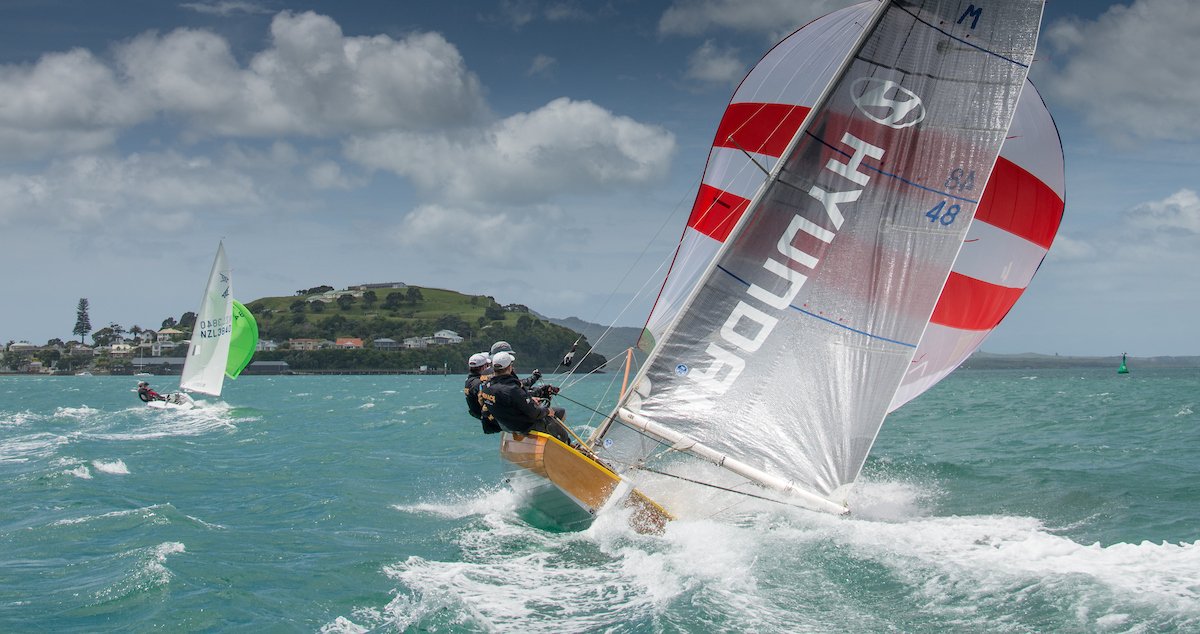
Modern M Class action on the Waitemata with trapeze- Live Sail Die
Into the Mainstream: 1938 and Beyond
It is Beecher Moore who receives the lion's share of credit in the standard histories, largely because his application of the trapeze was so public and its consequences so immediate. Moore fitted a wire suspension system to his 14-foot International dinghy VAGABOND in 1938. When deployed there for the first time it was called a Bell Rope.
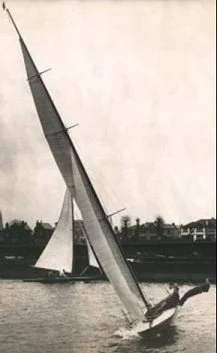
VAGABOND in action with trapeze
Crewed by Peter Scott — son of Antarctic adventured Robert Scott, he later became Sir Peter Scott, naturalist and founder of the World Wildlife Fund — the boat caused a sensation at that year's Prince of Wales Cup. VAGABOND won convincingly, and the trapeze was immediately embroiled in controversy.
Beecher Moore himself was an interesting character and was a highly influential in the development of dinghy sailing in the United Kingdom after the Second World War. He worked for many years with Jack Holt who designed numerous dinghies, and together they did much to make sailing a pastime accessible to the masses. (He was also a keen patron and collector of art and literature and accumulated a large collection of illustrated and written erotica. In 1964, during the puritanical scare period around the Profumo affair, he made a significant donation to the Private Case collection in the British Library. In the early 1990s he sold another collection of erotic writing and drawings many of which were the work of his friend, the illustrator Tom Poulton. These were collectively published by Taschen in 2006.)
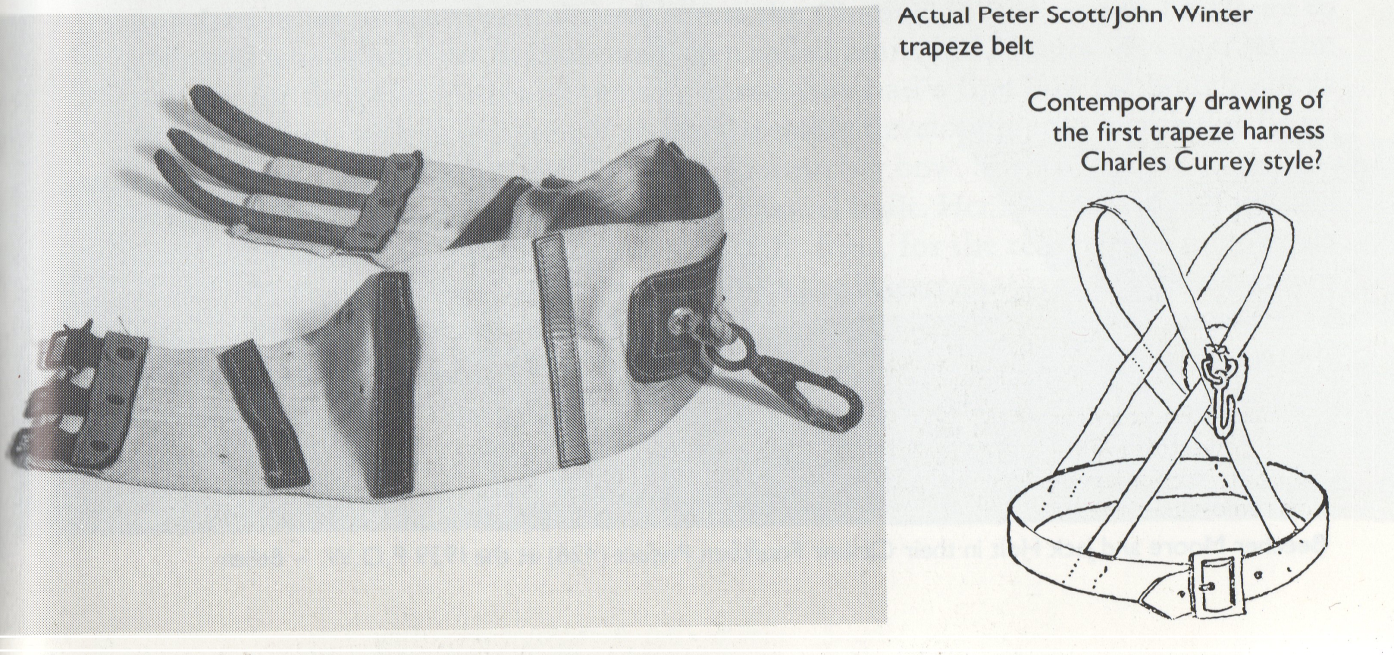
On balance it seems likely that Peter Scott developed Beecher Moore's Bell Rope, which was satisfactory for river use, into the more seaworthy harness used on THUNDER & LIGHTNING in its 1938 Prince of Wales Cup success. The modern trapeze developed from there - in spite of some temporary official opposition.
The response from the establishment was swift and hostile. The International 14 class voted to ban the device before the following season, fearing it gave an unfair technical advantage and would price out less wealthy competitors. This pattern — innovation followed by regulatory resistance — would repeat itself in sailing governance for decades to come. Despite the ban, interest in the trapeze simmered through the 1940s. By the early 1950s, the Flying Dutchman class was built from the outset with trapeze use as a core element of its design philosophy. When the Flying Dutchman was selected as an Olympic class in 1960, the trapeze received its most important endorsement yet: it was now part of the pinnacle of the sport.
Expansion and Standardisation: 1960s–1980s
The Olympic seal of approval opened the floodgates. Through the 1960s and 1970s, the trapeze spread rapidly across performance dinghy classes. The 505, the Fireball, the Tornado catamaran — each incorporated the wire as a standard and celebrated feature.
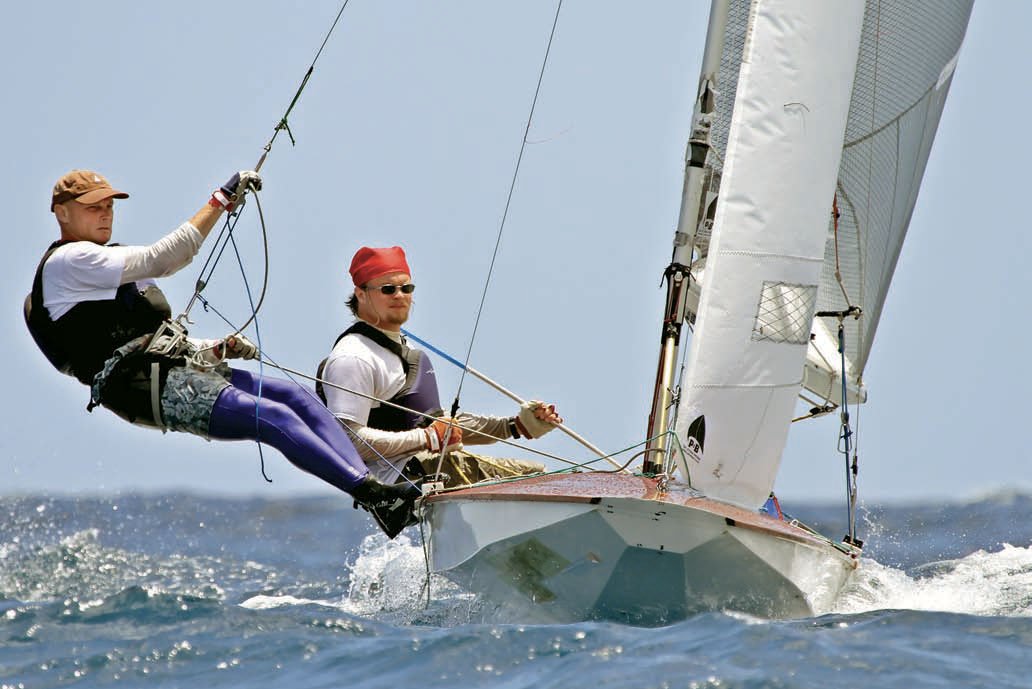
The Fireball dinghy
Harness design evolved significantly during this period. Early systems were rudimentary, little more than a hook on a canvas belt that could concentrate uncomfortable forces on the crew's lower back. By the 1970s, seat harnesses and spreader bars had improved the ergonomics considerably, allowing crews to trapeze for extended periods without debilitating fatigue. The physical demands remained formidable. Trapezing requires sustained isometric effort from the legs and core, and the skill of swinging outboard smoothly during a tack or gybe — without capsizing the boat or losing precious ground — took significant practice to master. Sailing clubs in performance-oriented countries began offering specific trapeze training sessions, and the role of the "wire crew" became a recognised and respected position in its own right.
The Double Trapeze Era
A natural next step was to put both crew members on wires simultaneously. The double trapeze further multiplied the righting moment available and allowed designers to carry ever-larger rigs on ever-lighter hulls. Boats like the 49er — a skiff-style dinghy designed by Julian Bethwaite and introduced in the 1990s — pushed this philosophy to its logical extreme. Extraordinarily wide racks extended the crew's trapezing stance further still, and the 49er's rig was so powerful that competent double-trapezing was simply a prerequisite for sailing the boat at all. The 49er became an Olympic class in 2000 and remains one today.
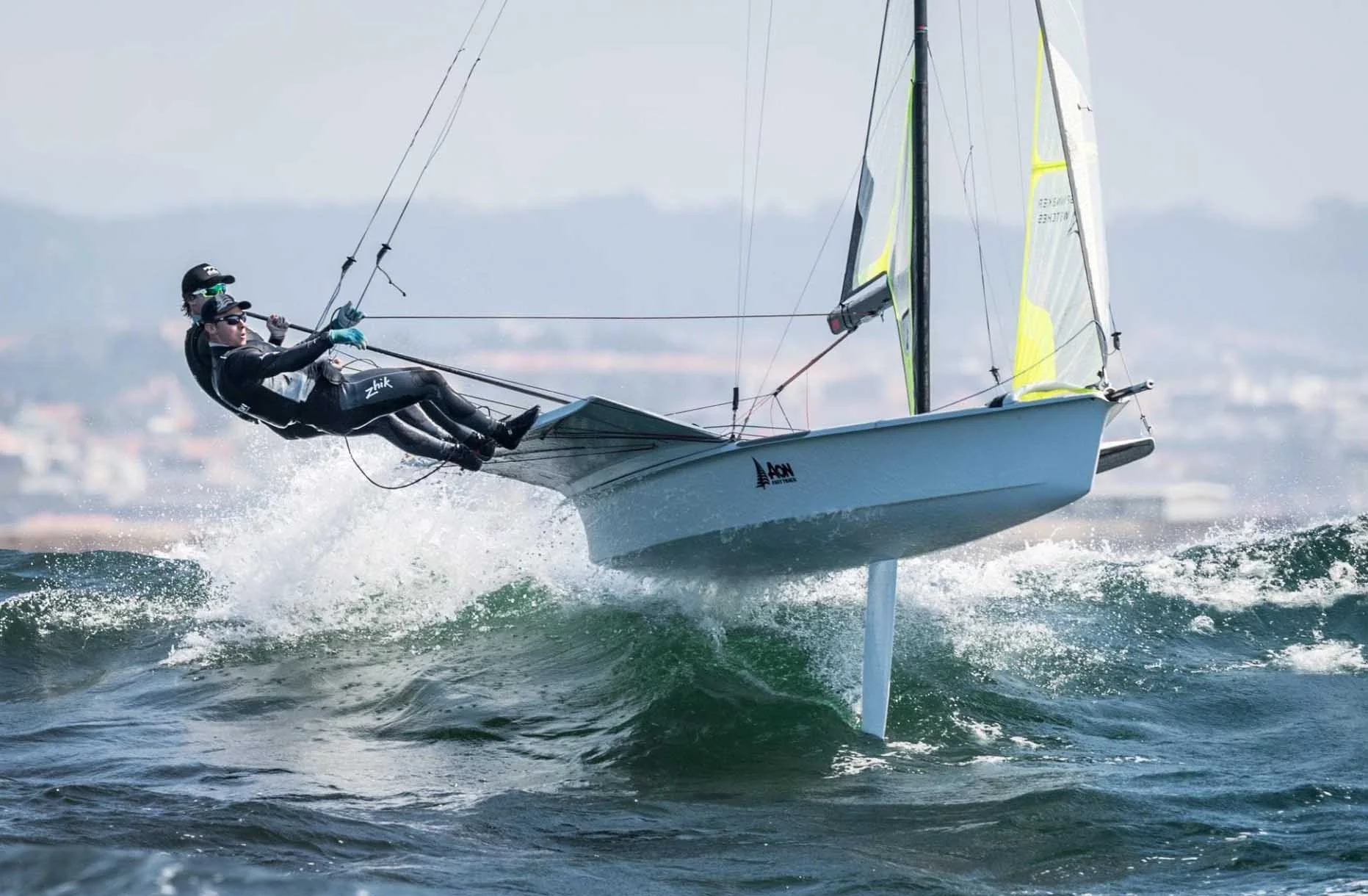
49er Olympic Class
The Trapeze Today
Technology has refined but not fundamentally altered the trapeze itself. Modern wires are typically dyneema or stainless steel, terminating in a handle at head height. Harnesses are lightweight, ergonomic, and highly adjustable. The hook — the simple interface between harness and ring — remains reassuringly mechanical, a deliberate choice in a sport where the ability to release quickly in a capsize is a genuine safety consideration. From the kolek sailors of the Malay Archipelago the foiling Nacras of the current day Olympics, the trapeze has become a standard solution to converting wind power into forward motion beyond the confines of simple hull form stability.
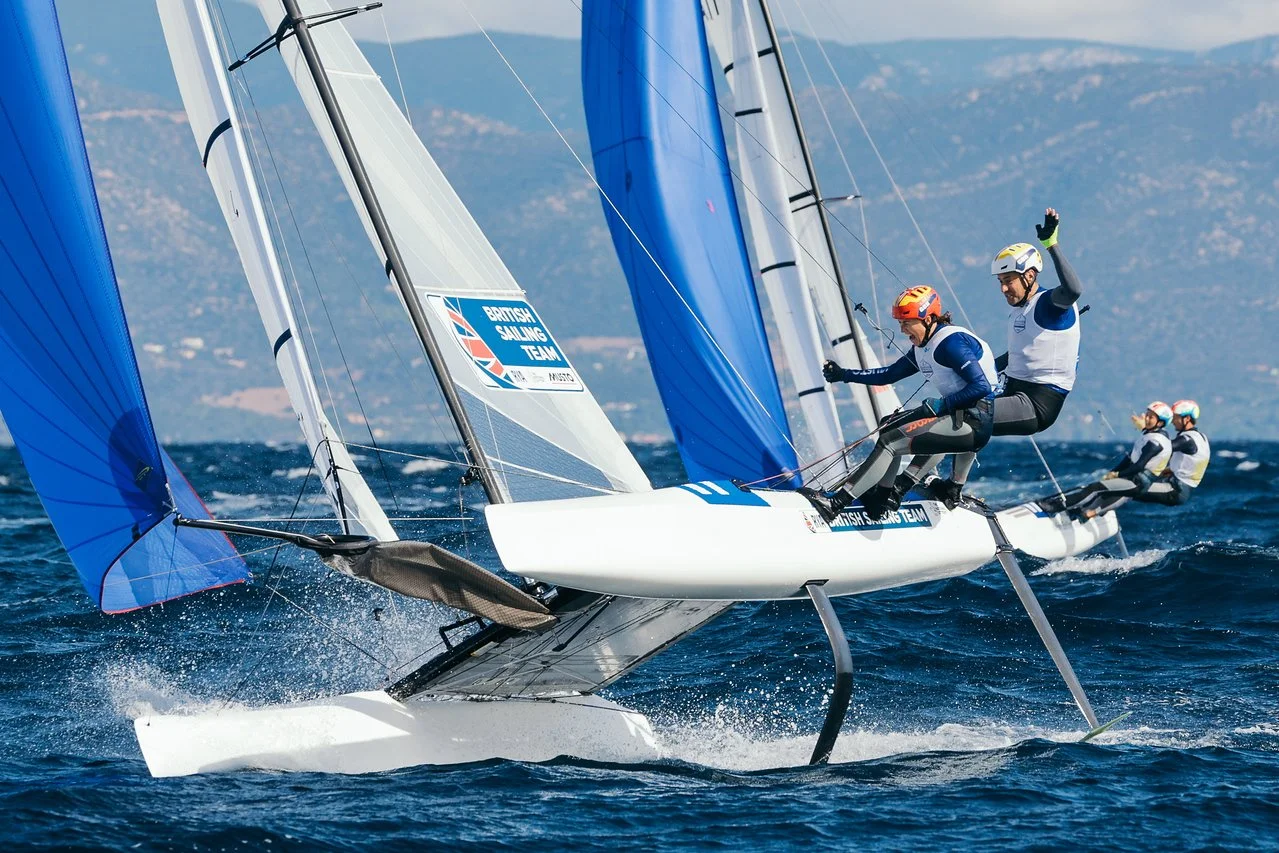
2025 49er, Fx, Nacra 17 Worlds, Cagliarir12 October, 2025rr© SAILING ENERGY