
Old Hat
Many of you will know SEAHORSE as the premiere sailboat racing publication in the world, covering the latest developments and cutting edge technology in the global race to win. However they also have a deep respect for the lineage from which today’s boats evolved. Over the next few months we will bring you a series of handpicked articles from their archives highlighting this history, and showing that deep satisfaction in sailing comes from understanding, just as much as winning! The generous people at SEAHORSE are offering readers of SWS a significant discounts of up to 30% on both digital and print editions of this seminal magazine. Click the banner below to check out the offer.

Technical terms streaming seemlessly off the America’s Cup course in 2021, lables that many sailors take for granted but others may find obscure… The speeds of the AC75s may be unprecedented but much of the nomenclature in play has been around for ever. Iain McAllister explains.
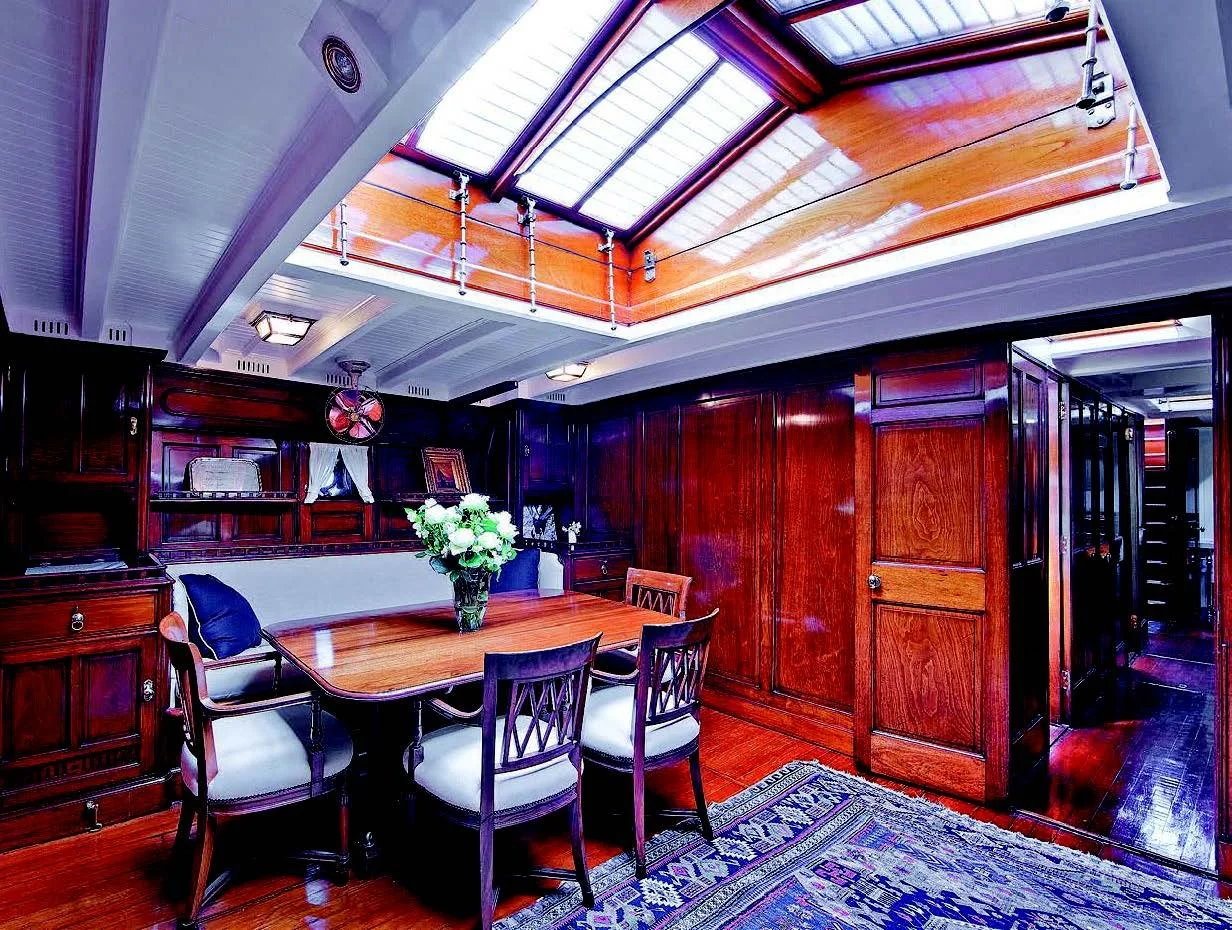
The 1931 Fyfe schooner ALTAIR was a valuable client for JS Highfield’s
simple but ingenious skylight lift catches, (See drawing below) -Iain McAllister collection
Listening to Ken Read and Nathan Outteridge discuss something as normal as Cunningham tension during the 36th America's Cup almost seemed at odds with the technological duel on show. But wasn't it wonderful for the helmsman of the successful 1958 Cup defender Columbia to be name checked over 60 years on.
Briggs Cunningham (1907-2003) may be better known now to students of motor racing history, but his yacht racing expertise was legendary – recipient of the US National Sailing Hall of Fame 2020 Lifetime Achievement Award – and, of course, his name long ago entered the sailor's lexicon for his invention of the luff tweaker we all know and use without giving it a second thought. Today it is so taken for granted as part of the on-deck scenery that more often than not it is written without a capital c.
Such a fate has also befallen the likes of the Barber brothers, JS Highfield, Rear Admiral Sir Edward Fitzmaurice Inglefield, KBE, and Captain Charles Noble.
Don't call yourself a sailor if you don't know their inventions – although, in the case of Highfield, you might be excused for not knowing them all. And don't scoff at Charlie Noble and his galley smoke stack if you haven't sweated halyards and sheets all race long on an authentic classic yacht with no winches; the cooks aboard 19th and early 20th-century America's Cuppers were their battery banks and hydraulic accumulators.
Ever since humans first learned to pimp their dugouts with wind assistance we've been inventing systems and gadgets to make the handling of sails and other items of onboard equipment more efficient. Their names fill huge dictionaries with words undecipherable to the landlubber; doubly so in cross-language nautical dictionaries. And the industry involved in making and supplying them has become a substantial one.
While each culture mostly named these gadgets by their function, those yacht fittings named after their inventors are perhaps most interesting for a diversion such as this. Let's take some alphabetically.
Barber hauler
Who was Barber? Actually, there were two; the Barber brothers were 1950s San Diego Lightning class sailors who wanted better jib trim; don't we all.
Highfield lever
John Sommerville Highfield (1871-1945) was a Cheshire-born, London-based consulting electrical engineer and inventor/patentee. During the first world war he was involved in the development of hydrophone technology for submarines. As a yacht owner he had a penchant for large, no longer class competitive Metre Class yachts; one of them quite famous in her day, and now.
In the spring of 1923, soon to become Royal Thames Yacht Club Rear Commodore, JS Highfield replaced his Alfred Mylne-designed, Robertson of Sandbank -built 1909 International 12-Metre CYRA with the William Fife-designed and built 15-Metre TUIGA. Under her second owner, Oslo shipowner Jac MH Lindvig, as BETTY IV she had joined a group of 15-Metres that continued racing in Norway during and after the first world war.
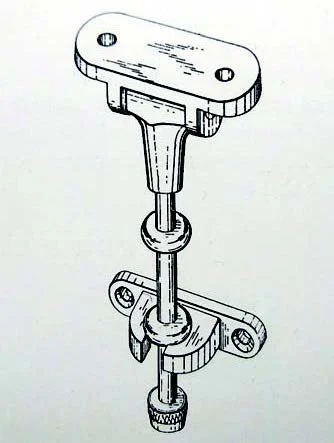
Top left- Schematic of ALTAIR’s skylight lift catches.
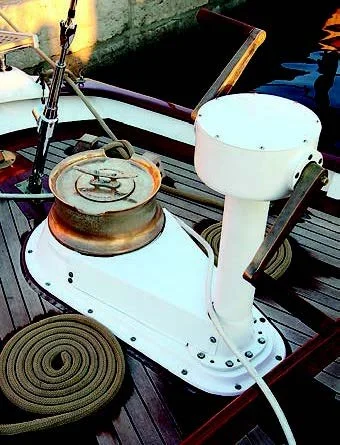
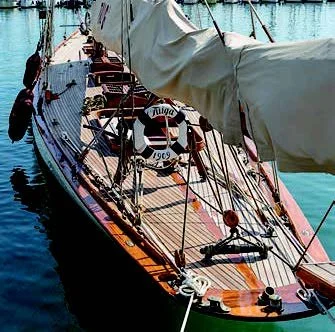
Top right-Still in use the single Merriman aft pedestal winch on the restored 1938 Stephens design BLITZEN – refurbished with components from one-time rival Lewmar; it still handles the boat’s huge overlapping genoas. One winch for two sheets – clever, lighter and also cheaper, though probably rather less of a priority in heady pre-war days. Tellingly BLITZEN was one of the few yachts of the era built as a stripped-out racer in the modern idiom.
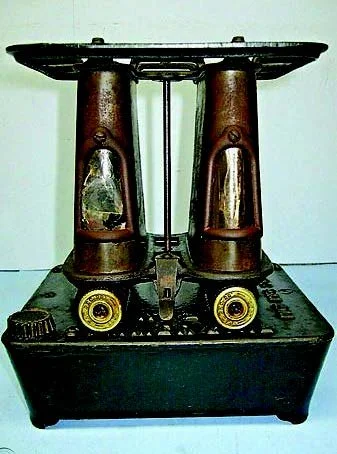
Bottom left: an original Taylor two-burner paraffin stove. This example is now in a museum but many Taylor stoves of similar early-1900s vintage have either been kept operating or restored and are still in use.
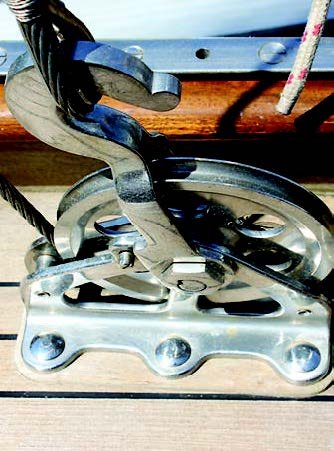
Bottom right an elegant large-diameter running backstay sheave with quick release for the leeward runner on the 60ft Laurent Giles sloop ALBACORE, launched in 1966
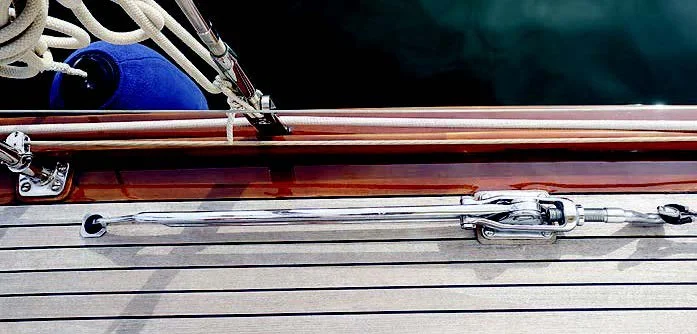
Highfield changed her name to DORINA after his daughter Dorothy and wife Marina, and it is aboard DORINA that he developed his tensioning lever for her running backstays, initially only on one side to compare the relative performance against tackles. He soon patented the Highfield lever, which became immediately popular, particularly for running backstays, and as quick-release tensioners for the removable inner forestays of the increasing number of Bermudan cutter-rigged offshore racing cutters through the 1930s.
A particular fan was Jack Laurent Giles who refined the lever to something approaching sculpture; beautiful examples of which can be seen in Giles designs well into the 1970s.
As KISMET III for her next owner, J Colin Newman, the by now Bermudan cutter-rigged 15-Metre took line honours in the 1935 Fastnet race. Hopefully, if still fitted, the Highfield levers helped.
Famously rebuilt and restored in the early 1990s to her original extreme gaff cutter rig by Fairlie Restorations, TUIGA has sailed the classic regatta circuit since 1993 and been owned by Yacht Club de Monaco for the last 25 years… but now without a Highfield lever in sight as it's back to sweating in the backstays on this authentically restored and sailed classic.
However, together with most of her authentic and authentically restored William Fife-designed and built sisters, TUIGA is still fitted with examples of one of JS Highfield's finest and most ingenious yacht fitting designs, a beautifully simple skylight lifter/catch celebrated by Uffa Fox in the 'Gadgets' chapter of his 1938 book, Thoughts on Yachts and Yachting. Once you have experienced this multifunction fitting, everything else seems ugly and clumsy.
I can't describe it any better than Uffa:
'… it consists of a fairly long bar threaded into a swivelling socket attached to the skylight. On the bar two knuckles are made, a further casting shaped to take these knuckles above or below is fastened to the coaming beside the skylight, and when the latter is shut the upper knuckle is underneath the casting and hove down tight, anchoring the skylight and preventing its lifting. When air is required the bar is unscrewed and the knuckle lifted above the casting, and if still more air is required the skylight is lifted still more, and the second knuckle (as shown in plan) rests on the casting and the skylight is now well open.
'This skylight fastener has the advantage of being simple yet strong and very effective, because it is the lock and also the prop for holding up the skylight in one.'
High praise from the master of innovation himself.
Inglefield clip
Though no longer a regular item of racing equipment, race organisers have used these simple signal flag hoisting clips, sometimes including swivels, for over a century. Lieutenant Edward Fitzmaurice Inglefield (1861–1945) developed his invention in the early 1890s onboard the only significant British Royal Navy warship built on Malta, HMS Melita, and patented it in 1894. On leaving the Navy and placed on the retired list as a Rear Admiral in 1906, Inglefield became secretary to Lloyd's of London and was knighted in 1919.
The corporate creations
As well as individual fittings named after their inventors, some famous classic yacht equipment manufacturers and suppliers were and are still known by their founders' names, even if this isn't always apparent. Although many of the major 19th and 20th-century yacht builders continued to make everything in-house (sometimes even the engines) manufacturers and distributors of yacht fittings became established from the mid-1800s. Many of these firms have not survived into the 21st century, but their products were so well designed, and manufactured from the finest of materials, that they can still be acquired. Names that spring easily to mind include:
Blakes – best known now for their throne-like marine toilets.
Davey & Co, London – manufacturers into the 21st century of a wide range of yellow metal and galvanised fittings and in the process of being relaunched.
Lewmar, Havant, UK – a leading name in yacht hardware since 1950 and still very much alive, the company is named after founders Len Lewery and Leslie Marsh. By the 1960s Lewmar were manufacturing almost every part of a yacht's deck equipment, including stanchions, pulpits and pushpits, but gradually their range focused on sail-handling equipment before broadening back out again. By the turn of the 21st century they were sharing Scottish ownership with Simpson-Lawrence, producing the famed S-L anchors (eg CQR and Delta) with windlasses also coming under the Lewmar brand. A nice, relatively recent example of Lewmar paying homage to their past was their involvement in the restoration of Sir Francis Chichester's 1966 Illingworth & Primrose/Camper & Nicholsons ketch GIPSY MOTH IV.
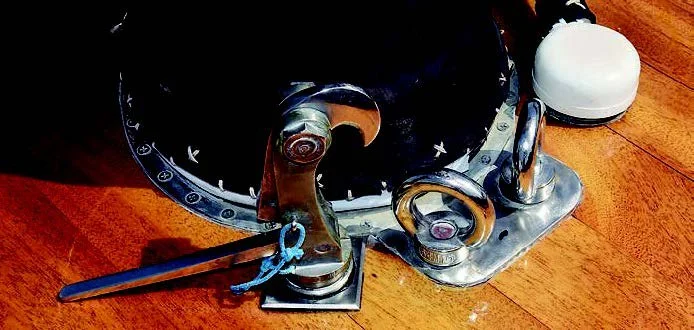
Top Left - Ivan Carr quick release headsail halyard hook, on SOLWAY MAID
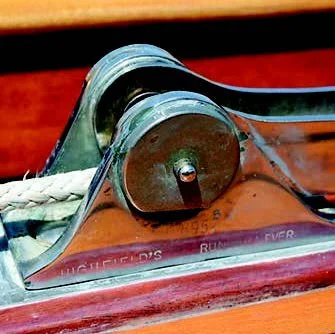
Top Right - the Highfield levers on MAID still bear the inventor’s original patent stamps;
Middle Left - very modern-looking Highfield lever on the 1940 Fyfe SOLWAY MAID;
Middle Right-– TUIGA, flagship of the Monaco YC.
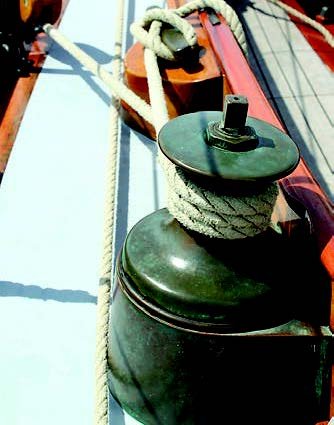
Bottom Left- an earlier Merriman winch on the 1949 S&S-designed 44-footer LAUGHING GULL – preserving working original deck gear is a source of pride in today’s fleets
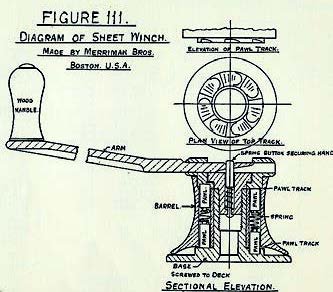
Bottom Right - original drawing for a 1950 Merriman sheet winch. Note the two sets of pawls top and bottom in the drum to reduce twist, an indicator of the use of softer materials such as bronze – now largely replaced by modern hard alloys;
Merriman Brothers, Boston, USA – the makers of undoubtedly the best – and best-looking – bronze winches of their day, and arguably the best other hardware anywhere; sadly demised, but their products are still very findable, and de rigueur for any self-respecting US-designed yacht restoration.
Pascal Atkey, Cowes – not just a chandlery in days past; also manufacturers and distributors of everything for the proper yacht… including pianos. Their oldest catalogues are a page-turning feast to the classics-favouring eye, featuring mostly iron equipment fit to test any yacht's ability to float to its lines. But by the 1930s they included a range of 'Birmabright' aluminium alloy fittings 'a third of the weight of brass, gunmetal, iron etc'. Modernity indeed.
Paul Luke, Maine, USA – makers of fine cooking stoves, cabin heaters and anchors.
Simpson-Lawrence, Glasgow – and later internationally. Perhaps the most famous company in marine hardware to disappear in recent years, Simpson-Lawrence was a household name until reorganisation by its Scottish holding company, which by the early noughties owned Simpson-Lawrence, Lewmar, Navtec Rigging and Whitlock Steering. The S-L legacy of anchors and windlasses continues under the Lewmar name. Founded in the early 1900s by relatives David Dunlop Lawrence and Andrew Simpson Lawrence, an early catalogue of c1912 offers everything for a yacht in 130 pages, even including complete items of deck carpentry such as companionway hatches and skylights. Their core self-manufactured product lines were anchors (CQR and Delta), windlasses and sea toilets, enhanced by a myriad stocked products by others. By the late 20th century Simpson-Lawrence was probably the world's largest yacht equipment distributor outside North America.
Taylors – the design of their paraffin stoves and heaters has barely changed since they were launched more than 120 years ago. Still popular for classic yachts because of the difficulty of concealing safe by modern standards gas lockers. Well-maintained Taylors stoves from the early 1900s are still in regular use.