
All on Your Own
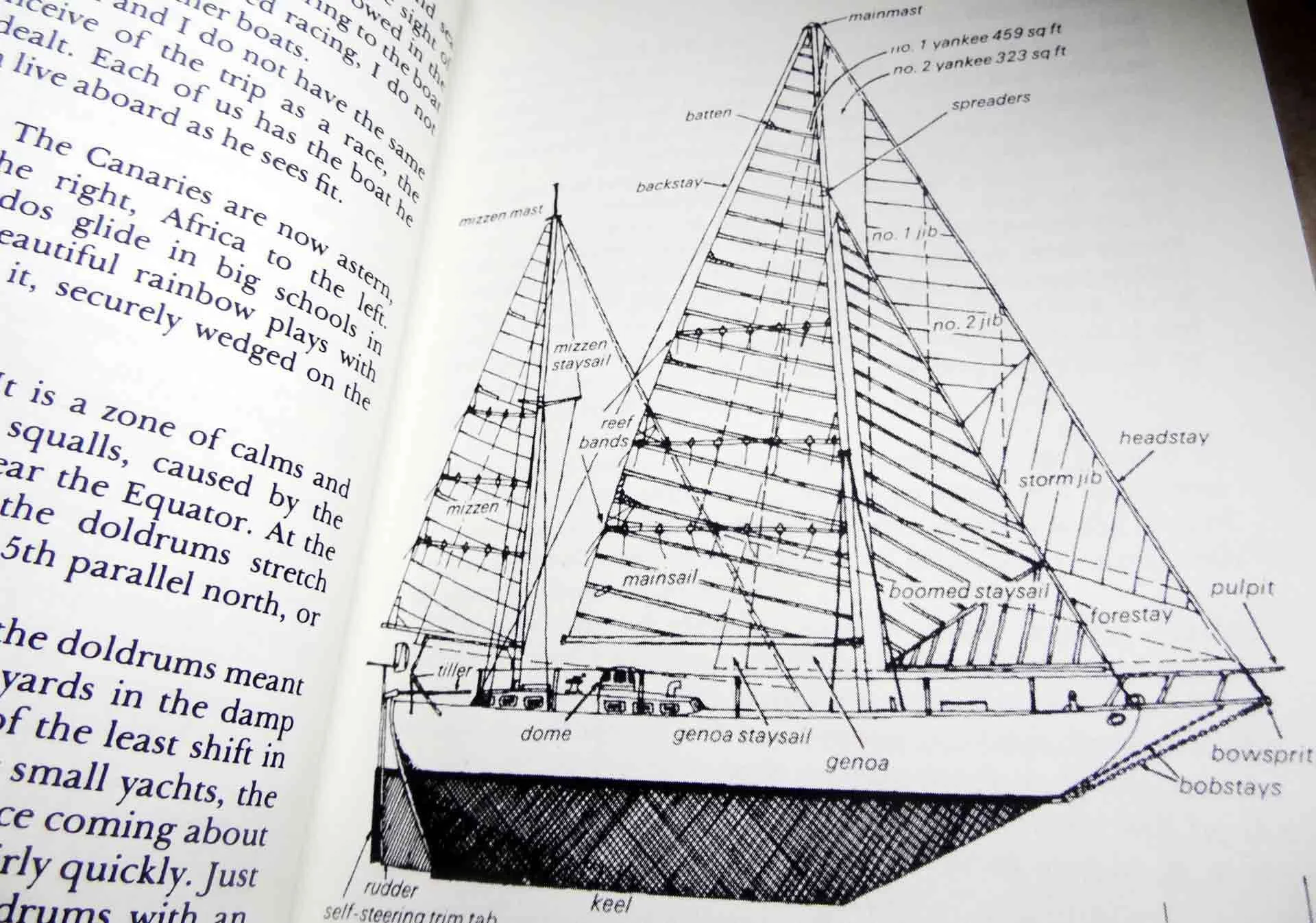
Pages from Bernard Moitessier’s famous solo voyaging book “The Long Way”
It will take a moment to work your way through these three chronological and related article from LOOSE CANNON (by Peter Swanson) but its well worth the effort. His Substack site is well researched, refreshingly opinionated and definitely worth signing up for. Many Thanks for letting us reproduce.
Article One- Solo-Sailing Banned in 2026? Yup, YouTuber Says So Using British Accent. By PETER SWANSON (Video Views, 37,000)
You can say this: That YouTube AI master in Slovenia really knows how to push our buttons. For 20 minutes, you watch and listen to a seemingly plausible argument that international regulators are using algorithms and bureaucratic trickery to sideline older sailors and solo sailors.
The regulators, you see, are conspiring with Big Insurance.
The channel is Yachts & Boats. The video is entitled: “The ‘Solo-Sailing’ Ban: Why New 2026 Regulations Target Older Captains.” This from the video summary:
The era of the independent solo mariner is under a coordinated, systematic attack. New 2026 maritime regulations are now being weaponized to target a specific demographic: the experienced, older captain who values the absolute freedom of the open sea. By exploiting the fine print in "Physical Competency" mandates and aggressively redefining COLREG Rule 5—the "Proper Lookout" clause—international regulators are effectively engineering a solo-sailing ban. These bureaucrats claim this is about safety, but the cold reality is that insurance conglomerates are using these rules to force "high-risk legacies" off the water, clearing the way for a more controlled, corporate-friendly maritime environment.
In this deep-dive investigation, we expose the "Article 14 Amendment" and the secret "Lloyd’s Pivot" of 2025 that began pricing independent sailors out of their own passion. We break down the invasive "Solo Surcharges" and the new AIS-tracking technology used to flag older captains who dare to maintain a traditional, independent watch. You’ll discover why a veteran with 40 years of sea-sense is now legally considered a liability, while a novice with a "certified" sensor is the industry's new golden child. This isn't just a policy change; it’s a calculated assault on the last frontier of human independence. Learn the truth about the 2026 mandates and how you can maintain your mechanical and legal sovereignty before the door to solo-sailing is locked forever.
To ensure maximum credibility, the guy from Slovenia used an old marketing trick that has been proven to work on American audiences. His AI narrator has a British accent. (If only you knew some of the Brits I have known!)
The problem with the narrative is that it doesn’t contain a single checkable fact, at least not that I could discern. I emailed the guy in Slovenia for copies of documents upon which the video is based and received no reply.
For a reality check, I asked Loose Cannon friend Sean Welsh to watch the video. The retired telecom/satcom professional and full-time cruiser is the go-to guy for answers to regulation questions. Welsh said:
There is no “Marine Transport Authority” as appears in a “safety circular” and I could find no such circular. I found no “Article 14” anywhere nor any “Physical Competency” standards. Of course, we merchant mariners are required to pass routine physicals, and any number of things will cost us our tickets. But none of that applies to private owner-operators. Even in the U.K., where proficiency must be demonstrated to operate private vessels offshore, I found nothing.
To their credit, many who commented on the video made the same points.
There are a slew of other videos on the Yachts & Boats channel, so you might assume that they are equally questionable. Yet, as a former Catalina 22 owner, I found nothing amiss in it’s treatment of the 22’s history.
My assumption is that the Channel owner fed AI a bunch of magazine articles on the subject, and a narrative was thus regurgitated. Some human with graphics sophistication ensured that AI didn’t include stupid illustrations (as it is wont to do) in making the video.
The offending video is included here, not to drive up the channel’s numbers per se, but to show what we are up against as media consumers in the 21st century.
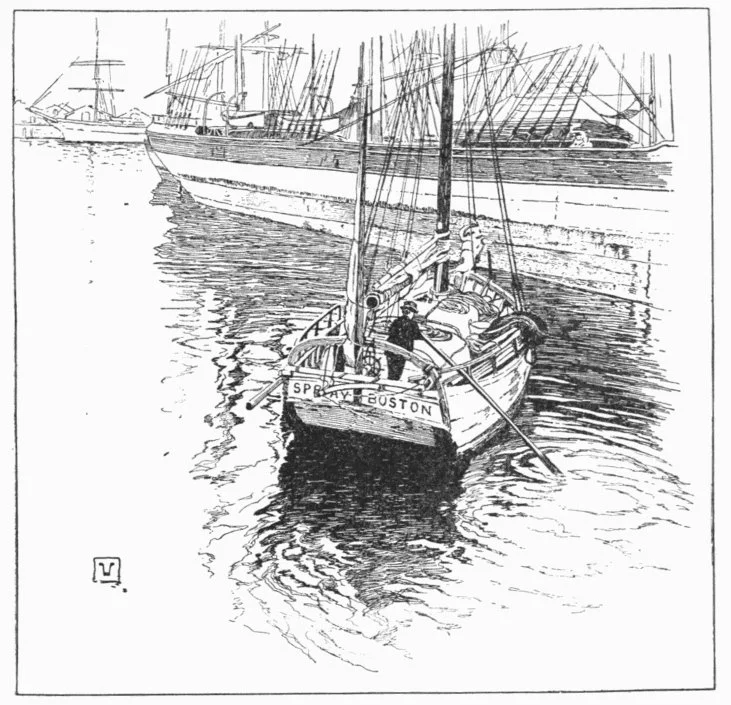
Joshua Slocum working his way up the Yarra in Melbourne…all by himself!
Article Two- The Legal Implications of Solo Sailing by BOB ARRINGTON
The author is a writer, trainer and marine consultant. He holds a U.S. Coast Guard 100 Ton Master’s License and STCW Certification. He submitted this essay after the article above
The lockmaster was getting a little impatient with the motoryacht in front of us, as its sole occupant was trying to handle the bow and stern lines by himself. My wife, Dori, and I were tied behind him in our vessel, and we were also a little surprised to see a nearly 50-foot boat being single-handed. The rest of the day, we discussed whether we thought it was safe to handle a boat of this size by yourself.
I can speak from personal experience that regardless of how well you’ve prepared, or how capable you are, when you’re out on the water, you have to expect the unexpected. It could start with a mechanical issue—say, a blocked thru-hull causing an engine to overheat, or an engine belt breaking, or a critical hose clamp failing or a fuel filter clogging.
The list is long of things that may require your attention away from the helm. Handling any of these problems when alone on a boat becomes more difficult and potentially more dangerous.
Even if we set the unexpected aside for a moment, everyone has to eat, drink and relieve themselves. All are potential distractions from operating the boat. Just staying alert for hours at a time when single-handing presents enough of a challenge.
Single-handing a boat also raises a potential legal issue. The International Regulations for Preventing Collisions at Sea is an agreement among member countries for boating rules of the road. Anyone operating a boat in these countries is legally bound by the rules.
Rule 5 presents another problem for the single-handed boater: “Every vessel must at all times keep a proper lookout by sight, hearing and all available means in order to judge if risk of collision exists.” Under normal circumstances, even with two of us on the boat, it is challenging to maintain the “at all times” part of this rule, let alone when something on the boat takes your attention away from the helm.
The single-handed skippers I know seem to get away with their best attempts to manage these issues. But if there is an accident, the solo boater is exposed to significant liability. If the master of a vessel is found to have violated one or more of the COLREGS, he or she may be found liable for costs of rescue efforts, property damages, loss of income, salvage costs and environmental cleanup. In the event of a death, even criminal gross negligence charges are not out of the realm.
Single-handed boaters should also be aware that they are likely not covered by their insurance when they are cruising alone. Here’s what Scott Stusek said; he’s a cruising yacht specialist with Gowrie Insurance in Annapolis, Maryland:
A skipper operating a boat single-handed will have violated at least one provision of their policy. All insurance companies have an implied warranty that the vessel is seaworthy. In tested legal cases, ‘seaworthy’ is defined as the vessel being reasonably fit to perform the services and encounter the ordinary perils of the voyage contemplated. This is extended to mean the vessel is operated within applicable COLREG rules, by a suitable crew for the voyage intended.
Similarly, Stephen White from the Baltimore-based law offices of Wright, Constable & Skeen wrote:
The warranties of seaworthiness are implied into every hull insurance policy by longstanding principles of marine insurance law…Two of the times the warranties are implied are the moment the insured accepts the policy, and the second is the moment the insured pulls away from the dock.
In other words, if a boater gets underway single-handed, the insurance company may be within its right to say the owner violated the warranty of seamanship by operating the vessel contrary to international maritime regulations. That is a big risk to take. Your policy may not specifically preclude the practice of operating single-handed, but it doesn’t mean you would be covered in an accident.
Stusek related the story of a couple who owned a boat and had secured insurance with both names on the policy. One partner chose to move the boat alone, while the other partner traveled to the destination by land. An electrical fire broke out on the boat, and the partner operating single-handed couldn’t maintain the helm and fight the fire. The boat was a total loss.
Based on the owner’s negligence to maintain a seaworthy vessel, the insurance company refused coverage. In U.S. courts, the absolute warranty of seaworthiness extends to the appropriate number of crew for the voyage intended.
In another recent sad case, a single-handed skipper suffered a heart attack while operating his trawler in the Bahamas. His boat was found days later, grounded on a desolate stretch of shoreline with the engines still in gear. Many cruising trawlers have enough fuel for days of operation. What if this unfortunate boater had not been in a confined chain of islands, but rather in the open ocean? His boat motoring along for days with no one at the helm would have been a hazard to all other vessels around it.
I interviewed owners who regularly single-hand their boats. Most report taking extraordinary steps to minimize their time away from the helm. They prepare meals ahead of time and do everything they can to operate safely—but when pressed, they also acknowledge they are taking added risks. They all claim they are being careful, but being careful in this situation works right up until it doesn’t.
Before single-handing your boat over any long distances, stop and think about the potential consequences. Lone boaters not only add risk for themselves, but also put all of the boats around them at increased risk. Find a friend or hire a mate to help you handle the boat. Not only will you be safer, but you may even find the cruising is even more enjoyable.
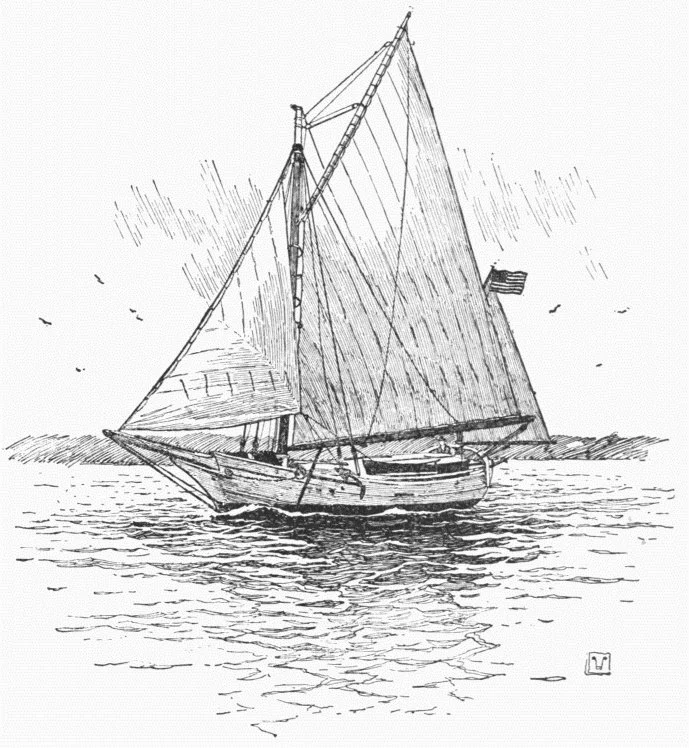
The SPRAY leaving Sydney, Australia, in the new suit of sails given by Commodore Foy of Australia. Slocum alone onboard.
Article Three - The Cult of the Solo-Sailor. Defending a Demonstrably Bad Idea, Being Asleep at the Wheel. By PETER SWANSON
Many readers pushed back against a recent story about the potential consequences of singlehanded operation. Their pro-solo-sailing arguments appeared on various Facebook boating groups and in the comments section of the story itself.
One argument went like this: Solo-sailors are the master mariners of the sea, compared to the incompetent lot that like to take other people with them.
In debate circles, this is called a false dichotomy. That’s a logical fallacy that presents two extreme options as the only possibilities when in fact other possibilities exist.
One other possibility is that singlehanders are actually not any more competent than the rest of us, taken as a group. Maybe the record-setters and round-the-world sailors are a cut above, but these represent a small subset of the solo category.
Let’s examine the reasons people make voyages alone.
Some are engaged in what one retired Coast Guard rescue swimmer called a “romantic quest for Emersonian self-reliance.” These folks may be the archtype that critics of the story used to bolster their position—they see wizzened, old-salt ocean warriors.
I call this the I-know-a-guy argument, but anectdotes, even when piled up, do not constitute data.
Can we be honest here? Many singlehanders also sail solo for entirely different reasons, which can fall into three categories: They are jerks and have no friends. They suck at sailing, and it shows. Or their boats don’t impress potential mates as being particularly seaworthy.
The Coast Guard doesn’t break out the number of times they have had to rescue solo-sailors, but a Google search will show there have been a fair number in recent years. These are just a few examples:
November 2020: Vendée Globe Race participant is rescued by a fellow after his vessel founders in heavy seas.
June 2021: A tanker rescued an 81-year-old German sailor whose 36-foot vessel, was disabled 400 miles southeast of Long Island.
August 2023: A solo sailor was rescued from a deserted island in the Bahamas after being stranded for three days, thanks to a “HELP” sign.
November 2023: A solo sailor was rescued 270 miles off North Carolina after their 38-foot sailboat was found adrift.
February 2024: A solo sailor was rescued after 46 hours adrift in a semi-submerged vessel during the Global Solo Challenge.
August 2024: A 62-year-old Frenchman survives for 16 hours in an air bubble inside his overturned boat until he was rescued by the Coast Guard.
Amazingly, the critics kept making the point that solo-sailors harm no-one, since they only have themselves to kill. They fail to consider that helicopter rescues are an expensive burden on the system and can put the rescuers themselves at risk.
Mario Vittone is a retired Coast Guard rescue swimmer and marine accident investigator. Vittone was asked if he thought single-handed types are any more capable that the rest of the voyaging herd.
“I would submit that the opposite is true. The solos lose one point for judgment in their romantic quest for their Emersonian self-reliance,” Vittone said, calculating potential human cost. “I think it lowers the risk of medical emergency (less people aboard) and raises the negative outcome of mishaps owing to the lack of hands. It may be a wash, really, overall.”
One such mishap was illustrated by the photo which accompanied Bob Arrington’s March 6 story. British sailor Jeanne Socrates was in the cockpit of her Najad 361, lying on its side, as waves broke around her on a Mexican beach.
Socrates holds the record as the oldest female to have circumnavigated the world nonstop single-handed and unassisted. One of the story’s critics responded in the comments section with a long list of her voyaging accomplishments. It was intended as a rebuke.
To me, losing your boat is not trivial, and her case illustrates the risks of singlehanding no matter how skilled the skipper.
Socrates said her autopilot had failed, which she obviously did not notice in time. As anyone who has sailed along a surf-beach will testify: If you are straying toward shore, you will eventually begin hear the dull roar of breaking waves.
Danger, Will Robinson!
The sound can be harder to notice, however, if you are sleeping.
Sleeping—that thing we all have to do.
One commenter suggested, without evidence but correctly, that Loose Cannonwas not a singlehander and therefore, son, you can never truly understand. He was only half-wrong. I had singlehanded just long enough to know that it was a bad idea, even though I am constitutionally built for it.
I can fall asleep sitting up and wake myself 20 minutes later to check displays, scan the horizon and…repeat. This may be the only way in which I am like Napoleon, whose catnapping allowed him to micro-manage an empire.
This is where the technology wing of the pro-solo-sailor party chirped in. With the ability to enable alarms on radar and AIS, their argument goes, sleeping in violation of Rule 5 of the International Regulations for Prevention of Collisions at Sea should not be thing. (Rule 5 is the one that says: “Every vessel must at all times keep a proper lookout by sight, hearing and all available means in order to judge if risk of collision exists.”)
The other side of the false dichotomy is that one skilled solo-sailor is at less risk than two, three, four—name a number—of the knucklehead population that owns boats. This fake argument completely ignores reality. People’s sailing skills lie along a spectrum that extends from knucklehead at the bottom all the way up to Warrior Sailing God.
The dichotomists also completely ignore that as folks move up the spectrum (as one hopes they do, over time), it doesn’t take too long before three moderately skilled people are more resilient in the face of catastrophe than one Warrior God.
This is 2026, and the American population is quite literate in terms of using technology.
Even if unskilled in other aspects of boat management, new people will probably find that mastery of the AIS, chart-plotter, radar, sounder and auto-pilot is not that difficult. So let’s not pretend this is sacred knowlege available only for the initiated.
And do you know when AIS and radar work best for collision avoidance?
When someone is awake and monitoring them, watching the displays and seeing potential danger even before an alarm is triggered.
It's called watchstanding, and takes a minimum of two to tango.
The greatest single-handed sailor ever (in my humble opinion) is Joshua Slocum, author of the best book ever written about the subject, “Sailing Alone Around the World.” I grew up two towns over from where Slocum rebuilt his gaff-rigged sloop Spray.
Alas, I was never able to visit his grave. Because why? The greatest single-hander in history died single-handing. On November 14, 1909, he sailed Spray out of Vineyard Haven, Massachusetts, and was never seen again. Lost at sea.
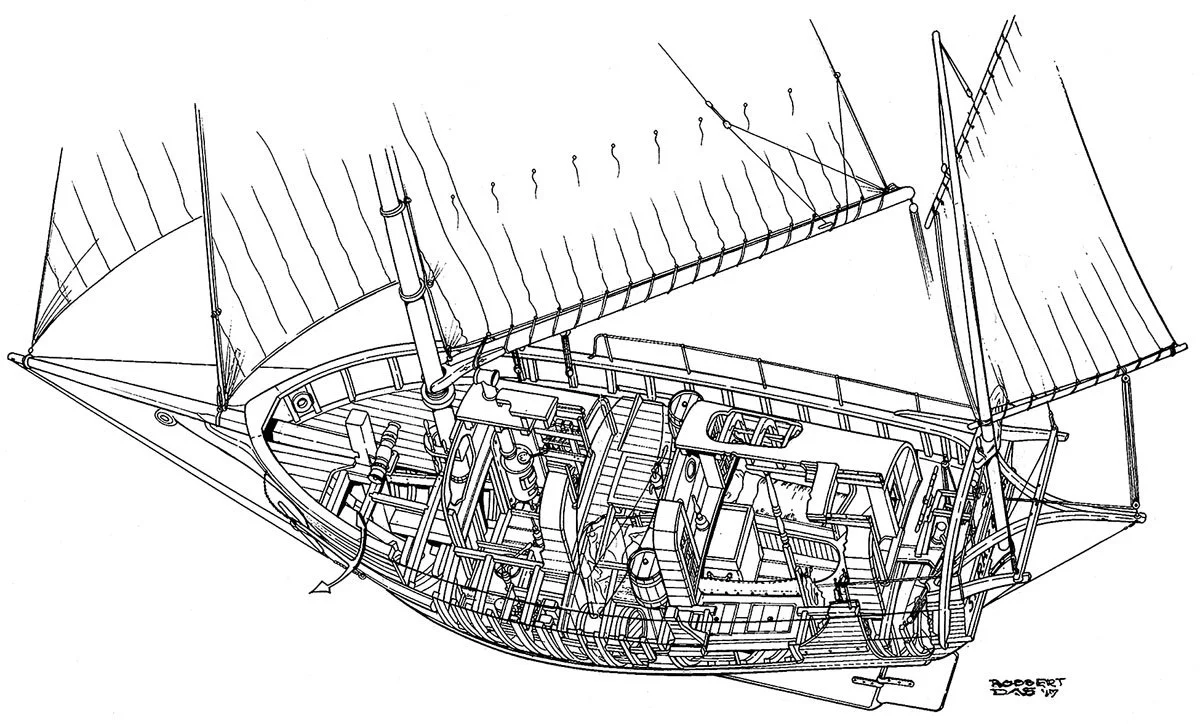
A cutaway illustration of SPRAY shows the boat as imagined by Dutch artist Robbert Das