
Quality Journalism accompanied by beautiful photography is becoming rarer and rarer these days, as our attention spans shorten, and we glance over each other’s metaphorical shoulder for the next best thing. The article below from the New York Times delivers both ideas and imagery… in spades.
Now that the tide seems to be turning in the USA, consider subscribing. (There’s currently an offer on at the moment giving full access for only 50c/week for a year)
By Ben Ryder Howe. Photographs by Federico Rios
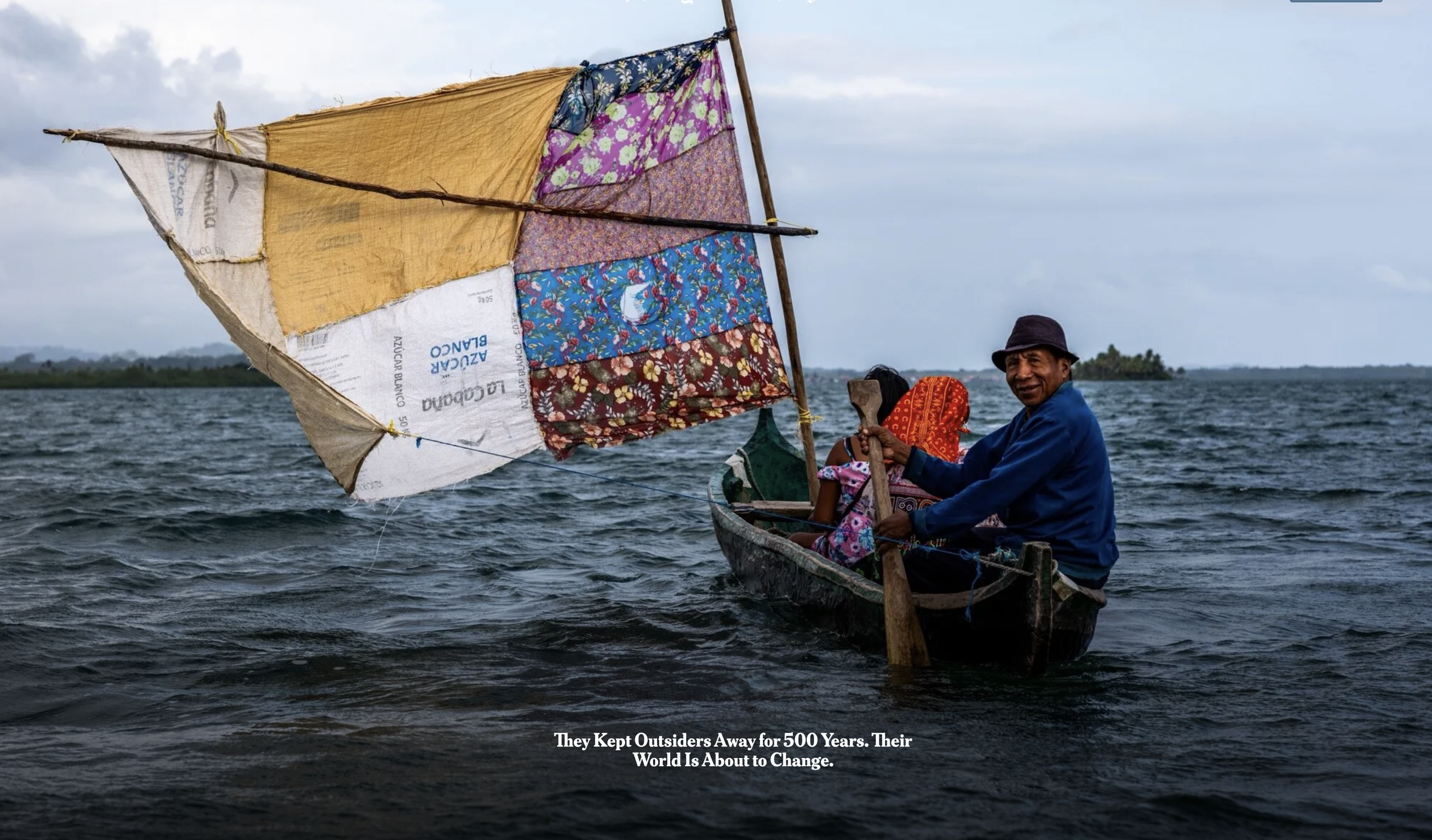
The Guna people in Panama inhabit what may be the most pristine jungle in all of Latin America, and for centuries they have been successful at keeping intruders at bay.
In 1970, my father, a shaggy 25-year-old from the Chicago suburbs finishing his Ph.D. in anthropology, traveled with my mother to the Gunayala region of northeast Panama to ask its inhabitants, the Guna people, for permission to study them. The Guna lived on an archipelago of sandy, palm-covered islets along the Caribbean coast and had a reputation as prickly and disagreeable.
My parents went from village to village as my father, James, introduced himself in Spanish. He was not the first anthropologist the group had seen. The Guna had a long history of interacting with wagas, as they called non-Guna. Wagas tended to be struck by Guna independence. According to a U.S. government report in 1964, the Guna’s “chief characteristic has been and continues to be a persistent determination to preserve their cultural and racial structure against pressures from the outside.” That had been evident when, just a few years before my father arrived, an American businessman named W.D. Barton built a resort on one of Gunayala’s more than 350 uninhabited islands. The Guna burned it down. And when Barton tried to rebuild it, they burned it down again.
My father spent much of the 1970s regularly traveling to live with the Guna, joined for several months at a time by my mother, June, and then by me. Digandiggi, our home, was a village of 200 thatched-roof homes built on a coral reef, half a mile from the mainland jungle and the hulking silhouette of the Serranía de San Blas, a mountain range that is an extension of the Continental Divide.
When I think of Digandiggi, I hear the thud of breakers and smell the burning of coconut husks in cooking fires. Our dirt-floored home, which we shared with a village chief, had a roof of palm fronds that crackled and popped in the afternoon heat. There was a fist-size hole in the corner leading to the lair of some nocturnal creature; afraid of snakes, I dared not ask what it might be. We had no privacy. The neighbors, whose roof almost touched ours, could hear every whisper through the cane walls. The only place on the entire island where I could find solitude was the communal outhouse, which stood over shallow water at the end of a narrow plank. I would hide there for hours, studying the mountains as clouds tumbled over the peaks.