
The Search and Rescue of the Albany Pilot Launch PELICAN
By Ross Shardlow AM with thanks to the Maritime Heritage Association which is dedicated to preserving and promoting the maritime heritage of Western Australia.
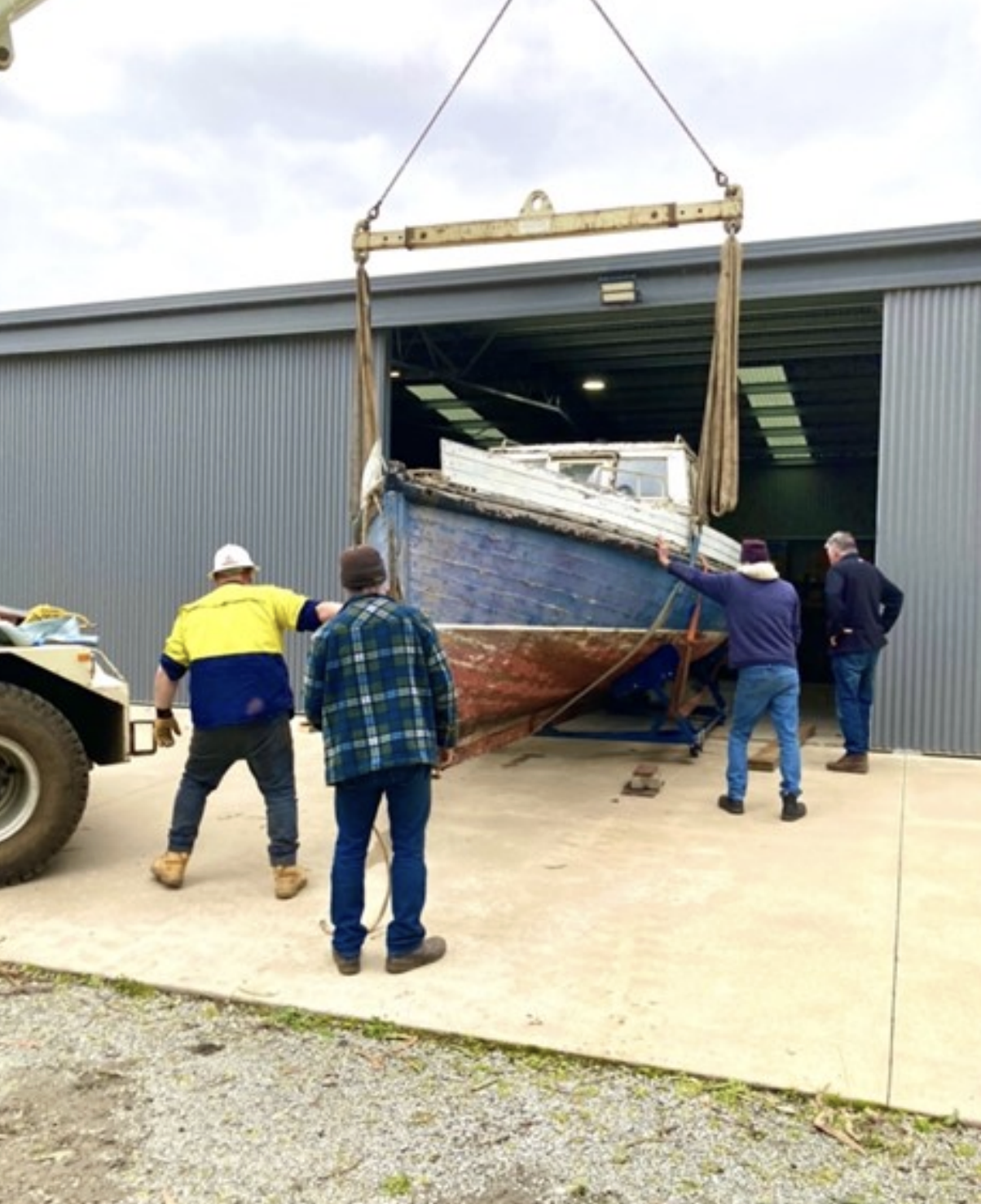
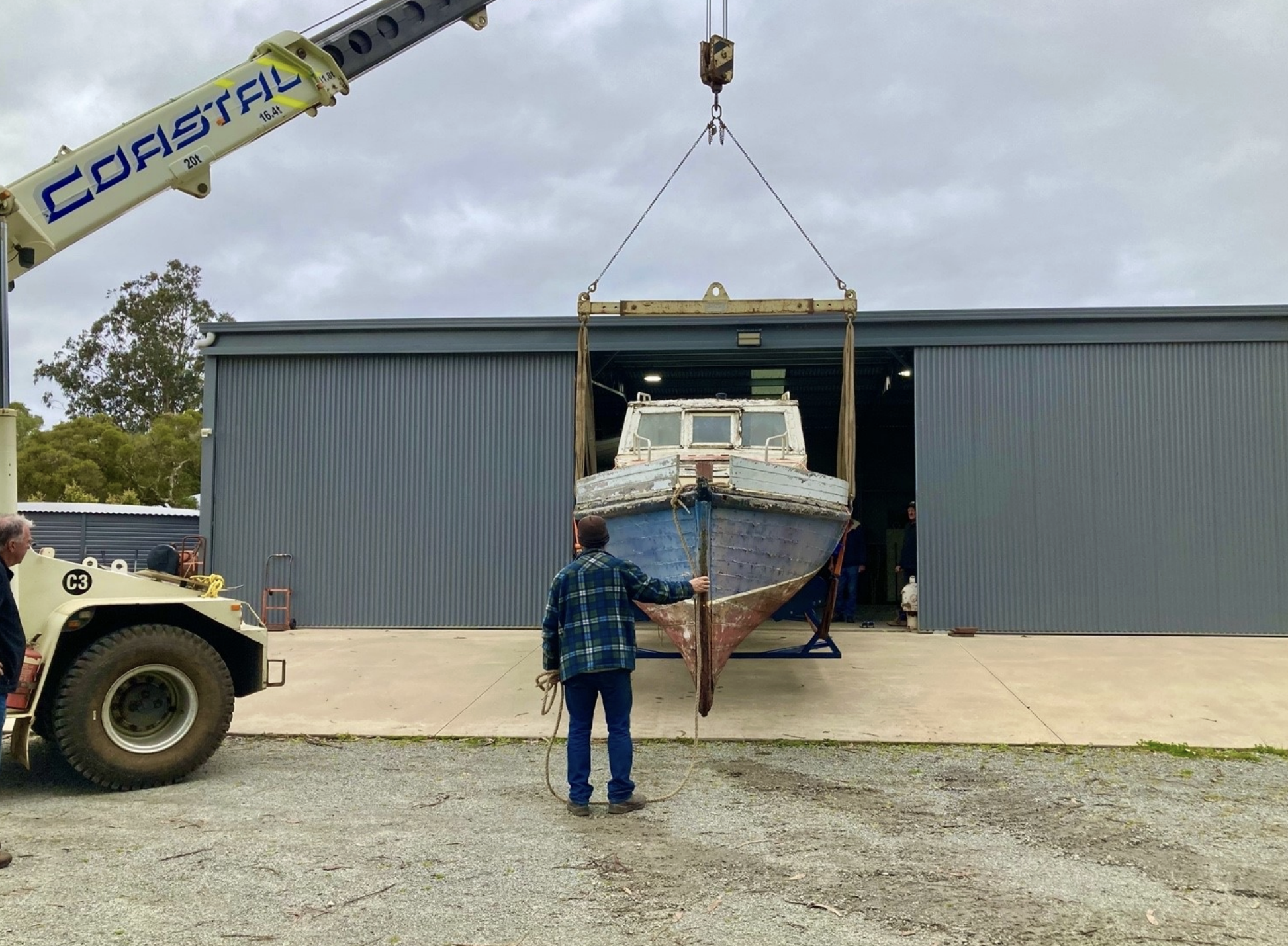
On the 29 August 2025, the Pilot Launch Pelican was successfully lifted from the Denmark Boatshed and transhipped back to her home port of Albany thus completing the first phase of our ‘Search and Rescue’ operation. Now safely secured under cover in the De Bruin Boatshed at Willyung (Albany) plans are now under way for the next phase of the operation – her stabilisation and assessment from which a conservation plan will follow.
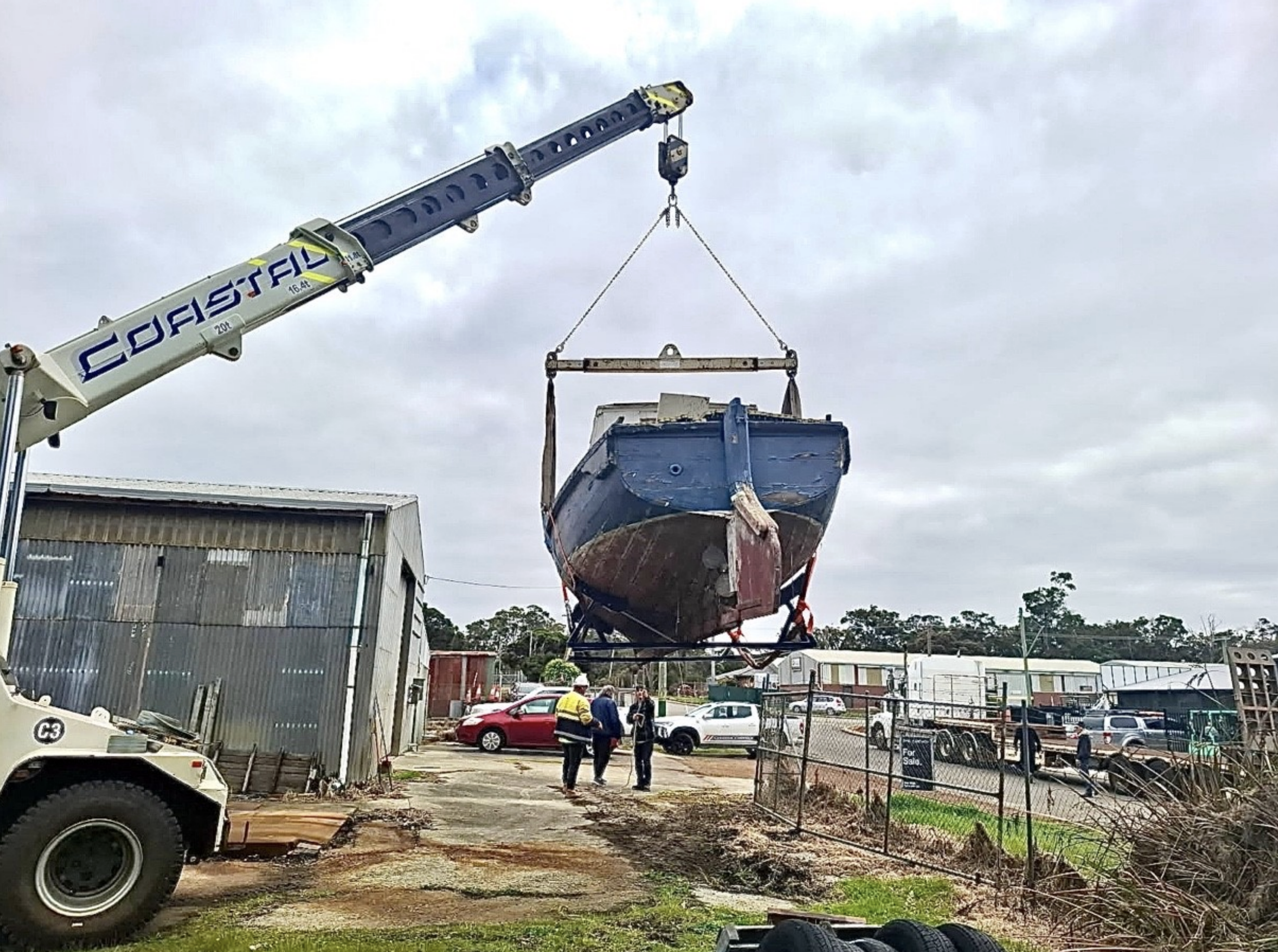
Pilot Launch Pelican being lifted by Franna crane from Peter Wilson’s Denmark Boatshed to be transported to Charles and Rose De Bruin’s boat shed at Willyung (Albany). Photo: Barbara Shardlow
The Search
The people of Albany have been acquainted with their Pilot Launch Pelican for over a hundred years. For the past thirty of those years various owners, custodians, ship-lovers and institutions have played a vital role in her preservation. It was not until 2008, however, that MHA member and Master Shipwright Bill Leonard (OAM) first alerted the MHA to a remarkable vessel that he had stumbled across while collecting material in Albany for his forthcoming book: In Search of Fish and Fortune: along Australia’s West Coast, WA Museum 2017. Bill immediately recognised the unmistakable grace and beauty of a classic Pilot Launch. Bill’s task at that time was to document the fishing boats of Albany, not pilot boats of Albany, and the opportunity to record this vessel slipped through his fingers. Bill’s affirmation has long been that we simply cannot save all the old boats we come across. Some fall to bits before our eyes, others are cut up for firewood, some are even scuttled to be shipwreck dive sites - most just disappear. In the time and expense it takes to preserve just one boat, we could preserve a fleet of boats simply by taking off their lines to record their shape, construction, beauty and purpose, a permanent record for posterity. Bill asked if the MHA might take up the task of lofting the pilot launch’s lines as we had done for Little Dirk in 2001 and the Navy Cutter Albatross in 2004. We had also drawn up a set of plans to replicate an 1854 Pilot Whaleboat for the Rottnest Pilot Station.
The search for Bill’s pilot launch proved to be elusive, even evasive. MHA member Ron Forsyth gave us a lead when he asked if we could find the 28ft pilot launch Pelican built by his grandfather ‘Chippy’ Forsyth and last seen at Emu Point (Albany) about 2000. By the time we did find her in 2020, her provenance, even her name, had been lost in the mists of time. We were not even sure if she was the Pelican. All we knew was she was a pilot launch that we thought/hoped to be the Pelican. Even if she was a Pelican we still had to determine which of four Pelicans she might be. We were ‘reliably informed’ she was built either in 1897, 1906, 1913, 1927 or 1952, and she was built by Mews, or A.E. Brown or Chippy Forsyth in Fremantle, or overseas or over east. A talk I gave at the Six Degrees Restaurant during Albany’s ‘Maritime Festival Month 2025’ outlined some of the events leading up to her latest search and subsequent rescue starting from the inception of Albany’s Pilot Service in 1827.
The Inauguration of the Albany Pilot Service 24 January 1827: On the departure of the Colonial Brig Amity from King George Sound on the 24th January 1827, Major Edmund Lockyer, commander of the new Settlement at the Sound, appointed . . .
“two experienced seamen as boat keepers and who would be able to act as pilots to bring vessels into harbour from the Sound . . . John Hobson and George Thomas destitute seamen from the Gov. Brisbane – appointed as pilots and departed by Amity as far as Middle Island to collect their possessions after which they were to return to the Settlement and ‘put on rations’.
Pilot Whaleboats
Albany’s first pilot boat was described as an ‘oared boat’ from the colonial sealer Governor Hunter that arrived in King George Sound with eight destitute men on 4 January 1827. The eight men had been abandoned on the south coast by the sealing vessels Governor Hunter and Governor Brisbane. John Hobson and George Thomas, from the Governor Brisbane, were appointed as Albany’s first pilots and the confiscated ‘oared boat’ from the Governor Hunter was retained as Albany’s first pilot boat.
The oared boat was most likely a five-oared whaleboat commonly used by sealers and whalers. Certainly a new Albany pilot boat, built in Fremantle in 1853 by William Hugh Edwards, late carpenter from the Colonial Brig Amity, was a five oared whaleboat. The pilot boat was built for the Rottnest Pilot Station but on completion was sent down to Albany to replace the Albany pilot whaleboat that had just been lost. The replica was built by Wooden Boat Works at Fremantle from plans drawn by the MHA in 1999. The replica pilot whaleboat is now on display in the Pilot Boathouse on Rottnest Island.
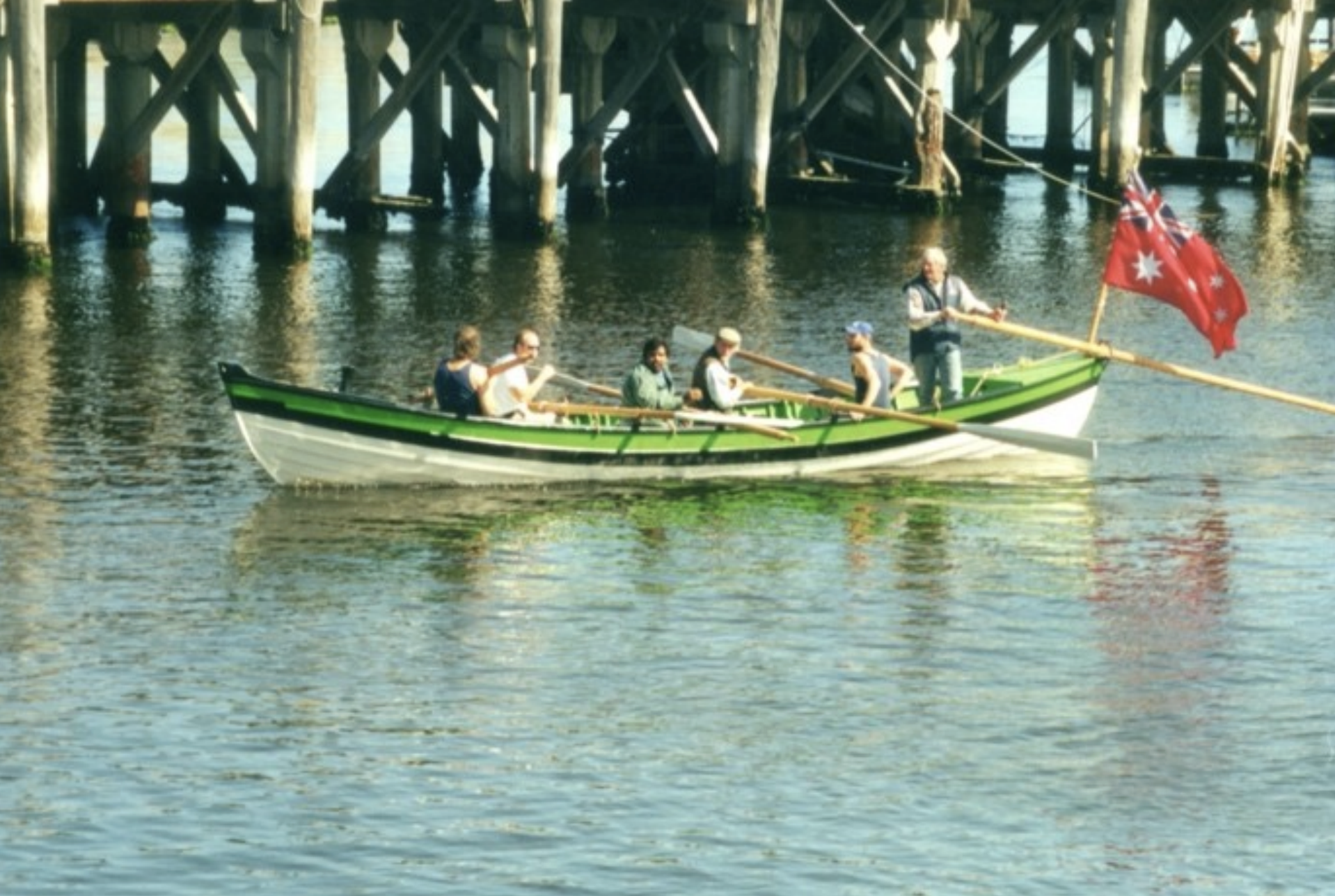
Replica pilot whaleboat built by Wooden Boat Works in Fremantle in 1999. Photo: Ross Shardlow
Another view of an Albany Pilot Whaleboat is shown in a pencil and watercolour sketch by John Thomas Baines. Dated 4 March 1857, this pilot boat may well be the same whaleboat built by William Hugh Edwards in 1853. Baines’ journal of 3 March 1857 describes:
“The pilot boarded us in a whale boat manned by natives one of whom was clothed in shirt, trousers and cap, whilst the rest rejoiced in their native costume of grease, red ochre and kangaroo skin . . .”
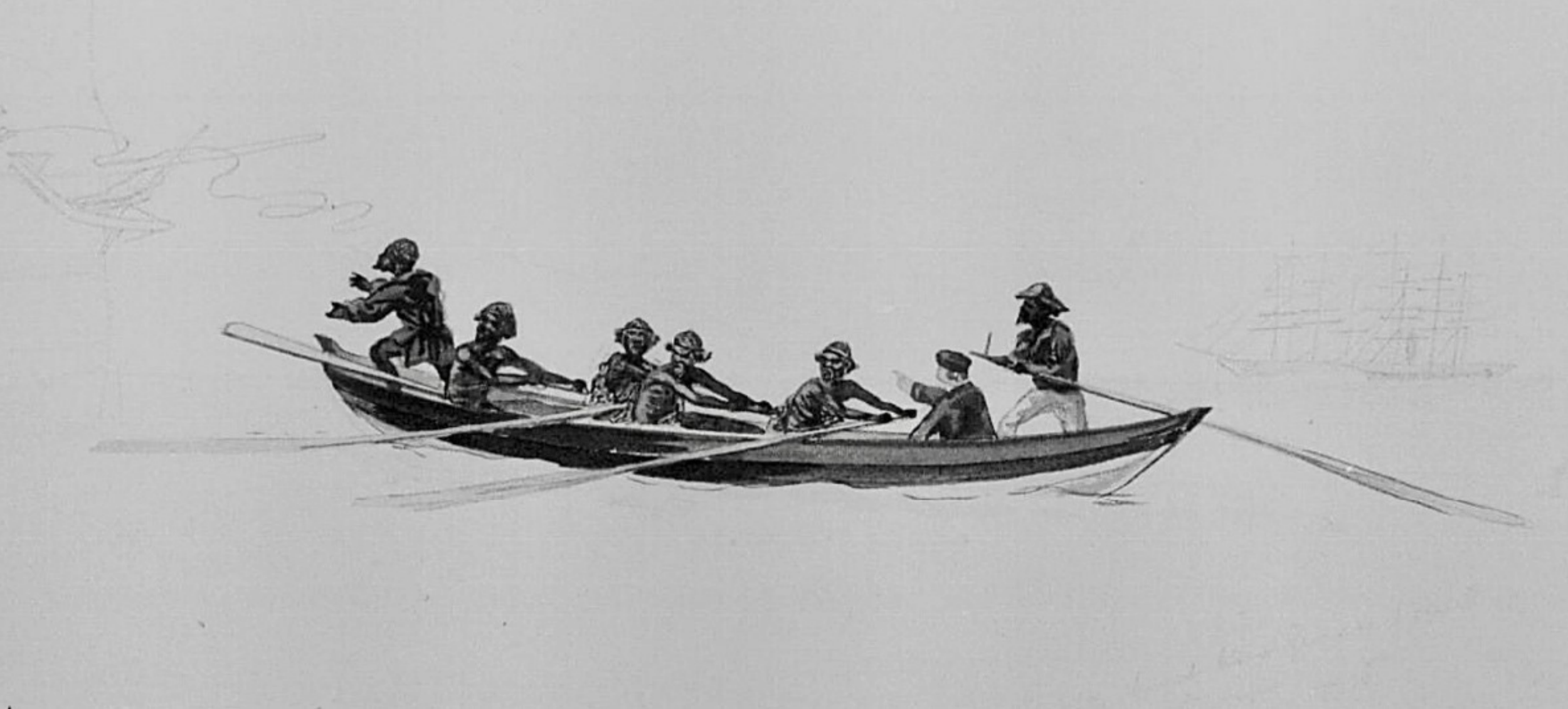
The Pilot Boat King Georges Sound – South West Australia March 4 1857, pencil and watercolour by John Thomas Baines (1820-1875). From Sketches of Thomas Baines (as filmed by the AJCP) M 397, National Library of Australia
The Pilot Whaleboat, along with gigs, lifeboats and dinghies, remained in the Albany Pilot Service long after the introduction of motorised Pilot Launches in 1897. The Harbour and Light Department Annual Report for 1904 states that the Albany Pilot Service, ‘retains the use of a whale-boat – used only in cases of emergency’. A photograph of the Albany pilot whaleboat taken in 1909 shows the whaleboat still in use with Captain Winzar at the helm and a full five man uniformed crew.
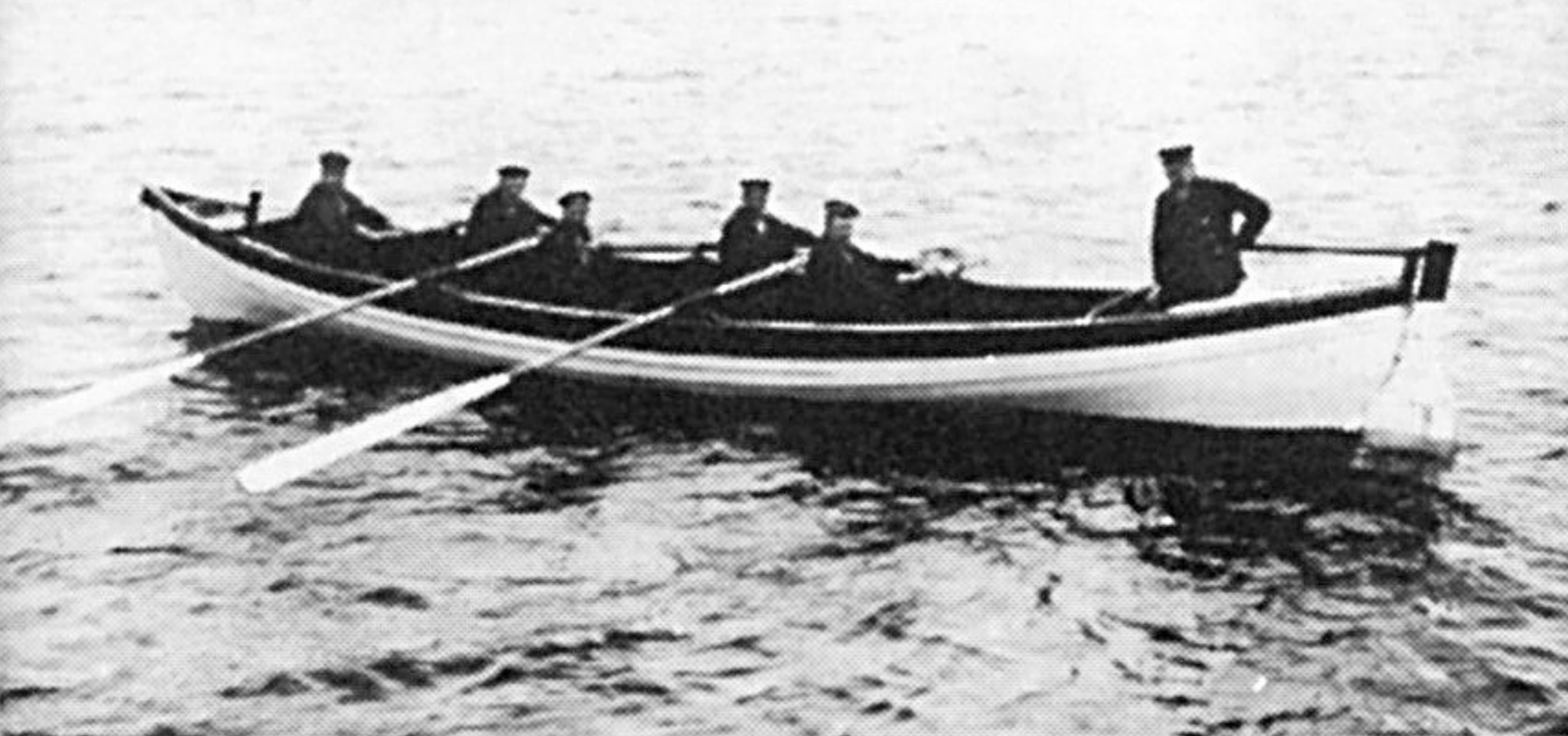
Albany Pilot Whaleboat, c.1909, with Harbour Master Captain Winzar at the helm. Photo: Stan Austin Collection, from Emu Point: A Pearl in an Oyster Setting, Stanley Austin, WA Museum-Albany 2003
Motorised Pilot Launches – SS Petrel
The first of Albany’s motorised pilot launches was the SS Petrel. She was built in England in 1895, 47ft overall x 10ft 6in beam, planked with teak over oak frames and coppered below the waterline. She came out to Albany on the SS Cornwall in 1897 and served as the Government Launch, Harbour Master and Pilot Vessel until 1910. In 1912 she was fitted with a new oil engine at Fremantle before 9 being transferred to the Bunbury Harbour Service for the Harbour and Light Department. In 1960 she was transferred to the Bunbury Sea Scouts. After being blown ashore and re-floated in 1969 she was sold to new owners in Perth to be a leisure craft and showboat. In 1987 she was scuttled off the beach at Rockingham for use as a dive site.
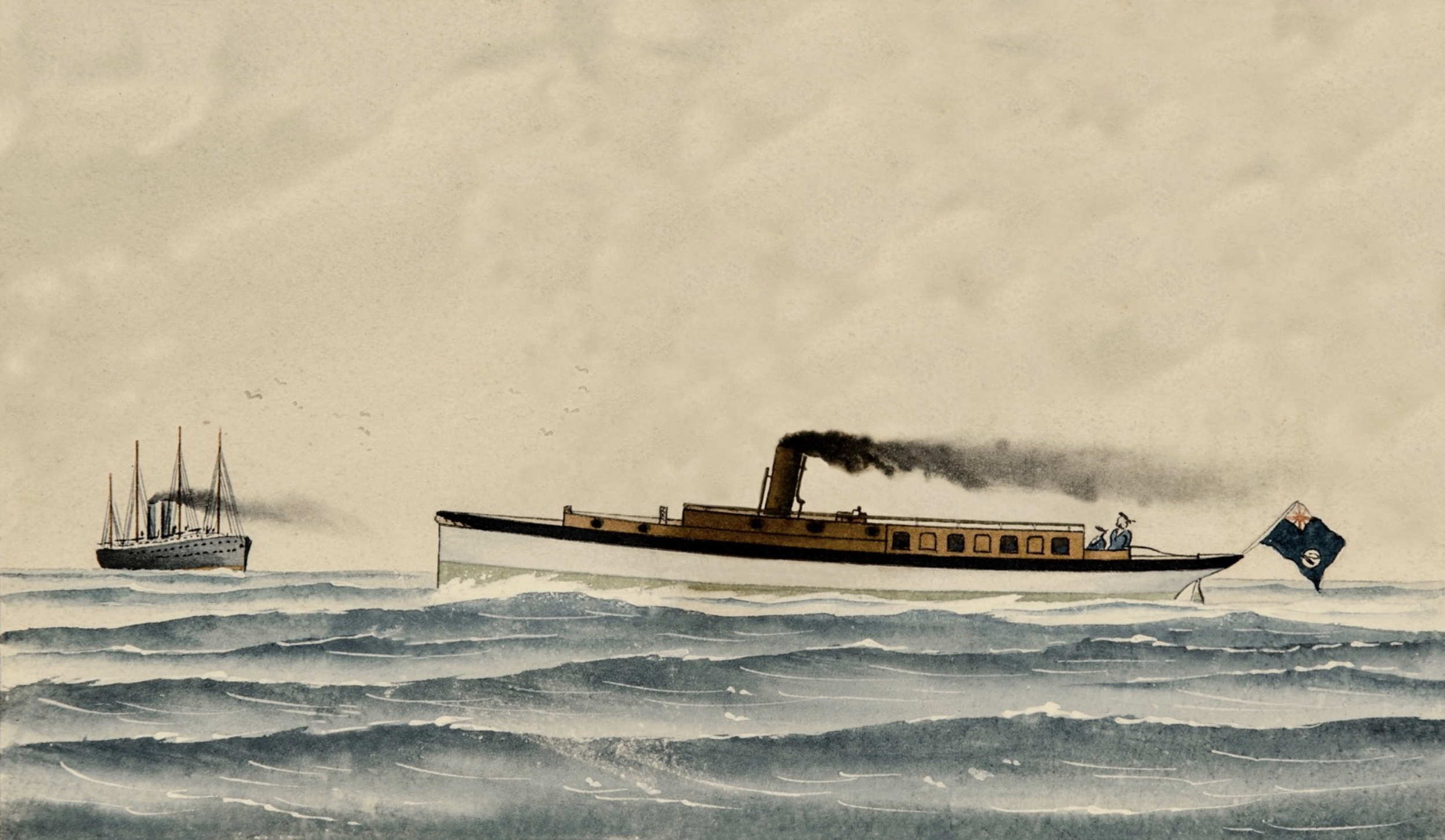
W.A. Govt. Launch “Petrel”, watercolour by George R. W. Bourne c.1900. Petrel served as the Albany Pilot Launch from 1897-1910 before being transferred to Bunbury Photo: David Nicolson from Shardlow Collection
Pilot Launch Waratah
The SS Waratah replaced the Petrel as Albany’s next Pilot Launch. The Waratah was built in Launceston, Tasmania by Edwin A. Jack in 1893. She was 48.6ft long (55ft overall) x 11ft beam x 5ft depth of hold. She was 15 tons gross and 8 tons net, had a counter stern and was built of Huon pine. She was fitted with a 10 nhp compound surface condensing steam engine. Waratah was sold to the Western Australian Government Public Works Department in 1897 to do hydrographic work making coastal, tidal and current observations but was little used except for towing dredging barges on the Swan River. In March 1898 she was engaged as the Health Officer’s launch and in August 1906 was taken over as the Police Launch. In 1910 Waratah was handed over to the Harbour Master’s Department and was towed down to Albany by the Government steamer Penguin arriving 20 February 1910 to replace the SS Petrel to become Albany’s new Pilot Launch. By 1914 Harbour Master Captain Winzar reported that the Waratah was ‘practically worn out’ and she was finally condemned and sold out of service in 1915 to be replaced by the motor launch Pelican. Waratah was sold to various private owners who intended to use her for towing shell-grit from the Lower Kalgan Bridge to Albany. When that venture failed she was abandoned and sank at the foot of the jetty next to the Lower Kalgan Bridge (presumably the lime shipment jetty south of the bridge on the eastern shore of Oyster Harbour). About 1922 she was re-floated and repaired by Captain (actually late Chief Officer of State Ship Kybra) Vernon Vinicombe (aka Charlie) Farley and partners who, with Lionel Austin, refitted her with a London bus engine and rigged her as a two masted gaff-rigged schooner. In January 1927, Charlie Farley obtained a Commonwealth contract for the carriage of stores to the lighthouse on Eclipse Island, a service he ran once a month with the Waratah into the early 1930s. Waratah was then sold to a consortium who fitted her out for a voyage of adventure around the world. Early attempts to round Cape Leeuwin resulted in her sheltering at Nornalup and then putting back to Albany to make repairs, adjust rig and add ballast. Her second attempt in April 1934 fared no better. Finding the Waratah in heavy weather and slow to answer her helm she again put back to Nornalup for shelter. After anchoring off the inlet the rudder fell off. The next day (6 April) she dragged her anchors and ended up on the beach on the east side of the entrance into the inlet. No lives were lost but after five days of pounding by heavy seas she became a total wreck.
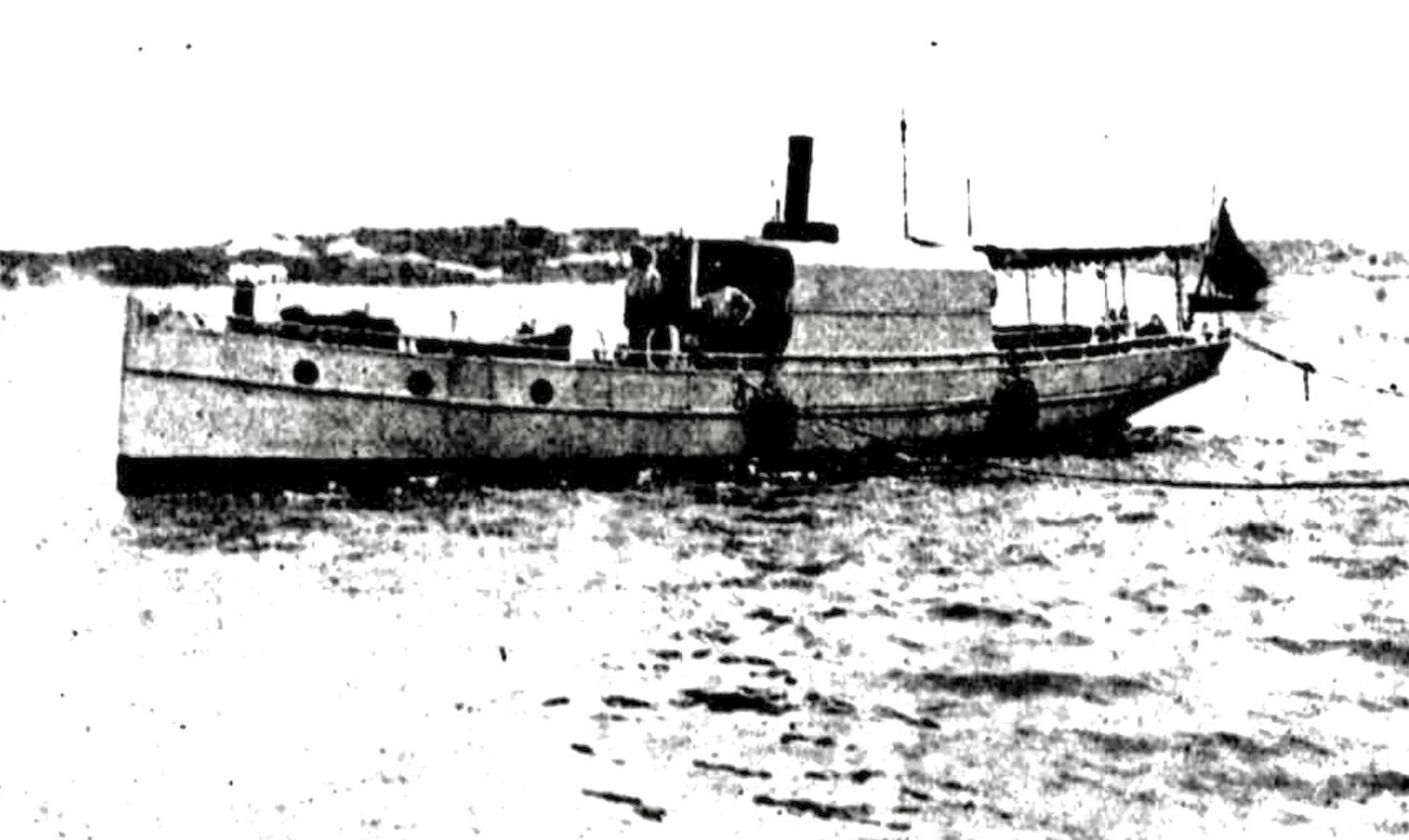
SS Waratah, Health Officer’s Launch, Fremantle The Western Mail, 10 March 1899. Article by SE-JE-GE (Sea Horse), real name J. E. Gannon.
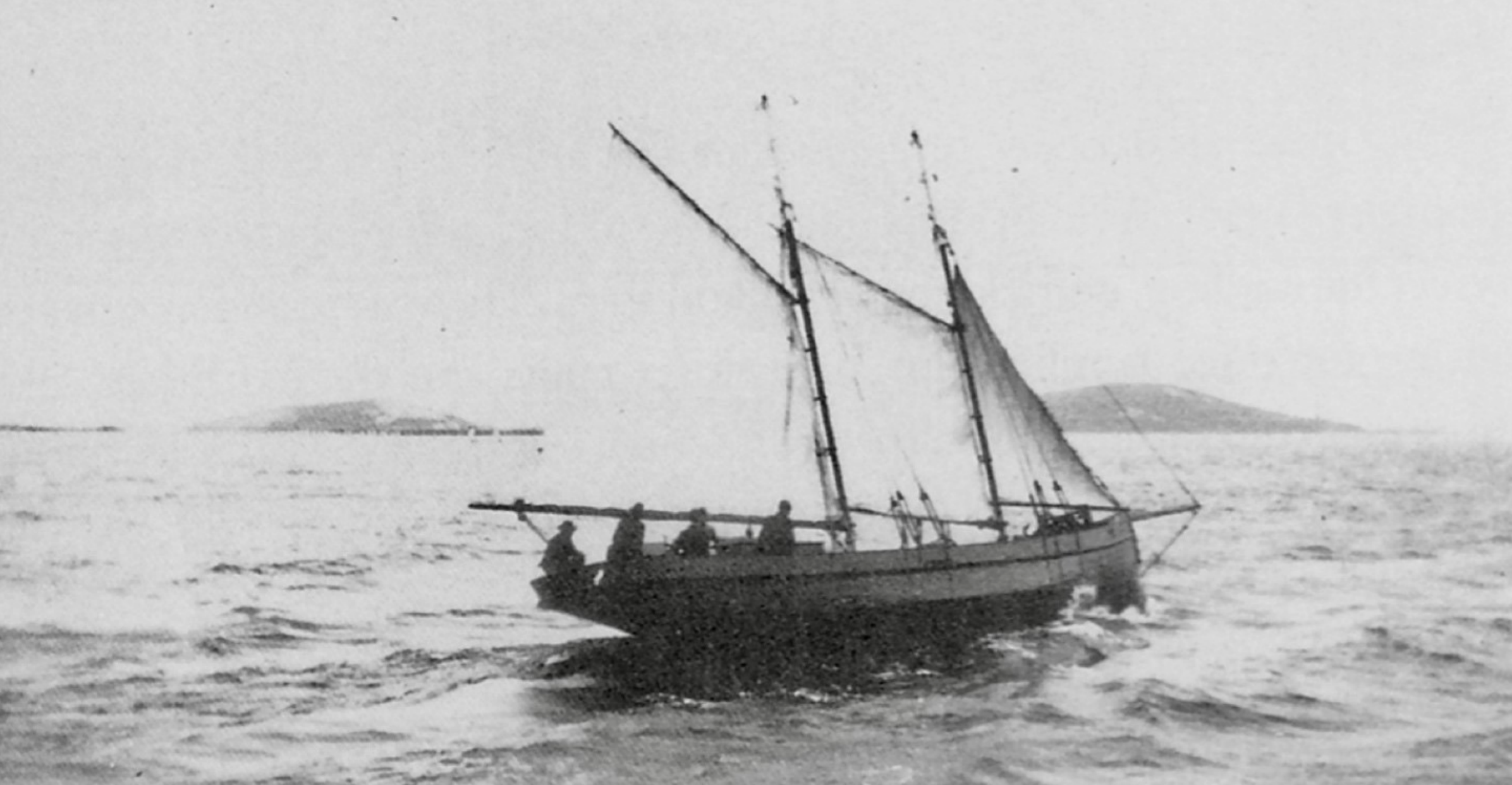
Waratah rigged as a schooner, possibly on a test run with Charlie Farley, Lionel and Stan Austin during the Centenary Regatta from Albany’s Town Jetty, Saturday 22 January, 1927 Photo: Stan Austin Collection, from Lighthouses of Albany, Stan Austin, WA Museum-Albany 2004
Pilot Motor Launch Pelican
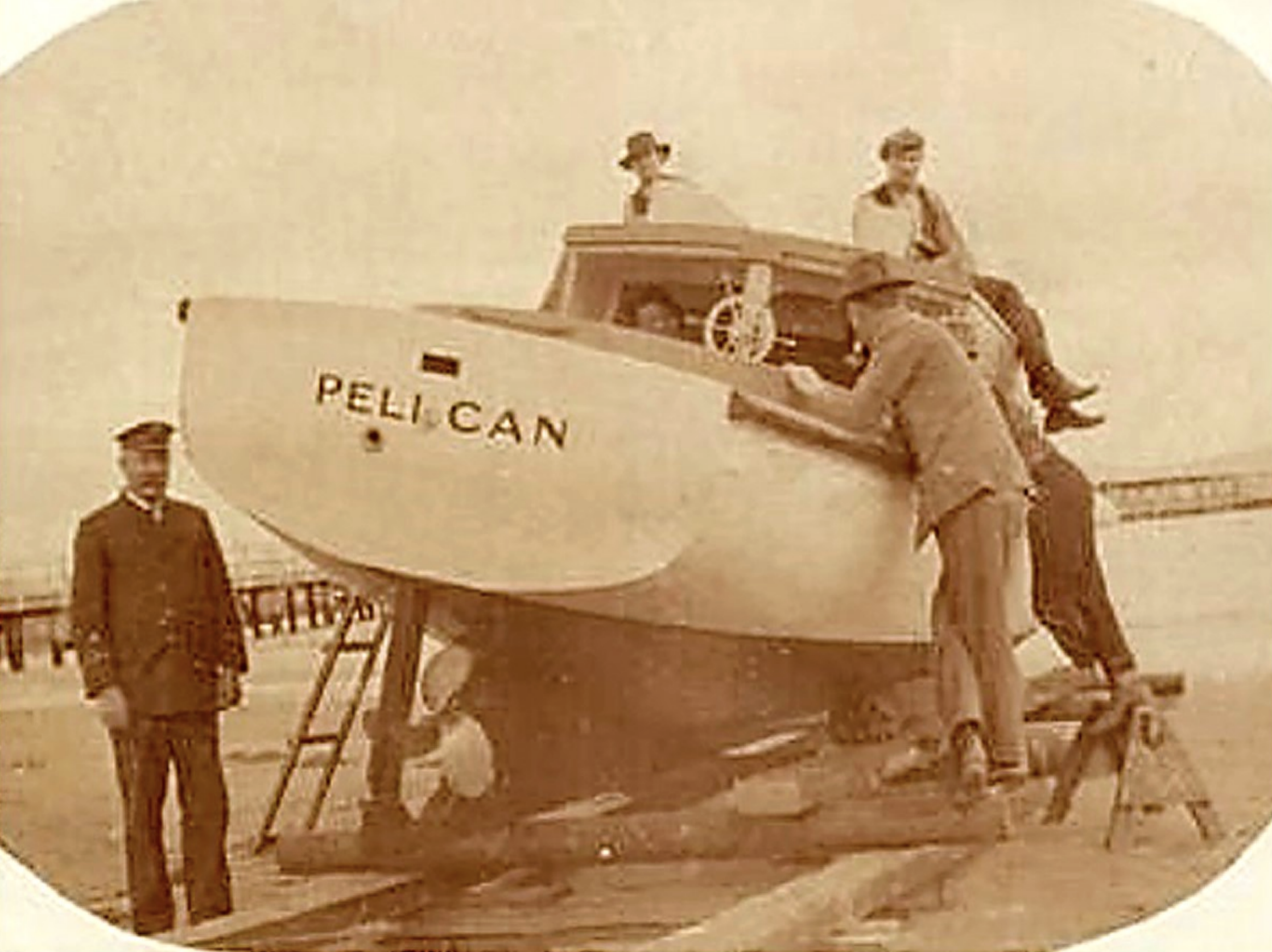
Pilot motor launch Pelican with Pilot Thomas Wilkinson Howe (left), Albany 1915. The person sitting on the cabin roof with a peaked cap (right) is most likely the coxswain. The person sitting inside the cabin with hat pushed back (left of the wheel) is most likely William (Bill) Forsyth. The jetty in the background is Albany’s Town Jetty. The slipway is attached to the Forsyth and Templer boatshed situated at the foot of the Town Jetty. The occasion is almost certainly the Commissioning of the Pilot Launch Pelican, September 1915. Photo: History Great Southern – Kaartdijin Biddi Albany, Albany Public Library Photo Collection (2707). Previously listed as Photo 27, City of Albany Local Studies Collection
The pilot launch Pelican was the third motorised pilot launch for the Albany pilot service and the first to have an internal combustion engine fitted as-built, the Petrel and Waratah being fitted with steam engines while the Pelican was fitted with a 15 hp Gardner petrol engine with a 9 gallon fuel tank. I am presuming it was a Gardner engine as it is spelt Gard(i)ner in the Letterbooks. The Albany Harbour Master’s Letterbooks for Captain Frank Winzar (1900-1917) confirm that Pelican was built in Albany by Messrs Forsyth and Templer in 1915. A letter from Winzar to the Chief Harbour Master Fremantle dated 25 May 1915 states:
As we decided to install a 15 H.P. Gardiner (sic) Engine, I have provided for, so you will see by the specifications, a strongly built boat. I consider the price submitted by Forsyth & Templer is reasonable and I strongly recommend accepting their tender.
On 10 June 1915 Captain Winzar wrote, ‘On receipt of your letter I instructed Forsyth to commence Motor Boat’, while his report for 2 July 1915 stated, ‘Pilot Launch. A new motor launch is being built for pilot work. The old launch “Waratah” has been condemned and is to be sold.’ Forsyth’s accounts for building the Pelican were submitted 26 October 1915. Frank Winzar’s Report for the year ended 30th June 1916, submitted to the Chief Harbour Master Fremantle 20 July 1916, 12 stated:
Pilot Launch. This was built in Albany and commissioned in September [1915]. She is a good boat very satisfactory.
The significance of the Pelican being built in Albany by a resident shipwright in 1915 cannot be over emphasised. William (Bill) Forsyth (aka ‘Chippy’ Forsyth), was born in Fremantle 18 March 1874. His father George Forsyth was Harbour Master at Fremantle, later Chief Harbour Master. Bill Forsyth was apprenticed to Alfred Edmund Brown in Fremantle around 1888 and married Ethel Marion Gibson in 1903. Bill, Ethel and their two children Keith and Elsie moved down to Albany in 1906 where Bill found employment with the launch proprietors Armstrong and Waters and moved the family into a house opposite Dog Rock in Middleton Road. While working for Armstrong and Waters Bill designed and built the 33ft motor launch Mary. In 1913 Bill designed and built the propeller for Albany’s first aeroplane and it was about that time he set up his own boatshed at the head of the Town Jetty and went into partnership with Norman Beavis Templer aka Bob Templer. The partnership with Templer did not last and was dissolved by Bill after Templer pocketed money from a client. The Forsyth and Templer boatshed at the head of the Town Jetty was the site where Bill built the 28ft Pilot Launch Pelican in 1915, the 50ft Wolverine and the 28ft Ailsa Craig. When business was slow he built half a dozen fourteen-foot dinghies for hire at Emu Point. Bill’s family moved back to Fremantle in 1923 but he did not sell his shed next to the Town Jetty until 1926. Bill returned to Albany in 1928 to supervise a team of eight carpenters and four labourers to refit the crew quarters of the fire damaged steamer Castlemoor that was laid up in Princess Royal Harbour after extensive damage from a fire in her coal bunkers.
On his return to Fremantle Bill was employed by the Harbour & Light Department as the department’s shipwright and built several pilot launches including the 32ft Geraldton pilot launch Charles Crowther in 1936. He also served as a relief assistant lighthouse keeper at the Woodman Point Lighthouse in 1934 and 1937. Bill’s son Keith joined the Harbour and Light Department in 1923 and became manager of the department in 1942. During his time with the Harbour and Light Department Keith commissioned five new pilot launches: Charles Crowther 1936 (built by Bill Forsyth), Koombana 1961, Princess Royal 1963, Champion 1965 and Esperance 1966. The Esperance was commissioned by Keith after his retirement from the Harbour and Light Department when he established the Esperance Port Authority.
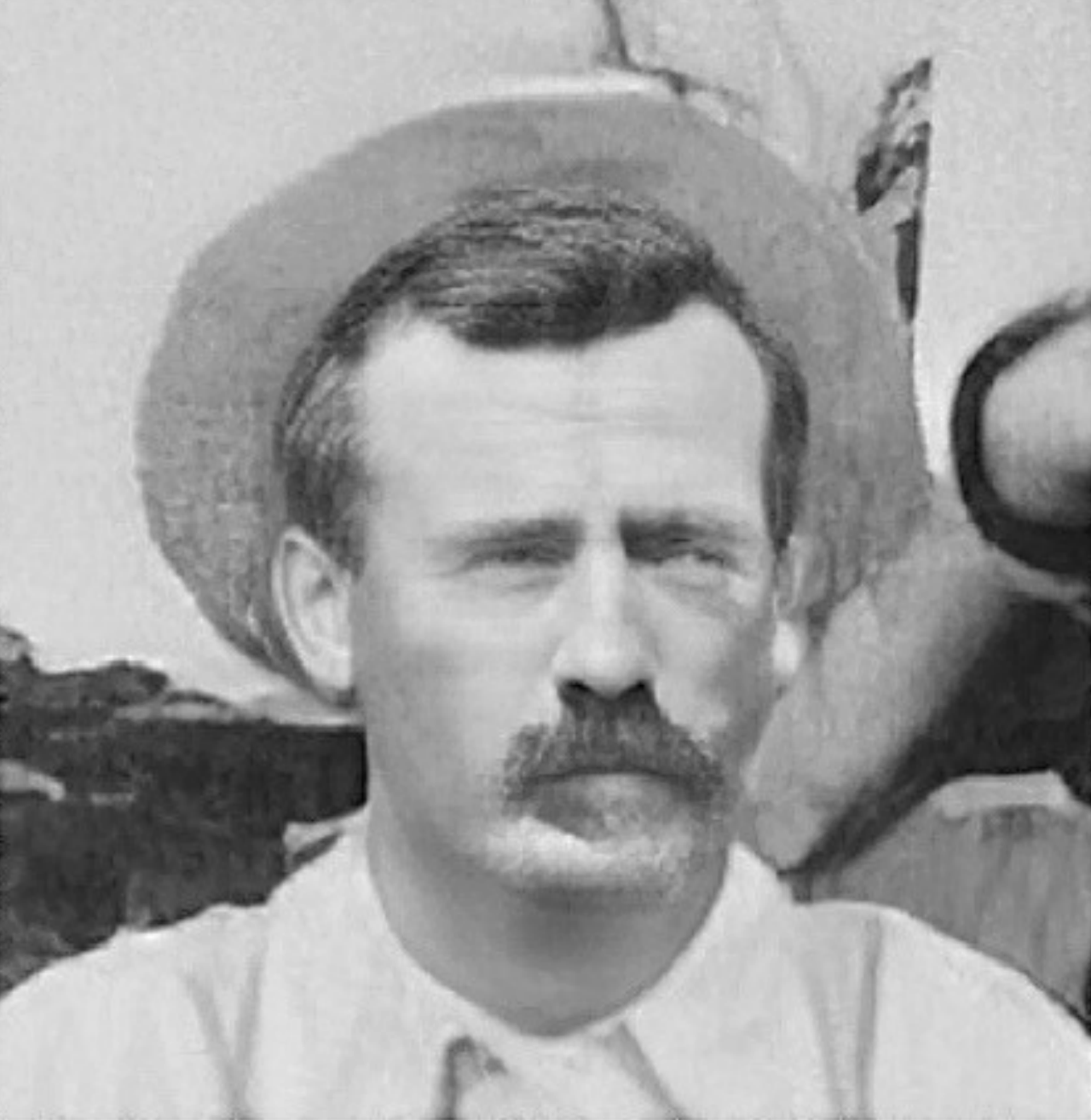
William Laurence (Chippy) Forsyth died 3 September 1946. Photo: Ron Forsyth Collection
The late Stan Austin, Albany boatbuilder, historian, yachtsman and legend wrote a paper in 1993 titled ‘Boat Building at Albany’ which was published as an Appendix (XXII) in Maritime Albany Remembered: Les Douglas et al, Gordon de L. Marshall, Tangee 2001. Stan’s paper also confirmed that Bill Forsyth built the Pelican
Bill Forsythe (sic) built boats at Albany between the wars and had retired before World War II. He had a boatshed at the foot of the town jetty near the ex-overhead bridge below the old Post Office. Stan Austin’s father [Lionel] worked there for a short time. He succeeded Forsythe in about 1929, but not at the same location. Forsythe built the 28ft Pilot Launch Pelican, now at Emu Point . . . his boat building premises were at the foot of the Town Jetty and parallel to it. It had a slipway but the only time there was any water around it was with a very high tide.
A Harbour and Light Department survey report for the Pilot Launch Pelican covering the period from 20 July 1961 to 1 July 1964 (the termination of her service with the Harbour and Light Department), gives Pelican’s measurements as:
Length – 28ft
Beam – 8ft 6in
Depth – 2ft 6in
Tonnage – not given
Propulsion – 3 cylinder 4 cycle “Lister” Diesel Motor (Direct Drive) 27/30 hp
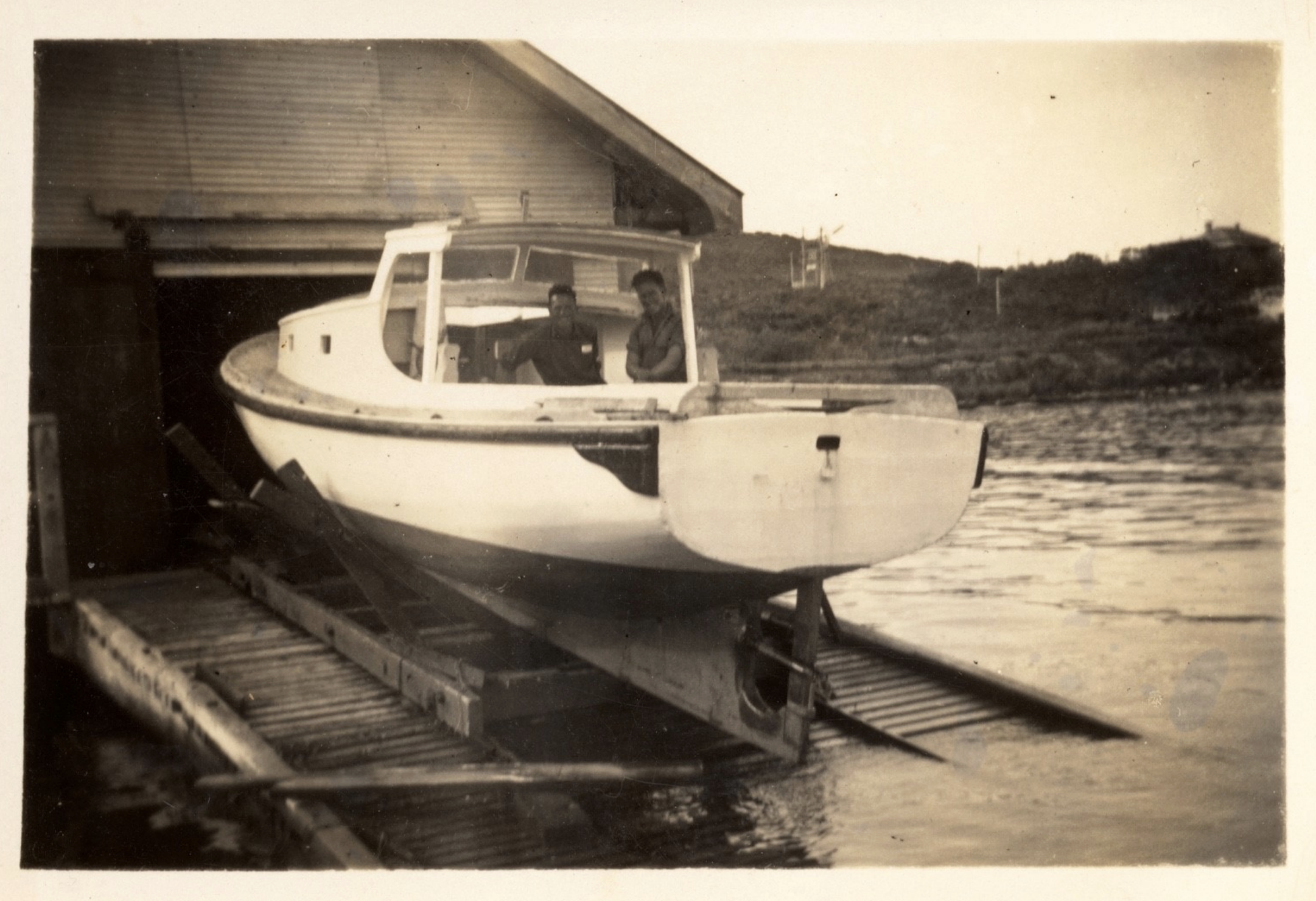
Pelican on the Pilot Jetty Slipway at the entrance of Princess Royal Harbour and King George Sound. This photo was taken in 1949 and shows a cabin arrangement with raised dodger quite different to her original cabin structure. The roof and chimneys of one of the Pilot Station Cottages can be seen on the far right. Photo: Westerberg Collection
The importance of this photo is not just what we can see in the photo, it is the information on the verso. This is one of three photos taken on the same day with the Pelican on the Pilot Jetty Slipway. Written on the back of two of the photos in Stan Austin’s hand is, ‘Pilot Launch Pelican 1949’ and ‘Pilot Launch 1949’, but on the back of one of these photos is the priceless inscription: ‘On Pilot Slipway at Deepwater Jetty 28ft Pelican 1912 – Built Albany by Bill Forsythe. Photo 1950s’. The dates are incorrect, Pelican was built in 1915, not 1912, and the photo was taken in 1949, not the 1950s. Stan Austin’s hand is quite distinctive as is his insistence in adding an ‘e’ to the end of the name Forsyth(e).
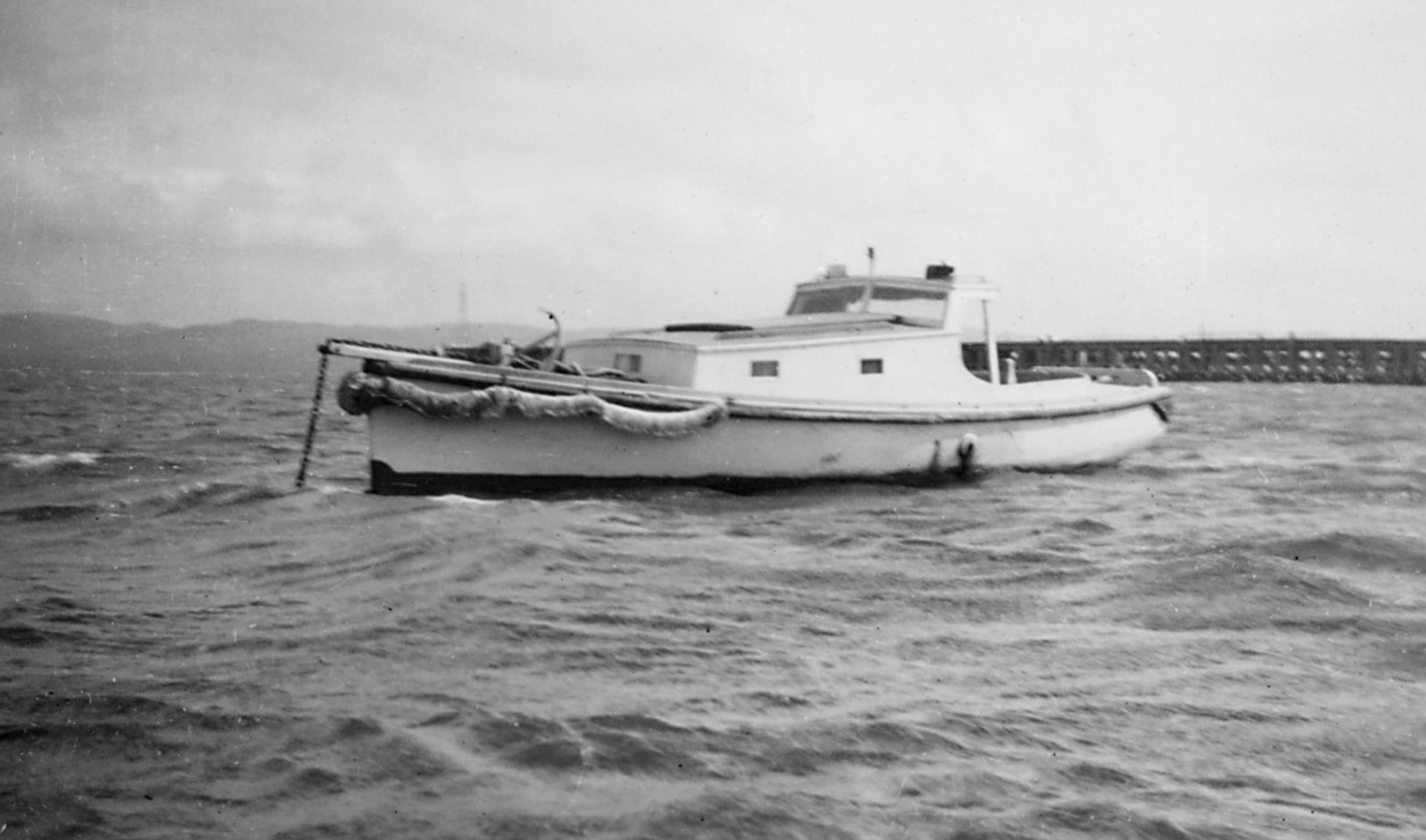
Pilot Launch Pelican on her mooring off the Pilot Jetty Photo: Westerberg Collection
Another photo from the Westerberg Collection taken about 1952. Pelican is on her mooring in Princess Royal Harbour just off the Pilot Jetty. The Deepwater Jetty is in the background. She has the same cabin and dodger arrangements as the slipway photos from 1949 and shows two rectangular portholes per side, and one porthole forward. She has side navigation lights above her cabin and a short masthead light, and is carrying a projecting anchor bow-roller. The fittings for the bow-roller are still in place on the boat today suggesting the projecting bowsprit-like structure was only put in place when mooring the vessel. Of the ten pre-1956 photos we have collected so far all show her with a white hull and none have the word PILOT shown on her superstructure, nor have we seen a flagstaff capable of carrying a Pilot flag. Only the original 1915 photo shows the name PELICAN painted across her transom.
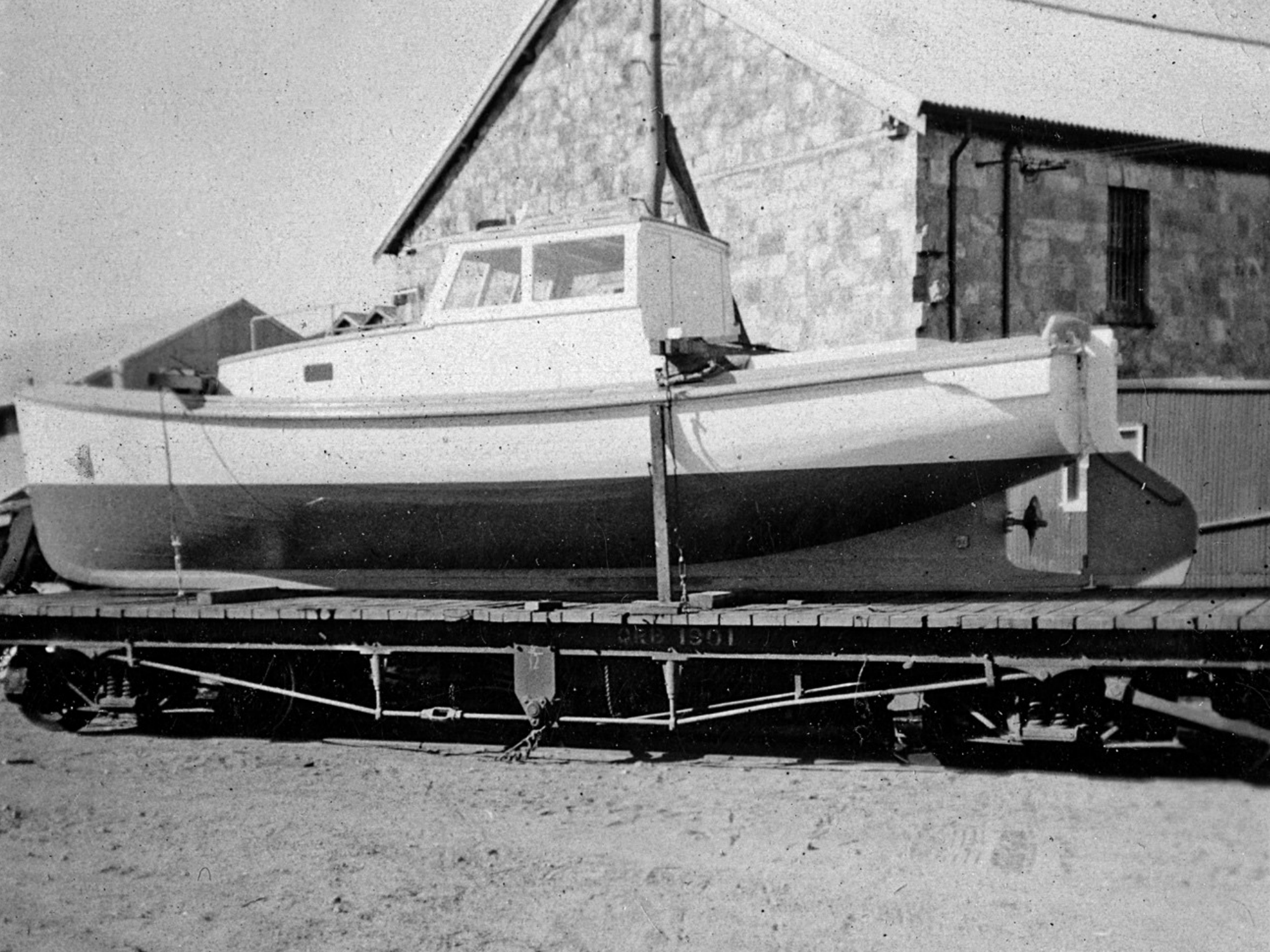
Pilot Launch Pelican on a railway flatcar outside the old Customs House, Fremantle, 1955. Photo: Jeff Beale Collection
This remarkable photo from the Jeff Beale Collection was taken in 1955. Jeff Beale, we might all remember, was the same Master Shipwright and Museum Volunteer who worked with Bill Leonard to restore the Museum’s small boat collection for display in the new WA Maritime Museum, Fremantle. Pelican had been sent up to the Harbour and Light Department in Cliff Street, Fremantle to have a major refit. The department’s shipwright, Jeff Beale, added an enclosed wheelhouse to the Pelican. The cabin has also been altered and now only has one rectangular porthole per side. The propeller aperture has been considerably altered as has the rudder pintle and gudgeon arrangement. Except for the towing arch over the tiller, this is pretty well how the Pelican looks today and shows the general arrangement we are likely to adopt for her conservation. According to her survey report she had a Lister diesel at this time. The photo shows the Pelican on a railway flatcar outside the old Commissariat and Customs House in Fremantle – now the WA Shipwrecks Museum and Gallery. Of the annual survey reports from 1951 to 1964, all were conducted in Albany except the 1955 survey which was conducted in Fremantle following Pelican’s refit. Tied down and secured, Pelican is about to be shipped back to Albany by rail.
Pelican was sold out of service in 1964 to be replaced by the Pilot Launch Princess Royal. Pelican was taken over by Brian (Crash) O’Callaghan, thought to be one of the transport workers on the Albany waterfront, hence ‘Crash’ O’Callaghan. In the late 60s, Peter Cooper purchased the Pelican and used her as a fishing boat. Peter Cooper sold the Pelican to Norm Angove who also took her fishing. Norm had trouble with the Lister diesel which was ‘as big as a fridge and bloody hard to start’. It was thought Norm replaced the Lister with the Perkins diesel that is now in the Pelican. We also heard that Norm had further trouble with the boat and ‘abandoned her in a paddock’. Further hearsay suggests Pelican was taken over by TS Vancouver Navy Cadets which accounts for her navy blue livery and boot topping but we have not been able to verify that story to date. In the late 1990s the late Jack Baxter from the Albany Maritime Foundation and Valerie Milne (OAM), Regional Manager of the Albany Residency Museum (now the Museum of the Great Southern), with help from Adam Wolfe, managed to squeeze the Pelican into the Museum’s Woolshed Stores in Albany for safe keeping – and that is where she was when Museum Manager Catherine Salmaggi, Regional Manager of the Museum of the Great Southern, approached me in 2020 to see if the MHA had a use for the boat that was now surplus to requirements.
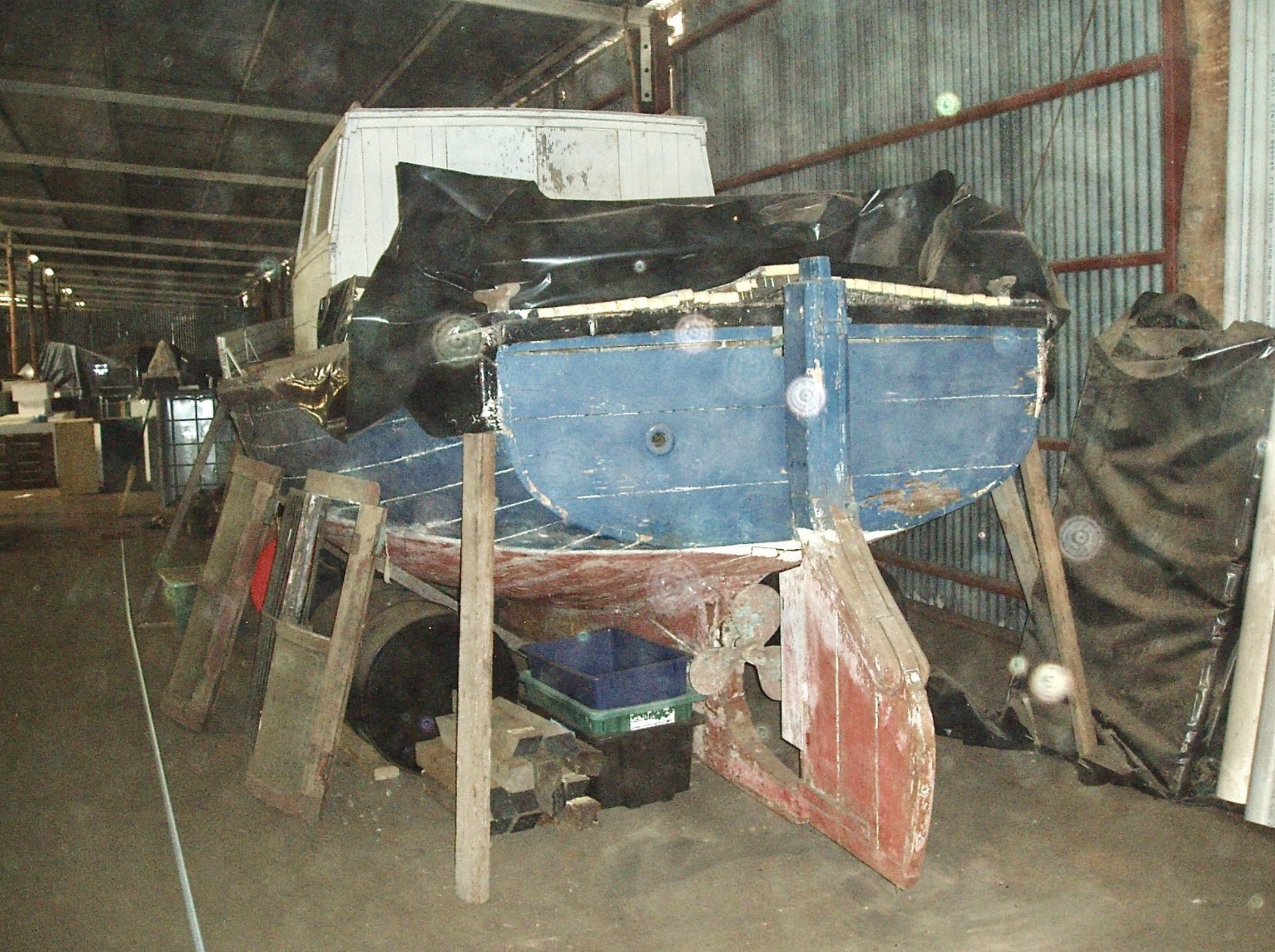
Pelican kept in safe keeping in the Albany Woolshed Stores, 2020. Photo: Ross Shardlow
While I was discussing options for a small boat museum with Mike Westerberg, Clive Walker and others, the Pelican disappeared. I heard on the grapevine it had been offered to Gavin Mair at Bremer Bay and later heard the Pelican had taken flight to Denmark and ended up in the care of boatbuilder Peter Wilson proprietor of the Denmark Boatshed. Peter showed me the Pelican at the Denmark Wooden Boat Show in 2023 where we also learnt that Pete was considering selling the Boatshed – and the Pelican. When the Government announced in May 2024 that the old Albany Pilot Station would receive $8.3 million to ‘preserve and celebrate the rich maritime and cultural history of the State’s oldest port’, a small group of enthusiastic Albany MHA members asked Pete if something could be done, even to selling the Pelican to us to keep her in Albany with a view of displaying her at the Old Pilot Station. Pete very generously offered the Pelican free of cost to our group on the understanding that she would be returned to Albany and given to the Albany Pilot Station by ‘The Friends of Pelican’ (Ross Shardlow, Peter Wilson, Charles and Rose De Bruin and Robert Palmer). Given that Pete now had to clear his property for the sale of his boatshed, Charles and Rose offered the use of their shed at Willyung to store the Pelican for safekeeping. The newly formed Friends of Pelican pledged $20,000.00 to cover the initial costs of building a cradle, transport and static display requirements. Southern Ports Albany have been very supportive with the proposal and have drawn up plans to house the Pelican in a safe undercover environment.
The Rescue
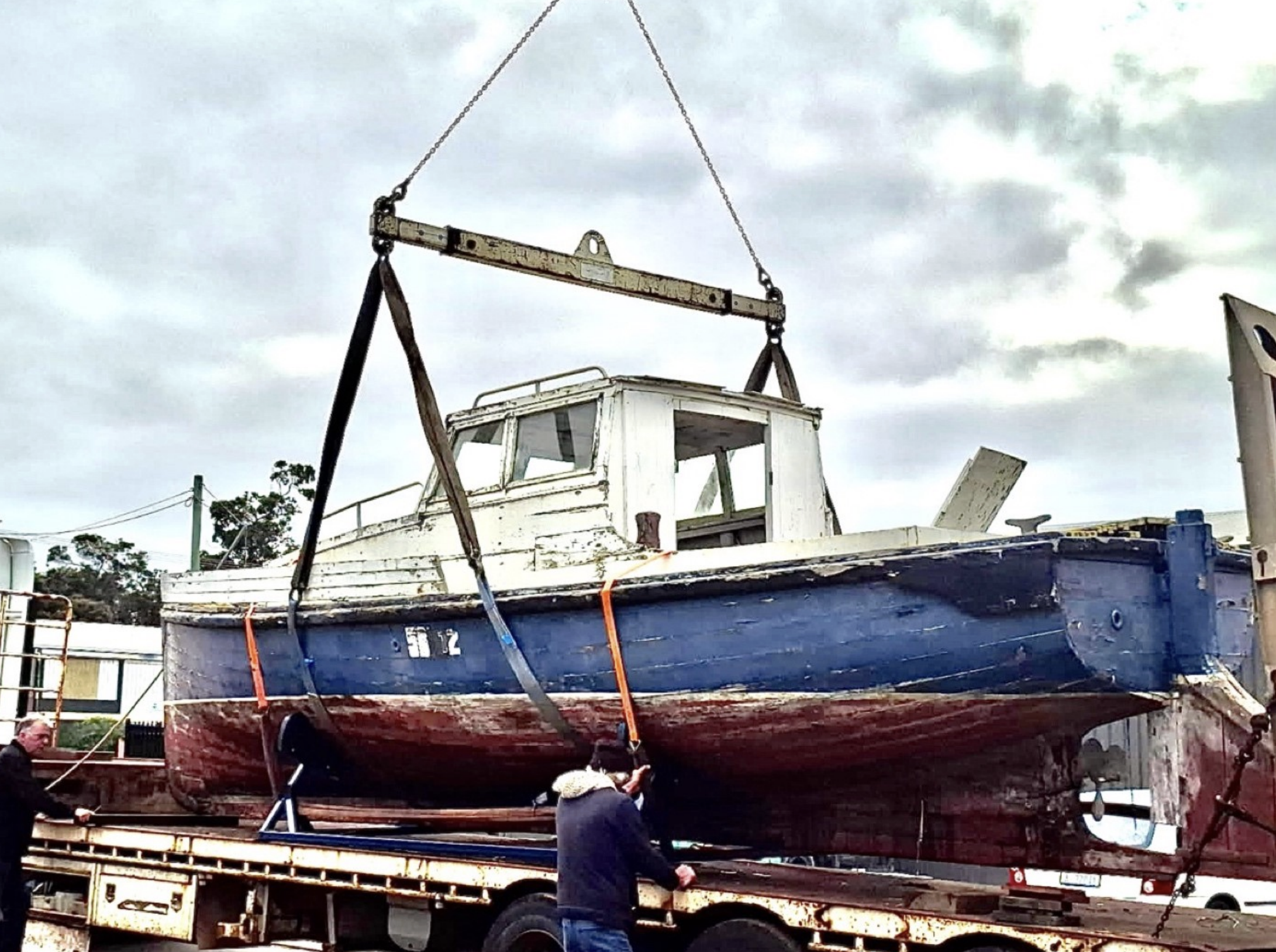
Loading the Pelican onto the Kenworth low loader at Denmark Photo: Barbara Shardlow
When the Pelican was delivered to the Denmark Boatshed three years ago she had a deadweight of 1.8 tonnes. After being out in the weather for three winters she weighed in at 2.8 tonnes. She might take her a season or two to dry out.
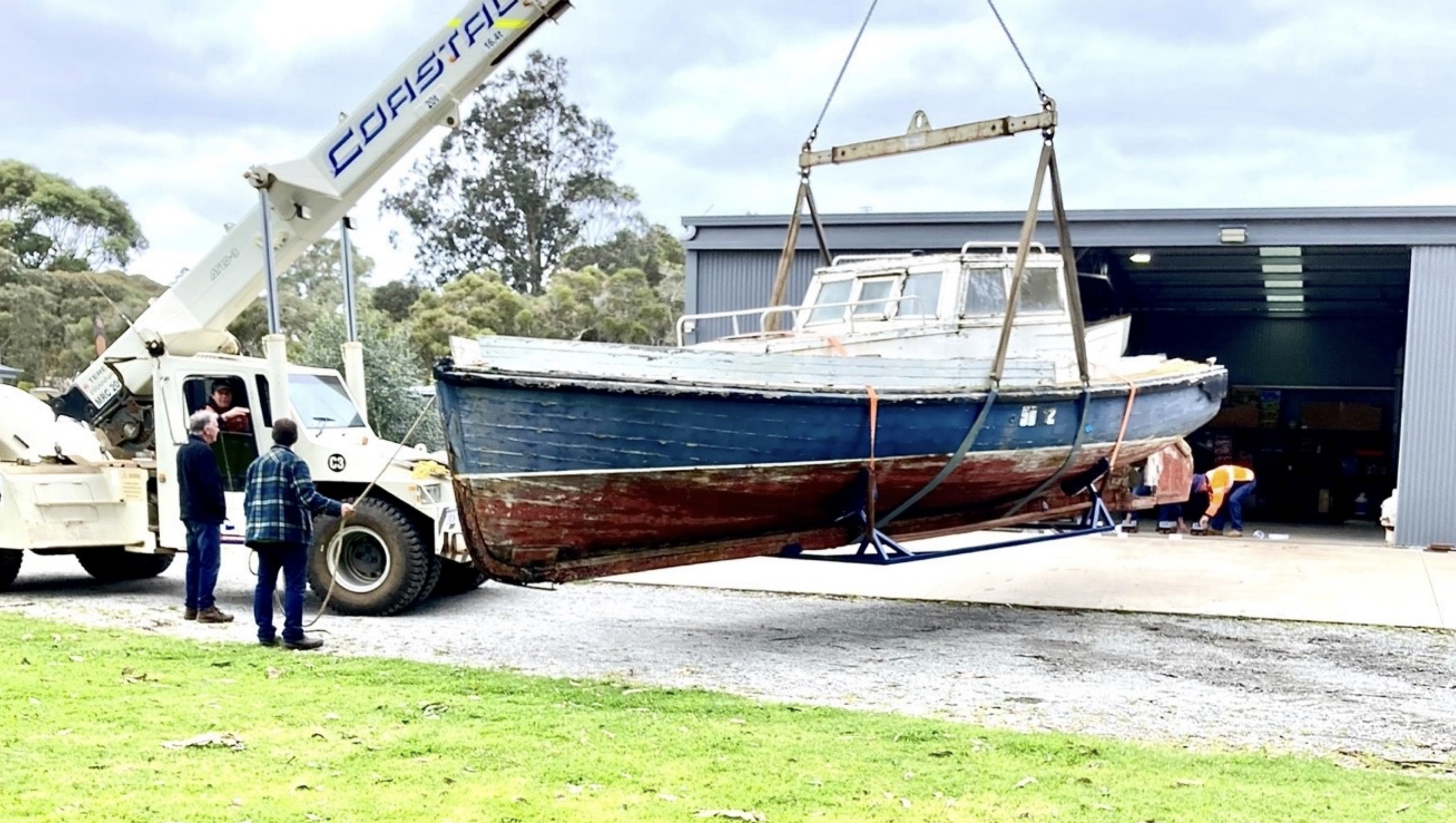
Ready to go in to the De Bruin Boatshed at Willyung (Albany). The support cradle made the job a lot easier and safer to handle. Photo: Barbara Shardlow
Lining her up. The De Bruin Boatshed at Willyung (Albany) Photo: Ross Shardlow
A few days after we moved the Pelican into the De Bruin shed we learnt that Ron and Jay Forsyth were in town, babysitting a friend’s house at Bayonet Head. We picked Ron and Jay up and drove them over to Charles and Rose De Bruin’s property at Willyung, slid open the shed door and said, ‘Ron, I would like to introduce you to the Pelican, the boat your grandfather built 110 years ago, the boat you have been searching for these past 25 years.’ A few days later Ron’s grandson Liam joined him and the two of them returned for a ‘photo opportunity’ by the Pelican – three generations of Forsyths as it were. Now that Ron has a better idea of what he had been looking for, he and Liam have been trawling through the Harbour and Light Department Letterbooks at the State Records Office of Western Australia, Perth WA, and are literally having the time of their life. For the record, there is no doubt that our conservation plan will include lofting the lines off the Pelican according to Bill Leonard’s wish. In the meantime, Pelican is setting her own course to ‘show the way’ for the Albany community.
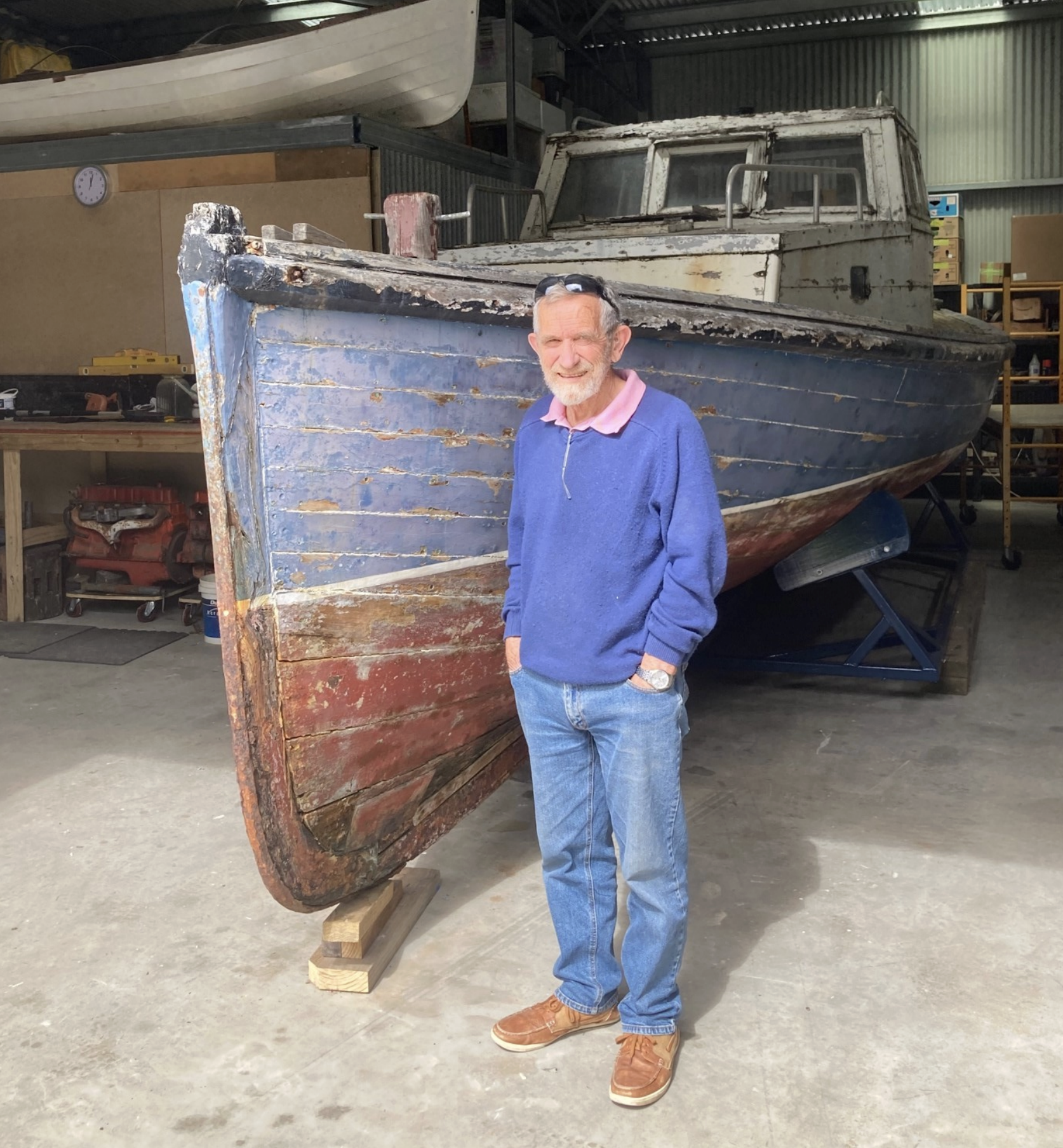
Ron Forsyth standing next to the boat that his grandfather, Bill (Chippy) Forsyth, built in Albany in 1915. Photo: Ross Shardlow