
The Antikythera Mechanism
Many Thanks to Jamie Thompson for alerting us to this wonderful story. It ties together the Greek Islands where we are currently sailing, and our home town of Melbourne where a man called Chris Budiselic is re-creating an Antikythera Mechanism and documenting it meticulously on his Youtube channel
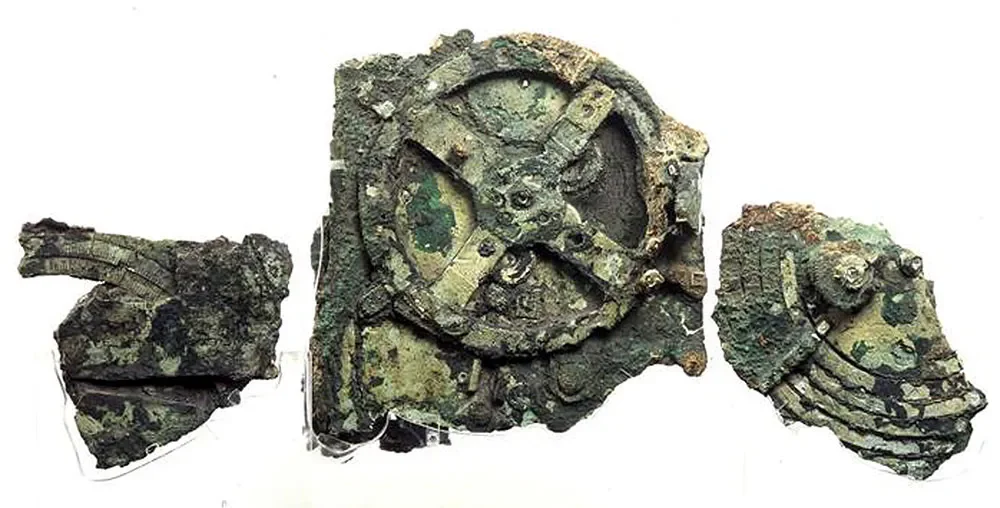
In the spring of 1900, sponge divers working off the small Greek island of Antikythera located a Roman-era shipwreck at a depth of roughly 45 meters. The ship, dated to around 70–60 BC, had been carrying a cargo of luxury goods — bronze and marble statues, glass vessels, jewellery, and coins — likely bound for Rome, possibly as spoils of war or trade goods from the eastern Mediterranean. Among the recovered items was a corroded lump of bronze, broken into several pieces, that initially drew little attention. It sat in the National Archaeological Museum in Athens for years, cataloged but not understood.
In 1902, archaeologist Valerios Stais noticed a gear wheel embedded in one of the fragments and suggested the object might be some kind of astronomical instrument. The claim was met with skepticism for decades — nothing from the ancient world was known to have this level of mechanical complexity, and many assumed later contamination or misdating. It wasn't until X-ray imaging in the 1970s (by physicist Derek de Solla Price) and, much later, high-resolution X-ray computed tomography in the 2000s (led by the Antikythera Mechanism Research Project) that the internal structure could be mapped without destroying the fragile bronze.
What the scans revealed was a system of at least 30 bronze gears, originally housed in a wooden case roughly the size of a shoebox, with inscribed bronze plates covering the front and back. The gear teeth were cut by hand, triangular in profile, at a scale of about 1–2 mm — a level of precision not matched again in surviving artifacts until European clockwork of the 14th century.
Functionally, the device was a geared analog calculator for astronomical positions. A hand crank on the side drove a main gear that, through a differential train, turned pointers on the front dial to show the position of the sun and moon against the zodiac, along with the date on an Egyptian calendar ring. The back of the device carried two spiral dials: one tracking the 19-year Metonic cycle (used to reconcile lunar months with the solar year) and the 76-year Callippic cycle, the other tracking the 223-month Saros cycle used to predict solar and lunar eclipses, including their approximate timing and character. A separate small dial is believed to have tracked the four-year cycle of the Panhellenic games, including the Olympiad.
The lunar position display incorporated a pin-and-slot mechanism that modeled the moon's variable speed across the sky — a physical representation of what we'd now call its elliptical orbit, though the Greeks explained it through epicyclic geometry rather than orbital mechanics. This is often cited as the most sophisticated element of the device, since it required translating an observed irregularity into a working mechanical solution.
Inscriptions on the plates, deciphered through the CT data, functioned as a kind of instruction manual, describing what the various dials and pointers indicated. Based on the mechanical design and the astronomical parameters used, researchers generally date its construction to the late 2nd century BC, with proposed origins including Rhodes — a center for astronomy at the time, associated with the astronomer Hipparchus — though this remains debated.
No comparable device survives from antiquity, and no textual source fully describes such a machine, though later writers like Cicero mention geared devices attributed to Archimedes that modeled celestial motion. This has left researchers to reconstruct both its function and its context almost entirely from the object itself. Research is ongoing, and some details of its full functionality — particularly around planetary displays, which were likely present but are poorly preserved — remain incompletely understood.
Here is Chris’s into episode. He’s BRILLIANT!