
Ron Spence-Vast Waters
After last week’s story about sailing a Mini 12 across Bass Strait we’ve had a few enquiries from sailors wanting to know more about this adventurous and independent man called Ron Spence.
Thanks to Bruce Finlay for steering us to a 1991 book called “Bass Strait and Beyond” by Jack Finlay (no relation). Here is an extract. It’s a great story and beautifully written.
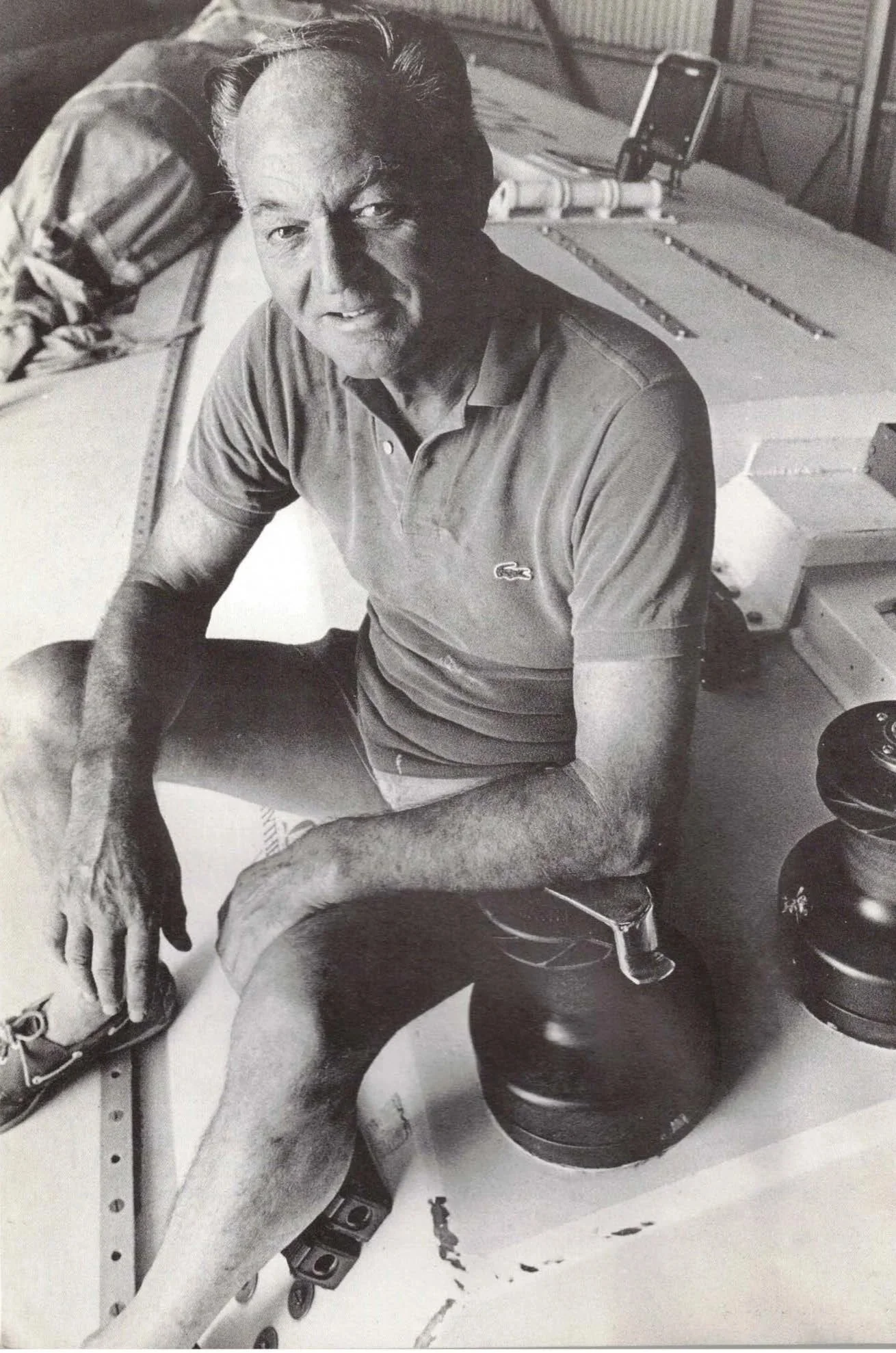
Ron Spence preparing for the 1991 double-handed Melbourne-Osaka race.
Ron Spence is quick to admit that ocean sailing has been “the focus of his recreation activities” for almost 25 years.
Now in his mid-sixties and preparing for his second tilt at the double-handed Melbourne-Osaka race, he bubbles with an intense but infectious enthusiasm. Surrounded by coils of kevlar sheeting, boxes of marine electronics, files of correspondence, faxes, and technical drawings for the keel of his new yacht, he exudes the purpose and direction of a man who makes things happen.
Whilst he concedes that the growth of his ocean sailing has been “evolutionary” and gradual, there can be no doubt that if ocean sailors were to be accorded a ranking, then Ron Spence would qualify for black belt status.
He has successfully ocean raced and cruised in boats from 7m to 16m, one of which he built himself. He has sailed double-handed with his son, with his wife and family, and fully crewed, in both the Northern and Southern hemispheres, making non-stop passages of up to 5,500 nautical miles. For someone who began his sailing over 100 kilometres from the sea, it is already an impressive record. Given Ron’s recent purchase of a 15.3m lightweight racing sloop, quite obviously the record is far from finished.
Ron Spence first sailed as a sea scout on the waters of Lake Wendouree at Ballarat. After war service with the Royal Australian Navy, he qualified as a civil engineer, and in 1954 took up the position of Engineer with the Shire of Barrabool, Geelong.
For a time he maintained only a casual contact with boats. He did a bit of water skiing and he helped his young son start sailing with a VJ. Sometime in the mid-sixties, a friend invited Ron to sail to Melbourne with him on a keelboat, and sparked Ron’s serious involvement with sailing.
On Port Phillip at that time, the 7.6m John Illingworth designed Top Hat class yachts were in their first flush. With their wholesome sets of lines, numbers of these strong pocket racer/cruisers were being hot moulded in timber by the Mordialloc company, Mouldcraft. It was one of these hulls that Ron Spence purchased in 1967, and fitted out himself. He called the boat Sioux II, launched it, and set sail with an optimistic innocence.
“In retrospect, I realise you can be a bit lucky,” Ron says now. “The very first cruise in the Sioux II, I took my wife Joan, and the three kids, around to Westernport Bay. We had no radio, no life raft, no lifelines, and no motor, and we went out the Port Phillip Heads on the full ebb tide! Just out into Bass Strait, we were caught in a violent South-westerly change, with rain squalls that blotted out the land. I had an aircraft compass that a friend had given me but I hadn’t fitted. There I was at the tiller with the compass between my knees trying to steer a course that would get us past Cape Schanck.
We arrived at Flinders in the dark and anchored. We then spent two days, with winds of 50 knots, waiting for things to moderate.
At one stage on the way home, off Cape Schanck, my daughter noticed something sticking into the mainsail from the leeward side. I leaned under the boom and looked up to see the mast spreader still attached to the cap shroud, but not the mast, spearing into the mainsail. Apparently, the rigging had stretched and the spreader, not having been bolted to the mast, simply fell out of its socket. We were lucky not to have been dismasted.”
If this was the first rung of the learning ladder, or the white belt of the beginner, Ron quickly set about paying his dues.
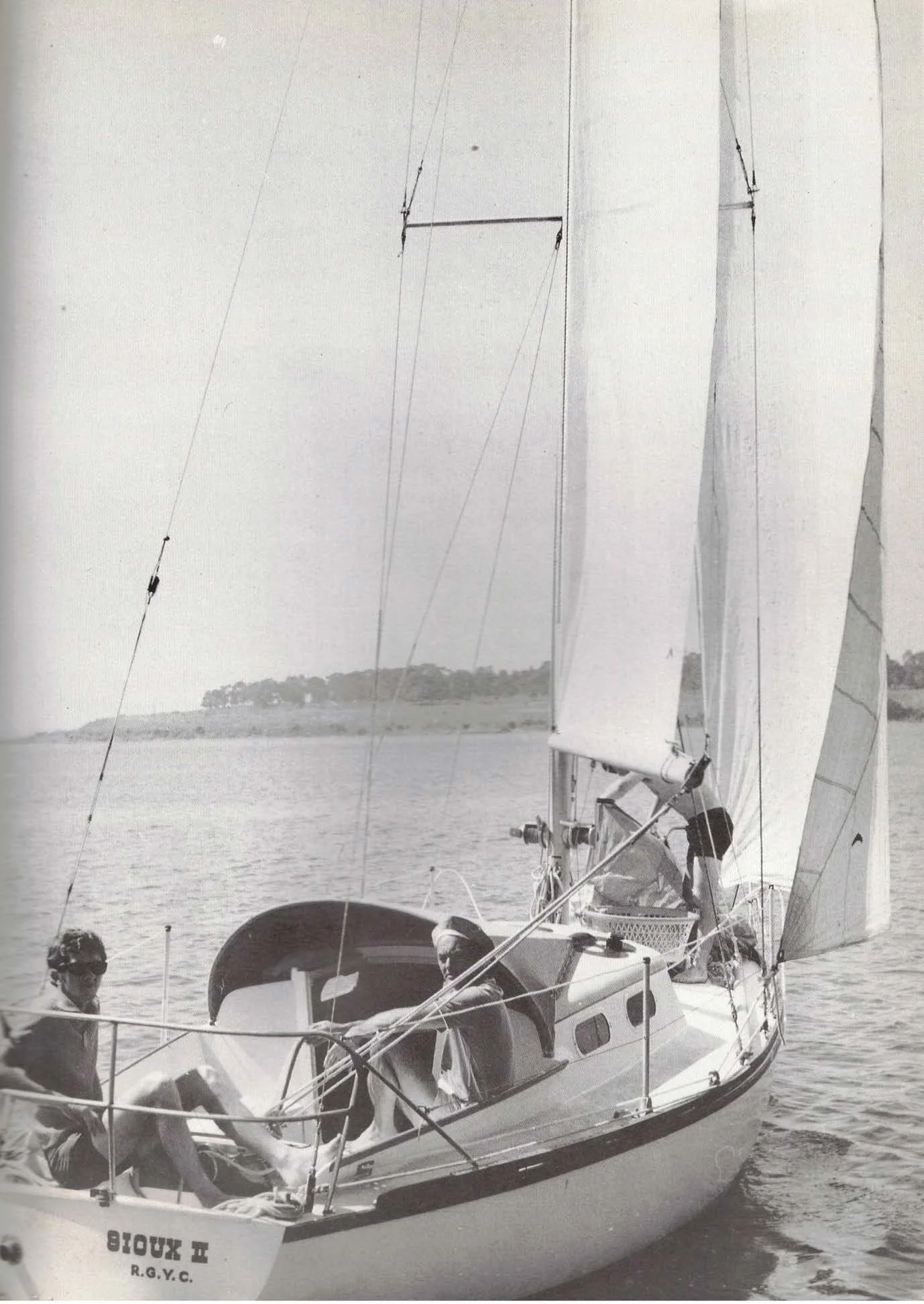
Max Stein (left) and Ron Spence (right) in the cockpit of the pocket ocean racer Sioux II in 1968
In ocean sailing, one of the fast lane routes to experience is via racing. Here everything from heavy weather handling to gear and energy conservation, presents itself with alarming rapidity and intensity.
To Ron Spence, racing his yacht was as comfortable as slipping into a warm bath. “I still sometimes get into trouble from the family about this,” he laughs now, “but I don’t like to enter anything unless I’m trying to win.” In 1968, it was no hardship to begin strenuously campaigning Sioux II in Port Phillip and Bass Strait races.
Over a two year period, the little yacht raced twice raced to Devonport, and was a consistent entrant in Port Fairy, Stanley, Portland and Apollo Bay events. Generally the smallest boat in the fleet, she would often be the last home, and carry the brunt of weather changes that larger entrants avoided. “There was one Port Fairy race where we didn’t get in until well after the others,” Ron remembers. “The weather was very bad, we were down to storm jib and reefed main, and the race organisers were worried. During the night, they sent a car along the cliff top from Port Fairy to Warrnambool and Port Campbell trying to pick up our lights at sea. We eventually got in at 3.00 a.m., but the boat was never in doubt — it was immensely strong.”
By 1970, Ron had decided that if he was to continue to race seriously, then it had to be under a measurement, not performance based, handicap system.
On the basis of this decision, he contacted the respected UK designer, Alan Buchanan, and commissioned a one-off design to the then current IOR rule. The result was a 10.1m sloop which Ron built himself by the cold moulded process, and called Appaloosa. It was a project that gave him immense satisfaction.
From its very first outing, Appaloosa was to prove a successful boat. It won the 1973 Melbourne to Hobart West Coast race, competed in the 1974 Hobart to Auckland race, cruised NZ and returned to Geelong, and placed second in its Division of the 1974 Sydney-Hobart race. In between these, it was campaigned with considerable success in local Victorian ocean races.
In the mid-1970s, Australian ocean racing began to march to the beat of a different drum, with the success of Bruce Farr designs and the acceptance of a design philosophy based on lightness, using the strength of modern materials. As an engineer, Ron Spence was fascinated by the interactions and trade-offs between strength, weight, durability, performance and safety in racing yachts.
In 1976, he purchased the Farr 1104 Chaos and entered the Sydney-Hobart race. “That year there were five or six of these Farrs in the fleet,” Ron remembers, “and everybody was saying none of them would get to Hobart. There was a bit of blow in that race but they did all get there.
Before the race, we went around the marina getting a handle on the opposition. The gun Farr that year was Piccolo, and we had a look at her. She had stainless steel tanks which we didn’t have, so we thought we’d be able to match her on weight.
The first night of the race it came in quite fresh, and we crossed tacks with Piccolo well down the NSW coast. She went in to the land and we went out. We debated whether to come across with her but decided it was six of one, half a dozen of another. Well of course Piccolo went on to win the race, and we placed well back. In retrospect, I suppose, we should have match raced her from that point on. But we weren’t to know it at that stage.”
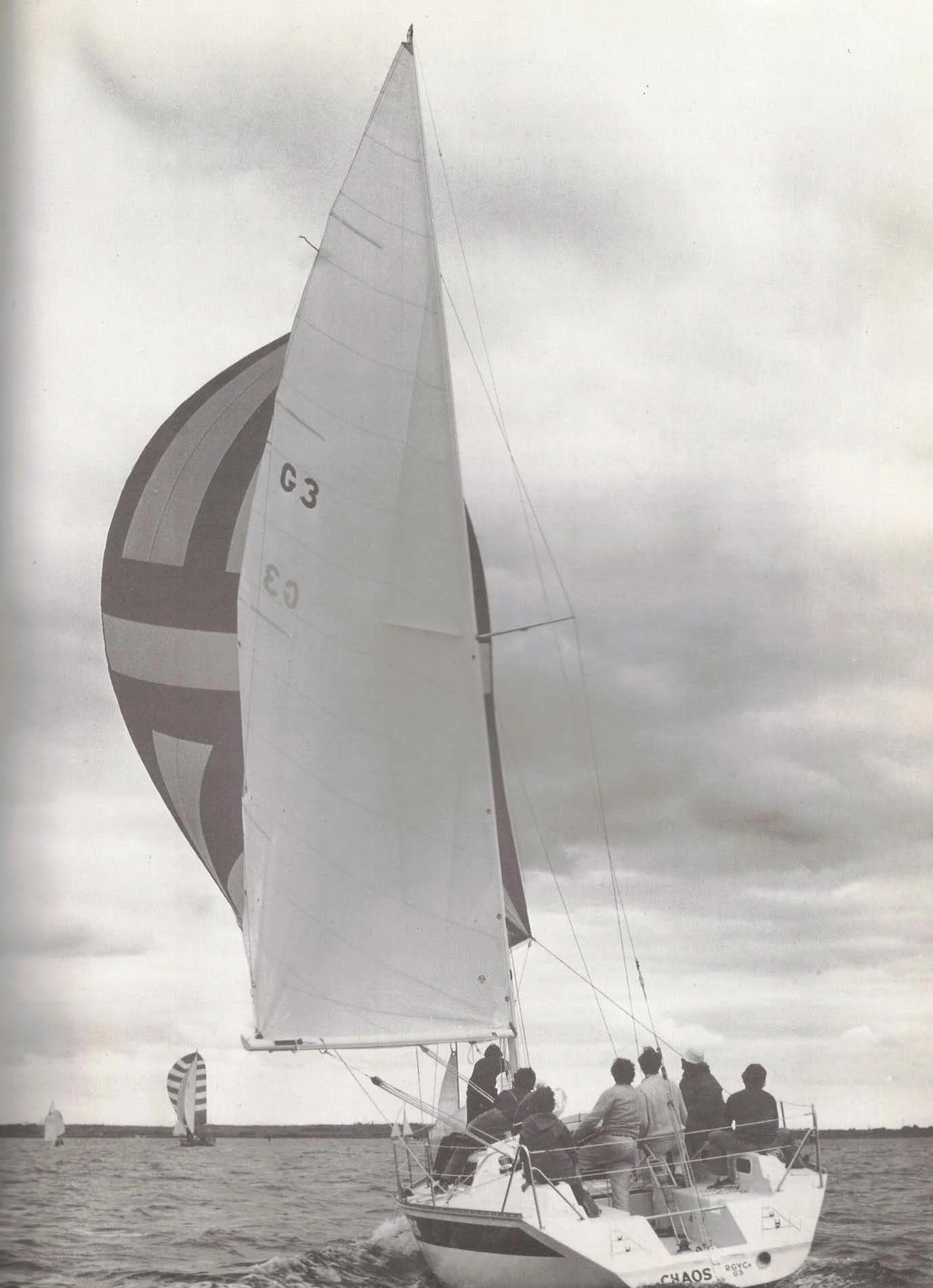
CHAOS
Like Appaloosa, Chaos was an immensely successful boat. Over the three year period 1976, ’77 and ’78, it competed in three Sydney-Hobart’s, and numerous Victorian ocean races; winning several of these including its first race, to Portland, and two consecutive Melbourne to Stanley races. It also participated in a One Ton Cup Series in Sydney.
Since selling Chaos, Ron has continued his participation in Australian ocean races, crewing on a variety of yachts including the 13m Adams designed Cutloose, the former Geelong based Quasimodo, and the Japanese maxi Marishiten. He has now competed in six Sydney-Hobart’s and five Melbourne-Hobart’s.
In 1987, with his son Murray, Ron entered in the inaugural double-handed Melbourne-Osaka race, in the heavily built 14.6m Herman Boro designed ketch, Dugong.
“I had done some short-handed racing with Murray in Chaos,” Ron says. “We won the first double-handed race conducted by the Ocean Racing Club of Victoria, from Queenscliff to a mark off Apollo Bay and finishing off Flinders. Racing to Japan seemed like a good thing to do!
Dugong was a cruising boat, so we were comfortable enough. At one stage prior to the start I was thinking that after a week or two I’d be asking myself, ‘What on earth am I doing out here?’. But once we got started, we were so busy that time didn’t drag. It was an enjoyable race.
We ran into heavy seas out level with the northern NSW coast. On one occasion, Murray and I were down below so I don’t know how big it was, but a wave came down over us with enough water to totally cover the boat, to bend the stainless steel dodger supports, and send cold water like a fire hose down every ventilator and hatch opening. Dugong was enormously high sided. Standing in a dinghy next to the topsides, I couldn’t reach the deck, so this wave must have been pretty substantial.”
Dugong sailed the 5,500 miles at an average speed of 5.54 knots and finished in the upper half of the fleet. After receiving an offer “too good to knock back”, it was sold in Japan.
Since then, Ron’s sailing has been a mixture of cruising and racing. He has circumnavigated Tasmania with his wife and another couple in his Farr 42 Southern Swell, and crewed on the 18m Japanese maxi Marishiten in the 1989 Sydney-Hobart race and the 1990 Kenwood Cup series in Hawaii.
“Sailing with the Japanese on Marishiten was an eye opener,” he says.
“There were 20 crew, Japanese, Americans, New Zealanders and Australians, but it’s the sheer professionalism that’s impressive, the whole way they run the project. One day, we went out for practice before the Kenwood Cup and did 41 gybes, one after the other.
During the races, we had a lot of bad luck, losing our mast twice. The first time, it came down at 3.00 p.m. one afternoon with the next race scheduled to start at 6.00 p.m. the following day. Before we got back to the marina, they’d telephoned through to have some replacement rod rigging flown out from Los Angeles. We spent the night transferring fittings from the broken mast to the spare, and made it to the 6.00 p.m. start. That’s the way they do things. The other competitors gave us a great cheer for making it back out there.”
When he looks back over his years of racing, the incidents that generally spring to Ron’s mind are ones where the element of competition has slightly intensified things. Crossing tacks with Piccolo in the night on Chaos, duelling up the Derwent in Appaloosa with the larger Corroboree, in the dying stages of the ’75 Sydney-Hobart race, are two examples.
It is in this same vein that the intensity of the Kenwood Cup competition appeals to him. “Just being out there with such close racing between those big boats was a great experience,” he says. “We were crossing tacks with yachts like Sorcery and Brindebella.”
Not unexpectedly, speed has a high priority in Ron’s listing of desirable attributes for the ideal yacht. “Even if you’re cruising, you want to be able to make a fast passage,” he says. “That way you get into an anchorage sooner, get the dinghy out and get ashore, meet people.”
He sees the ideal size boat for a cruising couple as being around 12m and believes the fractional rig, with its smaller headsails and spinnakers, offers as much to the cruising as to the racing sailor.
Speed, he recognises, is also a two edged sword. “In the 1989 Hobart race,” he says, “we had Marishiten down to storm jib and trisail and were still doing 9 knots to windward. The only way we could have stopped the crashing was to have paid off and lost ground, or stopped racing, and both those alternatives were unacceptable. In the end, we damaged the framing and had to retire. Speed and strength are always difficult components to balance.”
Currently, well into preparation for the 1991 double-handed Melbourne-Osaka race, speed figures prominently in his world. “I said to Murray that we did the last race in a cruising design so if we give it another go, why not try to be competitive,” Ron says.
To meet that aim Ron and Murray will be racing a 15.3m Castro designed sloop, built for short-handed competition. “The boat’s already done a double-handed Round Britain race and a Trans-Atlantic,” Ron says. “It’s got water ballast which we have to do away with by adding an extra tonne of lead to the 3m keel, and we’re adding a scoop on to the transom to take the length to 16m which is the upper limit of the Racing A Division.”
Their campaign is built heavily around two factors, which Ron sees as vital to the race; reliable weather information, and getting through the doldrums as quickly as possible.
“The weather aspect is critical,” Ron says, “that’s why we’ve purchased a weather fax and I’ve been talking with meteorologists. This technology is changing the face of ocean-racing. In the old days, you’d concentrate hard at night and maybe pick up a few miles on someone who’d lost concentration. These days, everyone’s concentrating all the time, and having the right weather information can give a real break on the opposition.
The other important element will be the ability to carry enough sail to get you through the doldrums area as quickly as possible. We’ll be using three roller furling systems, and carry an ultra-light large genoa for the light air days, the tack of which can be set outside of the bow to improve air flow into the slot between the jib and main.”
With characteristic understatement, Ron Spence talks of his ocean sailing as having “just sort of moved from one thing to the next”.
“I don’t think there’s much of a story to tell,” he said to me when I asked if I could talk with him about his sailing. Fortunately, I didn’t believe him.
Ron sailed on from this world in October 2019