
'Overloaded' Haitian Sloops Don't Get Enough Credit
Thanks to Peter Swanson for allowing us to reproduce this fascinating article from his Substack Page, “Loose Cannon” - Consider Subscribing!
The U.S. Coast Guard took this photo during its interception of the vessel. Note the guy standing at the mast. He might be taking a cellphone picture of the Coast Guard taking a picture of them.
How an Accident Investigation Revealed Their True Capabilities
You’ve seen the pictures. The Coast Guard has intercepted a Haitian sloop of 40-something feet with 150 people crowded on deck—way too many people.
The captions are written by Coast Guard public affairs officers, who call the boats “Haitian freighters.” The captions invariable say, “grossly overloaded Haitian freighter,” even the photo above was so described.
Does she look overloaded to you? She’s thundering along at close to hull speed, sailing beautifully.
But what if there were another hundred people below decks? Maybe the caption writer wasn’t wrong after all. When smuggling migrants, Haitian skippers jam pack their holds with human cargo, allowing small groups on deck in rotation. This is may well be what we are seeing here.
From the point of view of seaworthiness, the issue is not load as much as weight distribution. British accident investigators have determined that the typical Haitian migrant weighs in at a lean 143 pounds. Crowd 150 migrants into the hold, and a sloop’s tonnage increases by 21,500 pounds, but that load is likely within the carrying capacity of many of these boats.
Plying a small corner of the Western Hemisphere, Haitian sailing craft must surely represent one of the simplest and most successful designs in history, having changed little since their presumed introduction to Haiti by French colonizers in the early 18th century.
Sailing Media Invisibility
Recent news stories have announced boutique schooners bearing organic coffee and proposals for container ships driven by rotating foils. If the past is any indicator, these green initiatives will likely fail and be forgotten. Haitian sloops rarely get a mention, even though they endure, a reminder of the historical reality of commerce under sail—gritty and dangerous.
Yet, the contemporary view is that they are a menace. Alas, people are not sacks of rice. They are passengers with minds of their own. They are country folk and poor city dwellers, rarely seafarers themselves. If scared, their impulse is to get up on deck, which looks like this:
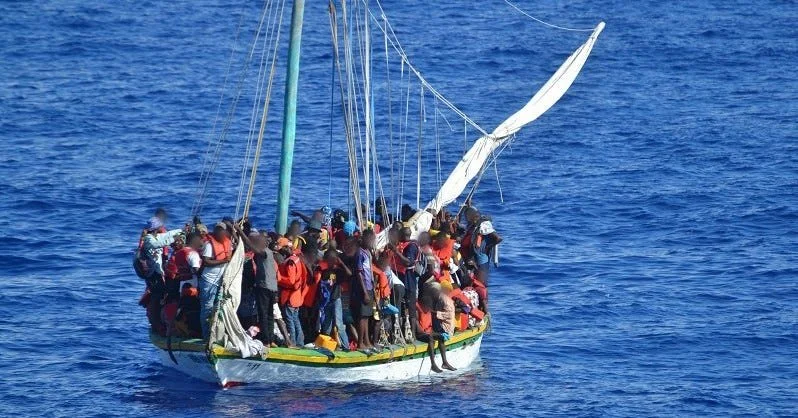
An overloaded Haitian vessel interdicted by Coast Guard Cutter Diligence and Coast Guard Cutter Bernard C. Webber on Sep. 14, 2021. The Coast Guard supplies migrants with life jackets; there would have been few if any on board during its passagge. (U.S. Coast Guard photo)
In August 2007, the British Marine Accident Investigation Branch issued a 49-page report that constitutes perhaps history’s only scientific evaluation of Haitian sloop performance.
Earlier that year, in May, a 37-foot Haitian sloop en route to Providentiales in the Turks & Caicos capsized with an estimated 150-200 migrants on board. At least 60 migrants drowned. Because the incident occurred in the waters of a British territory, MAIB investigated to determine the cause, the same way the National Transportation Safety Board investigates marine disasters in U.S. jurisdiction.
Sea Quest, a Turks & Caicos patrol boat, had picked up the sloop on radar at 1:26 a.m. as she was sneaking over the Caicos banks toward Providenciales. The sloop was intercepted, ordered to lower sails and taken in tow. As the tow was underway more and more migrants came up on deck. MAIB wrote in its report:
At approximately 0215, the engineer shouted to the captain to stop the launch because the sloop had capsized. The captain immediately took the engines out of gear and started to manoeuvre towards the sloop. As he did so, the engineer jumped down onto the main deck and slipped the bridle to release the tow line. Those crew observing from the stern of the police launch estimated that 50-60 persons were on the deck of the sloop when it capsized.
Chaos ensued as the Sea Quest crew undertook rescue efforts.
The inflatable tender was launched, and the engineer made numerous trips to pick up those in the water, returning each time with 6-8 survivors clinging to the small craft. On one occasion, so many survivors attempted to board the inflatable that it became swamped, and the engineer found himself in the water with them. Despite the press of people, Sea Quest was able to manoeuvre to the inflatable. The boat was bailed out, the engine restarted, and the engineer recommenced his rescue efforts.
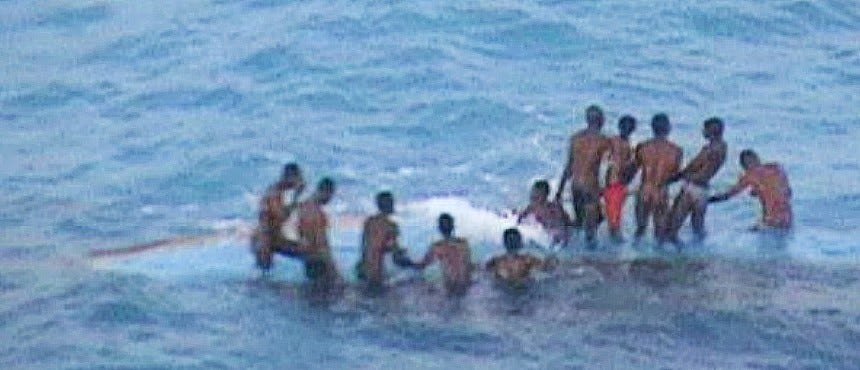
Migrants gather on the hull of the overturned vessel awaiting rescue. This photo was taken from a U.S. Coast Guard helicopter which had responded to the disaster.
To assess the stability characteristics of the vessel MAIB investigators created a computer generated model.1 They estimated the weight of the vessel and people aboard and determined the righting lever in various weight-distribution scenarios. Righting lever (GZ) is a measure of a vessel’s ability to return to the upright when heeled by an external force.
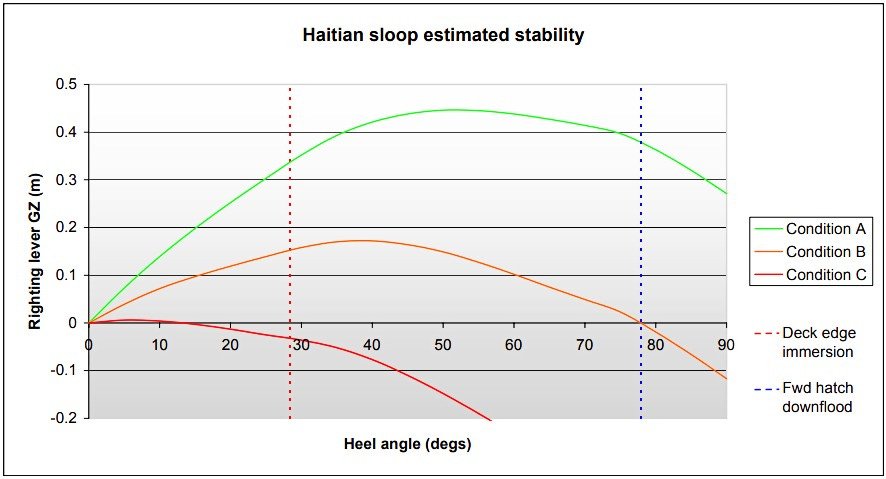
The area under the curve bounded between zero and the heeled angle is directly proportional to the moment righting the vessel. Condition A (green) represents the vessel on passage, with 25 persons on deck and 125 below deck. Condition B (orange) is prior to capsize, with 75 persons on deck and 75 below deck. Condition C (red) represents the capsize conditions, with 125 persons on deck and 25 below deck.
MAIB determined that even if 60 migrants had been taken off the vessel, stability would not have been improved if the remainder stayed on deck. Only if a full 120 migrants were removed would the sloop have become stable and safe again. Remarkably, MAIB concluded:
It can be seen that when most of the passengers are in the hold, in effect acting as ballast, the sloop had a healthy level of stability. The vessel also had a good minimum freeboard of 0.95 m and the deck edge did not immerse until nearly 30 degrees. In this condition, it is not inconceivable that those onboard would have had no particular concerns about the sloop’s stability while on their voyage.
MAIB found fault with the Turks & Caicos captain’s decision-making. The tow was conducted in circumstances in which even the slightest yaw could result in the sloop’s capsize. Without specifically saying so, MAIB also confirmed the sloop’s efficacy as a cargo carrier assuming proper distribution of weight. That is, cargo or passengers down below.

MAIB Investigators piece together the stem, where the tow rope had been attached. (Marine Accident Investigation Branch photo)
Route to ‘Lot Bo Dlo’
For 300 years Haitian boats have navigated the same trade route, passing by and sometimes clearing Customs at Great Inagua on the Bahamas southern frontier, then navigating the shallow banks west of the Exuma chain. Few cruisers brave the southernmost reaches of this old trade route, fearing the shallow sands, despite the aid of sonar and satellite technology.
Haitian skippers rarely have even basic GPS. They carry a compass and steer over the banks by the color of the water. Most sloops are engineless.
According to the Forced Migration Project of Oxford University, between 55,000 and 100,000 Haitian boat people managed to reach Florida in the 20 years leading up to 1981. According to one estimate, Haitian sloops conveyed as many as a quarter million migrants to South Florida over the decades, poor people crossing nearly 700 miles of water to become the region’s kitchen workers and cab drivers, fruit pickers, nursing home staff and drywall hangers.
They had fled a country where the average lifespan is 53 years and unemployment is said to be 60 percent. One of the few economic bright spots are the dollars sent back from Haitian migrants working stateside. Since 1982, when the U.S. Coast Guard ramped up its interdiction of migrant boats, probably 200,000 Haitians have been intercepted at sea, most of them to be repatriated. Thousands more have died trying to reach “lot bo dlo,” Creole for “the other side of the water.”
The Sun Sentinel newspaper of South Florida once had reporters trace one of these interdicted vessels back to its port of origin, a small seaside village on the North Coast of Haiti. The entire village had pitched in to finance and build the sloop and hire the crew. Each family picked a member to make the perilous journey with the understanding that the chosen would send back a portion of their pay. The village mayor complained to the reporters that returning would-be migrants had crushed the village’s hopes for a better life; people would die.
Derived from boats designed for commerce on the French coast around Brittany and Normandy and built on the beach by eye, the Haitian sloop endures because it is good at what it does. And for the long suffering people of Haiti, the sloop is an enduring symbol of hope.

Sam Devlin, a well known designer and builder in the Pacific Northwest, was sent the 3D rendering (above) without identifying it as a Haitian sloop. Based only on the rendering, Devlin arrived at essentially the same conclusions as MAIB regarding stability of the design.