
A Very Lively Lady
Many of you will know SEAHORSE as the premiere sailboat racing publication in the world, covering the latest developments and cutting edge technology in the global race to win. However they also have a deep respect for the lineage from which today’s boats evolved. Over the next few months we will bring you a series of handpicked articles from their archives highlighting this history, and showing that deep satisfaction in sailing comes from understanding, just as much as winning! The generous people at SEAHORSE are offering readers of SWS a significant discounts of up to 30% on both digital and print editions of this seminal magazine. Click the banner below to check out the offer.

She's famous as the boat that sailed around the world with a Southsea grocer as her skipper. For Alec Rose, back in 1968, it meant a knighthood, a book and a place up there with Sir Francis Chichester in the sailing halls of fame. Then 40 years later she went around again, this time with a group of young people crewing. Dan Houston joined them on her way back to India…
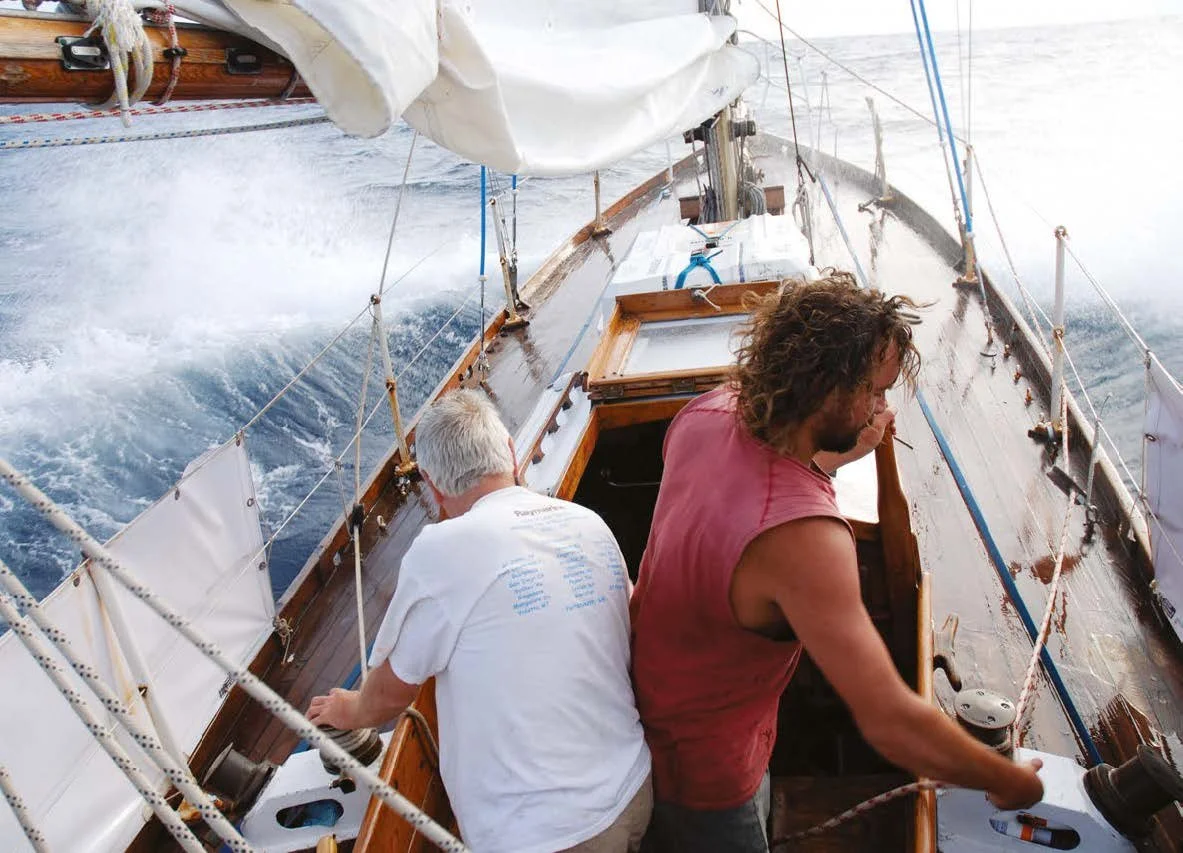
Despite her lines being from famous cruising yacht designer Fred Shepherd, and her world-girdling accomplishments in 1967-1968 under the solo captainship of Sir Alec Rose, Lively Lady, built in Calcutta, India in 1948, is a cranky old girl. Being more heavily built than Shepherd stipulated, and with less foresail area than she was drawn with, her motion in a seaway is unpredictable and tiring. This modern shot shows her crashing into no more than a moderate seaway, though heavily reefed and flying a smallish jib
The dolphins are like an old couple. For a day or so now they have kept us company, especially while we motor-sail in the shoal water off the beach. One is almost black and looks at least 8ft long while the other looks about half his (or her) size and is basically pink. We see them quite often in the crystal-clear water, over the white sandy seabed, sometimes even between us and the shore. Like us they seem to be heading north up the Malabar coast, and using the shallow water to reduce the effect of the south-going current in this late spring season. We've rigged a little awning on the mizzen shrouds which makes being on deck somewhat cooler when sitting aft of the cockpit. The dolphins are the only life we have seen pretty much since we came around the southern tip of India, after leaving Galle in Sri Lanka some four days back.
In the mesmeric heat of the early afternoon sun I can see the curvature of the earth. We are making about 5kt some 70 yards from the unbroken beach with its palm trees and jungle backdrop. There are no dwellings here and the sea, sand and green scenery are surprisingly dull and monotonous on the eyes. Then, every once in a while, you see palm fronds from the top of a tree rising out of the sea up ahead, they rise slowly with the bent trunk coming up too, curving down into the shore. As you get closer in passing it's not so obvious, but if you turn around 15 or 20 minutes later you can begin to witness the opposite effect. Slowly the palm leaves are there again, hovering above the water on less and less trunk before they too disappear below that bit of horizon. And you realise the only explanation for this is that you are gliding over the surface of a seriously large sphere.
I nip below for my mobile phone and am just as surprised to find we have good signal. Wah? I phone my mum and tell her how the earth is round; I probably sound a bit blown away. 'That's lovely, darling. Tell me more when you get back.' She always did like to save money on phone calls.
I'm aboard Lively Lady, a yacht built in India in 1948. When she was 20 years old she had a book written about her by her famous shopkeeping captain, when they went around the world together. With her new skipper Alan Priddy she's going round the world again, making stops and crewed by young adults from the Portsmouth area, with a different mate for each leg. I'm on the Indian leg.
Lively Lady, as you know, is one of our famous yachts. She was made intrepid by Alec Rose, the Southsea greengrocer, born in Canterbury in 1908 and 59 when he circumnavigated in 1967/68 one year after Sir Francis Chichester. Alec, who was knighted by the Queen the day after his return to Southsea in July 1968, went the classic Southern Ocean route, eastabout south of the Capes of Good Hope, Leeuwin and the Horn.
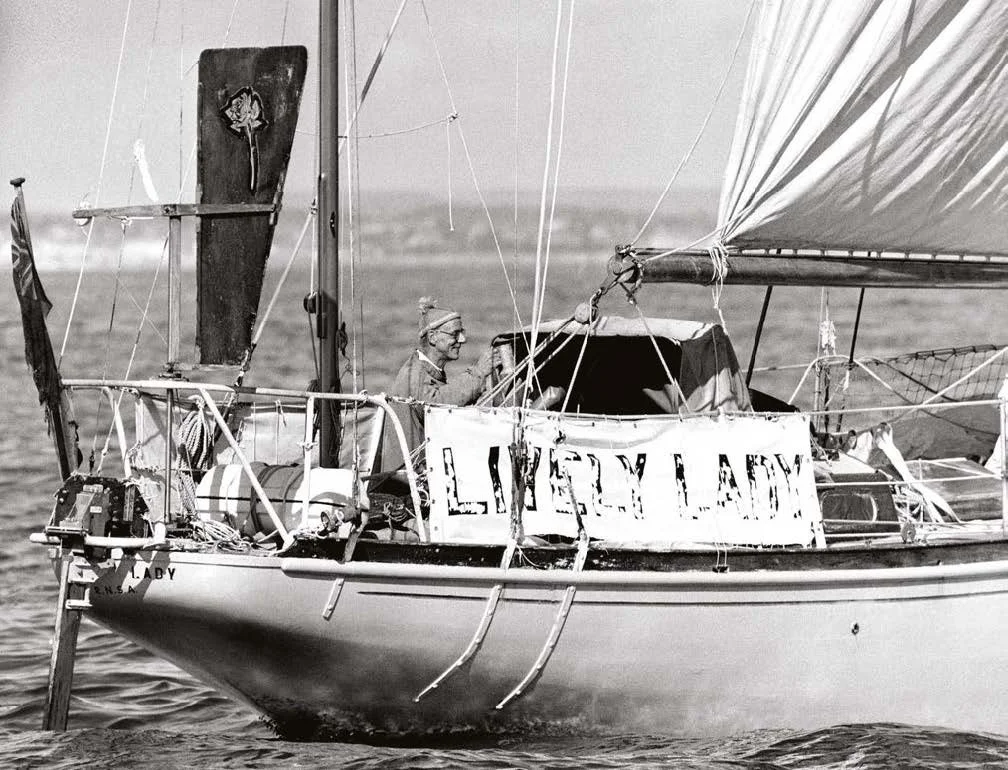
When he arrived back in Britain (above) after his near one-year circumnavigation, for several months Rose found it difficult to walk owing to damage caused by this unusual motion and was lent a car and driver while performing a long string of public engagements
Rose stopped in Melbourne to see his son, and was met by the Australian prime minister Harold Holt, who memorably disappeared later the same day after going for a swim. He also stopped for repairs at Bluff Harbour, New Zealand, before sailing to Cape Horn. He never got near India.
Alec Rose was the epitome of the can-do postwar generation. After serving as a mechanic on convoy escorts with the Royal Navy in the war, he'd saved up for years to buy Lively Lady and took part in the 1964 Observer Singlehanded Transatlantic Race, doughtily placing fourth out of the 13 competitors.
Although for that race she was rigged by Illingworth and Primrose, and he found her somewhat cantankerous, Rose returned to the famous design duo with a request for more sail. The result was a 4ft higher mainmast plus a mizzen – though to rig a mizzen staysail rather than to make her into a yawl. The idea was to use this sail in place of the mainsail when light airs and a lumpy sea could result in a flapping, thrashing main. However, Rose seldom used the unusual arrangement, and on this trip the staysail isn't aboard.
And if this is her first return to India since she was built then time certainly hasn't improved her manners. In terms of sea-kindliness she is all over the place. I've begun to wonder what, when he stopped in Melbourne in December 1967, persuaded Mr Rose to carry on?
Because, despite all the swank of being a world girdler and undoubtedly being a tough seaboat, the Lady is a crank.
During the last five days I've been allowed the incredible privilege of joining her and Alan Priddy, to sail the 343nm (rhumbline) from Galle to Cochin, and witness the Lively Lady Project in action. Also onboard are Portsmouth teenagers Katherine Davies and Carol Allen, with Bath-based teacher Duncan Fagg as the other co-skipper. I signed on as second skipper and have taken my watches and made our plots and been as mate-like as a writer (with a Commercial Yachtmaster ticket) can be. But basically, underneath the magic of making a landfall in India (an EM Forster-driven dream come true), lie some serious misgivings about this yacht.
OK, let's set the scene. From Galle in south Sri Lanka to Cochin in Kerala Province, India, we had the wind on the beam for a precious few hours. The rest of it was punching the wind and to some extent the current using the engine for almost five days solid. The times we did cut the cackle of the obedient Beta probably added up to less than a few hours. At one point on a beam reach in a Force 3 she actually acquired a motion that seemed to fit the definition of sailing – pulling along nicely with her number two jib and main and not literally jerking you off your feet.
Any sailor might pride himself on a sense of balance; from trying not to strap-hang on a tube train to being able to move around a deck in a gale… but I don't think anyone has been able to stand, unaided, a minute on deck with Lively Lady going upwind. You kind of make 50 seconds with extreme concentration and then whoa! She ups you. The motion is like an eccentric metronome; you cannot second-guess her moves. Up-down, half-roll, down, up-a-half-quarter-roll, downish, up, up-a-bit-more, think-about-a-roll, stop, plunge, way-up, stay-up, half-roll, now-down, smother, roll-against, big-up…
After our first day at sea, heading out across the 140nm Gulf of Mannar, between southern Sri Lanka and Kanyakumari (Cape Comorin), India's southern tip, my notes were already bemoaning this uneasy motion. 'She's a wonk-a-donk-tonk, fonk-a-lonk-clonk type of boat', I write after my first 12 hours afloat.
Two days later I note: 'She seems, perhaps through years of absence, to meet each and every sea wave with the abandon of a long-lost friend. She'll stay with each one too long, upsetting the natural motion of progress – in a deep salty smothery hug before coming up for air and charging onto the next one. Being her skipper is like being the inconsequential chaperone of a wayward belle of the ball, running this way and that, to stop and kiss absolutely everyone; though she agreed to leave 10 minutes ago.'
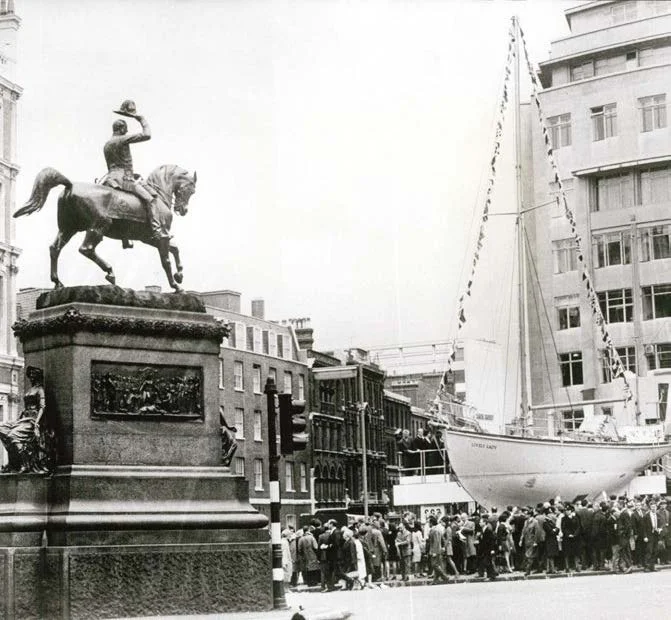
Lively Lady in front of the Daily Mirror building in Holburn, central London in July 1968. Dubbed ‘the modest mariner’ by an adoring British press, Southsea’s most famous green grocer and nursery owner was knighted by the Queen on 10 July 1968, six days after stepping back
'She is a terrible boat to sail,' agrees Alan, who has already managed most of her 28,000-mile circumnavigation – and will go on to complete it, via the Mediterranean. 'Many people don't know this,' he continues, 'but Sir Alec needed a car and driver, provided by Vauxhall, for four months when he returned… because basically he couldn't walk.'
I mention this to be frank about Lively Lady; yet it only increases my admiration for her crew and skippers and their amazing achievement of taking her round the world again 40 years after her first rounding. She's gone the balmier sightseeing route this time, through the Panama and Suez canals, with many stops, including the southern winter in Melbourne again.
What is surprising is that she is from a good designer, Fred Shepherd (MRINA), who sent lines and specifications to her first owner, SJP Cambridge, of Reading in Berkshire, who built her with the help of two cabinet makers in Calcutta.
Sir Alec bought her from Cambridge in 1963. He altered her rig, shortening her bowsprit and siting her new aluminium Proctor mast slightly aft, shortening her boom and later adding the mizzen for that staysail. In his book My Lively Lady, Sir Alec sadly does not give the dimensions of her original rig, with which Cambridge had sailed her since 1948 (and from India).
Of course it could have been our sail arrangement; not using a genoa, say, and not setting the famous mizzen staysail, added by the Illingworth-Primrose partnership. But three or four years previously I had sailed her with Alan Priddy as he worked up to taking her around the world again, and we'd noted how she had felt somewhat heavy and cumbersome – she originally weighed 9.7 tons. Alan overhauled the rig and I went aboard for a few hours again in 2006 and thought it was a lot better with much better handling and steadier motion; turns out I was wrong.
Certainly, by changing the rig you'd lose a lot of what Fred Shepherd conceived. But there's more. During her build grown frames of Thailand padauk were considered more suitable than the specified steamed timbers. And the planking, which had been specified as 1in (25mm) teak, arrived from Burma as 35mm planks and so that's what was used. And she was clearly built for strength; her frames are doubled throughout, with thick 5in (127mm) sidings, and deep 63mm mouldings, spaced at 369mm centres.
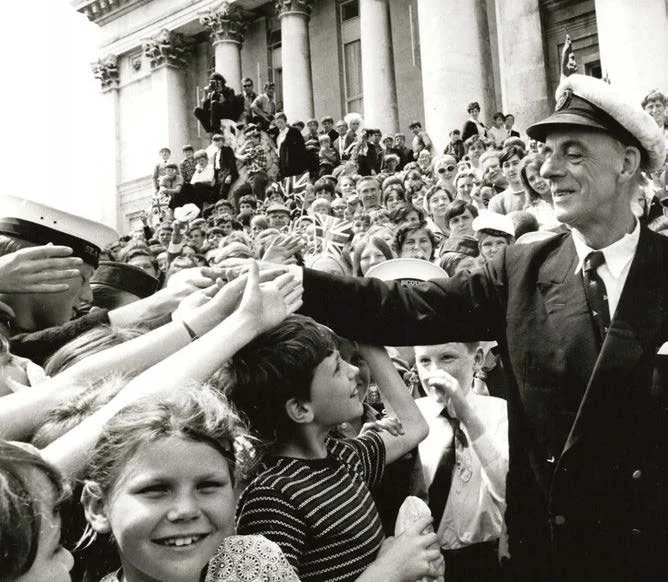
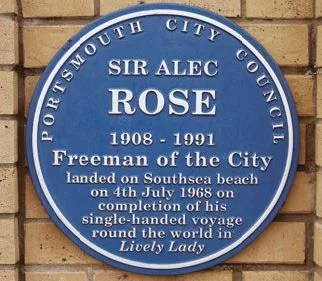
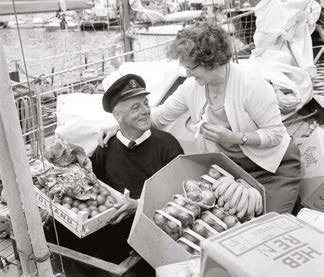
Hundreds of children clamour around a tired-looking Alec Rose on the steps of Portsmouth’s Guildhall in July 1968, three days after his return after 354 days at sea. Rose had survived a sickly childhood with long hospital stays and when he arrived back in England he was only just turning 60. His voyage had taken him around the globe, from and back to Southsea in Britain, south of the three famous great capes: Good Hope, Leeuwin and Cape Horn. Last-minute victualling as Rose takes on stores with his wife Dorothy – no shortage of fruit and veg! This blue plaque marks the moment of his safe return on Clarence Esplanade, Southsea
So basically, if we were in the Astral Café talking to Mr Shepherd about her, he would say: 'Well, she's not the boat I drew.'
Partly for my own peace of mind, when I got home from this passage I sent the lines to designer Ed Burnett, to check whether the numbers bore out my reaction to her. 'With a 26ft (8m) waterline she's quite a small boat,' Ed replied. 'But she is also very fine aft. Her Longitudinal Centre of Buoyancy is 51 per cent aft; normally it would be 53-54 per cent (aft of the bow), which doesn't sound a lot but makes a great difference.
'She has a lot of volume forward and a deep forefoot and she'd be prone to pitching. Her high-aspect rig looks wrong too; there's very little area in the foretriangle. She'd be better suited to a gaff yawl rig, with a bowsprit setting a small jib that would just hold her by the nose, and let the main drive her forward…'
It's almost inconceivable that, with her national-treasure status – reconfirmed with this project which saw young people raising their own sponsorship to take part – she would ever be re-rigged, although with her envisaged role as a training vessel for young people, a gaff and bowsprit would be just the thing to keep them busy.
It's true that there hasn't been much for Katherine and Carol to do aboard. I notice that Alan doesn't even let them make a cup of tea. Maybe that's for safety or insurance purposes. Alan and Duncan share the cooking for meals served in stainless-steel bowls: 'Dog bowls', Duncan says matter-of-factly. After so long into her voyage there is a paucity of cutlery; some must have dropped overboard during the washing-up-in-seawater routine. There weren't quite five forks to go round.
The Spartan atmosphere isn't just a shortage of galley accoutrements. She is sparsely kitted out with the bare minimum, apart from the copious array of marine electronics from her sponsor Raymarine. Daily reports are uploaded via satellite and our paper charts and logbook are backed up with the latest in chartplotter software and radar equipment.
Her forward bunks have been replaced by steel cages holding square plastic tanks of diesel – six per side carrying 40 litres each. Hence in port – the few days that she is in port – at least two crew have to stay in hotels. It means the two main pilot cots in her saloon are in almost constant use at sea. The starboard one is the better as it has a cooling little deck leak that can fill your ear with fresh or seawater while you sleep (or not) – as I discovered on our first night out.
Alan had become a bit fed up with Galle, the picturesque seaport founded by the Portuguese, taken over by the Dutch East India Company and then by the British. He'd found the paperwork and fees exhausting. And it is baffling – the two girls and I immigrated at the airport in Colombo and then re-immigrated (paying again) into the seaport at Galle, just to emigrate the next day.
After hours of customs clearance we slipped from the floating dock and negotiated the anti-Tamil frogmen nets to get out of harbour. Waving to the small armed patrol boat of this security-stricken state we made it to sea joined by dozens of catamaran fishing boats as the afternoon wore on. They are almost all in post-tsunami glassfibre, driven by powerful outboards, with a narrow hull stabilised by an outrigger and carrying seven or eight men. After sunset we were still in sight of these squid boats, which then turned on their powerful downlights as it grew dark.
I wasn't really thinking of Joseph Conrad when the first big splashes of rain that herald a line squall at sea at night landed on deck; we'd seen lightning in the distance for a couple of hours. With no time to reef we let out sail to cope with the wind, which seemed to be mainly blowing downwards with the rain. Water fell in an instant deluge, soaking us to the skin within seconds. It came straight through the brim of my Tilley hat and seemed to fill my ears, eyes and nostrils.
In the dim light of our tricolour I could see the rain bouncing off the sea surface, reducing visibility from good to around 50 or 60m in a matter of seconds. I was suddenly reminded of Conrad's passage in the Shadowline where he describes something similar in the Bay of Bengal. Our rain lasted 40 minutes or so, lessening from that initial downpour, and the expected wind did not arrive. After another day at sea the Indian coast, with the foothills of the Western Ghats showing misty purple in the sunset, showed us where Cape Comorin lay.
Early morning we saw single-hull wooden Dory-style fishing boats under sail. Using a crab claw rig they are clearly not as well off as their Sri Lankan counterparts and I was reminded of a friend's post-tsunami tale of corruption in this area: where the same set of new boats was given to each fishing village, with all the pomp and local press it deserved, before the dignitaries left and the miffed fishermen watched 'their' new boats being loaded up and taken to the next village… there to be 'donated' all over again.
We rounded the cape without fuss and, coming close inshore to seek beam-on land-and-sea breezes, we began our 150-mile chug up the coast.
The routines were set. Carol and I alternated with Katherine and Duncan while Alan did a bit of everything, including trying, unsuccessfully, to get a satellite link. Later we'll discover there is no footprint for comms here. We moved around the deck in the heat of the fore and afternoon watches, trying to find places where all our bones could achieve some semblance of comfort in repose.
I wonder how Alec Rose, fruiterer, navigator, singlehander, would feel about our comms. Some say the early single-handers, from Blondie Hasler to Donald Crowhurst, were finding ways to draw out a life of danger and violence, but also excitement, during World War II by other means; seeking in the solace of the ocean, and battling the elements, ways of achieving closure on the deep privations that gripped Europe in the 1940s and 1950s. Coincidentally, one of those pioneers, Vito Dumas, made his 1942 solo circumnavigation from Argentina as a direct statement against the Second World War.
Back aboard we have been sailing up the southwest coast of India and on this, our last night at sea, the smells of this magical old continent are wafting out to us on a land breeze. Overlaying an earthy, farm-animal smell – which could be from London Zoo's elephant enclosure – are hungry-making hints of human cooking and that new greengrocer tang of freshly picked vegetables. India, to a sailor just a few days out at sea, smells bosomy warm but with some intoxicating added flavours… There are curry leaves in there, coriander and cardamom. I daresay there must be benzine and ordure too, as you smell approaching any European coast, but these are masked by the panoply of spice smells that are able, just as they are, to turn this 400-mile voyage into a small rite of passage.
My eyes gauge the coast more keenly; I am suddenly like any European who – in the four centuries since Vasco da Gama first discovered a sea route to this part of India, in May 1598 – has arrived by sea.
This project was set up to deliver the experience of Lively Lady at sea. On earlier legs some of the 38 young crew tried astral navigation and, while they may not have done as much sail handling as Alec Rose, they stood a lot of watches with the sense of being 'at sea'. It seemed a shame to always use electric autohelm but Alan says her crankiness makes her hard to helm as well. One thing's for sure: it's a grateful, tired and slightly thirsty crew that takes its first lunchtime beer at the Bolgatty Palace Hotel while clearing customs in Kochi (Cochin) – a process that will take most of a day. And even before taking a shower we had to try the curry starters… after all we had brought Lively Lady back to India once again.