
Chilly Bits
Many of you will know SEAHORSE as the premiere sailboat racing publication in the world, covering the latest developments and cutting edge technology in the global race to win. However they also have a deep respect for the lineage from which today’s boats evolved. Over the next few months we will bring you a series of handpicked articles from their archives highlighting this history, and showing that deep satisfaction in sailing comes from understanding, just as much as winning! The generous people at SEAHORSE are offering readers of SWS a significant discounts of up to 30% on both digital and print editions of this seminal magazine. Click the banner below to check out the offer.

Sailing a 1909 pilot cutter from Spitsbergen 600 miles inside the Arctic Circle to northern Norway in late summer was a passage to look forward to. But when the ballast started jumping out of the bilge things changed a little...
BY Dan Houston
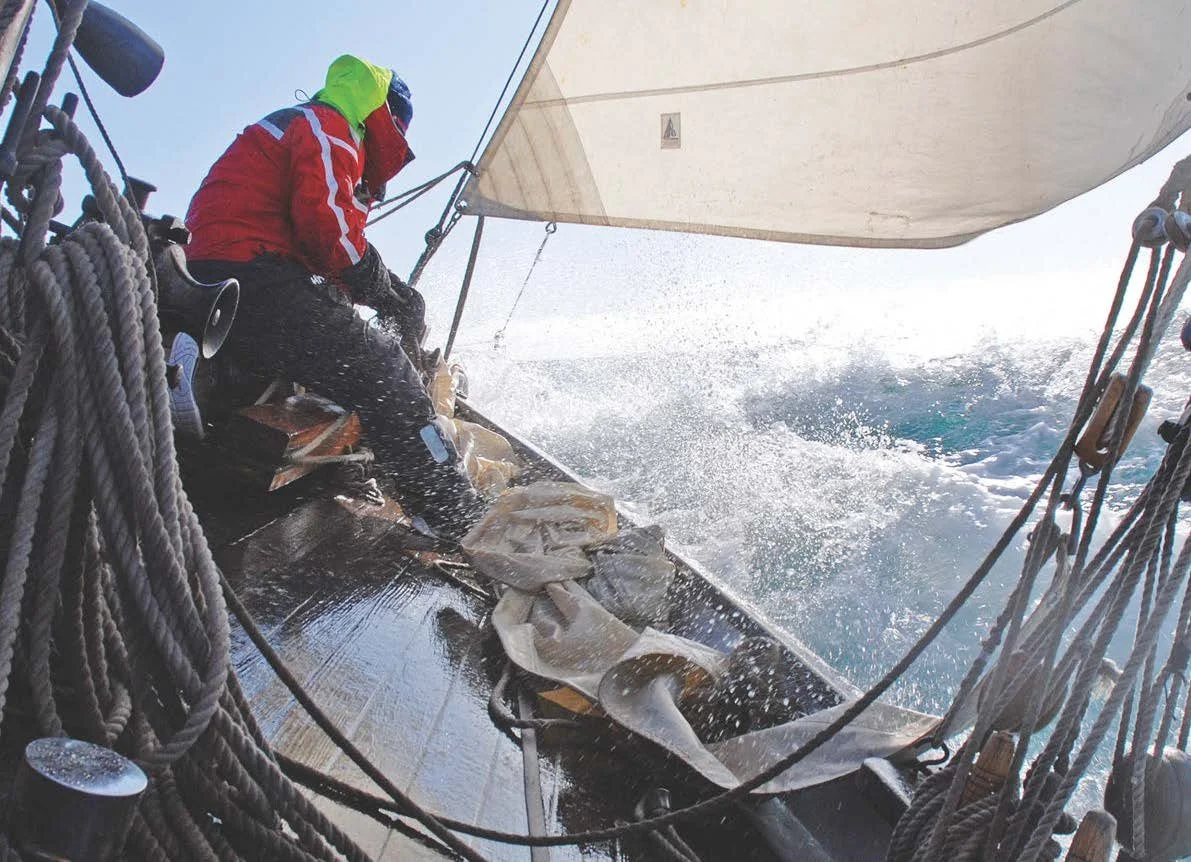
Reefing the bowsprit aboard the 38ft pilot cutter Dolphin shortly after leaving Svalbard on passage for Tromsø. This is at 077ºN and in a building seaway the long bowsprit was under strain as the boat plunged into the waves. It was easier to draw it aft onto the foredeck, leaving just seven-feet outboard, which was safer and also helped to keep the boat balanced.
'Morning, Roger! Tea or coffee?' I'm standing in the companion of the old pilot cutter Dolphin in just my thermals, telling the skipper the kettle's on and I'll be on deck for my watch in a few minutes, when suddenly a gust of wind, heavier than most in this easterly Arctic gale, pins the 20-ton cutter over on her side. I look down, across the starboard bulwark – we're sailing south – and there's no water for several metres below us. It does not feel like a knockdown – her sail's not in the water. Then a deep rumble from the bilges makes me turn around and with a kind of fascinated interest I watch several heavy pigs of iron bursting their way out of the bilge through the erupting cabin sole boards. A second or two and Dolphin rights herself as the huge wave passed under her but the idea of tea has disappeared, replaced by a wall of adrenalin. I've turned back to speak to Roger – even wrapped in full foulies against the icy spray, I note how tired he looks, and we both say it at once: 'We need to reduce sail… now!'
Getting dressed seems to take ages when you are trying to get on deck quickly. Mid-layer salopettes, then boots, mid-layer jacket – yes, it's that cold – then foulie salopettes, tugging gently over the boots because pulling hard just jams them… Velcro-strap the ankle, and finally scarf, woollen gloves – eugh, still wet and cold, foul-weather jacket, harness, fur hat and then the gauntlets.
Meanwhile, a Rolodex of options spins in the mind. But heaving-to, running under bare poles, lying ahull, trailing warps or setting a drogue from the bow can all come later. First the gaff mainsail has to come down but the port-hand topping lift had been removed weeks ago to make sail-handling easier. Two topping lifts, either side of the boom, help hold a gaff in place when lowering the mainsail. A swinging gaff can knock you overboard – it's what killed Eric Tabarly. In these Arctic waters (at around 3ºC) you really don't want to be over the side.
Avoiding the new large holes in the sole boards I get on deck where our antique 20-ton wooden vessel is scudding along at 9kt under deep-reefed main and staysail. The seas are impressive, with proper big rollers you associate with an ocean gale out in the deep range – we're in around 1,400m depth of water.
We're just west of an area the Norwegians call The Devil's Dancefloor – the comparatively shoal waters around Bear Island – and some confusion in the waves still shows that. The large rollers are 4 or 5m high – double that from trough to crest – and the crests are breaking with the wind sending spume down their faces, giving the sea that beautiful marbled effect. It's about 3am, murky but not fully dark. Richard arrives on deck an efficient minute or so later; deep sleep to fully suited and booted in minutes becomes the sailor.
At 74ºN we're still more than 250nm from the North Cape (and 500nm inside the Arctic Circle) and the fetch of this gale reaches all the way across the Barents Sea east to northern Russia. We'd left Svalbard two days earlier after a few days getting used to the boat. The passage to Tromsø in Norway across this part of the Arctic Ocean or Norwegian Sea is 450nm just east of south. We'd received the strong wind warning via a satellite weather check phone call as we left Hornsund, the southernmost fjord of Svalbard… in bright sunshine then, with an easterly three to four.
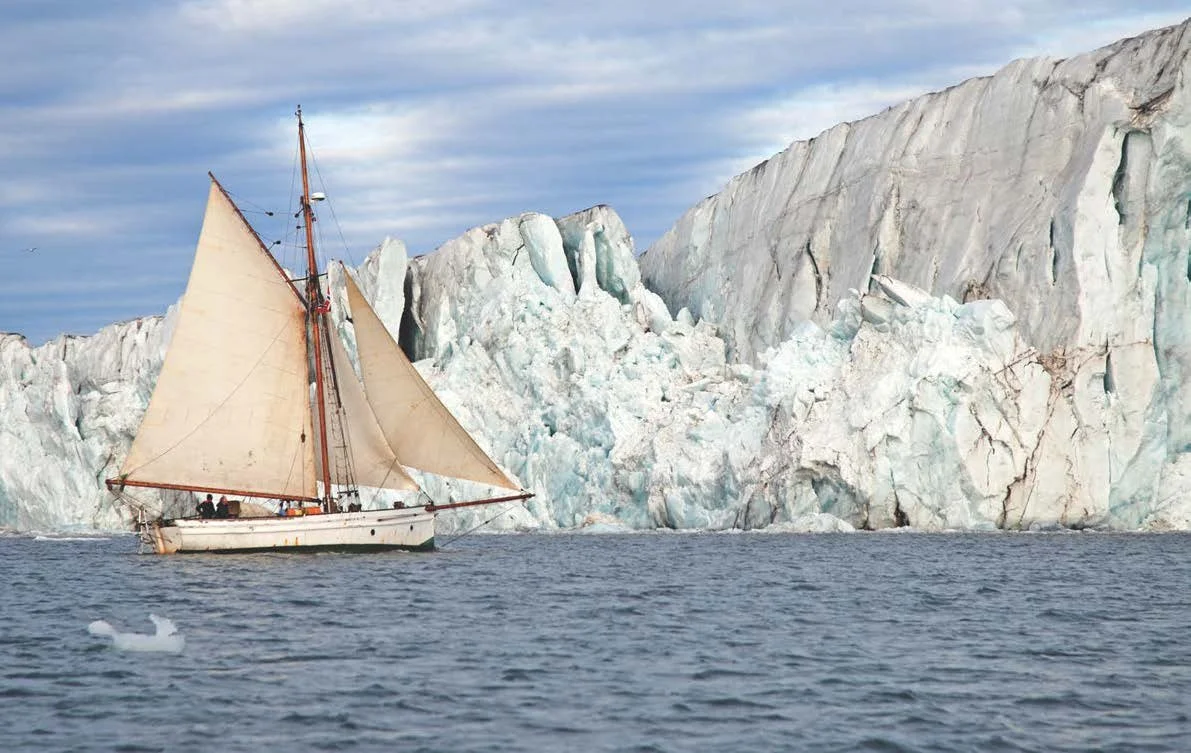
Shortly after seeing the (below) the author was put in the eight-foot tender with his camera to get a photo of Dolphin against the high ‘cliff face’ at the front of this impressive glacier. ‘So what about the bear?’ ‘You’d be surprised how fast you can row with a polar bear behind you’ came the reassuring reply from on deck. In late summer there is still plenty of ice in the sea with the glaciers rumbling like thunder to remind you of the constant movement. Blue sky, blue water, but up here you are a long way from anywhere.
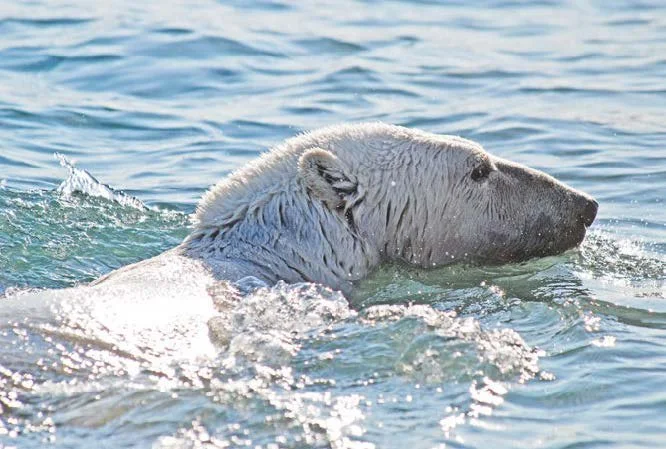
This bear jumped off his ice floe and then began swimming away from us while we sailed round him; but any fear was mutual
But the wind had steadily risen after that, and now it was… well, what was it? There was no time to think about that. If we got another knockdown in these huge seas the doughty old Dolphin could invert and then we'd see where those 3ft pigs of iron wanted to go – straight through the pine-planked cabin roof would be a good guess. And after that we could measure what life we had left in minutes.
Getting the main down is a two-man job. Dolphin is fitted, like other pilot cutters, with roller reefing around the boom so Richard and Roger go forward to handle the halyards and roll the boom while I helm. The helming's the same as we've been doing for 12 or more hours, but now in these rising winds we put our quarter to the following sea and as we get to the wave crest we come across the wind to make south. The process spills a little wind and slows us a bit so we don't plunge down the wave face. It is more comfortable than the wallowing-then-galloping feeling of running before the gale.
We sit on the starboard side of the cockpit so we can see the waves; watches of two hours-on, four-hours-off make for a fairly concentrated period on the helm but we've already lost a couple of foils from the self-steering wind vane system, so helming it is. We begin by bringing the boom down on deck, and lashing it against the lee bulwarks. The gaff comes down easily enough and Richard then snuffs the flailing life out of the sail by coiling a long rope around it and both the gaff and boom working from the mast aft. This keeps the work under control and after a few minutes the mainsail is securely furled across the deck. She's still running at 8kt with her staysail but she's not careering any more – time for that tea.
The glass in our shiny new barometer is still falling – around a millibar an hour as it has since noon the day before. There had been scoffs about this Weems & Plath barometer that I brought from England a few days earlier. In Svalbard it had remained resolutely at 1010mb so my two companions thought it must be stuck. But now we watch it with a studied regularity, and note the readings in the logbook.
With no anemometer we have to guess wind strength which has risen steadily since leaving Svalbard at 77ºN. Using Beaufort's reckoning I am guessing the gale is F9 now because of the sea state, with long breaking crests, spray blown straight off the top of them and the strong catspaws of wind rippling down their marbled faces. It's not F10 because the wind has not reached that sustained howl in the rigging, yet. Roger, filling in the log down below, asks: 'So what do you think the wind is, Dan, F5 now?' 'Oh, flat calm, just put flat calm down, Capps!' I rejoin, and instantly regret my sarcasm; it's been a trying half-hour or more and with the evidence of our heavy metal pigsty still visible by Roger's feet I feel my diaphragm clench with the realisation of how easily it could have all gone wrong.
Roger and Richard set about rearranging the ballast below while I gaze east into the scudding murk, wondering how the French are faring. Two nights ago we had anchored in Hornsund, Svalbard's southernmost fjord, near the Albarquel, of Dieppe, an 80ft wooden ketch built in Portugal in 1957 as a salt carrier. With a couple of charter guests aboard, captain Claude Minaudo, his wife and a girl crew had been planning to sail the 200nm to visit Bear Island. But landing there in this would have been impossible.
Weather warning
When we'd satellite-phoned for a forecast, after leaving behind the desolate beauty of southern Svalbard, and heard the easterly strong weather warning, we'd decided to give Bear Island a wide berth. We hoped they were alright.
But we are still making too far west. If this easterly persists then we'll be heading outside, or west of, the Lofoten islands. We decide to take down the staysail and see how she'll lie ahull. There is a spitfire jib we could hoist for heaving-to but we really don't want to be on the foredeck unless we have to.
But with all sail off Dolphin lies happily across the waves, rocking over the sharper crests in a way that makes standing upright difficult but is otherwise reasonably comfy. The chart-plotter shows us moving backwards in a NNW direction at 0.8kt. The engine is running, we need it to keep the cabin warm, and so I just engage her in ahead. I've lashed the tiller on the centreline and notice that instead of being pushed back north we are now travelling south, or south by west, at about a third of a knot. I marvel at how the Dolphin is so steady in these seas and how about 500rpm of the propellor isn't bringing her into or off the wind.
It's time to catch up on sleep and I don't even need to rig the lee cloth. The three of us disappear under the waves of tiredness that result from two nights at sea on scant watches.
A few hours later Roger wakes up, and wakes us with: 'Hey, we've got to get up, get the sails up! Get going – we're wasting time!' He remonstrates us out of deep sleep making his way aft before opening the companion doors. A seething freezing howl swoops into the warm dark funk of our cabin and I see a hill of hoary white water passing across the oblong of light outside framed by the cabin doors. I am just about to say: 'Really?' when Roger beats me to it with an: 'Oh, er maybe not.' And we all go back to sleep.
The next time we wake up it's to the sound of diesel engines and I get on deck to see a huge Russian trawler towering over us. I wave hello. 'They shouldn't be here,' says Roger.
We make sail and shape our course for the fjords north of Tromsø. Sailing over a benign sea was a good time to reflect on the previous days since my arrival in Svalbard. Flying north from Oslo I'd had the unusual experience of seeing the sun set and then dawn in the west, from the jet's window. We'd taken off at sundown and somewhere north of the Arctic Circle we'd caught up with its circumpolar progress, so that it looked like dawn again.
An unusual arrival
Meeting Roger at the airport at Longyearbyen, carrying his large bear rifle, had been a novel experience too – he'd walked a couple of miles along the beach to meet us. You never leave the boat without being armed here, though polar bear attacks are rare. Richard and I were relieving Roger's former crew and helping him sail the Dolphin back to Norway where he would be keeping her over winter.
Dolphin, with her newly fitted diesel stove, is cosy below and we acclimatised over a convivial few hours before the others departed for their flight. A few hours' sleep and a quick tour of the 2,000-population town saw us victualled and ready for sea. Our first sail was about 30nm to Barentsburg – the all-but-abandoned Russian mining town where we got tins of Polar Bear beer from a startled hotel keeper and enjoyed the midnight sun just dipping a limb below the horizon, for the first time in months.
From there we sailed south to anchor in front of the impressive Torrellbreen (glacier) which occasionally reminded us of the power of nature with sounds like distant thunder. Even late in the summer there is ice in the sea. Dolphin has copper sheathing above and below the waterline to protect her planks but even so to run into one of these berglets would be bad news. We didn't land, but the land is impressively barren with the saw-tooth steep-sided mountains stretching away in the distance – these are what gave Spitsbergen its name when it was discovered by the Dutch in 1596.
The treeless land is more of a wilderness now than a century ago when mining was taking over from an exhausted whale fishery. Only the occasional empty wooden hut or a mining adit, spewing rock detritus down a mountainside, would tell you man had ever been here; there are no roads left and Ski-Doos are the main transport.
On our third day, sailing into Hornsund, we met a group of Polish scientists in a steel yacht heading for Longyearbyen to restock before going home – several countries, including Britain, have research stations on Spitsbergen, many in the northern fjord of Ny Ålesund. The Poles didn't stop for long but headed out into the fog bank that was rolling in under the bright sunshine. There was more ice here and some is meltwater ice – like a 10-ton lump of clear glass bobbing in the sea; we kept a keen watch ahead as the fog extended arms of vapour into the sound on either side of us.
Then we saw the bear. Riding on an iceberg he sniffed the air at our approach before deciding to swim for it. We tacked once round him and my heart was pounding as I tried to photograph him. Seeing a bear like this, from a few feet above, is exhilarating and it gets the adrenalin going to be with such a wild apex predator in his environment. Even in the water his head was massive and although he was swimming away from us the feeling of fear was definitely mutual; we'd all seen footage of bears leaping up out of the water clawing their way up a wall of pack ice…
Crackling
On about the fourth morning in a bay on the south of Hornsund I woke up to a sound… like being in a bowl of Rice Krispies. On deck I saw two icebergs, the size of small houses, floating into our anchorage and it was their crackling noise I could hear through the hull. One came so close I 'fended it off' with a boathook. Roger had incidents like this all summer where they had to pull up the anchor fast and escape from being ice-locked. It was in Hornsund we met the crew of the Albarquel.
Each day now the sun is more below the horizon and there is a sense of how fast winter is approaching. You can almost feel the water wanting to solidify as the temperature dives below freezing without the warmth of the sun. You look around and see this place is throwing up signs that you are now unwelcome. Stay a week or two longer and you get a sense it might be too late to leave. It's a strange feeling because it's a long voyage and you want to pick the time, but actually it's already reached the stage where it's more like a race against nature. And her season to freeze will be her reason to seize, you, and your boat.
So it was time to go. And we left Hornsund with Suffolk Point to port and the Albarquel sailing inshore. She was the only vessel we'd see until after the gale. The sea was far from lifeless of course; white-beaked dolphins kept us company, as did the plentiful pelagic fulmars, and the loner great black-backed gulls. Arctic terns and skuas are also regulars.
Three days after the gale, as we tied up in Tromsø, we saw Albarquel, missing around 18ft of her topmast. It's lying on deck and it sounds like they had a tougher time than us. The broken section of mast went straight into the sea – getting it back aboard (using a parbuckle) would have been a supreme feat of seamanship. We have also got back to the depressing global warming news that two ships have traversed the North East Passage, and that the Arctic ice cap remains in danger of disappearing during summer within our lifetimes.
The following week sees a more gentle cruise, 250 miles south to get to Dolphin's winter home near Bodø. A route inshore of the Lofoten islands, through some of the most spectacular scenery on the planet. But we know that Svalbard's icy spiky desolate beauty is what is going to remain indelibly imprinted on our minds.