
Sliding Doors
Many of you will know SEAHORSE as the premiere sailboat racing publication in the world, covering the latest developments and cutting edge technology in the global race to win. However they also have a deep respect for the lineage from which today’s boats evolved. Over the next few months we will bring you a series of handpicked articles from their archives highlighting this history, and showing that deep satisfaction in sailing comes from understanding, just as much as winning! The generous people at SEAHORSE are offering readers of SWS a significant discounts of up to 30% on both digital and print editions of this seminal magazine. Click the banner below to check out the offer.

Had Ben Ainslie not scraped gold in the Finn at London 2012 and had Iain Percy caught that very last surf in the Star event, then the two great British Olympians would have left Weymouth three golds all…
Similarly, in the original Sunday Times Golden Globe Race of 1968-1969, had Nigel Tetley not destroyed his trimaran 1,100nm from victory, pressing too hard to stay ahead of fictitious rival Donald Crowhurst, then perhaps Tetley would have been the other Golden Globe skipper to achieve yachting immortality. Tim Jeffery looks back on a magnificent period in ocean racing… and a tragic story
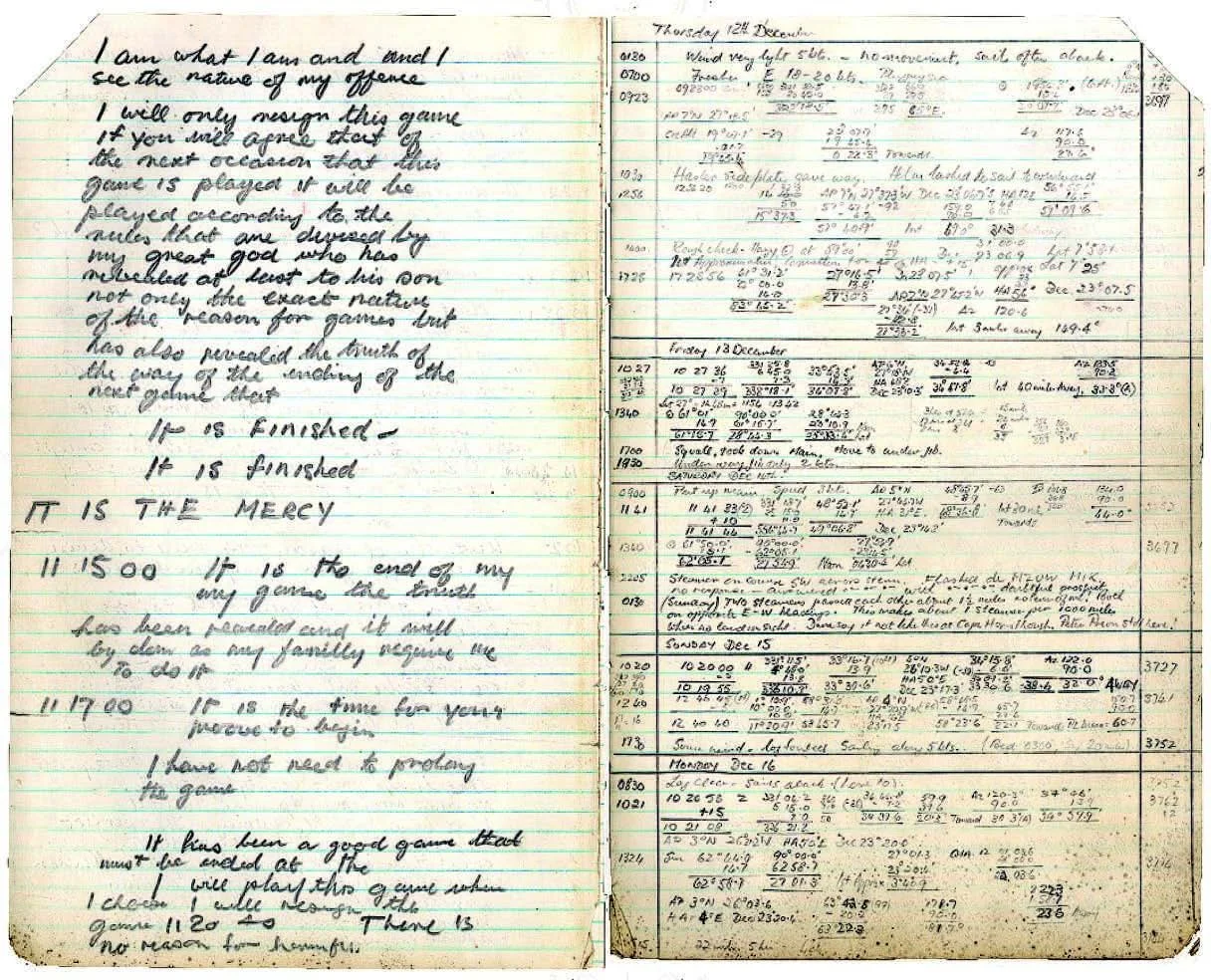
‘It is finished. It is finished. IT IS THE MERCY.’ The final log entry of Donald Crowhurst and on the facing page his, in hindsight, terrifying, detailed efforts to falsify a log for a round-the-world voyage – by this point Crowhurst knew full well that his log was going to come under tremendous scrutiny should he return to Plymouth.
Sailing had its own 1960s moment, of shackles being loosed, boundaries pushed and opportunities grasped. So, when Francis Chichester proved in 1966/7 that one person could sail alone around the world with a halfway refit break in Sydney, the inevitability of a non-stop voyage was immediate.
It was already in the minds of a handful of sailors. Some were actively organising their ambitions. These dreams became a race when The Sunday Times, then in its full pomp under Harold Evans' editorship, threw its weight behind the idea it named The Golden Globe.
It was frontier-seeking endeavour. Edmund Hillary and Tenzing Norgay had 'knocked off' Everest 10 years before Gypsy Moth 1V's voyage and it was far from certain that Kennedy's goal of man reaching the moon 'before the end of this decade' would be realised. Though unlike Tom Wolfe's exploration of the selection and training of America's astronaut programme, to find men of rare quality with 'the right stuff', the Golden Globe participants were self-selected with varying degrees of suitability in either person or boat. Or both.
Sailing alone non-stop around the world was still to many eyes way up on the improbable/impossible spectrum. The development of wind-vane self-steering had been the big enabler but it was not foolproof and damage could jeopardise a voyage.
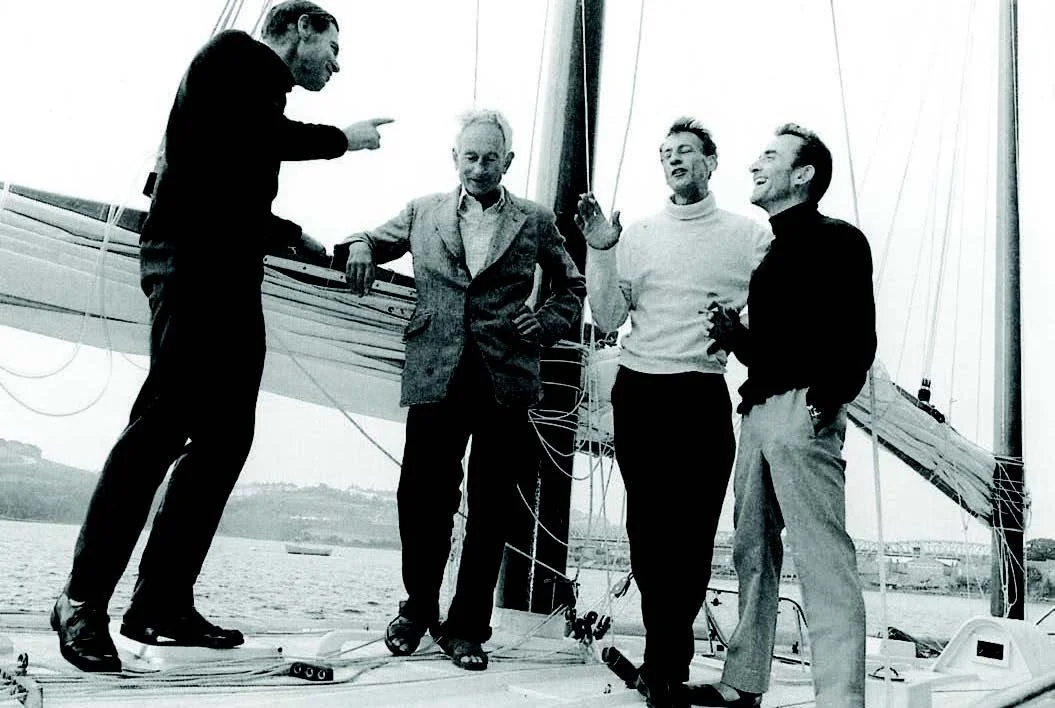
An extraordinary collection of heroes… four of the original Golden Globe competitors make light of challenges ahead. From left: Nigel Tetley, Bill King, Bernard Moitessier and Loïc Fourgeron
Robin Knox-Johnston and Suhaili wrote themselves into history as the winners of the Golden Globe when they made a hero's return to Falmouth on 22 April 1969. The voyage had taken 312 days.
Many people forget that John Ridgway and Chay Blyth were among the nine starters who attempted the race, or that there were two Frenchmen, not just Bernard Moitessier. Plus an Italian. One name that is always recalled is that of Donald Crowhurst. His deeds and death are not so easily forgotten.
Back in the 1980s a French film was released, Les Quarantièmes Rugissants, with Julie Christie playing Clare Crowhurst. In 2006 Deep Water took a documentary approach to the Crowhurst story. While in more recent years there has been The Mercy (2018) with Colin Firth playing Donald Crowhurst, and Crowhurst (2017) with Justin Salinger in the role. Crowhurst's vortex of debt, delusion and mental disintegration that led to his stepping off Teignmouth Electron has had a compelling attraction to filmmakers.
It's reasonable to believe that a second soul was lost as a direct result of Crowhurst's deception, in which he falsified his progress in the Golden Globe in his radio reports back to the organisers. It was that of another Briton, Nigel Tetley, who pressed on instead of easing up or even quitting in his own trimaran, Victress, believing he was being chased by the spectre of Teignmouth Electron, threatening to overtake him.
Crowhurst's boat was intact even though his mental state was not. Tetley's trimaran was not. Victress had been used as live-aboard home by Tetley and his wife Eve before the race. They'd sailed her extensively in home waters, but the Golden Globe subjected the trimaran to relentless punishment to which her fastenings and structure progressively succumbed.
Where Robin Knox-Johnston was first to complete a non-stop solo circumnavigation and win the Golden Globe, Tetley fought on towards the finish, his sights on the £5,000 prize (equivalent to £70,000 today) for the fastest time. Nine sailors had started but with Suhaili home, and the others retired, the final two months appeared to be a straight fight between Teignmouth Electron and Victress.
Being a professional seaman – a Royal Navy Lieutenant Commander – and an accomplished sailor altered Tetley's outlook as the phantom Crowhurst gained. After a bruising and battering in the Southern Ocean, Tetley's two month Atlantic ascent from Cape Horn was a repetitive cycle of backing-off/dealing with repairs/weighing up retirement against continuing.
Victress had the final say. Tetley managed to get a Mayday call out and take to his liferaft from which he was rescued. After the race the Golden Globe organisers awarded Tetley £1,000, mindful of Crowhurst's deception being a contributory factor in Victress's loss, along, perhaps, with The Sunday Times' own full-throttle publicity campaign. Chichester's earlier voyage had ensured the homecomings of the successful solo sailors of the 1960s all enjoyed mass public interest.
Crowhurst's and Tetley's stories are inexorably linked, yet it is only the former's that continues to have currency. The life and achievements of Tetley, have, sadly, largely been forgotten.
The ironic tragedy of the two men is that it was news of Victress's sinking that seemingly tilted Crowhurst's equilibrium for the final, fateful time as he realised that his falsified position reports, suggesting he had sailed around the world instead of proceeding no further than the South Atlantic, all suggested that Teignmouth Electron was the fastest boat. Having been the last entrant to set off Crowhurst's apparent progress had been astonishing. Scepticism about Teignmouth Electron's pace would turn to forensic scrutiny if she made fastest circumnavigation.
The intertwining of the two men's fate continued long after Crowhurst's suicide. Tetley ploughed his compensation into building a bigger, more suitable boat, the germ of which he'd already doodled at Victress's chart-table.
The crushing weight Crowhurst had brought down upon himself was there long before ever setting off for sea: trying to finish a new boat against the Golden Globe deadline; seeking to finance it; keeping his marine electronics company afloat; pursuing his vision that its handheldNavicator RDF fixing device would sweep the yachting market; raising expectations about the load/heel sensing automatic sheet-release electronic box of tricks aboard Teignmouth Electron which, combined with a masthead airbag, would avoid a capsize or allow recovery if one occurred.
Crowhurst's litany of needs, promises and obligations was way out of kilter with the ability to meet them. Entering the Golden Globe had created many of them; completing it might solve some of them, but only if the man and the boat were equal to the task.
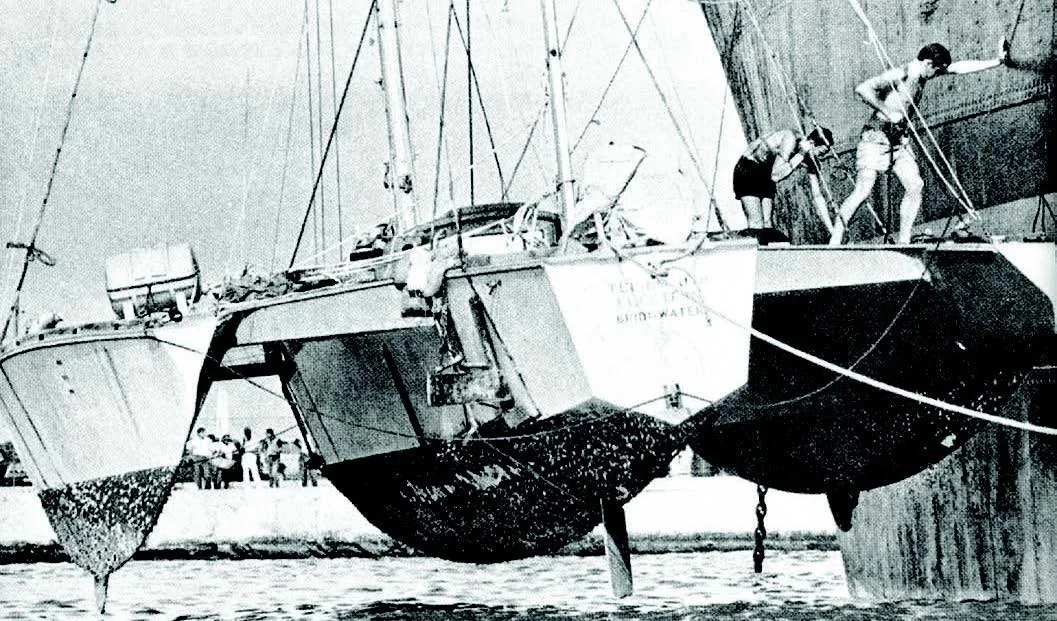
Crowhurst’s Teignmouth Electron, an Arthur Piver design like his nemesis Nigel Tetley’s Victress, is offloaded from RMY Pacardy which found her abandoned in mid-Atlantic. In spite of the tragic associations the 41-footer was sold on by Crowhurst’s estate, later on being employed as a diving platform in the Cayman Islands. Hauled out for repairs in the 1980s, but never relaunched, her wreck still sits there high on a beach. The name remains visible… but ‘Dream Boat’ has wittingly or unwittingly been added to her transom.
The Golden Globe was more like a Trophée Jules Verne. Instead of a fixed start time the nine competitors could pick their own departure. And in place of routeurs giving their skippers a Code Red/Amber/Green countdown for an optimum weather window, the Golden Globe skippers started in the prescribed 1 June-1 October period whenever they were ready. Better put, whenever they were least unready… or had simply run out of time.
Robin Knox-Johnston, a young but seasoned merchant marine officer, had already set his mind on being the first, actively seeking backing for a specially built vessel. So too was Bill King, a fabulously interesting Anglo-Irish submariner who, among much else, was a decorated war hero and married to a cousin of Winston Churchill. King lived to 102 at his castle; his yacht Galway Blazer was named after the local hunt.
King's desire to sail alone around the world was, he said, to exorcise 15 years of submarine service. With designer Angus Primrose he applied an interesting mix of proven technologies to create a special boat for singlehanding: cold mould ply construction with whale-back decks. His wartime chum Lt Colonel Blondie Haslar helped specify an unstayed schooner junk rig, which could be handled from the cockpit. Sail area control like a roman blind.
King and Knox-Johnston kept their ambitions for a solo circumnavigation close to their chests but, in speaking to the Daily Express and Sunday Mirror newspapers respectively, the word was out. At The Sunday Times Harold Evans pounced, sensing a good story for a nation hungry for heroes and a chance to spike the guns of his Fleet Street rivals.
It was Evans' good fortune to have Murray Sayle on call. They don't make journalists like Sayle any more. He'd got a taste of sailing after talking himself onto a plane that managed to spot Chichester approaching Cape Horn a year earlier. Scoops were Sayle's forte. He'd tracked down Che Guevara in the Bolivian jungle and snared Kim Philby, one of the Cambridge spies, by deducing that the spy whom everyone wanted to interview would collect his tainted earnings from the very place the Soviet machine would process them. He door-stepped the notorious spy outside Moscow's central post office with 'Mr Philby?'
Sayle had a butcher's dog of a nose for a good story and he found it in the Golden Globe, ensuring Evans' bet in backing the race sang off the pages of The Sunday Times. Shrewd, pugnacious, adventurous and with a gift for telling stories, Sayle found the cast of the Golden Globe Race jam-packed full of potential.
Along with the experienced and resourceful Knox-Johnston and King there were others experienced enough to know what they were taking on. Two were French, the famous Bernard Moitessier and a much lesser-known Breton, Loïck Fougeron, at the time working as a motorcycle dealer in Morocco.
Moitessier remains popularly perceived as the man who could have won the race had he not continued on into the Pacific, an adopted second home, instead of returning north up the Atlantic. He was a voyager, somewhat a nomad; anything but a racer. Famously he declared the idea of a race 'would have made him sick'. It fell to Sayle to head to France and use his guile to persuade Moitessier to be part of something his inclination would have avoided.
As a potential winner, it turned out that the numbers don't entirely support the Moitessier myth. Suhaili was, arguably, the slowest boat in the race, solidly built of Indian hardwoods and way down on her marks with stores. Knox-Johnston won by making steady progress, superb seamanship and extraordinary tenacity… none more so than his dives to try to caulk, and then brass tack a tar and canvas covering over persistently leaking planking. Aware of the shark threat, he wore dark clothing. He shot one during the several days and the repeated dives needed for the repairs.
Suhaili was three weeks ahead of Moitessier's later departing Joshua at Cape Horn and, given the French yacht's average speed across the South Pacific Ocean in pursuit of Suhaili, Knox-Johnston believed then, and today, that Joshua would not have overhauled Suhaili before the finish.
'It would have been close and who knows what different weather we might have had that could have changed his dates,' remembers Knox-Johnston. 'Apparently Bernard spoke to some fishermen off Tasmania and asked where I was. He was told I had left New Zealand a week before. He apparently answered, "It is finished".'
This chimes with what Sir Francis Chichester, a wonderfully skilled navigator in the air and sea, thought at the time. He was retained by the Golden Globe organisers and was plotting the progress of the yachts. He had Joshua finishing a day or two ahead of Suhaili provided that Moitessier maintained his average speed to Cape Horn all the way up the Atlantic. 'It is like saying a horse would have won the Grand National if it had not fallen at Becher's Brook,' was Chichester's pithy put-down of conjecture by the French media – and The Sunday Times too – fuelling the presumption of Moitessier's success.
Fuelling the Suhaili vs the chasing pack intrigue was that Knox-Johnston was without a working radio set; Suhaili's position was unknown for the four and half months since a pitstop at Otago, New Zealand, until she was spotted west of the Azores. By then Moitessier had long decided to turn back east. Knox-Johnston, the merchant marine 1st Officer, signalled by Aldis lamp to the BP tanker Mobil Acme to report his position to Lloyd's of London. Five days later another ship, the French Mungo le Havre, informed Knox-Johnston that Moitessier was now voyaging to his own beat, no longer part of the race. Also gone was Fougeron and Italian Alex Carozzo, whose 66ft Gancia Americano was the most potent boat entered. But an ulcer off Portugal had ended the Italian's bid soon after it began.
As for the other Britons in the start list, they had long realised that production weekend-cruising 30ft bilge-keelers were not what was needed. John Ridgway, famous for rowing the Atlantic with Chay Blyth, parlayed his prominence into a brand new 30ft bilge-keeler from Westerly Yachts. Blyth had Dytiscus, a Kingfisher 30. Blyth had no sailing experience but, true to the character the sport has known for 50 years, he didn't let that stop him.
Suhaili's return underlined just what an astonishing feat Knox-Johnston had performed. He'd battled through knockdowns, hull leaks, a cabin top that threatened to break off in the Southern Ocean, appendicitis which healed itself and, remarkably, he had relied on balancing his sailplan for half the circumnavigation when the self-steering was damaged beyond repair.
So now the Tetley versus Crowhurst denouement was teed up. If Knox-Johnston was first, who would be fastest?
As if falsifying his positions was not enough, Crowhurst breached the rules again by picking out the remote Argentine town settlement of Rio Salado to make an assisted repair to his leaking starboard hull. Teignmouth Electron's descent into ever more bizarre circumstances had seen Crowhurst select a seemingly remote spot which turned out to have its own Coast Guard outpost. His arrival was logged, passport noted and he was even assisted with transport to get materials for repair. Yet his presence never trickled up the chain of command.
Crowhurst used the stop to embellish his web of deceit, telling the Coast Guard that he was leading a round-the-world race. Back at sea, Crowhurst continued to reverse navigate, working his sextant calculations to where he claimed to be and filling in his logbook accordingly. He headed south again, sensing a radio call nearer to Cape Horn would help validate his deception.
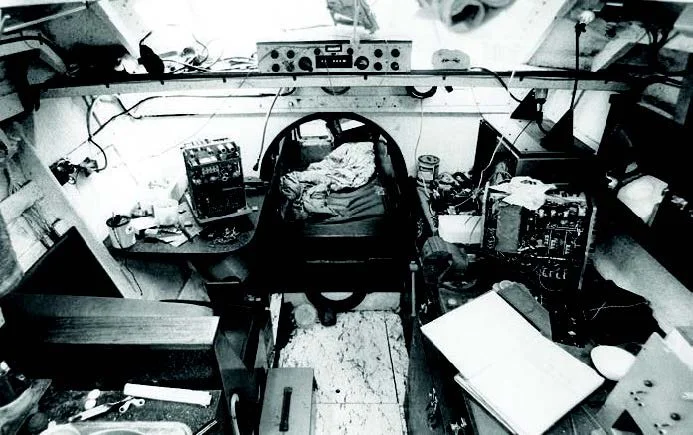
Not quite the final resting place… the partly but not entirely shambolic sight that greeted the First Mate of RMY Pacardy when he stepped below on the drifting Teignmouth Electron. Bit by bit the true story would be pieced together, as clues were found and Crowhurst’s two log books compared. Once the truth emerged the effect on Nigel Tetley, who lost any chance of victory by trying to ‘beat’ Crowhurst, was well concealed in public but not among his friends and family. The Golden Globe was to ocean racing as the America’s Cup is, nearer to shore, ‘of sailing but not about sailing
Preceding the recent movies, the 50th anniversary of the Golden Globe saw a couple of new books written about the events of 1968 and 1969. In researching his book, A Race Too Far, Chris Eakin is astonished when he finds that Crowhurst and Tetley could have almost stumbled upon each other near the Falklands. 'It was missed at the time by those tracking the race and has never been picked up in all the decades of the Golden Globe story being told,' wrote Eakin. He added: 'It was an episode that could have changed everything.'
Converging from opposite directions, any possible sighting – and the sea-level horizon makes visual contact highly improbable – was avoided when Crowhurst made a marked course change. Did Crowhurst pick up Tetley's Morse transmissions? This is something Tetley had pondered after the race, and which was related to Eakin decades later by Tetley's widow Eve.
In the following weeks the plausibility of Crowhurst's progress was starting to stretch credulity, as his own reports, the interpretations of them by his publicist and the hunger for a good story played against Chichester's calculations back in London. Master Mariner Captain Craig Rich was also working for the organisers. Independent of Chichester's, his estimates were also red-flagging Crowhurst's claimed progress.
The deception was about to become horribly real. Tetley had his own communication issues, and was unsure if his fellow out-of-contact competitors were in the race or even alive until the return Atlantic leg. When Tetley did make contact there was relief at Knox-Johnston's success along with the realisation that the only other boat still at sea was an Arthur Piver-designed trimaran very similar to his own and likely to beat him home. The competitive pressure started to ratchet up once again.
If Tetley was willing Victress was less so. He'd sailed at reduced pace in the Southern Ocean. The boat's structural problems were severe. The skins and frames of the starboard hull were threatening to part company, yet the prospect of being fastest man around the world was tantalising. Tetley picked up the pace and willed Victress to hold together. He pushed on until a new noise and a change of motion alerted him to something else being seriously wrong. This time Victress's port bow and part of her superstructure were flexing ominously.
Tetley had seriously considered retiring even before reaching Cape Horn. One particularly vicious Southern Ocean storm had stove in a 6ft Perspex cabin window; major structural timbers were springing off the cabin side, as had a deck edge and frames. 'The leaden shock-like effect of the water was very evident and its power to smash unquestionable,' wrote Tetley. He pondered whether to head to Valparaíso, put the boat on the market and fly home…
But improving conditions allowed him to work through Victress's repairs. Tetley, as was his wont during the voyage, wrote a ditty:
'Oh, what a lucky little Vicky You have had good weather for three whole days Miss Vicky, Miss Vicky And you're all right now. With a bent bow, And a bent side, And a smashed window, But you're all right now. For we're coming out of the Roaring Forties After three months and 12,000 miles.'
On 18 March Tetley passed Cape Horn. The fight to keep Victress above the waves and in the race lasted until 19 May when she was west of the Azores. It was halfway between those dates that he got news of Knox-Johnston's imminent triumph… and Crowhurst's looming threat.
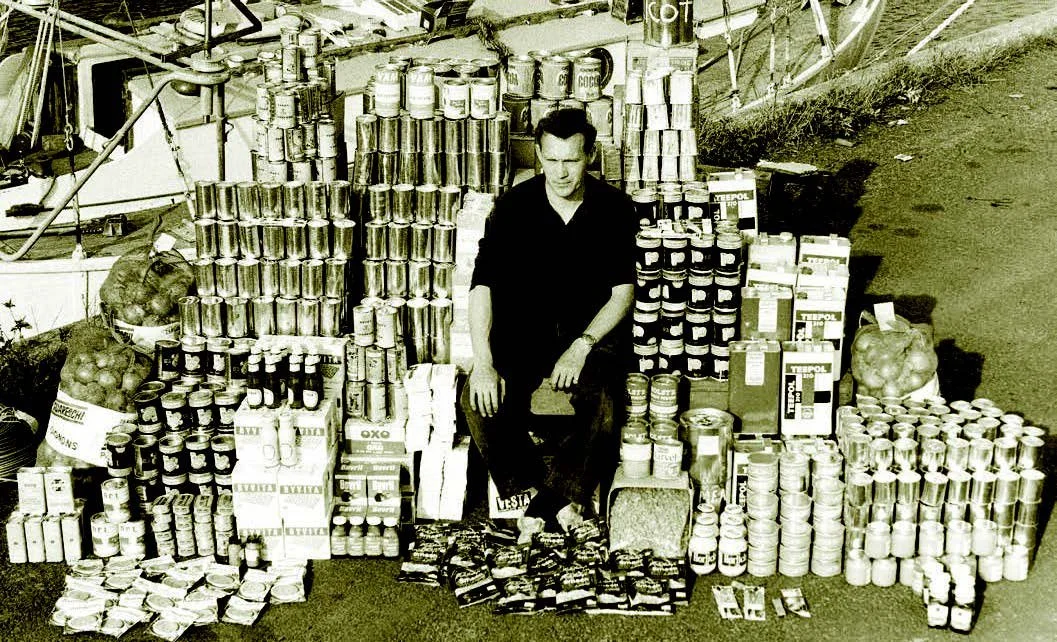
Yes, there was ocean racing before freeze-dried food and watermakers; a youthful Robin Knox-Johnston poses with the mostly tinned provisions he took with him on his cramped 32-footer Suhaili. Off camera are some fine whiskies and other skipper treats
'What a relief to hear that both are still afloat,' he noted. The position of Suhaili, so close to home, made for 'glad tidings'. Crowhurst was another matter. Tetley was generous enough to say he was ready to accept Teignmouth Electron's faster circumnavigation 'without envy'. But, ignorant of Crowhurst's deceit, he also wrote: 'I still wanted to win; or, to put it another way, I didn't want anyone to beat me, least of all in a similar boat.'
After another check of Victress Tetley concluded she was a write-off but that 'the old girl would see me home'.
She didn't. Tetley's book written after the race is fully illustrated. The images from around 19 April are wince-inducing. He was pressing on in a rising wind when ominous noises of water sloshing around forward were heard. The photos show strips of plywood missing from the topsides, frames detached, windows and ports boarded up…
What he couldn't photograph Tetley described vividly in words: 'The leading fairing back as far as the crossbeam had finally disintegrated, beams and all. Squatting in the narrow hull, knee deep in water, I could feel the sides moving in and out like a concertina. It looked as if the voyage was over…'
Yet again Tetley regrouped and fashioned jury repairs, debating but discarding the idea of diverting to Recife. By dint of heaving to, lying under bare poles or sailing as gently as he dared, Victress continued gingerly north until not only did the port bow detach completely but it holed the main hull. With the sea level rising rapidly inside the cabin, Tetley just managed to make his Mayday transmission before abandoning her.
'When I left the cabin for the last time water was tumbling over the sill into the engine space,' he wrote. 'The roll had changed to a drugged, swaying motion. I threw the liferaft overboard and put my gear inside.'
The liferaft drogue then became fouled, threatening to pull it back and be crushed by Victress's rising and falling sterns. All this on a moonless night. Tetley spent much of the following day trying to use his emergency transmitter. A successful rescue was completed by the BP vessel Pampero with a US Air Force plane overhead.
Two months later, on 10 July, Crowhurst's Teignmouth Electron was found, deserted but with all the evidence of her skipper's declining mental state there to be read. Crowhurst's existential crisis was unsettling to read, referring to his false reporting as 'the game'. Two words on the final page of Crowhurst's stream of consciousness writing stood out: The Mercy.
The writers Nicholas Tomlin and Ron Hall were among the first to try to make sense of it. Their book, The Strange Voyage of Donald Crowhurst, was published in 1970 and remains utterly absorbing.
The Golden Globe generated a considerable written output. A publisher's advance had made Robin Knox-Johnston's own entry into the race viable. What emerged from it, A World of My Own, is as fine a book of the sea as any I have read. Moitessier's The Long Way is also enduringly popular and rightly so. Its influence is magnified in that Editions Arthaud went on to publish Eric Tabarly, Loïck Peyron, Francis Joyon, Isabelle Autissier and Florence Arthaud herself.
Ridgway and Blyth referenced their Golden Globe in books of their later exploits, the former more tersely than the latter. Interest has been perpetuated by Eakin's work, along with Peter Nichols whose Voyage for Madmen also came out of the 50th anniversary.
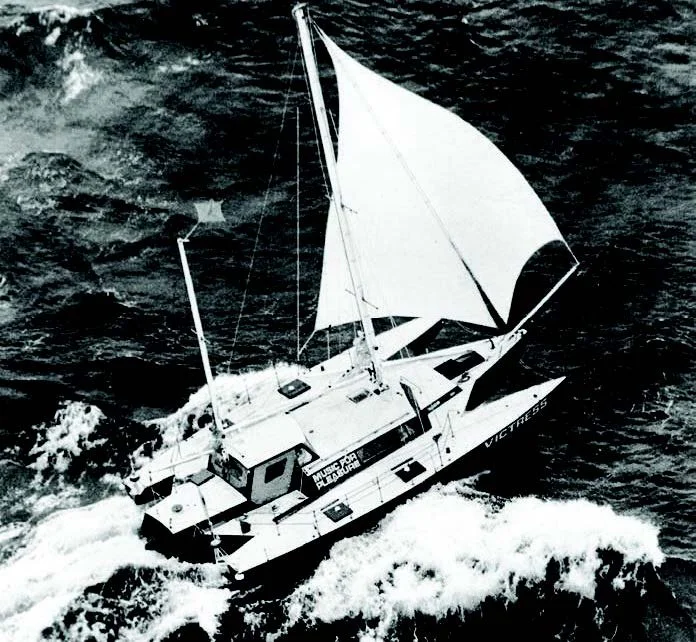
Slipping along just fine… Nigel Tetley and Victress. It is not certain his plywood Piver design could have completed the Golden Globe course, but without Crowhurst’s phantom pressure this first-class mariner may well have nursed his bruised craft home to win the trophy and £5,000 for fastest circumnavigation – and become the first person to sail non-stop around the world on a multihull (crewed or alone). Instead it would be many more years before that box was ticked… to finally silence the braying dinosaurs!
Tetley's own Trimaran Solo was another 1970 book. The mix of linking narrative and log extracts is not at all stylish, and the frequent referencing of his exotic tinned foods (hare, duck, grouse etc) contrasts with Knox-Johnston's corned beef, but it is a buoyant and optimistic book despite the corrosive worry of trying to keep afloat and alive in a boat that failed him.
So how do we make sense of what happened to Tetley? Throughout his voyage he'd planned for the future. His retirement from the Navy was confirmed mid-raceand he'd sketched idly at Victress's chart table of the 60ft successor in which to sail far and wide with his wife Eve.
Yet two and half years after the Golden Globe Tetley was found dead, hanging from a tree near Dover. Seemingly there had been no signs that anyone had picked up upon that anything was amiss with him. He was embarked on the next phase of his life. Work had already started on the 60-footer at Derek Kelsall's yard in Sandwich, using the £1,000 consolation prize from the Golden Globe. Kelsall was probably the last person to see Tetley alive.
At the inquest Eve Tetley's shock was amplified when the police revealed that her late husband had been found wearing women's underwear. The Coroner returned an open verdict. So, as with Crowhurst, there is a dark and unsettling legacy of the Golden Globe that consumed Tetley too.
Chris Eakin interviewed Eve Tetley for A Race Too Far. It is well worth seeking out. His death was 'so unexplained, so not Nigel', she said decades on from the tragedy. But for Crowhurst she was adamant her husband would have nursed his stricken boat home.
Given the huge publicity at the time, and the simple first/fastest narrative it generated, this would have counted as a huge success… instead of Tetley being left with the feelings of failure that accompanied the sinking and being rescued. The only thing to be reasonably sure about is the long-lasting impact of those left behind; true of both the Tetley and Crowhurst families.
Robin Knox-Johnston gave his Golden Globe winnings to the fund set up for Crowhurst's widow and children. He also went out of his way to help Eve Tetley get back on her feet; a mark of the man.
Tetley, today, could have been remembered as the man who set the fastest time around the world, a hero of equal standing to Robin Knox-Johnston. 'If he had not pushed harder on account of Crowhurst's claimed speeds I've always thought that Nigel would have made it,' says RKJ today, believing the recognition Tetley was due was never given.
Within five years of the Golden Globe both RKJ and Chay Blyth started many years of ocean racing in large multihulls. Eric Tabarly had also launched his spider-like trimaran Pen Duick IV, a futuristic 65ft aluminium André Allègre design. A collision ended Tabarly's chances in the 1968 Ostar race but, four years later as Manureva in the hands of Alain Colas, the big silver spider won the race.
'Had Nigel got back safely he would have helped to speed up the change in attitudes towards multis,' Knox-Johnston believes. 'There was a definite attitude at that time that multihulls were not safe and could not sail to windward anyway. It took a long time to move past that…'
Arthur Piver
Victress's designer Arthur Piver was a late convert to the multihull cause. Like the vast majority of 20th-century sailors, he was set in the ways of the monohull. Only later did he become an outlier. Piver grew up in San Francisco's Bay Area in Mill Valley, north of the Golden Gate Bridge, often sailing on the family's 85ft schooner Eloise.
A pilot who turned to trade-journal publishing, Piver was a yacht design self-learner whose introduction to catamarans came via the 16ft Lear Cat. Designed in 1950 by Skip Creger, along with the 18ft Sabre Cat, it was one of the very first factory-produced beach cats. The Lear was 17 years ahead of Hobie Alter and his Hobie cat which used grp in place of the Lear's plywood sheets.
By 1957 Piver was selling plans of his own designs. Despite moulded plywood being used widely for volume production during the war years, in the post-war period simplicity and low cost were a key factor for one-off or self-building. Piver favoured trimarans mainly for this reason, with V-sectioned hulls lending themselves to cut plywood sheets over frames. And Piver made things simpler still, developing a method that did not require lofting. Unsurprisingly, his designs sold in large number to amateur builders all around the world.
Piver's influence gained real purchase through his writing. His words fuelled the dreams that sold the plans to build the boats. He himself logged over 35,000 miles on his own creations, recounting the stories in six books with the rather descriptively titled Trans-Pacific Trimaran, Transatlantic Trimaran and Trimaran Third Book particularly lauded as elegantly written and informative texts.
One estimate put at 400 the number of his trimarans that had made a transoceanic passage. His deeds and words helped dent the stigma prevalent 50 years ago that multihulls were inherently unsuited to blue water passages… It was as if centuries of voyaging had been dismissed.
Sadly Piver was lost at sea in 1967, the year before the Golden Globe, on one of his own 25-footers borrowed from its amateur builder, having set off from San Francisco aiming to qualify for the 1968 Ostar race.
Piver's influence can be linked across those who carried the multihull torch forward. American Dick Newick was an avid reader of Piver's writings. Derek Kelsall's first tri was a Piver boat. They, and the likes of the Prout brothers and Rod MacAlpine-Downie, soon surpassed Piver's work developing superior hull forms and using moulded ply and grp to create the shapes they wanted.
Meanwhile, new-fangled daggerboards had also ended the upwind argument.