
Makes Smoko Go Quick
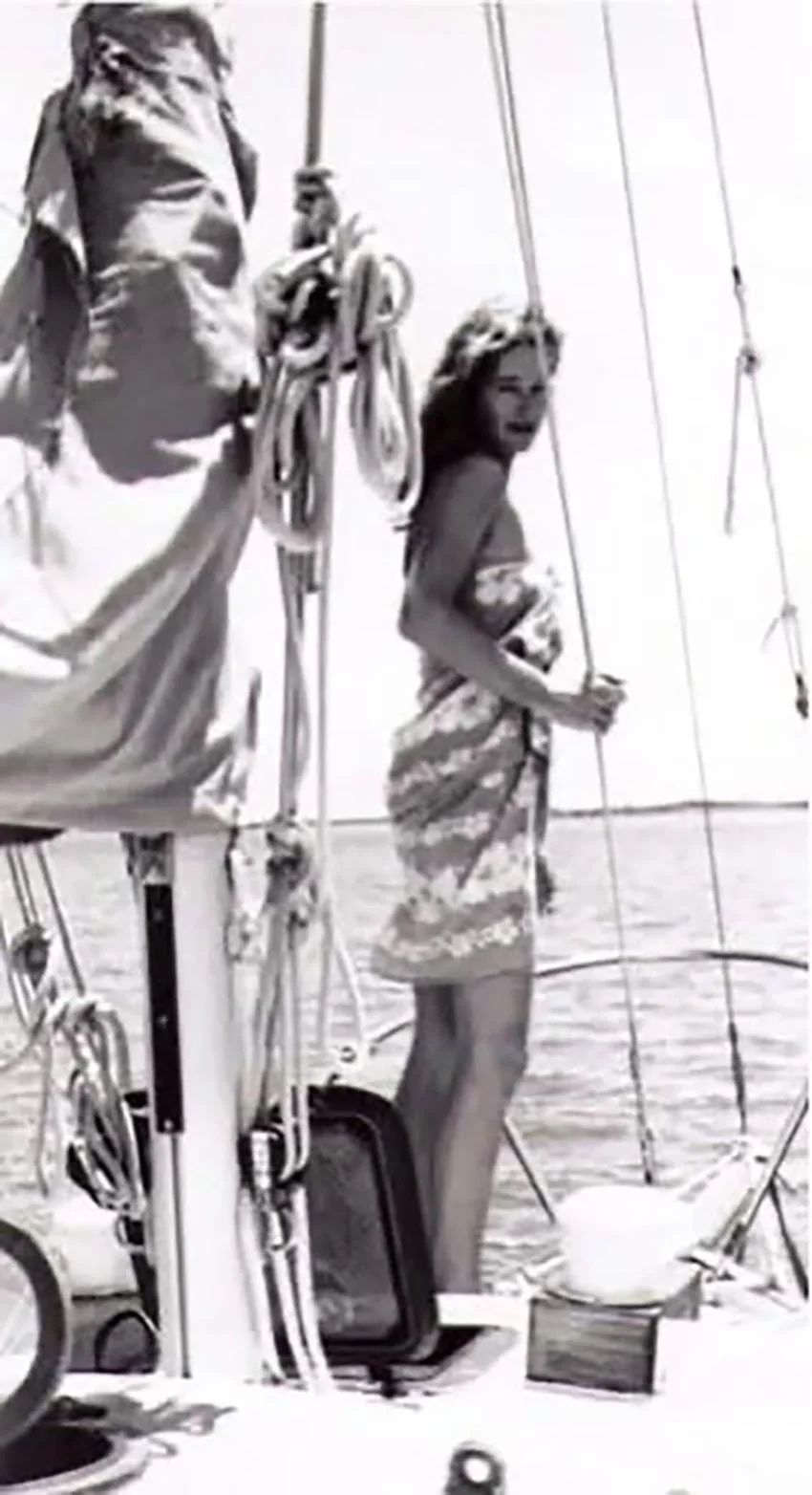
Genevieve Jacobs tells the story of her sailing adventures in Queensland aboard an 18ft Cold moulded Bruce Roberts Design in the early 1980’s
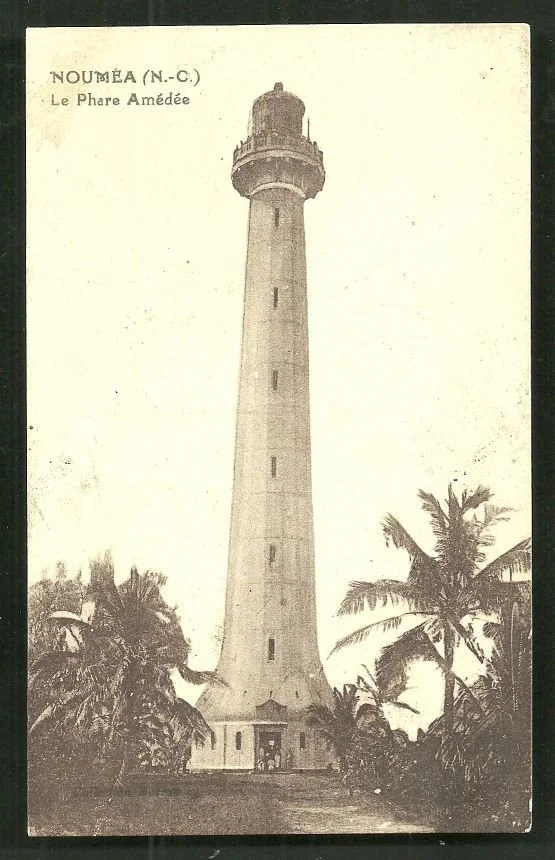
We had a few gentle days sailing out of Noumea, leaving the benighted, misbegotten, misappropriated Pharee Amedee astern. It was a massive lighthouse tower, supposed to have been delivered to a major port somewhere in Africa but oh well, it accidentally landed in Nouvelle Caledonie so the locals claimed it for their own. When an unexpected gift lands in your lap, you’d best accept it–quickly–with a hearty “Why, thank you!” before they can take it back!
One evening calm on watch I noticed a strange little noise, a tap tap tippety tapping along the waterline of our hull as we trickled quietly under sail. It sounded a bit like the popcorn I was eating, kernel by kernel, under the lantern with my book. In my dozy mind, quite unable to identify this odd sound, I half imagined our 18’ sloop was a kettle and there was some sort of “Russian Doll” effect whereby we ourselves were getting popped!
I quickly snapped alert and went to investigate. I scooped a hand over the side and brought up some little black “popcorn” balls. They were irregular shapes and sizes, floating all over the surface, streaming from ahead. I could smell a faint sulfur, and on further inspection, saw trails of black soot streaming across the surface in the direction of our sailing. I gave the Navik a quick twist and headed away to starboard on a reach before I could even fathom what this phenomenon might be. Noted time, new heading, speed in the logbook. Went back up to have another think and a better look, trying to suss this out.
Here in the Tongan trench, where submarine volcanoes let loose on the regular, they belch these little pellets of lava (I later learn) that are called Tephra.
I remembered friends telling us they’d been sailing here and witnessed a whole tree erupt in the night with a spectacular breach, punching the sky and then falling back on the horizontal. Apparently, trees that go adrift and float for years get ballasted by the root ends and sink and bob below the surface ever deeper and ever more vertical until one moment they reach a critical point and are urged by the swells to punch up and relieve themselves of the burden. But who knows?
This is the territory of vigias, of unexplained sightings of odd things (maybe land, maybe whales, maybe sea monsters) marked on the charts with dotted circles and the date of sightings and ship that sighted them. Like, “1786, HMS xxx”--Like me, they were curious– but not enough to stick their vessel into the matter. Just mark the spot, make notes, and make way away.
Approaching the midpoint of the Coral sea meets the Tasman, where that dastardly Lord Howe Rock sticks up like a magnet, I noted strange skies and opposing swell patterns with a feeling of growing dread. I alleviated my anxiety by fussing over every detail on deck– as if a whipped line end would make any difference in our fate. All my senses were on high alert. Claude scoffed in the way one would whistle in the dark. Extra precautions, food, checking everything, battening down.
Atrocious conditions ensued for several days, as we were caught in a trough called a Talbec in French, a “Beak”. My knees felt as if they’d turned into ice water at some point. The immensity of the elements almost broke my soul with beauty, once I had surrendered my fears to our fate. I felt it would be a good way to go.
At one point we became a submarine with water coursing over the decks continuously. At one point, it seemed to me we had gained altitude, as if we were above sea level: I felt–quite literally–high.
At one point, the seas seemed flattened by the force of the gale. At one point, everything was sheer white, even in the utter darkness. The noise was that of a subway station with an express train passing as you cling like a bug to the tunnel. The rigging sang like a steel hiss, everything, absolutely everything, stressed to it’s maximum limits. My nerves relaxed, paradoxically: as if, music floating off a tight strung harp, or the strings of a piano, or the arrows flying from the strings of an archer’s bow.
At one point, we were doing 3 knots under bare pole and making so much leeway that we had to alter our destination, Sydney, to Brisbane. Claude was very dismayed by this, as he had never before been forced to bend his will to suit the weather. He regarded it as some sort of personal failure. I just shrugged. Brisbane sounded fine to me. So long as we didn’t land on Lord Howe (Claude pronounced it “Lord Whoee”), like that aspiring world racer with the unfortunate number 13 on its hull. I seemed to recall the sailor had been stranded on that rock for days.
A few days in, we were able to pick up radio transmission from a ship about 40 nm from our estimated position, and they reported winds of 75 knots.
But, as it is prophesied, all things must pass. The winds abated leaving extremely sloppy jangling sea conditions post-Talbec. This was worse than anything that preceded it. With no way on, we rode up and fell into canyons and holes that couldn’t be predicted at all. Confused seas cascaded in crescendos onto the deck and our extra big scuppers had a job to empty our tiny cockpit. The colors were beyond belief or description. Light filtering through the wave tops made a moving cathedral and spires of blistering white water and greens and blues and even a sort of mauve. It was altogether an ecstatic misericordia. Like the phantom of the opera gone mad on the pipe organ as the rigging shuddered and everything was whacked. Motion was so violent you couldn’t lift a biscuit to your lips without it getting jerked aloft or hitting g forces and bouncing off your forehead.
But thankfully, the wind soon picked up. A Southerly Buster. We made pretty good time to the coast but a bit further South than intended, so we hove to overnight, planning to make a run in the morning light to the northern entrance of the long coastal channel into Moreton Bay. A good part of our decision was the unfortunate news over the crackling radio about a larger yacht on our course that had run aground attempting the same feat.
As we lay ahull with the jib backed, I listened to the radio, straining my ears to hear the rescue effort underway for that yacht, with three generations of family aboard, learning that the yacht was given up as lost, but there was still hope for the crew. They’d run aground on the channel’s edge, and several commercial ships stood by for support. As the children were hoisted up in a helicopter’s basket, and then the mother, it seemed all would turn out ok. But then the grandmother, aloft in the basket, tipped and was lost into the sea. I turned the dial and switched off the VHF.
I said a prayer with all my heart. I wonder where those children, now grown, are today. I wonder how they felt, aloft in the hovering copter, seeing their grandmother fly into the mystery. I wonder if she rejoiced as she was flung, if, by some grace, her fear vanished into these shrouds of white lace, of salt curtains, knowing the pure wonder of it all, as she met the embrace of her fate. If she let go her hands from clutching, her fists from curling, if she flew free at the last, with the fingers outspread, like a child in summer joy, diving from a tree limb, surrendering to the Great Trust.
The fact that it’s a miracle any of us have survived at all, this long, against all this. Surely it is a benevolent universe who ultimately claims us home again.
I wonder if she felt, in an instant, how many souls were hoping and holding her here from her flight, in the night: praying and weeping to keep her with us. At all costs. Our selfish grasping. Did her hands open? I wonder if she knew, in her last breath, some sense of freedom. Some sense of welcome.
DAYTIME COMES–AGAIN
Dawn light and Claude had been studying the chart of barely sufficient scale but decided we, with our two foot draft and our bilge keels, would do a daring cut in by the point instead of wasting a whole day gaining the top of the channel and then beating (which our boat did not do well under the best of times) all the way down this narrow beast unsheltered.
So we did. It was a little breathtaking but we made it, the current ripping us faster around this deep little curve than one would think possible, the sun shining brightly, the deep water brilliant ultramarine, and the shoals a yellow green not at all far–i mean, spitting distance– from our slice of grace.
As we carved through, carried largely by the current, the sails full, but not as convinced as the waters, absurdly there was a percussive noise in the air and a strange shadow: Claude with remarkable presence of mind, grabbed our Quebec blue fleur de lis and Canada maple red flags and rapidly clipped them to the backstay, as a News helicopter passed overhead, quite low, taking a closer look at us. Claude yelled “Dey ave a camera!” and I ducked below feeling absurdly exposed! I do wish i could see that footage today. Claude waved and yelled things in French, not sure what, but hey, Toujours Patriote! Represente!
He’d made a good call, we soon discovered, as even with our foreshortened course into Moreton Bay, we labored with the wind dead on the nose. Gray dull brown leaden brackish weirdly atlanticish water, burnished with pewter, so strange to my eyes after so much psychedelia of the years of Pacific seas.
We had to crank up the outboard to assist in our windward beat, and as it was cavitating in the chop, I sat outboard of the cockpit on the outboard motor to try to keep the prop underwater and avoid overheating or sucking air into the system.
As if things couldn’t get worse, one of the commercial ships heading south into Brisbane overtook us, to our starboard windward side, like an 18 wheeler when you’re riding a bike on a highway. Rather unnerving, as Claude could not leave the helm nor could I leave my perch on the motor to check our radio. They cut our seas but also our wind and hence much of our limited steerage. I prayed they would outpace us before we were sucked into their looming slab-sided hull.
Instead, the massive ship slowed down, calming our seas in their lee. They hung there with us, inching along at barely 4 knots, the rest of the hours down the channel into sheltered waters. We were like a little remora attached to a shark. Our cold molded hull, just a few diagonally glued layers of ⅛” mahogany doorskin, was strong like an eggshell, but not so great with direct or sharp impacts.
Sailors on deck leaned over and waved to us, encouragingly. What kindness. What merciful goodness there is in the world! Despite mercenary concerns and the almighty dollar, sailors the world over have a solidarity that moves me to tears.
KOOKABURRAS Moorings at the Botanical Gardens
We clean the boat furiously. It’s a bit of a mess down below after the previous weeks of hard weather. Looking pretty sharp and fairly dry by the time the customs comes to check us in. Well, the boat is, if not the crew. The cats earn stern reprimands and a few pats and grudging admiration. We may not at any time contact the shore, if the cats escape they will be quarantined in custody for a year, hefty fines, and possibly put down. The cats I mean, not us. I could only assume.
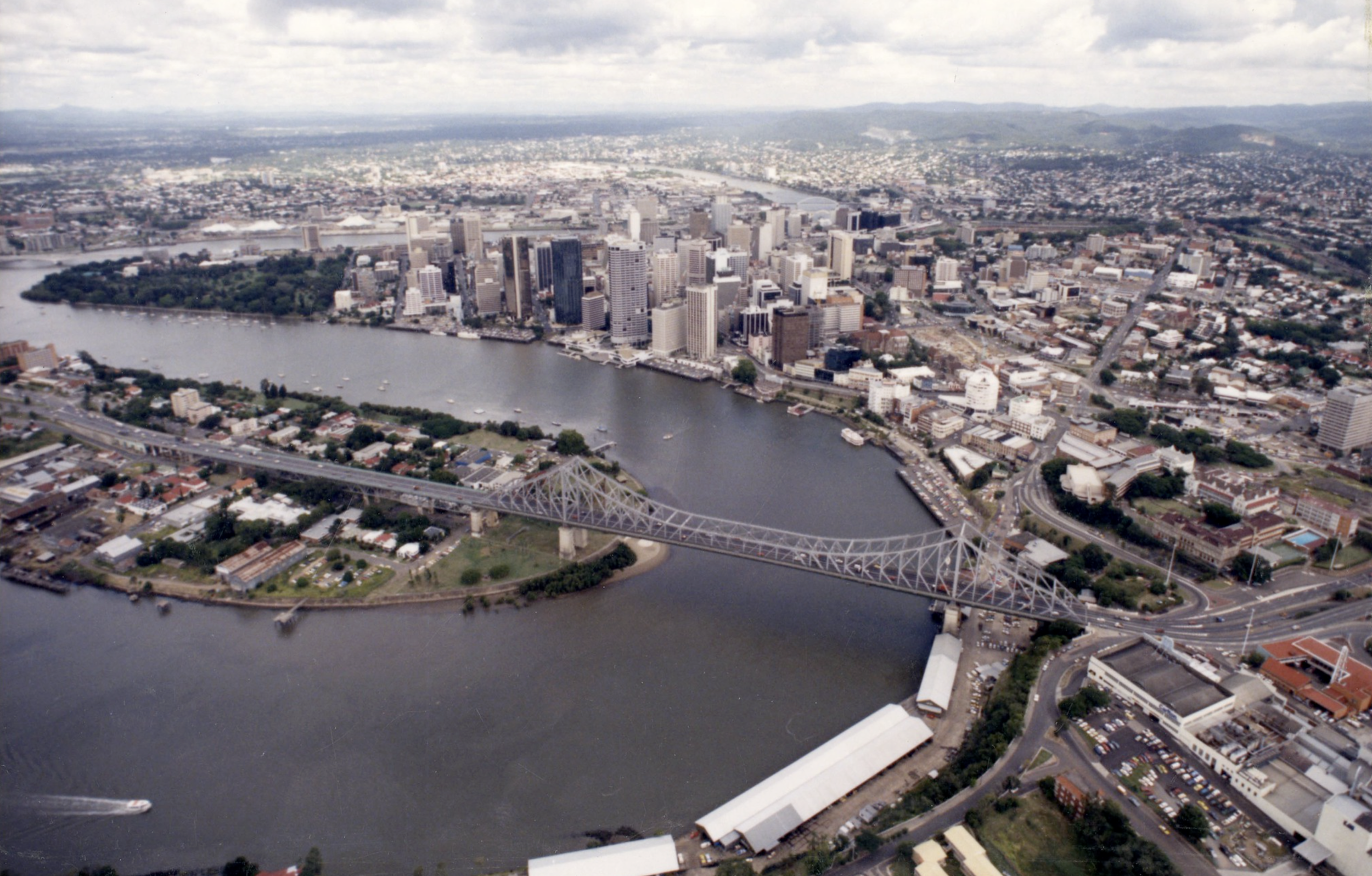
The Brisbane River in the early 1980 with the Botanical Gardens and boat moorings just visible top left
So it’s to anchor for us, as long as our visas permit us to stay. We take a mooring off the Botanical Gardens, where the music of singing birds and the intoxicating scents of vegetation fill my senses with bliss. At night across the way there are sheer cliffs, lit with floodlights. I watch fascinated as climbers practice rappelling down and climbing up these cliffs, their shadows long and black and leaping.
In the daytime, a robust voice calls out cheerfully “Nice fat cats ya got there, I could eat them for supper!” We make a new friend, Parni, originally from Papua New Guinea. He is only half kidding about the cats. We play chess on his boat, and he shares his photo album of news clippings. He had been an orphan, adopted by nuns, and was a dab hand at climbing the coco palms, grew up to take on a job opportunity as a rigger for a big tower construction company in New Zealand.
Very proudly told of his acrobatic feats at high altitudes, how he could throw a knot with one hand while holding on for his life with the other, until one day his fortune turned and he fell an astonishing distance into a concrete foundation vat. Paralyzed but barely still alive, the company presented him with a fortune, fully believing he would die before he could collect.
Thus fortified, he made a miraculous recovery. Hence the newsprint. The photos. The fame. All that remained of his catastrophic fall was a tiny patch of paralysis on his left cheek, giving him a piratical smile. And perhaps an even more eccentric personality. But who among us hasn’t got one of those?
He asked himself what he should do with his newfound riches. So he bought a sailboat, and cruising was the life for him ever after. He ate steaks and spaghetti and often treated us to dinner, hungry as we were. I sold a story to a sailing magazine stateside but the check never came. I wrote them a letter on one of my last pieces of paper, begging them to send payment ℅ Amex Brisbane, detailing our last food stores down to the bean. I wish I’d been able to afford to make a xerox of that letter. In hindsight I suppose they didn’t believe this was nonfiction? If they went bankrupt, they had it coming.
So growling bellies and all, Claude had a theory that when you’re down to your last coin, you should spend it on something extravagant to swing your luck.
Therefore, we went to a movie theatre and watched “Ghostbusters” which we found both hilarious and terrifying (that marshmallow monster! OMG!!!) and afterwards we ate a MacDonalds Happy Meal which Claude swore he could smell while we were still 5 miles offshore.
Sure enough, later that day, by chance, he met a man who had two hulls for a 40’ catamaran that needed to be joined together and finished up. I eagerly asked Claude what the man was like: Claude said “What you mean? He was a guy. He have two eye, a nose, a mouth. You know, a guy. What you hexpeck?” They shook hands on it and we sailed north to anchor in the Ningi Creek. The guy was a nice fellow I could describe in greater detail than I was provided by my husband but I will leave it at that.
TEA TREE SHED
Every day we’d row ashore, leaving the cats to their leisure aboard, and walk to the Tea Tree shed on a property owned by a friend of the aspiring Sailor. The property owner had two sons who were allowed to run their junk cars wild across the salt flats. Ibis, looking like ancient pharaonic hieroglyphs, flew in flocks across the sunset. Turtles wallowed with goldfish in his ponds, and a flock of pet parrots roosted in his trees, talking up a storm. He was a happy solitary fellow, the builder of the Tea Tree Shed, and let the kangaroos drink from a trough he built under his water spout. Inside his house he had created a labyrinth of aquariums, which felt like a living library, as each tank was interspersed by piles of mouldering books in the greenish light of the tanks.
The town had a population of 150 people, which swelled into the thousands seasonally. The little shop by the caravan strip sold baked goods, litres of soda, and you handed your money over a counter loaded with glass jars, each labeled with the names of poisonous vermin that the children had caught on the beach there, and presumably survived. This made me uneasy about wading even a few inches into the tide when we took our dinghy in and out at our little cove.
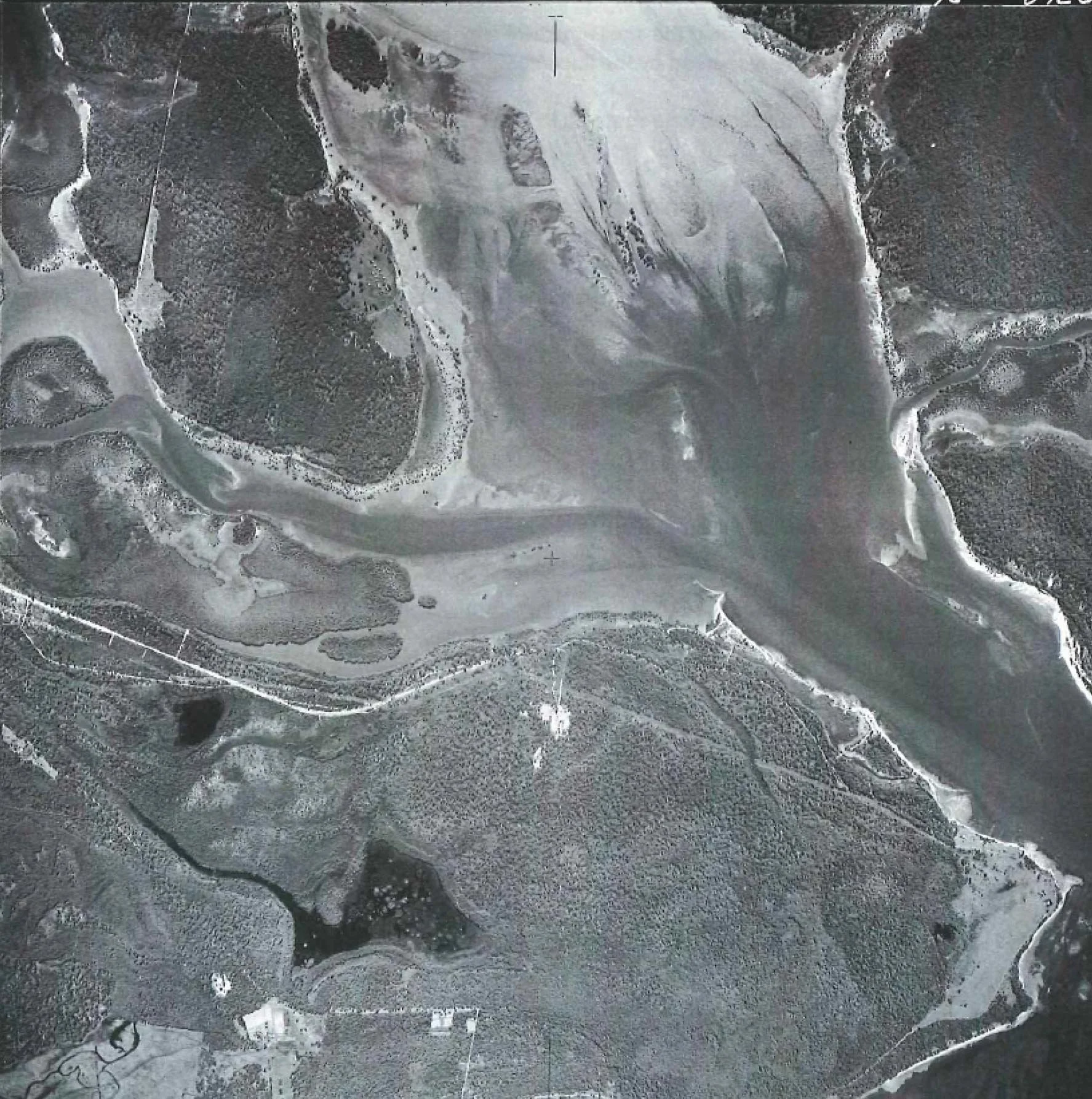
Ningi Creek, late 1970’s
I became a rather more observant Catholic than I’d been in past. Claude was allergic to religion and any whiff of spirituality, so I had to recite my “hail mary’s” silently as I’d kick off my flip flops and wade into the dark waters. One little blue ringed octopus no bigger than your thumbnail and invisible as a halo could fix you for good. It was equally ridiculous to tiptoe in the shallows, but i did. Between encounters with spiders the size of a truck and snakes that looked like a river undulating roadside…I somehow fell in love with this land anyway.
Sometimes we’d switch anchorage over to Elimbah Creek. The boat owner gave us use of his little Japanese Ute, which did not go in reverse gear but so what. It was so tiny that I had to drive it with my head crooked downwards. One time a spider came lunging out from under the sunshade and i nearly crashed his truck. After I finished screeching and whirling out the door, and the dust cleared, I saw a woman protectively huddling her children on their porch a quarter mile away.
Every three weeks, the customs fellows drew lots as to who would be the lucky ones to take a cruise up our river to check on the moggies and make sure they were being good and staying aboard. I gave them coffee or tea and we would spin yarns together at length. I marvelled at how much time people had here, and how luxuriously they enjoyed their time!
Always the flats were full of locals fishing with tinnies and poking around for oysters or clams, gathering supper in a simple and unassuming commune with nature, seemingly unhurried and unencumbered by all the expensive flashy gear and equipment that Americans seem to feel necessary accoutrements to any outing. We made friends with whole families who floated chattily down river in tubes of an evening sunset, regardless of the crocs “Oh none here, they’re all over on the Bribie Island side!”
In the place where I’d grown up, where the Puritan Work Ethic still ruled bone deep, people would signal that they accepted an outsider by saying something like “A decent, hardworking, honest person”.
In Queensland, you knew you were deemed ok when somebody would say “Fair dinkum story teller” or “Makes a smoko go quick” or “I got time for them”.
But I got my love note from the locals one morning, as I tiptoed ashore towing the dinghy behind me, and went to the spot where I always left my blown out holy flip flops, nestled in a hollow between some tree roots, just above the tide line.
This one morning, I discovered that someone had stolen my blasted old sandals.
In their place, as if an easter bunny had left me a magical egg, I found a new pair, just my size. An extra luxe thick soled pair. With red velvety straps. The nicest, fanciest, most luxurious pair I ever had the pleasure to wear. I looked around as if there must be some mistake but the gum trees just nodded in the breeze and whispered “You’re alright. We’ve got your back. Yankee Wankers as you may be. Walk long and walk strong, it’ll take you a while to put holes in THESE thongs!”
The author is a longtime professor of Psychology and Communications. She landed in Vermont in 1987 after a decade of cruising under sail. This is an excerpt from her forthcoming book tentatively entitled “Jenny: A Night Sea Journey.” Her Substack site is HERE
Fora little background on the adventures described above, take a look at this 1984 article, taken from the now defunct Australian magazine, “Modern Boating”
Moored beside the glamour boats in Papeete or Suva or any of the World’s crossroads, they are barely noticeable. They look like trailer sailors, but the little yachts have an air of having crossed oceans, a windvane swings at the stern, a courtesy flag flies from the crosstrees.
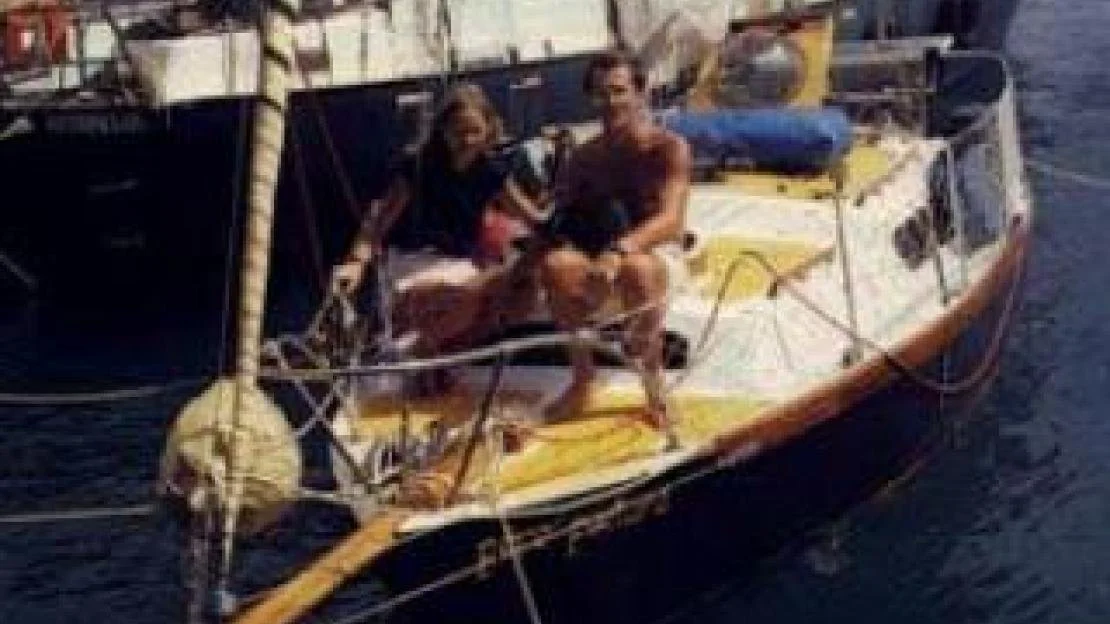
Claude and Genevieve Desjardins are French Canadians from Quebec. Claude, aged 26, is Mr. Average in appearance, clean-shaven, with a bank clerk’s hairstyle carefully parted on one side, he wears gold-rimmed spectacles which reinforce his office worker image. Genevieve is 23, and her one touch of flamboyance is her strikingly-long auburn hair. But they are not ordinary people, the boat in which they have sailed a quarter of the way around the World is 18ft long. They call her Pere Peinard, which means “quiet and lazy”, the way you feel when you go fishing. But life on the big Ocean in an 18-footer is frequently anything but quiet.
“In a little boat like this,” said Claude when I spoke to him in Papeete, you expect at least one knockdown on a long trip. For us it happened very early, on a lake in Canada. I had too much sail up when we were hit by a squall. The boat was knocked flat and the crosstrees hit the water. My father was below making coffee at the time and he poked his head out the hatch and said: “What are you doing?”
Claude and Genevieve say they are often dubbed crazy, but a close look at their boats shows a meticulous approach to safety. Genevieve calls her husband affectionately “this crazy perfectionist”.
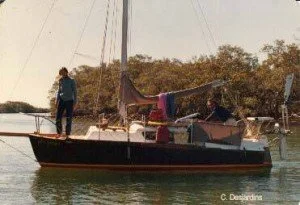
Pere Peinard was designed by Bruce Roberts as a trailer sailer, but Claude made a host of changes as he built her. The hull is cold-moulded timber. He added a bowsprit, made the cockpit smaller, changed the keel, the coachroof and many other details. Mindful of the tiny boat’s vulnerability Claude has made it virtually unsinkable. There are no through-hull fittings, not even a hawsepipe; the anchor is carried on deck. The aft section of the boat is sealed with an airtight bulkhead, and spare corners are filled with foam. “We can make the boat airtight, “says Claude. “And it will float even if full of water.”
Claude was a student when he began building. His philosophy in opting for such a small boat was to spend his few dollars on the best equipment he could afford. The windvane system is the well-proven Navik and he carries one and half more in spares. There’s nothing below in the way of luxuries, not even a head, but he carries a comprehensive set of electrics and hand-operated carpentry tools which have enabled him to earn money working on other peoples’ boats. Auxiliary power is a 6 hp outboard motor, and charging for the vessel’s small electrical needs is from a solar panel.
Below there is sitting [head] room only. There’s a single bunk each side with double in the forepeak. A tiny kerosene cooker slides out onto one bunk from beneath the cockpit seat and a few navigation manuals peep out from the other. When you ask about things like two–way radio and Satnav, Claude and Genevieve laugh.
Claude is proud of his boat’s performance in boisterous weather. “At one time,” he says in his mild way, “we averaged 6 knots for 10 hours, 2 knots more than our hull speed. The speedo was stuck many times on 10 knots but the boat was quite controllable. A 40-footer in the same area filled its cockpit three times but we never shipped any heavy water. Taking in a reef is a laugh. My feet never leave the companionway.”
The only time size is a crucial factor, says Claude, would be if he had to beat off a lee shore in severe weather. But Terje on Coco Loco has a different view. “Beating off a shore in 45 knots, a big boat can have as many problems as a small one. It depends on the shape of the waves.”
One thing every small-boat voyager must guard against is overloading. Pere Peinard now has less gear than when she started out. Two 22 litre jerry cans lashed to the deck make such a difference in trim that Claude always keeps them on the weather side. He posted home most of his library because when he moved the box of books around, it noticeably altered the trim.
A certain camaraderie exists among the small-boat sailor; even if they haven’t met they all know about each other. Claude thinks eight or nine boats under 25 ft are on their way around the World. He contemplated starting a club with three conditions of entry: The boat must measure less than 25 ft overall (7.6m), have no standing headroom, and no head.
Compared with ordinary yachts, these simple little craft cost practically nothing to run. Other cruising yachtsmen arrived in port with a list of spares to buy and maintenance jobs as long as their waterlines. The small boat skippers simply go ashore and enjoy. Manuel says, “The only thing I spend money on is food. The boat costs practically nothing.”
The three in whom I spoke all freely admitted that their prime reason for thinking small was economy, but none was in a hurry to change. Clearly if it meant the difference between going to sea or staying at home, a small boat was better than no boat. Manuel summed it up nicely when I asked him why he sailed. “There are three reasons,” he said. “I like to travel, I like the sea and why not?”