
Flotsam & Jetsam 25.09.26
A lifetime of sailing the Swan River inspires Perth sculptor Tony Jones
We are delighted to see long tern SWS supporter Tony Jones getting some much deseved kudos for the work he is doing preserving the dinghies and stories of the Swan River. Our first coverage of the project was in May 2022 but a lot has happened since then. Read on thanks to our ABC
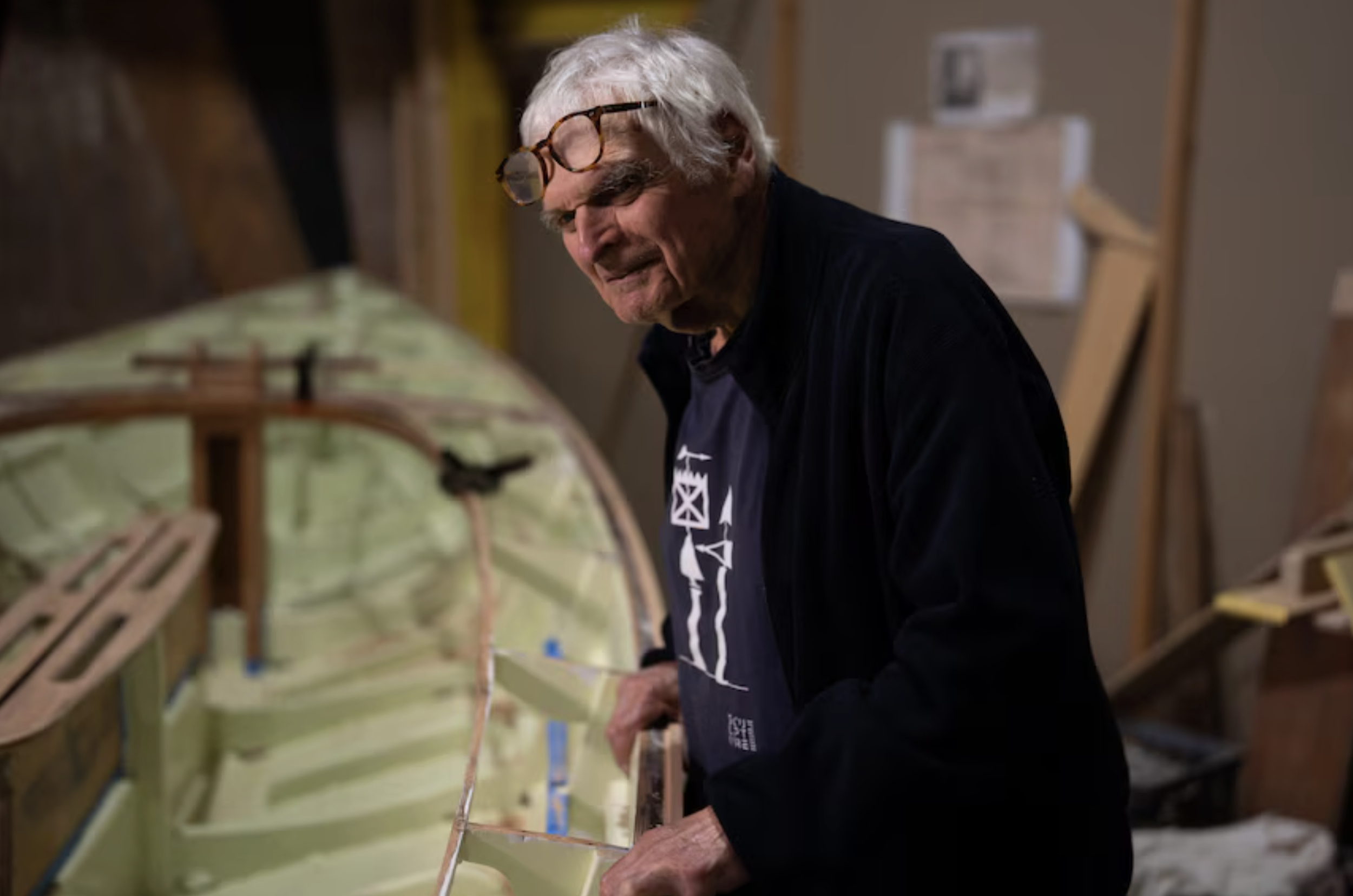

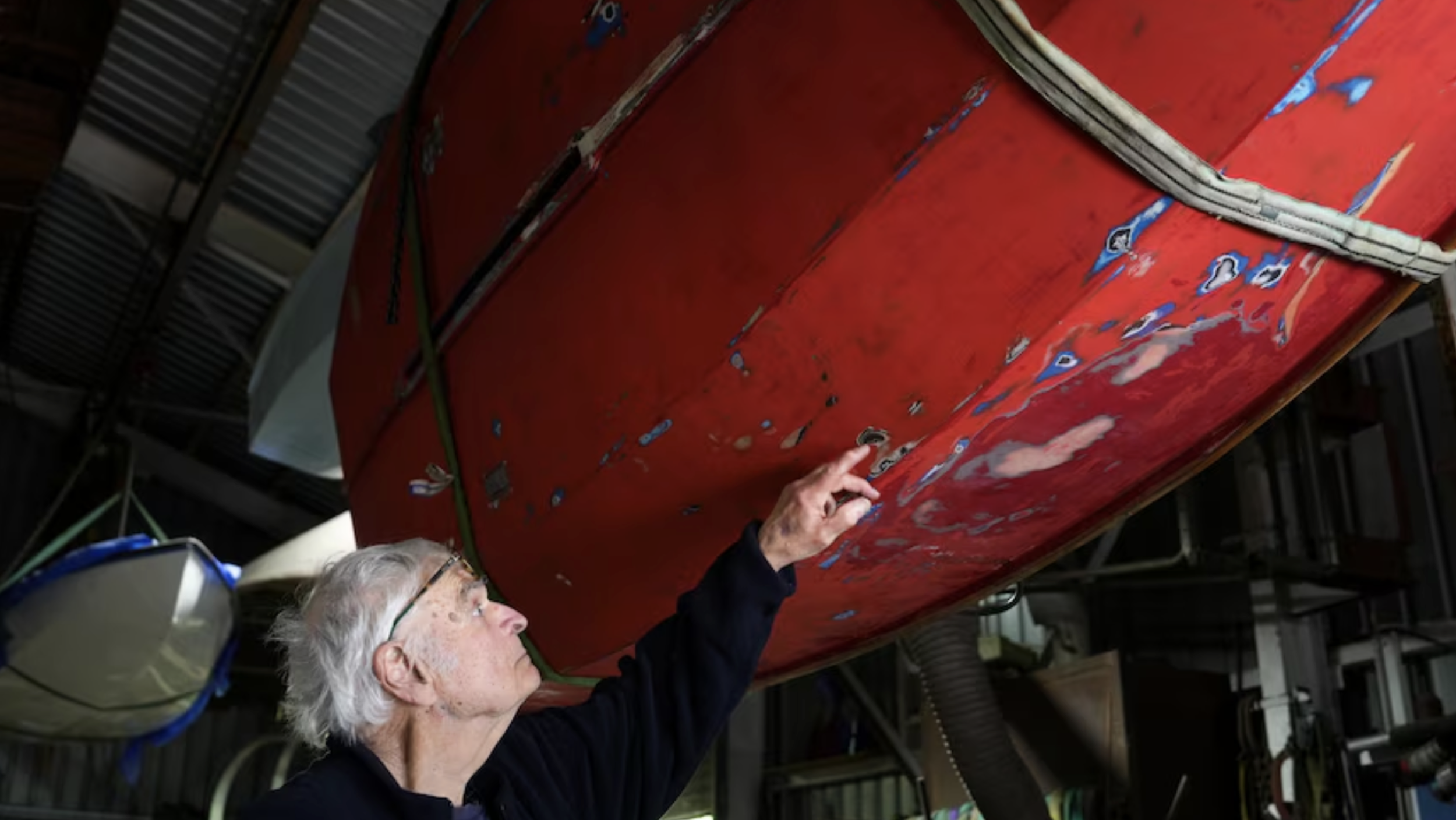
Images ABC News: Nicolas Perpitch
His statue of Eliza in the Swan River has a cult following and its own social media pages, while another of CY O'Connor riding his horse in the ocean is a much-loved North Coogee landmark.
But Tony Jones's art is better defined by its strong maritime theme, which was inspired by sailing at Chidley Point on the Swan River from the time he was a boy.
"It just made sense to me. You sit down with a piece of paper, what am I going to draw? I'd better draw a boat," the 81-year-old said, laughing.
Boat parts are often incorporated into Jones's sculptures. He also uses sailing motifs and has re-imagined navigational markers as striking art pieces.
His sprawling workshop near Fremantle is a treasure trove of his passions.
There are sculptures of birds, maritime markers and wind catchers, half-made projects and every sort of material for future projects, including decades-old wooden beams from long-dismantled jetties.
And there are, of course, boats. Everywhere.
Ray Kemp - Master Wooden Boat-builder - Woodbridge Tasmania
This week Gary Kerr added to his already incredible archive of videos about Southern Australian Wooden Boat history with this 53 minute history of the legendary Ray Kemp. It’s essential watching for followers of Tasmanian wooden boat culture.
Creating the Toe Rails.
Ep 18. Restoration of Logan Gaff Cutter
And while we are on the subject of wooden boat histories…. It’s time to catch up with Larry Eastwood and the PETREL project. Here’s Episode 18.
A Toe Rail is not a simple piece . It follows the sheer line, the deck camber, the flare and twist of the hull as well as decreasing in height from 100mm to zero from stem to stern. It also tapers from top to bottom. Once that's done, you have to add an oval capping! And this is all finished 'bright'! ...........so 'no where to hide' !
New Zealand opens marine reserves with groundbreaking Māori co-management model
By Edward Carver in Mongabay an independent media organisation reporting on Nature and planetary challenges with a global network of local journalists.
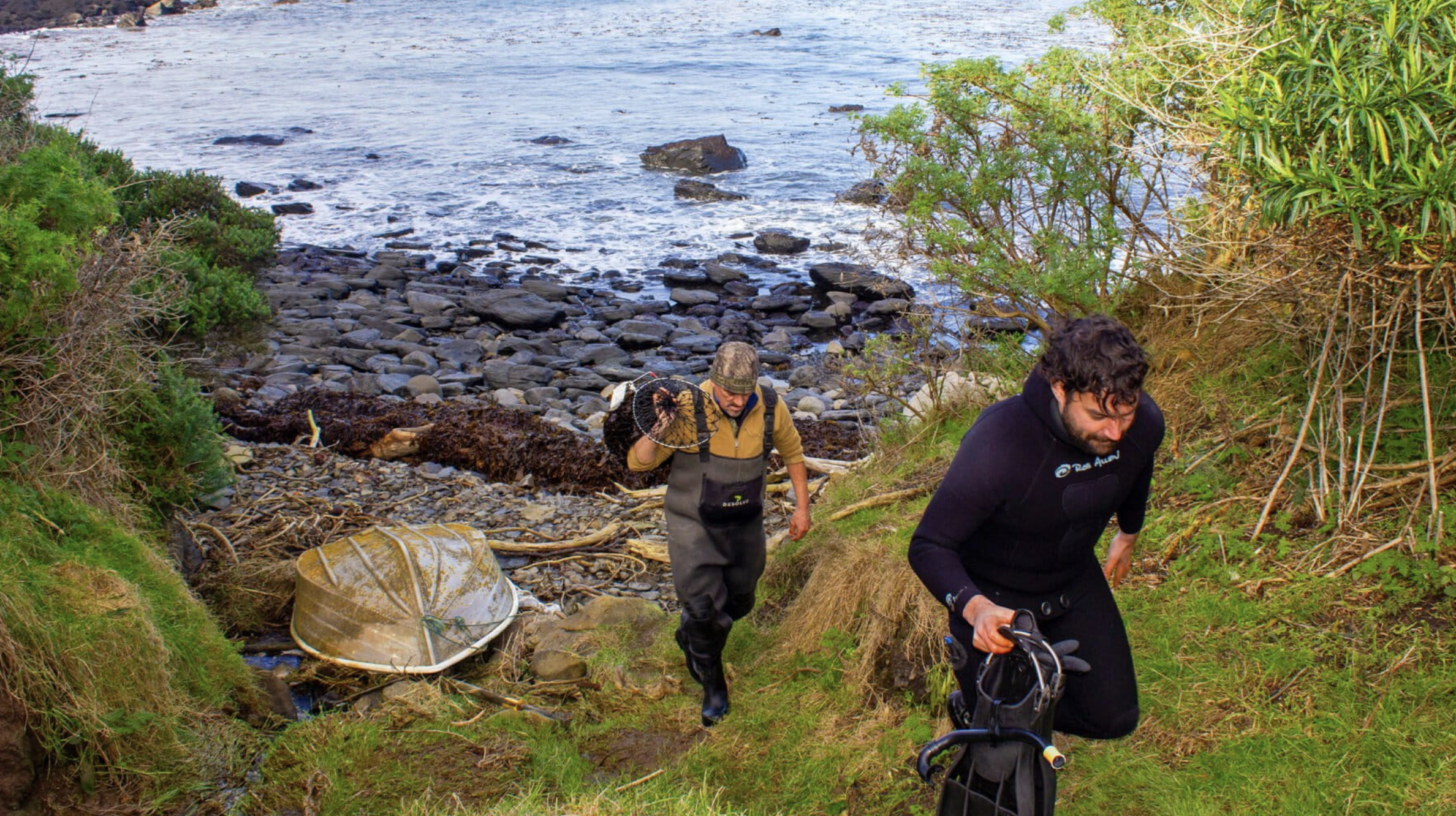
DUNEDIN, Aotearoa New Zealand — At a U.N. meeting in 2015, Aotearoa New Zealand’s then Prime Minister John Key made a major announcement that drew praise from international conservation groups: His administration would turn a swath of waters far larger than the country’s land mass into a marine protected area (MPA).
The Kermadec Ocean Sanctuary, planned for New Zealand’s northern waters, would have been one of the largest fully no-take MPAs in the world, but the sanctuary violated Māori fishing rights enshrined decades earlier. Key’s government had done relatively little to consult with Māori groups about the proposal, many of whom resisted the plan, calling for more recognition of their authority and their role in ocean governance. The sanctuary plan fell through.
Yet, even as Key’s top-down exercise drew criticism, a more bottom-up approach to marine governance was underway in the country’s far southeast.
There, Māori leaders helped develop a network of small MPAs, five of which became official on July 1, 2026, after more than a decade of grassroots and governmental work. A key aim is to protect seabed habitats, offshore canyons, rocky reefs, tidal lagoons and kelp forests. The network, called Te Au Roa o Te Rakihouia, is co-managed by the regional Māori tribe Kāi Tahu (Ngāi Tahu in standard Māori), and the Department of Conservation. The reserves are the first in the country to be co-managed by Indigenous people and the government using shared decision-making and a joint marine ranger team. The network name refers to the long wake of Te Rakihouia, a Kāi Tahu ancestor who explored the South Island’s waters.
“This is the only example of its type in the country and … could well be quite a good model going forward,” Edward Ellison, a Kāi Tahu leader and one of six governors of the network, told Mongabay. “It’s taking the best out of our legislation that we can and making it work in a way that carries the spirit of us exercising our rakatirataka, which is authority, and kaitiakitaka, which is guardianship.”
Mat Sheahan and Classic Boats- An unlikely combination!
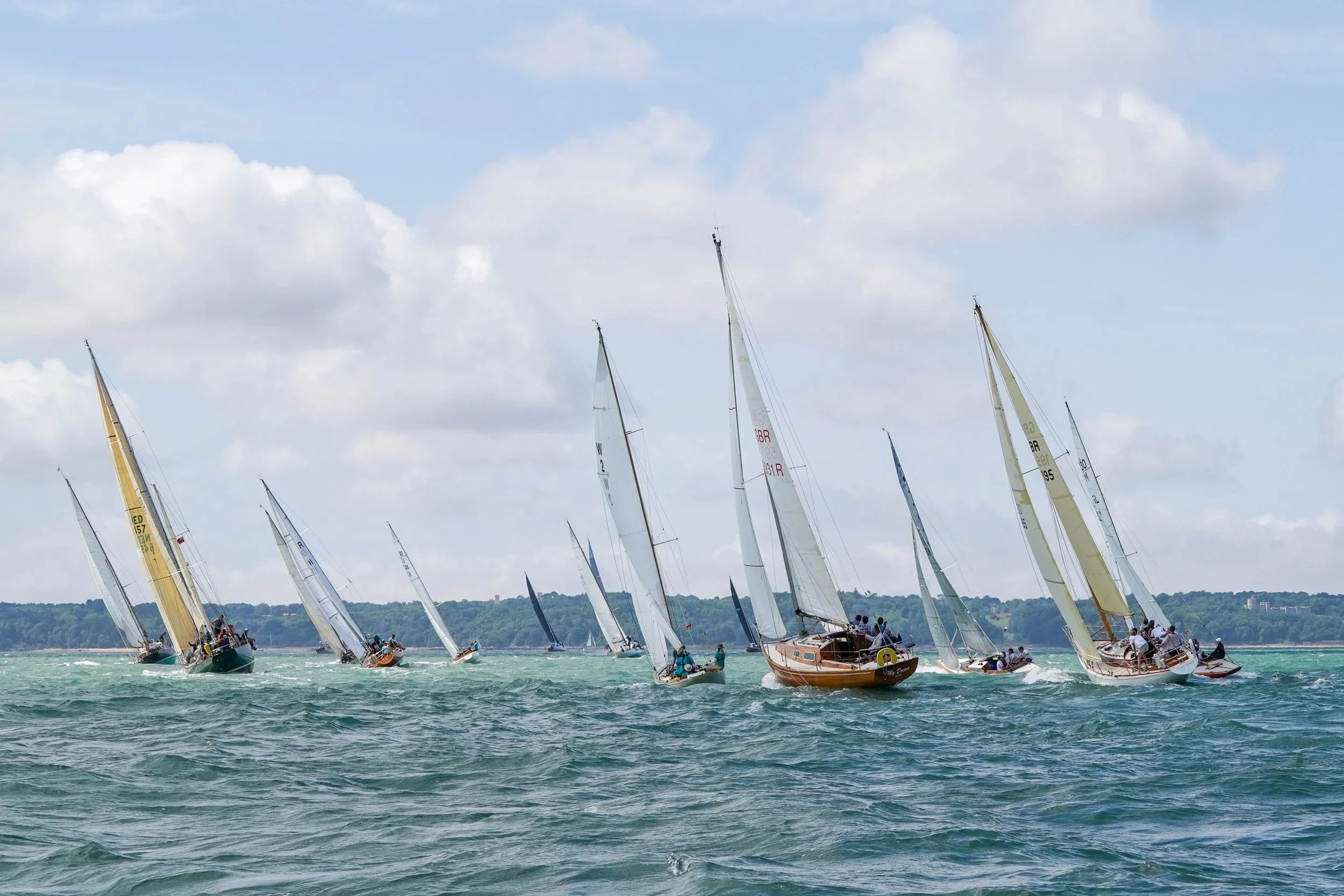
In the recent Yachting World Magazine Matt addresses the future of sailing regattas.
The two things no sailor ever has enough of are time and money. So what’s the magic balance to creating a successful regatta?
Classic yachts and some of their regattas are something I keep getting drawn to. It’s never been my bag before, having always been far too interested in performance boats and the latest advances in technology. I try to justify this as anything other than advancing age.
And this season I found a good reason at the British Classic Yacht Club event in Cowes. Now in its 24th year, this collection of venerable boats provided some forward-thinking ideas.
CYAA's 19th The Cup Regatta
30th October - 2nd November
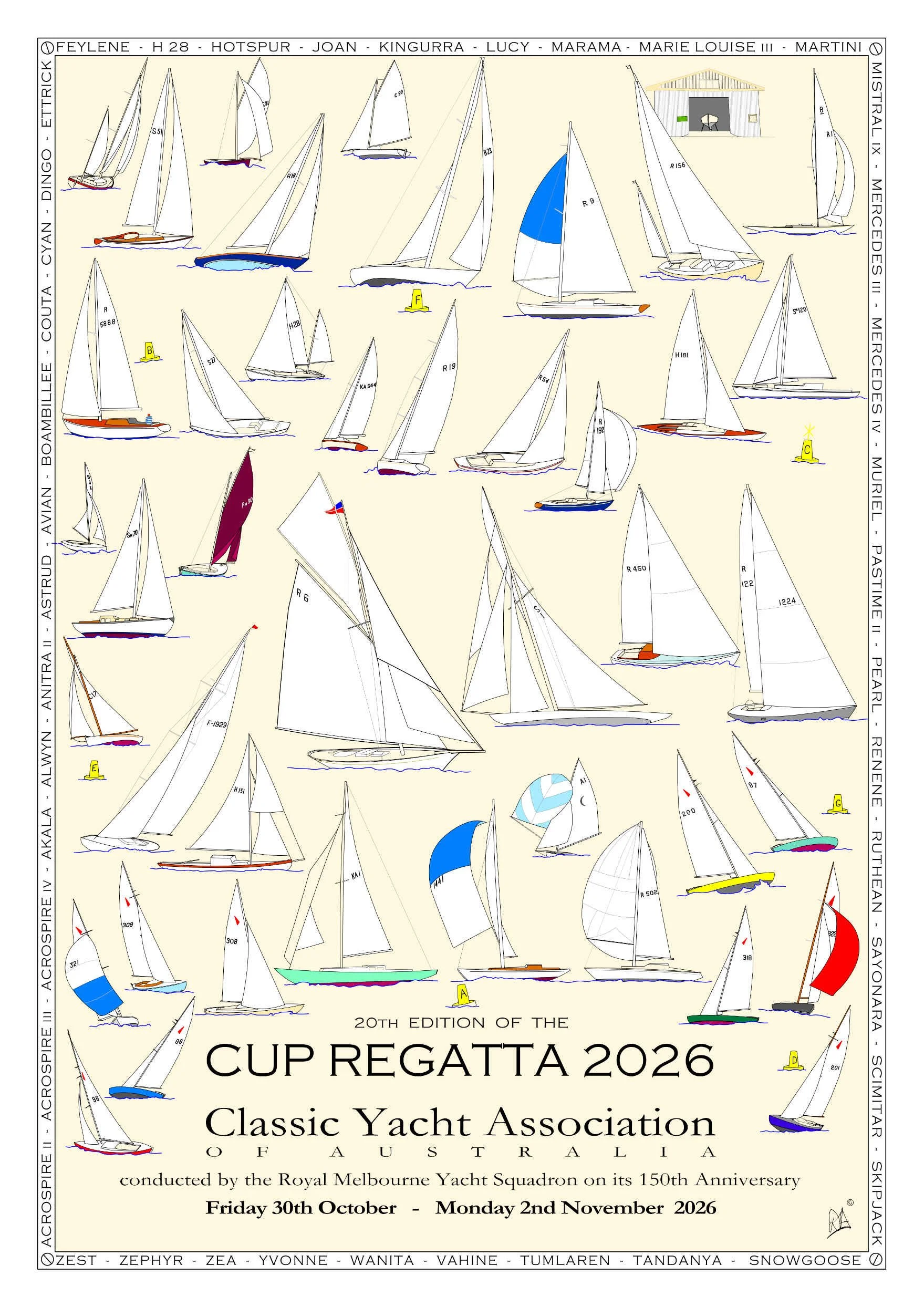
Notice of Race HERE
Sailing Instructions in the Works
Click HERE to look over and book yourself into the three Social events
16th October Event Briefing night at @ RMYS
30th Oct Reception @ Ferdi Darleys boat shed
31st Cup Regatta Dinner @ RMYS
Program of 2026 Cup Regatta Racing Events @ RMYS
30th October Cup Regatta racing
30th Oct Interstate Invitational
31st Oct Cup Regatta races
1st Nov Cup Regatta racing
Cup Regatta trophy presentations @ RMYS
2nd Nov Pursuit non scoring race
Folloed by Cup Regatta wind up session in RMYS Olympic Bar
SASC – Gaffers Day 2026
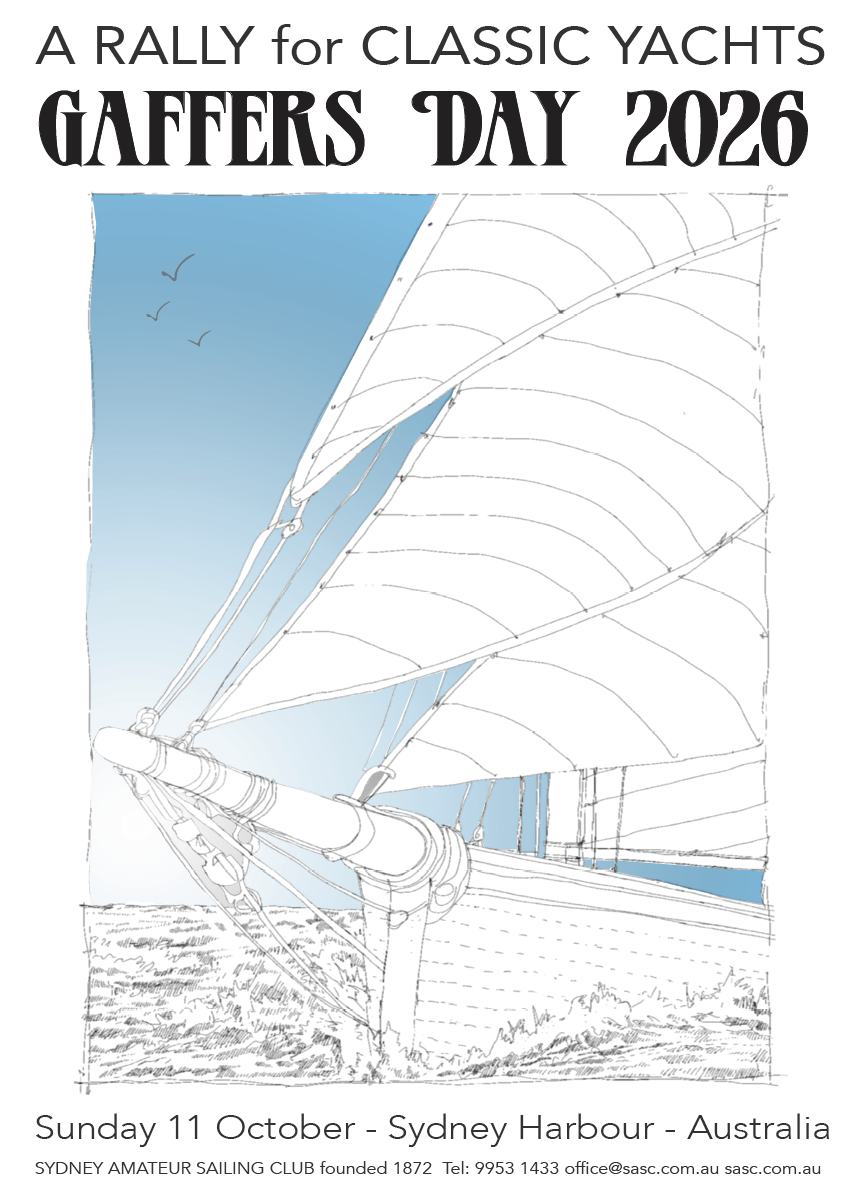
The Sydney Amateur Sailing Club (SASC) is once again holding its biennial Gaffers Day regatta on Sunday October 11, 2026.
First held in 1972, the event has become a significant gathering for classic boat enthusiasts, featuring a spectacular parade of vintage vessels that “hoist a spar”. The event attracts a diverse fleet of classic yachts from across New South Wales, Victoria, Queensland, and Tasmania, showcasing the timeless beauty and craftsmanship of these historical boats.
The event is a festive rally that celebrates the history and tradition of classic yachting on Sydney Harbour. Expectations are for a fleet of over 90 yachts, and will be a spectacle. Equally important though is that the regatta is a gathering, providing an opportunity for sailing enthusiasts to connect, share their passion for classic yachts and to celebrate their maritime heritage.
The SASC is now calling for registrations of interest for this years event and eccourages participants from around Australia to get involved.
Further information is available from the SASC HERE
A Season to Remember: 2026 Classic Yacht Challenge Series Wraps & Champions Crowned
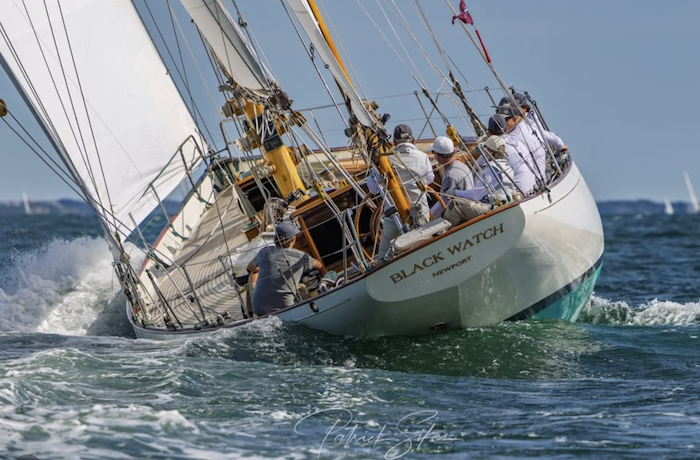
From Newport to Martha’s Vineyard, through the legendary waters of Penobscot Bay and Nantucket, and back to Southern New England, the 2026 Classic Yacht Challenge Series delivered a summer of close competition, exceptional sailing conditions and the camaraderie that defines classic yacht racing.
The season brought together more than 190 classic yachts for 22 scored races across 13 regattas in Maine, Massachusetts and the RI/CT/NY District. One hundred and one CYOA member yachts participated in the Series, with boats traveling beyond their home districts to compete for both regional and Overall Series honors.
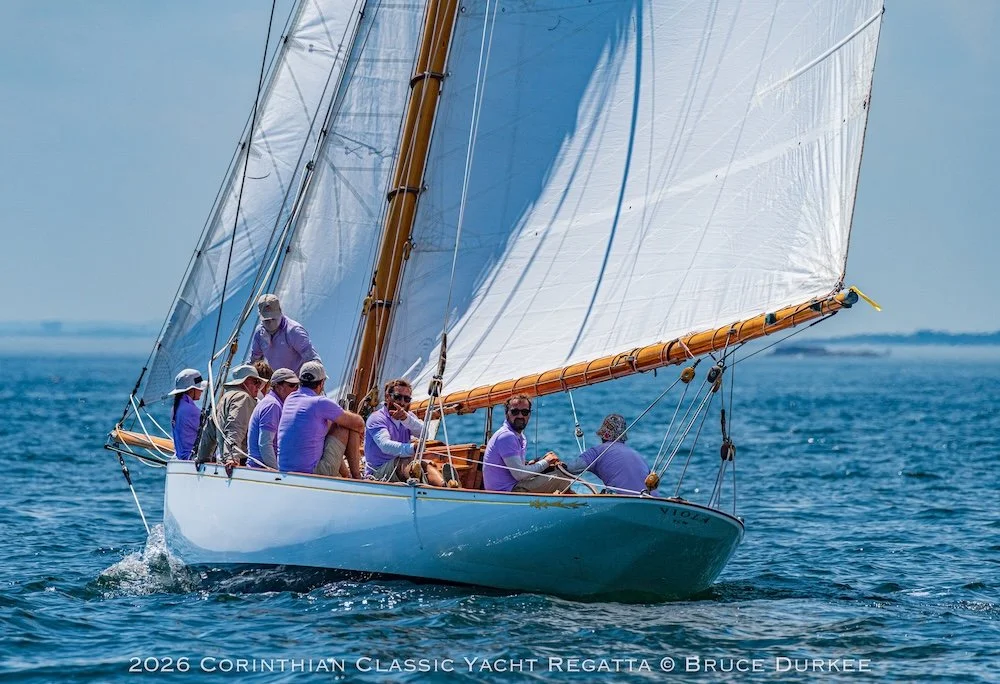
To qualify for the Overall Series, a CYOA member yacht was required to compete in at least five races across three regattas in two or more districts. District awards required three races across two regattas within the respective district.
McIntyre Golden Globe! So Far, So Good! Day 11 — 301 to Go?
A masthead repair for the leader, an Irish pursuer arriving seven hours later, and a chasing fleet finally finding its stride: the McIntyre Golden Globe Race 2026 has reached Lanzarote with plenty of stories already written—and another weather challenge taking shape. The fleet departed Les Sables-d’Olonne on 6 September 2026.
France’s Damien Guillou, aboard SOLAREM, was happy to discover he was leading for the first time, and Ireland’s Pat Lawless, sailing SILVERMINES HYDRO, was shocked and excited to find himself second, just hours behind the leader. He was convinced all the Rustler 36 yachts would be in front. Both completed their first film-drop rendezvous at Marina Rubicón on 16 September. Both are heading south again at speed, having turned their early escape from the Bay of Biscay into a substantial advantage. Behind them, a renewed breeze is producing some of the strongest sailing of the opening fortnight. But the opportunity may be short-lived. The race’s weather outlook points to fading winds around 20–21 September, potentially trapping the trailing boats while those farther south continue to pull away. After eight days of alternating frustration and fast sailing, the Atlantic is threatening another division.
Guillou reached the Marina Rubicón film-drop buoy at 12:15 local time on Wednesday, 16 September. Following his 20-minute interview with the GGR team, he anchored for approximately an hour to tackle a job best completed before returning to the open ocean. The Frenchman climbed the mast to replace a sheave in the masthead spinnaker block, taking advantage of the relatively calm conditions to complete the repair himself. Then it was back to the race. Anchoring for unaided repairs is permitted under the GGR’s rules. Bringing in a shore team to do the work is not. Even within sight of a marina, self-reliance remains central to the challenge.
At 19:15 local time, Lawless followed. With one reef in his mainsail, he furled his headsail and eased the pace, but was still making approximately five to six knots as the race team’s rigid inflatable boat kept station alongside for his interview. These are rendezvous, not conventional stopovers. They mimic the efforts of the 1968 entrants hoping to pass letters and films. The film gate provides a brief opportunity to collect footage, recordings and letters, and hear the sailors’ stories before they continue south. There is no compulsory rest at Lanzarote.
By September 17, the leading pair were away again, choosing different routes around the islands. Guillou’s accomplished spinnaker drop had provided another memorable moment for followers ashore. Ahead lay the next question: could either skipper turn the passage beyond the Canaries into a further escape?
“This is exactly what makes the Golden Globe such an extraordinary adventure! Damien anchors, climbs his mast, fixes the problem himself and gets straight back into the race. Pat is chasing hard, the boats behind are finally flying, and now another windless trap threatens to split the fleet again. It’s not just about sailing fast—it’s about solving problems, making good decisions and keeping yourself and your boat going,” said Don McIntyre, GGR Founder.
The foundations of their advantage were laid on 9 September, when a high-pressure system began spreading lighter winds across the Bay of Biscay. Guillou’s position close to the Spanish coast offered a favorable angle towards Cape Finisterre, while Lawless was also well placed to retain the breeze. Farther north, the opportunity to get south before the wind disappeared was narrowing. By the following day, the contrast was striking. Guillou had recorded 162 nautical miles in 24 hours. Britain’s Henry Wootton, aboard PRIVATEER, had managed just 24 nautical miles, while Canada’s Isa Rosli, sailing OLLEANNA, was almost stationary at the time of the report. The leading boats were escaping around Finisterre. Others were rolling in the remaining swell, trying to keep their sails drawing and their boats moving.
Yet even at the front, the advantage refused to settle. On 13 September, Guillou’s lead over Lawless stood at approximately 83 nautical miles. By 15 September, lighter winds had slowed the Frenchman and Lawless had recovered around 30 miles in a single day, reducing their separation to roughly 50 miles. Guillou was hand-steering under spinnaker, working for every fraction of a knot. Both men have unfinished business. Mechanical problems ended their previous GGR campaigns in 2022. Their return has now put them at the front of the same race that previously stopped them.
Behind the leaders, the chasing fleet has been anything but passive. Italy’s Andrea Lodolo, aboard BIBI, established himself at the head of the pursuit, while Britain’s Ertan Beskardes, sailing MISS BEAGLE, remained firmly in contention. As the leaders approached Lanzarote, stronger northerly winds began reaching the boats behind, bringing the prospect of recovering some lost ground.
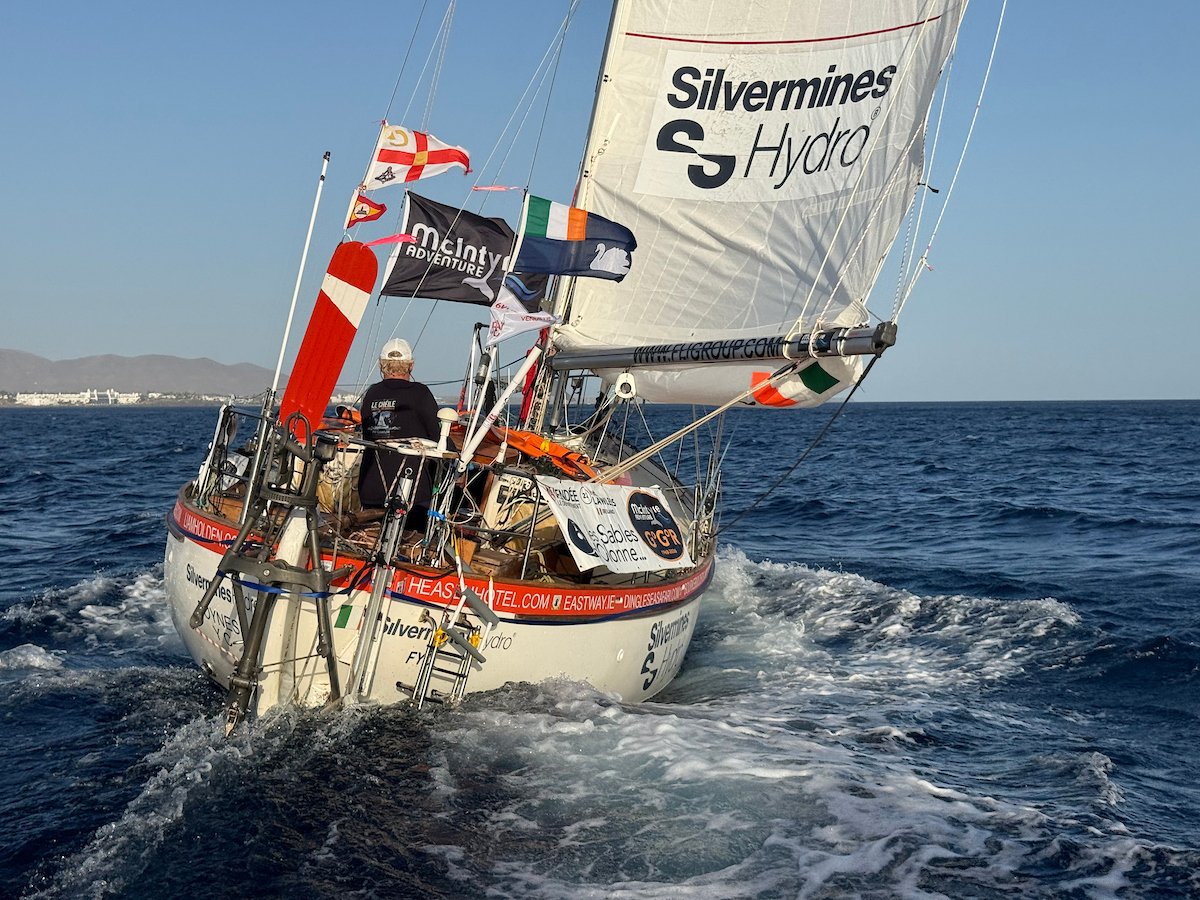
Seven hours behind the leader, and determined to keep chasing. Ireland’s Pat Lawless sails his Saltram Saga 36 SILVERMINES HYDRO off Lanzarote during the film-drop rendezvous on 16 September. His early escape from the Bay of Biscay has put him firmly among the front-runners as the fleet heads south. Credit: Don McIntyre / GGR2026
Some contests have been close enough to watch without a tracker. On September 11, Switzerland’s Etienne Messikommer, aboard BERNARD, and Italy’s Guido Cantini, sailing HANNAH OF COWES, were separated by only about half a nautical mile. A day later, GGR Window Live footage showed Messikommer pushing through strong following winds, with Cantini visible on the horizon and boat speeds briefly exceeding nine knots. Cantini subsequently posted a 163-nautical-mile day in the 16 September report, demonstrating the pace available as the breeze filled in.
By September 17, another close pairing had developed: Messikommer and Israel’s Daniel Pinsky, aboard EXODUS, were just 1.9 nautical miles apart, potentially close enough to see one another.
One important qualification concerns Lodolo. His displayed tracker position was out of date in the September 17 update, and the race team was working to obtain a fresh YB position. They are tracking his AIS via satellite too. His ETA in Lanzarote was approximately 22:00 UTC on September 17.
For American Guy deBoer, approaching the Canaries aboard SPIRIT carries particular significance. His 2022 race ended when the yacht grounded on Fuerteventura after the Lanzarote film drop. The rebuild and return have been a major undertaking. “But from that moment, I promised I’d rebuild and return,” he recalled in his official skipper profile before this year’s race. His opening Atlantic passage has already shown how quickly fortunes can change. The 11 September report recorded just 27 nautical miles of progress over the preceding day. The next report credited him with 177 nautical miles, one of the standout performances of the week.
Now there is another practical challenge. According to the 17 September update, deBoer is using his backup Windpilot following problems with his Hydrovane mounting brackets. France’s Louis Kerdelhué, aboard IE CHARGE, has also had to improvise. His early Hydrovane fastening problem required a temporary repair, allowing him to continue south rather than abandon the passage for a return to port. In this race, making the boat fast and keeping it functioning are inseparable tasks, and windvanes are critical.
After his frustrating opening in the light winds, Henry Wootton is showing a very different pace. The latest September 17 update credits PRIVATEER with 172 nautical miles in 24 hours. The change is not simply numerical. In a recent safety call, Wootton spoke candidly about the emotional difficulty of the opening days after years of preparation—a reminder of the personal adjustment behind every tracker symbol.
Norway’s Helga Marie “Mara” Løvenskiold Kveseth, aboard SHOWGIRL, has also been gaining momentum. Her more offshore positioning paid dividends earlier in the week: the 13 September report recorded 143 nautical miles, compared with deBoer’s 102 miles on a more inshore track. By September 17, Mara was making another strong showing with 161 nautical miles in 24 hours, accompanied by lively sailing on GGR Window Live. There have been quieter moments, too. Between sail handling and the demands of living alone offshore, her onboard updates have included reading Kirsten Neuschäfer’s book, an appropriate companion for someone following the GGR route herself.
“The fascinating thing is that we can see the whole picture ashore, but the sailors can’t simply open the tracker and check who is catching them! They’re trusting their navigation, their seamanship and themselves. The leaders have earned their advantage, but there’s a whole world still to sail. Nobody can afford to get comfortable, this adventure is only just beginning!”, said Don McIntyre, founder of the McIntyre Golden Globe Race
Elsewhere, Rosli, Americans Gunnar Christensen aboard POMPOEN and Matt Woodside aboard TIPI HAERE, and the surrounding boats are making the most of the renewed breeze. After the stop-start passage down the Atlantic coast, there are finally miles to be earned.
For Sweden’s Pär Nyman, aboard LAZY OTTER, the opening challenge was simply getting back to sea after repairs in Les Sables-d’Olonne. His delayed departure left him pursuing a fleet already stretched across Biscay. Turkey’s Selim Yalçın, sailing HELP DISABLED CHILDREN, has also been balancing forward progress with work aboard. Earlier reports explained that some of his slow sailing reflected time spent completing preparations and making the boat more comfortable. Now the weather threatens to make their pursuit more difficult.
Nyman is dealing with confused seas, while Yalçın has smoother conditions but less speed. Both could be exposed to the approaching loss of breeze around September 20–21. The September 16 outlook suggested several days of very light winds on the northern approach to the Canaries. That remains a forecast, not a certainty, but for the trailing boats, the risk is clear: a slow approach to Lanzarote while the boats ahead gain still more distance.
Through GGR Window Live, followers are watching the contrast between hard-driving sailing and the ordinary routines of life aboard LIVE. The system provides one-way live coverage: it brings the sailors’ world ashore without giving them an equivalent window into the outside world. That distinction matters. The GGR remains a race built around traditional navigation and individual decision-making. Organizers can follow satellite tracking information that the competitors themselves cannot consult during normal racing.
From Biscay’s calms to the Lanzarote sail-pasts, the past eight days have shown how differently the same ocean can treat boats separated by relatively modest distances. The leaders have cleared the first film gate. The chasing fleet is accelerating. Farther back, two sailors are trying to reach the islands before their breeze disappears. The boats are moving fast again. The question now is how many can keep moving if the wind switches off.
Details: http://goldengloberace.com/
In 1968, nine started the first solo non-stop sailing race around the World with 29 year old Sir Robin Knox Johnston as the lone finisher. He navigated only with a sextant, paper charts, and an accurate and reliable time piece, and the Golden Globe Race seeks to recreate the challenge.
Competitors must sail in production boats between 32-36 foot overall designed prior to 1988 that have a full-length keel with rudder attached to their trailing edge. Similarly, entrants must sail without modern technology or the benefit of satellite-based navigation aids.