
The (Not So) Impossible Race Around the World – The 2025 Mini Globe Race. Part Three
MAURITIUS TO ANTIGUA
By Graham Cox
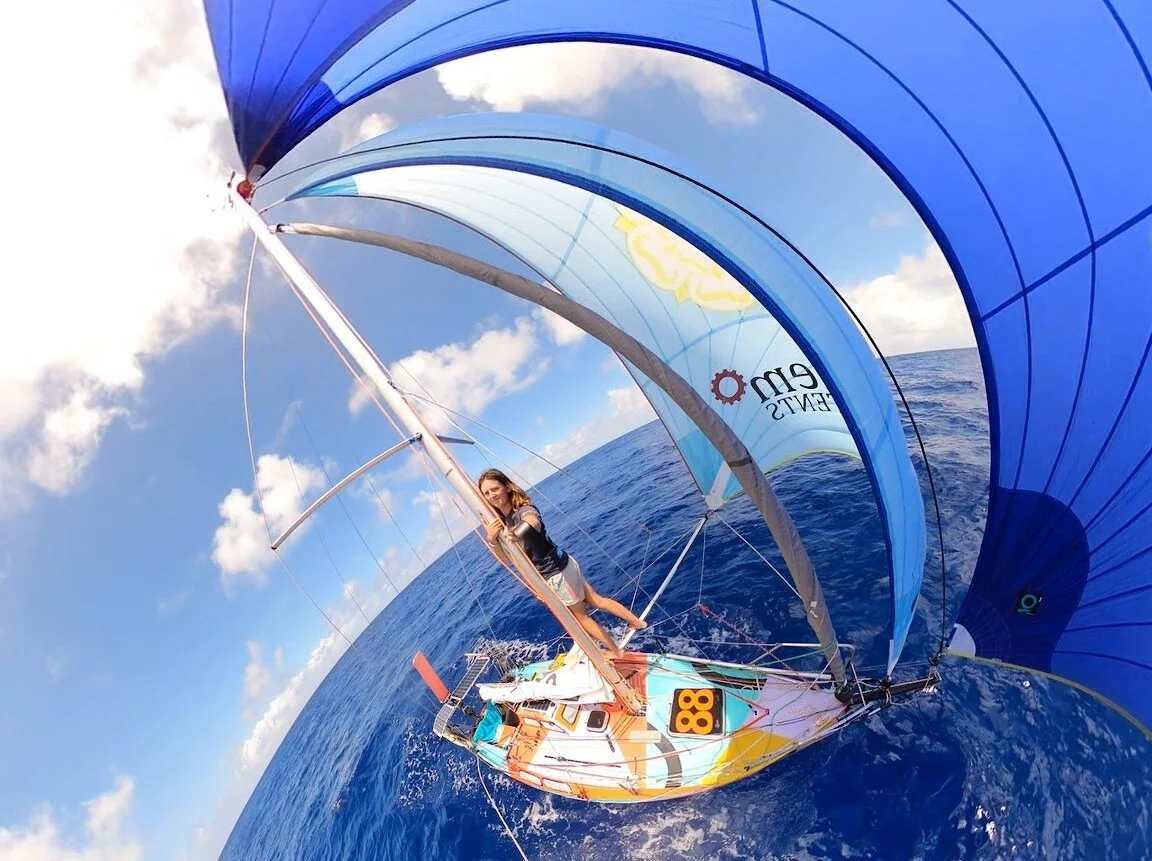
Jasmine aboard Numbatou.
The idyllic island of Mauritius provided a stunning but chaotic interlude between ocean passages. While the mountain vistas and French-inspired patisseries were a welcome delight, the logistical hurdles were significant. The necessity to clear customs in Port Louis, where boats were tossed against a rough concrete wharf by tugboat wakes, resulted in a litany of damages. Most notably, Numbatou’s bowsprit was snapped off, while Keri suffered damage to Origami’s solar panels. Eric said Sunbear’s spreaders were swinging wildly across the roof of the nearest building and he feared getting dismasted.
On the way back down from Grand Baie to the start off Port Louis, Adam watched in dismay as Little Wren’s mainsail tore in the same location as Josh’s had earlier – adjacent to the stiff Globe 580 logo. Fortunately, while he was busy clearing Customs, other entrants hastily repaired his sail with self-adhesive sailcloth patches. A number of entrants had their sails overhauled by local sailmakers here, but it was only the beginning of a long, difficult saga for many.
The start from Mauritius on October 25th was a spectacular sight, with the entire fleet bunched together. Renaud was first across the line, but the pack remained remarkably tight in the days that followed. By October 28th, the first seven boats were spread over just 20 miles, creating a unique and intense offshore match-race.
Dan reported sailing with Renaud’s stern light constantly in view. “It’s good and bad in a way,” he said. “It keeps me on my toes… I’m having quite a bit of fun with the competitive thing.” His strategy involved constant tweaking of his Hydrovane and sail trim, using his mainsail more than ever to keep pace with Renaud.
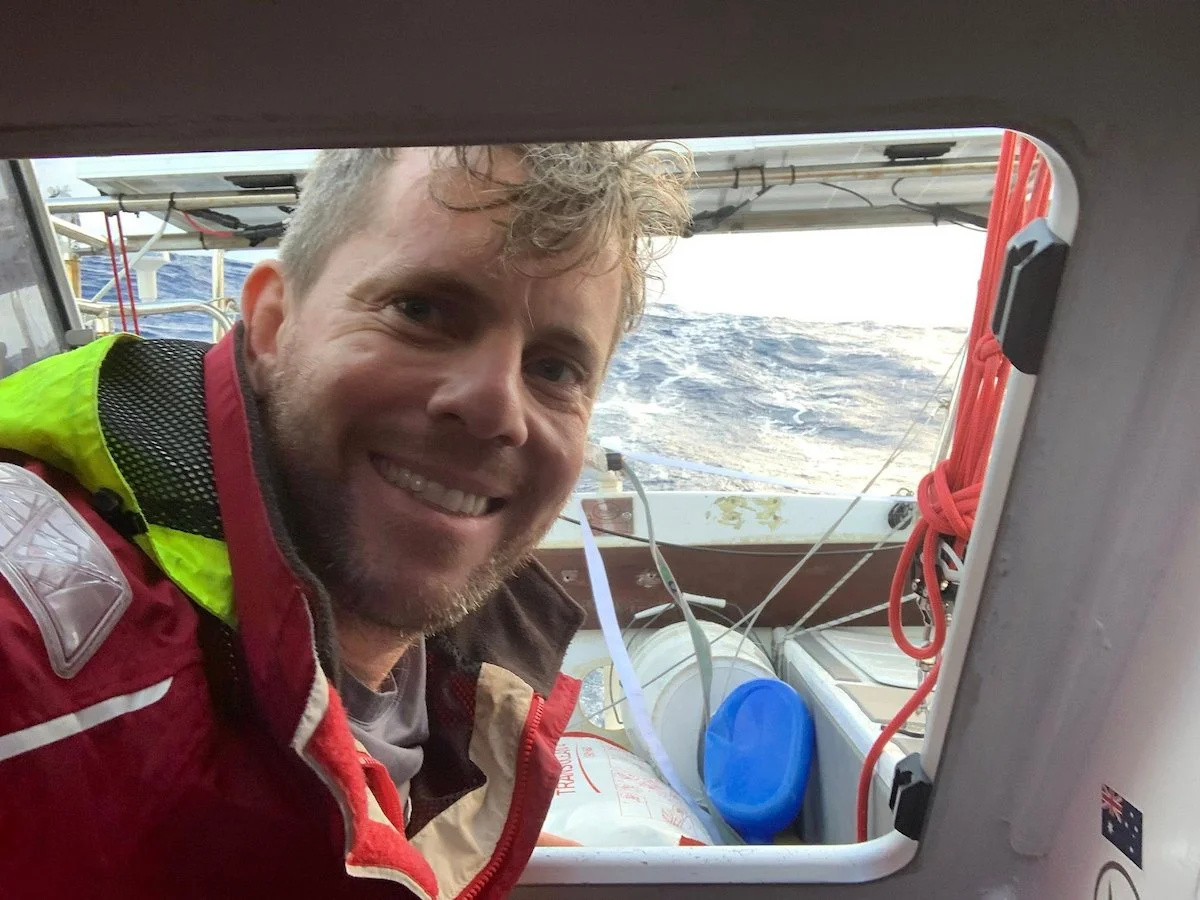
Dan Turner and Immortal Game chasing Renaud to Durban.
The battle extended throughout the fleet. Adam was sailing neck-and-neck with Christian. Jakub, who said that he had started “lazy,” was pushing hard to close the gap, though admitted that the downwind rolling was exhausting, and his limited sail inventory made balancing the boat a challenge. He wanted to run twin jibs but didn’t have two sails of the same area.
Ertan, typically a laid-back cruiser until then, shocked everyone by holding onto 4th place initially, logging one 132-mile day. Nonetheless, he was still a bit more relaxed than other competitors. By day, he hoisted his A5 spinnaker and hand-steered, or assisted the Hydrovane from the cockpit; by night, he reverted to a slower but safer jib-only configuration, allowing him to sleep soundly. “I sleep most of the night,” he confessed. That changed after he lost a critical link in his windvane. He then used one of his two small autopilots in easy conditions, but had to hand-steer in anything over 15-20Kts.
Keri was facing a different kind of challenge – a critical power shortage. With two of his three solar panels damaged against the wharf in Port Louis, he was unable to run his Starlink for weather updates, or use his plotter consistently. “I’m running a bit blind,” he stated, and dusted off his sextant for traditional navigation. He was forced to sail more conservatively, “husbanding the boat” as he put it, and conserving his remaining battery power for navigation lights in these busy shipping channels.
Jasmine was battling fatigue and a finicky Hydrovane that over-corrected in bigger seas, requiring long stints of exhausting hand-steering. And yet she was right in the middle of the pack, posting a current-assisted new 24-hour speed record for the 580s of 179 miles! “If I see a boat pulling away from me, I’m like, Okay, what are they doing that I’m not?” she said. “It just motivates me rather than bringing out a competitive edge.” She also said that she was determined not be left behind in that treacherous part of the ocean, something that also motivated Ertan. To that end, she hung onto her A5 at times when other sailors were shortening down. They just shook their heads in admiration.
Further back, Josh was in his element. Now equipped with a good mainsail, he planned to skirt 60 miles off the southern tip of Madagascar, to avoid a known wind and current acceleration zone. Not having Starlink on board, he relied on pilot-book information and what he could glean from radio reports. His approach remained that of a mountaineer making the most of a weather window – focused, deliberate action, unpressured by the immediate competition. The only indulgence he allowed himself in Mauritius? Five boxes of his favourite raspberry tarts– an unexpected find on this remote Indian Ocean island – which he had enjoyed during earlier expeditions.
The sole skipper who significantly diverged from the pack was Pilar. She chose to steer Peter Punk on a more westerly route, leaving Reunion Island to port, but fell into a wind hole and slipped from 4th to 11th place, a stark lesson in the tactical perils of this leg. Being the true ocean racer that she is, though, this just motivated her to try harder, and she began working her way back through the fleet with the longest 24hr runs for several days.
The passage from Mauritius to Durban was always going to be a challenge for the MGR fleet – and it was – but it was also fast. Renaud, first home as usual, brought Capucinette into Durban on November 6th, a mere 12 days after departing Port Louis, with the rest following over the next four days.
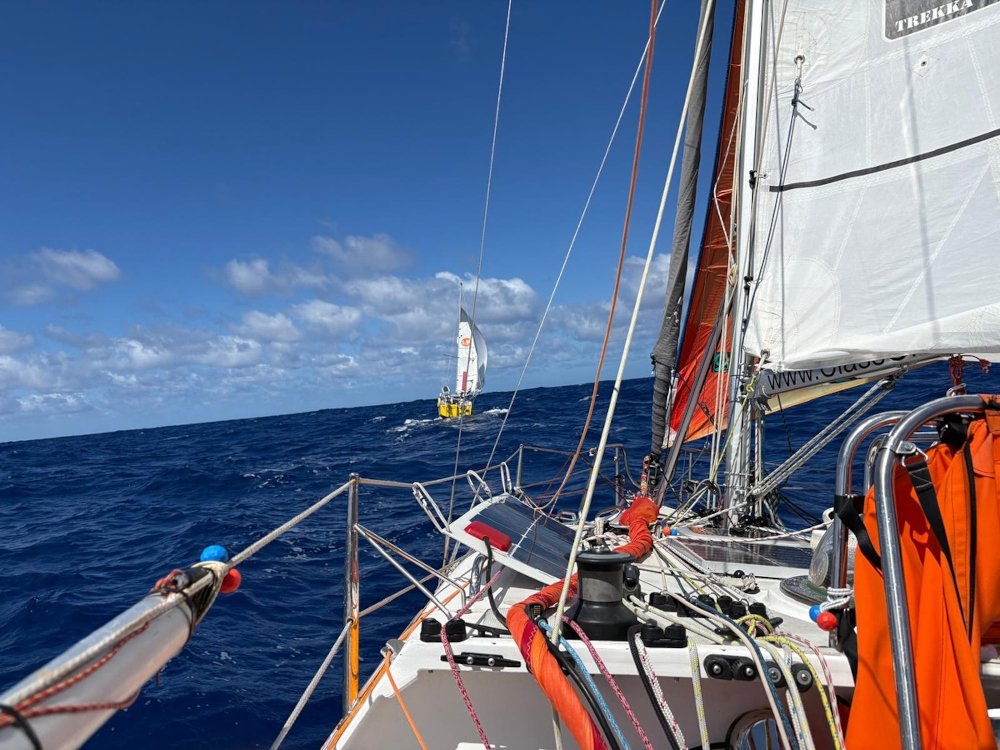
Ertan chasing Eric off the coast of Madagascar.
These are remarkable passage times, although it is likely that access to wind and current data via Starlink gave most of the fleet significant advantages over earlier passage-makers. Even those who got caught up in the wide, counter-clockwise current gyre (an anticlockwise swirl that looked like water going down a giant plughole), which was running at 2-3 knots and taking up half of the Mozambique Channel, probably shaved days off their passage by hooking into favourable currents when they could. Josh, with just a rough understanding of where the gyre was, stayed well north of it, and stole a march on a few of the others who gambled with the current and lost.
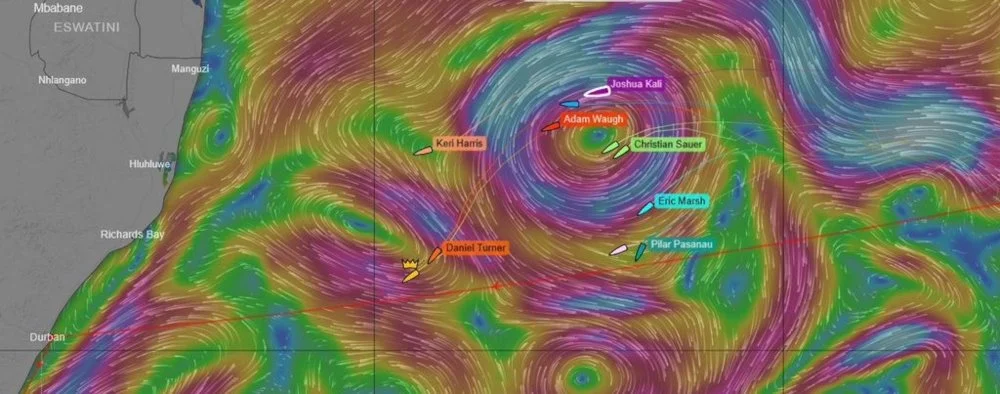
Current gyre in the Mozambique Channel.
Conditions were boisterous, with three vigorous fronts passing over the fleet, but it could be argued that the weather was moderate for this region. Nobody had to face a severe, prolonged storm, with wind blowing against the current, which accounts for the horror stories one hears about vessels sailing in these waters. John Guzzwell took 20 days to sail this leg in 1958, while in 1967, Robin Lee Graham took 17 days from Reunion Island aboard Dove, so let’s say 18 from Port Louis. John Sowden, on the 25ft Yachting World 5-tonner, Tarmin, took 21 days from Port Louis in 1969.

A large sea about to break aboard Argo during the NE gale off Madagascar.

Bibi running off before the gale south of Madagascar, with the storm jib aback to steady the course.
Capucinette carried a favourable current most of the way, due to Renaud’s tactical genius, but Renaud’s high average speeds indicate relentless deck work to keep the yacht sailing at its best day and night. After arriving in Durban, he said, “It was a really hard passage. I had a knot in my stomach all the way. We had three fronts, one northerly front when south of Madagascar, about 30 knots. Then we had the southwest front in the middle of the Mozambique Channel, about 45 knots, which was really hard. Then, two days before arriving, another southwest front, but this one was only 30 knots. So that one was like a holiday! But it is really, really hard to sail this part of the world. I did not have a lot of rest. By the time I arrived, it was difficult to keep my eyes open. Also, there were a lot of cargo ships. The night before arriving, I had up to 12 around me, all sailing different courses.”
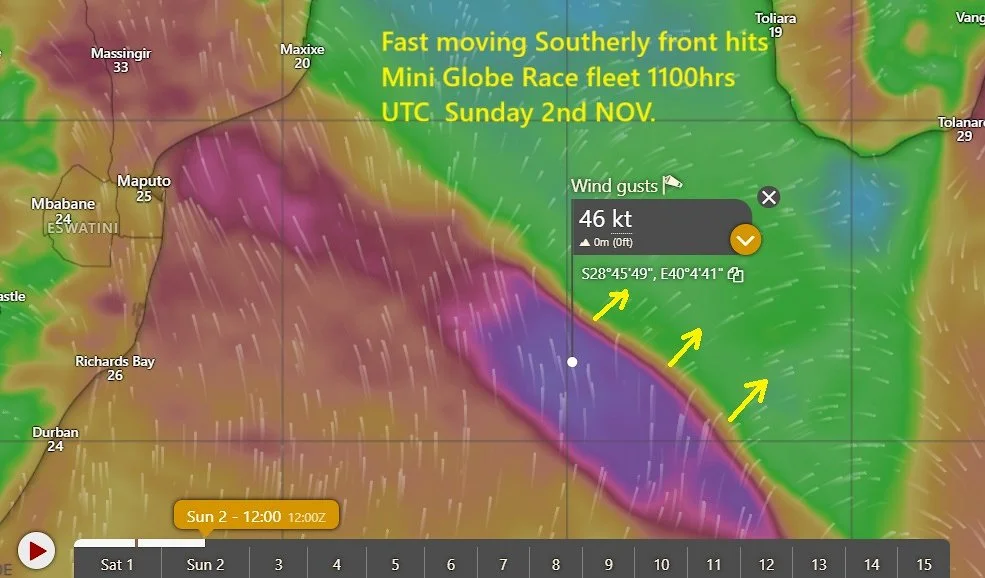
Front approaching the fleet enroute to Durban.
When the McIntyre MGR fleet glided into Durban Marina, they sailed straight into one of the warmest receptions any modern ocean race has received anywhere. The Royal Natal Yacht Club and Point Yacht Club have a history of welcoming voyaging yachts, going right back to the days of Slocum, Pidgeon, Moitessier, and Guzzwell.

The MGR fleet moored in front of the Royal Natal Yacht Club, with the Point Yacht Club in the background.
At 0045 on November 17th, with the lights of the commercial wharves reflected on the dark, still, harbour waters, Eric slipped Sunbear’s lines and became the first of the fleet to nose back out into the Agulhas Current, bound for Cape Town. Behind him a few hours later, in a staggered sequence of navigation lights and cheers, Renaud, Dan, Pilar, Ertan, Adam and Jakub set sail. The rest, with the exception of Keri, departed later that day. Keri’s beloved mother had died during his last passage, and he remained behind to attend her funeral online.
On this leg from Durban to Cape Town, only time on the water counted. Port time was voluntary, to allow for bad weather. Each skipper could start and stop at any time. The object was to leave whenever they could make a fast passage to the next port, hopefully avoiding serious gales. Most of the fleet opted to take this recommended inshore route.
Within hours, Renaud was back in the lead, clocking an outrageous 8.6 knots, while Dan, just astern, averaged 8.2. The rest were not far behind. Jasmine smashed yet another 24-hour record with 181 miles, reclaiming the title from Renaud, who briefly stole it from her with 180 miles the day before. “Fast, furious, cold, uncomfortable—and incredible,” said Jasmine’s mum, Susan, in a now-famous post. In less than two days, they were all in East London, 250 miles to the south, which rolled out the red carpet. The Buffalo River Yacht Club fed them, fixed them, rehydrated them, and probably would have adopted them if they had stayed another day.
The next window sent the fleet toward Mossel Bay. Spirits soared, winds dropped, AIS alarms screamed, and more than one skipper got so tired that they forgot what day it was. Pilar admitted, “Sometimes I don’t know how many nights I’ve been sailing. Things disappear…”
Josh, stuck briefly in Port Elizabeth after being headed by the breeze, received the ultimate South African welcome – craft beer, a hot meal, and new friends named Shane, Gordon, and Marcel. South Africans sailors love offshore voyagers. “Classy, genuine people well met,” Josh wrote.
Meanwhile Christian, nursing torn sails and a sore shoulder, ducked into Cape St Francis and was adopted by National Search and Rescue Institute (NSRI) Station 21 supporters, and said that he “needed a calendar to organise all the invitations.”
By the time everyone reached Mossel Bay, the verdict was unanimous: “Best stop of the entire race so far.” Clean, safe streets, good food, seals escorting boats out of the harbour –Mossel Bay became an unexpected MGR legend. Which was a good thing, as they were stuck there for a few days riding out inclement weather.
While they were waiting, Keri departed Durban on Origami. He decided to take the offshore, nonstop, route to Cape Town. Some of the veteran ocean voyagers I met as a teenager in Durban in the late 1960s chose this option, saying that they preferred the safety of sea-room over the dangers of seductive comfort, but it has largely fallen out of fashion now due to the reliability of modern weather forecasting and communications, which makes the port-hopping option a safer bet.
Keri’s reward was a mind-bending 24-hour run of 217-miles, the fastest ever recorded by a 580 (to date, ha ha). Surfing under a poled-out jib in 35–40 knot winds and 3-5m seas, Origami tore down the coast like a mythical creature. “There was no point trying to slow the boat,” Keri said. “She just wanted to go.”
He blasted past East London, past Cape St Francis, past the other entrants holed up in Mossel Bay – until a SW gale clawed him sideways in the most dangerous place, on the edge of the Agulhas Bank. Yet even that couldn’t stop him. He popped out of the current, wriggled around a calm patch, and crossed the finish line on December 1st at 0859 local time, the first 580 to finish Leg 3. His elapsed time of six days at sea, Durban to Cape Town, has only been matched by two other yachts, and they were both 50ft racing vessels! He beat Renaud’s time for this stage by 14hrs, but overall was still sitting in third place.
If you asked the fleet what the hardest part of the entire Indian Ocean crossing was, most will point to the final 10 miles into Cape Town. Table Mountain had one last trick up its sleeve. After a graceful night sail toward Table Bay, Ertan’s Trekka crossed the line at dawn – only to be hammered by 40- 50-knot katabatic bullets blasting down off the mountain. After his mainsail split, he tried to anchor but the boat dragged towards the rocks. He then called the NSRI and they towed him into port.
Jasmine’s arrival also became an epic. After a ship almost ran her down in broad daylight, despite her AIS and Echomax units being switched on, she was beset by calms while sailing up the Cape Peninsula, then struck by 50-knot squalls, then blown sideways by a 30-knot headwind. Then she ran out of battery power. She came very close to retiring from the race and calling for outside assistance, but conditions suddenly improved at dawn, giving her a beautiful view of the lights of Cape Town. She finally crossed the line at 10:31, exhausted but victorious.
Eric also had a not-so-fun time. One moment Sunbear was surfing past the Cape of Good Hope, then the boat fell into a hole with zero wind. Then they were slammed with 30 knots on the nose at the harbour entrance. “I needed to launch my kites again just to get in.”
Renaud and Dan crossed the finish line two minutes apart – then immediately disappeared back out into the bay. Tracker spectators waiting for them at the marina, where the morning breeze was gentle, were baffled. Were they having such a good time that they had decided to go for a jolly around the bay? The answer was that they had been blasted back out to sea by a 35-knot southeaster that had bypassed the marina undetected, and needed to reset storm sails before beating into harbour.
Christian arrived fatigued, bruised, grateful, and philosophical. He nearly fell overboard on the last night, when he slipped on the foredeck edge while lowering one of his A5 spinnakers, saved only by the middle safety rail. Before that, he had taken a jubilant self-portrait with the Cape of Good Hope in the background. “One thing is for sure,” he said on arrival, “life will be very different for me after the MGR. I am not going back to my old life.”
Pilar arrived smiling, despite multiple failed attempts in 35-knot headwinds to enter the harbour. She followed Jakub and Adam to refuge in a nearby downwind marina, entering Cape Town Harbour the next day. “I am finished with the Indian Ocean. It is not an easy place to sail,” she said. Having infamously said, during her first Atlantic crossing, that Peter Punk sailed like a snake, she had come to love her boat. She now talked to the boat every day. “We are a couple,” she said. “I understand him and I think he understands me.”
When Jakub finally sailed through the breakwaters of Cape Town Harbour, he found himself suddenly having to claw off the rocks in another katabatic blast. He arrived at the dock with his knees still shaking. He became famous for the amusing hats he wore at the beginning and end each major leg. This time, he was sporting an aviator’s hat, the type worn by Snoopy in the Charlie Brown cartoons.
When Adam rounded Cape Agulhas, he whispered to himself, “I never thought I’d make it this far.” Supporting the Ella Dawson Foundation – and now a newly-appointed ambassador for the charity – helped push him through the hardest days! There were plenty, but those last 10 miles… AGGH!.. There was no way Little Wren could enter the harbour, despite Adam’s wife waiting and watching from the shore. They met the next morning!
Josh arrived last, but in immaculate condition – as always. “Two of the best days of the entire circumnavigation were rounding Cape Agulhas and the Cape of Good Hope,” he said. “It felt like Florida sunshine… except it wasn’t.” This, more than anything, perfectly sums up the advantages of taking the inshore route, making best use of modern weather forecasts like Windy, accessed via Starlink. Roll over Beethoven, or in this case, John Guzzwell. Times have changed.
The final leg, up the Atlantic back to Antigua via Saint Helena Island and Recife in Brazil, began on December 28th, 2025. The wind died a few minutes after the gun, creating a true drifter in the lee of Table Mountain! Keri was first across the line, but was not to hold the lead for long. The use of electric engines were allowed five minutes after the start, and in the glass-out conditions prevailing, with wind just two miles to the west and visible on the horizon, most of the fleet fired up their engines and chugged off.

Jakub Ziemkiewicz waiting for the breeze after the start of Leg 4 off Cape Town.
Keri and Jakub decided to wait for the wind, but 20 minutes later Jakub changed his mind. Keri, who once said he’d rather come last than use his motor while racing, waited. By the time he finally got going, two days later, he was indeed at the back of the fleet! At 1200 UTC on the 29th, 24hrs after the start, the leaders were 150 miles away, sailing at 7kts.
Out front, a compelling duel developed. Renaud extended his advantage with disciplined sailing, though he reported a squall that briefly laid his boat over. Close behind, Dan consolidated second place overall, adopting a philosophical mindset. “I’ve lost my competitive nature,” he reflected, focusing instead on enjoying the journey and drafting a book about his voyage. All he wanted to do at that stage was hold onto his overall ranking. Or so he said. Immortal Game carried on sailing remarkably well!
The battle for third place intensified. Jakub, Adam and Pilar traded positions almost daily. Jakub credited his longer-than-standard daggerboards (a permitted variation) for helping Bibi hold a steadier course in the chaotic, washing-machine sea-state. Pilar briefly led the trio, celebrating New Year’s Eve with champagne in Peter Punk’s cockpit, only to later slip back to fourth place after finding lighter winds east of the rhumb line.

An ebullient Christian Sauer sailing Argo past the Cape of Good Hope, with three oceans in the wake.
Further back, Christian, in sixth place, and Jasmine in seventh, faced early setbacks with kelp wrapped around their keels – a common nuisance in the first days. Jasmine later cleared hers by entering the water – a risky manoeuvre she undertook with caution. Eric, the eldest entrant, and Jasmine, the youngest, engaged in a spirited tussle for seventh place, exchanging the lead several times.
Ertan and Josh reported some of the most pleasant sailing conditions. Ertan, ever the relaxed cruiser, spoke of sunny days, ample fresh food, and charging his devices with solar power. Josh, the methodical mountaineer-turned-sailor, enjoyed “the best sailing we’ve done yet,” though he too encountered kelp, which he cleared with a GoPro-assisted inspection and a swim. Obviously, as these two sailors showed, being a laid-back cruiser has its advantages!
As the fleet closed in on Saint Helena, the race solidified but did not simplify. Renaud arrived first on the morning of January 10th, completing the 1,700-mile passage in about 12.5 days. He marked the moment by toasting with Antiguan rum, having now sailed a full 360 degrees of longitude around the globe since the race started.

Dan in the South Atlantic between Cape Town and Saint Helena Island.
Dan followed hours later, noting that it was his 200th day at sea. Jakub secured a hard-fought third place on this leg, arriving at dusk – his best stage performance yet, having found what he called Bibi’s “secret sweet spot”. Pilar and Adam finished almost neck-and-neck, with Peter Punk just edging out Little Wren for fourth.
The island’s notoriously difficult anchorage lived up to its reputation. Jasmine arrived at midnight and tangled her mooring line around Numbatou’s keel, requiring Jakub’s assistance to free it the next morning. Eric struggled with a stubborn anchor that kept dragging in deep water, but couldn’t be retrieved. He needed a local diver’s help to re-set it. A couple of boats dragged anchor half a mile! The local sailing club, who had heard of the race through an interview with Jasmine on the BBC (the Saints were avid BBC fans), had laid special moorings especially for the MGR – but unfortunately there were not enough for all the fleet.
Gear wear continued to take a toll. Keri reported that his mainsail was now dotted with so many adhesive patches it that “looks like it’s got smallpox.” Christian mourned the sudden failure of his little-used A3 spinnaker, and Ertan was frustrated by expensive sail repairs in Cape Town that hadn’t held up. Jasmine faced repeated failures of her Hydrovane’s flip-flop frame, requiring creative on-the-go repairs with bolts and tape.

Little Wren resting on the mooring provided by the Saint Helena Yacht Club during Adam Waugh’s mandatory 7-day stopover.
As the fleet departed Saint Helena in staggered succession, two distinct narratives emerged – intense rivalries at the front and a more philosophical, cruising rhythm toward the rear. At the sharp end, the enduring duel between Renaud and Dan continued unabated. Renaud, employing a relentless watch system and strategic weight distribution, maintained a narrow but persistent lead. “Capucinette slides on the waves,” he reported, enjoying the downwind tradewind sailing, while warning of tougher upwind conditions to come on the last stage. Dan, in a more reflective mood, admitted he was “not really too focused on the other competitors,” prioritizing boat and personal well-being. And yet, his competitive spirit flickered, as he kept Renaud within 20-30 nautical miles virtually all the way!

During the long journey of the Mini Globe Race around the world, there’s time for more than sail changes—there’s time to reflect on life itself. Pilar Pasanau aboard Peter Punk.
Behind them, a spirited battle unfolded between Pilar and Jakub. Peter Punk slowly reeled Bibi in over several days of focused sailing. Jakub, grappling with a cracked daggerboard housing and a diet leaning heavily on canned goods, which gave him indigestion, remained the consummate conservative sailor, prioritizing boat integrity over raw speed – but he staying in contact with Pilar all the way. It had taken most of the world for Jakub to hone his racing skills – perhaps if the MGR were to go around one more time, he might even win! Despite missing his children, he was dreading the end of the race.

Exhausted after a rough night at sea, Eric fights sleep while filming a vlog update aboard Sunbear between Saint Helena and Recife..
Further back, Eric and Keri were also engaged in a gripping match race, exchanging the lead multiple times. Eric joked over the radio, “Oh, please slow down, Keri, give an old man a chance!” as Keri pressed hard. Keri, finding dead downwind sailing “dull,” filled hours with celestial navigation practice, Portuguese lessons, and even contemplated doing a bit of creative painting (at which he is very talented). Both skippers spoke of the exhausting heat, with cabin temperatures soaring above 33°C.
Christian, despite battling persistent shoulder pain, sailed a remarkably consistent course. Often hand-steering due to unruly cross-seas, he nonetheless overhauled Adam in the final days. Adam found the passage to Recife particularly taxing, frustrated by the “terrible sea-state” and the limitations of his South Atlantic self-steering unit in confused following seas. “I’ve just had enough of downwind sailing,” he confessed to me during a patchy Starlink call. He experienced a very low spell mentally, when he wondered if he could cope long enough to make Recife. Luckily, it passed.
Ertan, as usual, made it all look effortless. He sailed with poled-out headsails, napped in his cot, and enjoyed a fresh-provision bounty from Saint Helena friends – a stark contrast to the freeze-dried and other processed food diets of his peers, who had struggled to buy fresh food on the island. He even had a bountiful supply of eggs – rarer, dare one say it – than hen’s teeth on Saint Helena.
Jasmine, recovering from her epic swim around Saint Helena (the sort of thing one does while resting between race passages), settled into a steady rhythm aboard Numbatou, though faced challenges with a jammed furler and a delicate A3 spinnaker that was on its last legs. Its glorious, bright pink colour had faded to a pale rose.
Bringing up the rear, Josh chose a northerly route to align with traditionally favourable currents, and giving him a better wind angle, adding minimal distance for maximum comfort. His passage became one of deep reflection and appreciation for solitude, with stunning sunsets and full-moon nights. “Every day feels the same, like that movie, Groundhog Day,” he mused, savouring his final long ocean passage before the finish.
Renaud secured yet another line honours win at 0929 UTC on January 30th, with Dan arriving just hours later at 1408 UTC. Images quickly circulated of the friendly rivals sharing a well-deserved cold beer in the 30+ heat on the Recife Marina pontoon. Pilar claimed a hard-earned third place on January 31st, already looking ahead to Carnival celebrations and the final leg to the Caribbean.

Jakub in the doldrums between Recife and Antigua, with a squall approaching.
Jakub sailed Bibi through the breakwaters later that same day, securing fourth place. His achievement on a shoestring budget, staying deeply in tune with his boat, echoed the spirit of his inspiration, Bernard Moitessier (not to mention his desire to go around again!). Christian took fifth place on February 1st, after enduring significant physical discomfort with characteristic grit. Adam arrived shortly afterwards to claim sixth place, visibly relieved to be free of the incessant rolling on this predominantly downwind leg.
The Keri-Eric duel finally resolved in Keri’s favour, with Origami taking seventh place. Eric, ever the entertainer, celebrated his approach to Recife Marina by serenading followers with an original song, titled, “Lonely Sailor.” Jasmine continued her steady progress, with an ETA of February 4th, enjoying calm conditions towards the end of the passage, giving her time for recovery and reflection. Ertan cruised in comfortably, as always, and Josh, though the last skipper at sea, reported the fastest 24-hour speed in the fleet one day, slowly closing the gap, and still savouring his final days of oceanic solitude.
The fleet of 11 Class Globe 580s set sail from Recife on February 19th, 2026, drifting out of the harbour in light winds. Ahead lay the last 2300-mile leg of a 24,000-mile solo race around the planet, offering skippers the tactical challenge, once again, of navigating through the doldrums, plus the risk of collision with floating logs from the Amazon, extreme currents, and winds more on the beam than in previous stages – even forward of it during the last days into Antigua. Sails were tired and sun damaged, but the boats remained strong. Eric took a 48hr time penalty before departure for fitting a new mainsail, while others took a chance that their sails would hold together.
Keri and Christian headed offshore, looking for the current and a stronger breeze, but the rest of the fleet held inshore, sailing in light headwinds but laying the course. 14 hours later, Keri was 40 miles behind Pilar, who was leading the fleet for the first time. More than a few had stated that they hoped to get in front of Renaud on this last stage of the MGR. He had won every Leg so far! This passage, however, proved to be a classic “sting in the tail,” throwing everything it had at the fleet as they fought their way north.
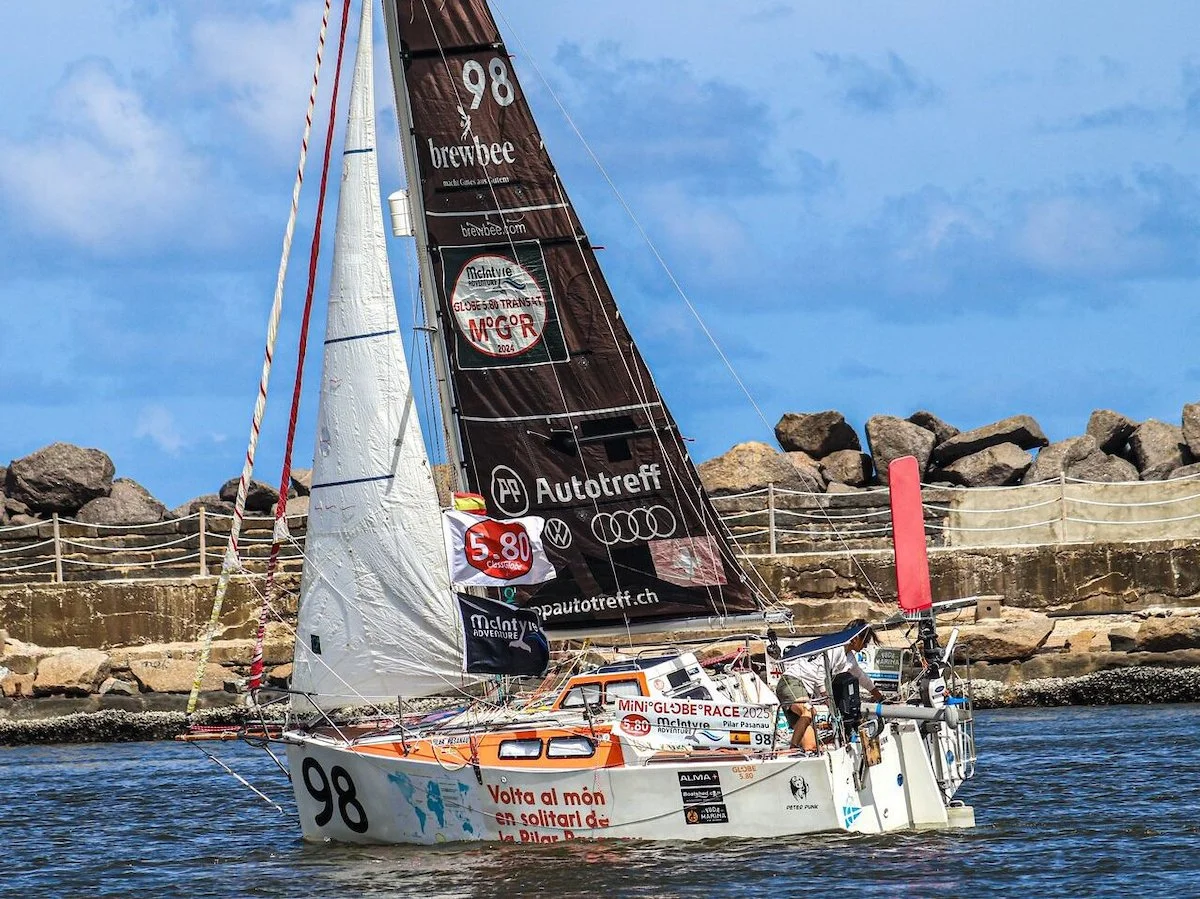
Pilar and Peter Punk departing Recife.
On top of this, the vibrant carnival city left a parting gift for several skippers. Keri and Jasmine both departed battling high fevers and fatigue, while Jakub and Josh struggled with gastric issues, making the first few days a gruelling test of willpower.
The race up the coast of South America became a fascinating tactical battle. The leaders, Renaud and the ever-determined Pilar, hugged the Brazilian coast, chasing a powerful 1.5-knot current that propelled them forward. “It’s just a lottery,” Renaud chuckled during a check-in while dodging squalls and fluky doldrums. “Each time you have a cloud, it will either push you if you are ahead of it, or stop you if it is in front of the bow. I am hoping for more clouds to pass my transom.” He managed to get ahead of Pilar again off the coast of Guyana when a tactical decision gave him the advantage.
Dan, hot on their heels despite a pulled back muscle and three days recovering in his bunk, still claimed he was only focused on having fun. “I’ve got nothing to prove,” he said, while dodging unlit fishing boats that made sleep a rare commodity.
Jakub, now recovered from his fever, revelled in the conditions and in having wind on the beam, his favourite point of sailing. 600 miles from the finish, he fell heavily in the cockpit while reefing the mainsail. Fortunately, there was no injury to anything more than his pride perhaps, since the incident was captured live on a video feed. To those watching, his sudden disappearance backwards from the viewfinder smacked of slapstick comedy. One minute he is chirping away happily – the next minute nothing – then he pops back up with a sheepish look on his face.
Further back, the fleet was a mix of strategic gambles and sheer grit. Christian, still battling the shoulder injury that had plagued him since his Atlantic crossing in the 2024 Globe Transat Race, was persevering with remarkable resolve. Adam, who nearly threw in the towel psychologically on the previous passage, was back in high spirits after a “delightfully dry” equator crossing, though he admitted that the final upwind miles “seem to take forever.” It hadn’t been so long since he’d been going nuts as Little Wren rolled down to Rio – or in this case, Recife – and he was wasn’t about to complain too loudly.
Soon, though, the conditions became brutal. Torrential rain, 40-knot squalls, and confused seas pummelled the tiny yachts as they battled over the Equator and back into the Northern Hemisphere. Jasmine reported being knocked down with her cockpit flooded, and fighting to control Numbatou for six hours straight. “I hate squalls,” she posted. “They don’t like to at least kiss you first out here.” Eric faced a 45-knot squall that came from nowhere, and was grateful for his new mainsail. The old one would not have stood a chance. He then succumbed to asthma, with his respiratory system aggravated by the constant moisture.
Meanwhile, Ertan was enjoying a slightly more civilized passage. By sticking to his routine of reducing sail at night and retreating to his dry cabin for an uninterrupted sleep, he kept Trekka in pristine condition. “The trip must be comfortable and fun,” he said, sipping tea and deciding what to watch next on Netflix. Despite slipping back a few places in the rankings, he was as upbeat as ever. He was already planning new adventures – in October 2026, he was at sea once more, lying in 3rd place in the Golden Globe Race aboard his Rustler 36, Miss Beagle. It is pleasing to see, in his live GGR feeds, that he is as sanguine as ever!
As the fleet cleared the mouth of the Amazon, a new enemy appeared: massive mats of sargassum seaweed. Dan described his speed halving as he ploughed through a field of it, while Josh was constantly clearing it from Skookum’s rudder. Every skipper lost time and miles to this pernicious weed.
With just under 400 miles to go, the final tactical decisions were being made. The western gamblers – Renaud, Pilar, Dan, Keri, Christian – were riding a favourable current close inshore along the South American coast, but risked a hard beat to windward to reach the finish line. The eastern pack – Jakub, Adam, Jasmine, Eric, Josh, Ertan – hoped for a better wind angle and a shorter final sprint. One thing was certain – every one of these skippers had shown the courage to chase a dream. As they closed in on Antigua, they were all, in their own way, victorious.

Adam looking a little worse for the wear as he beats to windward across the Doldrums enroute to Antigua.
In the end, the western group emerged victorious, finding a small lift in wind angle from north-east to east in the final days, allowing them to squeak over the finish line off Falmouth Harbour, Antigua, without tacking. The eastern group, though, were barking at their heels and it was a remarkable close finish all around.

On 8 March 2026, Australian sailor, Dan Turner, aboard Immortal Game, arrived back in Antigua, stopping the clock at 184 days, 1 hour, 20 minutes and 42 seconds. Credit Rob Havill.
Records were broken. Jasmine’s Numbatou became the smallest British yacht to be sailed solo around the world by a woman, while Pilar became the first Spanish woman sailor to circumnavigate solo, in the smallest Spanish yacht ever to do so. Josh set a record for the smallest American-flagged yacht to circumnavigate, solo or otherwise. All this followed in the footsteps of the late John Guzzwell, who in 1955 – exactly 70 years before – set off in Trekka to sail solo around the world, and subsequently held the record for the smallest yacht to do so for many years.
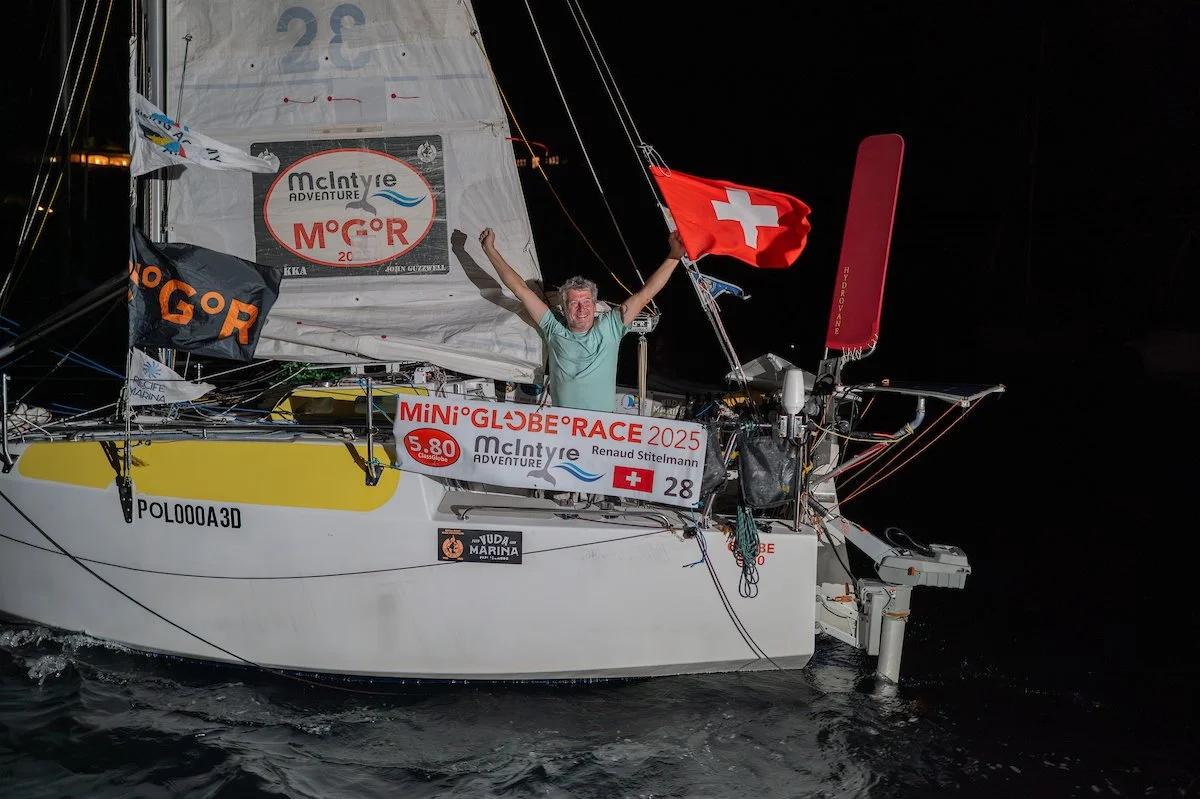
Renaud was the first home again, though Pilar kept him honest, nipping at his heels all the way, finishing this stage in second place. Below are the final results for all four legs combined.
1 Renaud Stitelmann Capucinette 180 days 11 hours 25 mins 57 secs
2 Dan Turner Immortal Game 184 days 1 hour 20 mins 42 secs
3 Keri Harris Origami 190 days 21 hours 4 mins 45 secs
4 Pilar Pasanau Peter Punk 191 days 16 hours 10 mins 4 secs
5 Adam Waugh Little Wren 199 days 21 hours 59 mins 28 secs
6 Jakub Ziemkiewicz Bibi 200 days 13 hour 18 mins 7 secs
7 Christian Sauer Argo 201 days 19 hours 10 mins 23 secs
8 Eric Marsh Sunbear 213 days 13 hours 39 mins 34 secs
9 Jasmine Harrison Numbatou 214 days 16 hours 43 mins 8 secs
10 Ertan Beskardes Trekka 216 days 30 hours 2 mins 8 secs
11 Joshua Kali Skookum 223 days 2 hours 11 mins 39 secs
The statistics are impressive for such small yachts. Top speed recorded was 17kts, and the best 24hr run was 219 miles, both set by Keri in Origami between Durban and Cape Town. Extreme conditions in the Southern Ocean delivered 6-7m seas. While most entrants experienced knockdowns at some point, the one-design ALMA Globe 580s have proven themselves. None suffered structural damage to their hulls, or had rudder or keel issues, and when they arrived back in Antigua were basically ready to go around the world again! The Quantum sails performed well, but the material suffered badly in the sun. Spreader issues needed constant attention, and the electric outboards were at times failing, but that was it. 15 yachts started, 11 completed the circumnavigation, while the four retirees did so for personal or economic reasons.
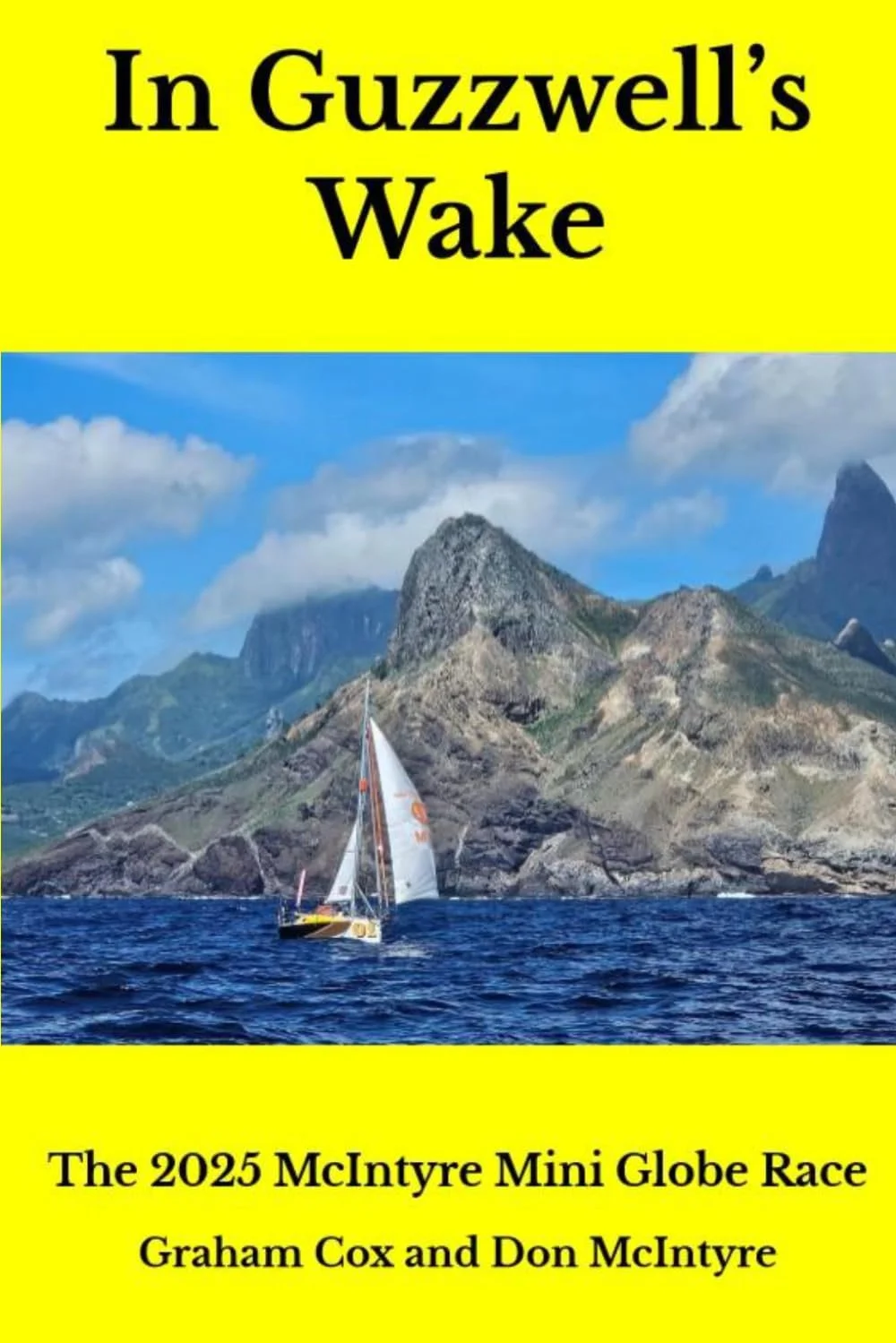
Graham Cox was the official scribe for the Mini Globe Race, talking to each skipper once a fortnight while they were at sea. He is the author of In Guzzwell’s Wake, the official story of the Mini Globe Race. He is also the author of Last Days of the Slocum Era, the acclaimed memoir which is also a selective history of cruising under sail in the days before satellite navigation. Both titles are available from Amazon, and the e-book versions are also offered by Kobo.
All images used in this article are the property of McIntyre Adventures and their respective owners, and may not be reproduced without permission.