
The Grain Races - Part Three: The Discovery Phase
In the footsteps of Gustaf Erikson in Åland and south eastern Finland
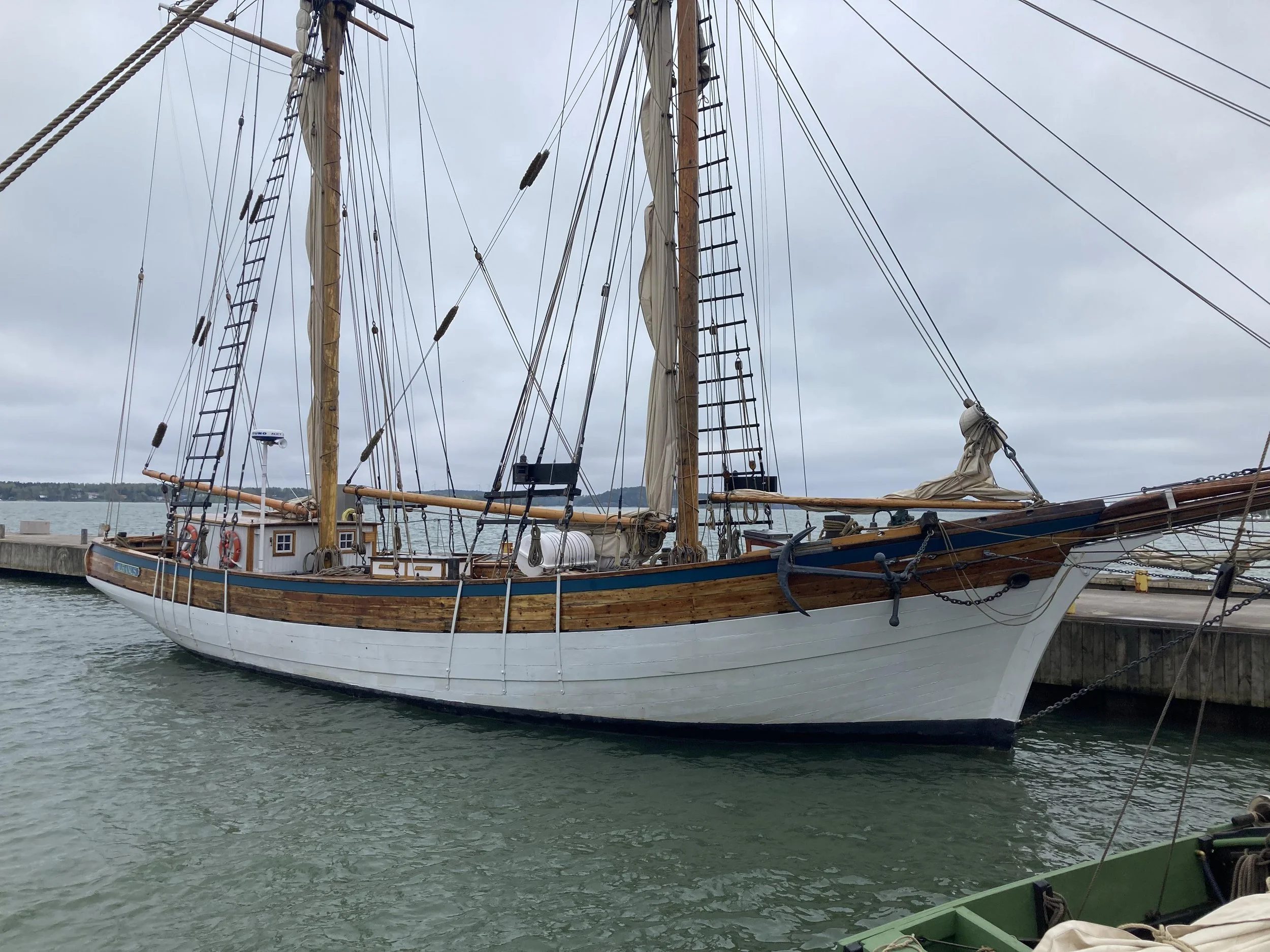
Galeas: the second ‘Albanus’ in Mariehamn, May 2026
A Model Maker’s Pilgrimage
By Jeremy Brown
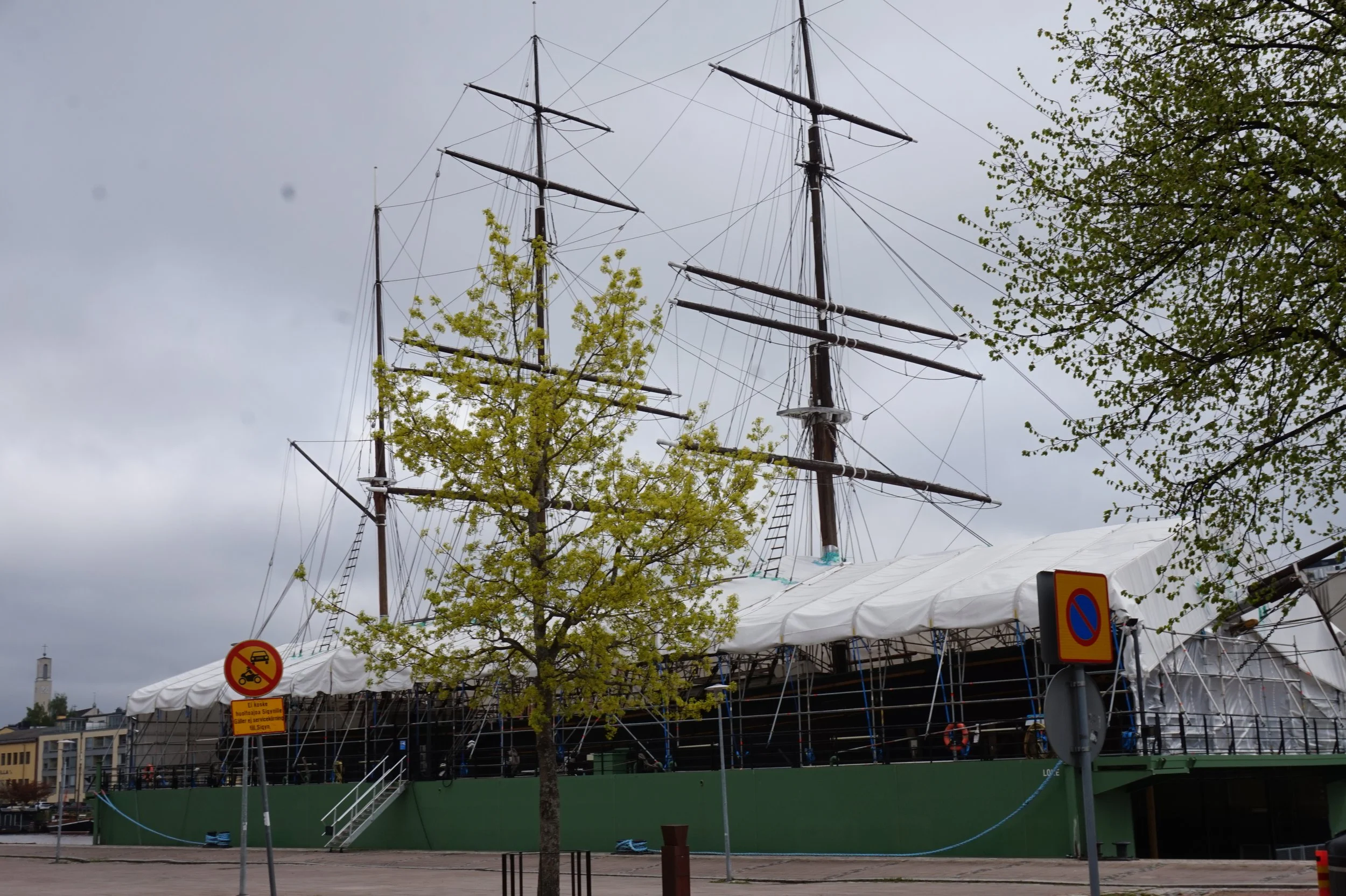
Turku: Forum Marinum’s museum ship, three masted barque ‘Sigyn’, hiding under wraps in the purpose-built floating dock, ‘Loke’, Turku, May 2026
Following on from Part 2 of our article, Part 3 is entitled the Discovery Phase. With preparations made and confirmation from our various contacts in museums in Mariehamn, Åland Islands and Turku, Finland, that we would get off-season access to critical aspects of their facilities, we were prepared for the fact gathering we had pre-planned for each centre.
For now, after arriving in Mariehamn as described in Part 2, we would be focusing on the Sjöfartsmuseum (maritime museum) and its Director, Dr Hanna Hagmark, their beautiful museum ship, four-masted barque Pommern and contacts Hanna had arranged for us with two experts, Henrik Karlsson and Allan Palmer. As an added bonus, and to our surprise, a very fruitful morning session in the museum led on, after a traditional lunch of Baltic herrings in the museum restaurant, to an afternoon visit with Allan to the Sjökvarteret, an Åland government supported precinct on the eastern arm of the harbour dedicated to the building of traditional style sailing and small craft. This was unexpected and a real bonus, as it traces the skills and design capability that led Sweden and Finland to larger sailing craft such as Sigyn in Turku.
This Part 3 of our article covers, therefore, visits to the two world-class maritime museums in Mariehamn and Turku, the visits and photo opportunities of the sailing vessels Pommern, Sigyn and Soumen Joutsen and, as a bonus, the latest traditional style galleas, the 25m Emelia under construction now in Mariehamn. It winds up with departure through Helsinki, with a quick look at artifacts on the city’s world heritage listed fortified island, Suomen Linnar, where-another connection-the badly hogged Sigyn received the emergency work that started the process that saved the hull from collapse.
Mariehamn – Western arm
The following historic photograph of square-riggers in the Western arm of Mariehamn in summer is sourced from a framed photograph in the pilot house at Kobba Klintar, attributed to the Ålands Sjofartsmuseum. It shows several Gustaf Eriksen owned square-riggers in the Mariehamn’s Western harbour
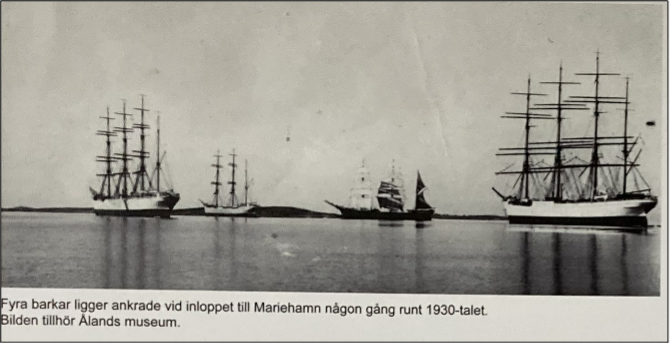
An undated photograph (1930s?) in the Kobba Klintar pilot house. Research and other sources identify the ships taking a summer break as (l-r) Viking, Killoran, Penang ghosting into the anchorage, and far right, Herzogin Cecilie.
Despite having missed out seeing our ferry’s approach to Mariehamn, this disappointment was fully outweighed by a trip a few days later by small boat out to the wind-swept extremities of the harbour, punctuated by a rolling commentary by our tour guide for that day, Åland islander Vilhelm Holmberg. The historic photographs on the walls of the old Kobba Klintar pilot station in its remote location and the almost palpable atmosphere of the old timber buildings, took us right back to those far-off days. It became easy to visualise the harbour studded with square rigged masts and yards. More about that side trip later…
An interesting comment on the granite formation of the Baltic islands by Vilhelm Holmberg in Mariehamn was that while Stockholm, Åland and south western Finland (Turku) archipelagos similarly comprise very evidently granite-based islands, the coloration of the shoreline changes. The rock of the Stockholm archipelago is mostly light grey, which darkens somewhat when wet, as is the Finnish side approaching Turku, whereas in the Åland archipelago in mid Baltic, rock is distinctly pinkish, lending a rose tint to the whole of Mariehamn, particularly when it is wet, clearly from the use of locally quarried granite chip on the roads, paving, building facades etc.
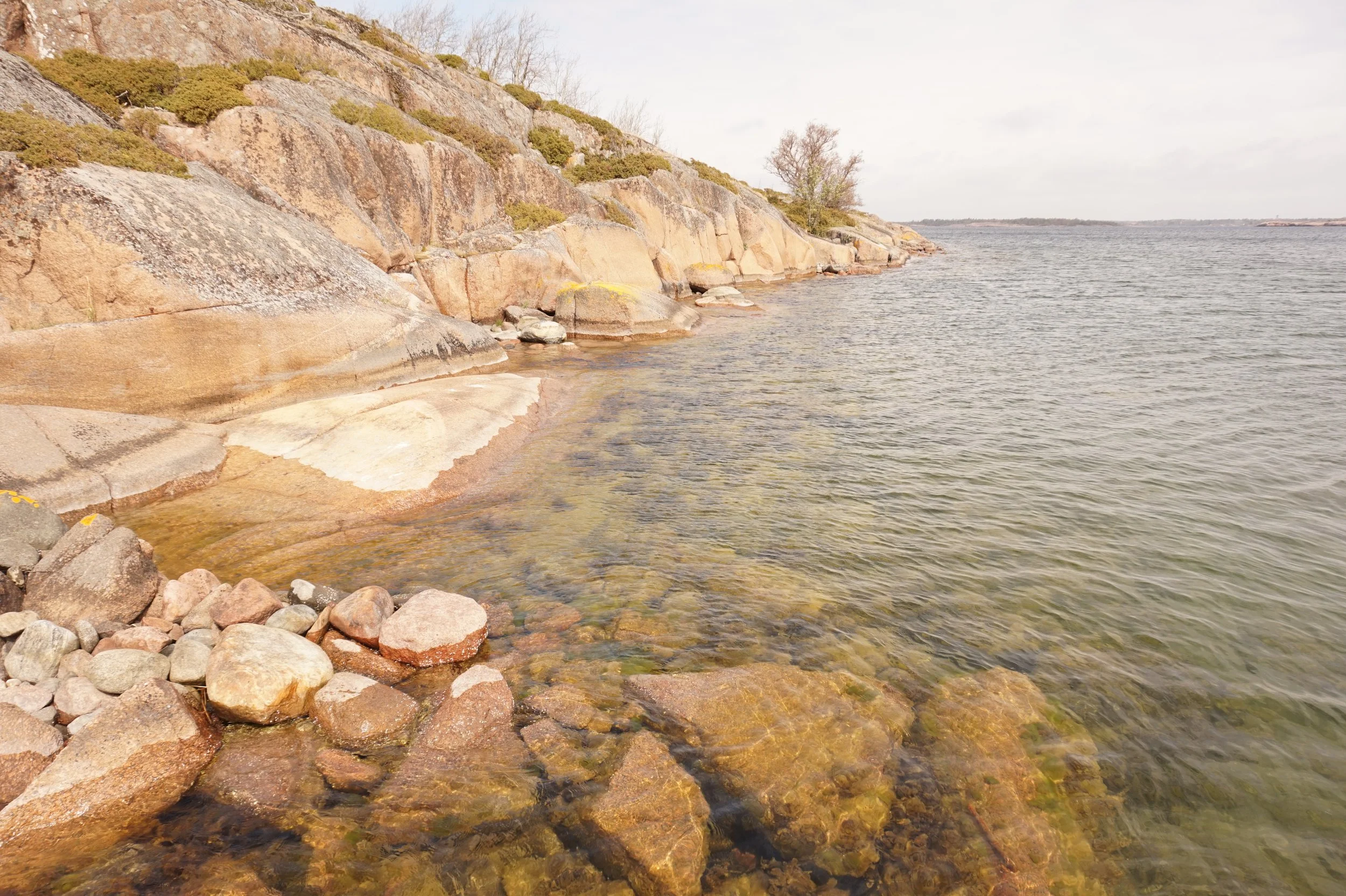
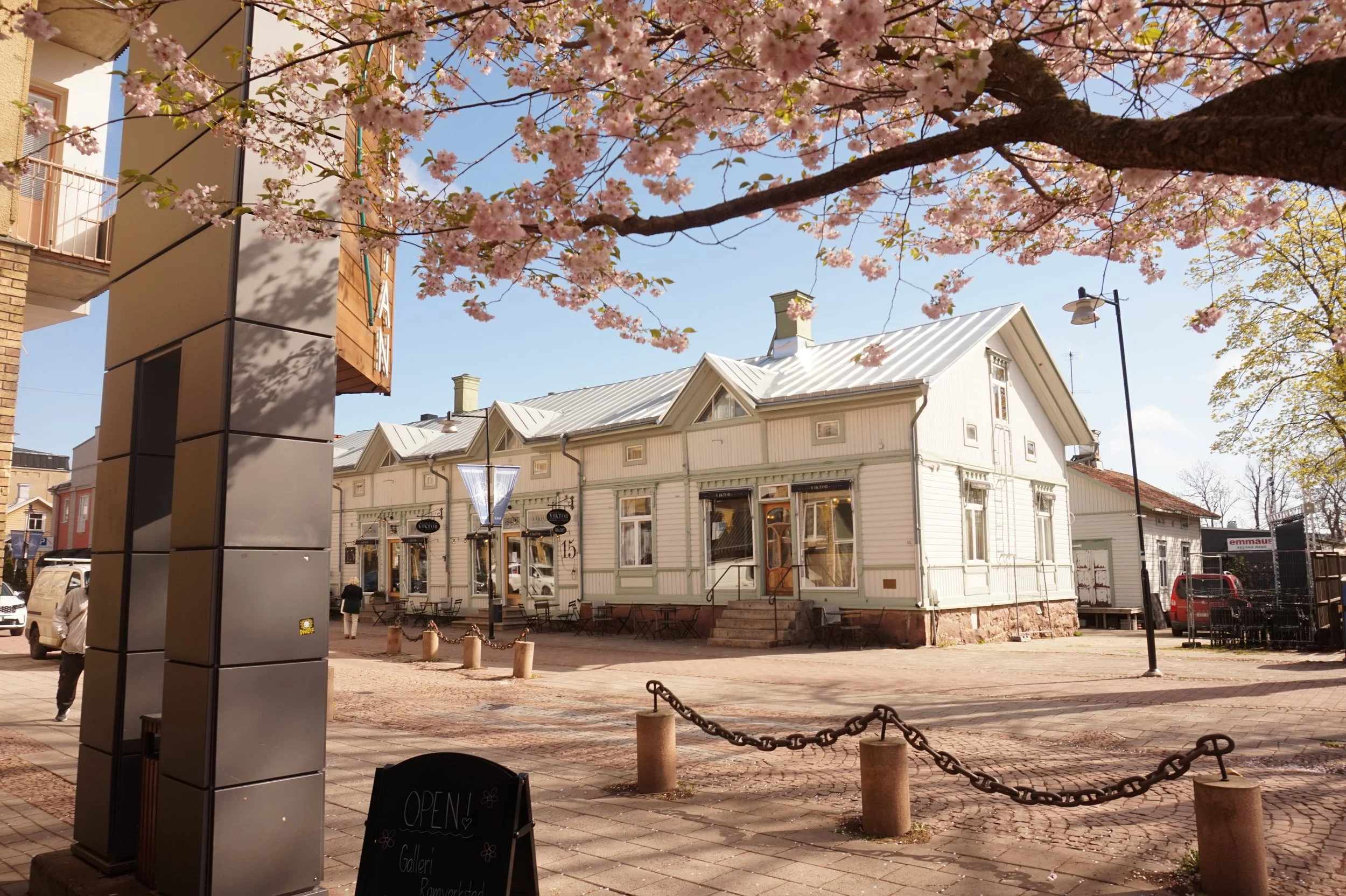
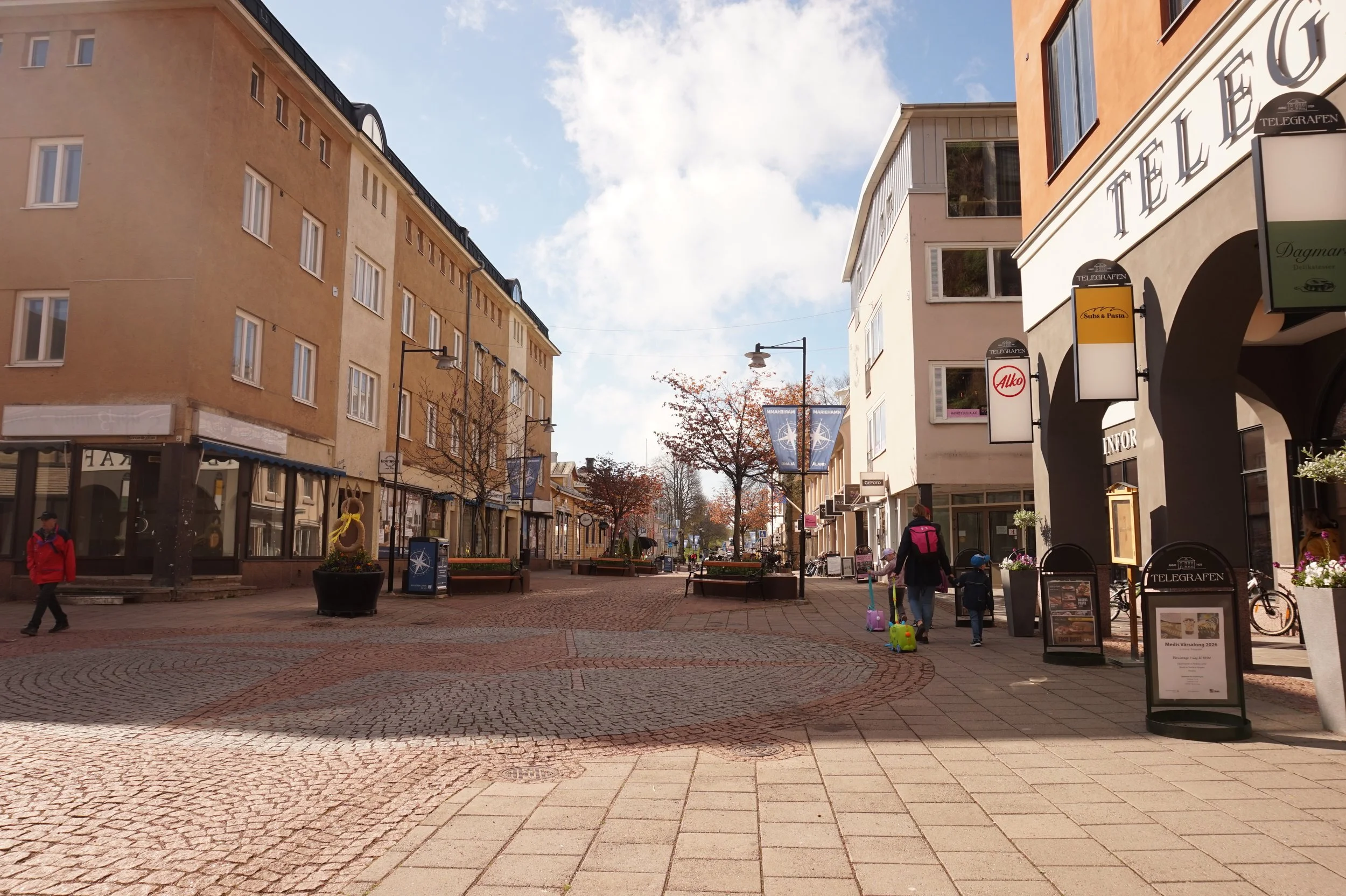
Pink granite on islands in the Ålands archipelago reflects in roads, paving and building façades of Mariehamn CBD.
The visit to Mariehamn was the central item on our itinerary, with the main thrusts being to visit (a) the maritime museum and (b) the 4-masted barque Pommern, a key ship in Gustaf Eriksen’s fleet and in the grain races, and (c) to seek a deeper understanding of Mariehamn’s place in the grain race era. And to research Archibald Russell’s figurehead for modelling purposes, of course!
The museum visit was in two parts -the first an initial face to face meeting with the Director of the maritime museum, the charming and informative Dr Hanna Hagmark, and a guided tour of their museum ship, 4-masted barque Pommern, afloat but permanently moored on the harbour adjoining the museum. To accomplish these objectives, it was agreed with Dr Hagmark that we would meet her for discussions on the first day of our three-day visit, and the tour of the vessel Pommern was booked for the last day of our visit. In the interim, we had arranged some one-on-one trips to view historic sites, and, importantly, as mentioned above, a trip by boat to the old Kobba Klintar pilot station, which still guards-in spirit anyway- the entrance to Mariehamn harbour waters and had seen service throughout the period we were researching.
The final step before a return to Australia from Helsinki, was to be a visit to Turku in southwestern Finland, a short distance from Mariehamn as the crow flies, but once again, we resorted to ferries to get a feeling for the matching archipelagos of small islands that stretche almost the whole distance between the two cities.
Before we take that next step, in addition to the guided tour of the Pommern, there was time in Mariehamn to chase down some unanswered questions about Gustaf Eriksen and his cohorts in their homes and offices in the Åland Islands. These were predominantly answered by the very knowledgeable and enthusiastic Director at the Maritime Museum, Dr Hanna Hagmark, and by two helpful and informative senior ex-seafaring Ålanders, Henrik Karlsson and Allan Palmer, whom Dr Hagmark had lined up to talk to us on the subject of square-riggers, their operations and their management under Gustaf Eriksen and his shipping cohorts (allies, affiliates – or competitors?).
In the Åland Sjöfartsmuseum, a side objective was to seek details – archive photographs etc. - of the figurehead for my current model of the Archibald Russell. The original figurehead was a gilt and painted carving, very decorative, but not glorified by a scantily clad females that figure so prominently in ship photographs. The only sources have grainy silhouettes but no detail, or colours. Rather than pictures, the Director led me downstairs straight to the original figurehead itself, part of the museum’s gallery of famous figureheads.
![IMG_4153[1].jpg](https://images.squarespace-cdn.com/content/v1/5f83c5947bb62b2036f18924/1783583123295-7JRSD77GMN5YBXWQOX0V/IMG_4153%5B1%5D.jpg)
![IMG_4158[1].jpg](https://images.squarespace-cdn.com/content/v1/5f83c5947bb62b2036f18924/1783583147194-AUB70RZNSTREQ6H5Q4QE/IMG_4158%5B1%5D.jpg)
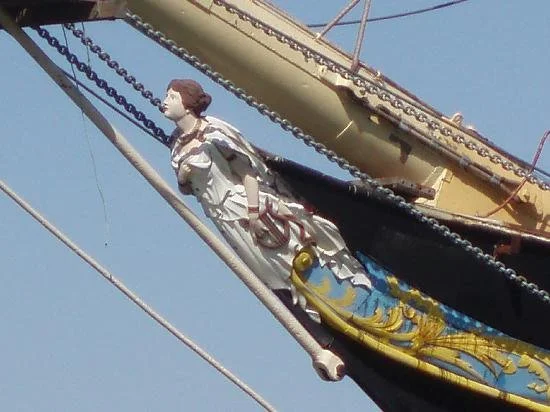
Figureheads in Mariehamn Sjöfartsmuseum: left-to right, Archibald Russell; Herzogin Cecilie; and Pommern’s replacement figurehead as it now appears on the ship
The Director then introduced us to the two experts she had lined up on our behalf to provide first-hand knowledge of the sailing ship era, which – true old sea salts as they were - they did very ably. Henrik Karlsson, a former Director of the museum (who also was kind enough to proof read this article and added some very worthwhile comments) and Allan Palmer, an author, artist and expert on traditional boats. Both of them ex seafarers who, with their families before them, had actually sailed on square riggers, added the human aspect to the extensive collection of artefacts, models, dioramas and relics held by the museum. As prize exhibits, the figureheads of many famous sailing ships are preserved, and multi-skilled Allan Palmer had even carved a full-sized replica for installing on the Pommern when the original was found to be rotting under its many coats of paint. He also had a hand in the design and construction of the remarkable dioramas in the museum, and his paintings and photographs grace both the ship building precinct Sjökvarteret (see below) and his photographs books such as the Bjorn Svensson 1983 monograph Pommern.[1]
The museum has a very well-presented collection, with a focus on the big sailing vessels. As mentioned above, a striking part of the exhibits is a collection of actual figureheads from some of the best-known ships, including of course the Pommern, whose deteriorating original figurehead was replaced by the perfect copy by Allan Palmer, along with those of Herzogin Cecilie, Archibald Russell plus many others. Ship models and dioramas illustrate better than words could the maritime history. Other exhibits include the actual saloon and captain’s accommodation recovered from the wrecked Herzogin Cecilie, and a remarkable reconstruction of the poop deck and steering gear of such ships. Our experts joined us for lunch in the museum’s excellent restaurant –- a meal of little Baltic herrings and the ubiquitous pureed potatoes was recommended by the two experts. How could you not enjoy such a traditional meal seeing through the windows the whole length of the barque Pommern? Clearly identifying my interest in the Ålanders shipbuilding history, following the tour of the museum, Allan Palmer provided a tour of the area on the shore of the Eastern Harbour that has been made available by the city for building traditional wooden vessels. Since this fitted neatly with discussion on Swedish wooden ship design, the following is a detailed view of the Sjökvarteret and some of its products.
Traditional boat building skills alive and well – the Sjökvarteret
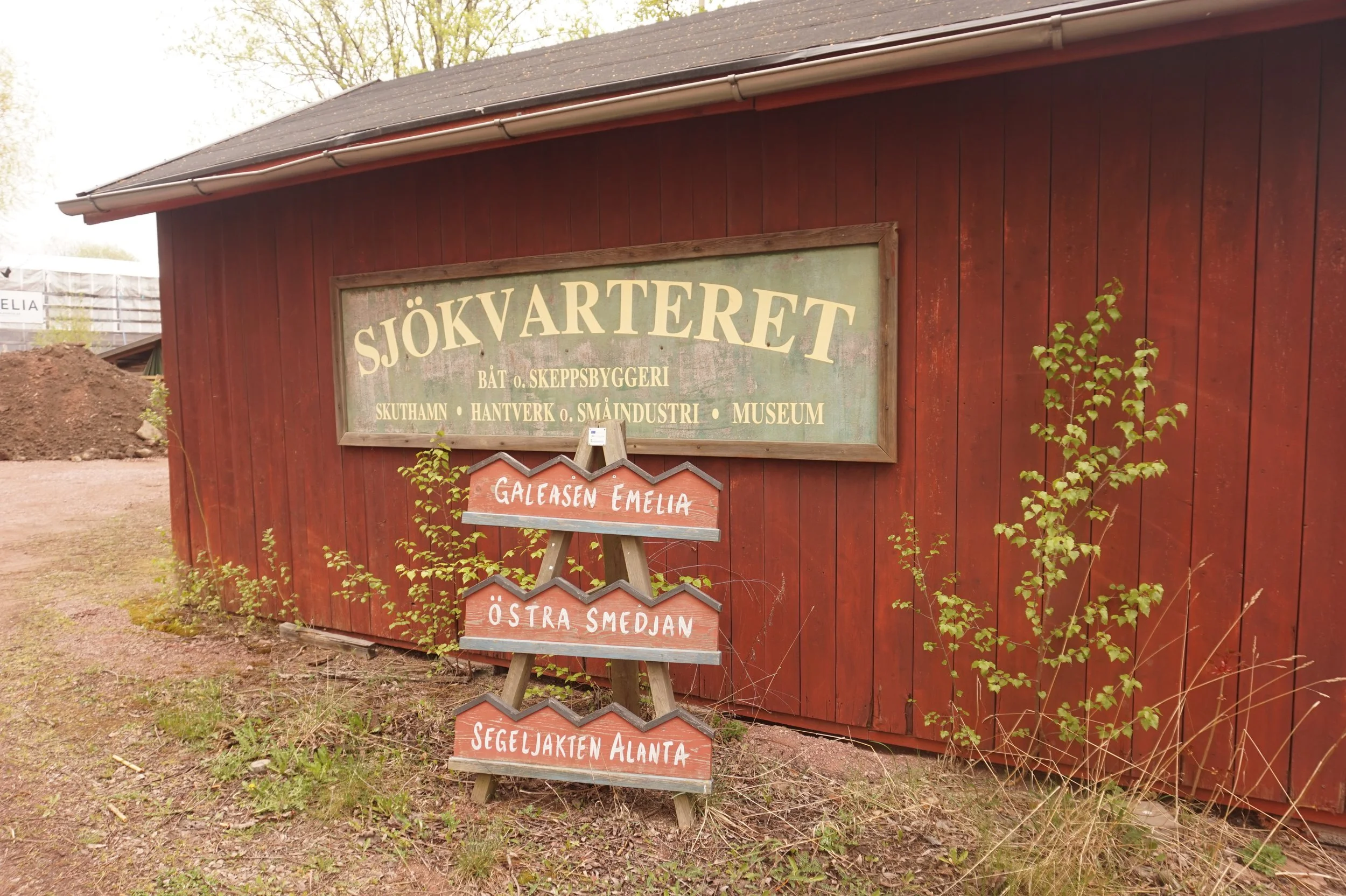
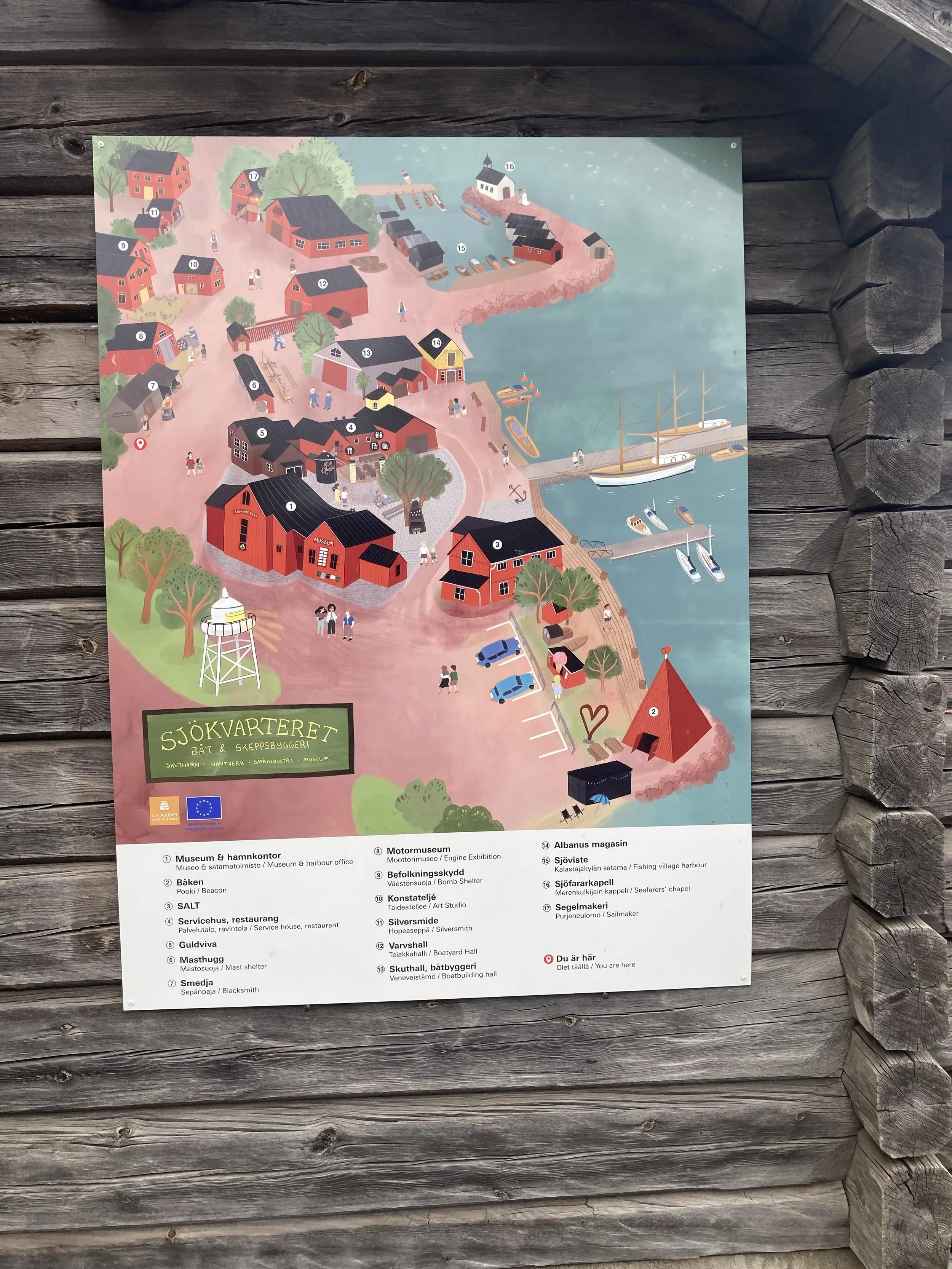
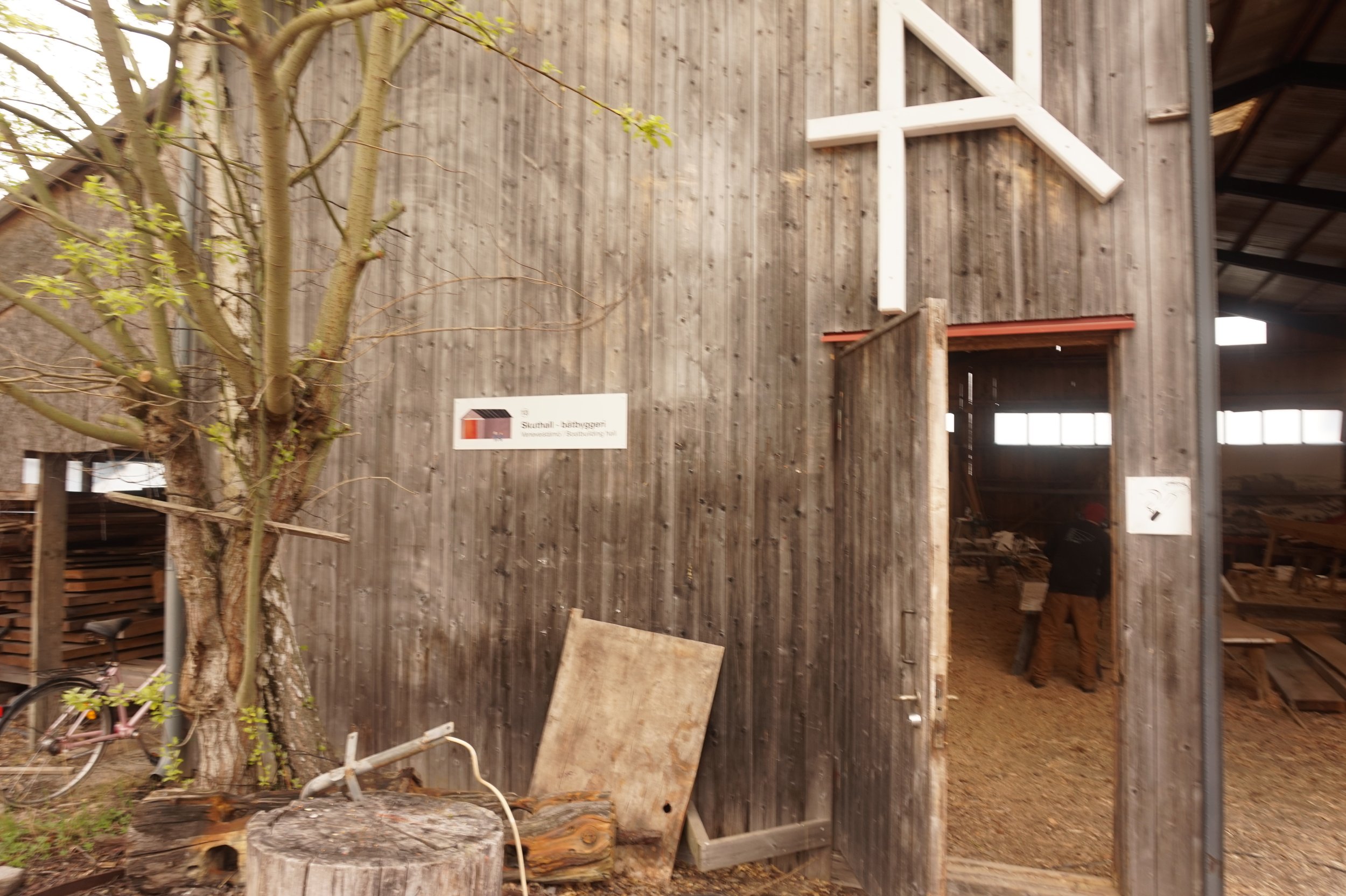
On an area of previously underutilised land on the shore of the Eastern arm of Mariehamn, a boat- and ship-building precinct has been developed for the community on land understood to have been provided by the city of Mariehamn. Entitled Sjökvarteret– bat & skeppsbyggeri (translated as Maritime Quarter- boat and ship building), the Sjökvarteret extends several hundred metres along the shoreline, comprising modern timber sheds of varying sizes, well equipped with modern amenities but built along traditional lines, all available for heritage related building projects. Ample wharf space is provided, with specialised shore facilities include mast storage, a forge, a steaming box and one large temporary shed over a slip on which a traditional 25 metre galleas Emelia, (a faithful replica of the original galeas Emelia built in 1889-90) is under construction, due to be launched in July 2026. To quote the website Emelia.ax, the latest galeas “is being rebuilt with modern solutions where environmental and sustainable standards are on a high level…”
An interesting connection to our main theme (Gustaf Eriksen) is that the original galeas Emelia, launched in 1890, was built by master shipwright Erik Söderstrom, from Geta, in Åland’s north, and designed to carry timber from Åland to Turku. Söderstrom also built the topsail schooner or barquentine Ingrid, in which Gustaf Eriksen initially bought shares and, eventually, ownership. The Emelia.ax website also notes that the original Emilia was “a little sister of Ingrid.” This is borne out by her lines, so similar.
[1] Pommern; Author Bjorn O Svensson, published by the Åland Nautical Club, 1988.
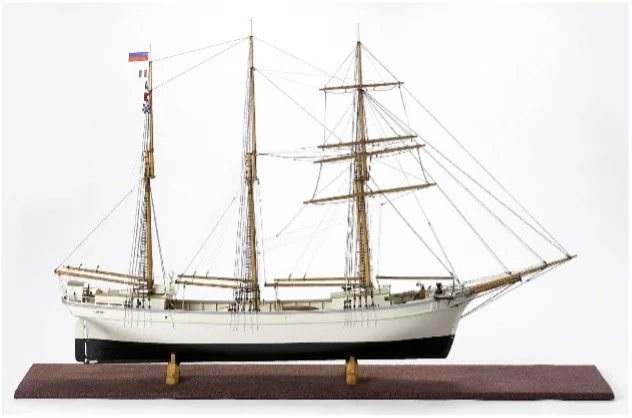
A model of Ingrid in the Royal Museum, Greenwich
In a side note, and another strange connection to our central theme, the last photographs of Ingrid we can find show her derelict in a tidal stretch of river near Fowey, Cornwall in 1937, only about 50miles from where Herzogin Cecelie, which started our story, had met her end the previous year.
Probably adjacent to where the Emelia is currently being built, historic photographs reveal that among vessels under repair there previously was the barque Sigyn, in her floating dock Loke, both of which we feature later in this article, detailing our visit to her during our time at Forum Marinum in Turku, Finland.
Alongside the southern wharf/breakwater was the renowned 30 metre schooner rigged galleas Albanus, built in 1988, whch has taken part in several Tall Ships Races and has been awarded for goal oriented work with young people by Sail Training International. She in turn is replica of the original Albanus but is now
Sjökvarteret - Traditional vessel construction area eastern arm, Mariehamn
![IMG_4172[1].jpg](https://images.squarespace-cdn.com/content/v1/5f83c5947bb62b2036f18924/1783583535554-ABDTSTMHXT5L84V85YFU/IMG_4172%5B1%5D.jpg)
Sjökvarteret Site map and major projects board – Galleas Emelia and Segeljakten Alanta discussed below feature prominently and the latest version of 30m galleass Albanus.
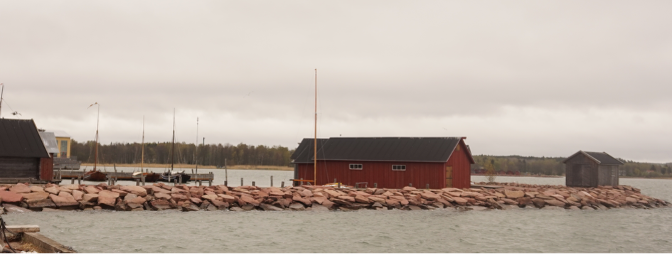
The Sjökvarteret breakwater of typical pink Åland granite and moored beyond several traditional jakt as built at the precinct
One of the larger sheds is being used currently to build several small clinker boats, but medium sized sheds are available to build varying sizes of oka, jakt and galleass. Sheds close to the water can be converted into launching ramps by removing the end wall and bull-dozing a ramp to the water’s edge. In a temporary steel framed plastic covered slip, the full-size (25m 100 tonne) galleass style vessel, Emelia, is under construction, due to be launched in July 2026.
Special facilities include a long shed for storage of masts, rigging and long timbers drying for masts, spars etc.; a forge and a steaming box and furnace for bending timber components (for frames, clinker construction, etc.); and storage for an array of small boats encompassing a range of traditional craft.
Lying alongside and on moorings are a variety of traditional boats ranging from oka and jakt up to galleass size, and including a well-boat or sump, with open top wells for live fish transport. The latter, Palmer reports, causes some concern among other boat users when under way, as its after deck is awash when the fish wells are filled, leading to frequent calls to safety authorities of a vessel sinking.
The term galleas, based on the older term galleon, referred to a two masted warship, and has been adopted for the current schooner rigged boats, usually 25 to 30 metres overall, built along traditional lines with wooden hull, these days carvel built, using locally sourced (Baltic) pine and oak.
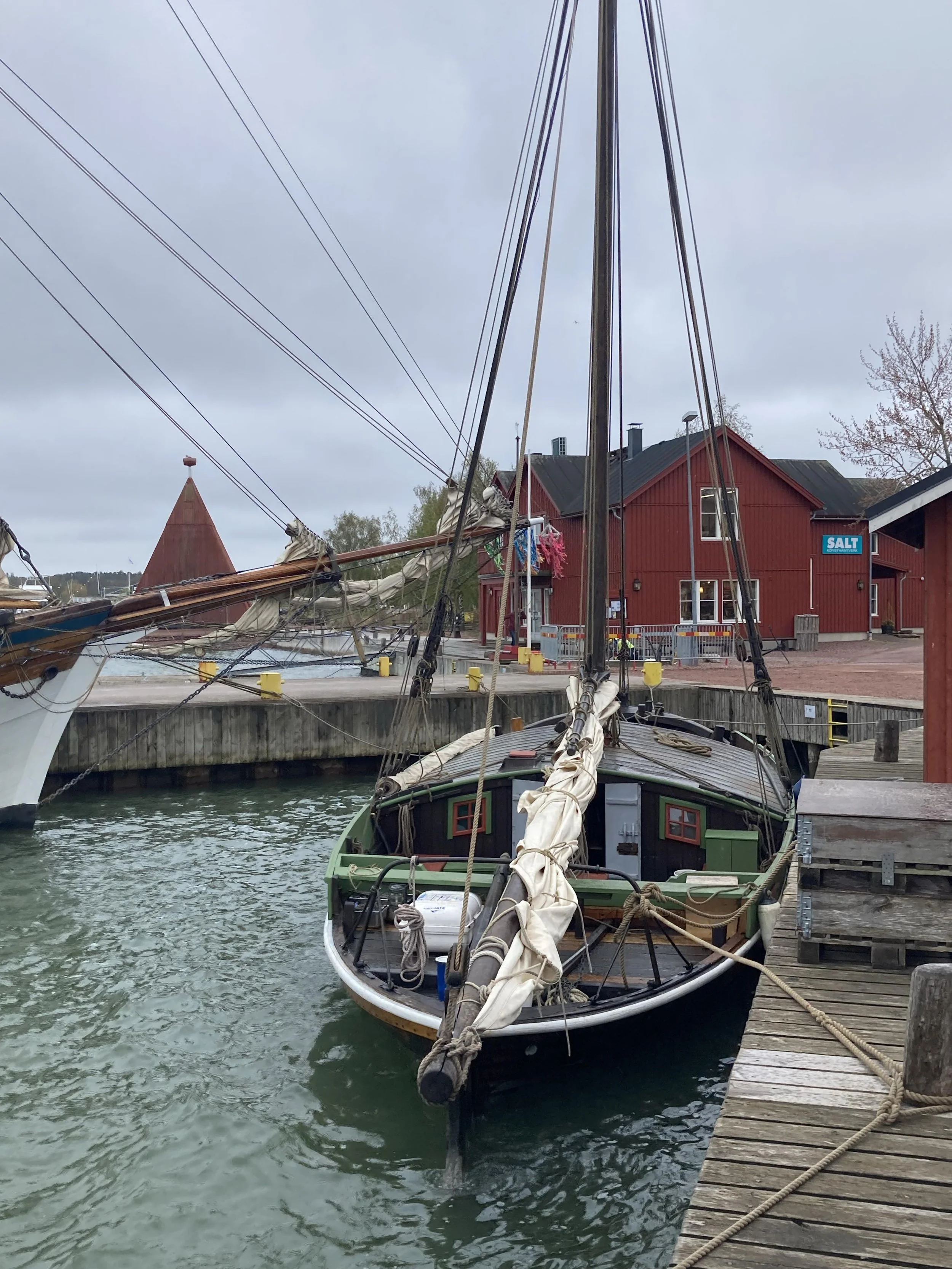
Foreground, traditional well-boat and bowsprit of 1988 built galleass Albanus, which is lying alongside the Sjökvarteret main southern wharf.
Traditional vessel construction area eastern arm, Mariehamn
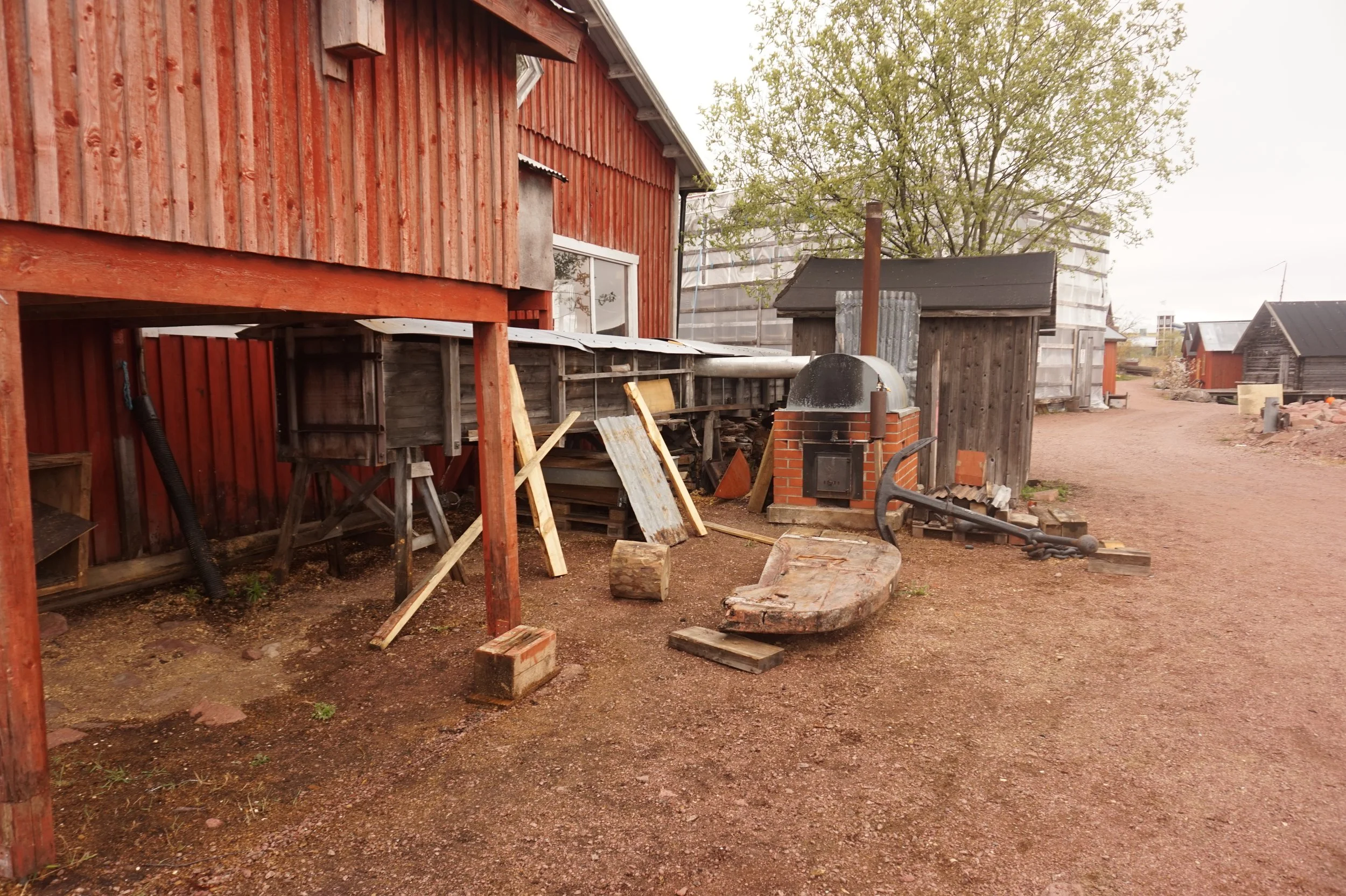
![IMG_4170[1].jpg](https://images.squarespace-cdn.com/content/v1/5f83c5947bb62b2036f18924/1783584207776-1MW32XNLCWFF4UI6RWKC/IMG_4170%5B1%5D.jpg)
Major project is the galleass Emelia (in big temporary shed in background of photograph of steaming facility) Inside the main workshop , that aerofoil shaped oak rudder is for new galleass Emelia – it weighs 3 tonnes!
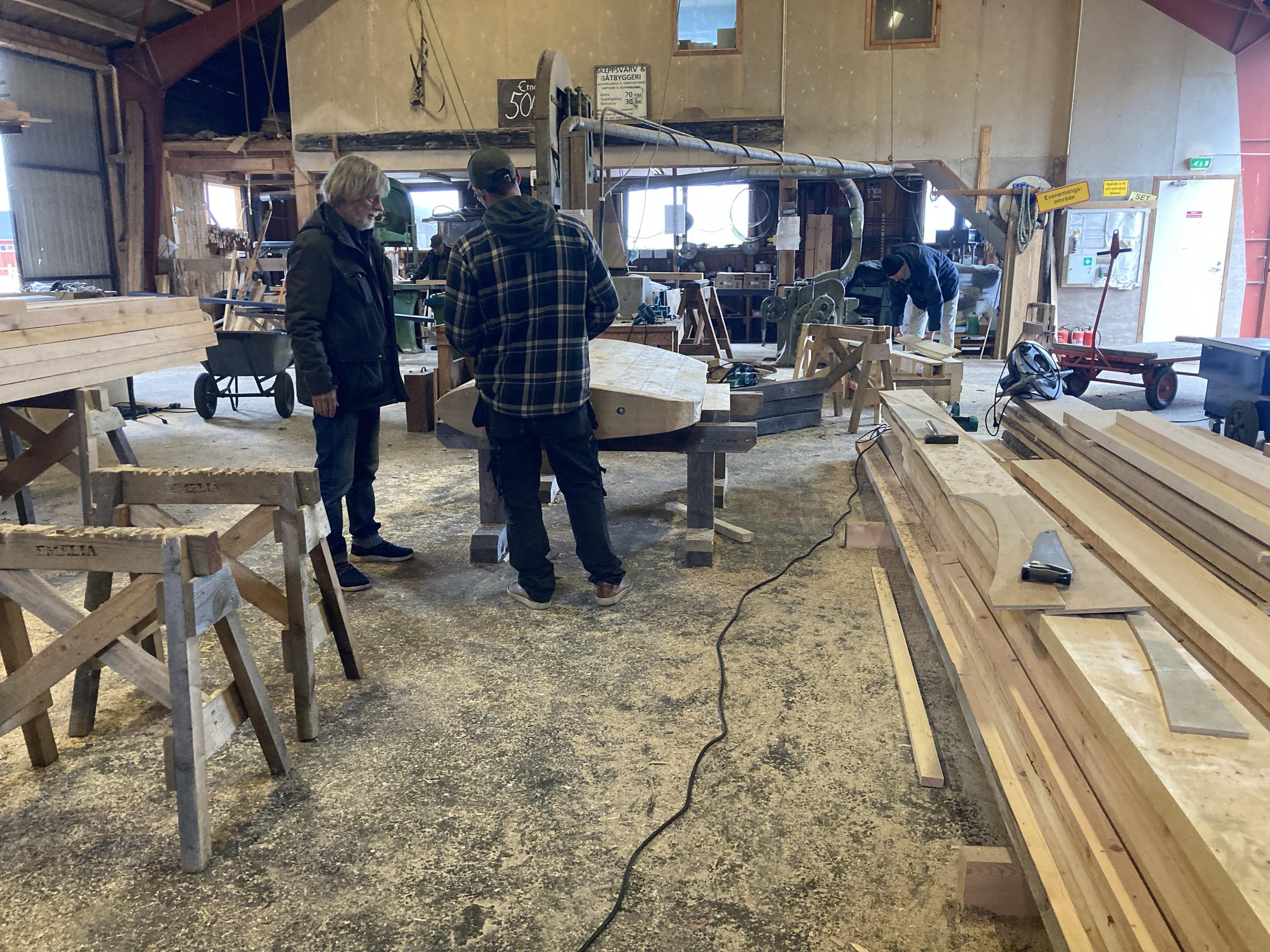
Allan Palmer (left) discusses with contractor steel pintle fittings for rudder for new-building galleass Emelia
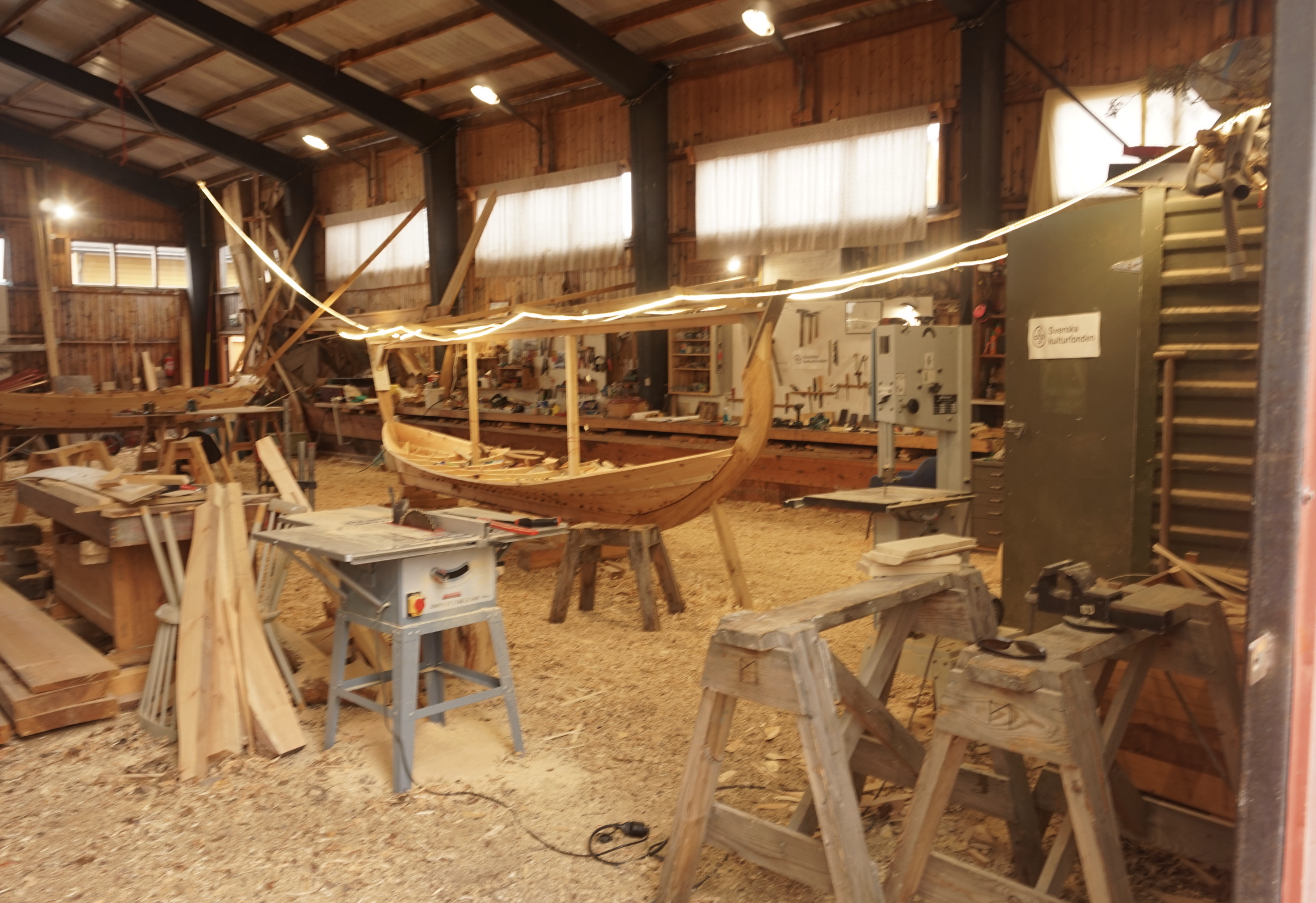
Traditional boats under construction – most new open boats are still clinker built using seasoned pine (when available) and oak.
Facilities are leased out on a project basis, with bigger hulls built in sheds that also provide simple launching ramps by removing the end wall and bulldozing a slipway. The main workshop was a busy scene with clinker hulls of several boats under construction, and the stacks of pine and oak timber that would be the envy of every boat builder in Australia. As a ship modeller, I would just like to get loose in the scrap bin! Pride of place in a covered slip goes to a traditionally built galleass under construction, Emelia, for which Allan Palmer is an unpaid expert volunteer. The framing is nearing completion, and deck and interior woodwork is progressing. Emelia will be 25 metres LOA and weigh in around 100 tonnes. The aerofoil rudder alone, being finished in the shed, comprises three tonnes of hand worked oak. The Emelia is clearly going to be a splendid vessel, with workmanship and quality to match the several completed boats photographed at the berths.
The following day, the proof is seen and photographed by us from a rocking small boat – a pair of broad-beam, shallow draft jakts (Alanta was one), motoring round to the Westen harbour against a stiff southerly, sails being bent on ready for the run north into the western harbour.
Ålands boat building seems alive and well, thanks to stalwarts like our two experts and supportive government. Allan Palmer, showing his amazing versatility, while at the facility was also meeting with plumbers carrying out major drainage works, as well as holding in-depth discussion with engineers developing the steel work for the Emelia’s rudder pintles. He can clearly turn his hand to anything. Hanging conspicuously in the sheds are large prints of his watercolour of the finished vessel (see below), I guess just to keep workers and volunteers focused.
Palmer has also salvaged two handsome old style companion ways, one complete with original clock, which are planned to be built into Emelia, keeping continuity with a past much-loved schooner that had to be scrapped. Not only are the materials and skills transferred to the new building, but maybe even the spirit of the past.
The following is some initial information on the galleass Emelia under construction.
Note: For more information or to get an on-line 360 degree view of progress to date, please visit www.emelia.ax
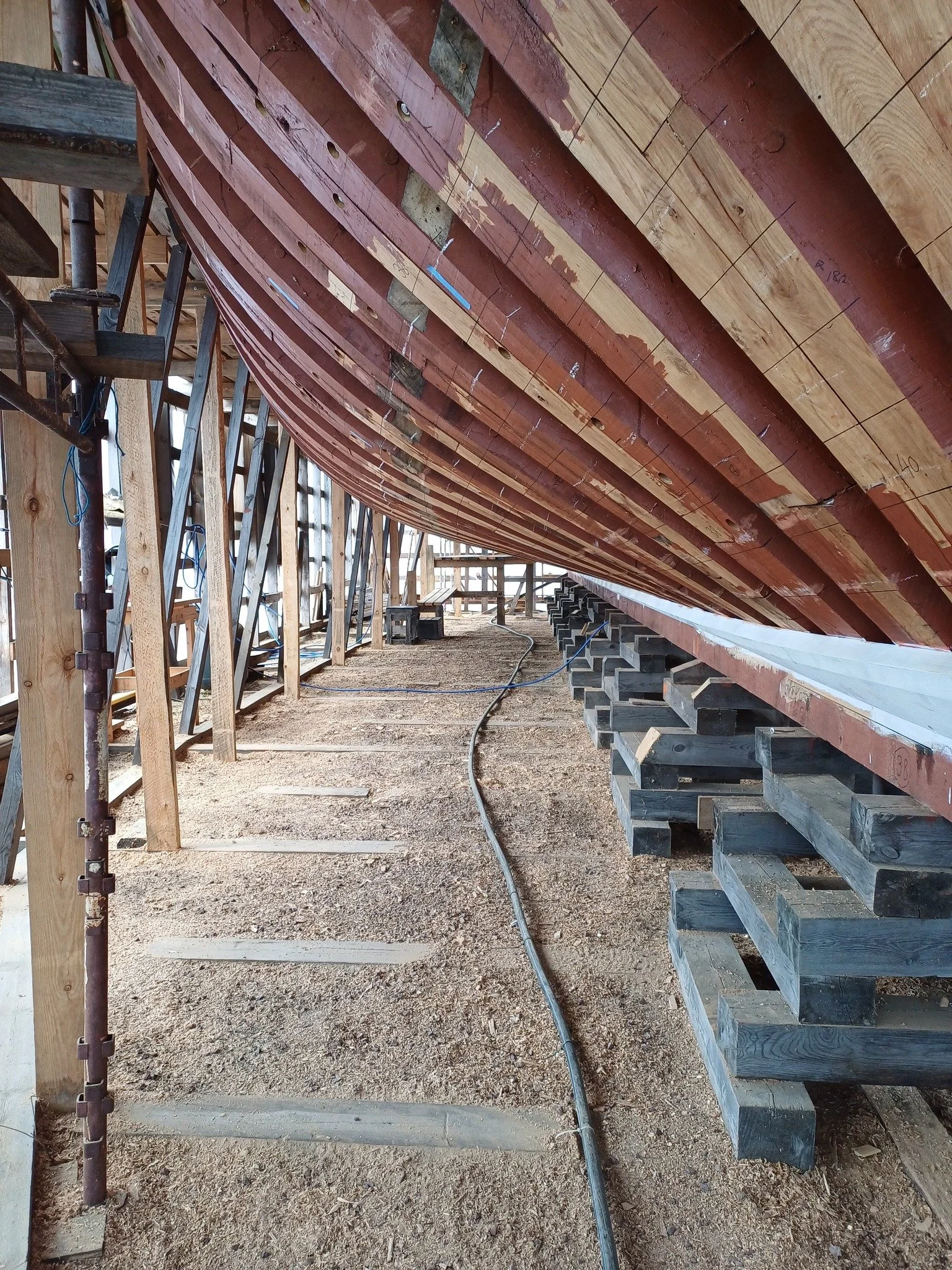
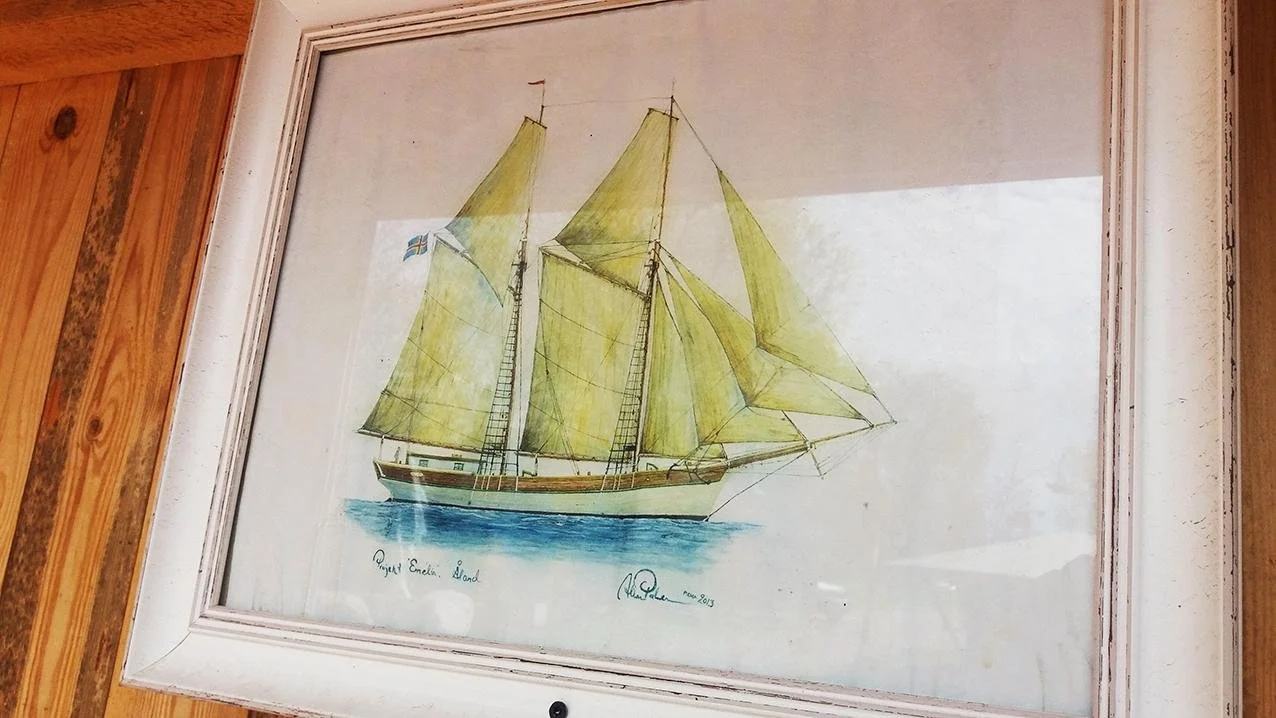
New build galeass Emelia – left framing nearing completion, planking to go;
right – how she will look. Watercolour by Allan Palmer (photo source emelia.ax website) -
The cost of the new build is estimated at 2.3 million Euros, with 25% funded by the Ålands Government, the remainder to be raised by public donation. The launch date is scheduled for July 2026, but there was a great deal left to do when we visited, although the fully planked hull has already been painted, mainly to prevent protect the timber. The quality of build is very high, and scantlings massive. The frames where they rise out of the hull into the bulwarks must be close to 300 mm square, giving great strength in waters where ice is a regular winter hazard. It is understood that grown oak is used for knees etc. where possible. Pine is preferred for ease of working, but is not as available as in the past, and oak is used for strength but is harder to work.
![IMG_4175[1].jpg](https://images.squarespace-cdn.com/content/v1/5f83c5947bb62b2036f18924/1783584665852-LJ8TJ4KY84HMI32COYH8/IMG_4175%5B1%5D.jpg)
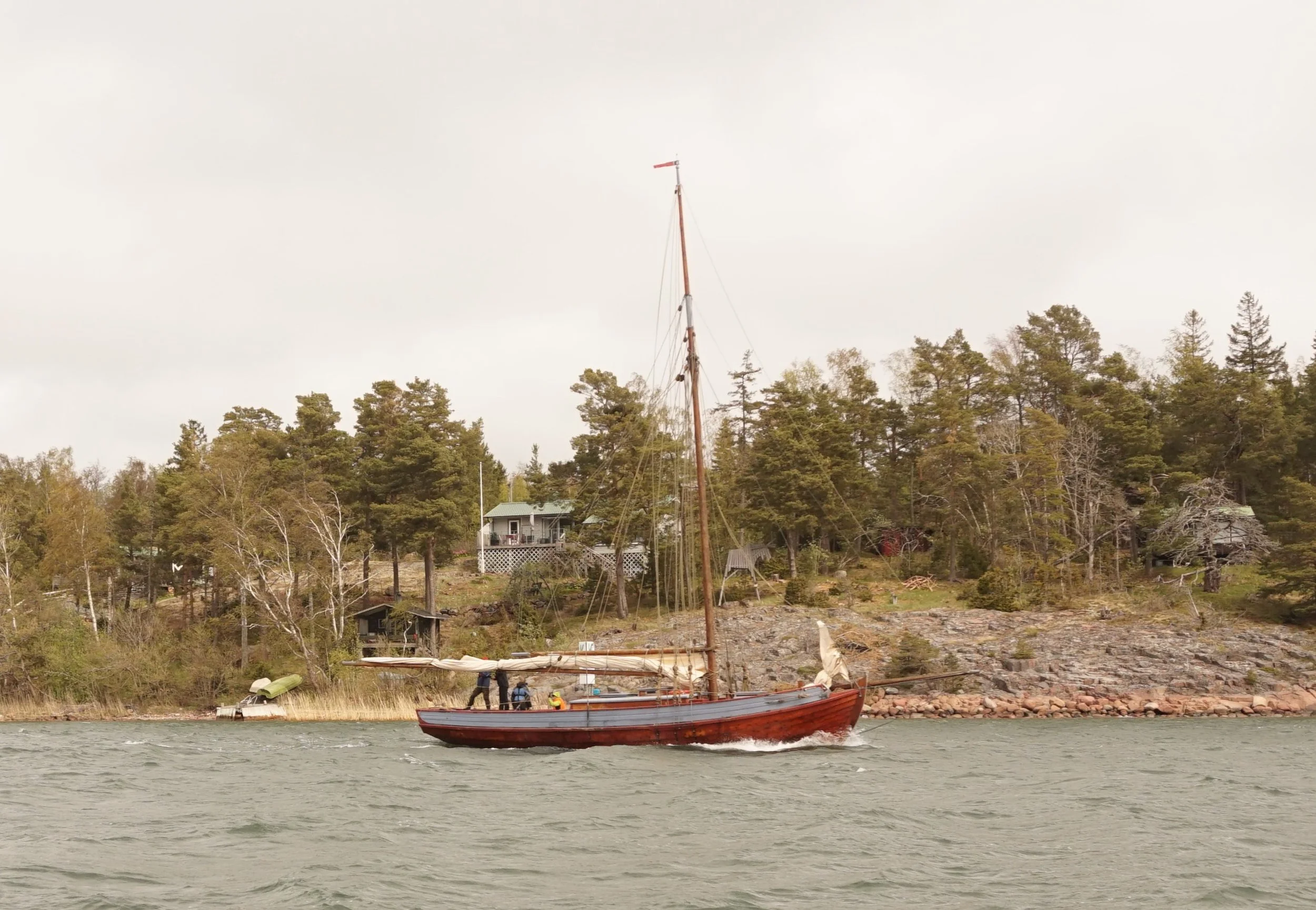
The author explores Alanta, a recently built jakt (left) and (right) the same ‘segeljakten Alanta’ in the eastern arm.
Maritime Museum, Mariehamn, and traces of Gustaf Eriksen
A high priority for our visit to Mariehamn, following the planned visit to the Director of Mariehamn’s world-renowned maritime museum, was a visit to the main exhibit, the 4-masted barque Pommern. Completed in Reid’s shipyard, Glasgow in Scotland as Mneme, for the German shipping company Wencke Sohne of Hamburg in 1903, she later passed through ten months ownership by Hamburg based Reederei A-G 1896, and was eventually purchased by the operators of the famous P Line owned the German company founded by Ferdinand Laeisz (their ships, all beginning with P, were known as the Flying Ps), and renamed Pommern. Initially the vessel was deployed carrying nitrates (saltpetre) from South America to Europe.
German ownership meant that after WW1 the ship was interred and went through the war reparations process, which saw it briefly flying the Greek national flag, but it was subsequently purchased by Finland’s Gustaf Eriksen, the flag changing from the German imperial ensign of early photographs to Finland’s blue cross on white, and deployed in the grain trade from Australia to Europe. It thus became an integral part of Eriksen’s fleet of big sailing ships, and in the so-called Grain Races from mostly South Australia to European ports, which is the central theme of our current pilgrimage.
As set out in our earlier article, the theme of our trip is to get to know better Gustaf Eriksen, and the story behind the 40 plus major sailing ships he owned and managed during the early 20th century, peaking in the mid-1930s and declining after 1935, culminating with the sale of the few remaining large sailing vessels by Gustaf’s son Edgar in the mid to late1940s. We started by fleshing out our desk research with views, predominantly from the Museum’s director, Dr Hanna Hagmark, but subsequently by personal interviews with Henrik Karlsson and Allan Palmer, the expert contacts provided by the Dr Hagmark. The overall objective was to research the drivers for Gustaf and the Eriksen family’s success, and eventual demise, and to add eventually up to three ships to a collection of ship models in Australia exploring his life work, which culminated in establishing the biggest fleet of major sailing vessels, when the advent of steam and motorships was forcing their demise. Ålands Islands and Mariehamn were central to our theme, and, dominated by the masts and spars of museum ship Pommern, Mariehamn still shows evidence of the history we were researching.
We were hoping to obtain some guidance on what would be the most iconic ships of Eriksen’s fleet to model, and names such as; his first real command, Southern Belle; his first fully owned purchase Dutch built Tjerimai, a historic ship in her own right, with composite hull built along clipper lines; and Lawhill, Eriksen called her the Lucky Lawhill, were discussed as possible subjects, but it seems that there are no firm favourites with the museum staff apart from Pommern of course, and a little known late addition to the GE fleet, reputed to be much favoured by Eriksen, the Glasgow built Loch Linnhe, launched as a fully rigged ship but subsequently converted to a barque.
Although Gustaf Eriksen is probably the best known of the Åland shipowners, there are other families and names that have added their own strengths. Local contacts directed us to Eriksen’s house, not overly publicised, which, it appears, has been moved from Lemland islands to its current site in Mariehamn, to a landscaped site where it housed GS’s first city office, across the street from Rederi GE’s modern office. The site also includes his son Edgar’s house. Edgar took over the shipping operation after Gustaf’s death in 1947, inheriting several large sailing ships that remained from the fleet, including well-known names like Pommern, Passat, Archibald Russell and others. However, the times were changing and it also befell Edgar to arrange the demise of the no longer profitable ships, including, finally, gifting, with his sister, the Pommern to Mariehamn city, where it is now the last of these 4-masters to be preserved virtually in its original state.) The fact that Eriksen’s house does not get a major fanfare typifies a reserve by the Ålanders, a low-key approach that maybe goes someway to explaining some enigma surrounding the Eriksen empire. Dr Hanna Hagmark may have alluded to this. In Australia, Gustaf Eriksen has some profile, but other Åland families are not so well known, despite having had a perhaps comparable impact on the global shipping industry. She asked why the attention to Eriksen, while others may have had as lasting an impact on the industry. In particular, she mentioned the Lundqvist family, which may have influenced Eriksen into steam and subsequently motor vessels, and has perhaps had a longer-term influence on the global industry with their fleet of large tankers. Other names arose during this and subsequent discussions, such as August Troberg, Nikoli Sitkoff and the Mattsson, and it is clear that expanding research into Gustaf Eriksen and the ongoing activities of the family company Rederi GE to include these other influences, could add further to illustrating the success of the Åland shipping on the world scene.
![IMG_4240[1].jpg](https://images.squarespace-cdn.com/content/v1/5f83c5947bb62b2036f18924/1783584838457-51C41YV4MNCLXZL8CNIN/IMG_4240%5B1%5D.jpg)
![IMG_4225[1].jpg](https://images.squarespace-cdn.com/content/v1/5f83c5947bb62b2036f18924/1783584860238-NX1RTXYA5YXGECU0EADF/IMG_4225%5B1%5D.jpg)
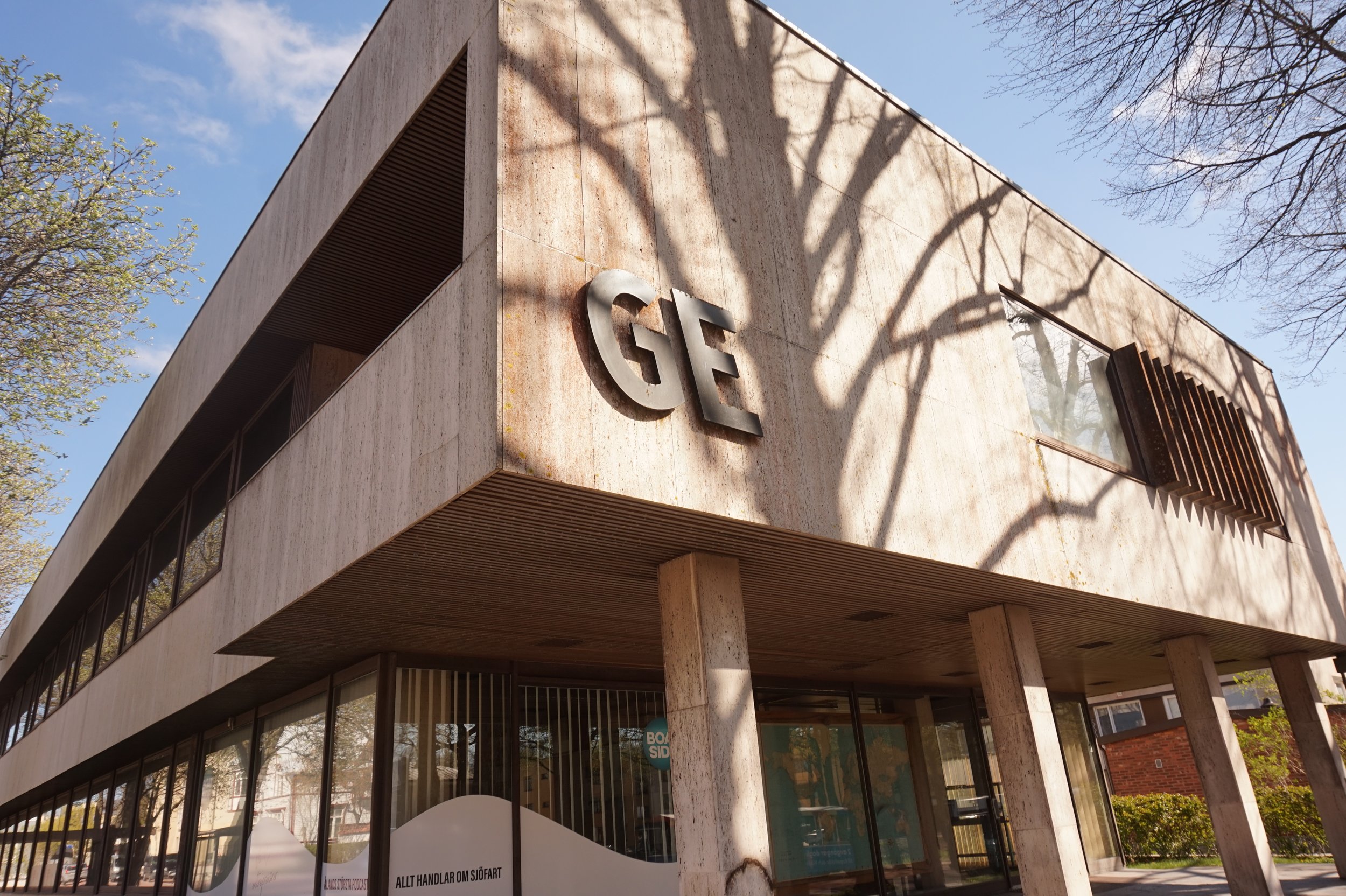
Familiar names around Mariehamn; Left Gustaf Eriksen (GE rederi) company offices; centre Lundqvist offices, both companies still in existence, and (right) August Troberg’s home now apparently an aged care facility, all in Esplanadgatan, Mariehamn. Sitkoff is another iconic ship-owning family name emblazoned on a city building and on the main sporting stadium.
The stroll around Mariehamn revealed the stylish Eriksen (Rederi GE) offices still in existence and operating, as are the busy Lundqvist office, which speaks also of a going concern. Another cohort (and mentor?) of Eriksen’s, August Troberg and his wife Johanna have a memorial plaque embedded in the north wall of the city’s most prominent church of St George, a focal centre on Esplanadgatan, and local historians confirm that both the Trobergs and Gustaf and Hilda Eriksen are on the list of donors behind the building of the church, along with other religious buildings in Åland. Troberg’s original residence and compound next door is now an old peoples’ home. Although Eriksen’s name is more recognised, certainly in Australia, other family names to be seen around Mariehamn have made similar impacts on the maritime world, some intertwined with Eriksen and Lundqvist through marriage or business alliances, both inevitable in this small, remote but highly maritime-oriented community. As Dr Hagmark at the Maritime Museum suggests, perhaps there are grounds for more historic research in these little islands, into a people who were perhaps shaped by hardship and fierce weather, maybe to become hard and impenetrable like the granite on which they lived and farmed. Books have been written about the practicalities of shipping in those days, particularly women’s part in it, but maybe there is opportunity for a dramatised history, focusing on the major families and their influence on the global scene, with the broader historic background the motor and steam versus sail saga, and – apart from Eriksen, and Lundqvist perhaps - the migration of maritime business people to Helsinki. Fortunately, for future researchers, copious archives exist, jointly held by the Ålands lands authority and the maritime museum.
Enquiries indicated that Gustaf Eriksen’s house is preserved in Mariehamn, but, with typical Ålands low key approach, you have to go looking. It was found on a corner block, across from the GE offices. The attractive walled garden area, entered through square-rigger styled (Pommern, perhaps) gates, includes a house being used by several small entities (immigration agents etc.), and indications the Gustaf used part of it as his first office. Also included on the landscaped site is the four-square house of Edgar Eriksen, the oldest son who took over running the GE company after Gustaf’s death in 1947. The site is not clearly signed, although a plaque (see below) is embedded in the wall of Edgar’s house adjacent to the double gates, which feature the same square-rigger motif in wrought iron. Hiding behind the gates, are two buildings, one clearly marked as that of Edgar Erikson (eldest son of Gustaf) and the other, not clearly signed for English speakers, assumed to be Gustaf’s residence, moved from elsewhere (Lemland, it seems).
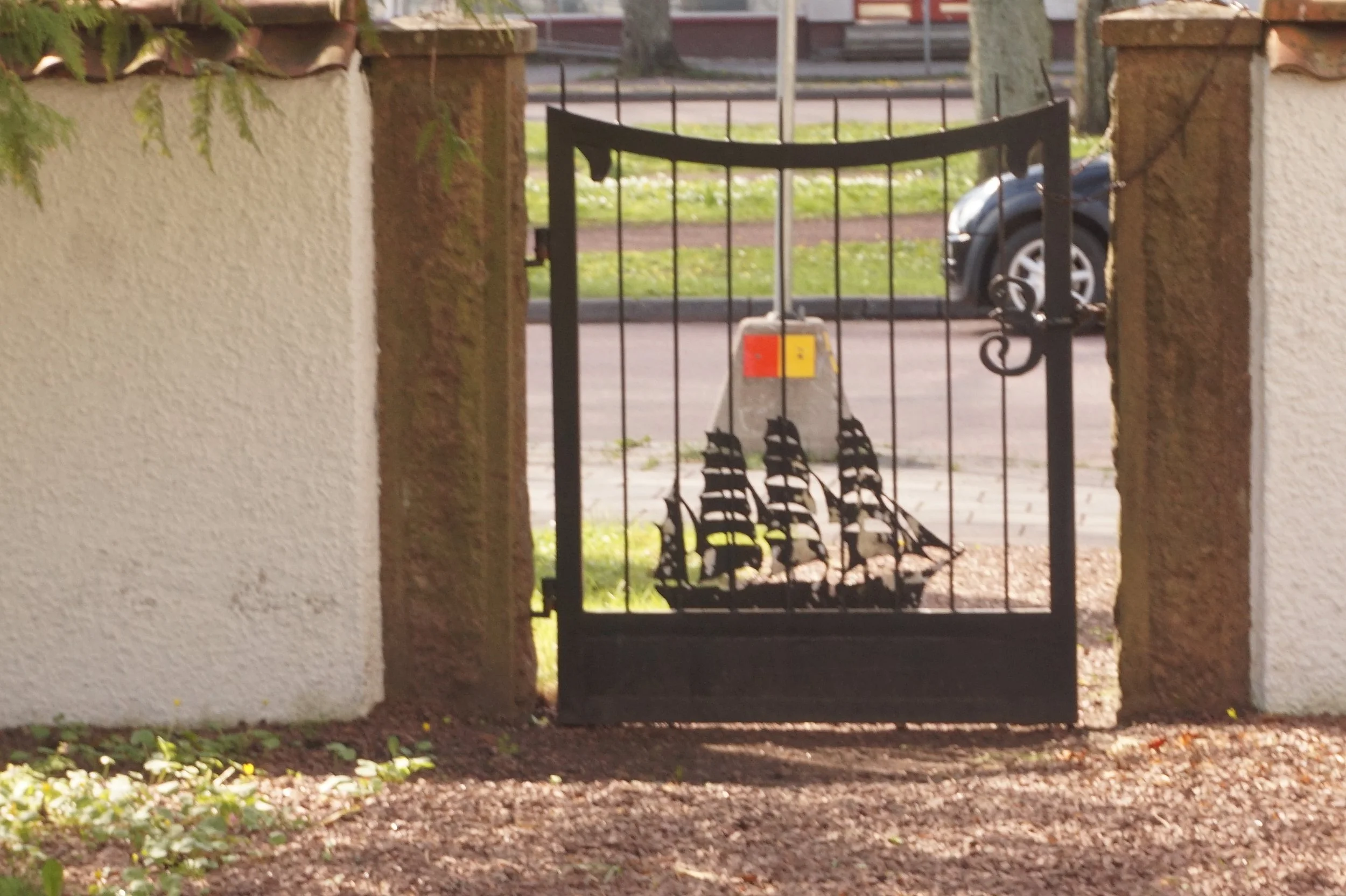
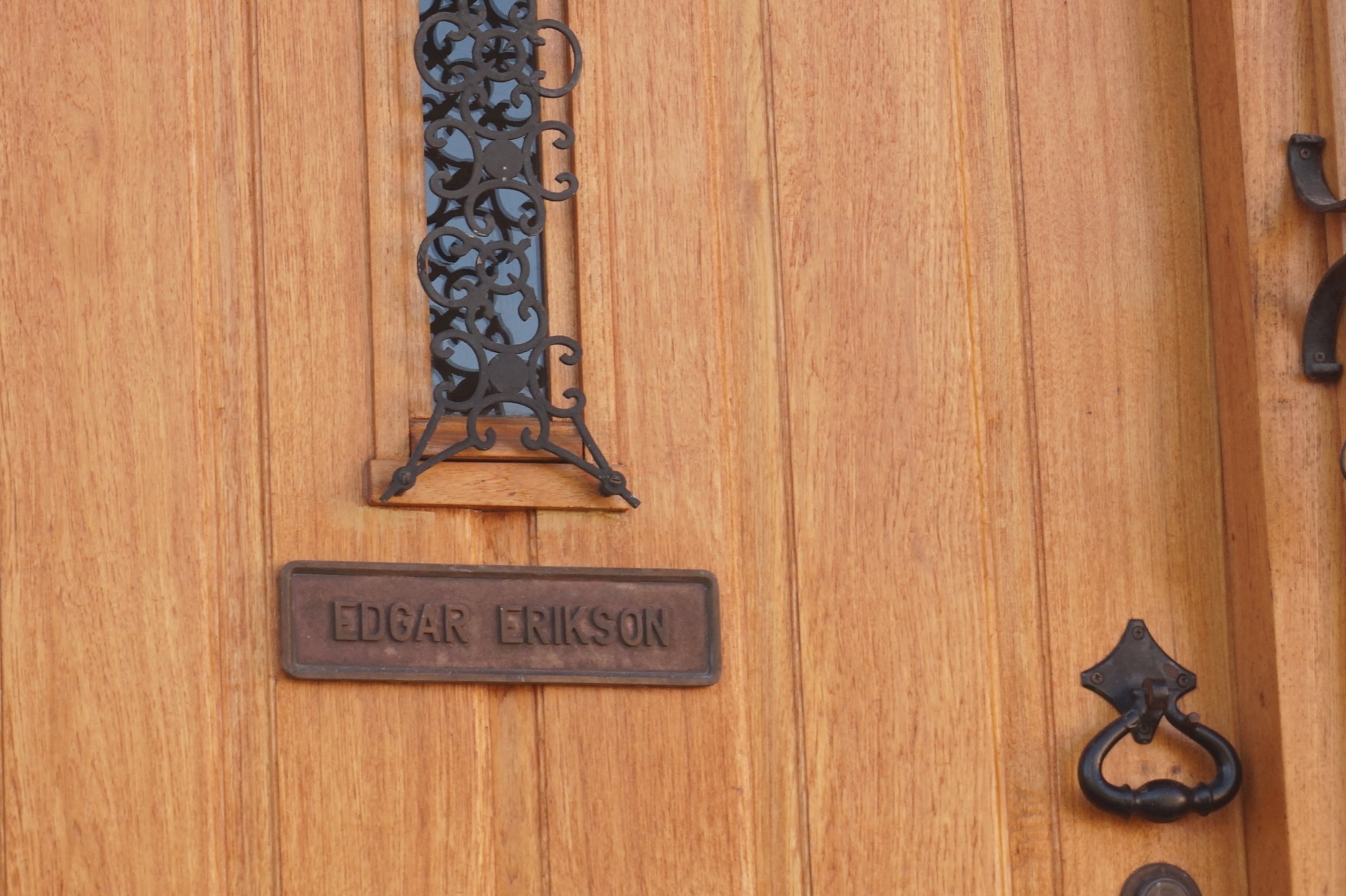
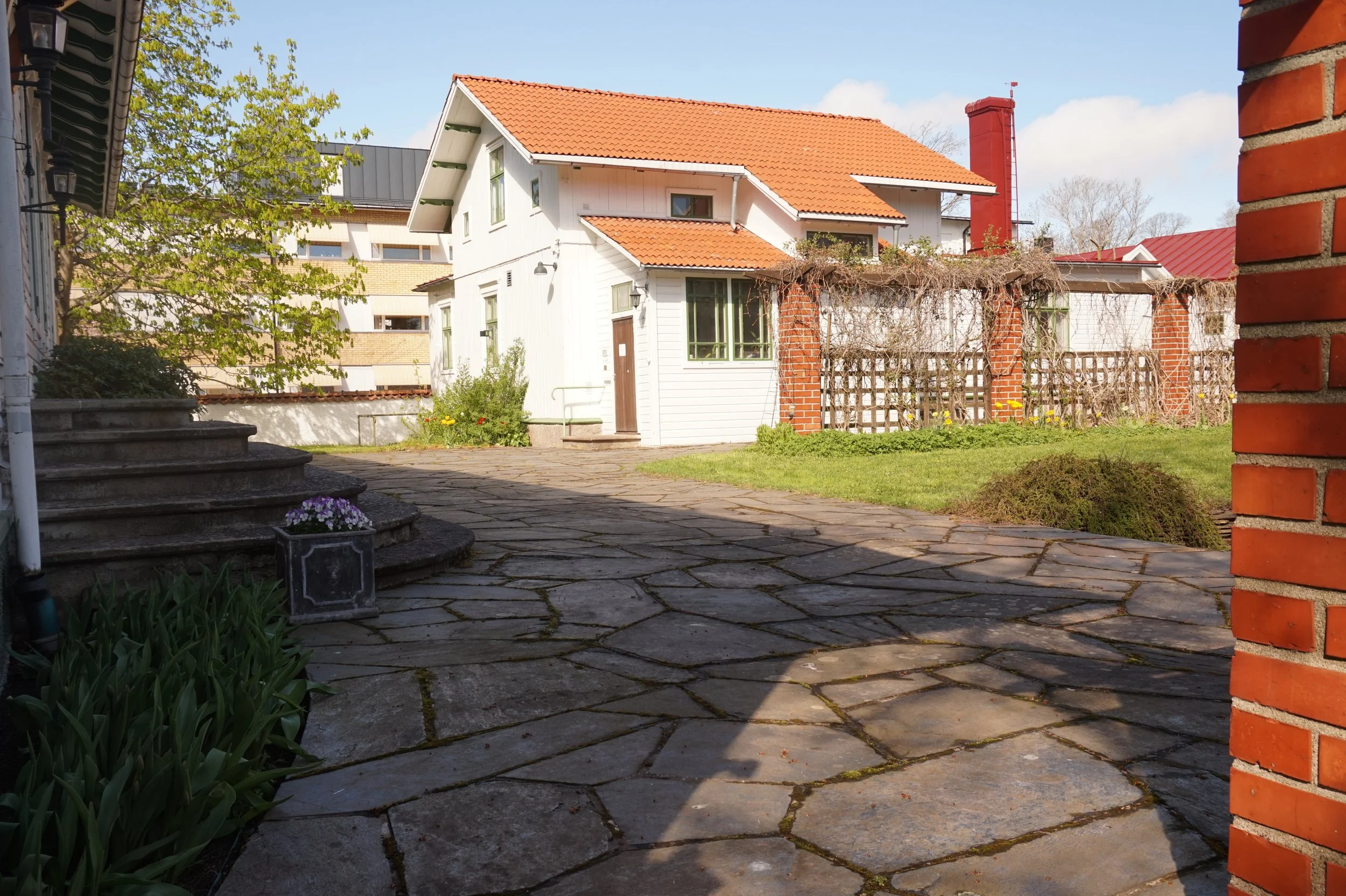
Erikson home ground; the low-key gate (left); Gustaf Eriksen’s house/original office centre and son Edgar’s house – steps to the left in centre photograph.
There is something typically low-key about the lack of signing of Åland’s highest profile historic figure’s residence. However, stories of him riding his bicycle between the wars, silver topped cane across the handlebars, down from the offices to visit one of his ships ring true. It would be an easy ride. The family’s large American car was apparently driven only by Edgar, his father having never held a licence to drive, another small indicator of a man who seemingly didn’t believe in unnecessary luxury.
The plaque* set into the wall of Edgar’s house does not carry an English translation, but although something may have been lost in our initial inexpert translation, circumstantial evidence suggests that we had found Gustaf’s one-time house, and office. Subsequently, we had Swedish connections translate the brass plaque for us (see below). Incidentally, photographs on the internet purporting to be of Gustaf Eriksen’s grave stone should be treated with caution. One in particular much photographed marble slab on the worldwide web even has his date of birth, but the date is incorrect and the slab omits his middle names, Adolf Mauritz. Gustaf (or Gustav) is a common name. There are no doubt many Gustaf Eriksens!
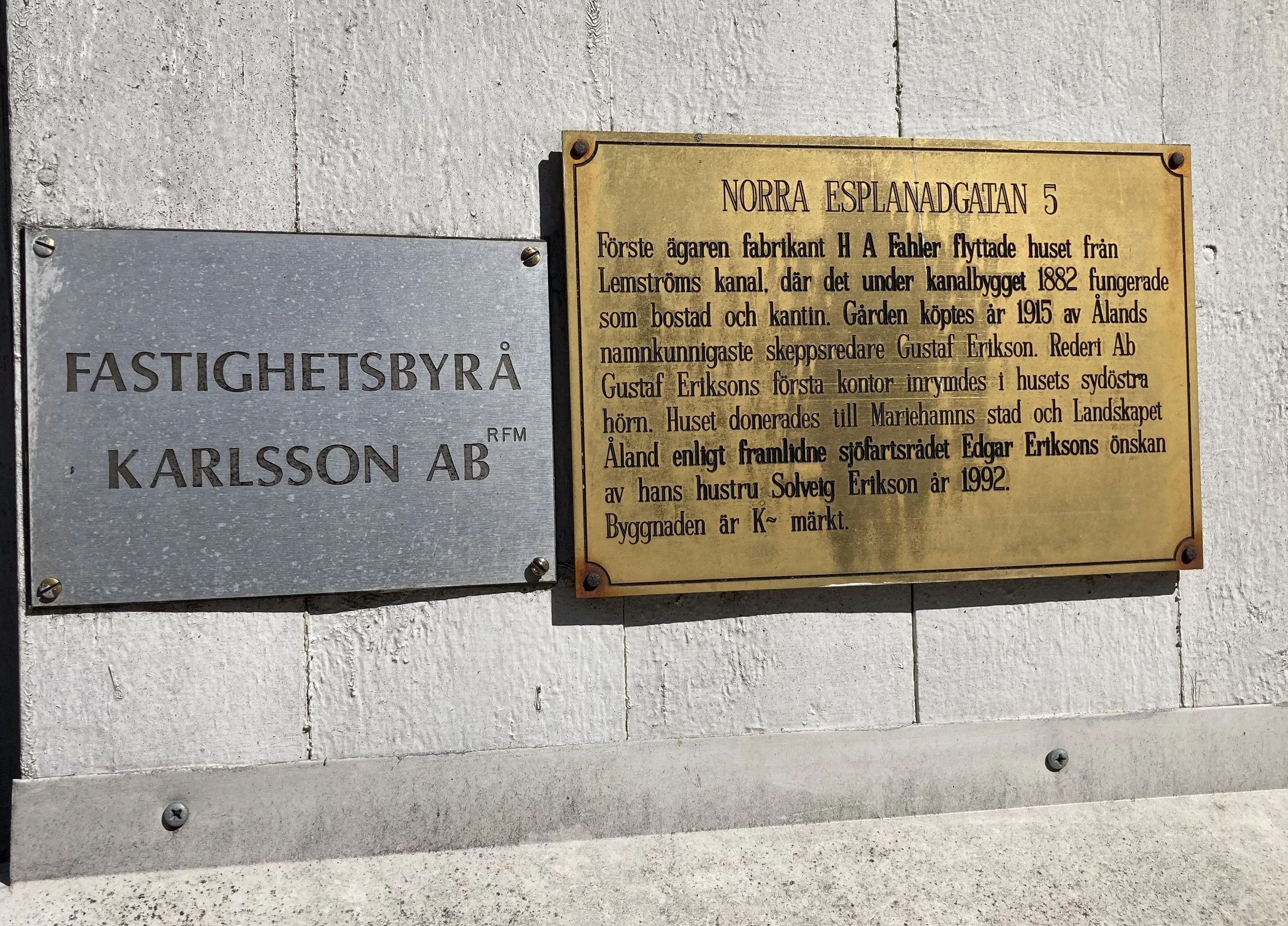
Brass plaque at the Eriksen residence, Esplanadgatan, Mariehamn
*We asked our Swedish contacts for a translation of the wording on the plaque, but it proved a little difficult as our translators (residing in southern Sweden) found some wording archaic, and had to guess at meanings. The following is their understanding, which makes complete sense in the context:
“First owner FABRIKANT H A Fahler moved the house from Lemströms kanal (channel/canal), where it during the canal/channel build [in] 1882 was used as a residence and a canteen. The estates were bought [in the] year 1915 by Ålands most famous (known) SKEPPSREDARE gustaf eriksson. Rederi Ab Gustaf Erikssons first office was located in the southeasten corner of the house. The house was donated to the city of Mariehamn and to the province of Åland by Solveig Eriksson according to her husband Edgar Erikssons wishes, year 1992. The building is heritage protected”
Note on translation: FABRIKANT is archaic, but our translators see it as ”factory owner”, ”manufacturer”, or ”maker/producer”. SKEPPSREDARE they understand to mean either” ship owner”, ”ship magnate”, ”ship operator”. Or all of them. (In Gustaf Erikson’s case, it would have been all of them, but might also extend to a ‘commissioner of maritime’, an honorary title he is known to have inherited). Note also the double ‘s’ in Eriksen, which seems to be an alternative used by some of the family.
The final event in our time in Mariehamn was to visit the barque Pommern, and the following section details our visit to the ship, a key point in our pilgrimage. The weather held for us, with a cool breeze but bright sunshine, that had other visitors making the most of the spring weather.
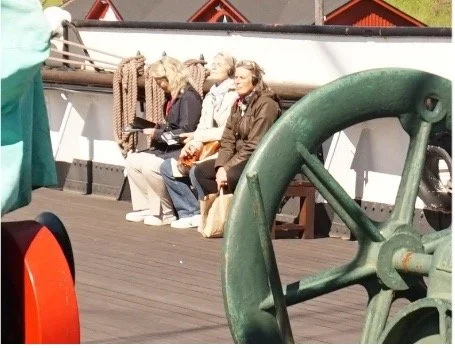
Pommern visitors soak up the spring sunshine in a sheltered spot on the main deck.
Many photographs were taken to bank against possible future modelling of the vessel. These are valuable to model makers, as the layout and working details of the deck machinery are critical in accurately portraying a working vessel. Winches in particular must be placed correctly in relation to the run of wires etc. and construction details represented reasonably accurately. Few plans will show the intricacies of, for instance, a Jarvis brace winch, or an anchor windlass hidden from plan drafters under the forecastle head. This bank of photographs will be part of cache of information that can apply to a model of any similar vessel.
Barque Pommern
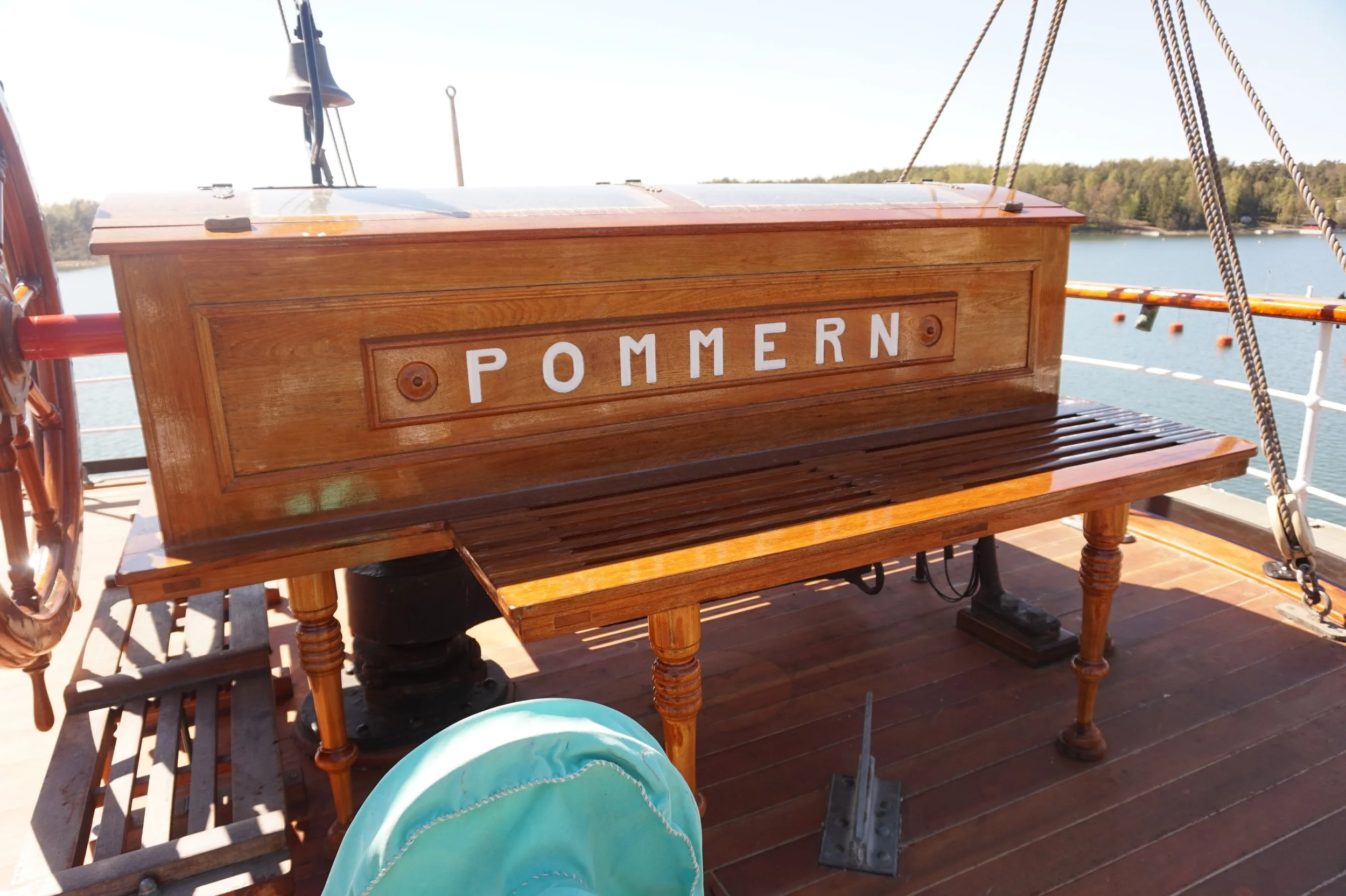
Wheel box and ship’s bell. Pommern was a well-balanced vessel, light on the helm, and required only a single wheel. Most barques had a double wheel, and some later builds had duplicate steering positions amidships (Viking for instance).
The tour of the Pommern was a key point in our pilgrimage. To actually walk on the decks of a vessel with the background of this one was inspiring, and the main purpose, getting photographs to ensure accurate deck machinery and layout for a model was achieved. It is true that one picture would equal a thousand words of description. (We took 84 photographs…)
The state of repair is amazing, and the museum clearly has its sights set on maintaining the ship to a very high standard but minimising the impact of any modifications on authenticity. Wooden ships such as the Vasa in Stockholm, however well preserved, will of necessity deteriorate over time, driving more and more costly treatments. Not so with a steel hulled ship with steel masts and spars such as Pommern, particularly in the low salt = low-rust environment of the Baltic. It could live for ever if ropes and wood sheathed decks are replaced and rust repelled. (We compared this with Sigyn in Turku, which over a period became so hogged that the hull was in danger of breaking completely. Long term preservation of Sigyn may dictate lifting the entire vessel on to dry berth, as has been achieved with Vasa in Stockholm. Even then, on-going attention is required – controlling atmosphere, ultra violet etc. - to slow deterioration.)
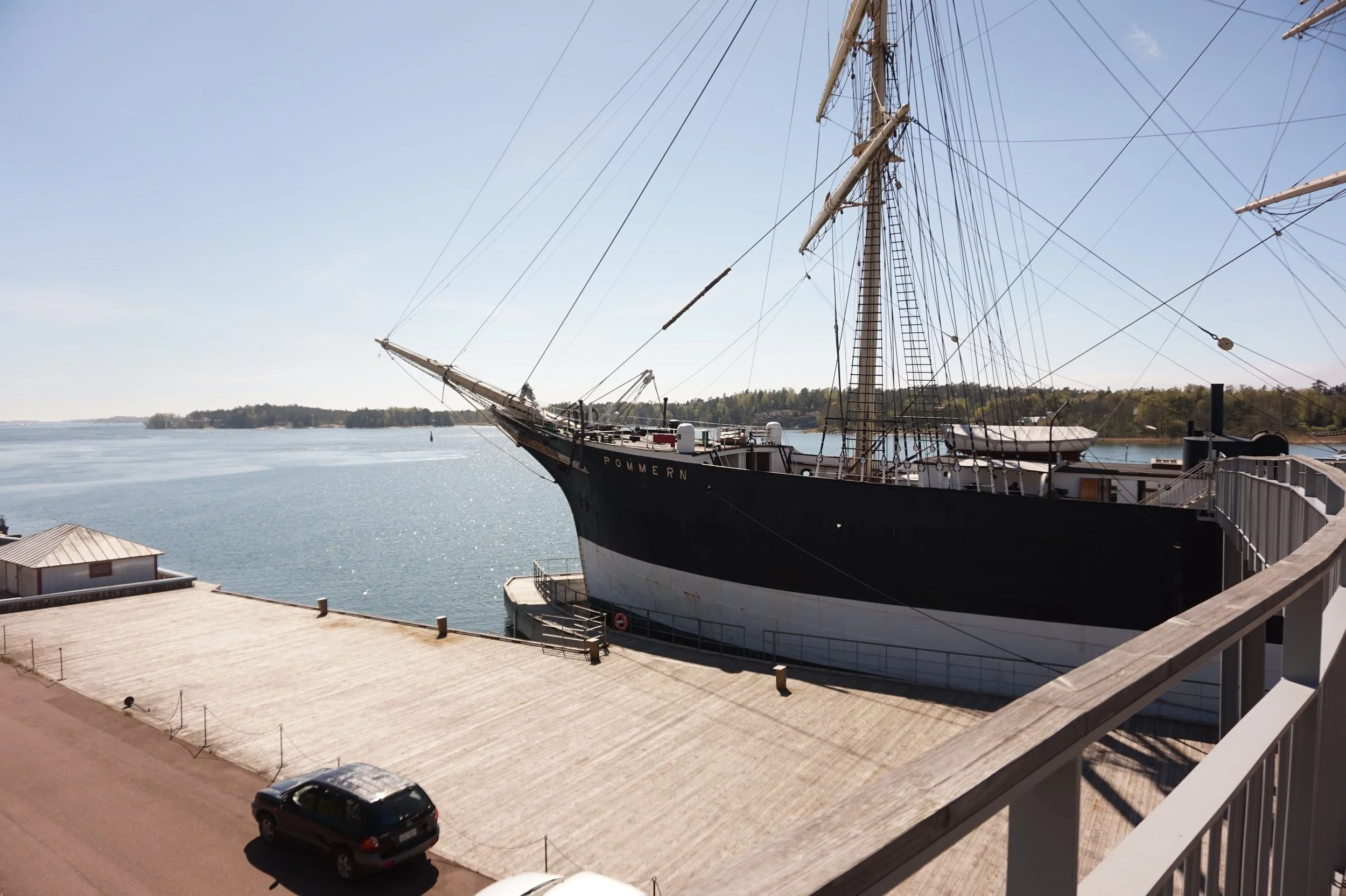
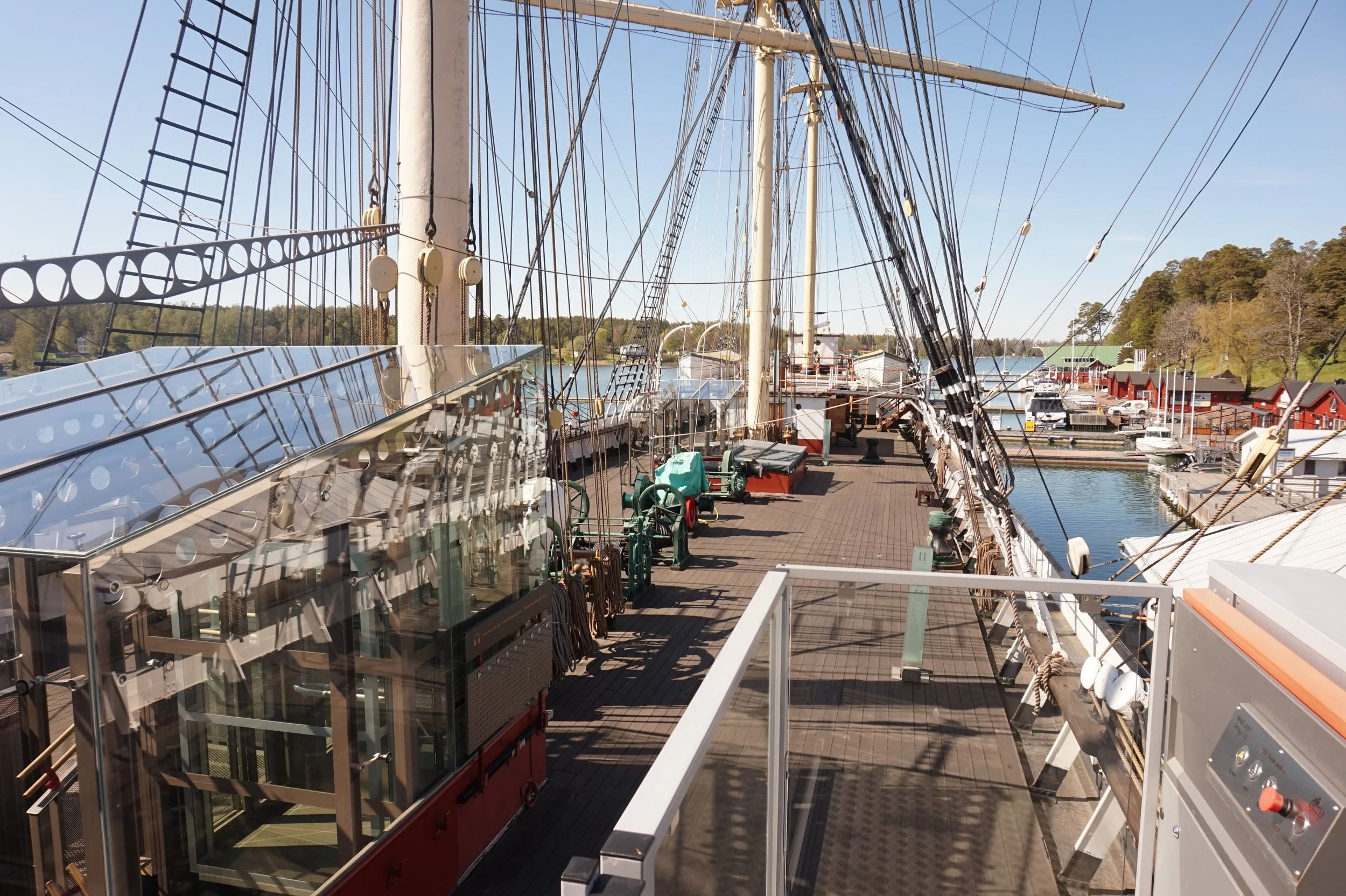
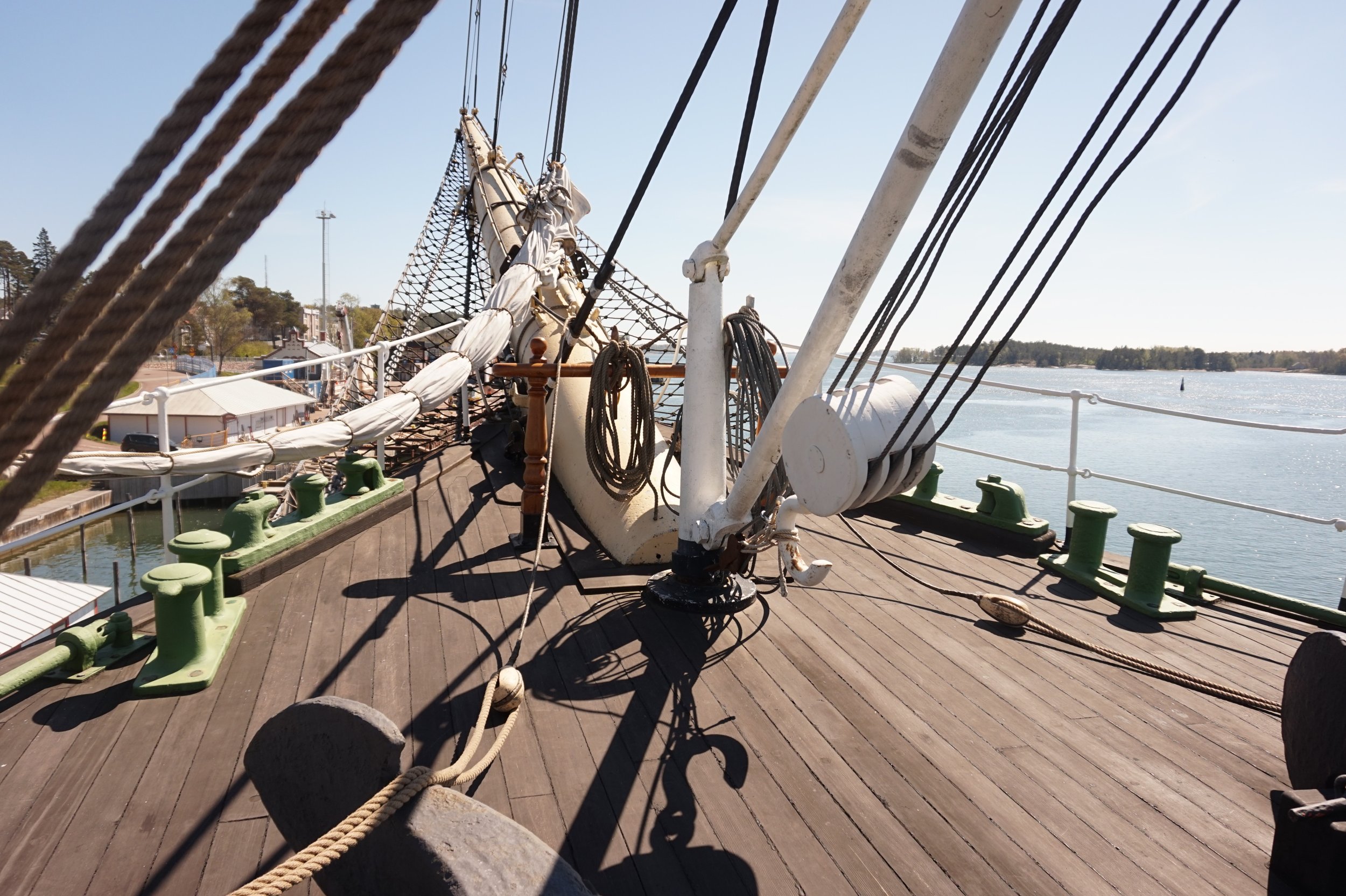
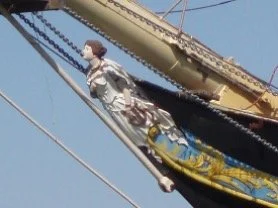
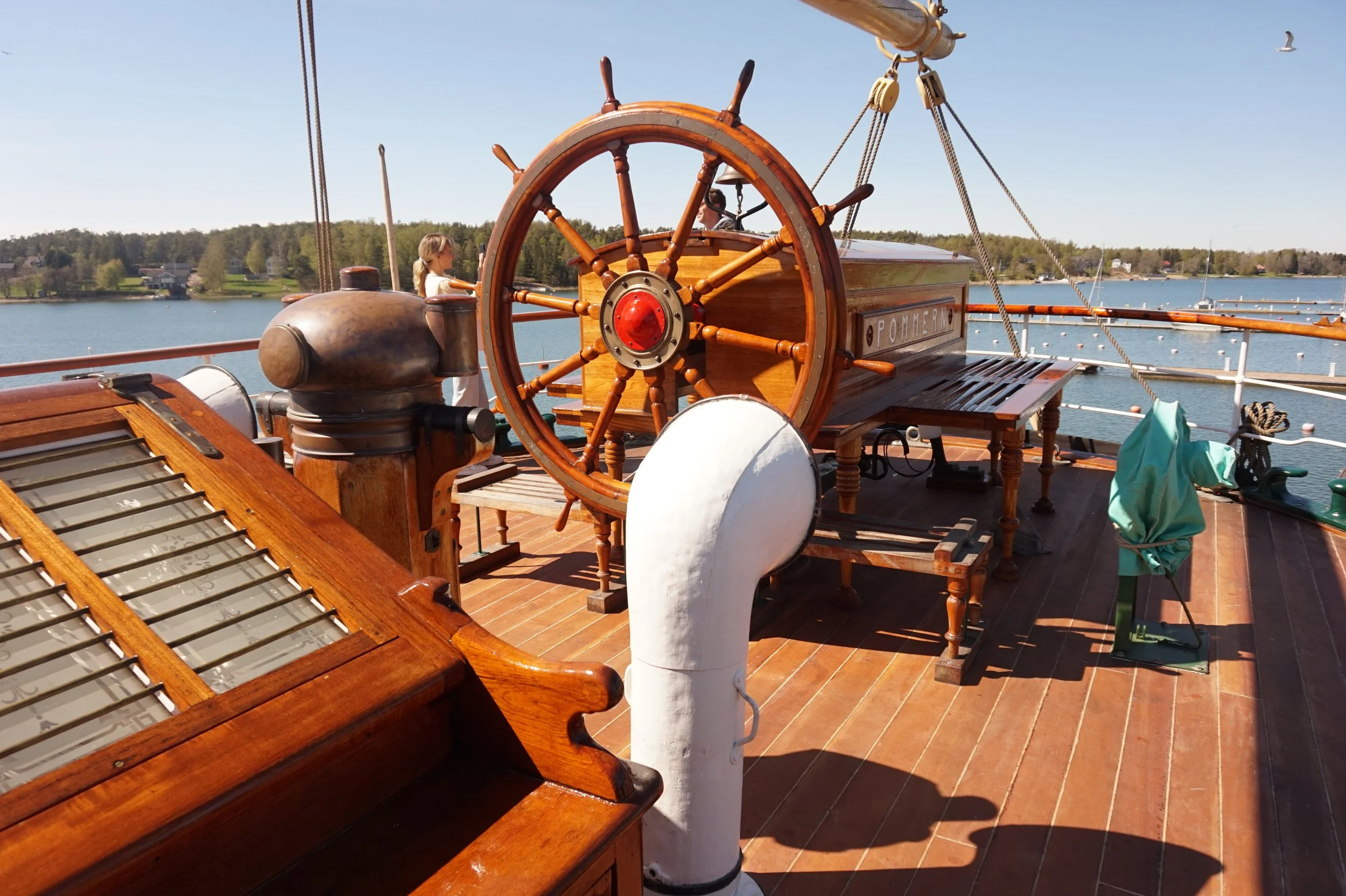
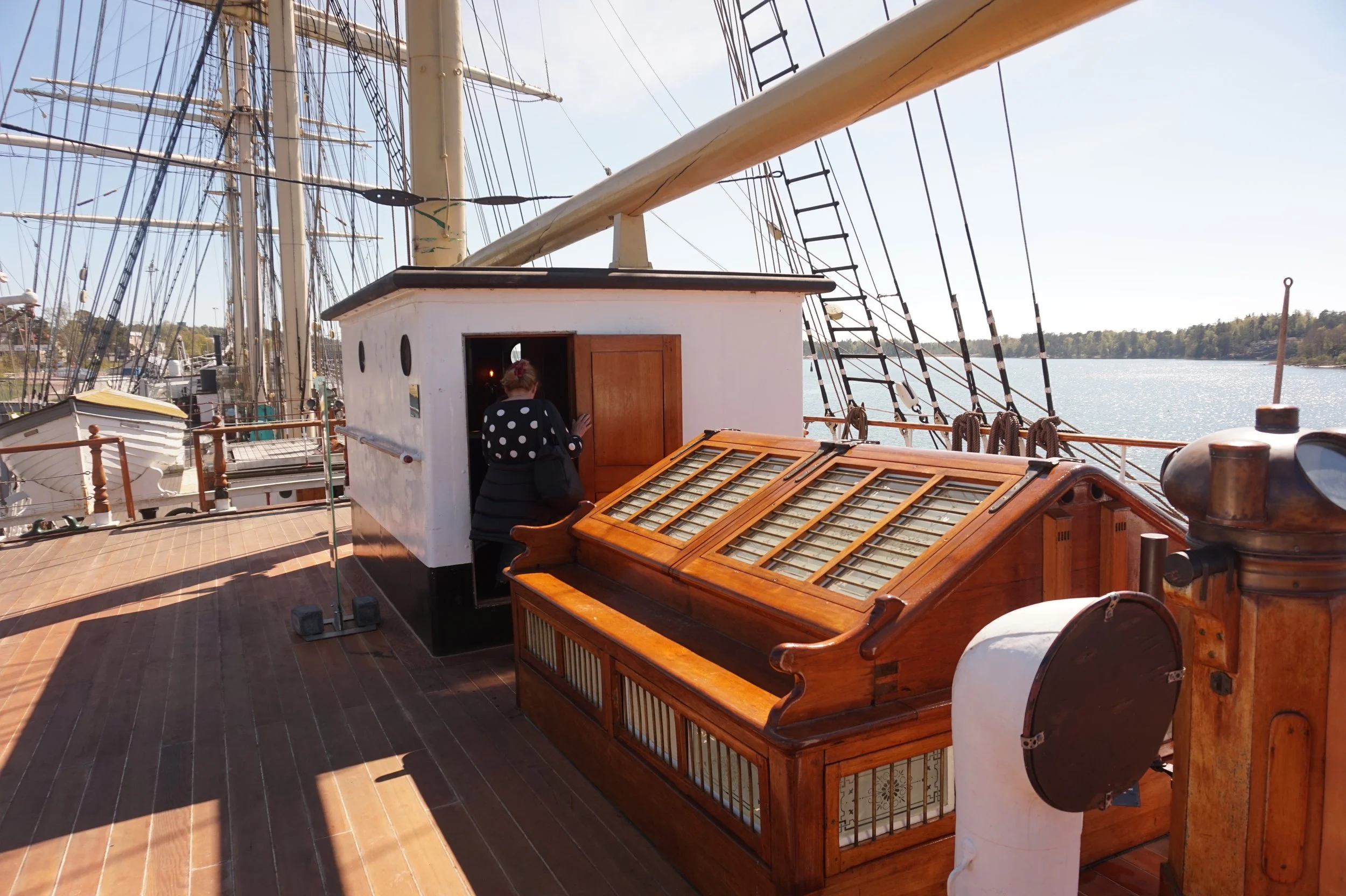
Clockwise from top left bow from access ramp; view aft from access ramp; and forecastle head; view forward from poop deck with pilot house; wheel and standard compass; figurehead (replacement),
Nothing structural has been done to the Pommern, apart from an access ramp to the forward well-deck and modern lift shafts have been built into the main hatch for visitor’s use, giving access to the tween deck, while, down below, the lower hold has been floored out just above keelson height and audio-visual equipment installed to provide information and entertainment for visitors walking the cargo spaces, video being projected on to the spar ceiling. This didn’t necessarily enhance the experience for a purist or serious history buff, but is no doubt essential, when hundreds of thousands of visitors have to be catered for annually.
The deck machinery and positioning were an important element for model making. Few plans are really suitable but a few photographs will ensure accurate placing and workability, useful for models generally.
![IMG_4253[1].jpg](https://images.squarespace-cdn.com/content/v1/5f83c5947bb62b2036f18924/1783585748470-20L54BT352KG99KASJJ5/IMG_4253%5B1%5D.jpg)
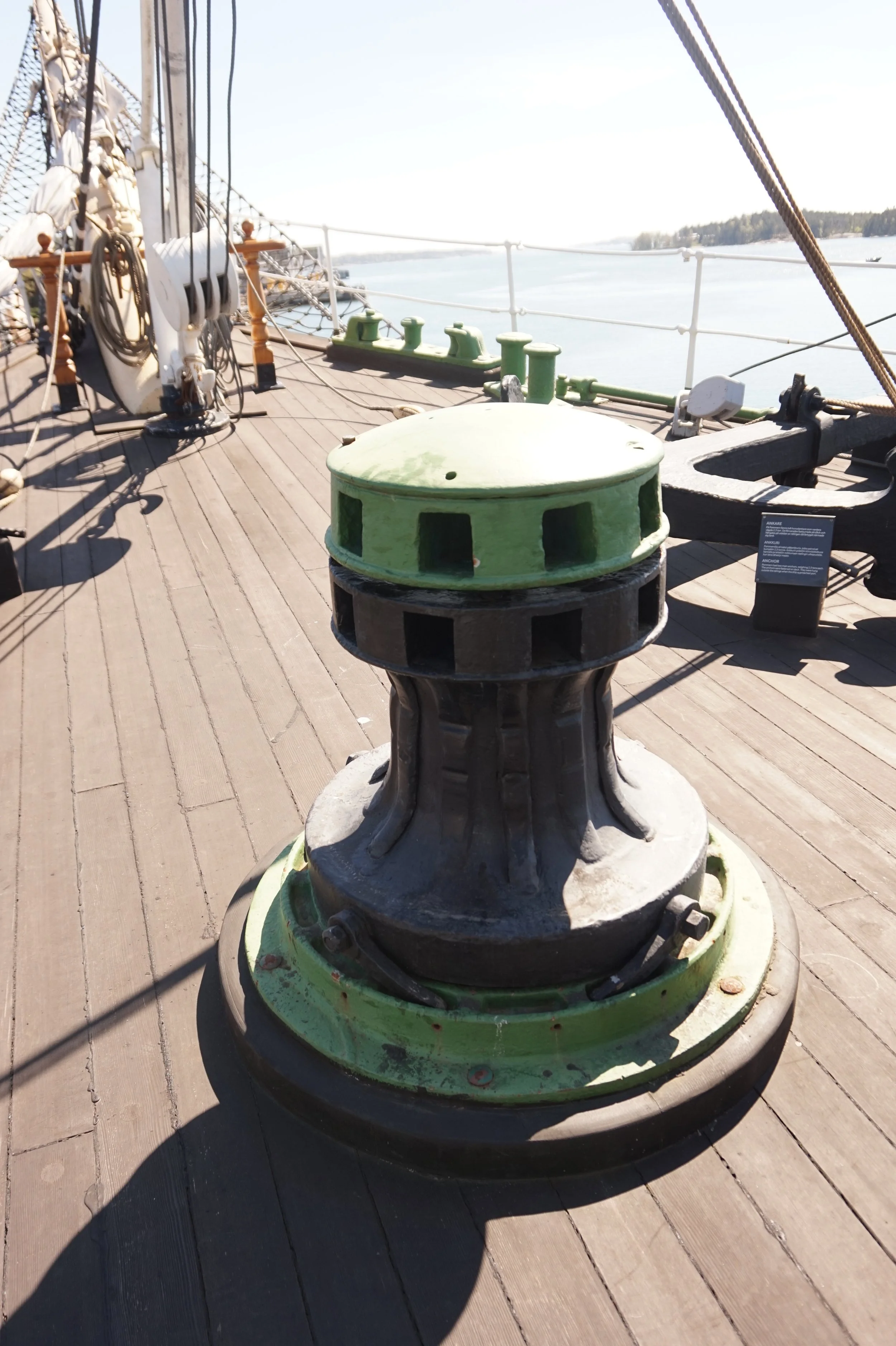
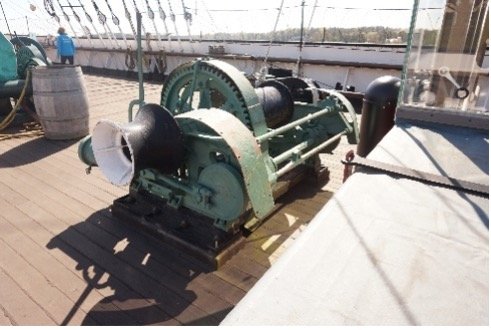
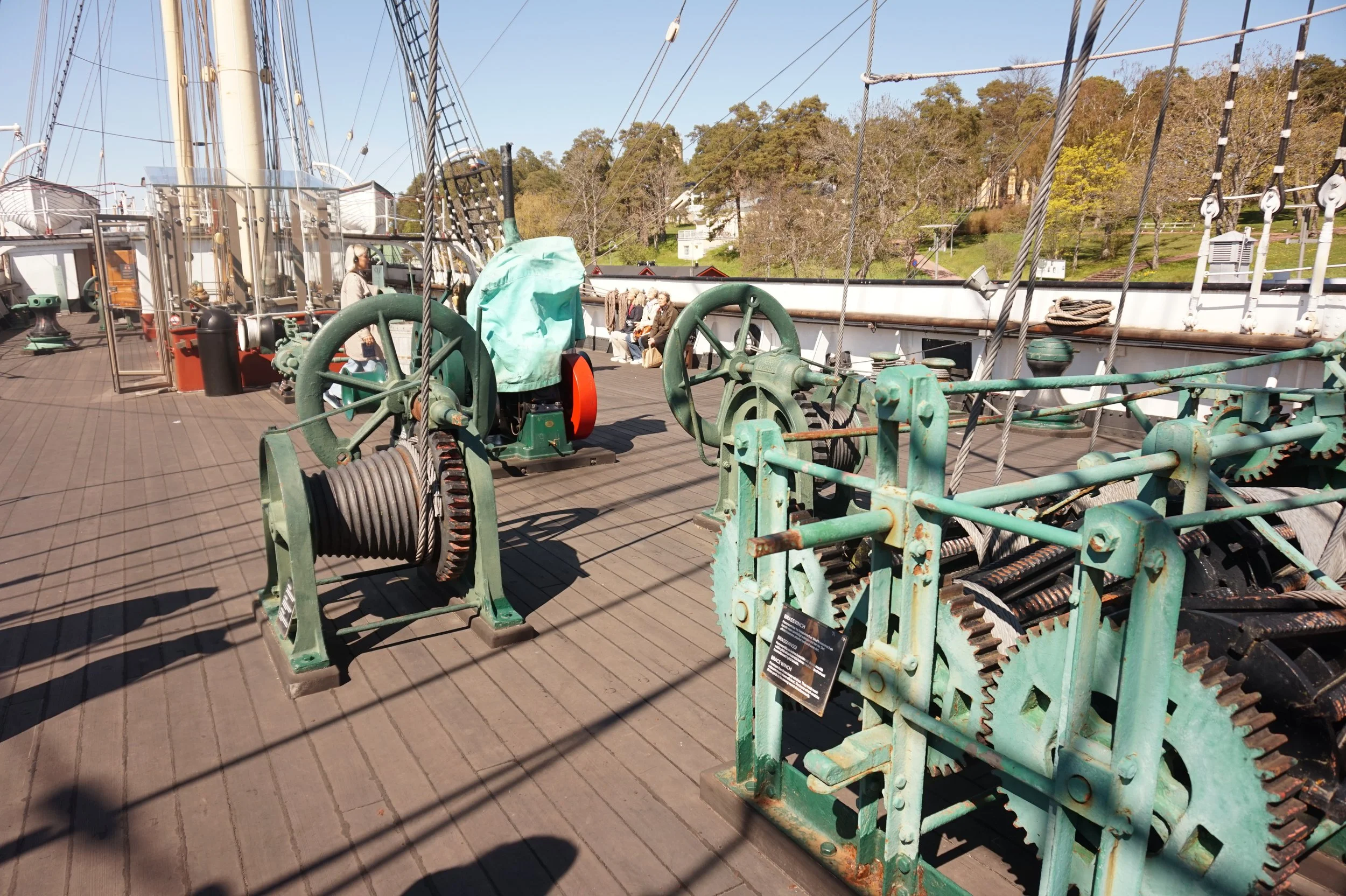
Deck machinery; left windlass (driven by capstan on forecastle head [inset] or steam); centre steam driven cargo winch; right Jarvis brace winch and two halyard winches, all hand operated. Canvas covered object behind halyard winch is a patent “hot bulb” internal combustion powered winch, a later addition (1922), used for cargo work and for hauling the anchor.
![IMG_4260[1].jpg](https://images.squarespace-cdn.com/content/v1/5f83c5947bb62b2036f18924/1783586032433-CCY6QP951TKJ2YT6YZFU/IMG_4260%5B1%5D.jpg)
![IMG_4261[1].jpg](https://images.squarespace-cdn.com/content/v1/5f83c5947bb62b2036f18924/1783586031612-OLCQEMXAKJNP3TUNUL1S/IMG_4261%5B1%5D.jpg)
![IMG_4262[1].jpg](https://images.squarespace-cdn.com/content/v1/5f83c5947bb62b2036f18924/1783586038215-AKQ7YCMILN54BKQP95SA/IMG_4262%5B1%5D.jpg)
Elegant skylight on the poop deck illuminates the saloon, for officers and entertaining (with owner’s portrait as a reminder!), sideboard and door to Captain’s accommodation.
The accommodation has been particularly well preserved, with cabins and saloon totally authentic. The ship is an absolute credit to the Sjöfartsmuseum and to the determination of Ålanders to preserve their maritime heritage in a typically low key but authentic fashion.
![IMG_4263[1].jpg](https://images.squarespace-cdn.com/content/v1/5f83c5947bb62b2036f18924/1783586234197-477QN6QY7NRURPGMZFUR/IMG_4263%5B1%5D.jpg)
![IMG_4267[1].jpg](https://images.squarespace-cdn.com/content/v1/5f83c5947bb62b2036f18924/1783586238693-J11SP6GN6OVNAADHK25H/IMG_4267%5B1%5D.jpg)
![IMG_4265[1].jpg](https://images.squarespace-cdn.com/content/v1/5f83c5947bb62b2036f18924/1783586241261-E6RSTZLADPUQ98CTMLQZ/IMG_4265%5B1%5D.jpg)
Between deck (left); lower hold with sand ballast installed for stability; one sail (there are about forty in a complete set, two sets minimum, one for light conditions and one set of ‘storm’ canvas. This one weighs in at 3 tonnes!
Perhaps one of the most impressive features were the holds, reminding visitors of the principal purpose of the ship – to carry cargo, and to make money while doing it. The tween-decks, maintained largely as they were with numbered removable floors and heavy timber spar ceilings, and the lower holds, with their added ballast bins (dry sand and water tanks) reminding visitors that Pommern is still afloat, somehow really emphasise the massive size of this huge, sophisticated 120 year-old cargo carrying machine.
Altogether, the Pommern is a credit to the Åland sjöfartsmuseum. Long may it continue…
Mariehamn: the harbour and the Åland Islands archipelago
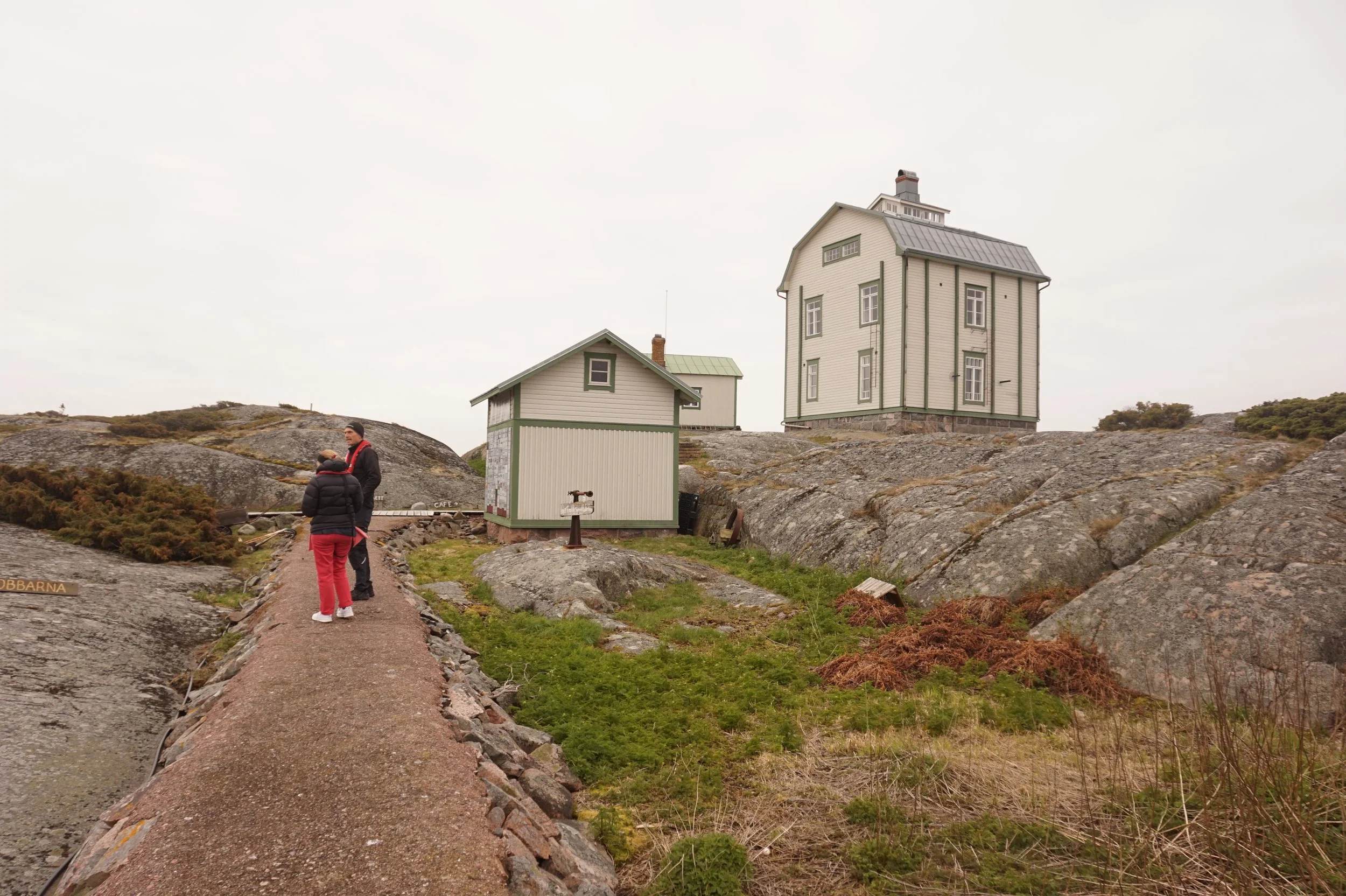
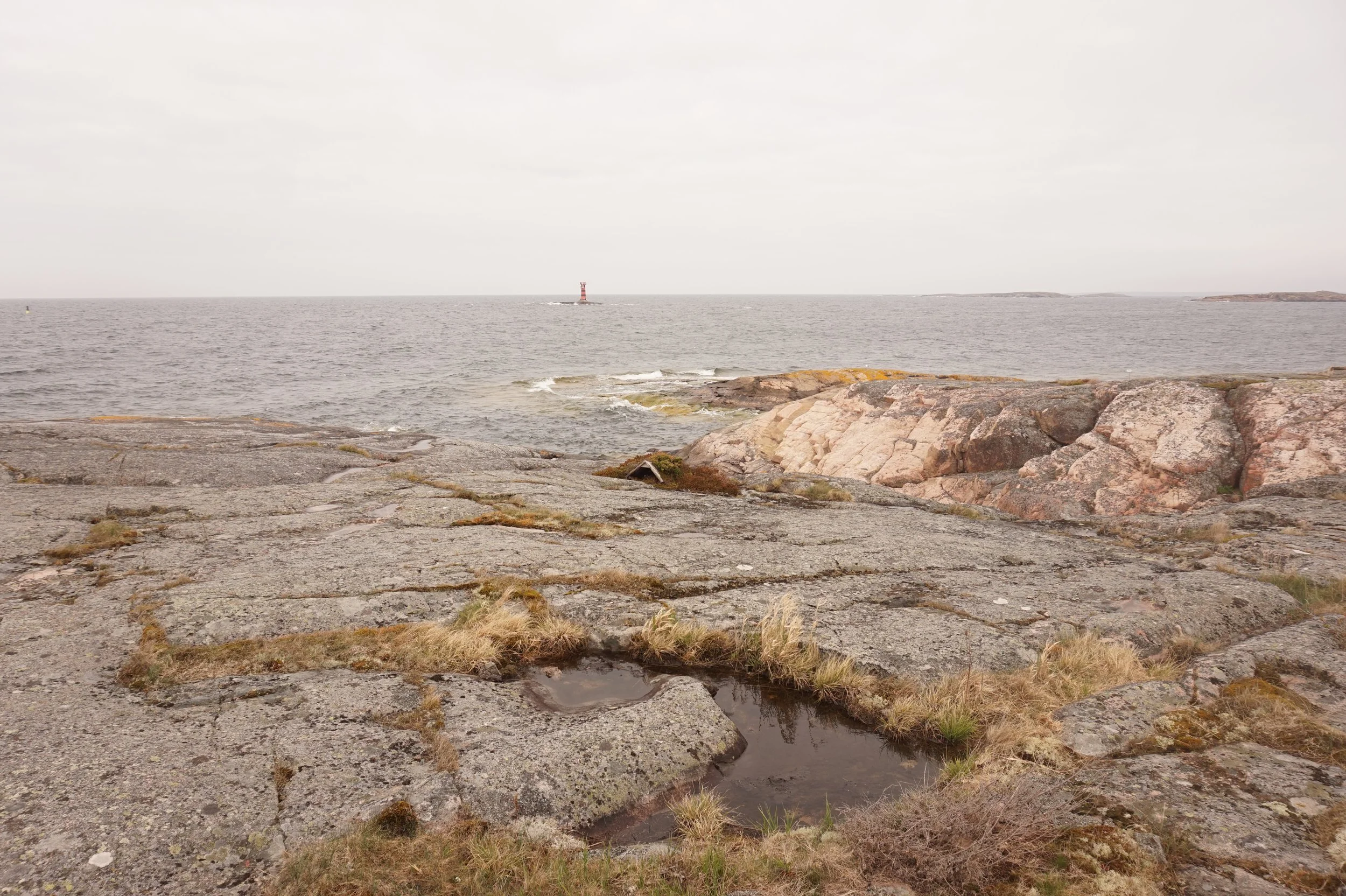
Åland archipelago – left pilot houses Kobba Klintar; lighthouse in harbour entrance; typical island granite scenery
In the view of our small party, a visit to the Åland islands would not be complete without a trip by small boat out the Kobba Klintar pilot station, incorporating, if possible, an unhurried look around the islands that comprise the Ålands archipelago.
Mariehamn is situated on a neck of land between two viken or bodies of water, both accessible by reasonably large vessels, but the deeper western arm providing the main commercial (ferry) berths and the maritime museum, overlooking the harbour and the museum ship, Pommern.
The other – eastern arm – has wharves and breakwaters providing berthing for smaller vessels, water taxis and sailing craft. It also provides facilities for building traditional vessels, the Sjökvarteret (Maritime Quarter) we describe in detail above. We had booked a half day trip by small boat to explore the archipelago to the south of the Mariehamn, leading out to the old pilot station, at the entrance to the two arms of the harbour, and to visit the Kobba Klintar pilot house, these days a museum and – in the summer season – a café and gift shop. This time of year, it was windswept and cold, with a sea mist restricting visibility somewhat. Our conveyance, however was comfort itself, with heating and light aircraft style seating, and a deep V hull which took the steep little seas comfortably. The pilot house itself is well preserved, and along with an interpretive centre and conference facility in the shape of a pyramidal beacon, was inhabited on the day only by sea birds and a boat full of divers who were resting after diving on the popular and well-preserved wreck of the Plus, a square-rigger which came to grief in 30 meters of water in the 1930s with the loss of most of her crew.
The story of the loss of the Plus underlined for us how difficult a landfall Mariehamn would have been for these big, engineless sailing vessels in bad weather, a feature of the region, and relying on a handful of pilots boarding, if available, from small boats. Once inside the harbour, good sheltered waters and reasonable anchor holding-ground meant relative safety, but getting there by sail only, wearing the vessel perhaps and bringing her up into the wind to anchor while simultaneously handling sails and cables would be no mean feat, particularly for a small crew exhausted after a trip through the constricted waters of the Skagerrak and Kattegat, with no doubt the weather wracked English Channel or North Sea not far behind them. Ironically, it is where many of Gustaf Eriksen’s ships would spend the summer. Their schedule would be to load grain in Australia in January, discharge their cargo in the UK or elsewhere in May-June, and then come home for rest and maintenance in the summer. They would seek a timber cargo going south after the summer, back to the Southern Hemisphere, or they just took ballast in late August, and sailed to the Spencer Gulf in time for the harvest South Australia in December. The Plus previously one of Germany’s “Flying Ps”,in fact came to grief in winter, sailing home from London to winter in Mariehamn in the lead up to a Christmas, the crew aiming to be with their families at last, an extreme irony.
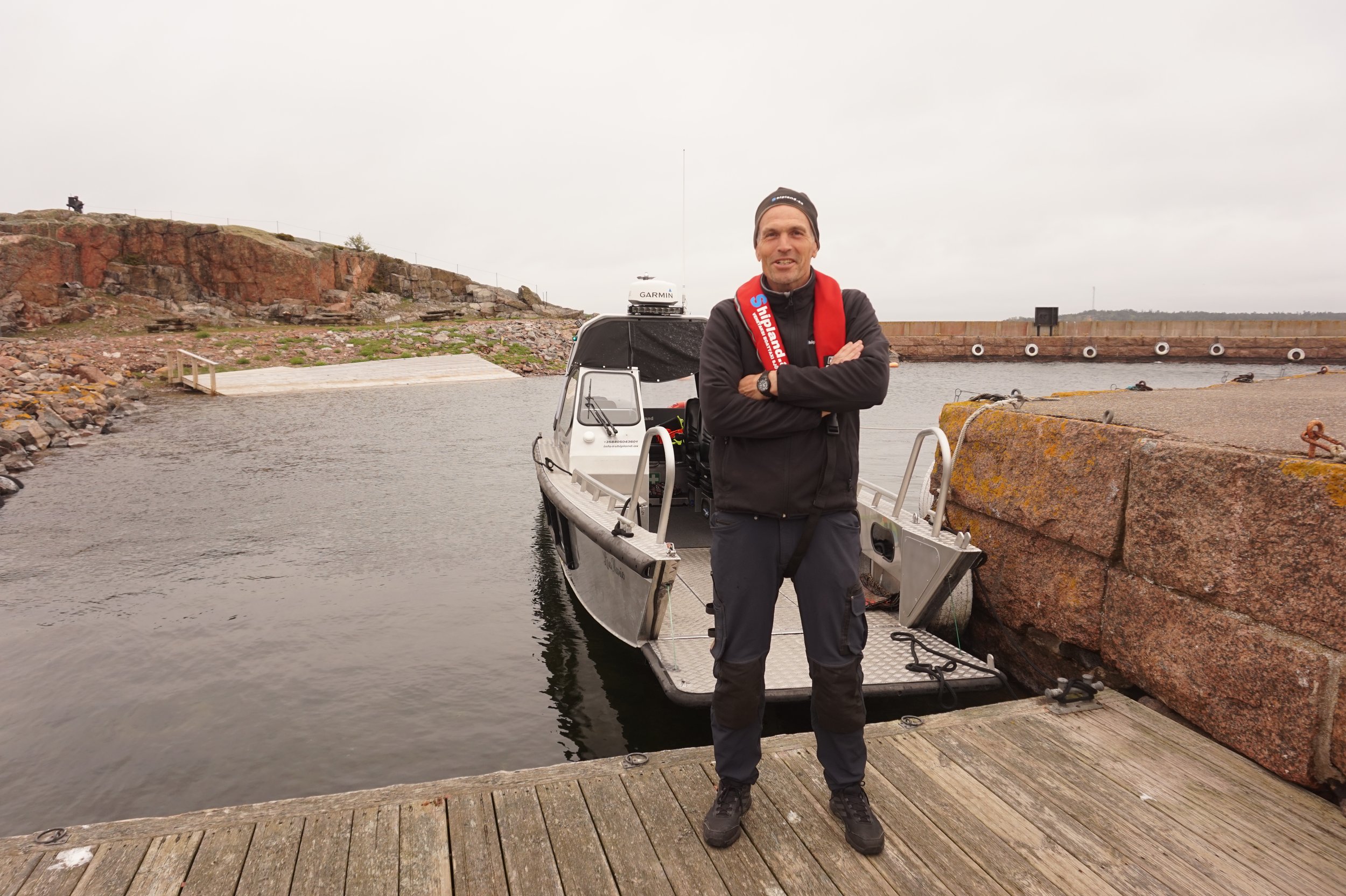
The trip out to Kobba Klintar was arranged with Vilhelm Holmberg, who through his company Shipland.ax (his website www.shipland.ax) provides taxi services using a purpose-built, deep-V aluminium boat, with a comfortable cabin, an open deck and bow ramp suitable for wheelchair access, and a business-like 250 hp outboard motor on the back. Vilholm’s highly professional approach to navigating the boat, ensuring passenger safety and providing a full-on commentary in perfect English, made for a very pleasant and informative trip, and gave complete confidence in his capabilities.
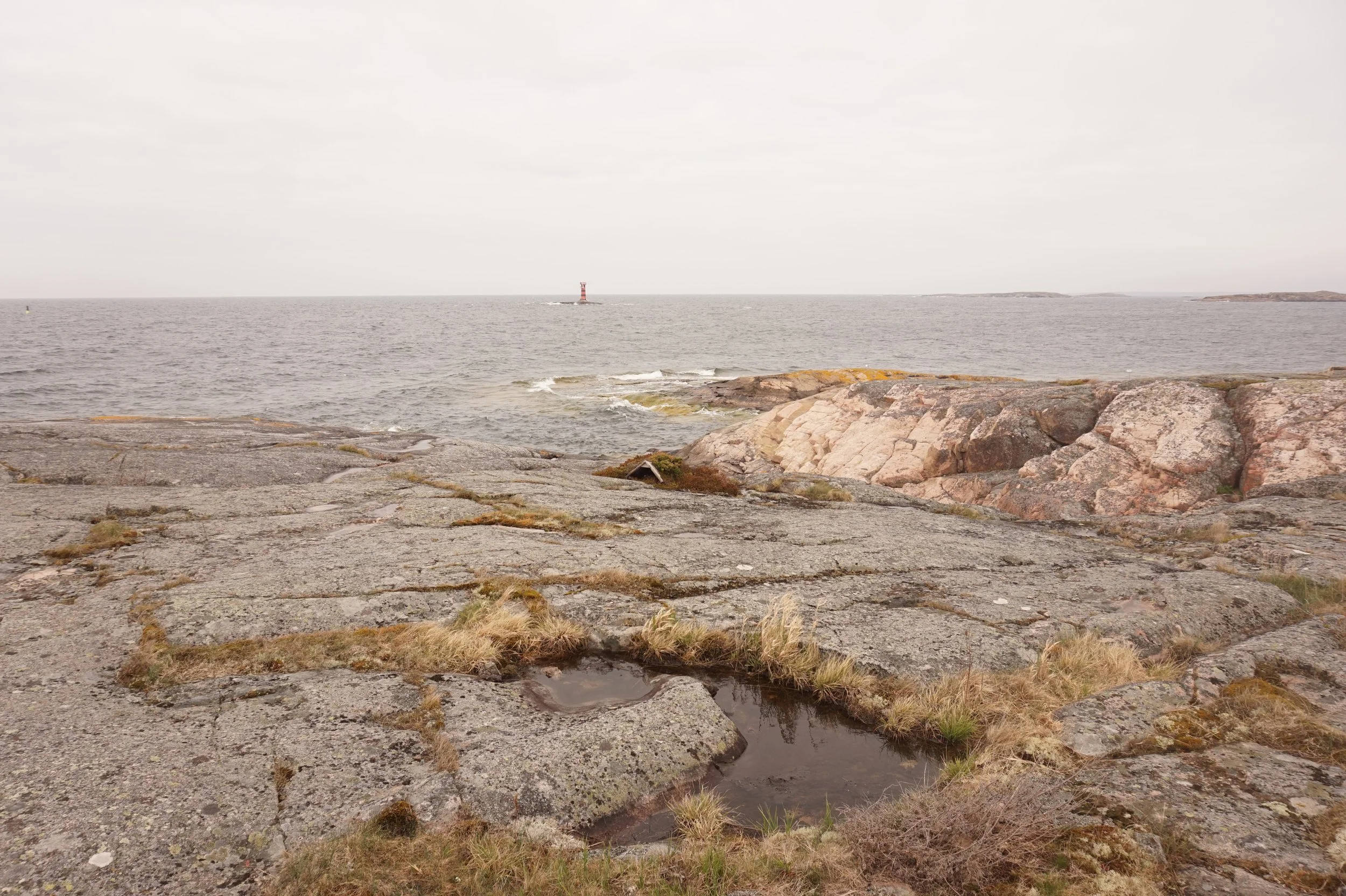
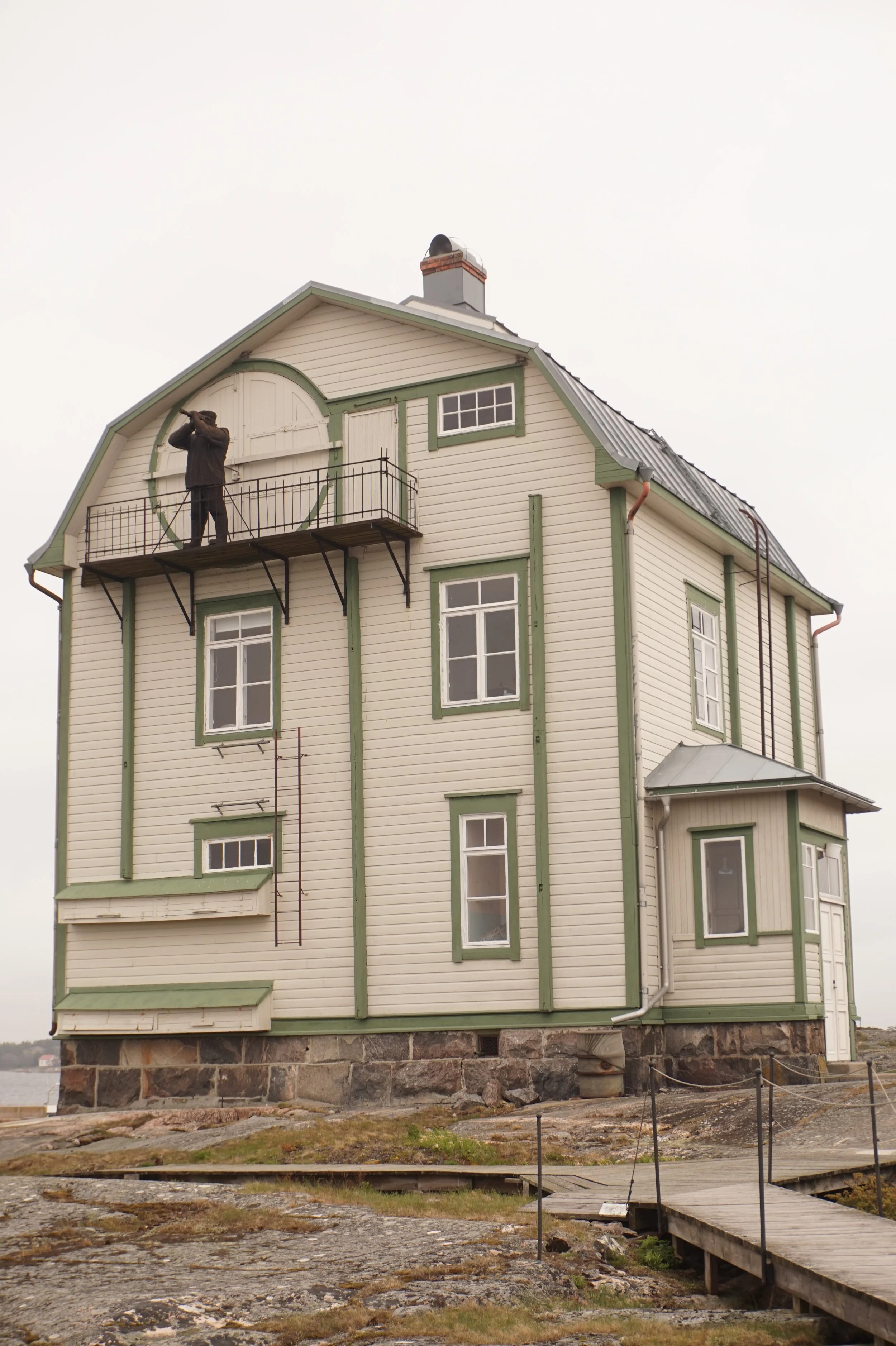
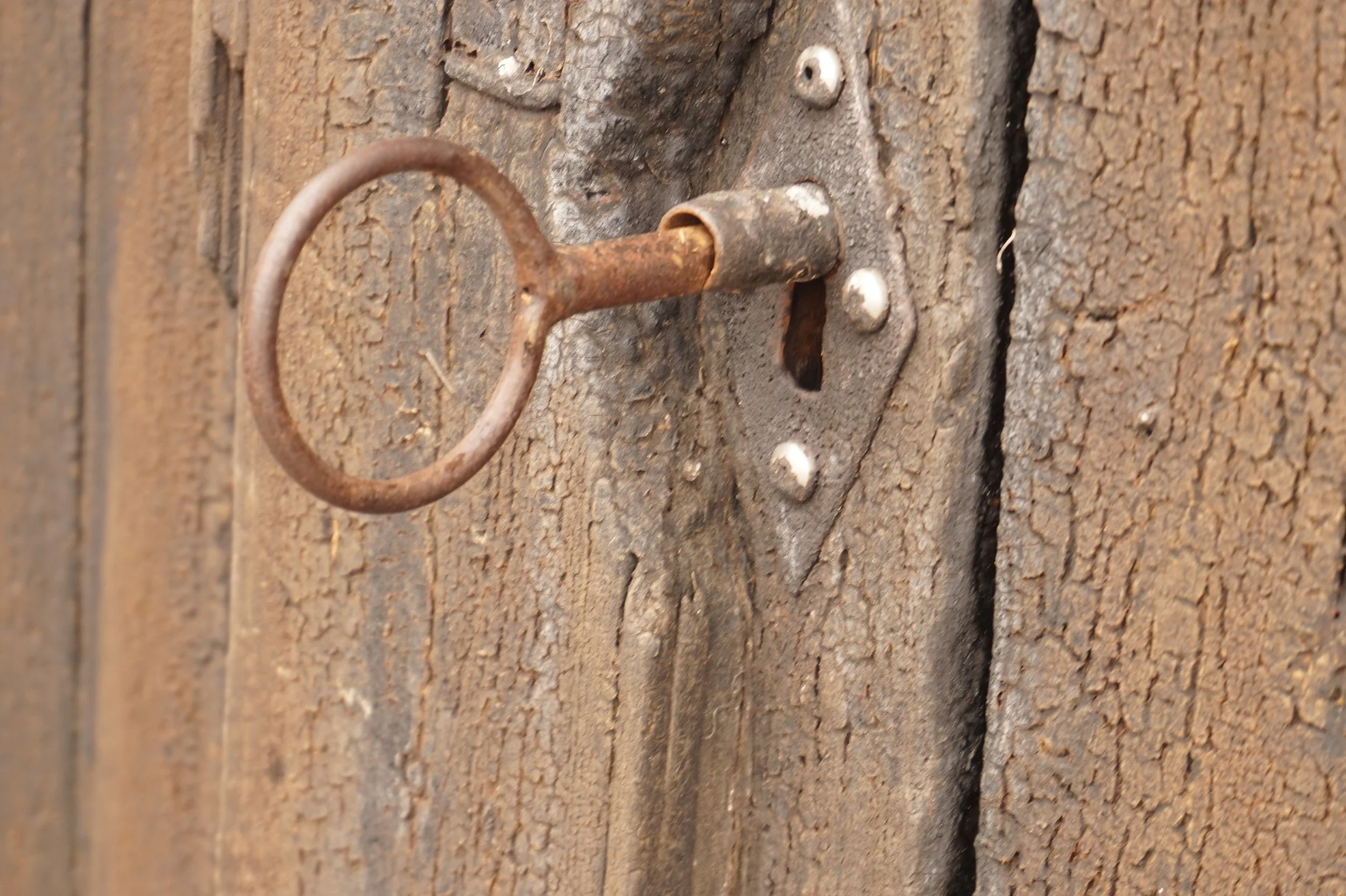
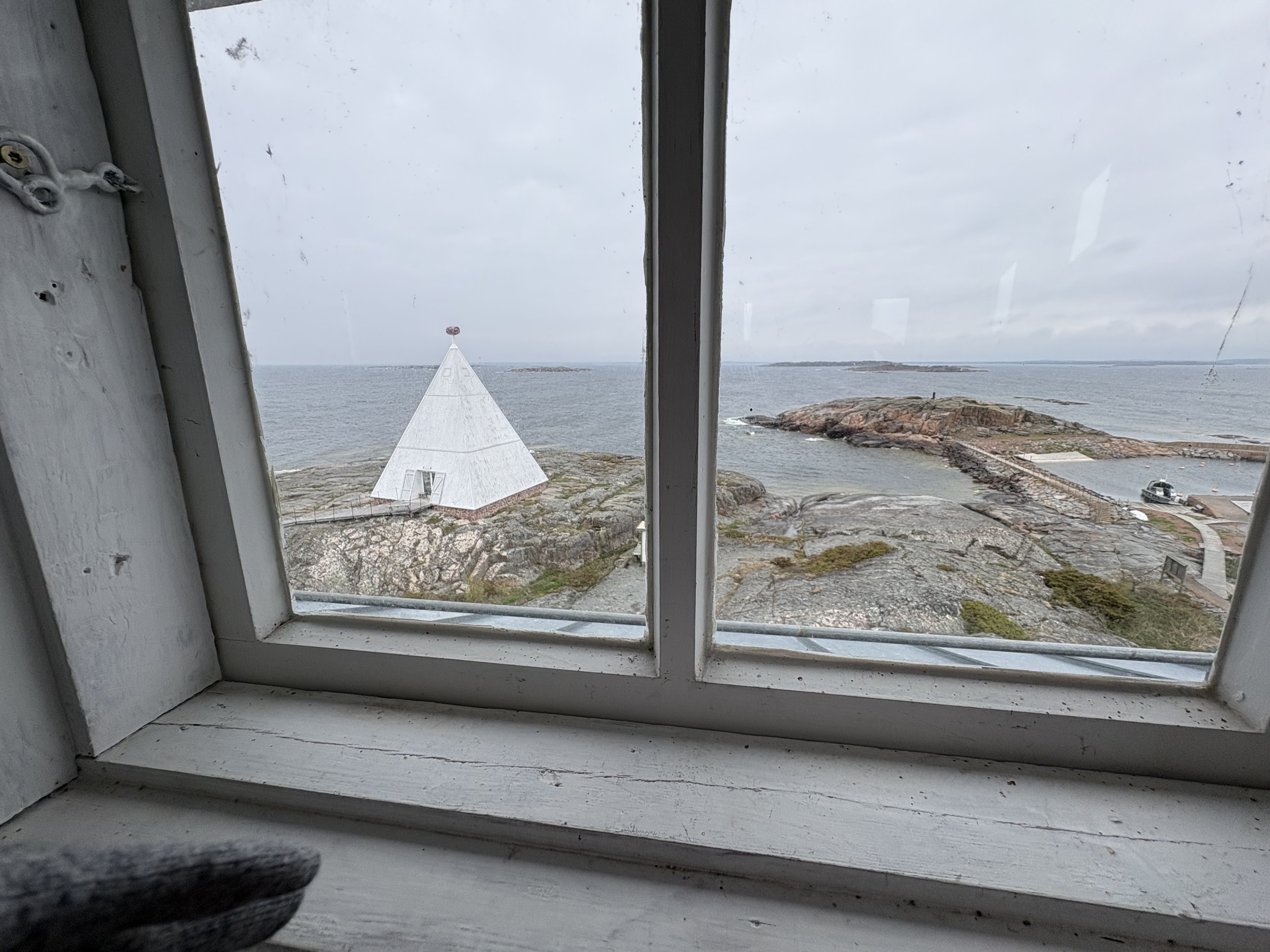
Kobb Klintar – left the channel, centre the pilot station (with statue of lookout in front of fog horn aperture) on Mariehamn’s southern approaches. (Right) The crow’s nest view of the channel and ‘beacon’ style conference and interpretative facility. Inset: High security: the massive key was cleverly concealed under a piece of driftwood!
The photographs above emphasise the difficult approach to Mariehamn, with unforgiving granite islands on both sides and a single, small lighthouse on a reef in the centre. Little wonder that before the age of radar and GPS, several big ships came to grief within sight of the light, or even inside the harbour as happened to the barque Plus mentioned above, her watery grave marked by the dive boat pictured below.
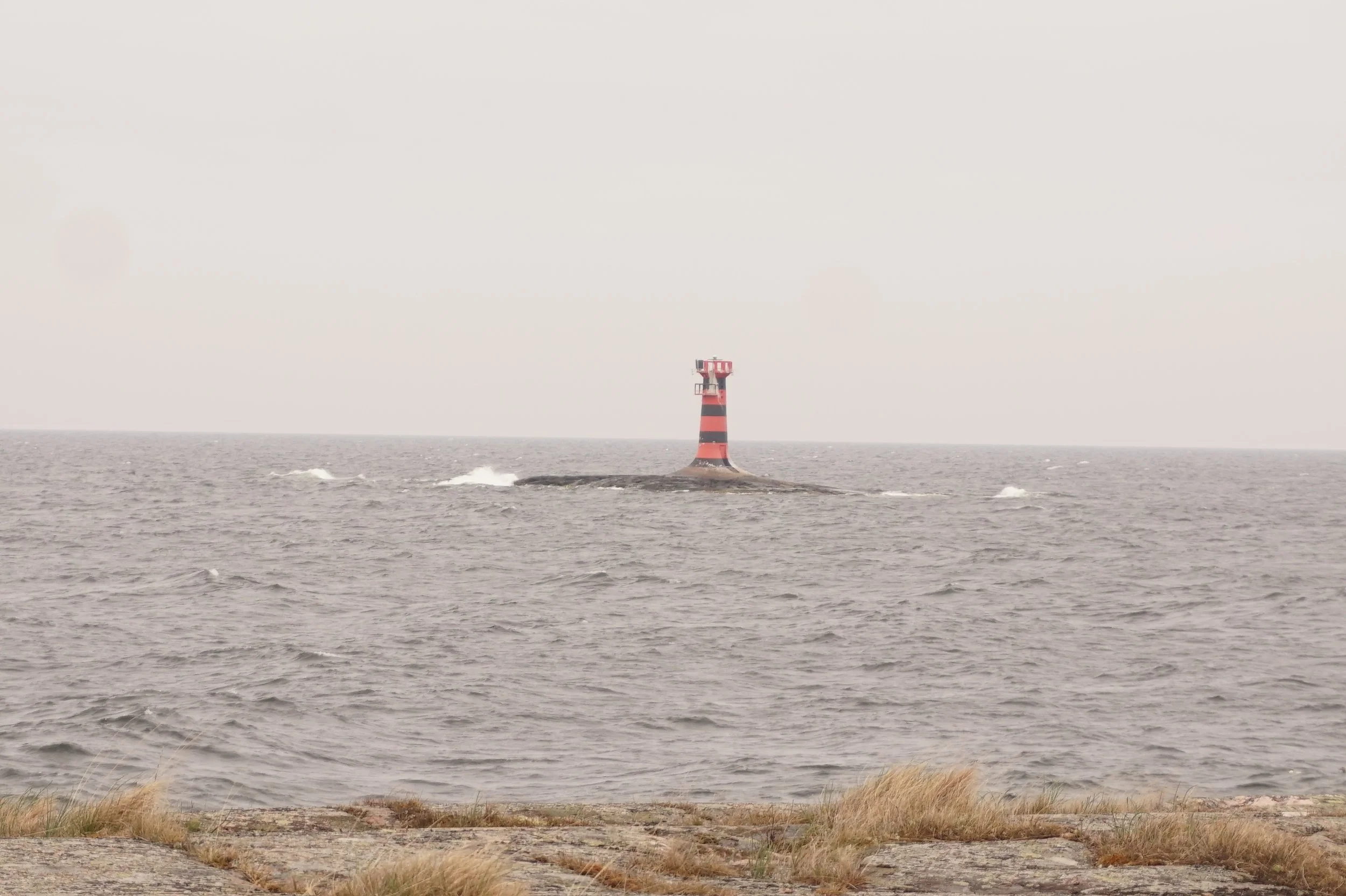
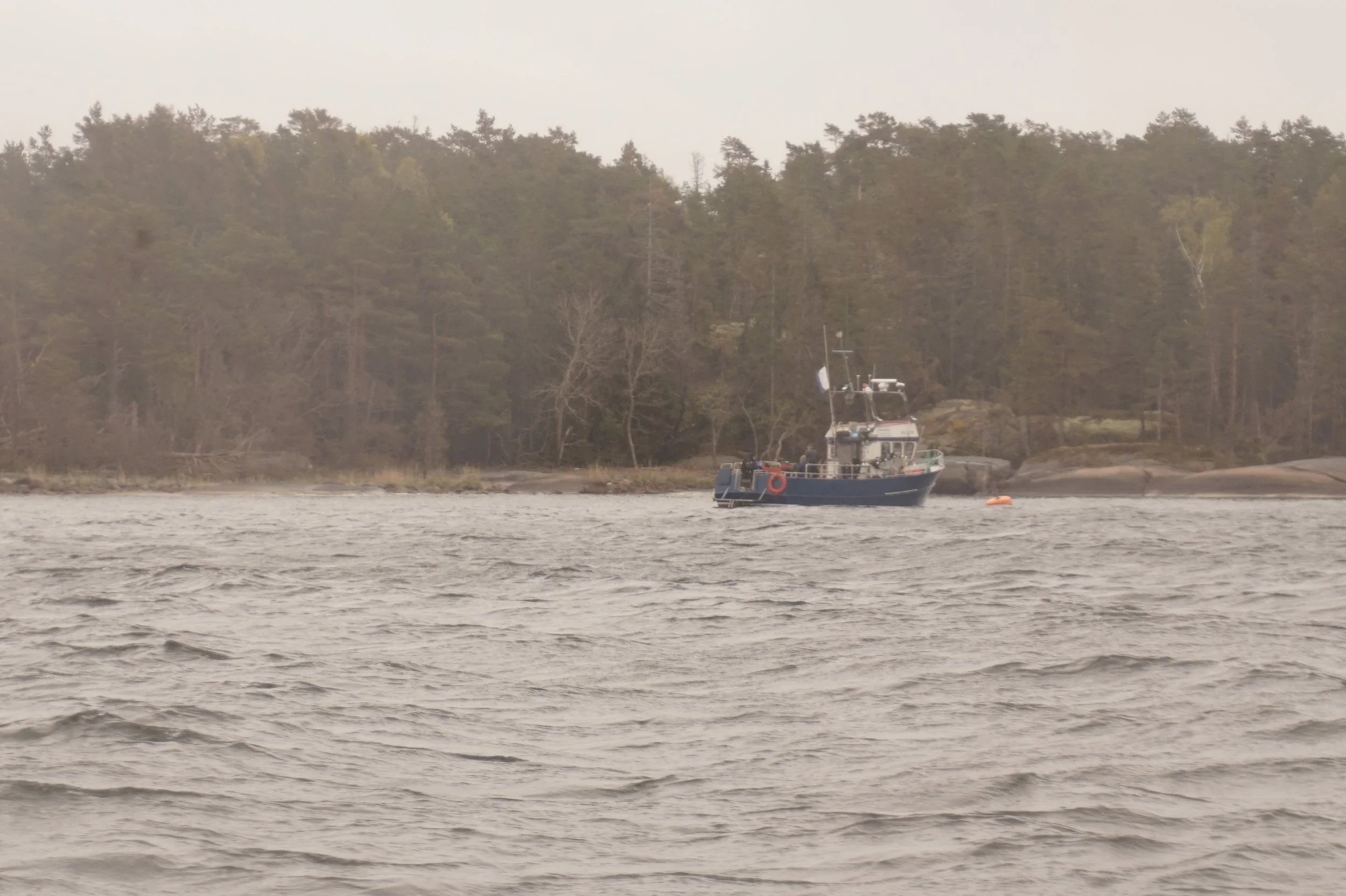
Mariehamn heads - the single light house. Inside the heads, the penalty for miss handling the approach. Divers on the 1933 wreck site of German built barque Plus.
As a clue to the weather conditions and dangers of those days, the pilot house also contains a massive air-driven fog horn. Below, a member of our team provides the scale!
![IMG_4189[1].jpg](https://images.squarespace-cdn.com/content/v1/5f83c5947bb62b2036f18924/1783587623243-3U8RLMBLDH2RZMV64OB2/IMG_4189%5B1%5D.jpg)
Author’s wife provides scale for the Kobba Klintar fog horn. Right – Vilhelm, our multi-skilled guide to the archipelago
Mariehamn to Turku
The next leg of our journey was by ferry again, to Turku in southwestern Finland. We were booked on the ferry Baltic Princess, also owned in Tallin, but configured differently to Silja Serenade, although similarly well-appointed with restaurants, bars and duty-fee shopping centres.
One small issue arose departing Mariehamn. The taxi prearranged by travel agents took us from the hotel to the ferry berth that we had arrived at, and from which we expected to depart. The airport style departure board in the terminal, however, did not show the ferry we were booked on. Thanks to a friendly off-duty Viking staff member who made time for us despite our tickets not being for a Viking ferry, (Viking being the competition to Silja on the Stockholm/Helsinki route) it became clear that the Tallin based Silja Line ferry to Turku berthed at a different satellite port facility, Långnås, not known to us and some 40 kilometres away in the Lumpurland island region of Åland.
Fortunately, we had arrived early and getting a taxi (the same one with possibly the only driver in Åland who didn’t speak English, and who had already dropped us at the wrong place!) and getting to the right berth in by world standards light traffic was not a problem. In fact, in small print on the itinerary the different berth was shown but our unfamiliarity with Åland meant we did not register that it was a distant berth. Although the taxi ride through the islands of Lemland and across the canal to Lumpurland was pleasant enough, seeing on the way signs to Hellestorp and other key locations in Gustaf Eriksen’s early life, we were pleased to finally see the bulky ferry Baltic Princess thread the needle to ease into the Långnås berth, all to pick up just a handful of passengers. It had been a trap for the unwary, but easily rectified in this case. With fewer alternatives, it could have been otherwise. (Note: subsequently our Denmark based travel people quickly and with no fuss reimbursed us for the extra taxi fare, so all is well.)
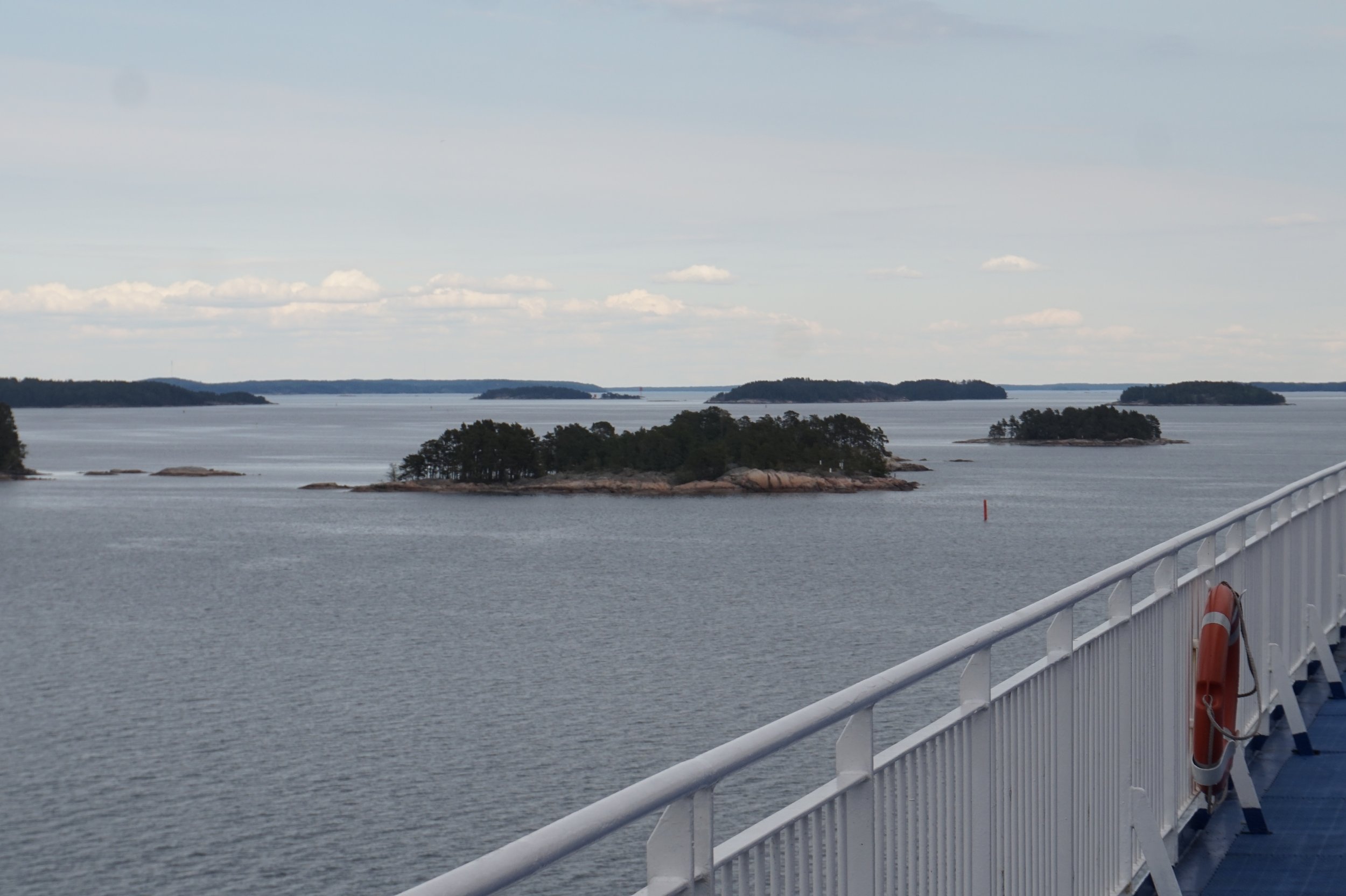
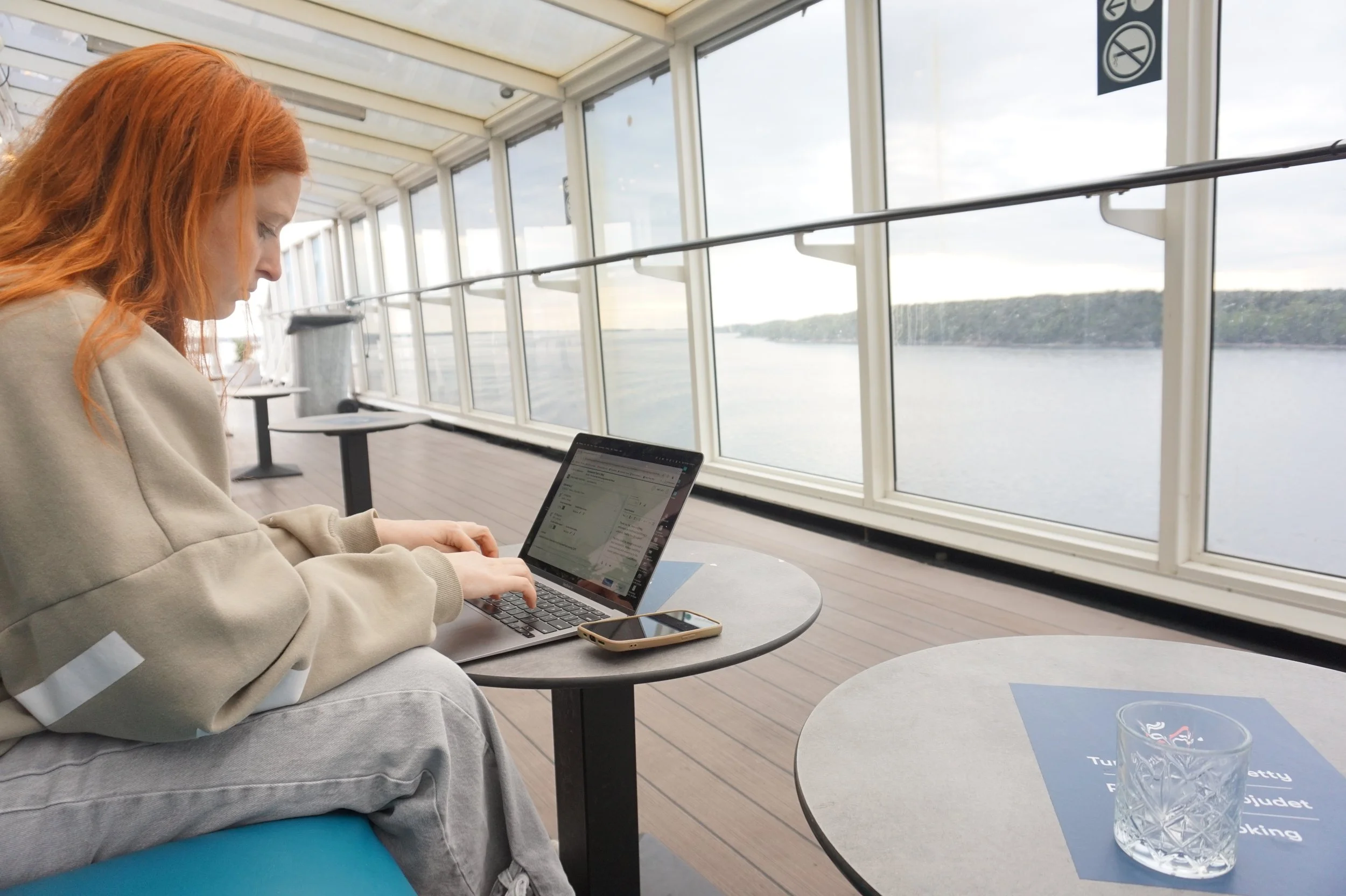
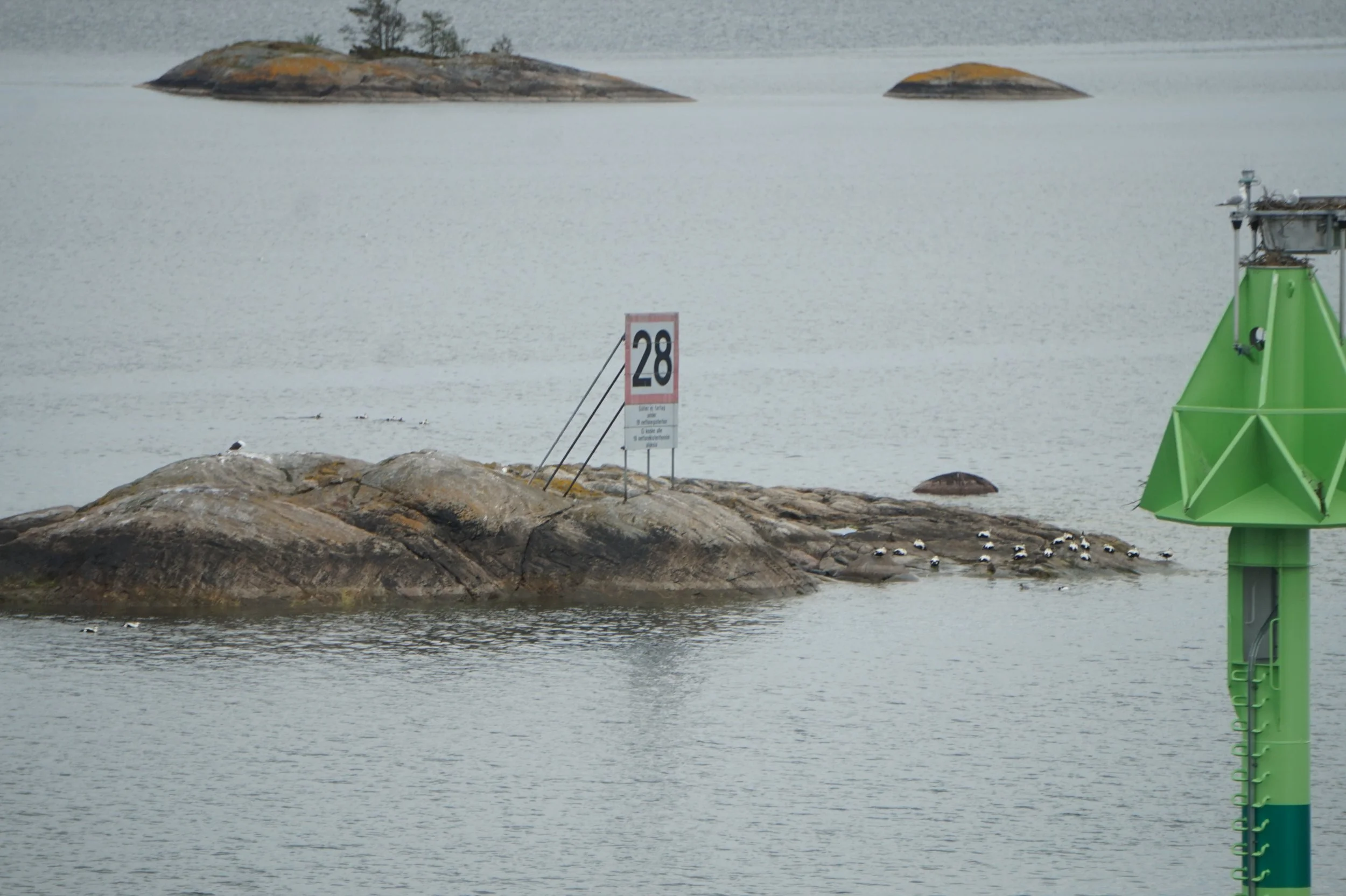
Ferry ‘Baltic Princess’ Mariehamn to Turku: Centre – our team catches up on notes; Left and right, Islands in the stream…
The ferry ride was pleasant enough, although this time, given the transit time of only 4 hours, we were ‘deck’ passengers rather than having a cabin. Baggage was stored in a locked room and we were free to move around. The restaurants and bars were well frequented, as it is clear that most passengers were there only for a weekend excursion and a chance to buy tax-free alcohol, which they did with gay abandon in some cases. Party time soon commenced. Although it was all very good humoured, we took to the top mainly open deck, which had some seats under cover and a small bar, little used on this trip, well placed to ease the burden of watching the islands slide by.
As I wrote a first draft of this article, I had a backdrop, thanks to Finnair’s Airbus 350-900 3-D mapping technology, a seamlessly updating screenshot of a small, white Finnair aircraft passing between Mount Ararat and Kabul, and heading at 39,000 feet for the Bay of Bengal on the way to Bangkok. A world – and a century - away from the ships and history we have been rubbing shoulders with in Sweden, Åland and Finland. Such is technology…
Turku and the Forum Marinum
Turku emerged from the haze an hour before the Baltic Princess was due to arrive at the berth. After four hours of threading its way through the multitude of islands making up the Ålands archipelago, which effectively merges into the archipelagic south western coast of Finland, our first sight of Turku was massive gantry cranes of shipyards down river from the city. The Baltic Princess berthed in Turku’s port on the Aurajoki (Aura river), about 4 kilometres from the city centre. Since we had to rescue our cases from the luggage area and find the right deck for disembarking, we missed seeing too much of the river that runs through the centre of the city. Fortunately, we had several days to explore what turned out to be a very pleasant city.
The voyage from Mariehamn’s satellite ferry berth in Långnås was without incident, with plenty of islands sliding past on both sides and enough other traffic to be interesting. There was much partying going on on-board and, clearly the mainstay of the ferry services’ profitability – tax free alcohol - was very evident in the party atmosphere that quickly took over as the many bars and restaurants swung into action as the last line was cast off. Most passengers were clearly there for the tax-free alcohol, both consuming it and carrying it home. Most left the ship with a single backpack, and a large stack of boxes of the current fashionable canned hard (=alcoholic) spritz, heavily taxed in Finland, teetering on folding wheeled luggage carriers. Almost inevitably one of these, plus it’s no doubt inebriated owner, sledged dramatically head first down the terminal’s main escalator on disembarking, scattering people, luggage and escaping spritz cans ahead of him. Alcohol may have assisted in keeping down the casualty list! We were pleased that with our full-sized cases we had waited in the long queue for the only lift (‘hiss’ in Finnish).
Turku as noted above, turned out to be a pleasant city, partially peopled by more robot food delivery machines than we had seen anywhere else. The city centre, with plaza and pedestrian shopping streets, falls to a river frontage with paved walkways and shady trees and an abundance of restaurants, ice cream vendors, cafes and coffee houses. Commercially, it has grown in importance as an industrial and maritime centre despite losing its capital status to Helsinki, and much of its shipbuilding to satellite areas (Rauma etc.). Turku was founded in 1229, a few years before Stockholm, as we were proudly informed by a delightful senior lady who befriended us on a sunny bench in the plaza. Adding to its interest, after Finland came under Russian rule in 1809, Turku was briefly the capital of the then Grand Duchy of Finland until the Russian occupiers relocated the capital status to Helsinki. Turku is now the third largest metropolitan area in Finland, and, although the once dominant industry – Wärtsilä ship building - has moved out (see below), its place is being taken by pleasantly constructed residential areas looking across to the port and Turku’s historic castle, with paved areas still in the shadow of a couple of Wärtsilä’s giant dock-side luffing cranes. As in Gothenburg, these cranes have been retained, presumably to maintain a pleasing link back to the modern city’s heavy industrial past.
The Wärtsilä shipbuilding facilities were moved to a new shipyard in Perno neighbourhood, part of Turku situated around 10 kilometres from the city centre, in the 1970s. The last ship completely built by the old shipyard was delivered in 1980 and the repair yard operations by the river Aura ended finally in the early 2000s. The Perno shipyard, nowadays owned by the German Meyer family company, is still today a very significant industry in Turku employing around 2400 people directly and has an important impact on many companies in the Finnish maritime sector. The Meyer Turku shipyard now focuses on building some of the world´s largest and most innovative cruise ships, and is the biggest shipyard in Finland and considered to be one of the major shipyards in Europe.
For any visitors interested in this important element in Turku’s history, we highly recommend a visit to Forum Marinum museum, where outstanding models of the shipyards on the Aura river in their heyday are paired with detailed dioramas of the original yards, complete with classic vessels under construction. The collection of old wooden vessels is also very impressive.
In the port area, some 5 kilometres downriver from the city centre, is a substantial area of land, owned by the city, but leased to what has become a world-class maritime precinct and museum, the Forum Marinum. The maritime museum is in several buildings, along with a pleasant restaurant with outdoor eating in a purpose-built structure encapsulating a locally famous sailing craft. The outlook is across grass areas to the 3 masted barque Suomen Joutsen, in two-and-a-half masted form currently as the main topmast and spars were being serviced elsewhere in the off-season, and the lower main mast is under scaffolding and wraps.
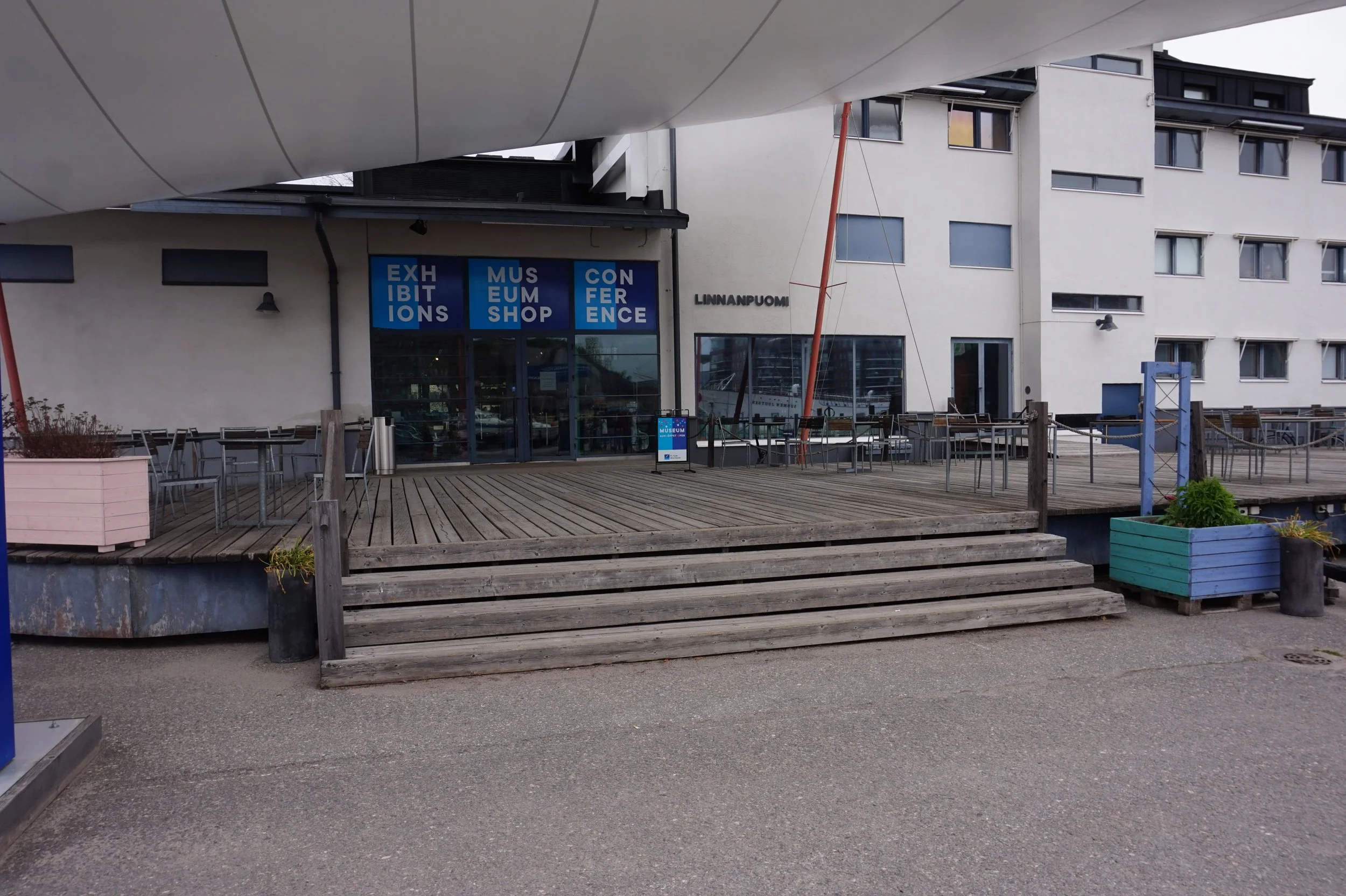
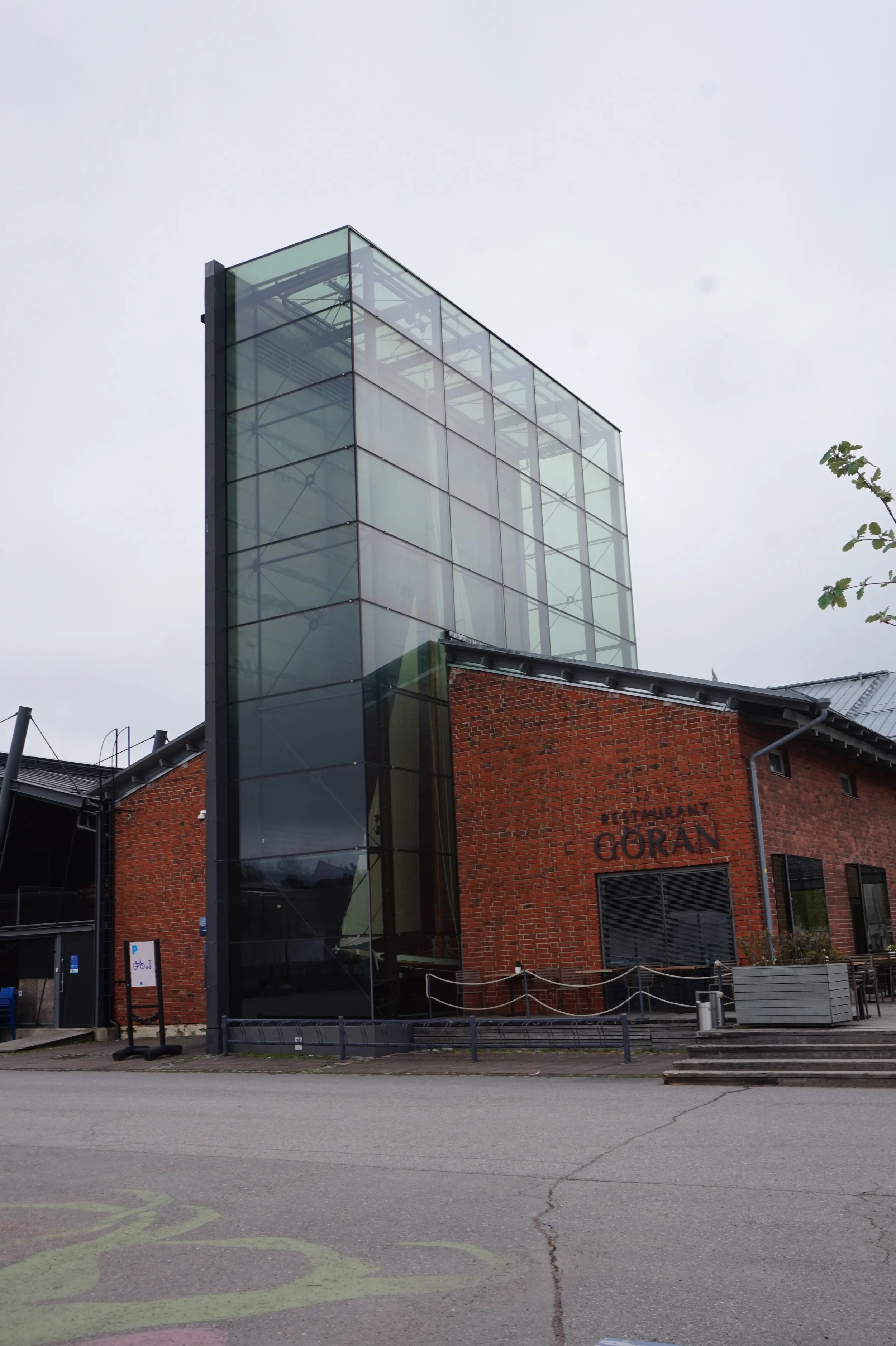
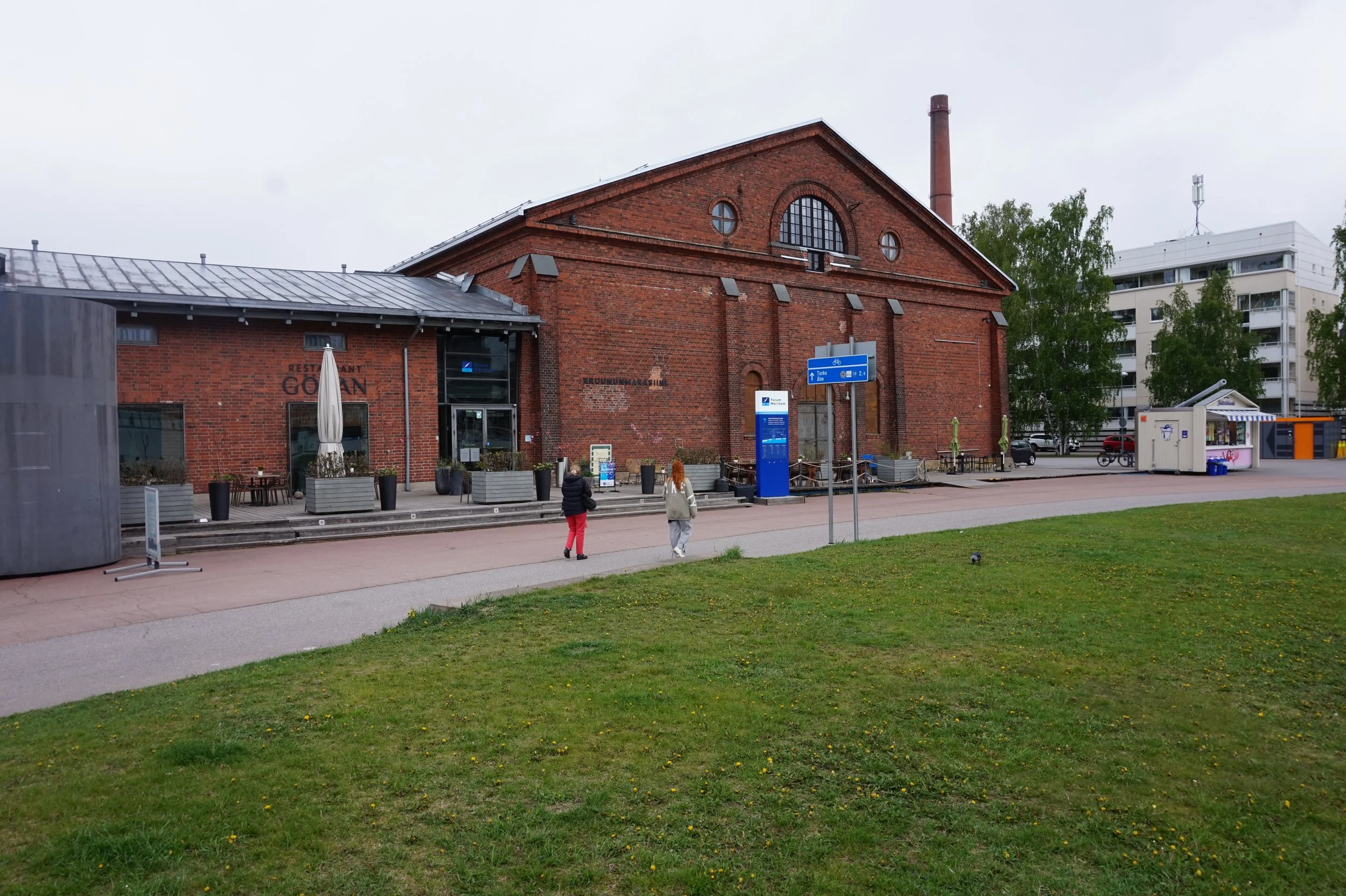
The maritime museum precinct of Forum Marinum – the precinct building looks across grass to the barque Suomen Joutsen
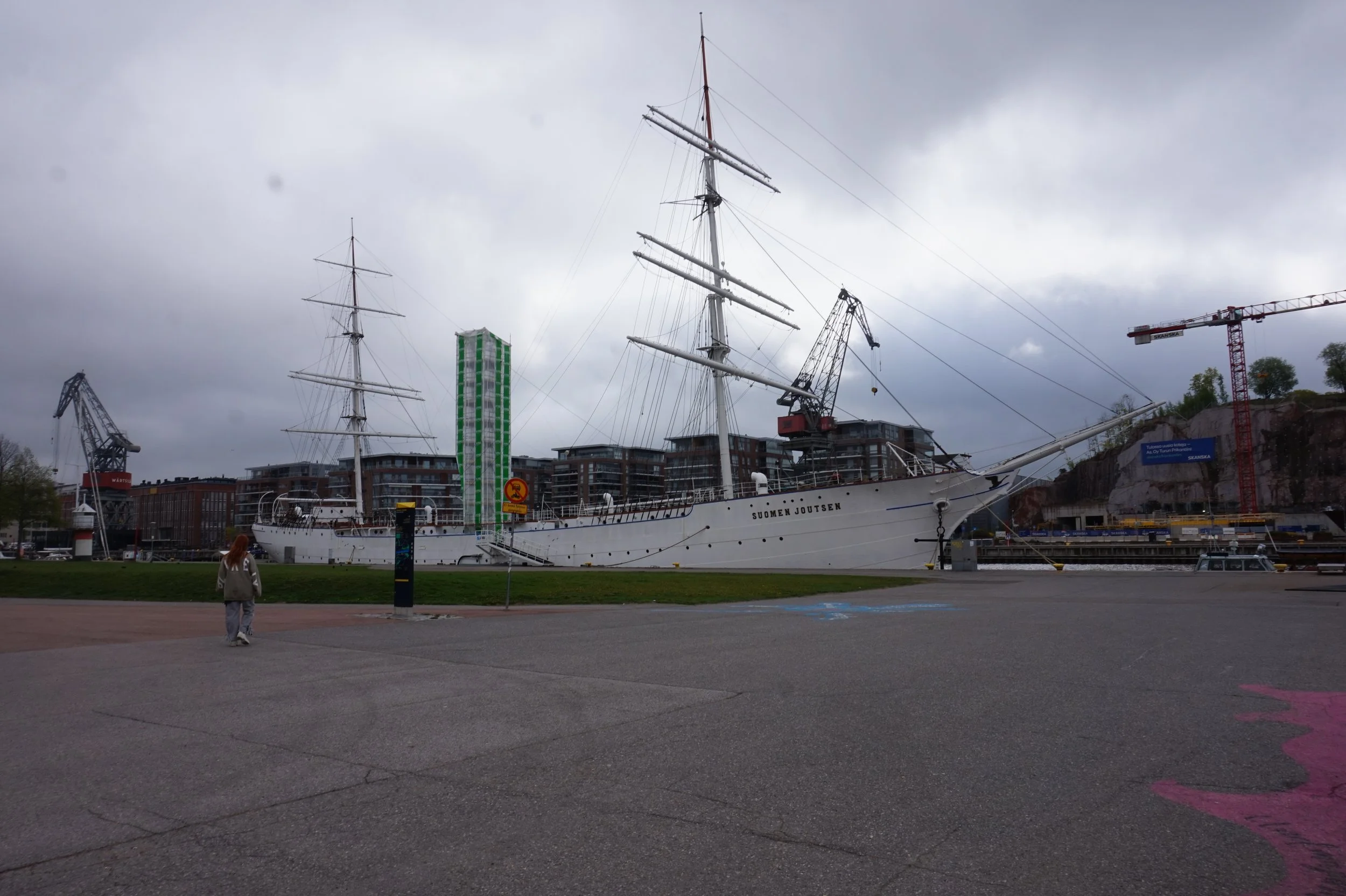
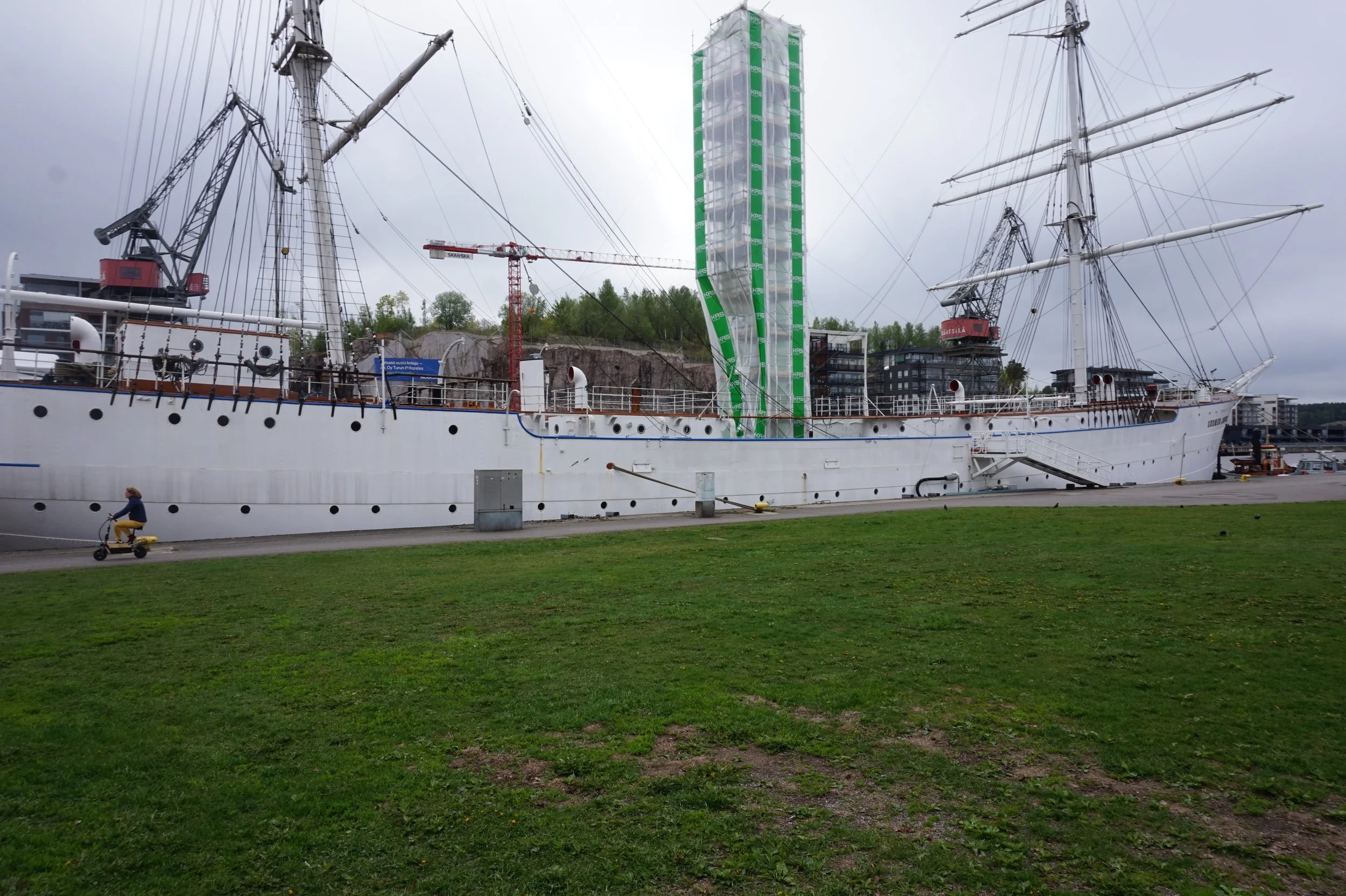
Fully rigged ship ‘Suomen Joutsen’, ex-‘Oldenburg’, originally French built ‘Laennec’ -participant in the Grain Races (just!)
The Sigyn, the main feature of our Turku visit was a few minutes stroll up river, in her own purpose-built floating dock, Loke, and fully shrouded for off-season maintenance with scaffolding and plastic, decks during our visit still tacky with fresh tar.
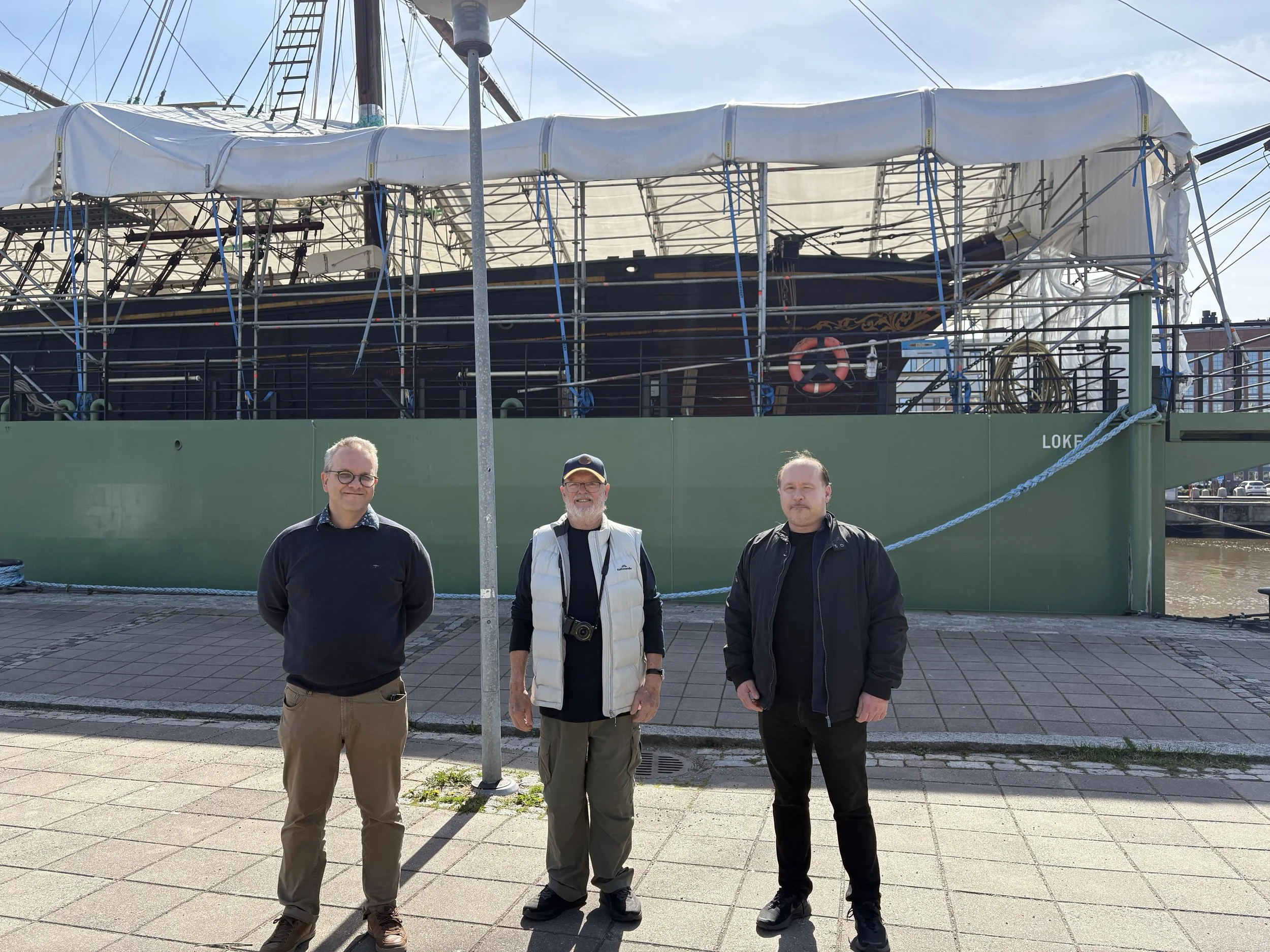
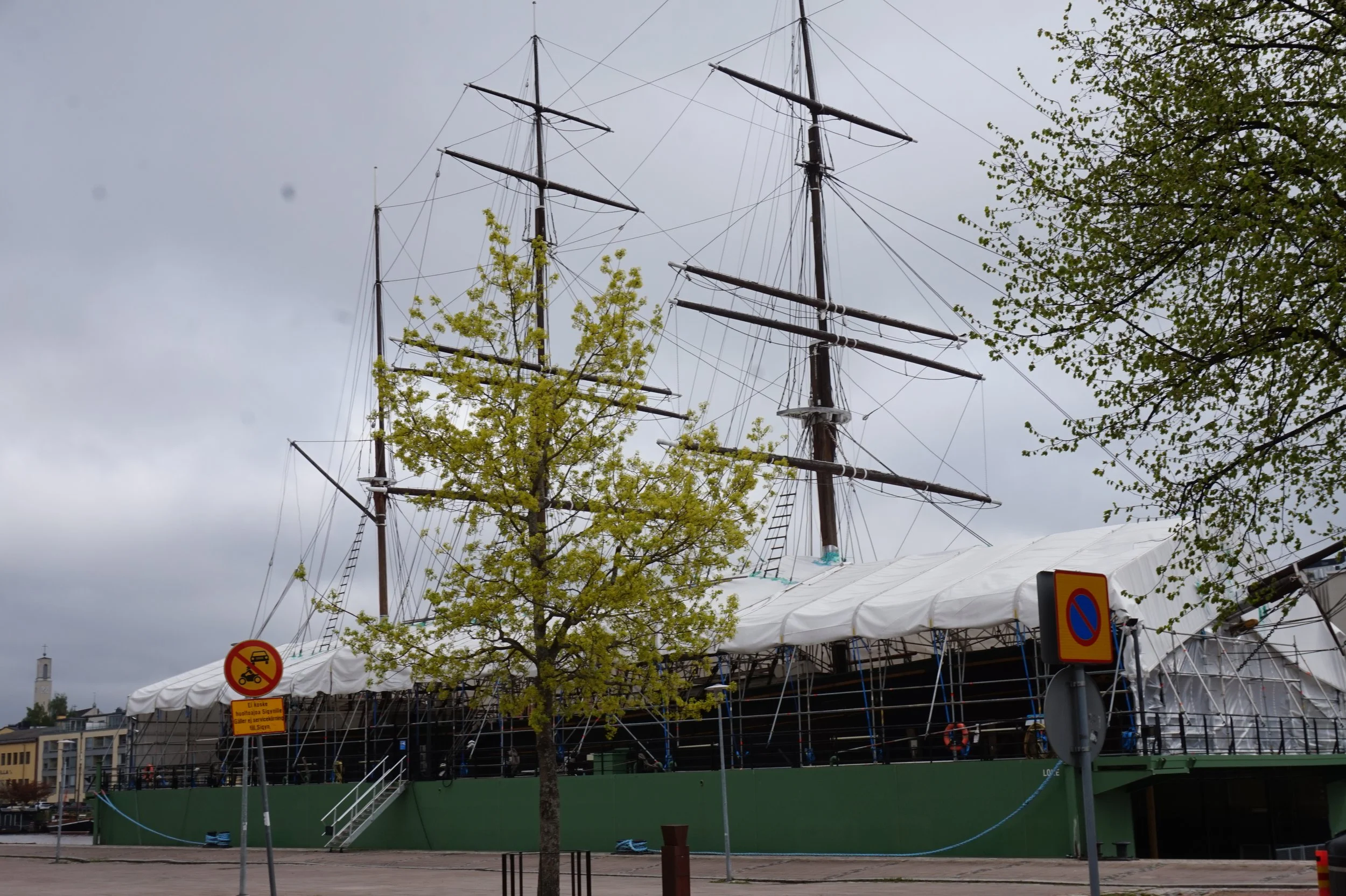
Barque Sigyn shrouded over for winter maintenance and (right) Forum Marinus’ curators Mikko Meronen and Pauli Kivistö with author (centre)
We visited Sigyn on a Monday, the only day that suited our tight schedule, and the museum and the two sailing ships were all closed to the public. Never the less, Senior Curator Pauli Kivistö had arranged for us to gain access to both the museum and the two ships, with the added advantage of only workers on board so clear space for photographs and exploring as we wished. As visitors from far lands, we were privileged to a private showing by the two curators, Pauli and Mikko. To clarify, the Museum Curator Pauli reminded us of the opening hours. The Forum Marinum's exhibition halls are open all year round, but during winter months they are closed on Mondays. However, during the high season in summer months (June - August) we are open daily. The museum vessels are also open for public mainly in the summer season, otherwise primarily closed for maintenance (excluding the museum and hostel ship
Many photographs (samples below) were taken with a view to a model of Sigyn in due course, assisted greatly by plans provided electronically by Pauli Kivistö. A 1:50 model of the ship in her purpose-built floating dock, Loke, is envisaged. This may have historic value as there is a plan to move the ship on to dry land in the area currently under car parking south of the museum buildings, adjacent to the other ships and boats of the museum fleet. Note the shiny decks – freshly tarred (Stockholm tar, perhaps?), clearly an annual necessity for fragile wooden decks to be subjected to the feet of many thousands of visitors.
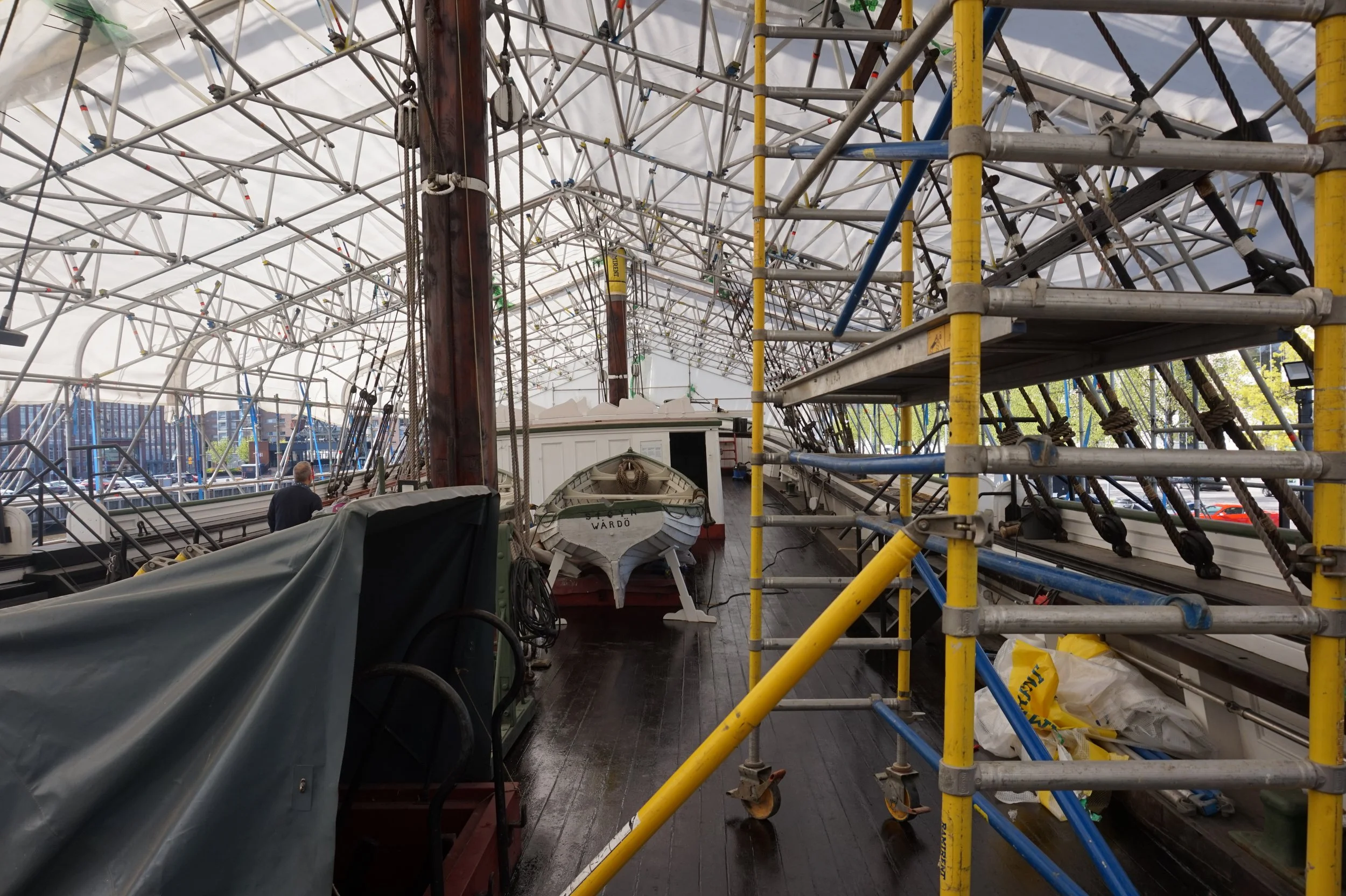
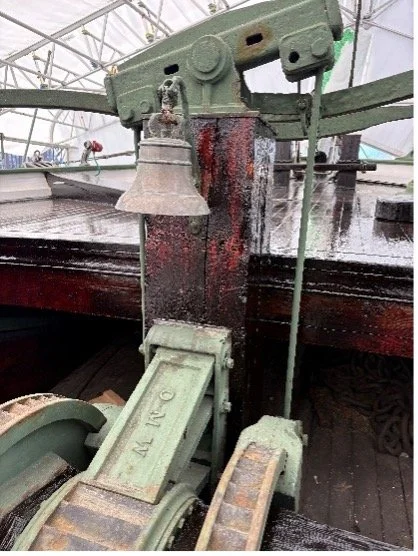
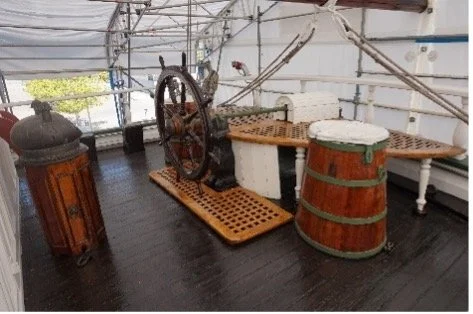
Left to right – amidships main-deck; anchor windlass and bell at break of forecastle, and poop deck and wheel. Necessary to see through the nest of steel and plastic of a ship under annual maintenance.
As arranged with Senior Curator Pauli, he and colleague curator Mikko Meronen gave up their Monday morning to lead us round, Pauli on his day-off, and were both very knowledgeable and keen to share the features of the Forum Marinum maritime precinct on Turku’s Aura (Aurajoki) river.
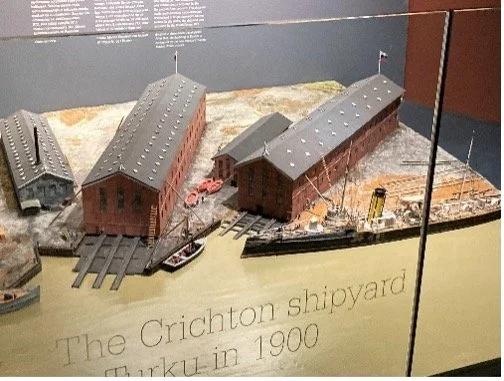
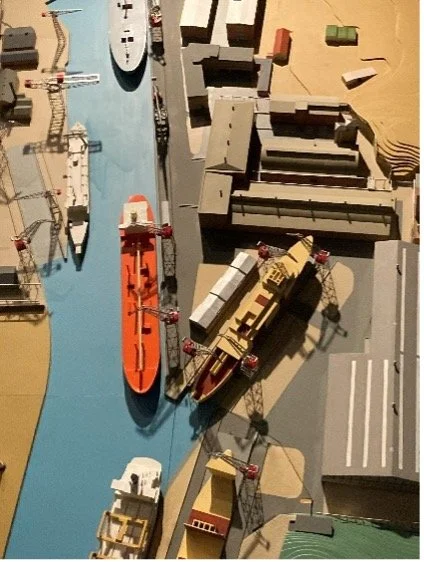
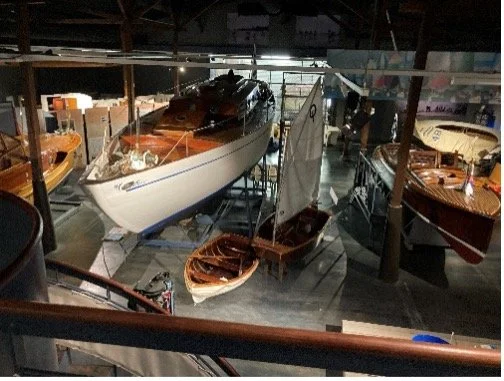
Aura River shipyard models - dioramas, past (left) in 1900s, centre model of a drone’s eye view in the shipyards 1970s heyday; and (right) a collection of historic wooden boats, all in Forum Marinum’s museum, port of Turku.
The precinct is opposite the historic site of shipyards of shipbuilder Wärtsilä, the ship building operations of which, beautifully modelled in the museum, originally stretched all the way from the city proper to the port, but space restrictions meant its operations have shifted elsewhere. The company started life as a major sawmill, expanded into ship building and ironworks, and eventually into ship building and propulsion. Its engines are a household name to those in the shipping industry worldwide, and one of their revered ship’s diesel engines remains on display on the site across the river from Forum Marinum, visible in our photograph below. Although the company abandoned its shipbuilding operations in the late 1980s, it remains today one the world's leading manufacturers and developers of ships’ engine and propulsion systems, with industrial units both in Finland and in several countries.
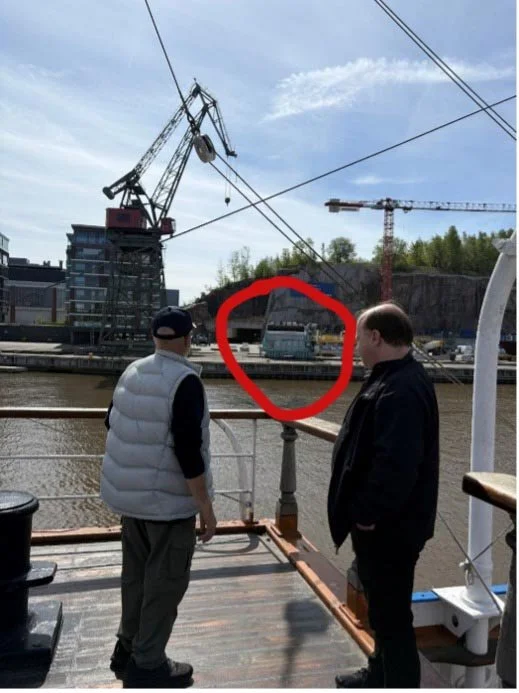
Forum Marinum Senior Curator Pauli and the author (left) on Soumen Joutsen’s poop deck, looking across to reminders of the shipyards, including a wharf crane and a ship’s engine (circled), among the residential developments that have taken over the southern bank.
As set out above, previously its shipyards took up much of the southern bank of the river, and, as in Gothenburg, its massive dockyard cranes have been retained as reminders of the city’s maritime industry past. A further reminder is a detailed model of the Silja Serenade ferry, our transport from Stockholm to Mariehamn, in the maritime museum, a cruise ship/ferry engineered largely by Wärtsilä.
Now ship building has shifted but the rail mounted shipyard luffing cranes still stand sentinel, vying with the masts and yards of the square-riggers Sigyn and Suomen Joutsen across the river as the tallest structures on the river. It was Sigyn that drew us to Turku, and the Suomen Joutsen came as a bonus.
Before leaving the Forum Marinum museum fleet, mention should also be made of the elegant twin funnelled ship, Bore, once a passenger ship trading between Sweden and Finland and now part of the museum fleet. Completed in 1960 for scheduled traffic between Finland and Sweden. The ship remained under the ownership of Bore Shipping Company until 1977, after which it had multiple different operators over the years, including the operation of Kristina Cruises of Kotka, known for its popular cruises. Over more than two decades, Bore visited countless countries and ports, from Arctic waters to West Africa and the Red Sea. The ship sailed under the Finnish flag until August 2010, but when Kristina Cruises acquired a new vessel, Kristina Katarina, and Bore faced either sale or scrapping.
The ship was saved when it was purchased and restored by s/s Borea Ab. It was repainted in the original colours of the Bore Shipping Company, and its original name was restored. In October 2010, Bore was towed to Turku. In May 2011, it was moored at Forum Marinum’s pier as part of the maritime centre’s museum fleet, as seen in the photograph below, downriver of Soumen Joutsen, with the minelayer Keihässalmi, the gunboat (corvette) Karjala and assorted interesting tugs and small craft in between.
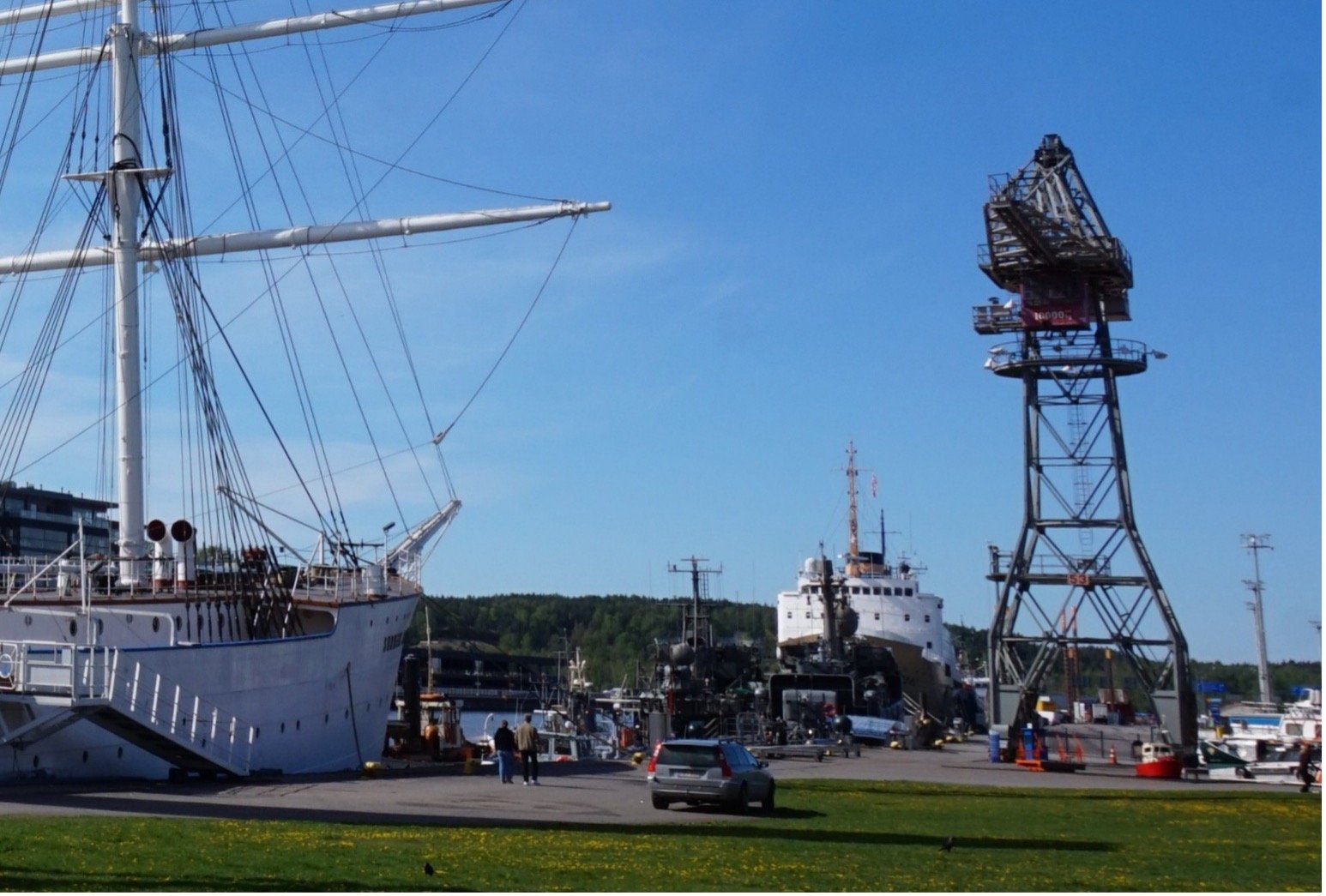
: A view of the Museum fleet: Left Suomen Joutsen; centre a corvette, a minesweeper and small craft; right hostel ship SS Bore
Although not in our central theme of sailing and wooden craft, Bore is considered historic and deserves attention. It is on the Finnish Heritage Ship Register. Once settled with Forum Marinum, in addition to its function as a museum ship, accommodation and restaurant services were launched on board. Then, in 2018, Turku’s Vocational Institute began providing educational activities on board the Bore, taking over the ship’s accommodation, restaurant, and conference operations. The SS Bore now offers a unique multidisciplinary learning environment for students in a variety of skill fields, and opportunities for media and business studies, as well as various entrepreneurship projects.
Offering 250 beds in cabins for 1–4 people, the hostel operates year-round, accommodating both groups and individual travellers, and has conference and restaurant facilities available. A restaurant serves lunch on weekdays from autumn to spring, and during summer, a café allows guests to enjoy the ship’s sun deck.
While our accommodation at the central Scandic hotel was convenient to the city centre and comfortable, any future visit may be enhanced by staying on Bore, if this can be arranged.
Finnish square-riggers: 3-masted barque Sigyn and 3-masted ship-rigged Suomen Joutsen
The main attraction for us in Turku was the Sigyn, a 3-masted barque and a historic ship in her own right as an outstanding example of a dying breed of square-rigged wooden ships. Although of a size and configuration that precluded her from the South Australian grain races, she did make many voyages world-wide. The ship is preserved as part of the museum fleet preserved by Forum Marinum, berthed in a purpose-built floating dock on a river berth neighbouring the maritime museum precinct. Mirroring to some extent Mariehamn’s Sjöfartsmuseum, a small café style restaurant looks across paved areas to the ship, offering the ubiquitous Scandi shrimp sandwiches among other delicacies.
Sigyn is named after the loyal wife of a Norse God, Loke, (Loki in English) whose life she saved in unpleasant circumstances. If we can accept the mythology, Sigyn today, supported by floating dock Loke, is said by some sensitive locals to be held in the gentle (and grateful, presumably) arms of her Godly husband.
As soon as we set up contact with their world-class maritime museum in Turku requesting an out- of-season visit to Sigyn, which we knew to be under wraps being prepared for the summer season, they understood our specific interest and agreed a visit, and also offered a visit on board the other square rigger in their museum fleet, the three-masted ship Suomen Joutsen. We then realised from maps on board the latter that, under a previous name (Laennec or Oldenburg), she had not only been a small part of the Australian grain races, calling at Port Victoria, the grain port in South Australia, but had also visited Geelong, our home base in Australia. On the basis of the one voyage to Port Victoria, she could just be considered a participant in the grain races.
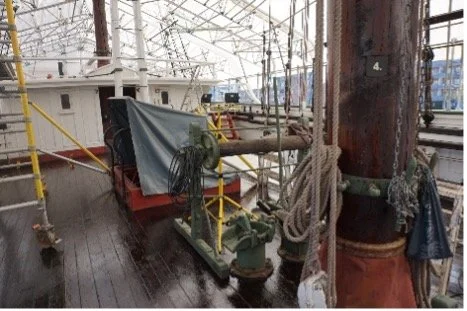
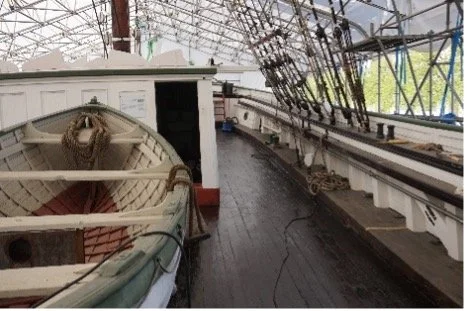
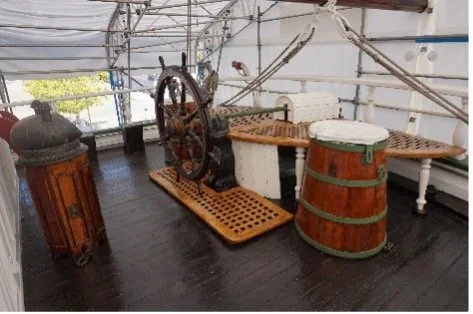
Barque Sigyn: Left and centre - two of many photographs of the main deck; Poop deck -wheel and standard compass
The temporary plastic covers over the vessel protect her and workers during maintenance, but Forum Marinum Senior Curator Pauli Kivistö advises that the cover, installed last year, is not only just for winter maintenance. Its purpose is also to protect the Sigyn's structures all year round from weather extremes, including rainwater, snow and intense sun. The shrouding is therefore aimed to be at least semi-permanent, the solution also an important part of the long-term planning for preservation of the Sigyn until her future museum concept is decided, including one possibility of moving her to a dry land location nearby.
The Sigyn is known to be one of the last of her type and is historically significant. Built in the Old Shipyard (Gamla Varvet) of Gothenburg, Sweden, she was constructed as a 3-masted barque, and progressed through a barquentine rig until being rerigged again as a barque, square rigged on fore and mainmasts, and fore-and-aft sails on the mizzen or jigger mast aft. Although small – she was built with shallow draft, displacing 500 tons at a time when the other European shipyards were building ships capable of carrying 4,000 tons of cargo - she found a niche where shallow draft was essential, and something in her lines meant that she could at times maintain speeds in excess of 10 knots, faster than many of the steam and motor ships that were starting to come off Europe’s slipways. Jerker Orjans in his 2007 book ‘Sigyn, a lucky ship’, quotes Charles Palmqvist the head pilot in Gothenburg, at the time centre of Sweden’s maritime industry, in his book Slutad kryss (The Final Tack), describing Sigyn and an earlier ship from the same stable, Gurli, in the following terms:
“The Gurli and the Sigyn were the most beautiful ships built of wood I have ever laid eyes on. They were perfect masterpieces.”
Experience tells me that pilots, as a profession, are not given to flowery words. These ships must have been really something! Hence my desire to build a model, rigged as a barque, and probably as she is now in her purpose-built floating dock. The timberwork is quite elegant, with, for instance, panelling on the inboard side of the well deck bulwarks, a most unusual touch and elegant carved elbows on deck houses and break of the poop.
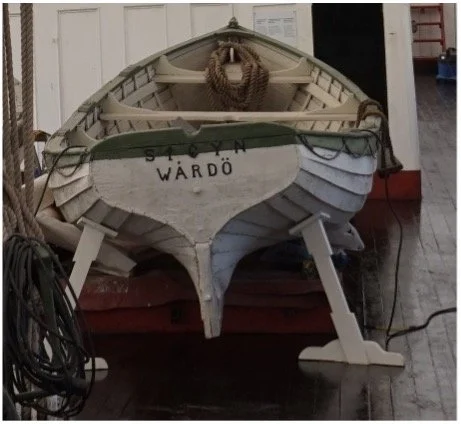
One of Sigyn’s original clinker built boats, like Sigyn herself, still shows Vardo as port of registry.
Small, but what ship charter brokers would refer to even these days as “handy”, this did not completely limit Sigyn’s ports of call to carrying timber cargoes around the Baltic and North Sea, for which she was primarily designed. For example, in the years 1894 to 1900 she called at places as far apart as Rio De Janeiro, Barbados, Texas, Buenos Aires, Uruguay, Antwerp, Nantes (France), Durban, Bangkok, Dominican Republic, London, Recife, Port Elizabeth, Haiti, Cape Town, Cuba and Liverpool. Cargoes carried in the same period included the expected timber planks and battens, but included also such diverse commodities as glass sand, teak, coal, coffee, salt and hides. A true blue-water traveller. (Unlike rust susceptible iron and steel vessels, residue remaining from salt being carried as cargo in a wooden ship is a preservative. Wooden vessel owners sometimes sought out otherwise less than desirable salt cargoes specifically for its residue.)
It was interesting that her port of registry on her transom and on her original clinker-built boats is still shown as Wardo in the Åland islands, although her current ownership is Finnish, further underlining the relationship between the two countries’ maritime sectors. The last time I know her to have been in the Åland islands was when she was docked in Mariehamn in 1998, in her own floating dock, Loke, no doubt not far from where the replica galleass Emelia (featured above) is currently being built. However, during her many years as a cargo vessel, she was based in the Åland islands, notably the islands and viken (waters) of Vargata and Vardo, or Wardo, which now remains on her oval transom stern as her port of registry. Basil Greenhill and John Jackman, in their authoritative 1986 book The Grain Races, background the Sigyn in the following terms:
“For years owned by this community [Vargata], she sailed from here in the traditional way, until the end of the 1930s, lying each winter in Bathusviken [sound] and fitting out each spring for the summer sailing (*). She is the world’s last wooden three masted square-rigged cargo-carrying merchant sailing ship – the very last example of a vehicle which, from its development in the 15th century to its demise in the late nineteenth century, played a fundamental part in European history, in the exploration and colonisation that shaped the modern world…”
* This also epitomises the reasons for our present pilgrimage, as the modus operandi that saw Sigyn laying up in the ‘viken’ in the Åland Islands in winter mirrors the summer rest of the in Mariehamn of big four-masters that the likes of Eriksen, Lundqvist, Troberg, Sitkoff, Matsson et al assembled in the late 1800s and early 1900s, and results in the black and white and sepia tinted photographs of the western arm of Mariehamn as a veritable forest of tall masts and spreading yards of six, seven or eight big square riggers laid up until the year end when southern spring heralds the grain harvest in South Australia and, provisioned and crewed once more for many months, the big ships set off south, sometimes with a back-load of timber if it can be fixed.
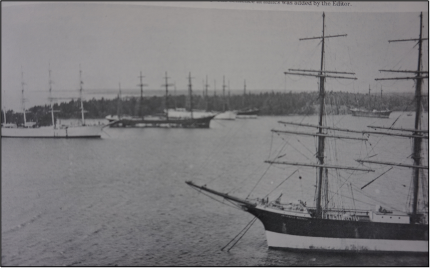
Herzogin Cecilie, Olivebank, Viking, Mozart, Wnterhude and (foreground) Archibald Russell Mariehamn’s western arm.
Source photograph in the Kobba Klintar pilot station, Mariehamn
The three-masted ship Suomen Joutsen was also made available by Forum Marinum for us to visit, despite being currently without her main topmast and rigging for maintenance. The rigging renovation work is also connected to preparations for the drydocking of the ship this European autumn. Copious photographs were again taken. She is somewhat altered from her original state, French built, having started life as the Laennec under the French tricolour, later as Oldenburg under the imperial German ensign and finally as Suomen Joutsen (meaning, we are advised, Finnish Swan), under the Finnish blue cross on a white ground. At various stages, her accommodation has been augmented, particularly to suit her role as a sail training vessel, and now as an occasional conference and entertainment venue.
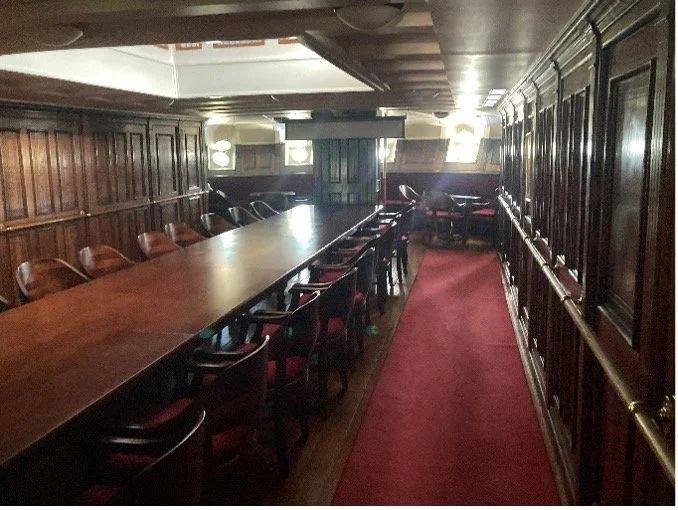
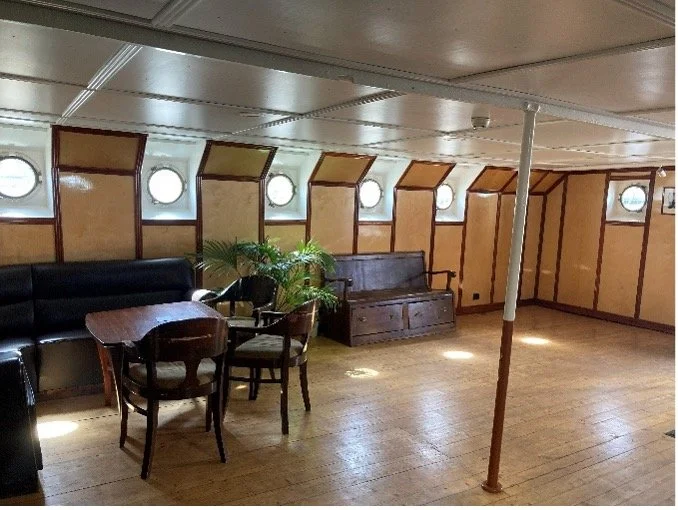
Fully-rigged ship Suomen Joutsen, ‘palatial’ accommodation/conference venue facilities
Some parts of her accommodation are palatial compared to the more basic arrangements for masters and officers in ships such as Pommern and Herzogin Cecilie, preserved in Mariehamn’s maritime museum, although even they were also considered quite luxurious in their day, and even more so compared to Sigyn’s spartan living areas. Possibly by virtue of her size and pristine white paint job, Suomen Joutsen now takes pride of place in the Finnish Forum Marinum museum fleet in Turku, lording it over the corvette, minelayer and tugs etc. which comprise the floating part of the museum, although, and not to upstage Suomen Joutsen, it is the wooden hulled Sigyn, perhaps due to her unique build, place in history and amazing current state of preservation after near-death dictated major renovations, that would attract the most attention from sailing aficionados. If she does make it to a dry-land berth south of the museum buildings, which we understood has been mooted, it would be good to visit her again and understand the then state of the art in ship preservation that develops constantly. As witnessed in the Vasa Museum, Stockholm, where information displays indicated that despite the amazing state of preservation now, still more major investment is planned to slow further the inevitable continued deterioration of a wooden ship. More ground breaking preservation measures are envisaged.
WOODEN SHIPS: PRESERVATION SSUES
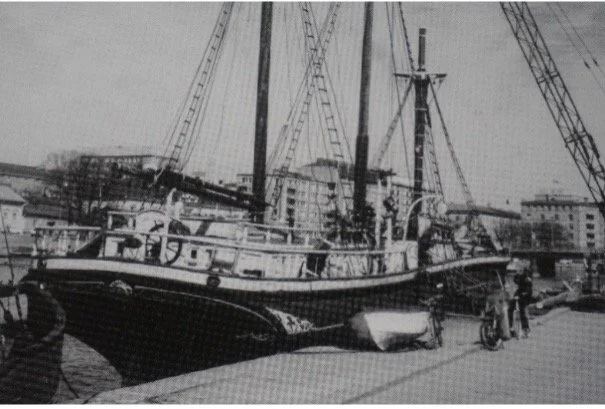
Sigyn in Turku, 1971. Heavily hogged and In a state of collapse
Wooden sailing ships generally suffer from hogging. A ”would-you-believe-it?” photograph of Sigyn in the spring of 1971, in Turku it would appear. The photograph is borrowed from the Jerker Orjan’s 2007 book, Sigyn, and attributed to B Carpelan and the Lars Gronstrand Collection. It shows the barque, stripped of her rigging down to her lower masts, being readied to be towed to Suomen Linna, Helsinki, for much needed dry dock repairs. The serious hogging was eventually reduced, eliminating an almost certain collapse of her hull. At its worst, the keel had been deflected up amidships by as much as 90 centimetres.
Ships’ hulls always flex under load stress, but steel or iron hulls will spring back when the load is removed. Wooden ships do not, and will develop hogging. The ends of the ship are heavier and less buoyant with the waterline cut-away shape at the bow and counter. The flotation forces are greater midships with the fuller body, causing the hull to bend, effectively drooping at the ends. This is avoided by building in diagonal stiffening at the ends. Even when Sigyn was built, steel diagonal bands were being incorporated at the ends, but Sigyn was considered too small to warrant the expense. Eventually the price had to be paid for that erroneous assumption.
Jerker Orjan’s 2007 book goes on to say”
An old wooden vessel that remains stationary will become hogged because it won’t be carrying a cargo that would compensate for the excess buoyancy amidships, and when it is not loaded with sufficient ballast.
The following drawing of Sigyn, by courtesy of Forum Marinum, appears to show the diagonal bracing installed since correcting the hogging, and to prevent recurrence. From our photographs it appears that the perfect original sheer in the drawing is almost fully recovered.
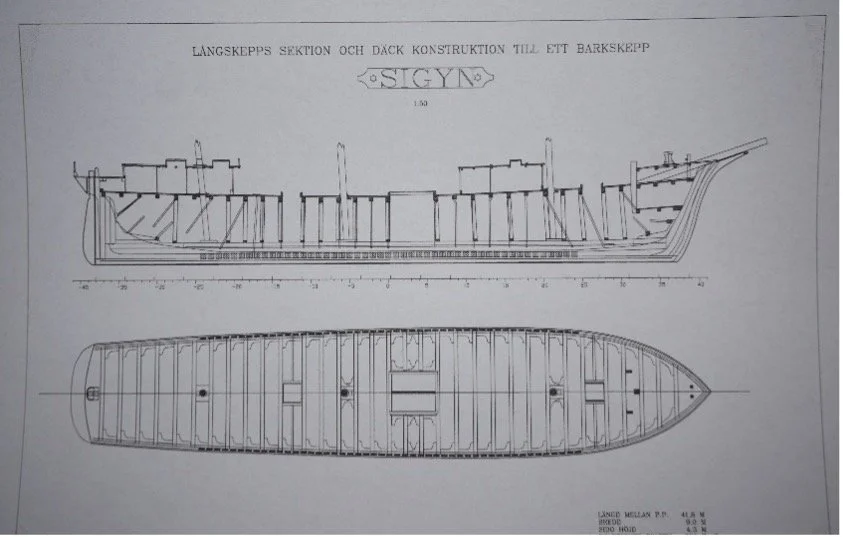
These measures will not solve the additional problem that afflicts wood above the waterline in a floating vessel, where exposure to the elements will continue the deterioration despite conservation measures. Controlled conditions can slow this process. (e.g., the Vasa in Stockholm, which it is understood is planned to have an internal steel frame ). Currently, hogging is defeated by Sigyn being supported in multiple places in the floating dock Loke and by internal bracings. This does nothing for the planking and upper works.
Possible plans to move the barque ashore on to the Forum Marinum area, used currently for car-parking, may provide a long-term preservation solution provided it allows the vessel to be effectively encapsulated (the Vasa again; and nearer to home, a similar process is understood to be mooted on a smaller scale for the HMS Krait in the Sydney Maritime Museum. Turku’s Forum Marinum has already a similarly preserved vessel with full sails set built into their restaurant.). We await further news of plans for Sigyn.
As an aside, and further underlining the interconnected history of Åland and southern Finland’s Turku, one of our experts in Mariehamn, Henrik Karlsson, has indirect family connections with Sigyn. He comments as follows:
“When my grandfather served as a Pilot in the Archipelago before his retirement, one of his colleagues was Fredrik Eriksson, the last Captain and owner of the Sigyn in Vårdö. They were living in the same village and I met Fredrik many times when I was a young boy and also at the Pilot Station [Kobba Klintar-features in our article] when I spent time there with my grandfather.”
A further clear confirmation of the close relationship between these neighbouring maritime communities.
The way home
From Turku, and physically down to earth again, we drove the excellent motorway to Helsinki, to catch our Finnair flight to Bangkok, and on to Melbourne by Thai International. Helsinki offered many possibilities for the two days there, and we opted for a run in a small tourist boat out to the world heritage listed fortified island of Suomen Linna, mainly because we had picked up that Sigyn had been drydocked there during her serious hogging crisis. It proved a fruitful visit, the island being a historic marvel deserving far more hours than we had available, but worth it just for the small museum from which we were able to obtain some photographs of models, used in this paper, illustrating Swedish and early Finnish historic ship types. It also had useful information on the so-called Archipelago navy, a Swedish Army unit equipped with many hundreds of small craft, including sail and oar propelled gun boats and schooners of the galleon/galleas lineage. Some of the excellent models were made from designs and original models developed by Swedish ship designer af Chapman, after whom the square-rigger in Stockholm is named, and who in the1700s not only designed and modelled ships, but - more particularly - developed the use of stability calculations prior to building a vessel, a capability that could have been used to avoid the calamity of the Vasa had af Chapman been born a hundred or so years earlier. A fitting finish to our pilgrimage.
And did we answer all the questions we’d set out with? Well, most of them.
The finale
We saw plenty of ships and obtained masses of photographs, a few that have made it to this paper. We saw and touched, or climbed aboard two of Gustaf Eriksens’s actual ships, Viking and Pommern, and took photographs that include several shots of the elusive figurehead of the other Gustaf Eriksen barque, Archibald Russell. We explored Mariehamn and its harbour, and walked the rocky tracks on the island of the Kobba Klintar pilot station, heard the story of the demise of barque Plus, getting thus a feel for the trials and tribulations of exhausted masters manoeuvring big, engineless sailing ships into a largely landlocked bay, possibly in blizzard conditions with no pilot, and we maybe got a feel for what made those farmer/captains so determined and – possibly - irascible. We talked to some committed enthusiasts, both of history but also in the building of traditional wooden ships in Mariehamn, and discussed with the amazing Dr Hanna Hagmark, Director of the Åland maritime museum, how, thanks to some indomitable individuals and families, the Åland Islands became the centre of historic sailing activity in partnership with the Australian grain ports, particularly those of South Australia. And finally, in Turku we added another ship to our list of grain race participants, the now Finnish flagged barque Suomen Jousten (the Finnish Swan) ex Oldenborg, ex French built Laiennec), and fell in love with a ship that Gustaf Eriksen did not own, named after the wife of a Norse god, the barque Sigyn, in the arms of her husband, the floating dock Loke, sheeted over at the time but preparing for the crowds in the coming summer season on Turku’s river Aurajoki.
However, as usual, travel stimulates the mind and I personally have a lot of new questions for the next time. And models to build…
So, given our theme of sailing ships, and that this article is prepared for a pre-eminent wooden boat magazine, maybe it is fitting if we finish with an amazingly sharp photograph of a one that was built of wood, barque Sigyn, the photograph borrowed from Jerker Orjan’s book Sigyn, a lucky ship, showing her setting sail outside Gothenburg for Pernambuco and Recife in South America, with a cargo of timber (planks and battens) on 25th May 1899, (would you believe over a century and quarter ago? What a great pic.) Notable is that amazing graceful sheer, and that invaluable wooden ship accessory, a wind mill powered bilge pump to cope with the inevitable leaks. Difficult to believe that at one stage in her later life in Turku, as shown in the previous photograph above, she was so badly hogged that the sheer was more than reversed, and the hull, bent by almost a metre, was literally in danger of total collapse.
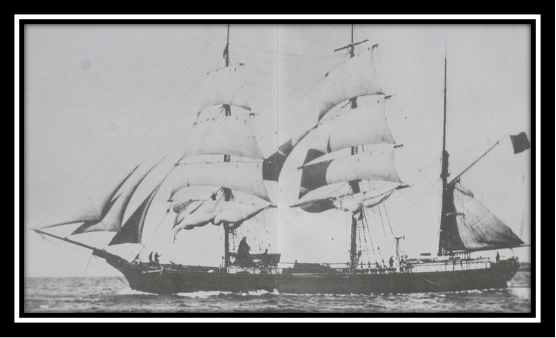
Barque Sigyn departs Gothenburg for Pernambuco and Recife, Brazil 25 May 1899. Sails are being set. The ubiquitous wooden ship windmill pump in place but sail-less.
Does she fit our theme? Maybe (a) Gustaf Eriksen didn’t own her, and (b) maybe her size meant she didn’t make it into the Grain Races, but no doubt from the professional commentary on her sea-kindliness, strength and handling, she could have - and GE would perhaps have been as happy with her returns as he was with his early favourite, Tjerimai, snd those who built her would not have been disgraced. And what a pretty model she will make…
Long may Sigyn and Suomen Joutsen last and continue to please and educate their visitors, and keep up the good work Pauli and Mikko in Turku. And long life also to the wonderful Pommern, and may Dr Hanna, Henrik, Allan and Vilhelm in Mariehamn long keep up their good work. May history salute them all!