
The Grain Races - Part Two: The Journey
In the footsteps of Gustaf Erikson in Åland and south eastern Finland
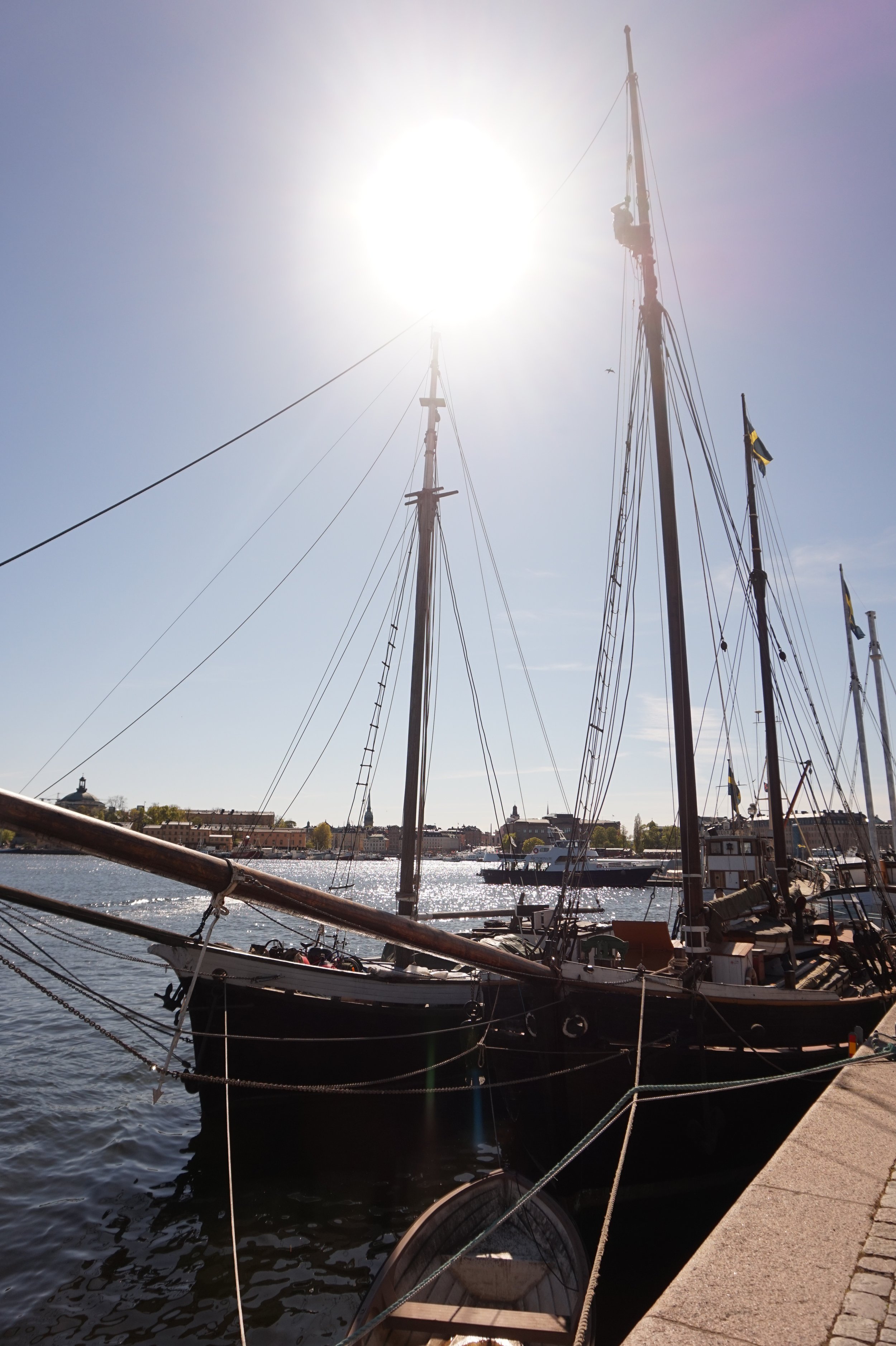
Old wooden ships, Stockholm
A Model Maker’s Pilgrimage
By Jeremy Brown
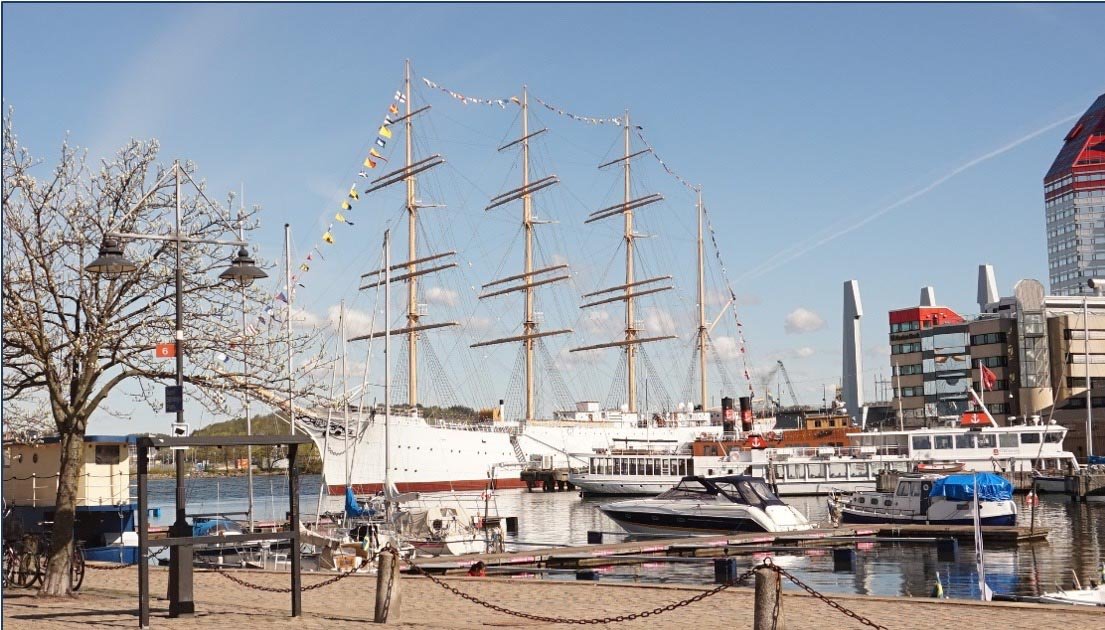
The first sighting of Gustaf Erikson’s fleet, the barque Viking,
now a hotel/restaurant, towers above river craft in Gothenburg’s port
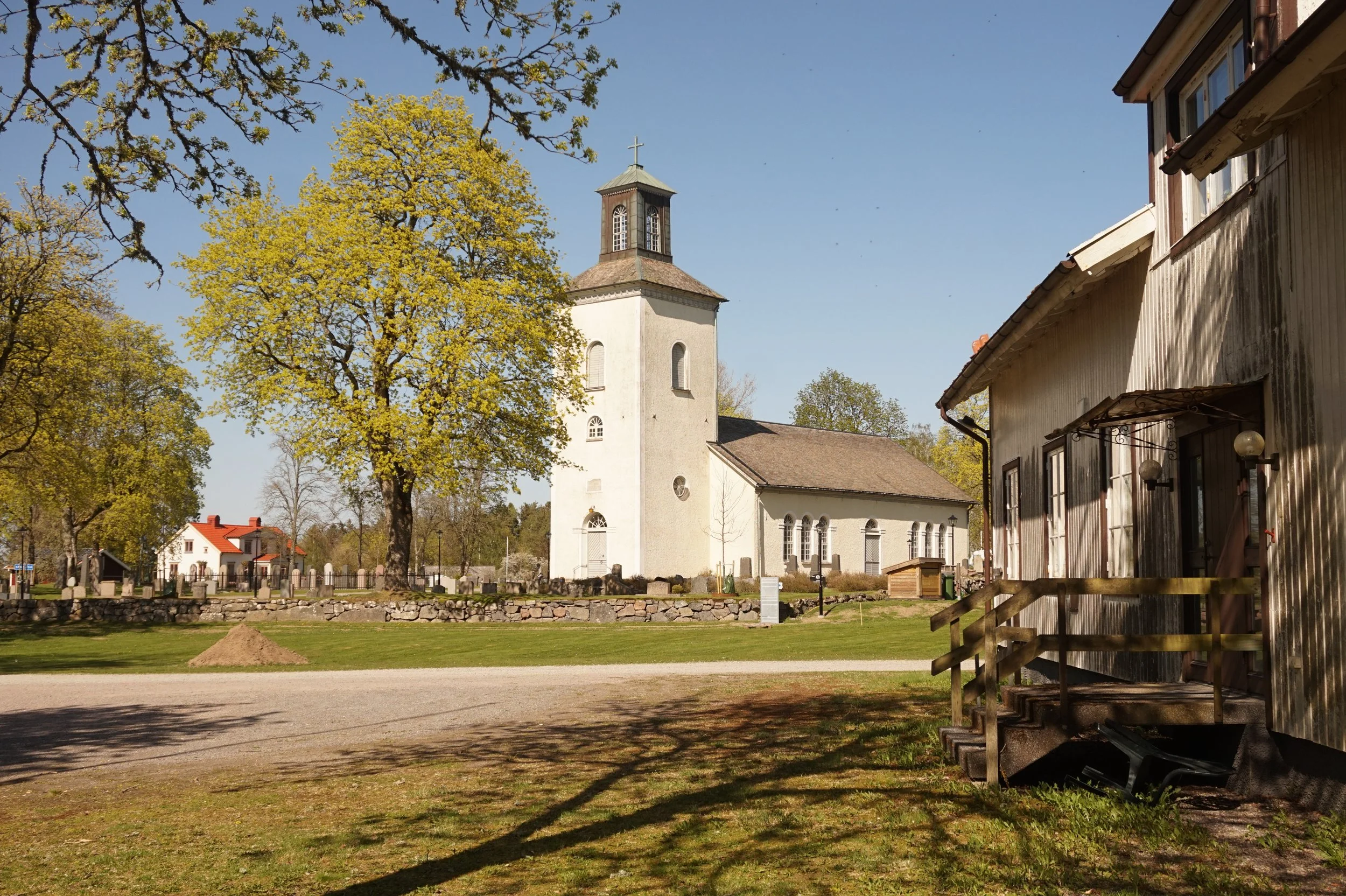
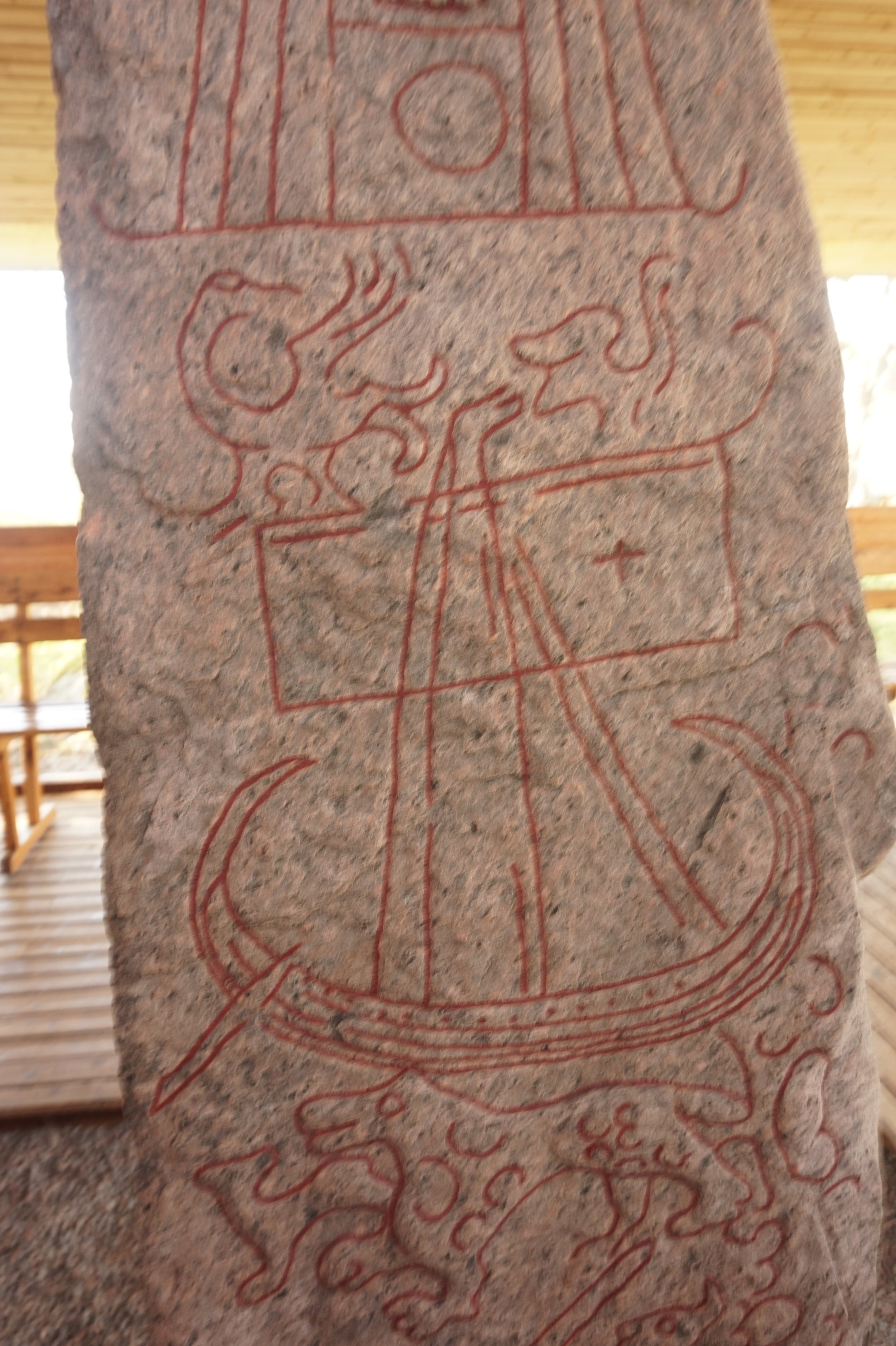
The church of Sparlosa in Vaster Gotland, near Gothenburg, and the 9th century rune stone with its engraved Viking ship
This Part 2 of our article on our sailing ship pilgrimage to Scandinavia takes up the story as we commenced our Swedish/Finnish itinerary in southern Sweden. Sweden is a very maritime nation and everywhere we travelled - in Gothenburg, in Stockholm and in the Swedish speaking Baltic islands – there is the evidence of this background. This was brought to our attention strongly when, shortly after our arrival in Sweden from Melbourne, Swedish friends in country town Grastorp, who probably knew the sailing ship theme of our travel, took us to view an ancient runestone recovered from an old church in the nearby small village of Sparlosa, many kilometres from the sea in Vaster Gotland, near Gothenburg.
The stone was discovered in the 1930s in two pieces embedded virtually as construction material in the wall of a country church many kilometres from the ocean. Unfortunately, no one has fully translated the rune writing so the exact significance of the ship imagery is not known, but clearly it was an important issue in the purpose of the stone (legal agreement, boundary contract and marker maybe?) and brought out for us the significance of ships and the sea in the nation’s history and pre-history. Although experts have been unable to agree on the meaning of the stone, they agree that its engraved imagery dates back to the 9th century, and it clearly includes a ship, probably an engraved Viking longship.
The first sighting of a Gustaf Erikson ship – Viking in Gothenburg
The first reaction from one of our small team on approaching Viking alongside her berth in Gothenburg (to the Swedes Goteborg, which sounds to us like ‘Hoterberry’, was “I had no idea they were so BIG!”
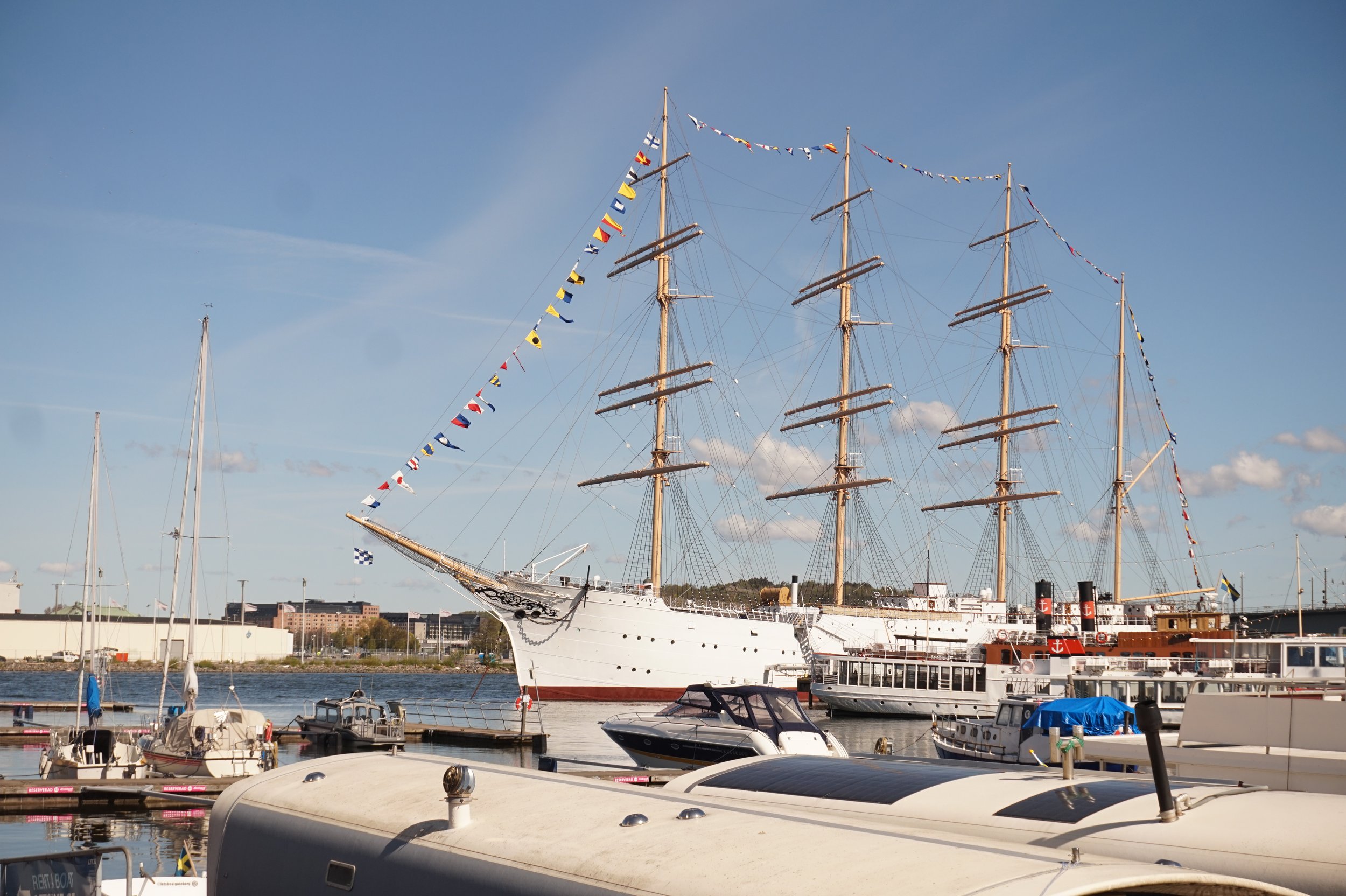
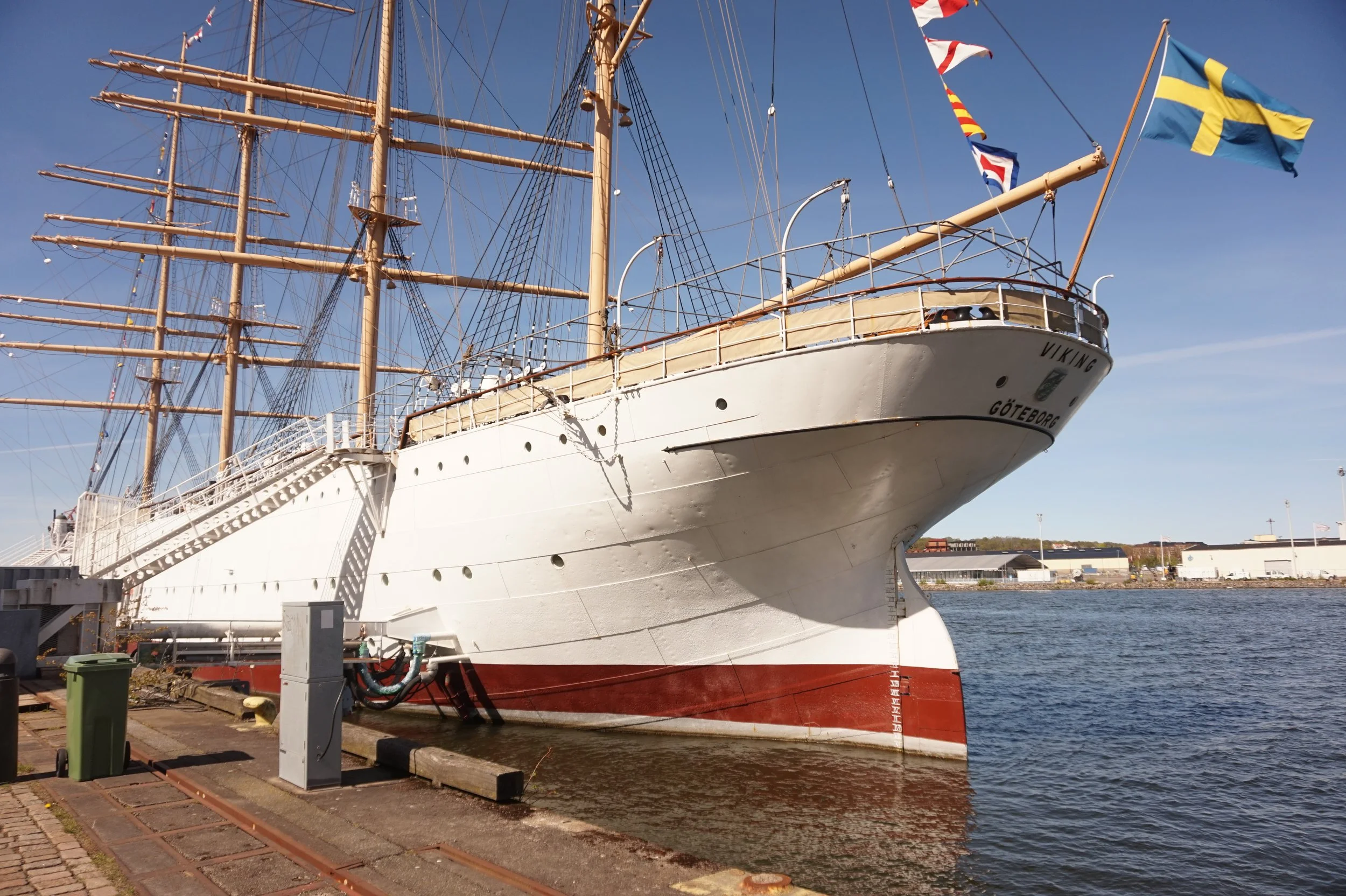
Gustaf Erikson’s mighty 4-master Viking on her permanent berth in the port of Gothenburg.
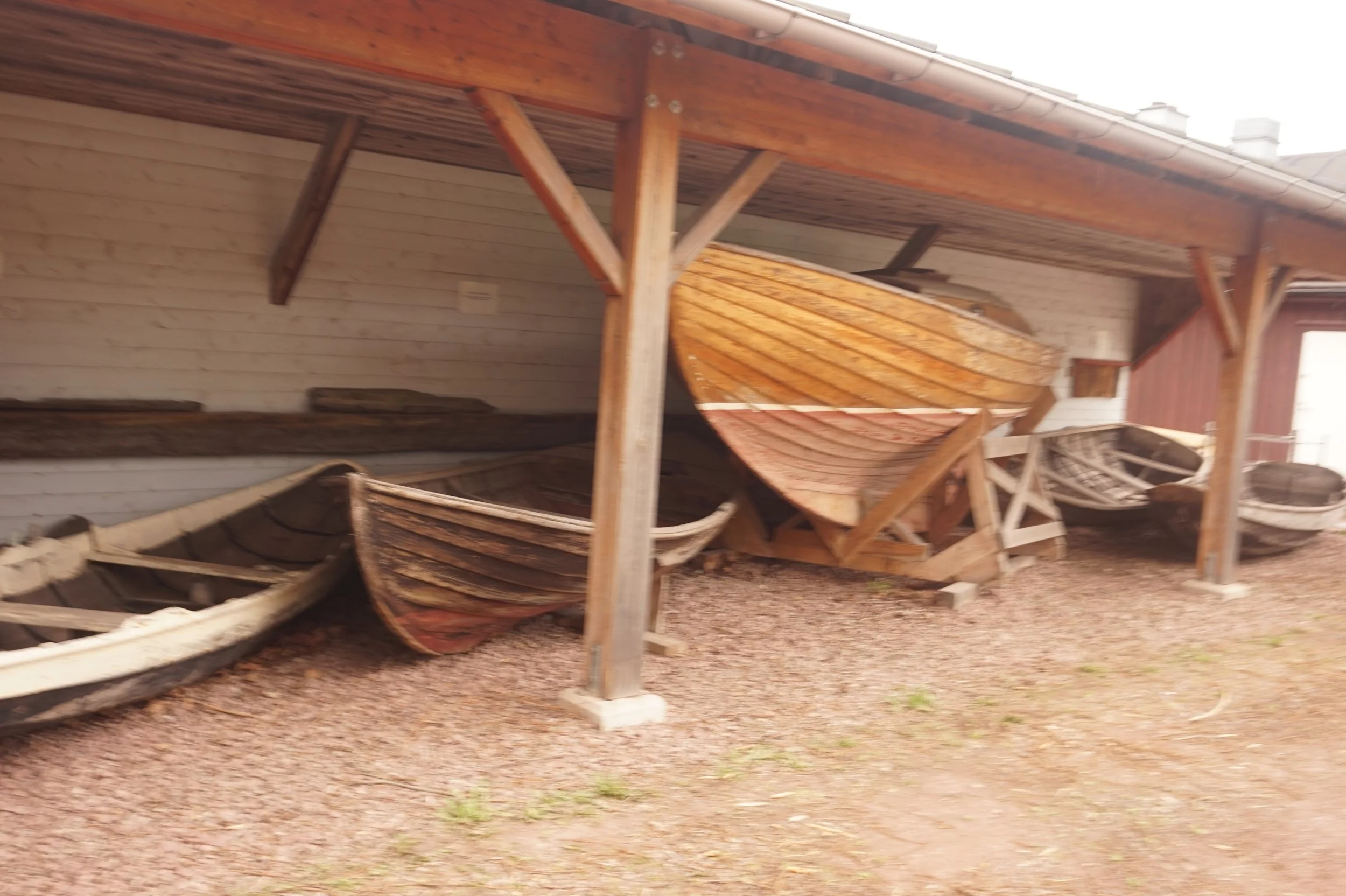
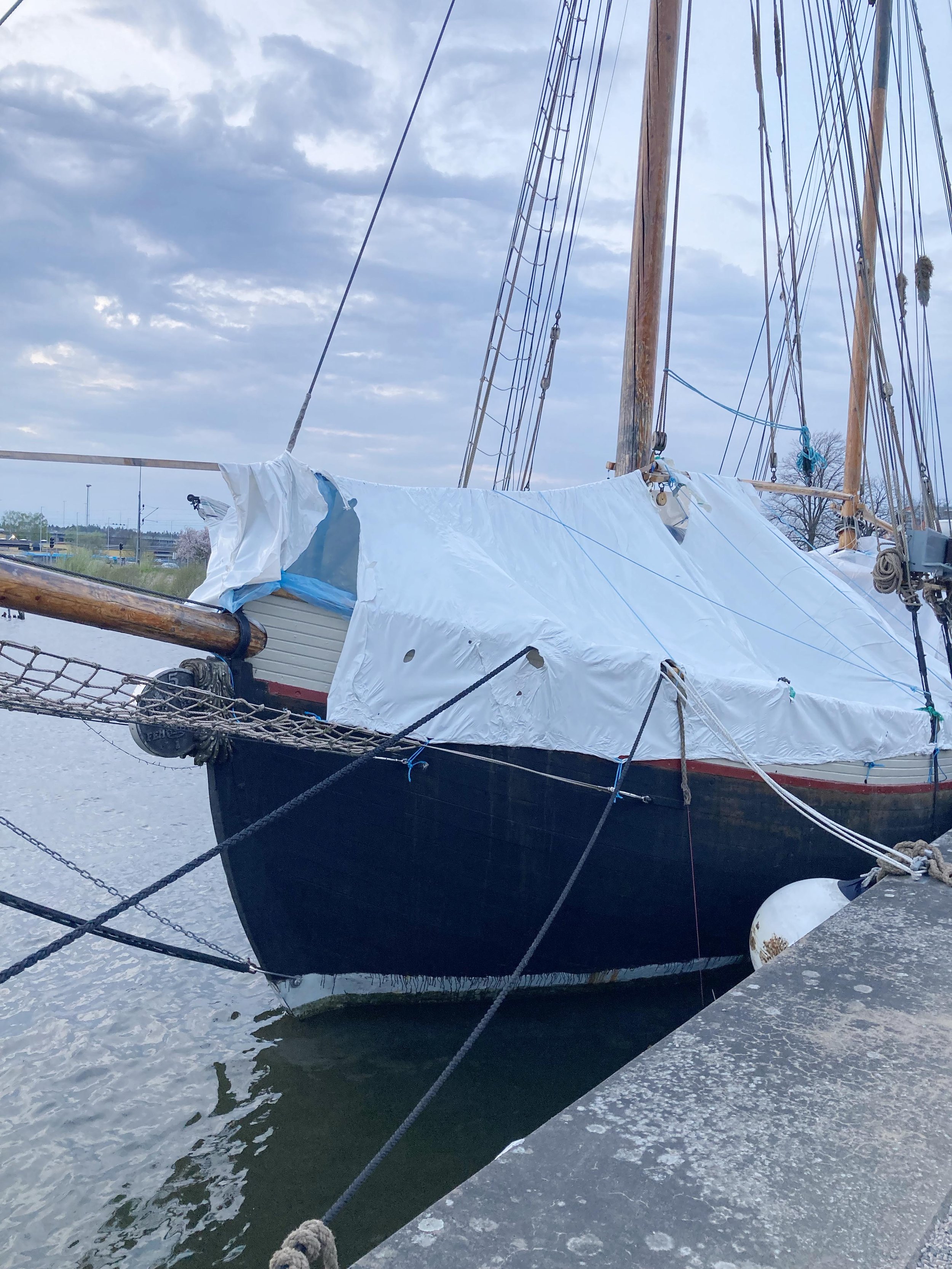
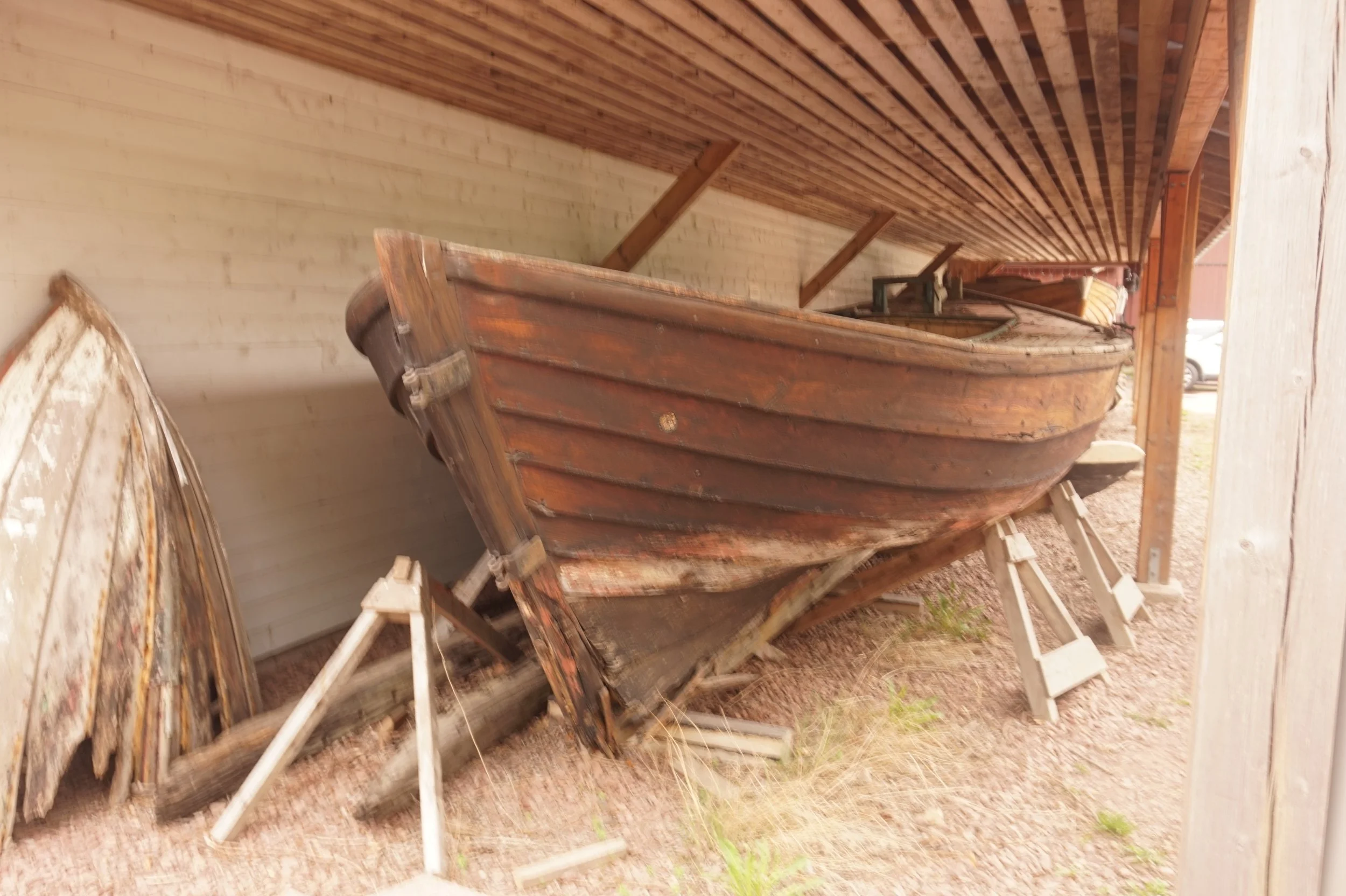
Traditional small craft awaiting renovation and a Jakt or small galleass in winter coat in Vennersborg
So the Swedes are very maritime aware and the long shorelines and multitude of lakes and linking canals host many small craft and steamers. But we were seeking bigger prey, and Gothenburg was our next stop.
The first sighting of a Gustaf Erikson ship – Viking in Gothenburg
The first reaction of our small team on approaching Viking lying alongside her berth in Gothenburg was the sheer size of the ship. Indeed, after the various small craft – open boats such as clinker built[1] ‘oka’ (dinghies) and ‘storbats’ (big boats), jakt (yachts) and various galleass – we have seen to date in our trip through southern Sweden, the towering steel hull and massive masts and yards of the ex-grain race veteran at her permanent berth in Gothenburg’s river port was certainly inspiring on a cold, blustery but sunny May morning. We wandered along the quay, but resisted going on board. The rows of recently installed ports and pyramids of air-conditioning plant on her decks underlined that, while the outer shell of the great windjammer is scrupulously maintained, the interior has been stripped and rebuilt, first as a hostel and then as hotel accommodation. A glimpse down on to the inaccessible deck from the nearby river bridge indicated that there is nothing to be gained here for an avid ship modeller looking for authentic detail. Like so many of her cohorts, such ships that have survived have ended up so often more as theme park attractions - hostels, hotels restaurants, etc. Viking’s decks are no longer a place of winches, capstans, pin-rails etc., but industrial scale air-conditioning machinery. Even if we did not board, we could not resist walking up the access ramp to reach out to touch the original steel plating.
A little sad to see Viking’s fate, but at least the ship lives on. As a direct contrast, the next Gustaf Erikson ship we would see is the famous ‘flying’ P’, barque Pommern, in Mariehamn, Åland Islands, (pronounced Awland), which has been preserved as she was, with only stairs, lifts and, down below, flooring for access added, with lower holds floored out in Baltic pine to give visitors to access hold spaces. Otherwise - as many locals pointed out - she could go to sea tomorrow, although - as some more informed suggested - there would no doubt be a struggle to meet current OHS standards and technical certifications.
[1] In his 1948 book The Last Tall Ships, Georg Kahre notes that until a century before both galleass and smaller ‘smacks’ were all open, clinker built. The Emelia being built in Mariehamn is fully decked, one possible variance from tradition, along with modern screw steering and diesel, of course.
Stockholm and the Vasa (of course!)
However, before heading for the Baltic, first we were travelling through to Stockholm with plans for a family reunion with our Scotland based relatives, and of course a visit to the famous Vasa, in her cocoon - ashore, but at least almost in sight of her initial resting place, mere kilometres away from the site of her disastrous launching nearly 400 years ago.
For anyone with any feeling for historic ships, a visit to the Vasa Museet (museum) in Stockholm is a must a must see.
The presentation in the Vasa Museet could hardly fail to impress any visitor to the vast, purpose-built climate-controlled building, with its extensive videos, models, dioramas and simulations of the tragedy, and actual relics and remains (human and otherwise), showcasing the tragedy itself, the human aspects and, of course, the amazing engineering that brought her back out of the mud. For anyone with a feeling for sail to be almost able to reach out and touch the ancient vessel is mind-blowing. The fact that the reconstructed vessel comprises over 98% of the original structure after 398 years in the harbour mud is a tribute to the painstaking salvage process, and maybe to the almost salt free Baltic waters.
If you plan a visit, prebooking on line is recommended. You can’t totally avoid the queues but, of the two queues, the prebooked line was a lot shorter.
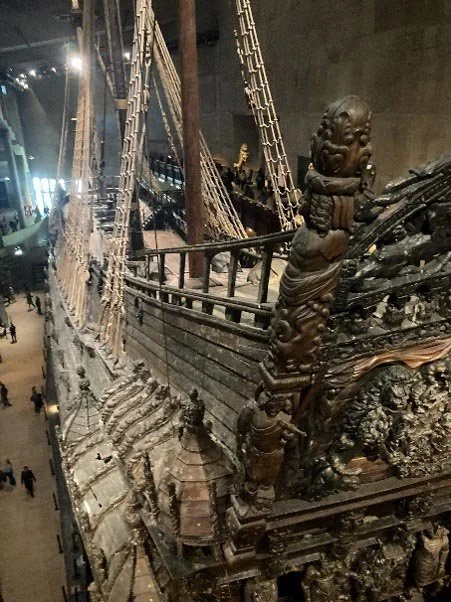
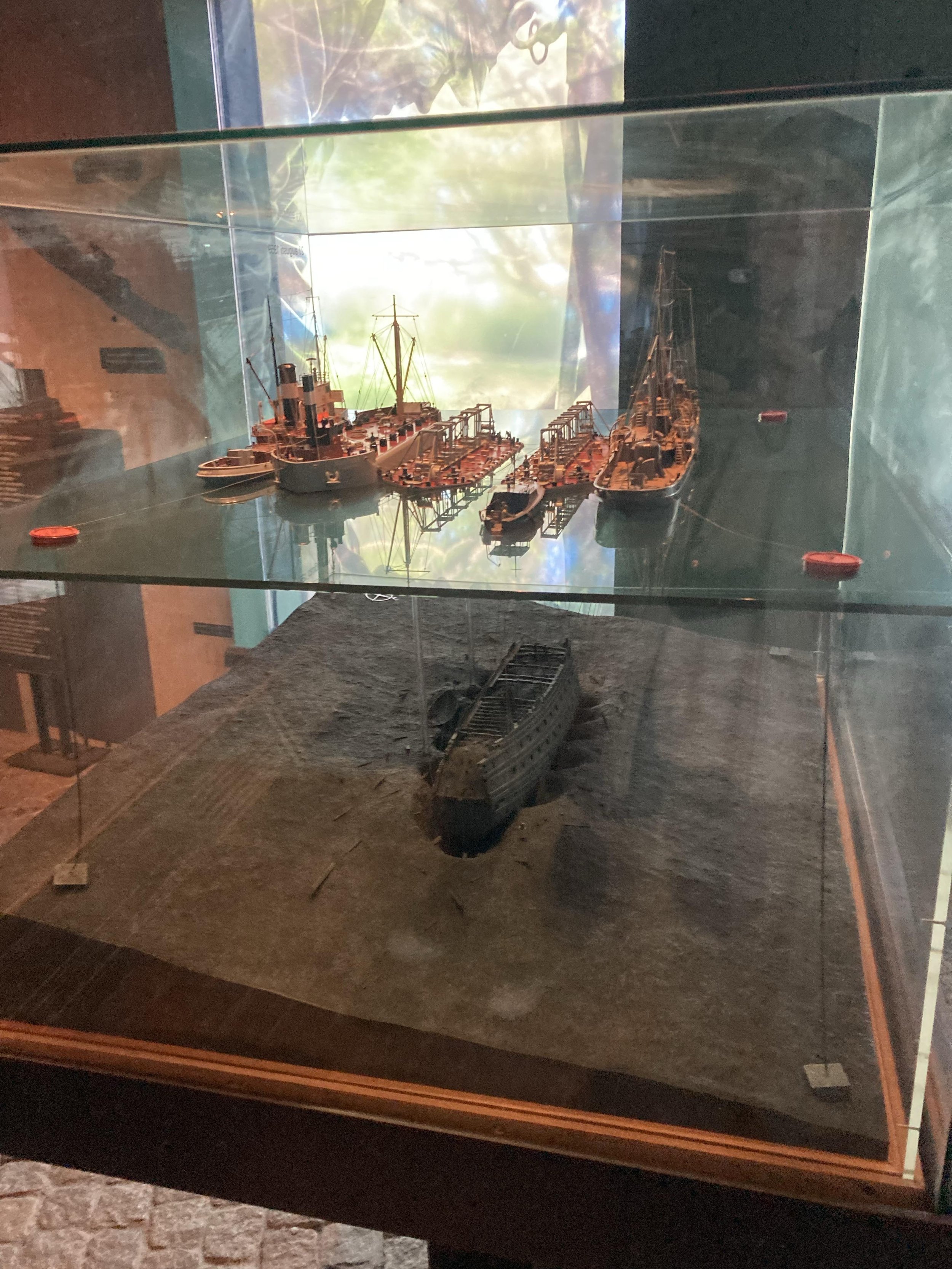
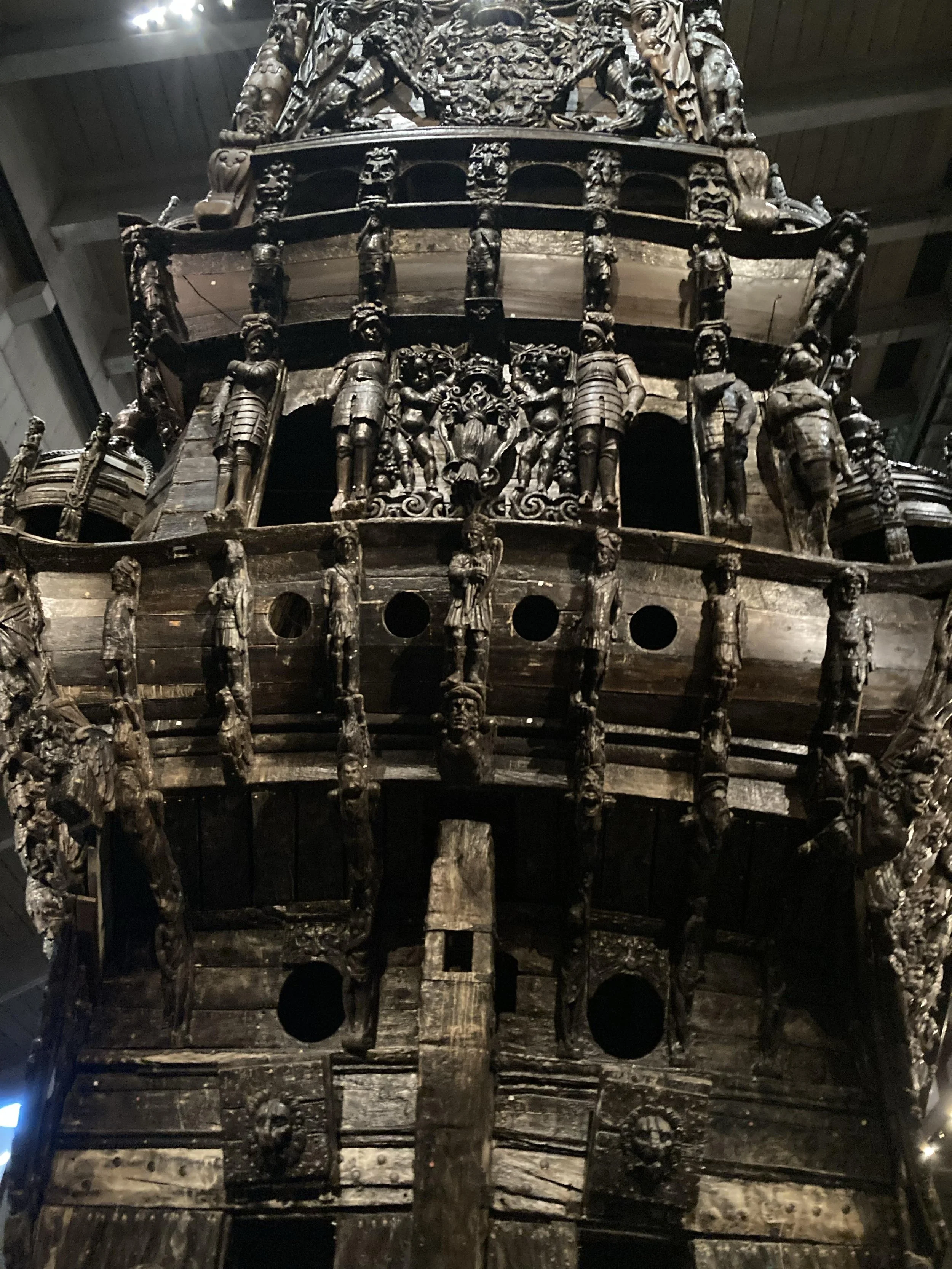
The Vasa Museet, Stockholm – left-right port side of the reconstructed ship, diorama of salvage and stern carvings. Figures of visitors (extreme left) hint at the scale of this faithful reconstruction.
Aside from within its many museums and galleries, Stockholm city centre’s most evident square rigger is the historic af Chapman, berthed at Skeppsholmen in Stockholm’s city centre, forming an interesting contrast to the visiting cruise ships. Built as three-masted, full-rigged steel ship in 1888, and saved from the scrapyard in 1947, she operated until recently as a youth hostel. The vessel’s future is understood to be in doubt. We are advised that she no longer operates as a hostel and authorities have yet to decide her future location.
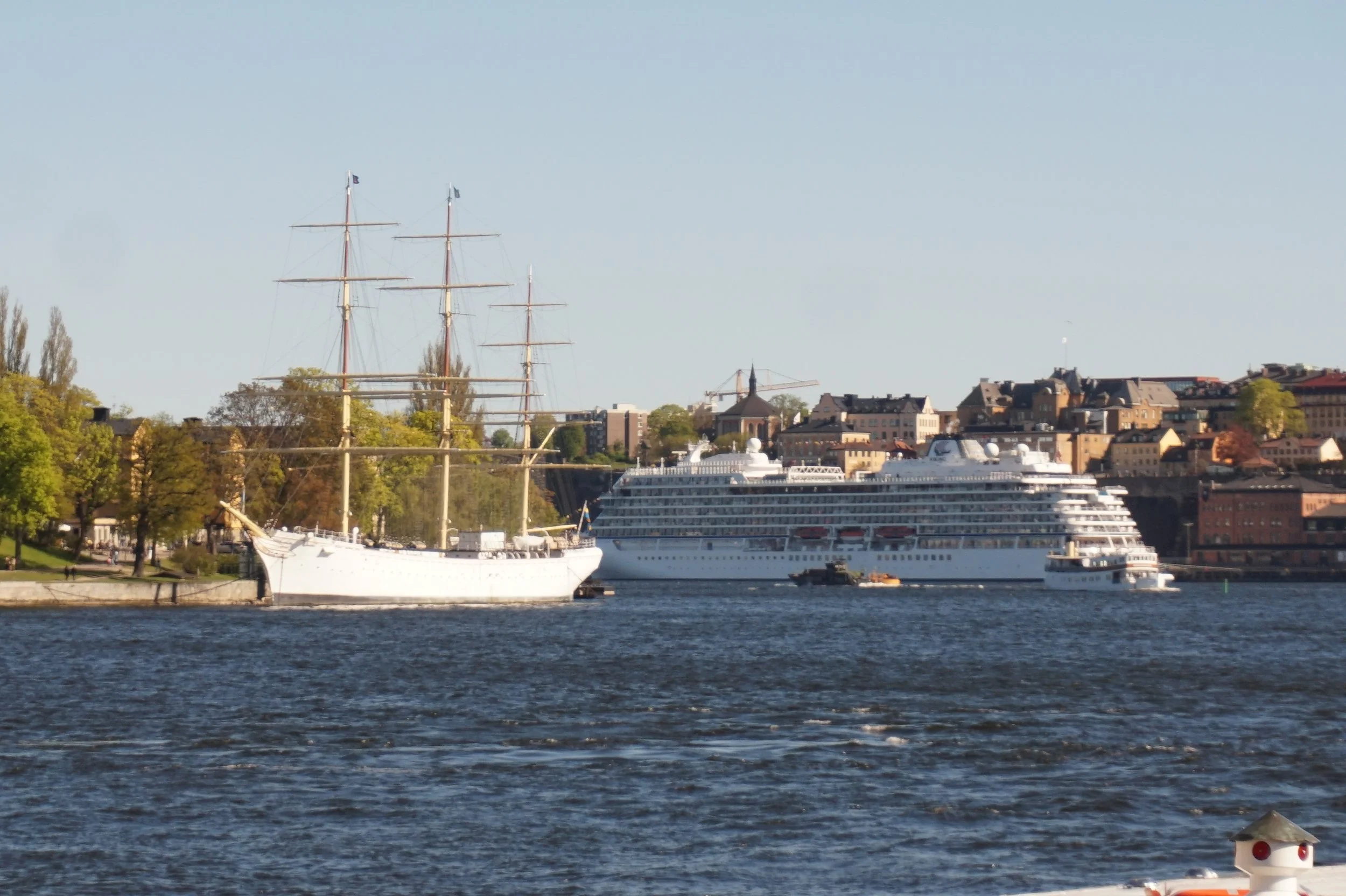
Fully-rigged ship af Chapman, until recently a youth hostel, moored at the Skeppsholmen, seen from Stockholm city centre.
In addition to the Vasa and af Chapman, Stockholm has many classic ships in evidence. Its maze of islands is served by a large fleet of ferries, many authentic classics, some new-built on classic lines with tall stacks and much varnished brightwork and polished brass. Central Stockholm with its many promenades and breastworks provides berthing for a range of ferries, tourist boats and some classic craft. Ferries and tourist boats comprise decades old, and some newer builds but in the classic style and provides berths for private small craft, double banked ‘live-aboards’, many ketch and schooner rigged, some renovated-‘improved’- with care but many apparently with doubtful respect for authenticity.
A stroll along the popular Skeppsholmen promenade, crowded in the early spring sunshine, provided glimpses of many galleass style vessels, ketch or schooner rigged, and sloop rigged jakt with massive carvel planked hulls, no doubt built to defy frequent ice conditions in the low salt Baltic waters. Many have been converted to live-aboard level. We discuss these classics and the efforts to maintain traditional designs and building skills further in Part 3 of this article, when we chance upon an active traditional boat and ship building precinct in the Åland Islands.
From a historic perspective, Sweden did have its own fleet of big sailing ships, of which probably the best known in the grain race era is the lovely 4-masted barque Beatrice, which is remembered for its ‘race’ from South Australia to Europe with the ill-fated Herzogin Cecelie, the voyage the basis for Alan Villiers’ evocative book Falmouth for Orders, (first published in 1929, still in print 1972. Although perhaps a little fanciful in some respects, this book, along with Newby’s The Last Grain Race, is probably one of the most readable and best-known ever written about the era. In addition to the Vasa, as discussed above Stockholm is home to another classic vessel, the fully rigged ship af Chapman in Stockholm pictured above, and Gothenburg is home to the painstakingly accurate rebuild of the East Indiaman Goteborg in the ship yards in the city whose name it bears. However, further away across the Baltic Sea is where the grain race era and our current pilgrimage has its roots.
But first some background to the terminology of small ships for which Sweden is famous. In particular, we focus on the galleass. The basis for terminology is a little complex. The boats of most interest to us are those little two-masters that Swedish farmers used initially to carry their produce, notably timber, and these are generally termed galleass. Some commentators suggest that may have originated from the c. 16-17th century term ‘galleon’, which in English is used generally to mean any large vessel, cargo carrying or warship, and generally refers to a square-rigged vessel. These little two masters in Scandinavia were to morph into full sized wooden sailing ships such as the iconic Swedish built Sigyn, now in Turku, described in detail in Part 3 of this article.
The term galleass, it seems from looking at museum models of historic vessels, then gravitated down to a largish sail powered vessel which also had provision for banks of oars (as for the galley or galleas of the Mediterranean). Based on initial British designs (HMS Blenheim of the early 1800s is an example) where large sweep oars provided secondary power, and further developed by the famous ship designer af Chapman, Sweden adopted a similar design for gunboats, which also attracted the title of galleass, for utilisation in their ‘Archipelago navy’. This is described in Wikipedia as officially the "fleet of the army" (Swedish: arméns flotta), a maritime branch of the Swedish Armed Forces which existed between 1756 and 1823, its purpose to protect the coasts of Sweden, which is surrounded by a natural barrier of archipelagos.
Specifically designed to operate in confined waters, these were handy, usually two masted vessels, generally schooner rigged but sometimes with some square sails, and in sailing only form, became a model ship type for Baltic archipelago farmers, particularly where they were self-built by farmers and farming communities for moving their cargo, predominantly timber, in confined waters. Despite their shallow draft, these vessels were sturdily built and eventually were used across the North Sea, and ultimately to the Americas. It seems that it was from this base that vessels such as the barque rigged Sigyn evolved. Built in Gothenburg in the late 1800s predominantly for the Baltic and North Sea trades, the 3-masted wooden barque, in the event, traded almost world-wide (at times as a barquentine), anywhere where her relatively small size and shallow draft allowed her to access cargoes the big ships either chose to, or had to turn away, a characteristic still prevailing in some trades (the ‘handy-size’ reefer is still a popular choice among charterers for some trades shipped in smaller quantities or utilising ports without access to deep water). We will feature Sigyn as an almost unique remaining example in the world of these handy, sea-kindly but relatively small sailing ships during our visit to Turku.
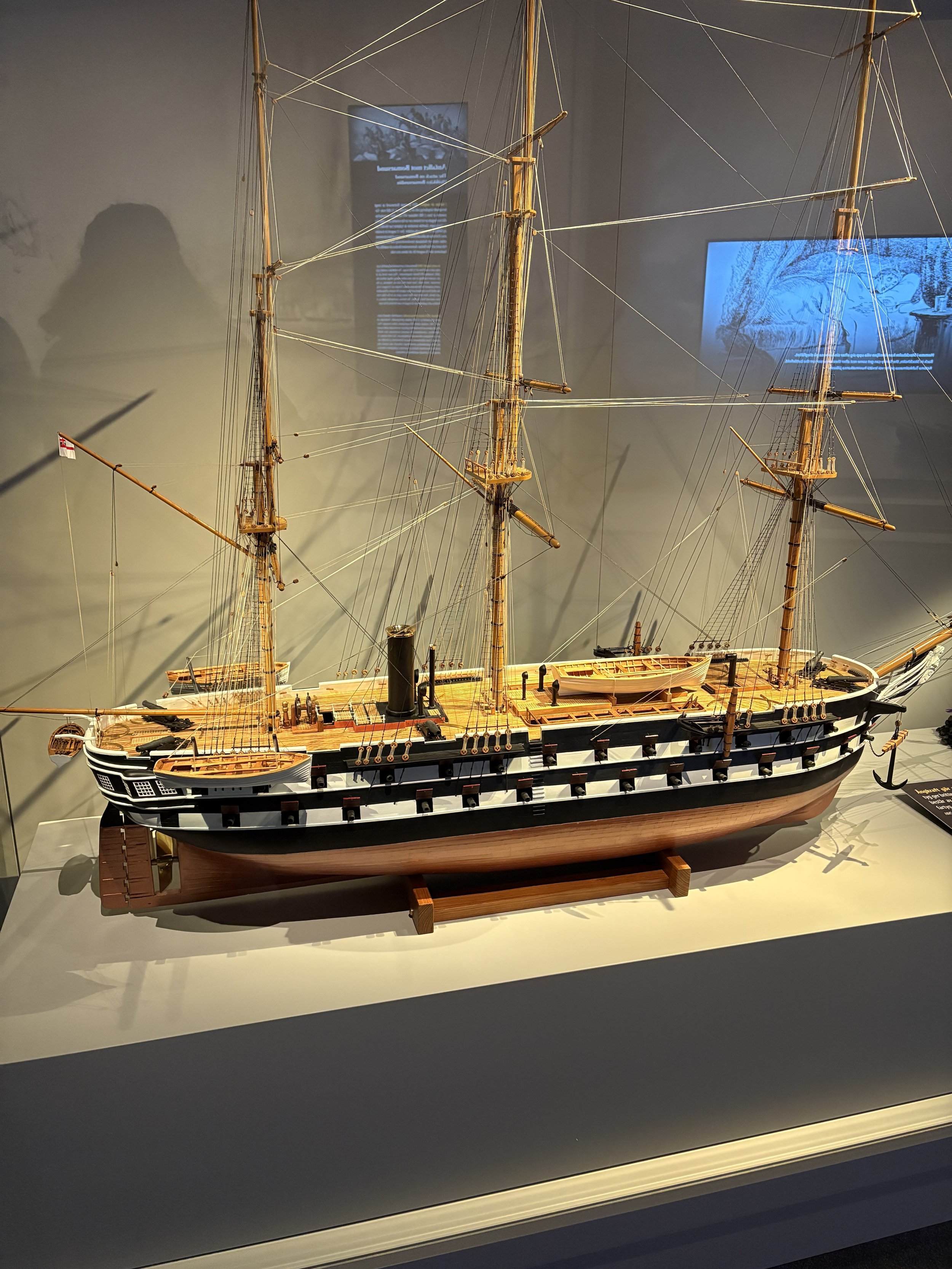
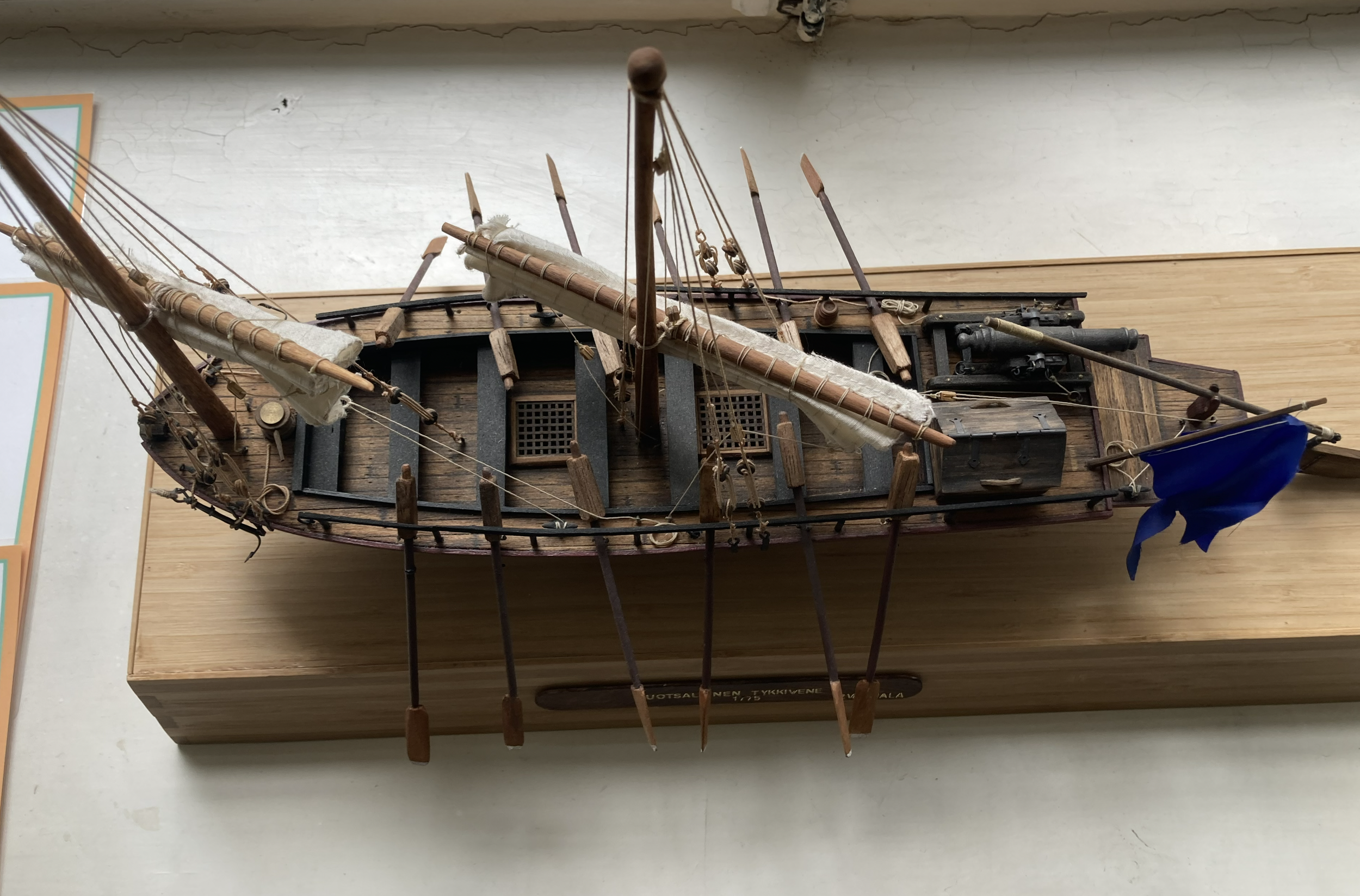
The forerunners of the current Scandinavian galleass style. HMS Blenheim, an early example of a British ship-of-the-line with steam and oars as secondary and tertiary propulsion, right an early Swedish gunboat and below units of the Swedish Archipelago navy.All Models in Suomen Linnar museum, Helsinki.
History notes that British warships of the 1700s and 1800s often mounted long ‘sweep’ oars as secondary propulsion. HMS Blenheim above was a ship of the line (galleon) built in the early 1800s so equipped, and also with with steam and a screw propellor. Sweden learned the flexibility of these vessels in various conflicts, and developed ships combining at least two of the forms of propulsion, sail and oars, initially with one large canon and a smaller cannonade (see photograph above) for their Archipelago fleet. Eventually, the large number of oarsmen (up to 240 is quoted for big vessels) and lack of accommodation and carrying capacity for provisions etc. was seen to be out of proportion to their potential firepower, and the oar option was dropped. Britain also moved away from oar power in favour of steam/screw drive. However, in Swedish ships, the hull design provided shallow draft and wide deck spaces (ideal for deck cargoes of timber), and the small, two masted version became in time the basis for the broad beamed, shallow draft schooner style vessels that were to be the favoured design for Baltis community building projects. And the galleass nomenclature stuck.
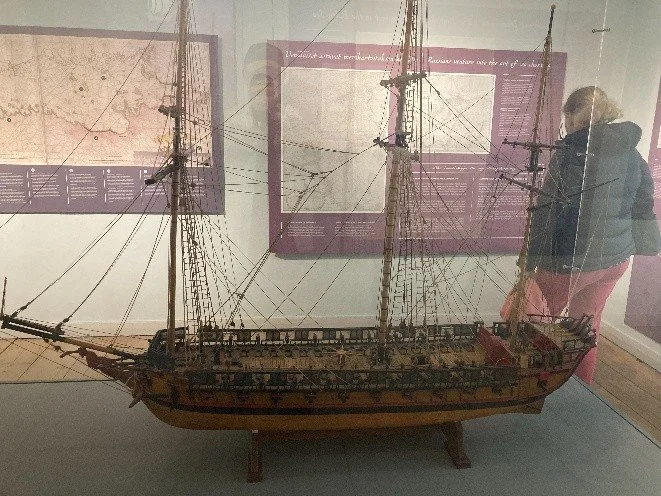
![IMG_4369[1].jpg](https://images.squarespace-cdn.com/content/v1/5f83c5947bb62b2036f18924/1782980885837-107K3TA5QFP3DP3WUCPE/IMG_4369%5B1%5D.jpg)
These 1930s built models of ship types Hemmema and the Pojama, built in Stockholm in 1775 and 1790 respectively, we photographed in the museum on the fortified island of Suomen Linna, Helsinki. These later models were based in turn on 18th century models prepared by Frederik Henrik af Chapman (1721-1808), the famed Swedish ship designer and pioneer of ship stability calculations. They are examples of the sort of ships that were probably originally developed for Sweden’s Pomeranian wars (fighting between Sweden and Prussia between 1757 and 1762), but later formed the backbone of the Swedish army ‘Archipelago Navy’, a branch of the army developed to protect Sweden’s borders. The shallow draft was well suited to patrolling the multiple islands and skerries of the Baltic coast. No doubt, this ‘navy’ benefitted from being a branch of the army; there were always plenty of people to row.
The broad beam and shallow draft was to be a feature of Swedish wooden small craft, and probably reached a peak with the building of the Sigyn in Gothenburg in the 1890s. As we discussed in the first tranche of this article, although other European yards were already building burdensome steel barques capable of lifting 4,000 plus tons, the little 500 ton Sigyn found plenty of work lifting cargoes other ships had to turn away for reasons of quantity, their hazardous/unpleasant nature or depth of water at load points.
Sweden’s wooden small craft heritage
![IMG_4177[1].jpg](https://images.squarespace-cdn.com/content/v1/5f83c5947bb62b2036f18924/1782981265846-U0J5B87TG6M84Y52AWLQ/IMG_4177%5B1%5D.jpg)
![IMG_4172[1].jpg](https://images.squarespace-cdn.com/content/v1/5f83c5947bb62b2036f18924/1782981300087-A10YGUFSE7HOOLRJTAN4/IMG_4172%5B1%5D.jpg)
![IMG_4173[1].jpg](https://images.squarespace-cdn.com/content/v1/5f83c5947bb62b2036f18924/1782981365424-BAIGH03UD7PFO9INFDVJ/IMG_4173%5B1%5D.jpg)
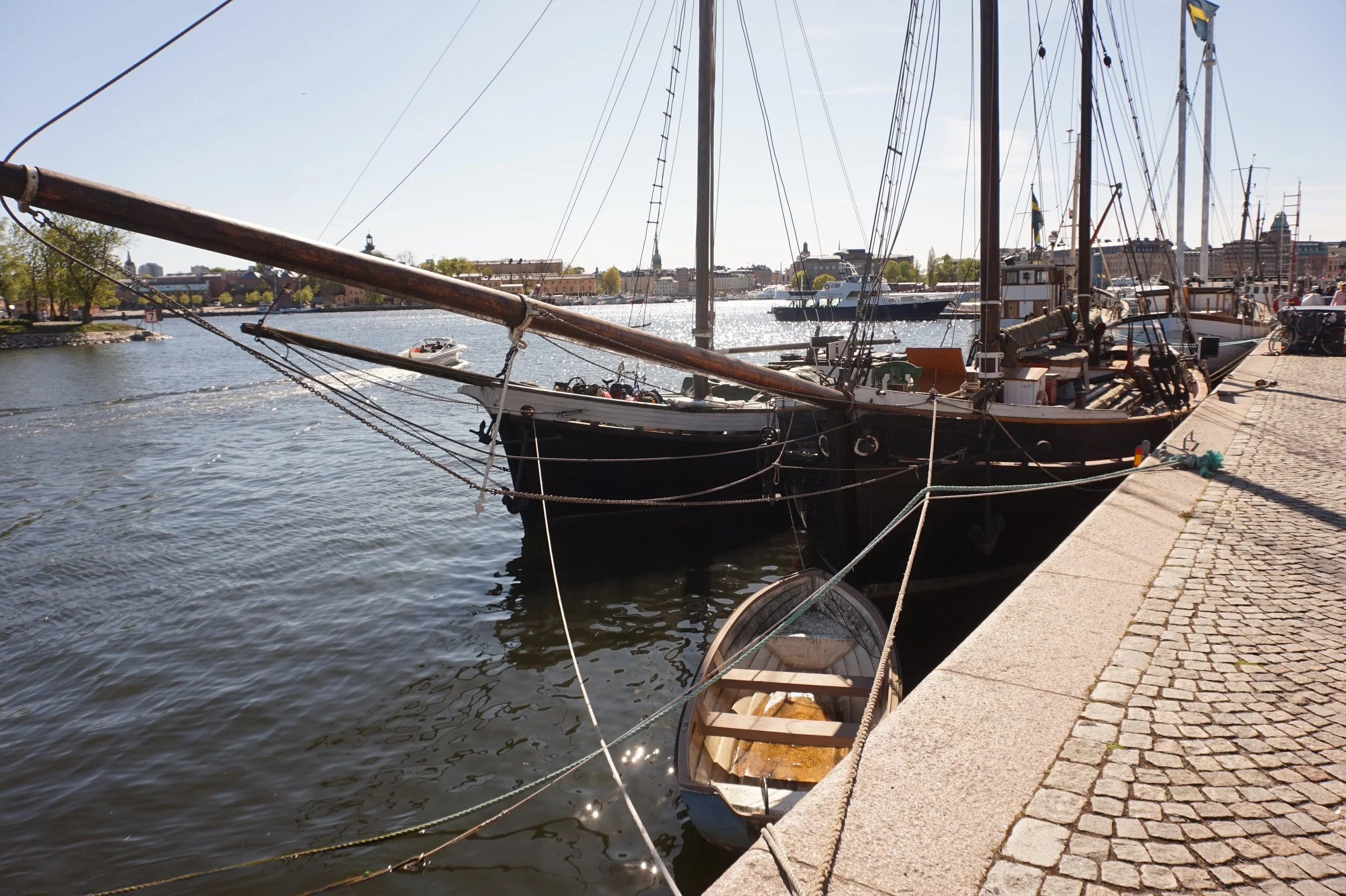
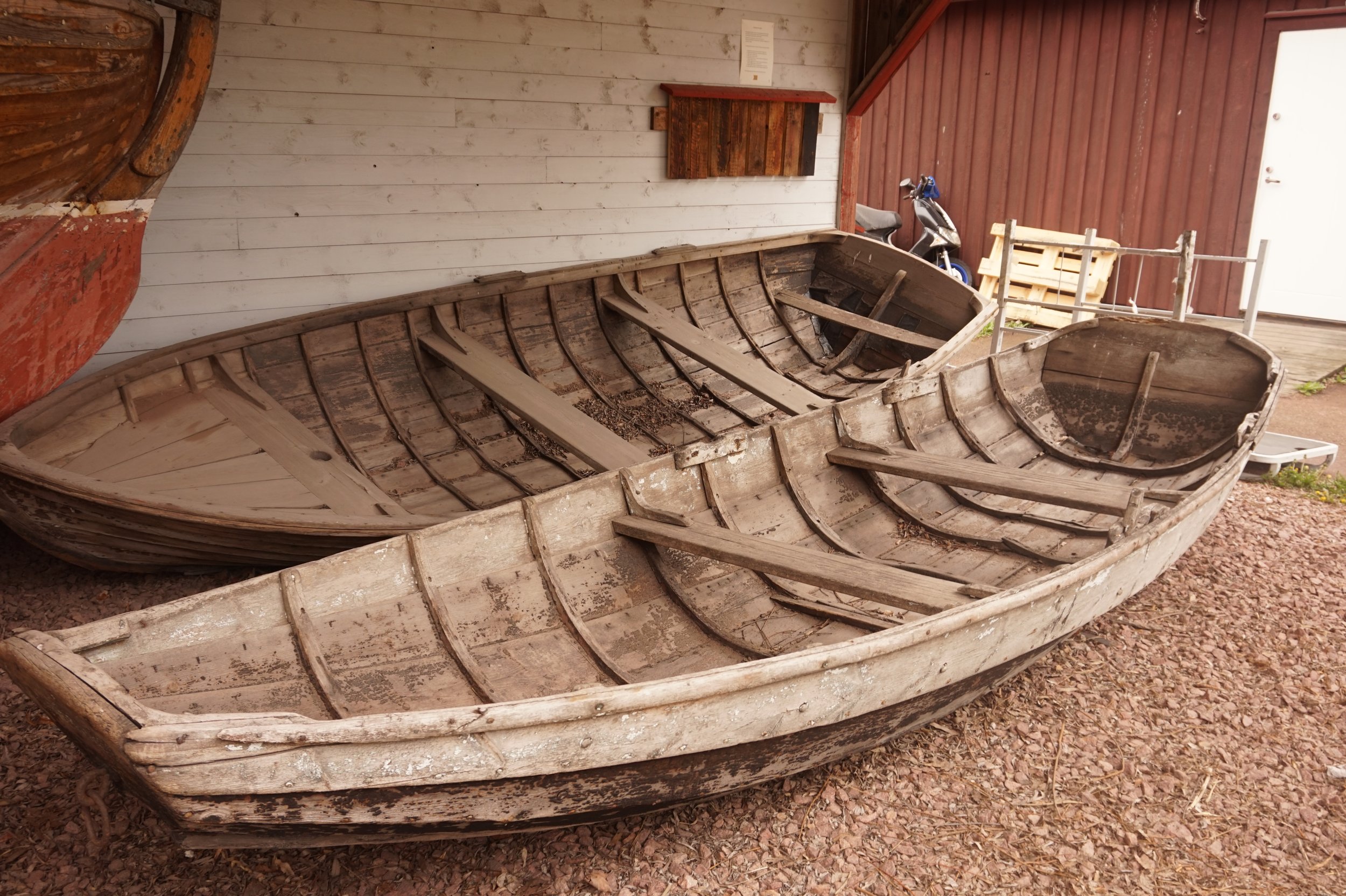
Swedish traditional small craft, clockwise from top left –‘oka’, ‘jakt’ (yacht); ‘sump’ or well boat (live fish in wells); ‘Albanus’ replica galleass, Mariehamn; live-abord ‘galleass’ at Skeppsholmen in Stockholm; recently built jakt Atlanta in Mariehamn
Stockholm to the Åland Islands
Our next tranche of travel was to take a ferry from Stockholm’s port, through the Stockholm archipelago and across the Baltic to the Åland Islands and their capital Mariehamn. We had chosen to travel this way to experience both the narrow Baltic Sea crossing, recently in the news through the damage being wreaked on its many communications cables by vessels ‘accidentally’ dragging twenty to thirty tonne anchors through the well-marked and internationally protected corridors, and to see in more detail the Stockholm Archipelago of islands, glimpsed previously by the author. Of course there was nothing to see of the recent criminal activity, but just the sense of traversing such an international hot-bed reminds you that this whole region is potential front line since the border incursions of the last ten years.
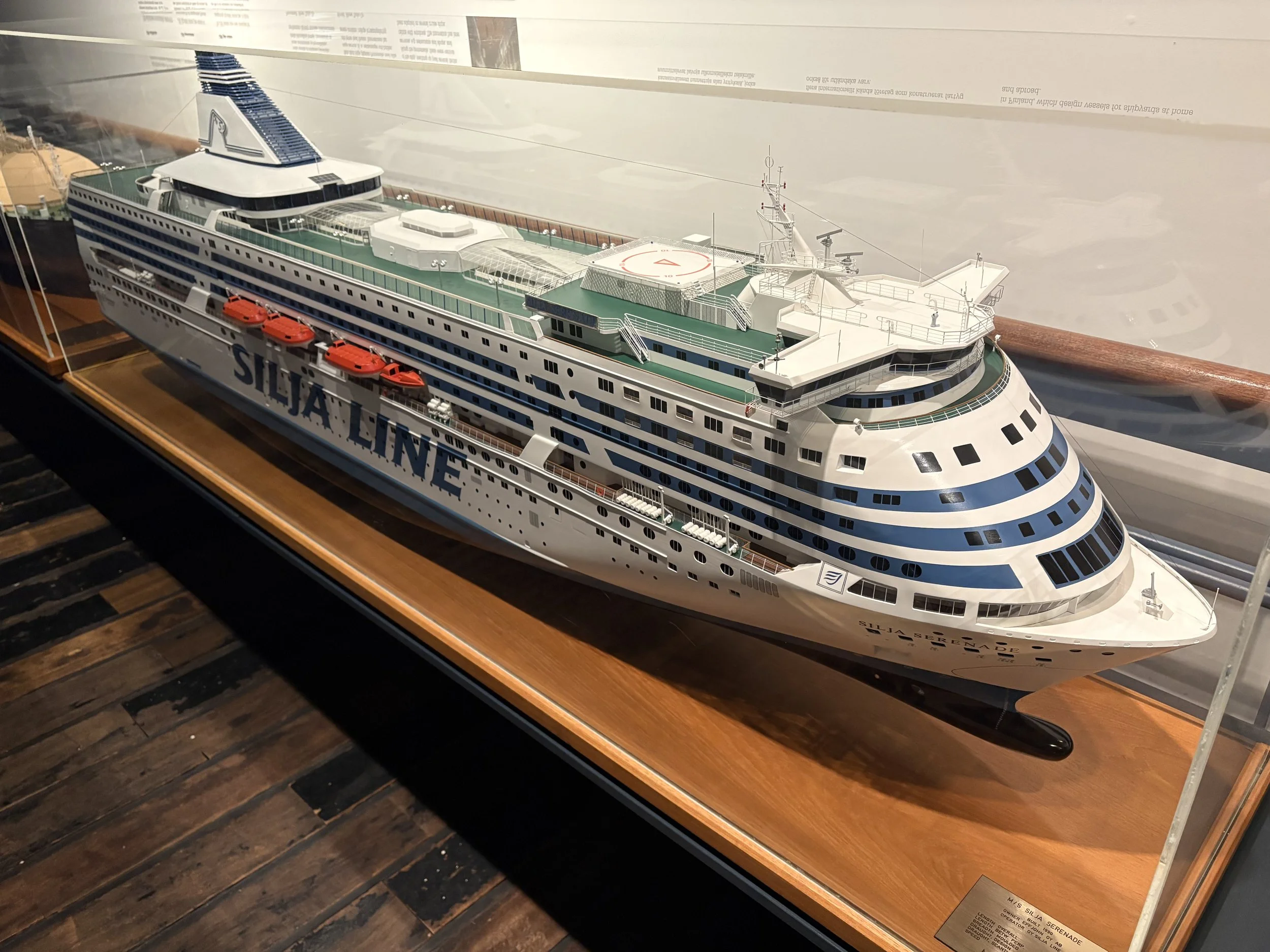
The vessel for the crossing was Silja Line’s Silja Serenade, one of two sister ships owned in Tallin, Estonia and registered (for the usual financial reasons, it seems) in Mariehamn. The Tallink Group claims to be the leading European provider of leisure and business travel and sea transportation services in the Baltic Sea region, with a claimed 40% of the extensive Baltic ferry business. The two Silja ships, identical in almost all respects (only the funnel materials are known to be different!), are closer to cruise ships than ferries, almost all cabin, and pioneered a design now common in cruise vessels of a central superstructure void.
![IMG_4147[1].jpg](https://images.squarespace-cdn.com/content/v1/5f83c5947bb62b2036f18924/1782981663176-ATFDV2U5ECQO595HB9YK/IMG_4147%5B1%5D.jpg)
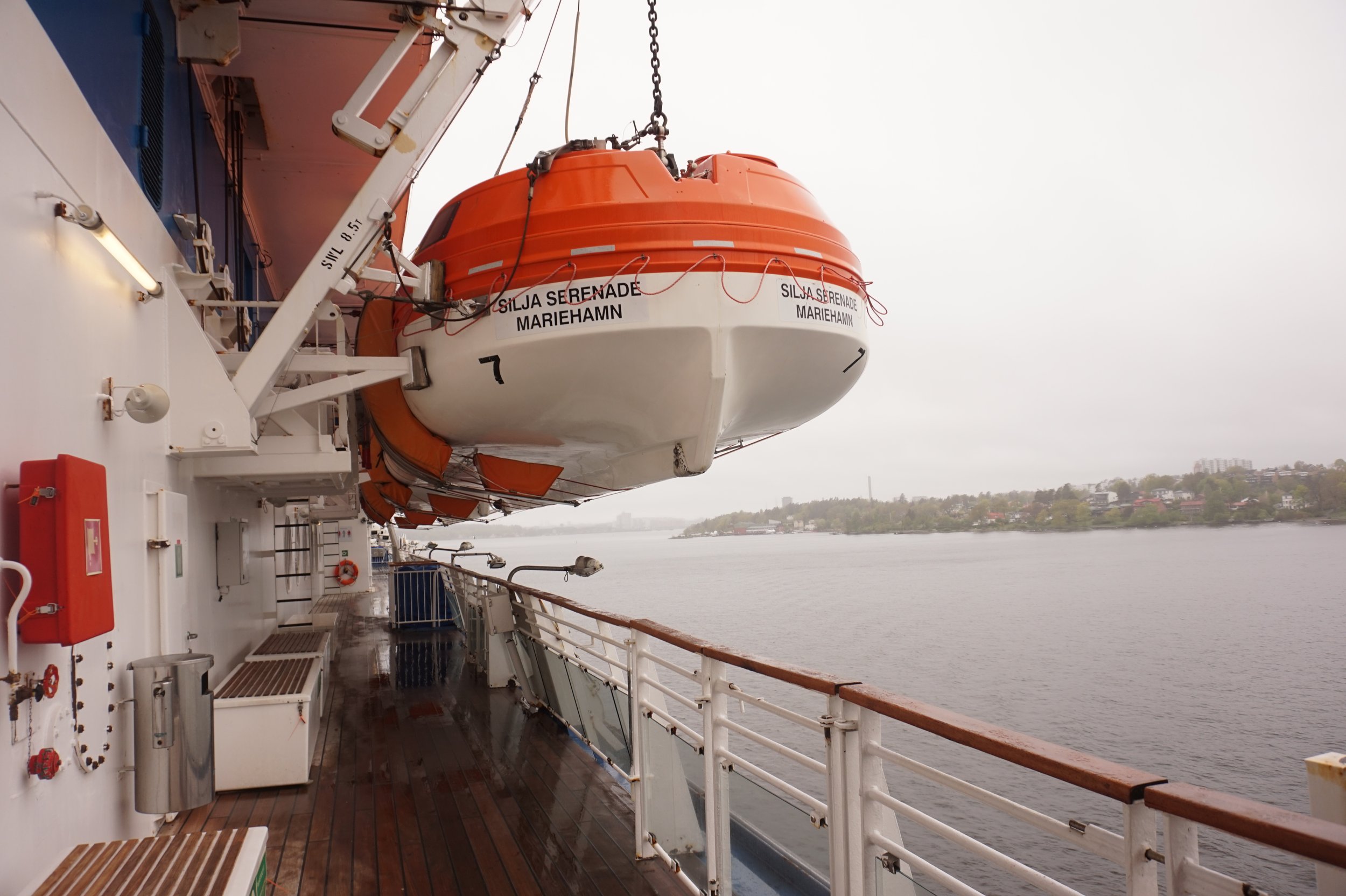
Silja Line’s Silja Serenade, - model in Forum Marinum, Turku, and the central ‘street’ in the Silja Serenade’s accommodation.
Entry to the vessel in the impressive major port terminals is by passenger linkspan (airbridge) straight into the central ‘street’, with inner view cabin windows rising four decks, served by glass walled lifts, above a ‘street’ of high-quality shops, bars, restaurants etc. These cabins, lacking sea views, have windows looking down on the ‘street’ scene below. Cabins with ‘sea view’, available at a slightly higher fare level, have good sized rectangular windows, (in the blue stripes on the model shown) allowing adequate views of the archipelago. Accommodation is simple but comfortable, suitable for the route between Stockholm and Helsinki, via Mariehamn in the Åland Islands, where voyage duration is limited to about eight hours on the longest leg. More luxurious accommodation is available - at a price – and appeared to us unnecessary.
The vessel’s progress is relatively slow for most of the voyage, no doubt to avoid shoreline damage from the wash, since for all but a couple of hours in open water, the ship is usually close in to islands, sometimes less than a ship’s length or two away. Wash is also reportedly limited by the hull’s underwater design aimed to minimise bow wave production. It is a leisurely and pleasant trip, with ample opportunity to see the many idyllic islands with summer cabins and retreats, and to sample the excellent food and drinks on board.
It should be mentioned that Silja is not the only carrier on the Stockholm/Helsinki corridor, Viking also serving the sector.
For the cruising yachtsman, these must be good sailing waters, with islands always at hand for shelter, and small settlements for supplies. Water depth for anchoring may however be an issue, given the close clearances by the big ferries, indicating quick drop off into deep water, and the many ferries themselves may be challenging, operating as they are in narrow channels. Despite the off season and cool weather for our trip, there were enough small sailing craft in the approaches to both Turku and leaving Stockholm to indicate a flourishing cruising scene in the season.
In their book The Grain Races, Basil Greenhill and John Hackman have the following to say of the archipelago, which reads like a warning to cruising yacht people on its suitability for visiting small craft.
The whole area is a labyrinth of islands and skerries, rocks and red granite reefs rising straight out of deep water. To sail these waters outside the well-marked and much used ferry and small craft channels requires intimate local knowledge.
No doubt this was true in the days when the book was written (1986), but in these days of well-found boats, GPS, accurate sounders and electronic charts, there may be little barrier to a well-equipped, careful navigators - such as, of course, SWS readers.
Overcast weather restricted sightseeing on our trip somewhat, but seemed also to add an element of mystery, with the many low, granite faced islands and islets, often wooded, shrouded in sea mist. The ferry route takes a north easterly direction from Stockholm inside the islands, before turning east across the Baltic after nearly four hours threading through sometimes narrow gaps between islands. With the sea mist and little wind, and stabilisers no doubt at work, it was difficult to tell when the ship left the archipelago to cross the narrow neck of open sea between the Baltic and the Gulf of Bothnia, into the approaches to Mariehamn. As discussed above, this Stockholm archipelago, mirrored by similar coastline on the Finnish side, would seem well suited to sail cruising, apparently always within easy reach of islands for shelter and occasional small towns for provisions, some well served by small passenger/car ferries. Discussion with informed locals indicated that despite private ownership of many of the islands, access is still technically available to Swedes as part of a national right to access land, and access even to islands with summer houses or cabins should technically be available to visitors, provided no damage is done. Channels seemed well marked, but the big ferry of course stayed within marked channels. The proximity of these big ferries to these granite islands would suggest deep water inshore, which may pose a problem for small craft seeking sheltered anchorage. Mediterranean style moor off rocks may be a solution, but some islands do have small beaches.
The timing of the ferry departure from Stockholm meant arriving in Mariehamn at 11.30 pm so, even with May days already leaving some light until 10 pm, it was too dark in the final stages to get any feel for the entry into Mariehamn’s western harbour (Mariehamn is sited on a peninsular bounded by inlets to the east and west, the latter of which is the deep harbour suiting commercial shipping). This was a little disappointing as followers of Gustaf Erikson will be familiar with the dramatic historic photographs of this expanse of water dotted with big sailing ships, most of which would have anchored or berthed without engine power, few pilots, and tugs not much mentioned in those days. However, this small disappointment was outweighed as we had booked a trip by small boat out to the entrance to the harbour, and the boat driver was able to talk authoritatively about the grain race era and the issues of the big engine-less sailing ships entering and anchoring in adverse conditions. We heard from this and several sources of the sinking of the Plus, an ex-Laeisz Line “Flying P Line’ barque owned by Åland islander Hugo Lundqvist, which sank in a blizzard 1933 while trying to anchor in the lead up to Christmas in the Western harbour. Only four of her sixteen crew survived. The tragedy underlined the danger of these big ships entering Mariehamn under sail, without power and with scant pilot services. Photographs in the Kobar Klintar pilot house illustrated this history, and underlined the dangers. (See also The approaches: Kobar Klintar pilot station in Part 3 of this article.
Charlotte Bjorklund, a project coordinator with the Åland Provincial Government, is reported as describing the importance of shipping to the Åland Islands as follows:
The shipping industry in Åland has a long history. It has been and continues to be Åland’s most important industry. Since it is surrounded by the sea, shipping is a necessary way of moving people and goods between this island province and the Finnish and Swedish mainlands. Heavy traffic is both national and international. Shipping is particularly important for tourism with approximately 1.8 million passengers arriving each year.
The shipping industry is a major economic and employment sector in the Åland Islands. It accounts for about 40% (2007) of the island’s economy and about 11% of employment for Åland residents. In 2014, about 1,060 people living on the island worked in the Åland shipping industry.
International shipping in Åland employs a total of around 6,100 people in and outside Åland. In addition to generating employment, shipping in the Åland Islands also has a positive impact on the Finnish shipbuilding industry. Therefore, the maritime cluster operating in Åland also has beneficial effects beyond the island itself.
Bearing this out, both Gustaf Erikson’s and the Lundqvist family companies still exist, although both have moved a long way since the square rigger days. Their respective offices are still major buildings on Mariehamn’s ‘Norra Esplanadgatan’, the main - and no doubt busy - street in the days of sail, terminating as it does, overlooking the commercial western arm of the harbour. The Esplanade these days is a quiet leafy avenue well away from the buzz of the city’s modern shopping hub.
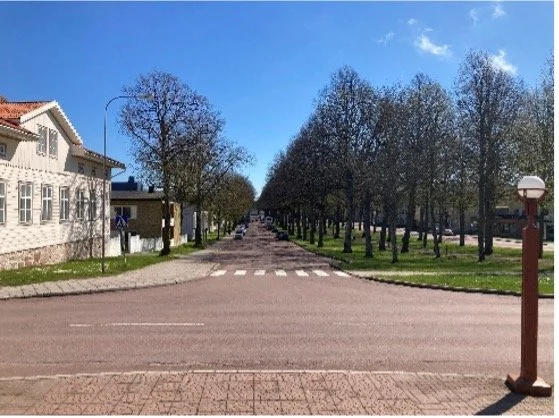
Mariehamn’s Esplanadgatan, the location for many historic shipping company offices, Gustaf Erikson’s and his son Edgar’s houses and August Troberg’s house (left).
Never-the-less, in the early spring sunshine, we kept an eye out for the ghost of ‘Ploddy Gustaf’ (as his crews are reported to have called him, affectionately, no doubt!) on his bicycle, complete with silver headed walking stick, heading down to one of his fleet tied up below, where Pommern lies today, on his way perhaps to discuss with the captain such minutia as the price of Stockholm tar, potatoes, ballast or red-lead paint. We explore Mariehamn’s historic business edifices later in Part 3 of this paper.
Mariehamn today, particularly outside the summer season when it is apparently crowded with visitors, has a pleasing peaceful atmosphere perhaps best illustrated by its famous “Non-violence” sculpture in the city’s civic centre. This underlines the lack of any military presence in the Åland Islands which, despite their strategic location, are a demilitarised zone under international treaties dating back to the 19th century.
Åland is situated in a strategically important location in the Baltic Sea, midway between Sweden and Finland, dominating physically the entrance to the Gulf of Bothnia, while also lying in close proximity to Stockholm and the industrial power base around Turku in Finland.
Despite this unique location, there is no visible evidence of this strategic significance, apart from a long-ruined castle or two, and some rock work on outlying islands attributed to Russia during the Crimean War era.
Wikipedia explains this demilitarised status as follows:
Åland is demilitarised, meaning that no military forces may be stationed on the islands and that they may not be fortified. Åland is also neutralised, and must therefore be kept outside armed conflict in the event of war. The demilitarisation of Åland is based on multiple international treaties as well as on customary international law.
This no doubt explains the laid-back attitude evident in people with whom we were in contact, although this does not appear to prevent the locals we worked with from feeling very much part of the world. it is not known how the recent involvement of both Sweden and Finland with NATO may impact on this apparent oasis of peace in a troubled world.
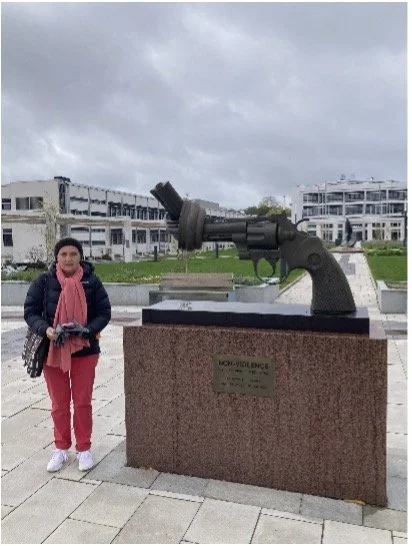
Mariehamn’s Non-Violence sculpture underlines it demilitarised status
Although the islands are a self-governing region of Finland, the local language is Swedish, maybe dating back to its early inhabitants being from country areas near Stockholm. The language now is mainly a dialect of Swedish but – according to Swedish friends who translated signs etc for us – it is an archaic form of Swedish which left them guessing over some compound words and technical terms specific to the Islands. For us lazy English speakers, it is hard to find anyone in the islands who does not speak near fluent English.
The next and final part of our pilgrimage:
Having reached in this Part 2 of our article, one of the two main attractions in our itinerary-historic, peaceful Mariehamn, we will shortly follow up with Part 3 of our article, sub titled “The discovery phase”.
This final Part 3 of our article will detail our exploration of Mariehamn, its historic connections to the sailing ship era, and cover off our visits to the two world-class maritime museums in Mariehamn and Turku, the visits to the sailing vessels Pommern in Mariehamn, Sigyn and Soumen Joutsen (translates as the Finnish Swan) in Turku and, as a bonus, the new building of traditional style galleass, the 25m Emelia in Mariehamn. It winds up with our departure through Helsinki, with a quick look at artifacts on the city’s world heritage listed fortified island, Suomen Linnar.
Please join us in Part 3of our pilgrimage, coming up soon, and share the highlights of our time with the historians and their museum ships in the Åland Islands and Turku, and travel through the archipelago to southwest Finland, and get to know as we did a truly iconic, globe-trotting, blue-water wooden sailing vessel.