
Enough but not too much- Maximising Satisfaction
I’ve been thinking a lot recently about the intersection between comfort and satisfaction. I suppose it’s been fuelled by spending time amongst the oversized, over-specced and poorly considered boats that make up 90% of the Mediterranean cruising fleet. Extreme hardship is without doubt miserable, and extreme luxury is usually unrewarding but somewhere on this continuum, there is a sweet spot, a place where we balance our needs and our desires … a spot that’s probably different for everyone.
Let’s start by taking a couple of examples at extreme ends of the spectrum.
The voyage of the JAMES CAIRD stands as one of the most extraordinary feats of small-boat seamanship in maritime history. In April 1916, after their ship ENDURANCE had been crushed by pack ice and their subsequent drift and boat journeys had brought Ernest Shackleton and his men to the desolate, uninhabited Elephant Island, Shackleton concluded that rescue would never come to them — they would have to go to it. He selected five companions, including the expedition's navigator Frank Worsley and the carpenter Harry McNish (who had reinforced the boat's hull, deck, and keel for the journey), and set out in the James Caird, a 22.5-foot lifeboat, on a roughly 800-nautical-mile crossing of the Southern Ocean to reach the whaling stations of South Georgia. This stretch of ocean is notorious for having no landmass to interrupt the wind and swell circling the globe, producing some of the most violent and unpredictable seas on Earth.
For seventeen days the six men endured conditions that pushed human survival to its edge: near-constant gale-force winds, mountainous waves, freezing spray that coated the boat in ice they had to chip away to keep it from capsizing, and temperatures cold enough that frostbite and immersion-related ailments were constant threats. They slept in sodden reindeer-skin sleeping bags, rationed food and fresh water carefully, and navigated using only occasional, fleeting glimpses of the sun, since Worsley had to take sextant readings while being thrown about the boat by the swell — a feat of navigation still marvelled at today, since a small error would have meant missing South Georgia entirely and sailing on into open ocean with no possibility of a second attempt. One especially violent wave nearly swamped and sank the boat outright. That they made landfall at all, arriving at South Georgia's coast with pinpoint accuracy after more than two weeks of dead reckoning through storms, is often cited as one of the great triumphs of navigation and endurance in the age of exploration — and it still wasn't the end of the ordeal, since Shackleton, Worsley, and Tom Crean then had to cross the island's uncharted, glaciated mountains on foot to reach the whaling station at Stromness and finally summon help for the men left behind.
I can without doubt categorically say that this was an adventure that I would never want to be part of. And yet the trials of the voyage and the lives they saved by undertaking it, would have engendered lifelong satisfaction.
If you have been reading SWS over the last fortnight you would know about Mr Fertitta and his boat the BOARDWALK. Since publishing our disapproval of the man and his boat, the New York Times has joined in!
“In recent weeks, while President Trump was locked in an unusually testy standoff with Prime Minister Giorgia Meloni of Italy, the United States ambassador to Rome was on a monthslong tour of Italy’s coastline aboard his $450 million superyacht.
As the leaders’ spat escalated over the Independence Day weekend, the ambassador, Tilman J. Fertitta, moored the 384-foot, seven-deck yacht off Palermo in Sicily to host a phalanx of Sicilian dignitaries.
The visitors could gawk at the boat’s pools, hot tubs, spa that offers facials and pedicures, movie screening room, putting green, multiple bars and two helicopters. They sipped wine, nibbled antipasti and posed for the ambassador’s Instagram feed — shoeless, as footwear is forbidden on the yacht — in rooms decorated with fluorescent artwork, varnished wood, crystal sculptures and chandeliers.”
Now it’s time for a confession… When the time is right, I love a bit of luxury! Being self employed my entire life, I’ve only ever flown business class once, (paid for by a very generous client) and I loved it! This privilege would be high on my list of discretionary spending if funds allowed. I relish a good hotel room. Crisp pillows and powerful showers.
But the idea of voyaging on Mr Fertitta’s yacht fills me with horror! Ther would be no achievement, no connection with the environment you sail (motor) through, and no understanding of the essence of a journey. Leave me out of it.
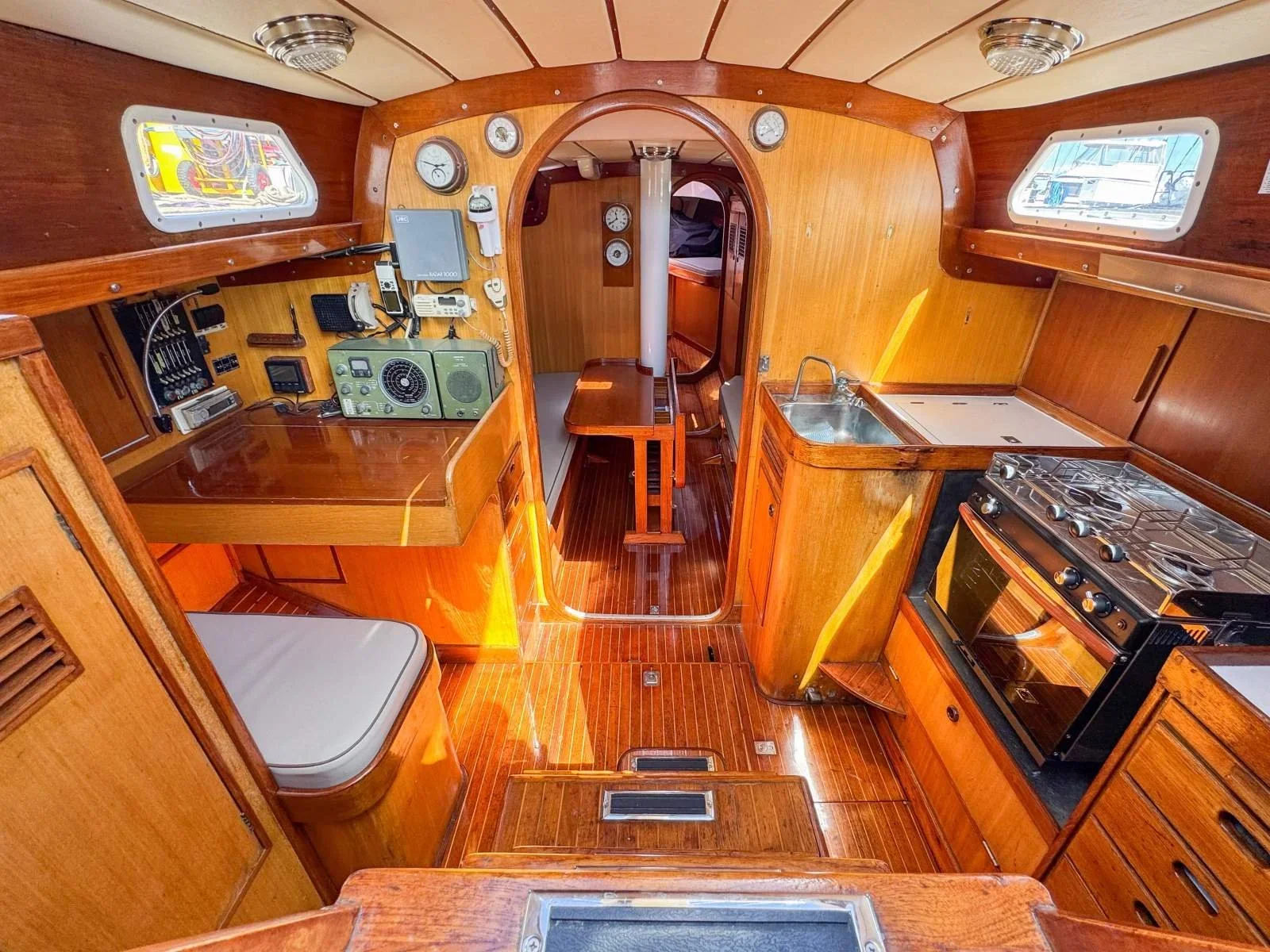
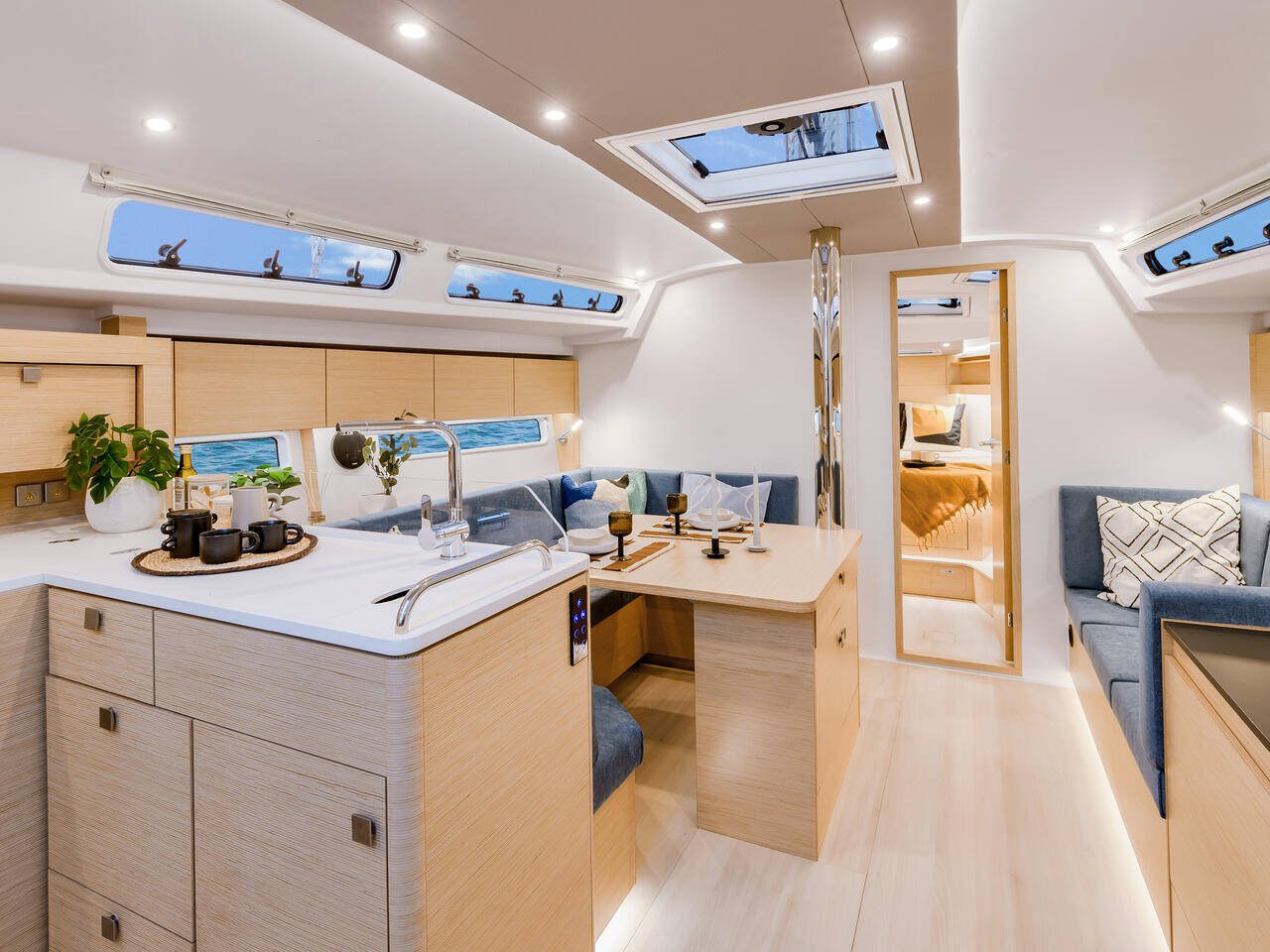
On the left the interior of a 1971 Swan 40, on the right a 2026 Hanse 41
I deliberately take these two examples and extreme ends of the comfort spectrum to make the point that for most of us, the answer lies somewhere in the middle. But I can’t help thinking that when assessing what is essential, desirable and superfluous on a boat nowadays we err more towards Mr Fertitta’s approach than Mr Shackleton’s.
Here’s a generic list of what we came with a standard production yacht in 1970
Rig & Sails
Aluminum mast and boom, wire (1x19) standing rigging
Hank-on jib and mainsail — no roller furling
Manual halyards and sheets, 2-speed bronze or chrome winches
Spinnaker pole, whisker pole often included
Navigation
Magnetic steering compass
Paper charts, dividers, parallel rules
Basic depth sounder ("flasher" type, analog)
Log (mechanical or paddlewheel)
AM/FM radio for weather broadcasts
RDF (radio direction finder) on better-equipped boats
Sextant carried by offshore-capable boats (not "standard" but common)
Auxiliary Propulsion
Small diesel inboard (20–40 hp typical), manual or basic electric start
Fixed 2-blade prop
Manual fuel gauge or dipstick
Deck Hardware
Manual anchor windlass or none — anchor hauled by hand
Bronze or stainless deck fittings, cleats, chocks
Manual bilge pump (diaphragm type)
Interior
Icebox (block ice)
Hand-pump freshwater system
Manual marine head
Kerosene, alcohol, or early propane stove (gimballed)
12V DC lighting only, minimal circuits
Safety
Basic flares, horseshoe buoy
PFDs (life jackets), not always harnesses
Liferaft rare — usually owner-added extra
Compare this to what you might find on a new 40 footer today
Rig & Sails
Aluminum (or carbon on performance models) mast, rod or high-tech standing rigging
In-mast or in-boom furling mainsail (very common as standard or near-standard)
Roller-furling genoa/jib as standard
Self-tailing winches, often electric or electric-assist on at least primaries
Lazy jacks or integrated stack-pack systems
Traveler and vang systems refined for shorthanded sailing
Navigation & Electronics
Multifunction display (MFD) chartplotter at helm (often dual station)
GPS, AIS transceiver, radar (standard or common option)
Autopilot (standard on most cruising boats this size)
VHF with DSC
Wind, depth, speed instruments networked via NMEA 2000
Wi-Fi/cellular booster, Starlink increasingly offered
Engine and battery monitoring via touchscreen/app
Auxiliary Propulsion
Diesel inboard, electric start, digital gauges
Folding or feathering prop standard on many models
Bow thruster increasingly standard at 40'
Deck Hardware
Electric or hydraulic windlass
Recessed LED deck/cockpit lighting
Solar panels standard or common option
Sprayhood/bimini/cockpit enclosure as standard equipment
Swim platform (often folding/hydraulic)
Interior
Refrigeration (and often freezer)
Pressurized hot/cold water, sometimes watermaker option
Electric flush marine head, holding tank monitoring
Propane stove/oven, sometimes induction
Lithium or AGM battery bank, inverter, shore power charger
LED lighting throughout, USB/12V/110V outlets in most cabins
Air conditioning increasingly common on 40-footers
Safety
Liferaft Raft,
EPIRB
Jacklines, tethers, more standardised harness use
AIS-linked MOB systems on some models
Bilge pumps automatic with float switch and alarm
So much of the “Modern” list are wonderful advances, that have allowed more people to go cruising, and for them to do so with greater safely. So I’m not for one moment advocating for a return to the inventory of 1970.
But one consideration that I think stemmed from the seminal books of Lin and Larry Pardey, was “If you can’t fix it yourself then it should’t be on board”. Well that’s a bit extreme nowadays, but glancing through the 1970’s list I, (who am not a noted handyman), reckon I could learn to fix 90% of the items. In 2026 it would be less than 50%
So before adding to the payload of an existing boat, or settling on the specs of a new one, I hope you will honestly ask yourself do I really need this piece of kit. Will it genuinely enhance my experience of will it just give me temporary satisfaction and make me feel like I’m more “at home”, the exact place we are trying to get away from?!
Doing easy things is often unrewarding, but doing hard things can fill your soul!